ClearStepsCLEARSTEPS AI
Teacher Login →Student Login →

Areas Related to Circles: Class 10 Maths Practice Questions

30 original exam-pattern questions with full answers, matched to the current CBSE Class 10 paper design, including case-based questions. Attempt each question before opening the answer — or start a free 14-day trial ↓ for the full bank.

Q1Case-based4 marks

A school has decided to redesign its circular garden of radius 21 m. The garden is divided into 6 equal sectors. Out of these, 2 sectors are to be planted with roses, 2 sectors with marigolds, and the remaining 2 sectors are to be paved as walking paths. A decorative square tile of side 1 m is used for paving each walking-path sector.

A school has decided to redesign its circular garden of radius 21 m. The garden is divided into 6 equal sectors. Out of these, 2 sectors are to be planted with roses, 2 sectors with marigolds, and the remaining 2 sectors are to be paved as walking paths. A decorative square tile of side 1 m is to be used for paving each walking-path sector.

Based on the above information, answer the following questions:
(i) What is the angle subtended at the centre by each sector?
(ii) What is the area of each sector?
(iii) (a) Find the total area to be paved as walking paths. How many square tiles (each of side 1 m) are needed to pave the walking-path sectors? (Use π = 22/7)
OR
(b) The school also wants to put a circular fence along the boundary of the entire garden. Find the cost of fencing at the rate of ₹50 per metre. (Use π = 22/7)
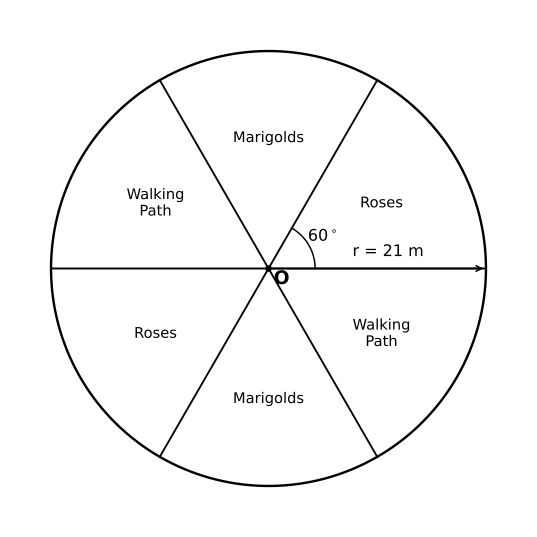
Diagram for question 1: Areas Related to Circles
Show answer
(i) The garden is divided into 6 equal sectors.
∴ Angle subtended at the centre by each sector = 360°/6
⟹ Each sector subtends an angle of 60° at the centre.

(ii) Area of each sector = (θ/360) × πr²

Here θ = 60°, r = 21 m

⟹ Area of each sector = (60/360) × (22/7) × 21 × 21
⟹ = (1/6) × (22/7) × 441
⟹ = (1/6) × 22 × 63
⟹ = (1/6) × 1386
⟹ = 231 m²

∴ Area of each sector = 231 m²

(iii) (a) Number of walking-path sectors = 2

Total area to be paved = 2 × Area of each sector
⟹ = 2 × 231
⟹ = 462 m²

Area of each square tile = 1 × 1 = 1 m²

Number of tiles required = Total paved area / Area of one tile
⟹ = 462 / 1
⟹ = 462 tiles

∴ The total area to be paved is 462 m² and 462 square tiles are needed.

OR

(iii) (b) Circumference of the circular garden = 2πr

Here r = 21 m

⟹ Circumference = 2 × (22/7) × 21
⟹ = 2 × 22 × 3
⟹ = 132 m

Cost of fencing = Length of boundary × Rate
⟹ = 132 × 50
⟹ = ₹6600

∴ The cost of fencing the boundary of the garden is ₹6600.
Q2Case-based4 marks

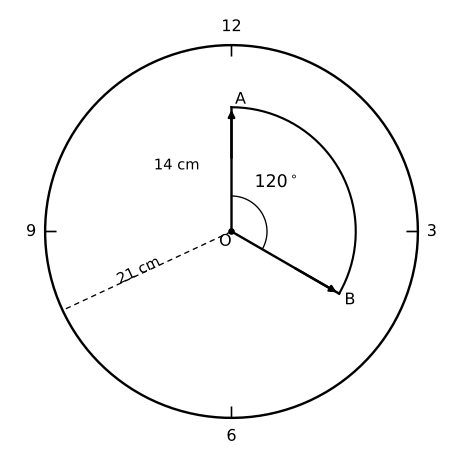
A decorative wall clock has a circular face of radius 21 cm. The minute hand is 14 cm long. The craftsman uses the minute hand's sweep to plan decorative painting.

A decorative wall clock has a circular face of radius 21 cm. The minute hand of the clock is 14 cm long. A craftsman wants to paint the region swept by the minute hand between 12:00 noon and 12:20 noon in gold colour.

(i) What is the central angle (in degrees) swept by the minute hand in 20 minutes?
(ii) What is the area (in cm²) of the sector swept by the minute hand in 20 minutes?
(iii) The craftsman also wants to paint, in silver colour, the remaining area of the clock face that is NOT swept by the minute hand in those 20 minutes. Find the silver-painted area.
OR
(iii) If the craftsman instead divides the entire clock face into 9 equal sectors to create a colour pattern, find the arc length of each such sector. (Use π = 22/7)

Diagram for question 2: Areas Related to Circles
Show answer
(i) The minute hand completes one full revolution (360°) in 60 minutes.

⟹ Angle swept in 1 minute = 360°/60 = 6°

⟹ Angle swept in 20 minutes = 6° × 20 = 120°

∴ The central angle swept by the minute hand in 20 minutes is 120°.

(ii) The minute hand has length = radius of the swept sector = 14 cm; central angle θ = 120°.

Formula: Area of sector = (θ/360) × πr²

⟹ Area = (120/360) × (22/7) × 14 × 14

⟹ Area = (1/3) × (22/7) × 196

⟹ Area = (1/3) × (22 × 28)

⟹ Area = (1/3) × 616

∴ Area of the gold-painted sector = 616/3 cm² ≈ 205.33 cm² [accept 616/3 cm²]

(iii) The clock face is a circle of radius 21 cm.

Area of clock face = πr² = (22/7) × 21 × 21 = (22/7) × 441 = 22 × 63 = 1386 cm²

Silver-painted area = Area of clock face − Area of gold sector

⟹ Silver area = 1386 − 616/3

⟹ Silver area = (4158 − 616)/3

∴ Silver-painted area = 3542/3 cm² ≈ 1180.67 cm² [accept 3542/3 cm²]

OR

(iii) The entire clock face has radius = 21 cm; it is divided into 9 equal sectors.

⟹ Central angle of each sector = 360°/9 = 40°

Formula: Arc length = (θ/360) × 2πr

⟹ Arc length = (40/360) × 2 × (22/7) × 21

⟹ Arc length = (1/9) × 2 × (22/7) × 21

⟹ Arc length = (1/9) × 2 × 22 × 3

⟹ Arc length = (1/9) × 132

∴ Arc length of each sector = 132/9 = 44/3 cm ≈ 14.67 cm
Q3Case-based4 marks

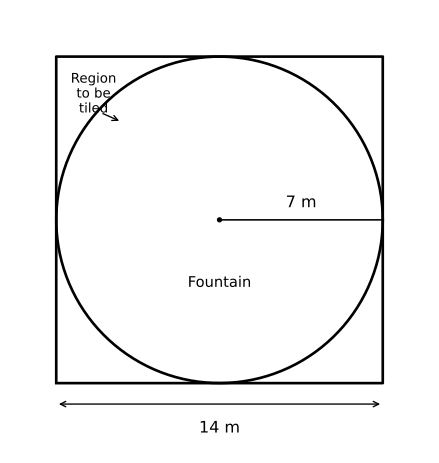
A school garden has a circular fountain in the centre. The gardener wants to tile the region around the fountain. The entire garden plot is a square of side 14 m, and the fountain is a circle of diameter 14 m inscribed in the square (touching all four sides). Use π = 22/7.

A school garden has a circular fountain in the centre. The gardener wants to tile the region around the fountain. The entire garden plot is a square of side 14 m, and the fountain is a circle of diameter 14 m inscribed in the square (touching all four sides).

(i) Find the radius of the circular fountain.
(ii) Find the area of the square garden plot.
(iii) Find the area of the region to be tiled (the region inside the square but outside the circular fountain). Use π = 22/7.

Diagram for question 3: Areas Related to Circles
Show answer
(i) Diameter of the circular fountain = 14 m

⟹ Radius = Diameter ÷ 2 = 14 ÷ 2

∴ Radius of the circular fountain = 7 m [1 mark]

──────────────────────────────────────

(ii) Area of the square garden plot = (side)²

⟹ Area = (14)² = 196

∴ Area of the square garden plot = 196 m² [1 mark]

──────────────────────────────────────

(iii) Area of the circular fountain = π r²

⟹ Area = (22/7) × (7)²

⟹ Area = (22/7) × 49

⟹ Area = 22 × 7 = 154 m²

Area of the region to be tiled = Area of square − Area of circle

⟹ Area = 196 − 154 = 42

∴ Area of the region to be tiled = 42 m² [2 marks]
Q4Case-based4 marks

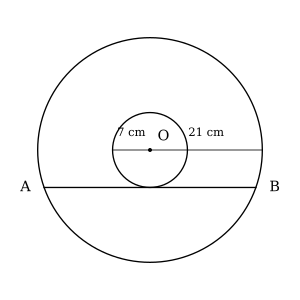
A decorative wall clock has a circular face of radius 21 cm. The minute hand is 14 cm long. A craftsman plans to paint certain regions of the clock face in different colours.

A decorative wall clock has a circular face of radius 21 cm. The minute hand of the clock is 14 cm long. A craftsman wants to paint the region swept by the minute hand in 20 minutes (the minor sector) in gold, and also paint the ring-shaped region between the clock face and a smaller concentric circle of radius 7 cm (the annular region) in silver.

(i) What is the angle (in degrees) swept by the minute hand in 20 minutes?

(ii) Find the area of the sector swept by the minute hand in 20 minutes.

(iii) Find the area of the annular (ring-shaped) region between the clock face (radius 21 cm) and the inner circle of radius 7 cm.

OR

(iii) If the craftsman instead paints the region between the two concentric circles that is NOT covered by the sector of the clock face (radius 21 cm, angle 120°), find that area.

(Use π = 22/7)

Diagram for question 4: Areas Related to Circles
Show answer
(i) The minute hand completes 360° in 60 minutes.

∴ Angle swept in 20 minutes = (20/60) × 360°

⟹ Angle swept = 120°

∴ The minute hand sweeps an angle of 120° in 20 minutes.

[1 mark]

---

(ii) The minute hand is 14 cm long, so radius of the sector r = 14 cm, θ = 120°.

Formula: Area of sector = (θ/360) × πr²

⟹ Area = (120/360) × (22/7) × 14 × 14

⟹ Area = (1/3) × (22/7) × 196

⟹ Area = (1/3) × 22 × 28

⟹ Area = (1/3) × 616

∴ Area of sector swept by minute hand = 616/3 ≈ 205.33 cm²

(Exact value: 616/3 cm²)

[1 mark]

---

(iii) [MAIN OPTION]

The clock face has radius R = 21 cm and the inner circle has radius r = 7 cm.

Formula: Area of annular region = π(R² − r²)

⟹ Area = (22/7) × (21² − 7²)

⟹ Area = (22/7) × (441 − 49)

⟹ Area = (22/7) × 392

⟹ Area = 22 × 56

∴ Area of the annular region = 1232 cm²

[2 marks]

---

[OR]

(iii) The sector of the clock face has radius R = 21 cm and θ = 120°.

Area of full annular region = π(R² − r²) = (22/7) × (441 − 49) = 1232 cm² [as above]

Area of sector of the clock face (radius 21 cm, θ = 120°):

Area of sector = (120/360) × (22/7) × 21²

⟹ = (1/3) × (22/7) × 441

⟹ = (1/3) × 22 × 63

⟹ = (1/3) × 1386 = 462 cm²

Area of sector of inner circle (radius 7 cm, θ = 120°):

Area = (120/360) × (22/7) × 7²

⟹ = (1/3) × (22/7) × 49

⟹ = (1/3) × 22 × 7

⟹ = 154/3 cm²

Area of annular sector (the part of the annular region inside the 120° sector) = 462 − 154/3

⟹ = 1386/3 − 154/3 = 1232/3 cm²

Area of annular region NOT covered by the sector = Total annular area − Annular sector area

⟹ = 1232 − 1232/3

⟹ = 3696/3 − 1232/3

⟹ = 2464/3

∴ Required area = 2464/3 ≈ 821.33 cm²
Q5Case-based4 marks

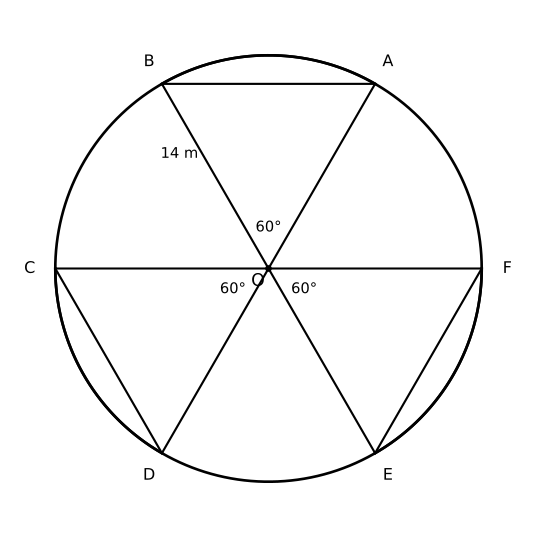
A landscape architect designs a circular garden lawn of radius 14 m. Three identical sectors, each with a central angle of 60°, are marked symmetrically on the lawn. Within each sector, the triangular region (equilateral triangle formed by the two radii and the chord) is covered with white tiles, the remaining curved segment of the sector is covered with red tiles, and the region of the lawn outside all three sectors is covered with green tiles. (Use π = 22/7 and √3 = 1.73.)

A landscape architect is designing a decorative garden feature. She plans to lay coloured tiles on a circular lawn of radius 14 m. The design consists of three identical sectors, each with a central angle of 60°, arranged symmetrically. The region inside each sector is to be covered with red tiles, while each sector also contains an equilateral triangle (formed by the two radii and the chord joining their endpoints) whose area is to be covered with white tiles instead. The remaining region of the circular lawn (outside all three sectors) is to be covered with green tiles.

(i) Find the area of one complete sector.
(ii) Find the area of the equilateral triangle inside one sector.
(iii) Find the total area covered by red tiles (i.e., the segment portions of all three sectors combined). [OR] Find the total area covered by green tiles.

Diagram for question 5: Areas Related to Circles
Show answer
(i) Area of one sector

Formula: Area of sector = (θ/360) × πr²

Here θ = 60°, r = 14 m

⟹ Area of one sector = (60/360) × (22/7) × 14 × 14

⟹ = (1/6) × (22/7) × 196

⟹ = (1/6) × 616

⟹ = 308/3

∴ Area of one sector = 308/3 m² ≈ 102.67 m²

---

(ii) Area of the equilateral triangle inside one sector

Since the central angle is 60° and both sides (the two radii) are equal (= r = 14 m), the triangle formed is isosceles with the included angle 60°. An isosceles triangle with two equal sides and the included angle of 60° is equilateral, so all sides = 14 m.

Formula: Area of equilateral triangle = (√3/4) × side²

⟹ Area = (√3/4) × 14²

⟹ = (√3/4) × 196

⟹ = 49√3

⟹ = 49 × 1.73

⟹ = 84.77 m²

∴ Area of equilateral triangle inside one sector = 84.77 m²

---

(iii) [Main Option] Total area covered by red tiles

Red tiles cover the segment portion of each sector (sector minus the triangle).

Area of one segment = Area of one sector − Area of equilateral triangle

⟹ = 308/3 − 49√3

⟹ = 102.67 − 84.77

⟹ = 17.90 m²

Total red tile area = 3 × area of one segment

⟹ = 3 × 17.90

∴ Total area covered by red tiles = 53.70 m²

---

[OR] Total area covered by green tiles

Green tiles cover the region of the circular lawn outside all three sectors.

Total area of circle = πr² = (22/7) × 14 × 14 = (22/7) × 196 = 616 m²

Total area of three sectors = 3 × (308/3) = 308 m²

Area covered by green tiles = Total area of circle − Total area of three sectors

⟹ = 616 − 308

∴ Total area covered by green tiles = 308 m²
Q6Case-based4 marks

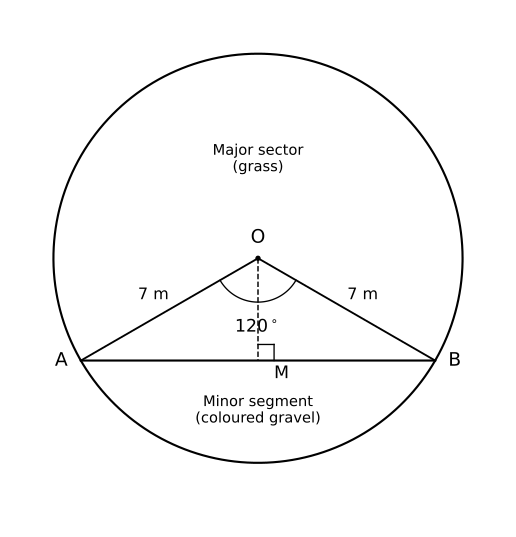
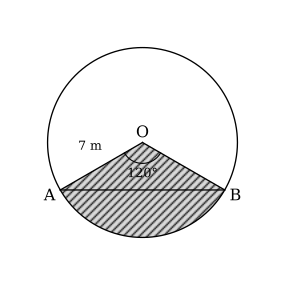
A town's municipal garden has a circular fountain of radius 7 m. A chord AB subtends an angle of 120° at the centre O. The minor segment (between chord and minor arc) is to be filled with coloured gravel, and the major sector is to be planted with grass.

A town's municipal garden has a circular fountain with radius 7 m at its centre. The gardener wants to create a decorative water-channel along a chord AB of the fountain such that the chord subtends an angle of 120° at the centre O. The region between the chord AB and the minor arc AB (the minor segment) will be filled with coloured gravel, while the major sector will be planted with grass.

(i) Find the length of chord AB. [1 mark]
(ii) Find the area of the minor segment (region of coloured gravel). [1 mark]
(iii) Find the area of the region to be planted with grass (major sector). [2 marks]

[Use π = 22/7 and √3 = 1.732]

Diagram for question 6: Areas Related to Circles
Show answer
Given: radius r = 7 m, central angle θ = 120°.

(i) Length of chord AB:

Drop perpendicular OM from O to AB. OM bisects ∠AOB.

⟹ ∠AOM = 60°

In right △OAM:
sin 60° = AM/OA

⟹ AM = OA × sin 60° = 7 × (√3/2) = 7√3/2

AB = 2 × AM = 2 × (7√3/2) = 7√3

∴ Length of chord AB = 7 × 1.732 = 12.124 m ≈ 12.12 m

(ii) Area of minor segment:

Formula: Area of minor segment = Area of minor sector − Area of △AOB

Area of minor sector = (θ/360) × πr²
= (120/360) × (22/7) × 7 × 7
= (1/3) × 22 × 7
= 154/3
= 51.33 m²

Area of △AOB:
In △AOB, OM ⊥ AB.
OM = OA × cos 60° = 7 × (1/2) = 3.5 m
AB = 7√3 = 7 × 1.732 = 12.124 m

Area of △AOB = (1/2) × AB × OM
= (1/2) × 12.124 × 3.5
= (1/2) × 42.434
= 21.217 m²

⟹ Area of minor segment = 51.33 − 21.217 = 30.113 m²

∴ Area of minor segment ≈ 30.11 m²

(iii) Area of major sector (region planted with grass):

Angle of major sector = 360° − 120° = 240°

Formula: Area of major sector = (θ/360) × πr²
= (240/360) × (22/7) × 7 × 7
= (2/3) × 22 × 7
= (2/3) × 154
= 308/3

∴ Area of major sector = 308/3 ≈ 102.67 m²
Q7Case-based4 marks

A municipal garden has a circular fountain of radius 7 m at its centre. The garden authority decides to install decorative tiles on two regions: Region P — a sector of the fountain pool that subtends an angle of 120° at the centre, and Region Q — the minor segment of the same circle cut off by the chord joining the two radii of Region P. (Use π = 22/7 and √3 = 1.73.)

A municipal garden has a circular fountain of radius 7 m at its centre. The garden authority decides to install decorative tiles on two regions: Region P — a sector of the fountain pool that subtends an angle of 120° at the centre, and Region Q — the minor segment of the same circle cut off by the chord joining the two radii of Region P.

(i) Find the arc length of Region P.
(ii) Find the area of Region P (the sector).
(iii) Find the area of Region Q (the minor segment). OR Find the perimeter of Region Q (the minor segment).

(Use π = 22/7 and √3 = 1.73.)

Diagram for question 7: Areas Related to Circles
Show answer
(i) Arc length of Region P

Formula: Arc length = (θ/360) × 2πr

Here θ = 120°, r = 7 m

⟹ Arc length = (120/360) × 2 × (22/7) × 7

⟹ = (1/3) × 2 × 22

⟹ = 44/3

∴ Arc length of Region P = 44/3 m ≈ 14.67 m

(1 mark)

---

(ii) Area of Region P (Sector)

Formula: Area of sector = (θ/360) × πr²

Here θ = 120°, r = 7 m

⟹ Area = (120/360) × (22/7) × 7²

⟹ = (1/3) × (22/7) × 49

⟹ = (1/3) × 22 × 7

⟹ = 154/3

∴ Area of Region P = 154/3 m² ≈ 51.33 m²

(1 mark)

---

(iii) Area of Region Q (Minor Segment)

Area of minor segment = Area of sector − Area of triangle OAB

where O is the centre and A, B are the endpoints of the chord.

For △OAB: OA = OB = 7 m (radii), ∠AOB = 120°

Area of △OAB = (1/2) × r² × sin θ

⟹ = (1/2) × 7² × sin 120°

⟹ = (1/2) × 49 × (√3/2)

⟹ = 49√3/4

⟹ = (49 × 1.73)/4

⟹ = 84.77/4

⟹ = 21.19 m²

Area of minor segment = Area of sector − Area of △OAB

⟹ = 154/3 − 21.19

⟹ = 51.33 − 21.19

∴ Area of Region Q = 30.14 m² (approximately)

(2 marks)

---

OR

Perimeter of Region Q (Minor Segment)

Perimeter of minor segment = Arc length AB + Chord length AB

Arc length AB = 44/3 m [from part (i)]

For Chord AB: In △OAB, OA = OB = 7 m, ∠AOB = 120°

Drop a perpendicular OM from O to AB; it bisects ∠AOB and AB.

⟹ ∠AOM = 60°

⟹ AM = OA × sin 60° = 7 × (√3/2) = 7√3/2

⟹ AB = 2 × AM = 2 × 7√3/2 = 7√3

⟹ AB = 7 × 1.73 = 12.11 m

Perimeter of Region Q = Arc AB + Chord AB

⟹ = 44/3 + 7√3

⟹ = 14.67 + 12.11

∴ Perimeter of Region Q = 26.78 m (approximately)

(2 marks)
Q8Case-based4 marks

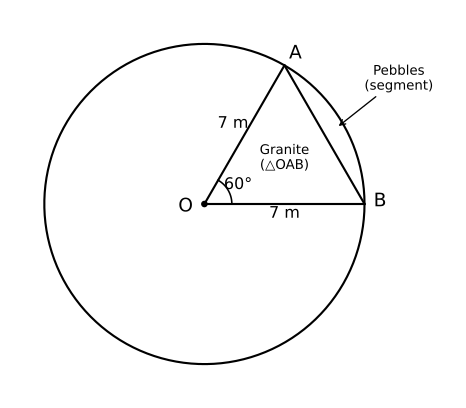
A municipal park has a circular fountain with radius 7 m. The park authority plans to tile the sector-shaped region OAB, where O is the centre and angle AOB = 60°. The triangular portion OAB is paved with granite and the minor segment (between chord AB and arc AB) is filled with decorative pebbles.

A municipal park has a circular fountain with a radius of 7 m. The park authority wants to tile the sector-shaped region OAB (where O is the centre) that subtends an angle of 60° at the centre, using two types of material:
• The triangular region OAB will be paved with granite.
• The remaining segment (between chord AB and arc AB) will be filled with decorative pebbles.

(i) Find the area of the sector OAB.
(ii) Find the area of triangle OAB.
(iii) Find the area of the minor segment (region between chord AB and arc AB). How much more area is covered by pebbles than by granite? [OR] The park also has a small circular flowerbed of circumference 44 m. Find the area of this flowerbed.

(Use π = 22/7 and √3 = 1.73)

Diagram for question 8: Areas Related to Circles
Show answer
(i) Area of sector OAB

Formula: Area of sector = (θ/360) × πr²

Here, θ = 60°, r = 7 m

⟹ Area of sector OAB = (60/360) × (22/7) × 7²

⟹ = (1/6) × (22/7) × 49

⟹ = (1/6) × 154

∴ Area of sector OAB = 77/3 = 25.67 m² (approx.) ...(1 mark)

(ii) Area of triangle OAB

Since OA = OB = 7 m (radii) and ∠AOB = 60°, triangle OAB is equilateral (all angles = 60°), so AB = 7 m.

Formula: Area of equilateral triangle = (√3/4) × side²

⟹ Area of △OAB = (√3/4) × 7²

⟹ = (1.73/4) × 49

⟹ = (1.73 × 49)/4

⟹ = 84.77/4

∴ Area of △OAB = 21.19 m² (approx.) ...(1 mark)

(iii) Area of minor segment and comparison

Area of minor segment = Area of sector OAB − Area of △OAB

⟹ Area of segment = 25.67 − 21.19

∴ Area of minor segment (pebbles region) = 4.48 m² (approx.) ...(½ mark)

Difference = Area of pebbles region − Area of granite region
= Area of segment − Area of triangle
= 4.48 − 21.19

∵ The pebble area (4.48 m²) is less than the granite area (21.19 m²), the granite covers more area.

∴ Granite covers 21.19 − 4.48 = 16.71 m² MORE than pebbles. ...(½ mark)

[OR]

Area of the circular flowerbed

Let the radius of the flowerbed = r

Given: Circumference = 44 m

Formula: 2πr = 44

⟹ 2 × (22/7) × r = 44

⟹ (44/7) × r = 44

⟹ r = 44 × (7/44)

⟹ r = 7 m

Area of flowerbed = πr²

⟹ = (22/7) × 7²

⟹ = (22/7) × 49

⟹ = 22 × 7

∴ Area of the flowerbed = 154 m² ...(1 mark)
Q9MCQ1 mark

A circular garden has an area of 346.5 m². What is the circumference of the garden? (Use π = 22/7)

Show answer
Option (A) is correct.

Explanation: Using Area = πr², r² = 346.5 × (7/22) = 110.25 ⟹ r = 10.5 m. Circumference = 2πr = 2 × (22/7) × 10.5 = 66 m.
Q10MCQ1 mark

A semicircular piece of cardboard has a radius of 21 cm. What is the total perimeter of the semicircular piece? (Use π = 22/7)

Show answer
Option (A) is correct.

Explanation: The perimeter of a semicircular piece = πr + 2r (curved length + diameter). Here r = 21 cm, so curved length = (22/7) × 21 = 66 cm and diameter = 2 × 21 = 42 cm. ∴ Total perimeter = 66 + 42 = 108 cm.
Q11MCQ1 mark

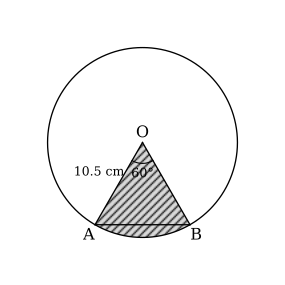
A sector of a circle has radius 10.5 cm and central angle 60°. Find the perimeter of the sector. (Take π = 22/7)

Diagram for question 11: Areas Related to Circles
Show answer
Option (A) is correct.

Explanation: Arc length = (θ/360) × 2πr ⟹ (60/360) × 2 × (22/7) × 10.5 = (1/6) × 66 = 11 cm. Perimeter of sector = arc length + 2r = 11 + 2(10.5) = 11 + 21 = 32 cm.
Q12MCQ1 mark

A circular clock face has an area of 38.5 cm². What is the circumference of the clock face? (Use π = 22/7)

Show answer
Option (A) is correct.

Explanation: Using Area = πr², 38.5 = (22/7)r² ⟹ r² = 38.5 × 7/22 = 12.25 ⟹ r = 3.5 cm. Circumference = 2πr = 2 × (22/7) × 3.5 = 22 cm.
Q13MCQ1 mark

The second-hand of a clock is 7 cm long. The angle swept by it between the 4th second and the 19th second is:

Show answer
Option (B) is correct.

Explanation: The second-hand completes 360° in 60 seconds, so it sweeps 360°/60 = 6° per second. Time elapsed between the 4th second and the 19th second = 19 − 4 = 15 seconds. ∴ Angle swept = 15 × 6° = 90°.
Q14MCQ1 mark

The radii of two circles are in the ratio 3 : 7. What is the ratio of their areas?

Show answer
Option (A) is correct.

Explanation: Area of a circle = πr²; if radii are in the ratio 3 : 7, then the ratio of their areas = r₁² : r₂² = 3² : 7² = 9 : 49.
Q15MCQ1 mark

The minute-hand of a clock is 9 cm long. The angle swept by it between 3:10 p.m. and 3:40 p.m. is:

Show answer
Option (B) is correct.

Explanation: The minute hand completes 360° in 60 minutes. Time elapsed from 3:10 p.m. to 3:40 p.m. = 30 minutes. ⟹ Angle swept = (30/60) × 360° = 180°.
Q16MCQ1 mark

A circular clock face has an area of 154 cm². What is the circumference of the clock face? (Use π = 22/7)

Show answer
Option (A) is correct.

Explanation: Using Area = πr², we get 154 = (22/7)r² ⟹ r² = 154 × 7/22 = 49 ⟹ r = 7 cm. Circumference = 2πr = 2 × (22/7) × 7 = 44 cm.
Q17MCQ1 mark

A circular disc has an area of 616 cm². What is the circumference of the disc? (Use π = 22/7)

Show answer
Option (A) is correct.

Explanation: Using Area = πr², r² = 616 × (7/22) = 196 ⟹ r = 14 cm. Circumference = 2πr = 2 × (22/7) × 14 = 88 cm.
Q18MCQ1 mark

A circular pond has a circumference of 132 m. What is the area of the pond? (Use π = 22/7)

Show answer
Option (A) is correct.

Explanation: Using circumference = 2πr, 2 × (22/7) × r = 132 ⟹ r = (132 × 7)/(2 × 22) = 924/44 = 21 m. Area = πr² = (22/7) × 21² = (22/7) × 441 = 22 × 63 = 1386 m².
Q19MCQ1 mark

The length of an arc of a circle with radius 9 cm is 6π cm. The central angle subtended by this arc at the centre is:

Show answer
Option (B) is correct.

Explanation: Arc length formula: l = (θ/360°) × 2πr. Substituting l = 6π cm and r = 9 cm, ⟹ 6π = (θ/360°) × 2π(9) = 18πθ/360° ⟹ θ = (6π × 360°)/(18π) = 2160°/18 = 120°.
Q20MCQ1 mark

The radii of two circles are in the ratio 5 : 8. What is the ratio of their circumferences?

Show answer
Option (A) is correct.

Explanation: Circumference of a circle = 2πr, so the ratio of circumferences = 2πr₁ : 2πr₂ = r₁ : r₂. Since r₁ : r₂ = 5 : 8, the ratio of their circumferences is 5 : 8.
Q21MCQ1 mark

A sector of a circle has a central angle of 144° and an area of 180π sq. cm. What is the radius of the circle?

Show answer
Option (B) is correct.

Explanation: Area of a sector = (θ/360) × πr². Substituting θ = 144° and area = 180π: (144/360) × πr² = 180π ⟹ (2/5)r² = 180 ⟹ r² = 450 ⟹ r = √450 = 15√2 cm.
Q22MCQ1 mark

A sector of a circle has a central angle of 45° and an area of 18π sq. cm. The radius of the circle is:

Show answer
Option (A) is correct.

Explanation: Area of a sector = (θ/360) × πr². Substituting θ = 45° and area = 18π: (45/360) × πr² = 18π ⟹ (1/8)r² = 18 ⟹ r² = 144 ⟹ r = 12 cm.
Q23MCQ1 mark

A sector of a circle of radius 18 cm has an area of 27π cm². The length of the arc of this sector is:

Show answer
Option (A) is correct.

Explanation: Using the formula Area of sector = ½ × r × l, where r is the radius and l is the arc length: 27π = ½ × 18 × l ⟹ l = (27π × 2)/18 = 3π cm.
Q24MCQ1 mark

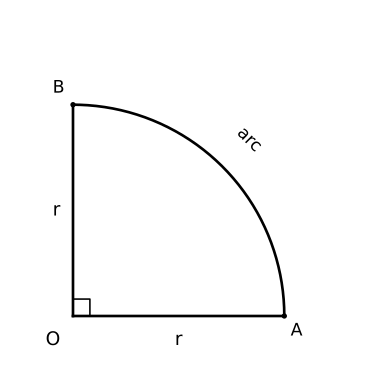
What is the perimeter of a quadrant (one-quarter) of a circle with radius 'r'?

Diagram for question 24: Areas Related to Circles
Show answer
Option (A) is correct.

Explanation: The perimeter of a quadrant consists of two radii and one arc. Arc length of a quadrant = (1/4) × 2πr = πr/2. ∴ Perimeter = πr/2 + r + r = πr/2 + 2r = r(π/2 + 2).
Q25MCQ1 mark

The perimeter of a sector of a circle with central angle 60° and radius 10.5 cm is: (Use π = 22/7)

Show answer
Option (A) is correct.

Explanation: Perimeter of a sector = arc length + 2r, where arc length = (θ/360) × 2πr. Substituting θ = 60°, r = 10.5 cm, π = 22/7: arc length = (60/360) × 2 × (22/7) × 10.5 = (1/6) × 66 = 11 cm. ∴ Perimeter = 11 + 2(10.5) = 11 + 21 = 32 cm.
Q26MCQ1 mark

The circumferences of two circles are in the ratio 5 : 7. The ratio of their areas is:

Show answer
Option (A) is correct.

Explanation: Circumference = 2πr, so ratio of circumferences = ratio of radii ⟹ r₁ : r₂ = 5 : 7. Area of a circle = πr², so ratio of areas = πr₁² : πr₂² = r₁² : r₂² = 5² : 7² = 25 : 49.
Q27MCQ1 mark

A circular garden has a circumference of 88 m. What is the area of the garden? (Use π = 22/7)

Show answer
Option (A) is correct.

Explanation: Circumference = 2πr ⟹ 88 = 2 × (22/7) × r ⟹ r = (88 × 7)/(2 × 22) = 14 m. Area = πr² = (22/7) × 14² = (22/7) × 196 = 22 × 28 = 616 m².
Q28MCQ1 mark

The areas of two circles are in the ratio 9 : 16. What is the ratio of their circumferences?

Show answer
Option (A) is correct.

Explanation: Area of a circle = πr², so πr₁² : πr₂² = 9 : 16 ⟹ r₁²/r₂² = 9/16 ⟹ r₁/r₂ = 3/4. Circumference = 2πr, so ratio of circumferences = 2πr₁ : 2πr₂ = r₁ : r₂ = 3 : 4.
Q29MCQ1 mark

The minute hand of a wall clock is 10 cm long. The angle swept by it between 6:10 a.m. and 6:45 a.m. is:

Show answer
Option (A) is correct.

Explanation: The minute hand completes 360° in 60 minutes, so it sweeps 360/60 = 6° per minute. The time elapsed from 6:10 a.m. to 6:45 a.m. is 35 minutes. ∴ Angle swept = 35 × 6° = 210°.
Q30MCQ1 mark

The diameters of two circles are in the ratio 3 : 5. What is the ratio of their areas?

Show answer
Option (B) is correct.

Explanation: The area of a circle is πr², so the ratio of areas equals the square of the ratio of radii (or diameters). With diameters in the ratio 3 : 5, the ratio of areas = (3)² : (5)² = 9 : 25.

Want unlimited practice on Areas Related to Circles?

The full ClearSteps bank has 89+ reviewed questions on this chapter alone — with step-wise solutions, difficulty levels, and progress tracking. Verify your WhatsApp number and your free trial starts right here.

CBSE · CLASS 10
🎟️14-day free trial · code PRAC auto-applied
Mobile Number
+91
OTP will be sent to your WhatsApp

⭐ Trusted by 12,000+ students across India

Areas Related to Circles — Class 10 Maths Practice Questions