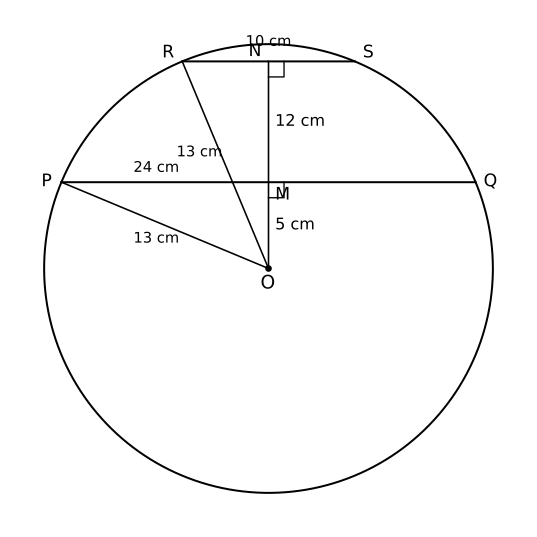
A circular clock face has its centre at point O and a radius of 13 cm. Two straight cracks appear on the clock face during transport: crack PQ and crack RS, both chords of the circle. Crack PQ is 24 cm long and crack RS is 10 cm long. Both cracks are on the same side of the centre O, and the perpendicular distances from O to each crack are to be determined for insurance assessment. The perpendicular from O meets PQ at M and RS at N.
A circular clock face has its centre at point O and a radius of 13 cm. Two straight cracks appear on the clock face during transport: crack PQ and crack RS, both chords of the circle. Crack PQ is 24 cm long and crack RS is 10 cm long. Both cracks are on the same side of the centre O, and the perpendicular distances from O to each crack are to be determined for insurance assessment. The perpendicular from O meets PQ at M and RS at N.
Show answerHide answer
By the theorem — the perpendicular from the centre of a circle to a chord bisects the chord — OM ⊥ PQ gives:
PM = PQ/2 = 24/2 = 12 cm
In right △OMP, by the Pythagoras theorem:
OM² + PM² = OP²
⟹ OM² + 12² = 13²
⟹ OM² = 169 − 144 = 25
∴ OM = 5 cm
---
(ii)
By the same theorem, ON ⊥ RS gives:
RN = RS/2 = 10/2 = 5 cm
In right △ONR, by the Pythagoras theorem:
ON² + RN² = OR²
⟹ ON² + 5² = 13²
⟹ ON² = 169 − 25 = 144
∴ ON = 12 cm
---
(iii)
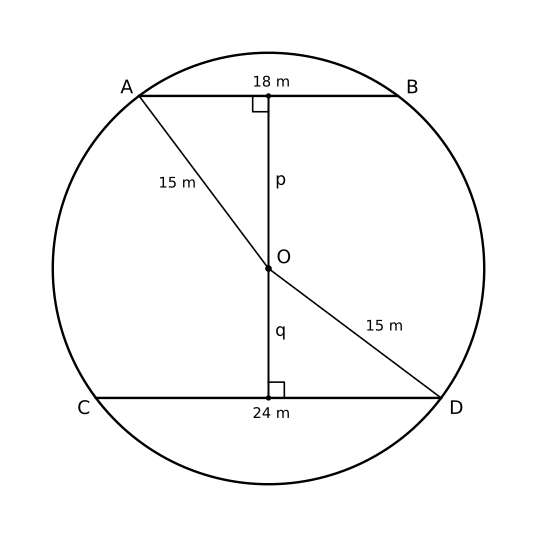
Let two equal chords AB and CD each be 24 cm long (AB = CD = 24 cm), with the perpendicular from O meeting AB at P and CD at Q.
By the theorem — the perpendicular from the centre bisects the chord:
AP = AB/2 = 24/2 = 12 cm, and CQ = CD/2 = 24/2 = 12 cm
In right △OAP (OA = radius = 13 cm):
OP² = OA² − AP² = 13² − 12² = 169 − 144 = 25
⟹ OP = 5 cm
In right △OCQ (OC = radius = 13 cm):
OQ² = OC² − CQ² = 13² − 12² = 169 − 144 = 25
⟹ OQ = 5 cm
Since OP = OQ = 5 cm, the two equal chords AB and CD are equidistant from the centre O.
∴ Equal chords of a circle are equidistant from the centre. Each of AB and CD is at a distance of 5 cm from O.
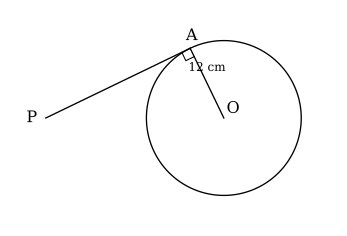
Now, for chord EF at perpendicular distance equal to the radius (13 cm) from O:
Let the foot of perpendicular be T. In right △OTE, OT = 13 cm and OE = 13 cm (radius).
(EF/2)² = OE² − OT² = 13² − 13² = 0
⟹ EF/2 = 0 ⟹ EF = 0 cm
∴ EF has zero length — it degenerates to a point, meaning the line is a tangent to the circle touching it at exactly one point.