ClearStepsCLEARSTEPS AI
Teacher Login →Student Login →

Circles (Tangents): Class 10 Maths Practice Questions

12 original exam-pattern questions with full answers, matched to the current CBSE Class 10 paper design, including case-based questions. Attempt each question before opening the answer — or start a free 14-day trial ↓ for the full bank.

Q1Case-based4 marks

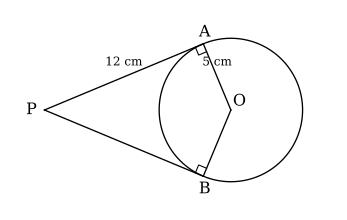
A farmer wants to fence a circular well. He stands at a point P outside the well and stretches two ropes PA and PB, each touching the circular wall of the well at points A and B respectively (PA and PB are tangents to the circular well from point P). O is the centre of the well with radius OA = OB = 5 cm, and PA = 12 cm.

A farmer wants to fence a circular well. He stands at a point P outside the well and stretches two ropes PA and PB, each touching the circular wall of the well at points A and B respectively (i.e., PA and PB are tangents to the circular well from P). The centre of the well is O.

Given information:
• PA = 12 cm
• OA = 5 cm (radius of the well)

Answer the following parts:
(i) Find the length of OP.
(ii) Find the length of PB.
(iii) Find the area of quadrilateral OAPB.
OR
Find ∠APB, given that ∠AOP = 67°.
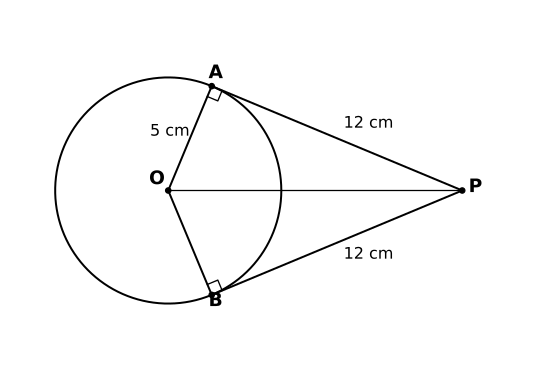
Diagram for question 1: Circles (Tangents)
Show answer
Part (i) — Find OP [1 mark]

By the theorem: The tangent at any point of a circle is perpendicular to the radius through the point of contact.

∴ OA ⊥ PA ⟹ ∠OAP = 90°

In right △OAP:
OP² = OA² + PA²
⟹ OP² = 5² + 12²
⟹ OP² = 25 + 144
⟹ OP² = 169
⟹ OP = 13

∴ OP = 13 cm

---

Part (ii) — Find PB [1 mark]

By the theorem: Lengths of tangents drawn from an external point to a circle are equal.

Here P is the external point, and PA, PB are tangents to the circle.

∴ PB = PA

⟹ PB = 12

∴ PB = 12 cm

---

Part (iii) — Find area of quadrilateral OAPB [2 marks]

Since OA ⊥ PA and OB ⊥ PB (radius ⊥ tangent),
∠OAP = ∠OBP = 90°

∴ Quadrilateral OAPB consists of two congruent right triangles: △OAP and △OBP.

Area of △OAP = ½ × OA × PA
⟹ = ½ × 5 × 12
⟹ = 30 cm²

By symmetry (OA = OB, PA = PB), △OAP ≅ △OBP (by RHS congruence)
∴ Area of △OBP = 30 cm²

Area of quadrilateral OAPB = Area of △OAP + Area of △OBP
⟹ = 30 + 30
⟹ = 60

∴ Area of quadrilateral OAPB = 60 cm²

---

OR (Alternative for Part iii) — Find ∠APB [2 marks]

Since OA ⊥ PA (radius ⊥ tangent),
∠OAP = 90°

In △OAP:
∠OAP + ∠AOP + ∠APO = 180° (angle sum property)
⟹ 90° + 67° + ∠APO = 180°
⟹ ∠APO = 180° − 157°
⟹ ∠APO = 23°

Since the two tangents from an external point are equal (PA = PB) and OA = OB (radii), by symmetry:
△OAP ≅ △OBP (RHS congruence)
∴ ∠BPO = ∠APO = 23°

∠APB = ∠APO + ∠BPO
⟹ = 23° + 23°
⟹ = 46°

∴ ∠APB = 46°
Q2Case-based4 marks

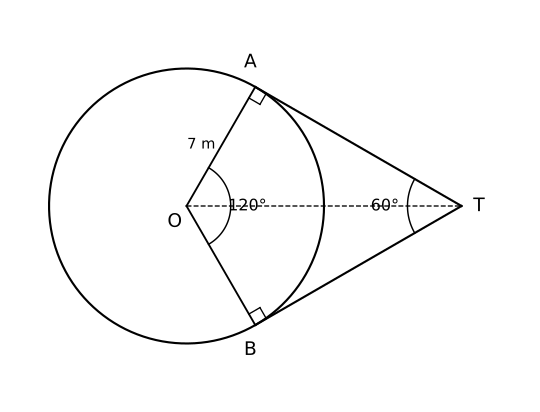
A circular fountain is built in the centre of a rectangular park. A park designer stands at a corner point T, outside the fountain, and observes that two straight pathways TA and TB can be drawn as tangents from T to the circular fountain, touching it at points A and B respectively. The designer notes that the angle between the two pathways (i.e., ∠ATB) is 60°. O is the centre of the circular fountain and the radius of the fountain is 7 m.

A circular fountain is built in the centre of a rectangular park. A park designer stands at a corner point T, outside the fountain, and observes that two straight pathways TA and TB can be drawn as tangents from T to the circular fountain, touching it at points A and B respectively. The designer notes that the angle between the two pathways (i.e., ∠ATB) is 60°.

(i) Find the angle ∠AOB, where O is the centre of the circular fountain. [1]
(ii) Prove that TA = TB (i.e., the two tangent pathways from the external point T are equal in length). [2]
(iii) If the radius of the fountain is 7 m, find the length of each tangent pathway TA and TB. [1]

Diagram for question 2: Circles (Tangents)
Show answer
Part (i): [1 mark]

Since OA ⊥ TA and OB ⊥ TB (radius is perpendicular to tangent at point of contact),

∠OAT = ∠OBT = 90°

In quadrilateral OATB,

∠OAT + ∠ATB + ∠OBT + ∠AOB = 360°

⟹ 90° + 60° + 90° + ∠AOB = 360°

⟹ ∠AOB = 360° − 240°

∴ ∠AOB = 120°

---

Part (ii): [2 marks]

Given: O is the centre of the circle. TA and TB are tangents from external point T, touching the circle at A and B respectively.

To Prove: TA = TB

Proof:

In △OAT and △OBT,

OA = OB (radii of the same circle) ...(i)

OT = OT (common side) ...(ii)

∠OAT = ∠OBT = 90° (radius ⊥ tangent at point of contact) ...(iii)

By the RHS congruence criterion,

△OAT ≅ △OBT

⟹ TA = TB (by CPCT)

Hence proved.

---

Part (iii): [1 mark]

From Part (i), ∠AOB = 120°

⟹ ∠AOT = 60° (since OT bisects ∠AOB, as △OAT ≅ △OBT)

In right △OAT,

tan(∠AOT) = TA / OA

⟹ tan 60° = TA / 7

⟹ √3 = TA / 7

⟹ TA = 7√3

∴ TA = TB = 7√3 m
Q3Case-based4 marks

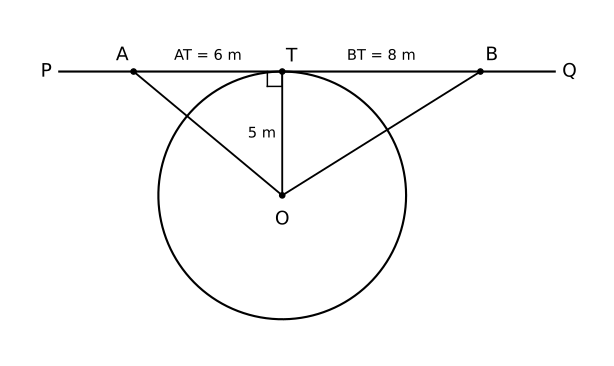
A municipal engineer is designing a circular fountain (centre O, radius 5 m) in a rectangular park. A straight decorative railing PQ is to be installed such that it is tangent to the fountain boundary at point T. Two lamp-posts are fixed at points A and B on the railing such that AT = 6 m and BT = 8 m. A straight path from A to B passes through the centre O of the fountain. The radius of the fountain is 5 m.

A municipal engineer is designing a circular fountain (centre O, radius 5 m) in a rectangular park. A straight decorative railing PQ is to be installed such that it is tangent to the fountain boundary at point T. Two lamp-posts are fixed at points A and B on the railing such that AT = 6 m and BT = 8 m. A straight path from A to B passes through the centre O of the fountain. Answer the parts below.

(i) Find the length of AB.
(ii) Find OA and OB.
(iii) Find the area of triangle OAB. OR Find the angle ∠AOB.

Diagram for question 3: Circles (Tangents)
Show answer
Part (i): Find AB. [1 mark]

Since PQ is tangent to the circle at T, OT ⊥ AB (radius is perpendicular to tangent at point of contact).

∴ OT ⊥ AB, with AT = 6 m and BT = 8 m.

∴ AB = AT + TB = 6 + 8 = 14 m.

∴ AB = 14 m.


Part (ii): Find OA and OB. [1 mark]

In △OTA, ∠OTA = 90° (radius ⊥ tangent).

By Pythagoras' theorem:
OA² = OT² + AT²
⟹ OA² = 5² + 6² = 25 + 36 = 61
∴ OA = √61 m.

In △OTB, ∠OTB = 90°.
OB² = OT² + BT²
⟹ OB² = 5² + 8² = 25 + 64 = 89
∴ OB = √89 m.


Part (iii) [Main option]: Find the area of △OAB. [2 marks]

OT ⊥ AB (established above), so OT is the perpendicular from O to base AB.

Area of △OAB = ½ × base × height
= ½ × AB × OT
= ½ × 14 × 5
= ½ × 70

∴ Area of △OAB = 35 m².


Part (iii) [OR option]: Find ∠AOB. [2 marks]

Using the cosine rule in △OAB:
cos(∠AOB) = (OA² + OB² − AB²) / (2 · OA · OB)

OA² = 61, OB² = 89, AB² = 196.

Numerator = 61 + 89 − 196 = −46.
Denominator = 2 × √61 × √89 = 2√5429.

√5429 ≈ 73.68
⟹ Denominator ≈ 147.36.

cos(∠AOB) = −46 / 147.36 ≈ −0.312.

∴ ∠AOB = cos⁻¹(−0.312) ≈ 108.2°.

[Alternate approach using tan — also acceptable for full marks:]
Let ∠AOT = α and ∠BOT = β.
tan α = AT/OT = 6/5, so α = tan⁻¹(6/5) ≈ 50.19°.
tan β = BT/OT = 8/5, so β = tan⁻¹(8/5) ≈ 57.99°.
∠AOB = α + β ≈ 50.19° + 57.99° ≈ 108.2°.

∴ ∠AOB ≈ 108.2°.
Q4Case-based4 marks

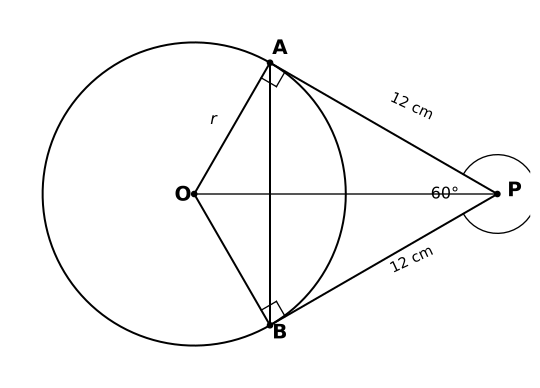
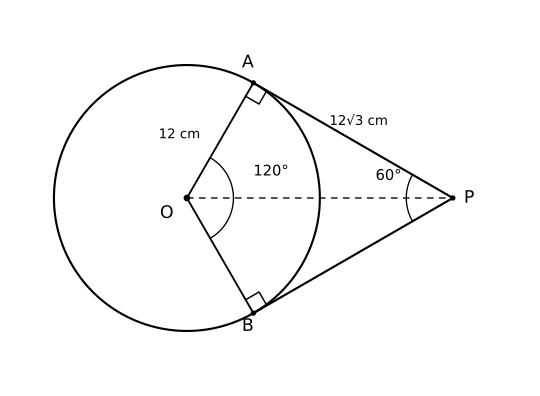
A circular fountain is installed in the centre of a rectangular park. A maintenance worker stands at a point P outside the fountain's boundary and stretches two ropes PA and PB that are just tangent to the circular fountain at points A and B respectively, where O is the centre of the fountain. It is given that ∠APB = 60° and PA = PB = 12 cm.

A circular fountain is installed in the centre of a rectangular park. A maintenance worker stands at a point P outside the fountain's boundary and stretches two ropes — PA and PB — that are just tangent to the circular fountain at points A and B respectively. The worker observes that ∠APB = 60°. The length of each tangent rope PA = PB = 12 cm.

(i) Find the length of AB.
(ii) Find the radius of the circular fountain.
(iii) (a) Find the area of the quadrilateral OAPB (where O is the centre of the fountain).
OR
(iii) (b) Prove that the tangents PA and PB are equally inclined to the line segment OA (i.e., ∠OAP = ∠OBP), using congruence of triangles.

Diagram for question 4: Circles (Tangents)
Show answer
Part (i): Find the length of AB. [1 mark]

In △APB, PA = PB = 12 cm and ∠APB = 60°.

Since PA = PB, △APB is isosceles.

⟹ ∠PAB = ∠PBA = (180° − 60°)/2 = 60°

⟹ △APB is equilateral.

∴ AB = PA = 12 cm.

---

Part (ii): Find the radius of the circular fountain. [1 mark]

By the theorem "The tangent at any point of a circle is perpendicular to the radius through the point of contact,"

OA ⊥ PA ⟹ ∠OAP = 90°.

In right △OAP:
tan(∠APO) = OA/PA

Since △APB is equilateral and OP bisects ∠APB (tangents from external point are equal),
∠APO = 60°/2 = 30°.

⟹ tan 30° = OA/12

⟹ 1/√3 = OA/12

⟹ OA = 12/√3 = (12√3)/3 = 4√3 cm.

∴ The radius of the circular fountain is 4√3 cm.

---

Part (iii)(a): Find the area of quadrilateral OAPB. [2 marks]

Since OA ⊥ PA and OB ⊥ PB (radius ⊥ tangent),
quadrilateral OAPB has right angles at A and B.

Diagonal OP divides OAPB into two congruent right triangles: △OAP and △OBP.

Area of △OAP = (1/2) × base × height = (1/2) × PA × OA

⟹ Area of △OAP = (1/2) × 12 × 4√3 = 24√3 cm².

By symmetry (PA = PB, OA = OB, OP common), △OAP ≅ △OBP (by RHS congruence).

⟹ Area of △OBP = 24√3 cm².

∴ Area of quadrilateral OAPB = Area of △OAP + Area of △OBP

= 24√3 + 24√3 = 48√3 cm².

∴ The area of quadrilateral OAPB is 48√3 cm².

---

Part (iii)(b): Prove that ∠OAP = ∠OBP. [2 marks]

In △OAP and △OBP:

(a) OA = OB (radii of the same circle)

(b) PA = PB (tangents drawn from an external point to a circle are equal in length) ...(i)

(c) OP = OP (common side) ...(ii)

By the theorem "Tangent to a circle is perpendicular to the radius at the point of contact,"
∠OAP = ∠OBP = 90° ...(iii)

⟹ △OAP ≅ △OBP (by RHS congruence criterion, using (i), (ii), (iii)).

⟹ ∠OAP = ∠OBP (by CPCT).

Hence proved.
Q5Case-based4 marks

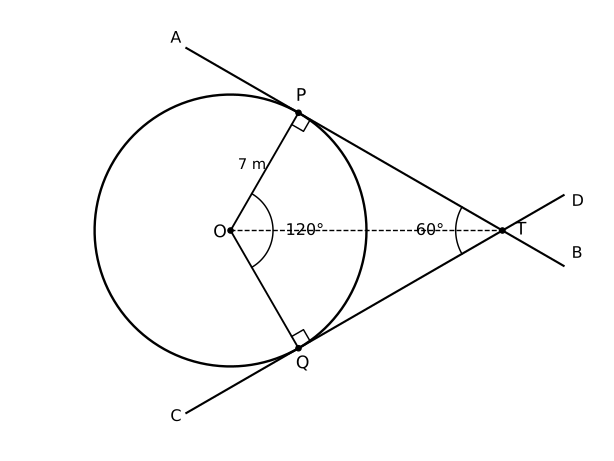
A circular garden has its centre at point O. Two straight pathways AB and CD are tangents to the garden boundary at points P and Q respectively, and both pathways meet at an external point T. The angle between the two pathways at T is ∠PTQ = 60°.

A circular garden has its centre at point O. A straight pathway AB is tangent to the garden boundary at point P, and another straight pathway CD is tangent to the garden boundary at point Q. Both pathways meet at an external point T outside the garden. A gardener observes that the angle between the two pathways at T (i.e., ∠ATD = ∠PTQ) is 60°.

Based on the above situation, answer the following questions:
(i) What is the value of ∠POQ? [1 mark]
(ii) What is the value of ∠OPT? [1 mark]
(iii) If the radius of the garden is 7 m, find the length of the pathway TP from the external point T to the point of tangency P. [2 marks]
OR
If TP = 7√3 m and ∠PTQ = 60°, find the radius of the circular garden. [2 marks]

Diagram for question 5: Circles (Tangents)
Show answer
Part (i): Finding ∠POQ [1 mark]

Since TP and TQ are tangents to the circle from external point T,
by the property of tangents from an external point,
∠OPT = ∠OQT = 90°

In quadrilateral OPTQ:
∠OPT + ∠OQT + ∠PTQ + ∠POQ = 360°
⟹ 90° + 90° + 60° + ∠POQ = 360°
⟹ ∠POQ = 360° − 240°
∴ ∠POQ = 120°

Part (ii): Finding ∠OPT [1 mark]

By the theorem: The tangent at any point of a circle is perpendicular to the radius through the point of contact.

Since OP is the radius and TP is the tangent at point P,
∴ ∠OPT = 90°

Part (iii): Finding the length TP [2 marks]

Given: radius OP = 7 m, ∠PTQ = 60°

Since TP and TQ are tangents from T, and ∠PTQ = 60°,
by symmetry, OT bisects ∠PTQ.
⟹ ∠OTP = 30°

In right-angled △OPT (∠OPT = 90°):

tan(∠OTP) = OP/TP
⟹ tan 30° = 7/TP
⟹ 1/√3 = 7/TP
⟹ TP = 7√3

∴ Length of pathway TP = 7√3 m

OR

Given: TP = 7√3 m, ∠PTQ = 60°

Since OT bisects ∠PTQ,
∠OTP = 30°

In right-angled △OPT (∠OPT = 90°):

tan(∠OTP) = OP/TP
⟹ tan 30° = OP/(7√3)
⟹ 1/√3 = OP/(7√3)
⟹ OP = 7√3/√3
⟹ OP = 7

∴ Radius of the circular garden = 7 m
Q6Case-based4 marks

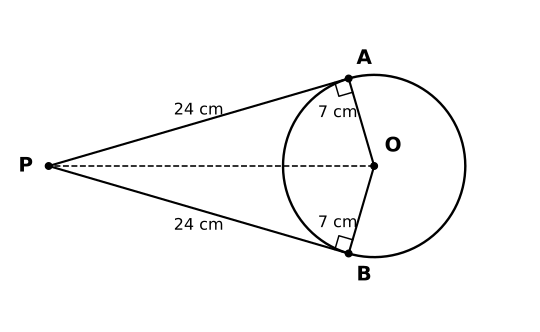
A circular fountain is installed in the centre of a park. A stone pathway is laid from a point P outside the fountain, touching the fountain's circular boundary at exactly two points A and B — one on each side. The radius of the fountain is 7 cm (scale model) and PA = 24 cm. OA and OB are radii of the fountain, and PA and PB are tangents from external point P.

A circular fountain is installed in the centre of a park. A stone pathway is laid from a point P outside the fountain, touching the fountain's circular boundary at exactly two points A and B — one on each side. The radius of the fountain is 7 cm (scale model) and PA = 24 cm.

(i) Find the length PB. [1]
(ii) Find the length of PO, where O is the centre of the fountain. [1]
(iii) Find the area of quadrilateral OAPB. [2]
OR
(iii) Find ∠OAP and hence find ∠APB if ∠AOP = 60°. [2]

Diagram for question 6: Circles (Tangents)
Show answer
(i) Since PA and PB are tangents drawn from the same external point P to the circle with centre O,
by the theorem — tangents drawn from an external point to a circle are equal in length,

∴ PB = PA = 24 cm

(ii) Since OA is a radius and PA is a tangent at point A,
by the theorem — the radius drawn to the point of tangency is perpendicular to the tangent,
OA ⊥ PA ⟹ ∠OAP = 90°

In right △OAP:
OP² = OA² + PA² (Pythagoras' Theorem)
⟹ OP² = 7² + 24²
⟹ OP² = 49 + 576
⟹ OP² = 625

∴ OP = 25 cm

(iii) [Main Option]
Since OA ⊥ PA and OB ⊥ PB (radius ⊥ tangent at point of contact),
quadrilateral OAPB has right angles at A and B.

By symmetry, diagonal OP divides quadrilateral OAPB into two congruent right triangles — △OAP and △OBP.

Area of △OAP = ½ × OA × PA
⟹ Area of △OAP = ½ × 7 × 24
⟹ Area of △OAP = 84 cm²

Since △OAP ≅ △OBP (by RHS congruence: OA = OB = 7 cm, OP common, ∠OAP = ∠OBP = 90°),
Area of △OBP = 84 cm²

Area of quadrilateral OAPB = Area of △OAP + Area of △OBP
⟹ Area of OAPB = 84 + 84

∴ Area of quadrilateral OAPB = 168 cm²

---
[OR Option for part (iii)]

Since OA ⊥ PA (radius ⊥ tangent),
∴ ∠OAP = 90°

In △OAP, ∠AOP = 60° (given)
⟹ ∠APO = 180° − 90° − 60° = 30°

Since tangents from an external point are equal and △OAP ≅ △OBP (by RHS),
the figure is symmetric about OP,
⟹ ∠BPO = ∠APO = 30°

∴ ∠APB = ∠APO + ∠BPO = 30° + 30°

∴ ∠APB = 60°
Q7Case-based4 marks

A garden designer is planning a circular fountain with centre O. A straight pathway is laid from a point P (outside the fountain) such that it just touches the fountain at two points A and B (i.e., PA and PB are tangents to the circle). The designer notes that ∠APB = 60°.

A garden designer is planning a circular fountain with centre O. A straight pathway is laid from a point P (outside the fountain) such that it just touches the fountain at two points A and B. The designer marks the angle ∠APB = 60°.

(i) Find the measure of ∠AOB. [1 mark]
(ii) Find the measure of ∠OAP. [1 mark]
(iii) If the length of the tangent PA = 12√3 cm and the radius of the fountain OA = 12 cm, verify that PA² = PO² − OA². [2 marks]
OR
(iii) If PA = (2x + 3) cm and PB = (4x − 7) cm, find the length of each tangent. Also find the perimeter of △PAB if AB = 10 cm. [2 marks]

Diagram for question 7: Circles (Tangents)
Show answer
Part (i): Find ∠AOB. [1 mark]

By the property: the radius is perpendicular to the tangent at the point of contact.
∴ ∠OAP = ∠OBP = 90°

In quadrilateral OAPB,
∠OAP + ∠APB + ∠OBP + ∠AOB = 360°
⟹ 90° + 60° + 90° + ∠AOB = 360°
⟹ ∠AOB = 360° − 240°
∴ ∠AOB = 120°

---
Part (ii): Find ∠OAP. [1 mark]

By the property: the radius is perpendicular to the tangent at the point of contact.
∴ ∠OAP = 90°

---
Part (iii) [Main option]: Verify PA² = PO² − OA². [2 marks]

Given: PA = 12√3 cm, OA = 12 cm.

Since the radius is perpendicular to the tangent at the point of contact,
∠OAP = 90°
⟹ Triangle OAP is right-angled at A.

By the Pythagoras Theorem:
PO² = PA² + OA²
⟹ PO² = (12√3)² + (12)²
⟹ PO² = 432 + 144
⟹ PO² = 576
∴ PO = 24 cm

Now verify: PO² − OA² = 576 − 144 = 432
And: PA² = (12√3)² = 432
∴ PA² = PO² − OA² = 432. Hence verified.

---
Part (iii) [OR option]: Find PA, PB and perimeter of △PAB. [2 marks]

By the property: tangents drawn from an external point to a circle are equal in length.
∴ PA = PB
⟹ 2x + 3 = 4x − 7
⟹ 7 + 3 = 4x − 2x
⟹ 10 = 2x
⟹ x = 5

∴ PA = 2(5) + 3 = 13 cm
PB = 4(5) − 7 = 13 cm

Perimeter of △PAB = PA + PB + AB
⟹ Perimeter = 13 + 13 + 10
∴ Perimeter of △PAB = 36 cm
Q8Case-based4 marks

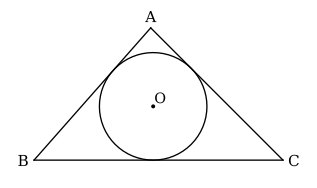
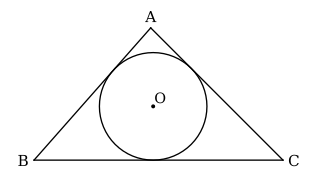
A municipal park has a triangular flower bed ABC in which ∠A = 90°. The incircle of △ABC has centre I and radius r. It touches BC at X, CA at Y, and AB at Z. AB = 6 cm, AC = 8 cm.

A municipal park has a triangular flower bed ABC in which ∠A = 90°. The park authorities decide to install a circular fountain whose boundary touches all three sides of the flower bed internally (i.e., the incircle of △ABC). The incircle has centre I and radius r, and it touches side BC at point X, side CA at point Y, and side AB at point Z.

(i) Prove that BX = BZ. [1 mark]

(ii) If AB = 6 cm and AC = 8 cm, find the length BC and the radius r of the incircle. [1 mark]

(iii) The park authorities also plan to place a decorative lamp post at point B such that two straight paths from B just touch the fountain circle at points X and Z respectively. Find the length BX of each path. Show your working.

OR

(iii) A second identical triangular flower bed A′B′C′ is constructed such that ∠A′ = 90°, B′C′ = 10 cm and A′B′ = 6 cm. Find the radius r′ of its incircle and verify that r′ = r (where r was found in part (ii)). [2 marks]

Diagram for question 8: Circles (Tangents)
Show answer
PART (i) — Prove BX = BZ [1 mark]

By the theorem: Tangents drawn from an external point to a circle are equal in length.

Point B is external to the incircle.
BX and BZ are tangents drawn from B to the incircle (touching at X and Z respectively).

∴ BX = BZ. Hence proved.

─────────────────────────────────
PART (ii) — Find BC and r [1 mark]

By the Pythagoras Theorem in △ABC with ∠A = 90°:

BC² = AB² + AC²
⟹ BC² = 6² + 8²
⟹ BC² = 36 + 64 = 100
∴ BC = 10 cm

For the inradius of a right triangle, the formula is:

r = (AB + AC − BC) / 2

(Derivation note — value point: since tangents from each vertex are equal:
AY = AZ, BX = BZ, CX = CY;
let AY = AZ = a, BZ = BX = b, CX = CY = c.
Then AB = a + b = 6, AC = a + c = 8, BC = b + c = 10.
Adding all three: 2(a + b + c) = 24 ⟹ a + b + c = 12.
Also, since ∠A = 90° and AY = AZ = r (the tangent from A to a circle whose centre is at distance r from each side meets at distance r along each side from A, i.e. a = r).
∴ r = a = 12 − 10 = 2 cm.)

∴ r = (6 + 8 − 10) / 2 = 4 / 2
∴ r = 2 cm

─────────────────────────────────
PART (iii) — Find length BX [2 marks]

From the tangent-segment working above:

Let AZ = AY = a, BX = BZ = b, CX = CY = c.

According to the question:
a + b = AB = 6 …(i)
a + c = AC = 8 …(ii)
b + c = BC = 10 …(iii)

From (i) and the result a = r = 2:
⟹ b = AB − a = 6 − 2 = 4 cm

∴ BX = 4 cm

[Verification: c = BC − b = 10 − 4 = 6; and a + c = 2 + 6 = 8 = AC ✓]

∴ The length of each decorative path from B to the point of tangency is BX = BZ = 4 cm.

─────────────────────────────────
PART (iii) OR — Find r′ and verify r′ = r [2 marks]

Given: ∠A′ = 90°, B′C′ = 10 cm, A′B′ = 6 cm.

By the Pythagoras Theorem:
A′C′² = B′C′² − A′B′²
⟹ A′C′² = 100 − 36 = 64
∴ A′C′ = 8 cm

Using the inradius formula for a right triangle:
r′ = (A′B′ + A′C′ − B′C′) / 2
⟹ r′ = (6 + 8 − 10) / 2
⟹ r′ = 4 / 2
∴ r′ = 2 cm

From part (ii), r = 2 cm.

∴ r′ = r = 2 cm. Hence verified.
Q9Short Answer3 marks

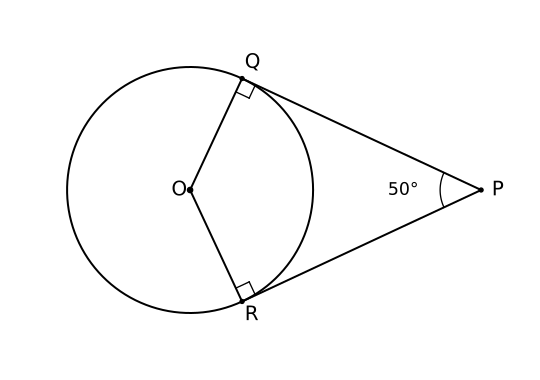
In the given figure, PQ and PR are tangents drawn from an external point P to a circle with centre O. If ∠QPR = 50°, find: (i) ∠QOR, and (ii) ∠OQR.

Diagram for question 9: Circles (Tangents)
Show answer
Given: PQ and PR are tangents from external point P to a circle with centre O; ∠QPR = 50°.

Diagram: External point P with two tangents PQ and PR touching the circle at Q and R respectively; O is the centre; PQOR is a quadrilateral.

(i) Finding ∠QOR:

Since the radius is perpendicular to the tangent at the point of contact (Tangent–Radius Theorem),
∠OQP = 90° …(i)
∠ORP = 90° …(ii)

In quadrilateral PQOR,
∠QPR + ∠OQP + ∠QOR + ∠ORP = 360° [Angle sum property of a quadrilateral]
⟹ 50° + 90° + ∠QOR + 90° = 360°
⟹ ∠QOR = 360° − 230°
∴ ∠QOR = 130°

(ii) Finding ∠OQR:

Since tangents drawn from an external point to a circle are equal in length (Tangent–from–External–Point Theorem),
PQ = PR

Also, OQ = OR (radii of the same circle)

⟹ OP is the perpendicular bisector of QR, so △OQR is isosceles with OQ = OR.

In △OQR,
∠OQR + ∠ORQ + ∠QOR = 180° [Angle sum property of a triangle]
⟹ ∠OQR + ∠OQR + 130° = 180° [∵ ∠OQR = ∠ORQ, base angles of isosceles △OQR]
⟹ 2∠OQR = 50°
∴ ∠OQR = 25°
Q10Short Answer3 marks

Two tangents PA and PB are drawn from an external point P to a circle with centre O and radius 5 cm. If the length of each tangent is 12 cm, find the length of OP and the angle ∠OPA.

Diagram for question 10: Circles (Tangents)
Show answer
Given: OA = 5 cm (radius), PA = 12 cm (tangent length), PA and PB are tangents from external point P to the circle with centre O.

Since the radius is perpendicular to the tangent at the point of contact (radius ⊥ tangent),
∠OAP = 90°

In right △OAP:
By the Pythagoras Theorem,
OP² = OA² + PA²
⟹ OP² = 5² + 12²
⟹ OP² = 25 + 144
⟹ OP² = 169
⟹ OP = 13 cm

∴ The length of OP is 13 cm.

For ∠OPA:
In right △OAP,
tan(∠OPA) = OA/PA = 5/12
⟹ ∠OPA = tan⁻¹(5/12)

Since sin(∠OPA) = OA/OP = 5/13 and cos(∠OPA) = PA/OP = 12/13,
we verify: sin²(∠OPA) + cos²(∠OPA) = 25/169 + 144/169 = 169/169 = 1 ✓

∴ ∠OPA = tan⁻¹(5/12)

Also, since tangents from an external point are equal in length (PA = PB = 12 cm), OP bisects ∠APB (tangents from an external point are equally inclined to the line joining the point to the centre).

∴ OP = 13 cm and ∠OPA = tan⁻¹(5/12).
Q11Long Answer5 marks

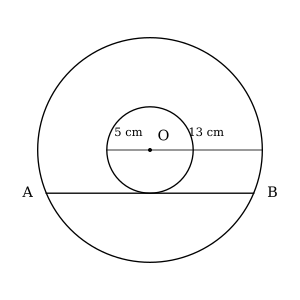
Prove that the tangent drawn at any point of a circle is perpendicular to the radius through the point of contact. Using this theorem, in the given figure, two concentric circles with centre O have radii 13 cm and 5 cm. A chord AB of the larger circle touches the smaller circle at point P. Find the length of the chord AB.

Diagram for question 11: Circles (Tangents)
Show answer
PART 1 — THEOREM PROOF (3 marks)

Statement: The tangent at any point of a circle is perpendicular to the radius through the point of contact.

Given: A circle with centre O. XY is a tangent to the circle at point A. OA is the radius through A.

To Prove: OA ⊥ XY

Construction: Take any point B (other than A) on the tangent XY. Join OB.

Proof:

Since XY is a tangent to the circle at A, it meets the circle at exactly one point A. Every other point on XY lies outside the circle.

⟹ OB > OA (∵ B lies outside the circle and OA is the radius, while OB is a line segment from centre O to an exterior point on the tangent)

Since B is any arbitrary point on XY other than A:

⟹ OA is the shortest distance from O to the line XY

⟹ OA ⊥ XY

(∵ the perpendicular from a point to a line is the shortest distance from that point to the line)

Hence proved.

---

PART 2 — APPLICATION (2 marks)

Diagram: Two concentric circles with centre O; radii OA = 13 cm (larger) and OP = 5 cm (smaller); chord AB of larger circle touches smaller circle at P.

Given:
Radius of larger circle, OA = 13 cm
Radius of smaller circle, OP = 5 cm
AB is a chord of the larger circle that touches the smaller circle at P.

Since AB is a tangent to the smaller circle at P, by the theorem proved above:

⟹ OP ⊥ AB

⟹ ∠OPA = 90°

In right-angled △OPA, by the Pythagoras theorem:

OA² = OP² + AP²

⟹ 13² = 5² + AP²

⟹ 169 = 25 + AP²

⟹ AP² = 144

⟹ AP = 12 cm

Since OP ⊥ AB and the perpendicular from the centre to a chord bisects the chord:

⟹ AP = PB = 12 cm

⟹ AB = AP + PB = 12 + 12 = 24 cm

∴ The length of chord AB = 24 cm.
Q12Long Answer5 marks

Prove that the lengths of tangents drawn from an external point to a circle are equal.

Using the above theorem, prove that the perimeter of △ABC is equal to 2(AQ + BR + CP), where Q, R, and P are the points where the incircle of △ABC touches the sides AB, BC, and CA respectively.

Diagram for question 12: Circles (Tangents)
Show answer
PART 1 — Prove that tangents from an external point are equal. [3 marks]

Given: A circle with centre O. A point P lies outside the circle. PA and PB are tangents drawn from P to the circle, touching it at A and B respectively.

To Prove: PA = PB

Construction: Draw radii OA and OB, and join OP.

[Diagram: Circle with centre O; external point P; tangent PA touching at A; tangent PB touching at B; radii OA and OB drawn; OP joined.]

Proof:

In △OAP and △OBP,

OA = OB (radii of the same circle) ...(i)

OP = OP (common side) ...(ii)

∠OAP = ∠OBP = 90° (radius is perpendicular to tangent at point of contact) ...(iii)

∴ △OAP ≅ △OBP (by RHS congruence criterion)

⟹ PA = PB (by CPCT)

Hence proved.

---

PART 2 — Prove that Perimeter of △ABC = 2(AQ + BR + CP). [2 marks]

Given: Incircle of △ABC touches side AB at Q, side BC at R, and side CA at P.

[Diagram: Triangle ABC with incircle touching AB at Q, BC at R, CA at P.]

From the theorem proved above (tangents from an external point to a circle are equal):

From vertex A: AQ = AP ...(i) (tangents from A)

From vertex B: BQ = BR ...(ii) (tangents from B)

From vertex C: CP = CR ...(iii) (tangents from C)

Now, Perimeter of △ABC

= AB + BC + CA

= (AQ + QB) + (BR + RC) + (CP + PA)

⟹ Perimeter = (AQ + BR) + (BQ + BR) ...

Re-grouping using (i), (ii), (iii):

= AQ + QB + BR + RC + CP + PA

= AQ + BQ + BR + CR + CP + AP

= (AQ + AP) + (BQ + BR) + (CR + CP)

= 2AQ + 2BR + 2CP [using (i), (ii), (iii): AP = AQ, BQ = BR, CR = CP]

∴ Perimeter of △ABC = 2(AQ + BR + CP)

Hence proved.

Want unlimited practice on Circles (Tangents)?

The full ClearSteps bank has 12+ reviewed questions on this chapter alone — with step-wise solutions, difficulty levels, and progress tracking. Verify your WhatsApp number and your free trial starts right here.

CBSE · CLASS 10
🎟️14-day free trial · code PRAC auto-applied
Mobile Number
+91
OTP will be sent to your WhatsApp

⭐ Trusted by 12,000+ students across India

Circles (Tangents) — Class 10 Maths Practice Questions