ClearStepsCLEARSTEPS AI
Teacher Login →Student Login →

Coordinate Geometry: Class 10 Maths Practice Questions

30 original exam-pattern questions with full answers, matched to the current CBSE Class 10 paper design, including case-based questions. Attempt each question before opening the answer — or start a free 14-day trial ↓ for the full bank.

Q1Case-based4 marks

A city planner is designing a straight road connecting a School located at S(1, 7) and a Hospital located at H(7, –5). A Bus Stop B is to be placed on this road such that SB : BH = 1 : 2. A Fire Station F is to be placed at the point that divides segment SH in the ratio 2 : 1.

A city planner is designing a straight road connecting a School located at S(1, 7) and a Hospital located at H(7, –5). A Bus Stop B is to be placed on this road such that SB : BH = 1 : 2. A Fire Station F is to be placed at the point that divides segment SH in the ratio 2 : 1.

(i) Find the coordinates of the Bus Stop B.
(ii) Find the coordinates of the Fire Station F.
(iii) The city planner claims that the midpoint M of segment SH, the Bus Stop B, and the Fire Station F are NOT collinear. Verify whether the claim is correct, showing full working.

Show answer
(i) Finding coordinates of Bus Stop B [1 mark]

S(1, 7), H(7, –5), ratio m : n = 1 : 2

Using the Section Formula:

B = ( (m·x₂ + n·x₁)/(m + n) , (m·y₂ + n·y₁)/(m + n) )

⟹ B = ( (1×7 + 2×1)/(1 + 2) , (1×(–5) + 2×7)/(1 + 2) )

⟹ B = ( (7 + 2)/3 , (–5 + 14)/3 )

⟹ B = ( 9/3 , 9/3 )

∴ Coordinates of Bus Stop B = (3, 3)

---

(ii) Finding coordinates of Fire Station F [1 mark]

S(1, 7), H(7, –5), ratio m : n = 2 : 1

Using the Section Formula:

F = ( (2×7 + 1×1)/(2 + 1) , (2×(–5) + 1×7)/(2 + 1) )

⟹ F = ( (14 + 1)/3 , (–10 + 7)/3 )

⟹ F = ( 15/3 , –3/3 )

∴ Coordinates of Fire Station F = (5, –1)

---

(iii) Verifying whether M, B, F are collinear [2 marks]

First, find midpoint M of SH:

Using the Midpoint Formula:

M = ( (x₁ + x₂)/2 , (y₁ + y₂)/2 )

⟹ M = ( (1 + 7)/2 , (7 + (–5))/2 )

⟹ M = ( 8/2 , 2/2 )

∴ M = (4, 1)

Now check collinearity of M(4, 1), B(3, 3), F(5, –1) using the Area of Triangle formula:

Area = ½ |x₁(y₂ – y₃) + x₂(y₃ – y₁) + x₃(y₁ – y₂)|

Here (x₁, y₁) = M(4, 1), (x₂, y₂) = B(3, 3), (x₃, y₃) = F(5, –1)

⟹ Area = ½ |4(3 – (–1)) + 3((–1) – 1) + 5(1 – 3)|

⟹ Area = ½ |4(4) + 3(–2) + 5(–2)|

⟹ Area = ½ |16 – 6 – 10|

⟹ Area = ½ |0|

⟹ Area = 0

∵ Area of triangle formed by M, B, F = 0, the three points are collinear.

∴ The city planner's claim is INCORRECT. M, B, and F all lie on segment SH itself and are therefore collinear.
Q2Case-based4 marks

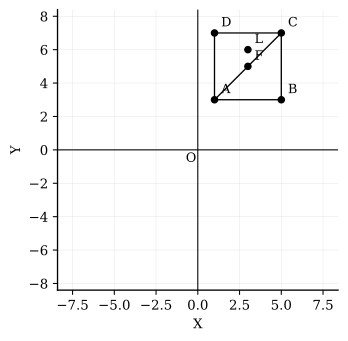
A city planner is designing a small rectangular park on a coordinate grid. The four corners of the park are at A(1, 3), B(5, 3), C(5, 7), and D(1, 7). A water fountain is to be placed at point F, the midpoint of diagonal AC. A lamp post is to be placed at point L(3, 6).

A city planner is designing a small rectangular park on a coordinate grid. The four corners of the park are at the points A(1, 3), B(5, 3), C(5, 7), and D(1, 7). A water fountain is to be installed at the point F, which divides the diagonal AC in the ratio 1 : 1 (i.e., at its midpoint).

(i) Find the length of the diagonal AC of the park. [1 mark]
(ii) Find the coordinates of the fountain F (the midpoint of AC). [1 mark]
(iii) A lamp post is to be placed at point L(3, 6). Find the distance of the lamp post L from the fountain F. Show your working. [2 marks]

Diagram for question 2: Coordinate Geometry
Show answer
(i) Length of diagonal AC:

Using the Distance Formula, the distance between two points (x₁, y₁) and (x₂, y₂) is
d = √[(x₂ − x₁)² + (y₂ − y₁)²]

Here A(1, 3) and C(5, 7).

⟹ AC = √[(5 − 1)² + (7 − 3)²]
⟹ AC = √[4² + 4²]
⟹ AC = √[16 + 16]
⟹ AC = √32
⟹ AC = 4√2

∴ The length of diagonal AC is 4√2 units.

(ii) Coordinates of fountain F (midpoint of AC):

Using the Midpoint Formula, the midpoint of the segment joining (x₁, y₁) and (x₂, y₂) is
M = ((x₁ + x₂)/2, (y₁ + y₂)/2)

Here A(1, 3) and C(5, 7).

⟹ F = ((1 + 5)/2, (3 + 7)/2)
⟹ F = (6/2, 10/2)
⟹ F = (3, 5)

∴ The coordinates of the fountain F are (3, 5).

(iii) Distance of lamp post L(3, 6) from fountain F(3, 5):

Using the Distance Formula,
FL = √[(x₂ − x₁)² + (y₂ − y₁)²]

Here F(3, 5) and L(3, 6).

⟹ FL = √[(3 − 3)² + (6 − 5)²]
⟹ FL = √[0² + 1²]
⟹ FL = √[0 + 1]
⟹ FL = √1
⟹ FL = 1

∴ The distance of the lamp post L from the fountain F is 1 unit.
Q3Case-based4 marks

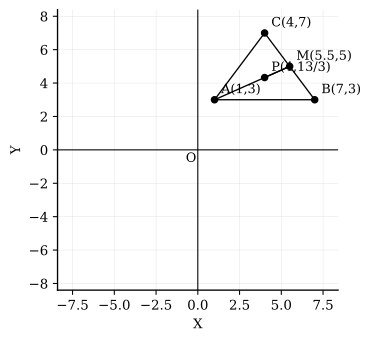
A city planner is designing an emergency response grid for a rectangular district. Three fire stations are located at points A(1, 3), B(7, 3), and C(4, 7) on a coordinate map (units in km). A new command centre P is to be placed at the centroid of triangle ABC. A supply depot D is to be placed on the x-axis equidistant from B and C.

A city planner is designing an emergency response grid for a rectangular district. Three fire stations are located at points A(1, 3), B(7, 3), and C(4, 7) on a coordinate map (units in km). A new command centre P is to be placed at the centroid of triangle ABC so that it is equidistant (in terms of weighted average) from all three stations.

(i) Find the coordinates of the command centre P (centroid of △ABC).
(ii) A supply depot D is to be placed on the x-axis such that it is equidistant from fire stations B(7, 3) and C(4, 7). Find the coordinates of D.
(iii) The city planner claims that the command centre P, the midpoint M of BC, and vertex A are collinear (they lie on the median from A). Verify this claim by checking whether A, M, and P are collinear using the area method.

OR

(iii) Find the distance between the command centre P and the supply depot D. Hence determine whether P and D are within a 3 km operational range of each other.

Diagram for question 3: Coordinate Geometry
Show answer
Part (i) — 1 mark

The centroid of a triangle with vertices (x₁, y₁), (x₂, y₂), (x₃, y₃) is
G = ((x₁ + x₂ + x₃)/3, (y₁ + y₂ + y₃)/3)

⟹ P = ((1 + 7 + 4)/3, (3 + 3 + 7)/3)

⟹ P = (12/3, 13/3)

∴ The coordinates of command centre P are (4, 13/3).

---

Part (ii) — 1 mark

Let D = (x, 0) on the x-axis.

Since D is equidistant from B(7, 3) and C(4, 7):
DB = DC

⟹ DB² = DC²

⟹ (x − 7)² + (0 − 3)² = (x − 4)² + (0 − 7)²

⟹ x² − 14x + 49 + 9 = x² − 8x + 16 + 49

⟹ − 14x + 58 = − 8x + 65

⟹ − 14x + 8x = 65 − 58

⟹ − 6x = 7

⟹ x = −7/6

∴ The coordinates of supply depot D are (−7/6, 0).

---

Part (iii) — 2 marks [Main option]

First, find midpoint M of BC where B(7, 3) and C(4, 7):
M = ((7 + 4)/2, (3 + 7)/2) = (11/2, 5)

To check collinearity of A(1, 3), M(11/2, 5), and P(4, 13/3), use the area formula:
Area = ½ |x₁(y₂ − y₃) + x₂(y₃ − y₁) + x₃(y₁ − y₂)|

Here x₁ = 1, y₁ = 3; x₂ = 11/2, y₂ = 5; x₃ = 4, y₃ = 13/3.

⟹ Area = ½ |1(5 − 13/3) + (11/2)(13/3 − 3) + 4(3 − 5)|

Compute each bracket:
5 − 13/3 = 15/3 − 13/3 = 2/3
13/3 − 3 = 13/3 − 9/3 = 4/3
3 − 5 = −2

⟹ Area = ½ |1 × (2/3) + (11/2) × (4/3) + 4 × (−2)|

⟹ Area = ½ |2/3 + 44/6 − 8|

⟹ Area = ½ |4/6 + 44/6 − 48/6|

⟹ Area = ½ |48/6 − 48/6|

⟹ Area = ½ × 0 = 0

Since the area of triangle formed by A, M, and P is 0, the three points are collinear.

∴ The claim of the city planner is verified — A, M (midpoint of BC), and P (centroid) are collinear, confirming that P lies on the median from A.

---

Part (iii) — 2 marks [OR option]

P = (4, 13/3) and D = (−7/6, 0).

Using the distance formula:
PD = √[(x₂ − x₁)² + (y₂ − y₁)²]

⟹ PD = √[(−7/6 − 4)² + (0 − 13/3)²]

Compute each term:
−7/6 − 4 = −7/6 − 24/6 = −31/6
0 − 13/3 = −13/3

⟹ PD = √[(−31/6)² + (−13/3)²]

⟹ PD = √[961/36 + 169/9]

⟹ PD = √[961/36 + 676/36]

⟹ PD = √[1637/36]

⟹ PD = √1637 / 6

√1637 ≈ 40.46

⟹ PD ≈ 40.46/6 ≈ 6.74 km

Since PD ≈ 6.74 km > 3 km,

∴ The distance between command centre P and supply depot D is √1637/6 km ≈ 6.74 km. P and D are NOT within the 3 km operational range of each other.
Q4Case-based4 marks

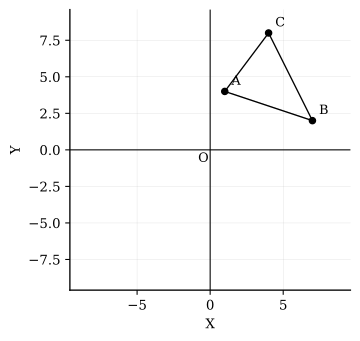
A city planner is designing a triangular park with vertices at A(1, 4), B(7, 2), and C(4, 8) on a coordinate grid where each unit represents 10 metres.

A city planner is designing a triangular park with vertices at A(1, 4), B(7, 2), and C(4, 8) on a coordinate grid where each unit represents 10 metres.

(i) Find the coordinates of the centroid G of the triangular park.

(ii) A water fountain is to be placed at the midpoint M of side BC. Find the coordinates of M.

(iii) The planner wants to verify that the median from vertex A passes through the centroid G. Show that A, G, and M are collinear.

OR

(iii) A walking path connects point A(1, 4) to point M (the midpoint of BC). Find the length of this median AM in metres (to the nearest metre).

Diagram for question 4: Coordinate Geometry
Show answer
(i) Finding the centroid G of triangle ABC:

The centroid of a triangle with vertices (x₁, y₁), (x₂, y₂), (x₃, y₃) is:

G = ( (x₁ + x₂ + x₃)/3 , (y₁ + y₂ + y₃)/3 )

Here A(1, 4), B(7, 2), C(4, 8).

⟹ G = ( (1 + 7 + 4)/3 , (4 + 2 + 8)/3 )

⟹ G = ( 12/3 , 14/3 )

∴ The coordinates of the centroid G are (4, 14/3). [1 mark]

──────────────────────────────────────

(ii) Finding the midpoint M of side BC:

By the Midpoint Formula, the midpoint of a segment joining (x₁, y₁) and (x₂, y₂) is ( (x₁+x₂)/2 , (y₁+y₂)/2 ).

B(7, 2) and C(4, 8).

⟹ M = ( (7 + 4)/2 , (2 + 8)/2 )

⟹ M = ( 11/2 , 10/2 )

∴ The coordinates of M are (11/2, 5). [1 mark]

──────────────────────────────────────

(iii) [MAIN OPTION] Showing that A, G, and M are collinear:

Three points are collinear if the area of the triangle formed by them is zero.

A(1, 4), G(4, 14/3), M(11/2, 5).

Area of △AGM = ½ |x_A(y_G − y_M) + x_G(y_M − y_A) + x_M(y_A − y_G)|

⟹ = ½ |1(14/3 − 5) + 4(5 − 4) + (11/2)(4 − 14/3)|

⟹ = ½ |1(14/3 − 15/3) + 4(1) + (11/2)(12/3 − 14/3)|

⟹ = ½ |1(−1/3) + 4 + (11/2)(−2/3)|

⟹ = ½ |−1/3 + 4 − 11/3|

⟹ = ½ |−1/3 − 11/3 + 4|

⟹ = ½ |−12/3 + 4|

⟹ = ½ |−4 + 4|

⟹ = ½ × 0

⟹ = 0

∵ Area of △AGM = 0, points A, G, and M are collinear.

Hence proved. The median from A passes through the centroid G. [2 marks]

──────────────────────────────────────

(iii) [OR OPTION] Finding the length of median AM in metres:

A(1, 4) and M(11/2, 5).

By the Distance Formula: d = √[(x₂ − x₁)² + (y₂ − y₁)²]

⟹ AM = √[(11/2 − 1)² + (5 − 4)²]

⟹ AM = √[(9/2)² + (1)²]

⟹ AM = √[81/4 + 1]

⟹ AM = √[81/4 + 4/4]

⟹ AM = √[85/4]

⟹ AM = √85 / 2

⟹ AM ≈ 9.22 / 2 ≈ 4.61 units

Since each unit = 10 metres:

∴ Length of median AM ≈ 4.61 × 10 ≈ 46 metres (to the nearest metre). [2 marks]
Q5Case-based4 marks

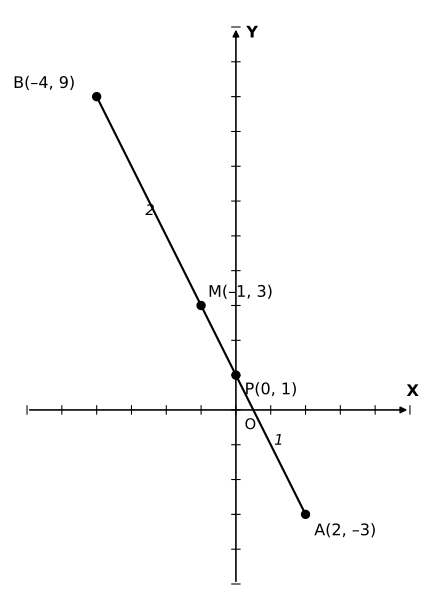
A city planner is designing a straight road connecting a Community Centre at A(2, –3) and a Library at B(–4, 9). A traffic signal post is placed at the midpoint M of AB, and a water pipe junction is placed at point P dividing AB in the ratio 1 : 2 from A.

A city planner is designing a straight road that connects a Community Centre located at point A(2, –3) and a Library located at point B(–4, 9). A traffic signal post is to be installed at the midpoint M of road AB. A water pipe junction is to be placed at point P, which divides road AB in the ratio 1 : 2 from A.

(i) Find the coordinates of M, the midpoint of AB. [1]
(ii) Find the coordinates of P, which divides AB in the ratio 1 : 2. [1]
(iii) Find the distance AB (the total length of the road). Also verify whether M, the midpoint, lies exactly halfway by computing AM. [2]

OR

(iii) The road AB, when extended, meets the x-axis at point Q. Find the coordinates of Q. [2]

Diagram for question 5: Coordinate Geometry
Show answer
(i) Coordinates of M (midpoint of AB):

Using the Midpoint Formula: M = ((x₁ + x₂)/2, (y₁ + y₂)/2)

⟹ M = ((2 + (–4))/2, ((–3) + 9)/2)

⟹ M = ((–2)/2, 6/2)

∴ M = (–1, 3)

(ii) Coordinates of P dividing AB in ratio 1 : 2:

Using the Section Formula: P = ((m·x₂ + n·x₁)/(m + n), (m·y₂ + n·y₁)/(m + n))

Here m = 1, n = 2, A(2, –3), B(–4, 9)

⟹ P = ((1·(–4) + 2·2)/(1 + 2), (1·9 + 2·(–3))/(1 + 2))

⟹ P = ((–4 + 4)/3, (9 – 6)/3)

⟹ P = (0/3, 3/3)

∴ P = (0, 1)

(iii) Distance AB and verification using AM:

Using the Distance Formula: d = √[(x₂ – x₁)² + (y₂ – y₁)²]

AB = √[(–4 – 2)² + (9 – (–3))²]

⟹ AB = √[(–6)² + (12)²]

⟹ AB = √[36 + 144]

⟹ AB = √180 = 6√5 units

Now, AM = √[(–1 – 2)² + (3 – (–3))²]

⟹ AM = √[(–3)² + (6)²]

⟹ AM = √[9 + 36]

⟹ AM = √45 = 3√5 units

∵ AM = 3√5 = (1/2) × 6√5 = (1/2) × AB

∴ AB = 6√5 units, and M lies exactly halfway along road AB, verifying M is the correct midpoint.

OR

(iii) Point Q where road AB meets the x-axis:

On the x-axis, y = 0. Let Q = (x, 0).

Using the Section Formula, Q divides AB such that its y-coordinate = 0.

Let Q divide AB in ratio k : 1.

Using Section Formula for y-coordinate:

y = (k·9 + 1·(–3))/(k + 1) = 0

⟹ 9k – 3 = 0

⟹ 9k = 3

⟹ k = 1/3

Now finding x-coordinate using same ratio k : 1 = 1/3 : 1 = 1 : 3:

x = (1·(–4) + 3·2)/(1 + 3)

⟹ x = (–4 + 6)/4

⟹ x = 2/4 = 1/2

∴ Q = (1/2, 0)
Q6Case-based4 marks

A city planner is designing a triangular park with vertices at A(1, 4), B(5, −2), and C(−3, 2). A water fountain is to be placed at the centroid G of the park. A lamp post is to be installed at point L, which divides the median from vertex A to the midpoint M of BC in the ratio 2 : 1 from A.

A city planner is designing a triangular park with vertices at A(1, 4), B(5, −2), and C(−3, 2). A water fountain is to be placed at the centroid G of the park. A lamp post is to be installed at point L, which divides the median from vertex A to the midpoint M of BC in the ratio 2 : 1 from A.

(i) Find the coordinates of M, the midpoint of BC.
(ii) Find the coordinates of the centroid G.
(iii) Find the coordinates of L, the point that divides AM in the ratio 2 : 1 from A. Hence verify that L and G are the same point.

OR

(iii) The planner now decides to place the lamp post at a point P on the x-axis such that PA = PB. Find the coordinates of P.

Show answer
(i) Finding coordinates of M, the midpoint of BC:

Using the Midpoint Formula, M = ((x₁ + x₂)/2, (y₁ + y₂)/2) with B(5, −2) and C(−3, 2):

M = ((5 + (−3))/2, (−2 + 2)/2)

⟹ M = (2/2, 0/2)

∴ M = (1, 0) [1 mark]

---

(ii) Finding the coordinates of the centroid G:

The centroid of a triangle with vertices (x₁, y₁), (x₂, y₂), (x₃, y₃) is:

G = ((x₁ + x₂ + x₃)/3, (y₁ + y₂ + y₃)/3)

With A(1, 4), B(5, −2), C(−3, 2):

G = ((1 + 5 + (−3))/3, (4 + (−2) + 2)/3)

⟹ G = (3/3, 4/3)

∴ G = (1, 4/3) [1 mark]

---

(iii) Finding coordinates of L, dividing AM in ratio 2 : 1 from A:

Using the Section Formula, a point dividing segment from (x₁, y₁) to (x₂, y₂) in ratio m : n is:

((mx₂ + nx₁)/(m + n), (my₂ + ny₁)/(m + n))

Here A(1, 4), M(1, 0), ratio m : n = 2 : 1:

L = ((2 × 1 + 1 × 1)/(2 + 1), (2 × 0 + 1 × 4)/(2 + 1))

⟹ L = ((2 + 1)/3, (0 + 4)/3)

⟹ L = (3/3, 4/3)

∴ L = (1, 4/3)

Since L = (1, 4/3) = G = (1, 4/3), the point L and the centroid G are the same point.

Hence proved. [2 marks]

---

OR

(iii) Finding coordinates of P on the x-axis such that PA = PB:

Let P = (x, 0), since P lies on the x-axis.

Using the Distance Formula, d = √[(x₂ − x₁)² + (y₂ − y₁)²]:

PA² = (x − 1)² + (0 − 4)² = (x − 1)² + 16

PB² = (x − 5)² + (0 − (−2))² = (x − 5)² + 4

According to the question, PA = PB:

⟹ PA² = PB²

⟹ (x − 1)² + 16 = (x − 5)² + 4

⟹ x² − 2x + 1 + 16 = x² − 10x + 25 + 4

⟹ x² − 2x + 17 = x² − 10x + 29

⟹ −2x + 10x = 29 − 17

⟹ 8x = 12

⟹ x = 12/8 = 3/2

∴ P = (3/2, 0) [2 marks]
Q7Case-based4 marks

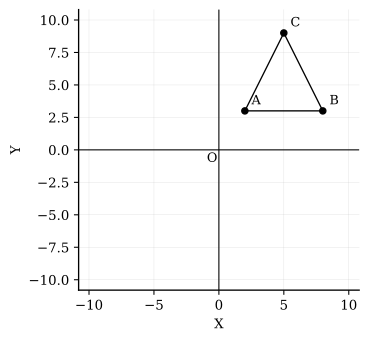
A city planner is designing a triangular park with three water fountains at A(2, 3), B(8, 3), and C(5, 9). A drinking-water kiosk is to be placed at the centroid G, and a path light at the midpoint M of BC.

A city planner is designing a triangular park with three water fountains placed at vertices A(2, 3), B(8, 3), and C(5, 9). She wants to install a drinking-water kiosk at the centroid G of the park, and a path light exactly at the midpoint M of side BC.

(i) Find the coordinates of the midpoint M of BC. [1]
(ii) Find the coordinates of the centroid G of triangle ABC. [1]
(iii) Find the length of the median from vertex A to the midpoint M of BC. Hence verify whether the centroid G divides this median in the ratio 2 : 1. [2]

Diagram for question 7: Coordinate Geometry
Show answer
(i) Using the midpoint formula, coordinates of M, the midpoint of BC where B(8, 3) and C(5, 9):

M = ( (8 + 5)/2 , (3 + 9)/2 )

⟹ M = ( 13/2 , 12/2 )

∴ M = (13/2, 6)

(ii) Using the centroid formula G = ( (x₁ + x₂ + x₃)/3 , (y₁ + y₂ + y₃)/3 ) for A(2, 3), B(8, 3), C(5, 9):

G = ( (2 + 8 + 5)/3 , (3 + 3 + 9)/3 )

⟹ G = ( 15/3 , 15/3 )

∴ G = (5, 5)

(iii) Length of median AM where A(2, 3) and M(13/2, 6):

Using the distance formula, AM = √[ (x₂ − x₁)² + (y₂ − y₁)² ]

⟹ AM = √[ (13/2 − 2)² + (6 − 3)² ]

⟹ AM = √[ (9/2)² + (3)² ]

⟹ AM = √[ 81/4 + 9 ]

⟹ AM = √[ 81/4 + 36/4 ]

⟹ AM = √(117/4)

∴ AM = (3√13)/2 units

Verification that G divides AM in the ratio 2 : 1:

Using the section formula, the point dividing A(2, 3) and M(13/2, 6) in the ratio 2 : 1 internally is:

x = (2 × 13/2 + 1 × 2) / (2 + 1) = (13 + 2) / 3 = 15/3 = 5

y = (2 × 6 + 1 × 3) / (2 + 1) = (12 + 3) / 3 = 15/3 = 5

⟹ The point is (5, 5), which is exactly G.

∴ The centroid G(5, 5) divides the median AM in the ratio 2 : 1. Hence verified.
Q8Case-based4 marks

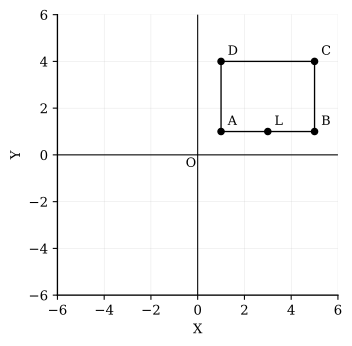
A city planner is designing a rectangular park on a coordinate grid. The four corners of the park are located at A(1, 1), B(5, 1), C(5, 4), and D(1, 4). A fountain is to be installed at the exact centre of the park, and a lamp post is to be placed at point L(3, 1) along the boundary.

A city planner is designing a rectangular park on a coordinate grid. The four corners of the park are located at A(1, 1), B(5, 1), C(5, 4), and D(1, 4). A fountain is to be installed at the exact centre of the park, and a lamp post is to be placed at point L(3, 1) along the boundary.

(i) Find the coordinates of the centre of the park where the fountain will be installed. [1 mark]
(ii) Find the distance of the lamp post L(3, 1) from the y-axis. [1 mark]
(iii) Find the distance between the fountain and the lamp post. [2 marks]

Diagram for question 8: Coordinate Geometry
Show answer
(i) The centre of a rectangle is the midpoint of either diagonal.

Using the midpoint formula for diagonal AC, where A(1, 1) and C(5, 4):

Centre = ((1 + 5)/2, (1 + 4)/2)

⟹ Centre = (6/2, 5/2)

∴ The coordinates of the fountain (centre of the park) are (3, 5/2).

(ii) The distance of any point from the y-axis equals the absolute value of its x-coordinate.

For lamp post L(3, 1), x-coordinate = 3.

∴ The distance of the lamp post from the y-axis is 3 units.

(iii) Fountain F = (3, 5/2) and lamp post L = (3, 1).

Using the distance formula:

FL = √[(x₂ − x₁)² + (y₂ − y₁)²]

⟹ FL = √[(3 − 3)² + (1 − 5/2)²]

⟹ FL = √[(0)² + (−3/2)²]

⟹ FL = √[0 + 9/4]

⟹ FL = √(9/4)

∴ The distance between the fountain and the lamp post is 3/2 units (i.e., 1.5 units).
Q9MCQ1 mark

PQRS is a rectangle with vertices P(1, 3), Q(7, 3), R(7, 11) and S(1, 11) taken in order. The length of its diagonal is:

Show answer
Option (A) is correct.

Explanation: Using the distance formula, diagonal PR = √[(7−1)² + (11−3)²] = √[36 + 64] = √100 = 10 units.
Q10MCQ1 mark

The distance of the point (5, −12) from the origin is:

Show answer
Option (A) is correct.

Explanation: Distance formula from origin: d = √(x² + y²) ⟹ d = √(5² + (−12)²) = √(25 + 144) = √169 = 13 units.
Q11MCQ1 mark

The shortest distance (in units) of the point (−3, −7) from the y-axis is:

Show answer
Option (B) is correct.

Explanation: The shortest distance of any point from the y-axis equals the absolute value of its x-coordinate. For the point (−3, −7), the x-coordinate is −3, so the shortest distance = |−3| = 3 units.
Q12MCQ1 mark

The distance of a point P from the y-axis is 5 units. Which of the following cannot be the coordinates of point P?

Show answer
Option (C) is correct.

Explanation: The distance of a point from the y-axis equals the absolute value of its x-coordinate. For the distance to be 5 units, |x| = 5, giving x = 5 or x = −5. For point (0, 5), |x| = 0 ≠ 5, so this point lies on the y-axis itself and cannot be 5 units from it. All other options — (5, 3), (−5, −2), (5, −7) — satisfy |x| = 5. ∴ (0, 5) cannot be the coordinates of point P.
Q13MCQ1 mark

The distance between the points P(−3, −2) and Q(4, 5) is:

Show answer
Option (A) is correct.

Explanation: By the distance formula, PQ = √[(4−(−3))² + (5−(−2))²] = √[7² + 7²] = √[49 + 49] = √98 = 7√2.
Q14MCQ1 mark

ABCD is a rectangle whose three vertices are A(0, 0), B(0, 7) and C(24, 7). The length of each diagonal of this rectangle is:

Show answer
Option (A) is correct.

Explanation: The fourth vertex is D(24, 0). In a rectangle, both diagonals are equal, so it suffices to find AC. Using the distance formula, AC = √[(24 − 0)² + (7 − 0)²] = √[576 + 49] = √625 = 25 units.
Q15MCQ1 mark

The distance of the point B(−5, 12) from the x-axis is:

Show answer
Option (C) is correct.

Explanation: The distance of any point from the x-axis equals the absolute value of its y-coordinate. For B(−5, 12), the y-coordinate is 12, so the required distance = |12| = 12 units.
Q16Short Answer1 mark

Assertion (A): The distance between the points (3, 4) and (0, 0) is 5.
Reason (R): The distance formula is √[(x₂-x₁)² + (y₂-y₁)²].

Show answer
Option (a) is correct.

Explanation: The distance formula between two points (x₁, y₁) and (x₂, y₂) is √[(x₂−x₁)²+(y₂−y₁)²]. Applying R to A: distance = √[(0−3)²+(0−4)²] = √[9+16] = √25 = 5. ∴ A is true, R is true, and R is the correct explanation of A.
Q17MCQ1 mark

PQRS is a rectangle with vertices P(0, 0), Q(5, 0), R(5, 12) and S(x, y). The length of each diagonal of this rectangle is:

Show answer
Option (A) is correct.

Explanation: The diagonals of a rectangle are equal in length. Using the distance formula, diagonal PR = √[(5−0)² + (12−0)²] = √[25 + 144] = √169 = 13 units. ∴ each diagonal of rectangle PQRS = 13 units.
Q18MCQ1 mark

The perimeter of a triangle with vertices A(0, 5), B(0, 0) and C(12, 0) is:

Show answer
Option (A) is correct.

Explanation: Using the distance formula d = √[(x₂−x₁)² + (y₂−y₁)²]:

AB = √[(0−0)² + (0−5)²] = √25 = 5 units; BC = √[(12−0)² + (0−0)²] = √144 = 12 units; CA = √[(0−12)² + (5−0)²] = √(144+25) = √169 = 13 units.

∴ Perimeter = 5 + 12 + 13 = 30 units.
Q19MCQ1 mark

The distance between the points (1 + √3, 2) and (1, 2 + √3) is:

Show answer
Option (A) is correct.

Explanation: By the distance formula, d = √[(x₂ − x₁)² + (y₂ − y₁)²]. Here x₂ − x₁ = 1 − (1 + √3) = −√3 and y₂ − y₁ = (2 + √3) − 2 = √3, so d = √[(−√3)² + (√3)²] = √[3 + 3] = √6 units.
Q20MCQ1 mark

If the distance between the points and is 9 units, then the values of are:

Show answer
Option (A) is correct.

Explanation: Using the distance formula, d = √[(x₂−x₁)² + (y₂−y₁)²]. Since both points have x-coordinate −2, the distance reduces to |y − 4| = 9. ⟹ y − 4 = 9 ⟹ y = 13, or y − 4 = −9 ⟹ y = −5. ∴ the values of y are 13 and −5.
Q21MCQ1 mark

The perimeter of a triangle with vertices P(0, 0), Q(5, 0) and R(0, 12) is:

Show answer
Option (B) is correct.

Explanation: Using the distance formula d = √[(x₂−x₁)² + (y₂−y₁)²], PQ = 5 units (along x-axis), PR = 12 units (along y-axis), and QR = √[(5−0)² + (0−12)²] = √[25+144] = √169 = 13 units. ∴ Perimeter = 5 + 12 + 13 = 30 units.
Q22MCQ1 mark

The distance between the points and is:

Show answer
Option (A) is correct.

Explanation: Using the distance formula d = √[(x₂ − x₁)² + (y₂ − y₁)²] with (3√2, 0) and (0, −3√2): d = √[(3√2 − 0)² + (0 − (−3√2))²] = √[(3√2)² + (3√2)²] = √[18 + 18] = √36 = 6.
Q23MCQ1 mark

The distance of the point (−9, 12) from the origin is:

Show answer
Option (A) is correct.

Explanation: Distance of a point (x, y) from the origin = √(x² + y²) ⟹ √((−9)² + 12²) = √(81 + 144) = √225 = 15 units.
Q24MCQ1 mark

The distance of the point (5, −12) from the origin is:

Show answer
Option (A) is correct.

Explanation: Distance of a point (x, y) from the origin = √(x² + y²) ⟹ √(5² + (−12)²) = √(25 + 144) = √169 = 13 units.
Q25MCQ1 mark

The distance between the points (sin 45°, cos 45°) and (−sin 45°, −cos 45°) is:

Show answer
Option (A) is correct.

Explanation: Using d = √[(x₂ − x₁)² + (y₂ − y₁)²] with sin 45° = cos 45° = 1/√2, the two points are (1/√2, 1/√2) and (−1/√2, −1/√2). ⟹ d = √[(1/√2 − (−1/√2))² + (1/√2 − (−1/√2))²] = √[(2/√2)² + (2/√2)²] = √[2 + 2] = √4 = 2.
Q26MCQ1 mark

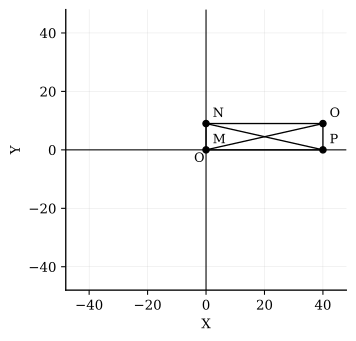
MNOP is a rectangle with vertices M(0, 0), N(0, 9), O(x, y) and P(40, 0). The length of each diagonal of this rectangle is:

Diagram for question 26: Coordinate Geometry
Show answer
Option (A) is correct.

Explanation: In rectangle MNOP, sides MN and MP are adjacent sides. MN = √[(0−0)² + (9−0)²] = 9 units and MP = √[(40−0)² + (0−0)²] = 40 units. By the distance formula, diagonal = √(MN² + MP²) = √(9² + 40²) = √(81 + 1600) = √1681 = 41 units.
Q27MCQ1 mark

The distance of the point (8, 6) from the origin is:

Show answer
Option (B) is correct.

Explanation: Distance of a point (x, y) from the origin = √(x² + y²) ⟹ √(8² + 6²) = √(64 + 36) = √100 = 10 units.
Q28MCQ1 mark

The point Q on the y-axis equidistant from the points A(0, −3) and B(0, 7) is:

Show answer
Option (A) is correct.

Explanation: Since Q lies on the y-axis, let Q = (0, y). Using the distance formula and setting QA = QB: √[(0−0)² + (y+3)²] = √[(0−0)² + (y−7)²] ⟹ (y+3)² = (y−7)² ⟹ y²+6y+9 = y²−14y+49 ⟹ 20y = 40 ⟹ y = 2. ∴ Q = (0, 2).
Q29MCQ1 mark

The distance between the points (2√3, 0) and (0, −2√3) is:

Show answer
Option (B) is correct.

Explanation: Using the distance formula d = √[(x₂ − x₁)² + (y₂ − y₁)²] with (x₁, y₁) = (2√3, 0) and (x₂, y₂) = (0, −2√3): d = √[(0 − 2√3)² + (−2√3 − 0)²] = √[12 + 12] = √24 = 2√6 units.
Q30MCQ1 mark

The distance of the point (4, −3) from the y-axis is:

Show answer
Option (A) is correct.

Explanation: The distance of any point (x, y) from the y-axis equals the absolute value of its x-coordinate, i.e., |x|. For the point (4, −3), the x-coordinate is 4, so the distance from the y-axis = |4| = 4 units.

Want unlimited practice on Coordinate Geometry?

The full ClearSteps bank has 118+ reviewed questions on this chapter alone — with step-wise solutions, difficulty levels, and progress tracking. Verify your WhatsApp number and your free trial starts right here.

CBSE · CLASS 10
🎟️14-day free trial · code PRAC auto-applied
Mobile Number
+91
OTP will be sent to your WhatsApp

⭐ Trusted by 12,000+ students across India

Coordinate Geometry — Class 10 Maths Practice Questions