ClearStepsCLEARSTEPS AI
Teacher Login →Student Login →

Heights and Distances: Class 10 Maths Practice Questions

22 original exam-pattern questions with full answers, matched to the current CBSE Class 10 paper design, including case-based questions. Attempt each question before opening the answer — or start a free 14-day trial ↓ for the full bank.

Q1Case-based4 marks

A lighthouse stands vertically on a cliff at the edge of the sea. An observer on a ship at sea level notes the angle of elevation of the top of the lighthouse as 60° and the angle of elevation of the base of the lighthouse (top of cliff) as 30°. The ship is 120 m from the base of the cliff horizontally.

A lighthouse stands vertically on a cliff at the edge of the sea. An observer on a ship at sea level observes that:
• The angle of elevation of the top of the lighthouse is 60°.
• The angle of elevation of the base of the lighthouse (i.e., the top of the cliff) is 30°.
The ship is 120 m away from the base of the cliff (measured horizontally along the sea).

(i) Find the height of the cliff. [1 mark]
(ii) Find the height of the lighthouse. [1 mark]
(iii) If the observer now moves 60 m closer to the cliff, find the new angle of elevation of the top of the lighthouse. [2 marks]
OR
(iii) A second observer stands at the top of the cliff and looks at the ship. Find the angle of depression of the ship as seen from the top of the cliff. Also verify that this equals the angle of elevation of the cliff top as seen from the ship. [2 marks]
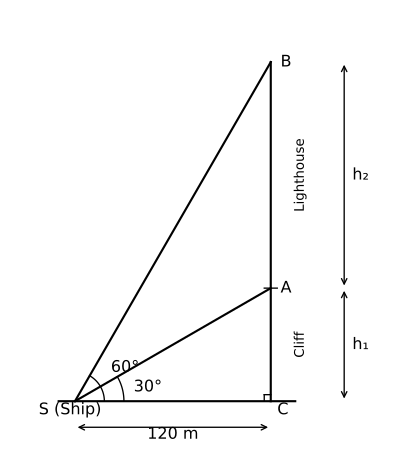
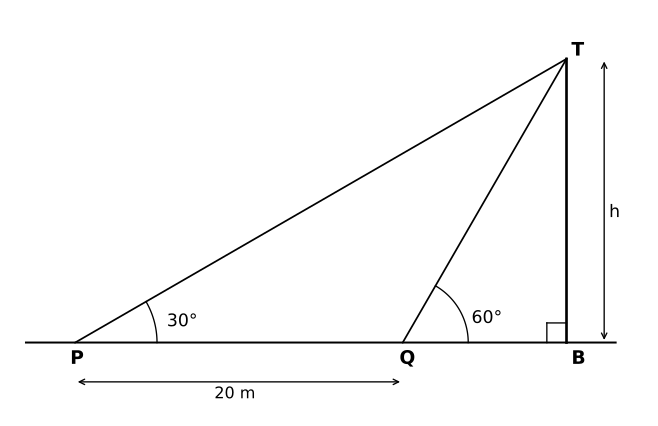
Diagram for question 1: Heights and Distances
Show answer
Let the height of the cliff = h₁ metres and the height of the lighthouse = h₂ metres.
Let the horizontal distance from the ship to the base of the cliff = 120 m.

[Diagram: Ship S at sea level; cliff base C directly above S's horizontal foot; cliff top A; lighthouse top B. Horizontal ground distance SC = 120 m. ∠ASC = 30° (elevation of cliff top A). ∠BSC = 60° (elevation of lighthouse top B). Vertical: CA = h₁, AB = h₂, total height CB = h₁ + h₂.]

━━━━━━━━━━━━━━━━━━━━━━━━━━━━━
Part (i): Height of the cliff [1 mark]
━━━━━━━━━━━━━━━━━━━━━━━━━━━━━

In right △SAC (right angle at C),

tan 30° = h₁ / 120

⟹ 1/√3 = h₁ / 120

⟹ h₁ = 120/√3 = 120√3/3

∴ Height of the cliff = 40√3 m

━━━━━━━━━━━━━━━━━━━━━━━━━━━━━
Part (ii): Height of the lighthouse [1 mark]
━━━━━━━━━━━━━━━━━━━━━━━━━━━━━

In right △SBC (right angle at C),

tan 60° = (h₁ + h₂) / 120

⟹ √3 = (40√3 + h₂) / 120

⟹ 120√3 = 40√3 + h₂

⟹ h₂ = 120√3 − 40√3

∴ Height of the lighthouse = 80√3 m

━━━━━━━━━━━━━━━━━━━━━━━━━━━━━
Part (iii) [MAIN]: New angle of elevation of top of lighthouse after moving 60 m closer [2 marks]
━━━━━━━━━━━━━━━━━━━━━━━━━━━━━

New horizontal distance = 120 − 60 = 60 m

Total height of (cliff + lighthouse) = h₁ + h₂ = 40√3 + 80√3 = 120√3 m

Let the new angle of elevation of the top of the lighthouse be θ.

In the new right triangle,

tan θ = (120√3) / 60

⟹ tan θ = 2√3

⟹ tan θ = 2 × 1.732 = 3.464 … (not a standard angle)

We express the answer in exact form:

∴ The new angle of elevation = tan⁻¹(2√3)

[Note for examiner: Since 2√3 ≈ 3.464, which corresponds to approximately 73.9°, the exact answer is expressed as tan⁻¹(2√3). Full marks are awarded for correct substitution and reaching tan θ = 2√3 with proper working.]

━━━━━━━━━━━━━━━━━━━━━━━━━━━━━
Part (iii) [OR]: Angle of depression from cliff top + verification [2 marks]
━━━━━━━━━━━━━━━━━━━━━━━━━━━━━

The second observer stands at the top of the cliff (point A) and looks at the ship (point S).

Height of cliff = h₁ = 40√3 m
Horizontal distance AS (base) = 120 m

Let the angle of depression of the ship from the cliff top = φ.

In right △SAC,
tan φ = h₁ / 120 (vertical drop / horizontal distance)

⟹ tan φ = 40√3 / 120

⟹ tan φ = √3 / 3 = 1/√3

⟹ φ = 30°

∴ The angle of depression of the ship from the top of the cliff = 30°.

Verification:
From part (i), the angle of elevation of the cliff top from the ship = 30°.

The angle of depression from A to S = angle of elevation from S to A, since AS is a transversal cutting two parallel horizontal lines (sea level and the horizontal at A), making alternate interior angles equal.

∴ Angle of depression (from cliff top) = Angle of elevation (from ship) = 30°. Hence verified.
Q2Case-based4 marks

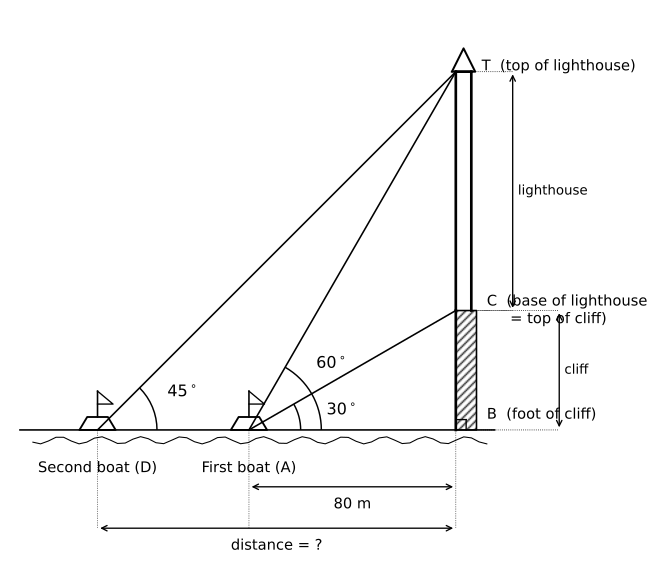
A lighthouse stands vertically on a sea cliff. The base of the lighthouse is at the top of the cliff. From a boat at sea, the angle of elevation of the top of the lighthouse is 60° and the angle of elevation of the base of the lighthouse (i.e., the top of the cliff) is 30°. The boat is 80 m away from the foot of the cliff (measured horizontally). (Use √3 = 1·73)

A lighthouse stands vertically on a sea cliff. The base of the lighthouse is at the top of the cliff. From a boat at sea, the angle of elevation of the top of the lighthouse is 60° and the angle of elevation of the base of the lighthouse (i.e., the top of the cliff) is 30°. The boat is 80 m away from the foot of the cliff (measured horizontally).

(i) Find the height of the cliff.
(ii) Find the height of the lighthouse.
(iii) A second boat is on the same side such that the angle of elevation of the top of the lighthouse from this boat is 45°. Find the distance of this second boat from the foot of the cliff. (Use √3 = 1·73)

Diagram for question 2: Heights and Distances
Show answer
Diagram:
Let C = foot of the cliff (sea level), A = top of the cliff / base of lighthouse, T = top of lighthouse, B = position of first boat.
BC = 80 m (horizontal distance), ∠TBC = 60°, ∠ABC = 30°.
Let AC = h (height of cliff), AT = l (height of lighthouse).

[Diagram: vertical line from C upward — first A, then T. Horizontal line CB = 80 m. Angle of elevation from B to A = 30°; angle of elevation from B to T = 60°.]

---

(i) Height of the cliff [1 mark]

In △ABC, ∠ACB = 90°, ∠ABC = 30°:

tan 30° = AC/BC

⟹ 1/√3 = h/80

⟹ h = 80/√3 = 80√3/3

⟹ h = (80 × 1·73)/3 = 138·4/3

∴ Height of the cliff = 46·13 m ≈ 46·1 m

---

(ii) Height of the lighthouse [1 mark]

In △TBC, ∠TCB = 90°, ∠TBC = 60°:

tan 60° = TC/BC

⟹ √3 = (h + l)/80

⟹ h + l = 80√3 = 80 × 1·73 = 138·4 m

Height of lighthouse = (h + l) − h = 138·4 − 46·13

∴ Height of the lighthouse = 92·27 m ≈ 92·3 m

---

(iii) Distance of the second boat from the foot of the cliff [2 marks]

Let B₂ = position of second boat, B₂C = d (required distance).

The total height of the top of the lighthouse above sea level = h + l = 80√3 m.

In △TB₂C, ∠TB₂C = 45°, ∠TCB₂ = 90°:

tan 45° = TC/B₂C

⟹ 1 = 80√3/d

⟹ d = 80√3

⟹ d = 80 × 1·73

∴ Distance of the second boat from the foot of the cliff = 138·4 m
Q3Case-based4 marks

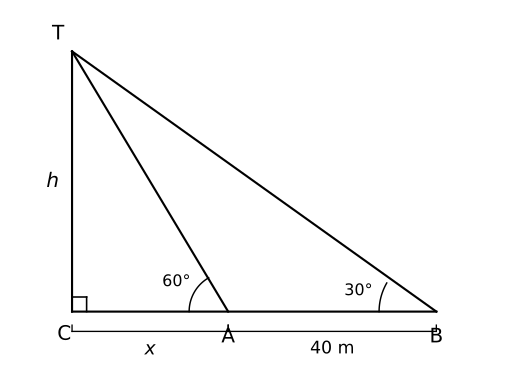
A mobile network tower stands vertically on flat ground. A technician standing on the ground observes the top of the tower from two points A and B on the same side of the tower, both in line with its base C. From point A, the angle of elevation of the top of the tower is 60°. Point B is 40 m farther from the tower than A, and the angle of elevation from B is 30°.

A mobile network tower stands vertically on a flat ground. A technician standing on the ground observes the top of the tower from two different points A and B, both on the same side of the tower and in line with its base C. From point A, the angle of elevation of the top of the tower is 60°, and from point B (which is 40 m farther from the tower than A), the angle of elevation is 30°.

Based on the above situation, answer the following questions:
(i) If the height of the tower is h metres and the distance AC = x metres, write the equation relating h and x using the angle of elevation from A. (1 mark)
(ii) Using the angle of elevation from B, write the equation relating h and x. (1 mark)
(iii) Find the height of the tower and the distance AC. (Use √3 = 1·732) (2 marks)

Diagram for question 3: Heights and Distances
Show answer
DIAGRAM (mandatory):

T
|
| h
|
C———A———B
x 40 m

(Tower TC of height h; AC = x; BC = x + 40; ∠TAC = 60°; ∠TBC = 30°)

─────────────────────────────────
(i) [1 mark]

In right △TCA, using the definition of tan:

tan 60° = TC/AC

⟹ √3 = h/x

∴ h = √3 x ...(i)

─────────────────────────────────
(ii) [1 mark]

In right △TCB, BC = (x + 40) m:

tan 30° = TC/BC

⟹ 1/√3 = h/(x + 40)

∴ h = (x + 40)/√3 ...(ii)

─────────────────────────────────
(iii) [2 marks]

From equations (i) and (ii):

√3 x = (x + 40)/√3

⟹ √3 × √3 × x = x + 40

⟹ 3x = x + 40

⟹ 3x − x = 40

⟹ 2x = 40

⟹ x = 20 m

Substituting x = 20 in equation (i):

h = √3 × 20 = 20√3

⟹ h = 20 × 1·732

⟹ h = 34·64 m

∴ The height of the tower is 34·64 m and the distance AC = 20 m.
Q4Case-based4 marks

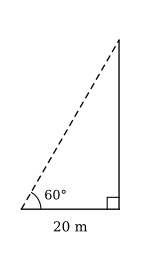
A school organises a nature walk in a park. Two students, Priya and Rahul, are standing on opposite sides of a tall flagpole on level ground. Priya stands 20 m from the base of the flagpole and observes the top at an angle of elevation of 60°. Rahul observes the top of the same flagpole at an angle of elevation of 30°.

A school organises a nature walk in a park. Two students, Priya and Rahul, are standing on opposite sides of a tall flagpole on level ground. They both observe the top of the flagpole. Priya stands 20 m from the base of the flagpole and observes the top at an angle of elevation of 60°. Rahul observes the top of the same flagpole at an angle of elevation of 30°.

Based on the above situation, answer the following questions:
(i) Find the height of the flagpole. [1]
(ii) Find the distance of Rahul from the base of the flagpole. [1]
(iii) Find the distance between Priya and Rahul. [2]

[Use √3 = 1.732]

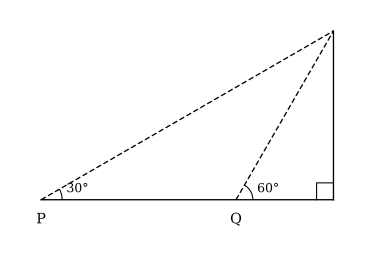
Diagram for question 4: Heights and Distances
Show answer
Diagram:

[Flagpole AB is vertical. A is the top, B is the base. Priya is at point P on the left of B with PB = 20 m and ∠APB = 60°. Rahul is at point R on the right of B with ∠ARB = 30°. All points P, B, R are on level ground.]

(i) Height of the flagpole:

Let the height of the flagpole AB = h metres.

In △ABP, using tan 60°:

tan 60° = AB/PB

⟹ √3 = h/20

⟹ h = 20√3

∴ Height of the flagpole = 20√3 m ≈ 34.64 m

(ii) Distance of Rahul from the base:

Let the distance of Rahul from the base, BR = d metres.

In △ABR, using tan 30°:

tan 30° = AB/BR

⟹ 1/√3 = 20√3/d

⟹ d = 20√3 × √3

⟹ d = 20 × 3 = 60

∴ Distance of Rahul from the base of the flagpole = 60 m

(iii) Distance between Priya and Rahul:

Since Priya and Rahul are on opposite sides of the flagpole,

Distance PR = PB + BR

⟹ PR = 20 + 60

⟹ PR = 80

∴ The distance between Priya and Rahul = 80 m
Q5Case-based4 marks

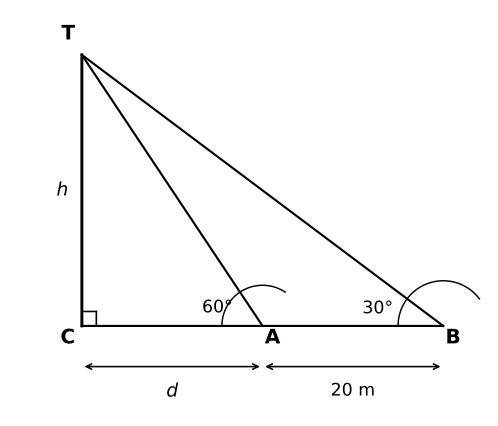
A student stands on one bank of a river and observes a tall tree on the opposite bank. From point A (on the river bank), the angle of elevation of the top of the tree is 60°. She walks 20 m away from the river to point B on the same straight line, where the angle of elevation of the top of the tree is 30°. Let h metres be the height of the tree and d metres be the width of the river (horizontal distance from A to the base of the tree).

A school organises a nature walk near a river. A student standing on one bank of the river observes a tall tree on the opposite bank. She notes the following:

(i) When she stands at point A on the bank, the angle of elevation of the top of the tree is 60°.
(ii) She then walks 20 m away from the river along the same straight line (to point B) and observes that the angle of elevation of the top of the tree is now 30°.

Using this information, answer the following:
(a) Find the height of the tree. [1]
(b) Find the width of the river (distance from point A to the base of the tree). [1]
(c) Find the distance AB and verify that it equals 20 m. [2]

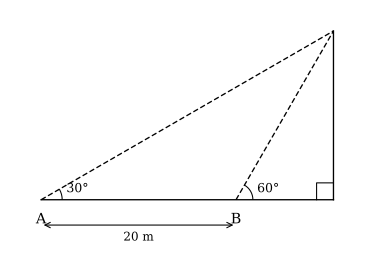
Diagram for question 5: Heights and Distances
Show answer
Let the height of the tree = h m and the width of the river = d m (distance from A to the base of the tree C).

Let T be the top of the tree and C be its base. Point A is on the river bank and point B is 20 m further from the river, so BC = d + 20 m.

[Diagram: Right triangle TCA with ∠TAC = 60°; right triangle TCB with ∠TBC = 30°; TC = h, AC = d, BC = d + 20]

From △TCA (right-angled at C):
tan 60° = TC/AC

⟹ √3 = h/d

⟹ h = √3 d ...(i)

From △TCB (right-angled at C):
tan 30° = TC/BC

⟹ 1/√3 = h/(d + 20) ...(ii)

━━━━━━━━━━━━━━━━━━━━━━━━
(a) Height of the tree:

Substituting (i) into (ii):

1/√3 = √3 d/(d + 20)

⟹ d + 20 = √3 × √3 d

⟹ d + 20 = 3d

⟹ 20 = 2d

⟹ d = 10 m

From (i): h = √3 × 10

∴ Height of the tree = 10√3 m

━━━━━━━━━━━━━━━━━━━━━━━━
(b) Width of the river:

From above, d = 10 m.

∴ Width of the river (distance from A to the base of the tree) = 10 m

━━━━━━━━━━━━━━━━━━━━━━━━
(c) Verification that AB = 20 m:

Distance AB = BC − AC = (d + 20) − d

⟹ AB = (10 + 20) − 10

⟹ AB = 30 − 10

∴ AB = 20 m

This equals the given distance of 20 m. Hence verified.
Q6Case-based4 marks

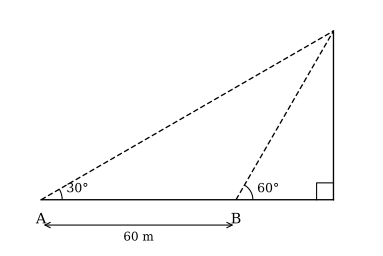
A lighthouse stands vertically on a sea cliff. A boat sails directly toward the cliff from position A to position B, covering 60 m. The angle of elevation of the top of the lighthouse from A is 30° and from B is 60°. The base of the lighthouse is at sea level.

A lighthouse stands vertically on a sea cliff. A boat is sailing directly toward the cliff. From the boat's current position A, the angle of elevation of the top of the lighthouse is 30°. After the boat sails 60 m closer to the cliff, it reaches position B, from where the angle of elevation of the top of the lighthouse is 60°. The base of the lighthouse is at the same level as the sea surface.

Based on the above situation, answer the following questions:
(i) Let the height of the lighthouse be h metres and the distance of position B from the base of the lighthouse be x metres. Write the two equations relating h and x using the given angles of elevation. (1 mark)
(ii) Find the distance x (i.e., distance of position B from the base of the lighthouse). (1 mark)
(iii) Find the height h of the lighthouse. (2 marks)
OR
(iii) Find the distance of position A from the base of the lighthouse, and verify that the boat travelled exactly 60 m between positions A and B. (2 marks)

Diagram for question 6: Heights and Distances
Show answer
DIAGRAM: Draw a vertical line representing the lighthouse of height h. Mark its base as O on the horizontal sea-surface line. Mark point B on the sea surface at distance x from O, and point A further away at distance (x + 60) from O. Draw lines from A and B to the top of the lighthouse T, making angles 30° and 60° with the horizontal respectively. Label all distances and angles.

(i)
In right △TOB, tan 60° = h/x
⟹ √3 = h/x
⟹ h = √3 x ...(i)

In right △TOA, tan 30° = h/(x + 60)
⟹ 1/√3 = h/(x + 60)
⟹ h = (x + 60)/√3 ...(ii)

∴ The two equations are: h = √3 x and h = (x + 60)/√3

(ii)
From equations (i) and (ii):
√3 x = (x + 60)/√3
⟹ √3 × √3 x = x + 60
⟹ 3x = x + 60
⟹ 2x = 60
∴ x = 30 m

∴ The distance of position B from the base of the lighthouse is 30 m.

(iii)
From equation (i): h = √3 x = √3 × 30
⟹ h = 30√3 m

Verification using equation (ii): h = (30 + 60)/√3 = 90/√3 = 90√3/3 = 30√3 ✓

∴ The height of the lighthouse is 30√3 m.

OR

(iii)
Distance of position A from the base of the lighthouse = x + 60 = 30 + 60 = 90 m.

Verification:
Distance AB = Distance of A from base − Distance of B from base
⟹ Distance AB = 90 − 30 = 60 m ✓

This confirms that the boat travelled exactly 60 m between positions A and B.

∴ The distance of position A from the base of the lighthouse is 90 m, and the boat did travel exactly 60 m.
Q7MCQ1 mark

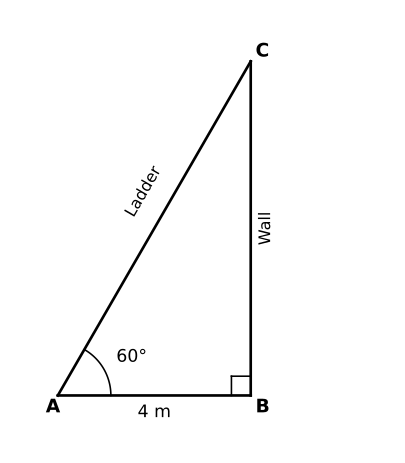
A ladder leans against a vertical wall such that its foot is 4 m away from the base of the wall. If the ladder makes an angle of 60° with the ground, what is the length of the ladder?

Diagram for question 7: Heights and Distances
Show answer
Option (B) is correct.

Explanation: The ladder, the wall, and the ground form a right triangle. The foot of the ladder is 4 m from the wall (base) and the ladder makes an angle of 60° with the ground.

Using cos θ = adjacent/hypotenuse:

cos 60° = 4 / length of ladder

⟹ 1/2 = 4 / length of ladder

∴ Length of ladder = 8 m.
Q8MCQ1 mark

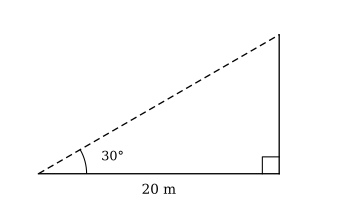
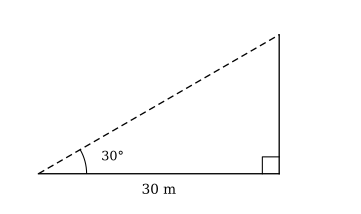
A tower stands vertically on the ground. From a point on the ground which is 20 m away from the foot of the tower, the angle of elevation of the top of the tower is 30°. The height of the tower is:

Diagram for question 8: Heights and Distances
Show answer
Option (C) is correct. Explanation: Let the height of the tower be h. By definition of tan, tan 30° = h/20 ⟹ 1/√3 = h/20 ⟹ h = 20/√3 m.
Q9MCQ1 mark

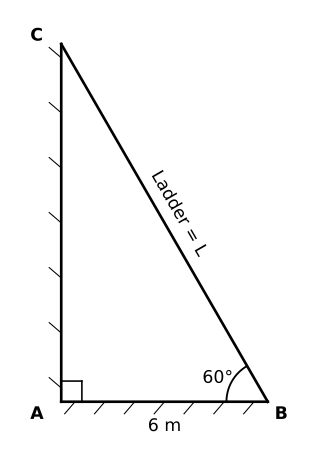
A ladder is leaning against a wall. The foot of the ladder is 6 m away from the base of the wall, and the ladder makes an angle of 60° with the ground. What is the length of the ladder?

Diagram for question 9: Heights and Distances
Show answer
Option (B) is correct. Explanation: In the right triangle formed by the ladder, the wall, and the ground, the foot of the ladder (adjacent side) = 6 m and the angle with the ground = 60°. Using cos 60° = adjacent/hypotenuse ⟹ 1/2 = 6/L ⟹ ∴ L = 12 m.
Q10MCQ1 mark

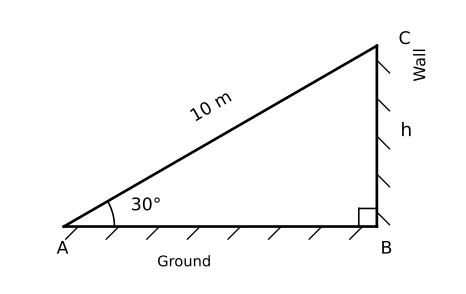
A ladder of length 10 m leans against a vertical wall. If the foot of the ladder makes an angle of 30° with the ground, what is the height reached by the ladder on the wall?

Diagram for question 10: Heights and Distances
Show answer
Option (A) is correct. Explanation: In the right triangle formed by the ladder, wall, and ground, the ladder is the hypotenuse (10 m) and the angle at the base is 30°. Using sin 30° = height/hypotenuse ⟹ h = 10 × sin 30° = 10 × ½ = 5 m. ∴ The height reached by the ladder on the wall is 5 m.
Q11MCQ1 mark

The angle of elevation of the top of a vertical tower from a point on the ground, 30 m away from the base of the tower, is 30°. The height of the tower is:

Diagram for question 11: Heights and Distances
Show answer
Option (A) is correct.
Explanation: Let AB be the tower of height h and C be the point on the ground such that BC = 30 m and ∠ACB = 30°.
In right △ABC, tan 30° = AB/BC ⟹ 1/√3 = h/30 ⟹ h = 30/√3 = 30√3/3 = 10√3 m.
∴ Height of the tower = 10√3 m.
Q12Short Answer3 marks

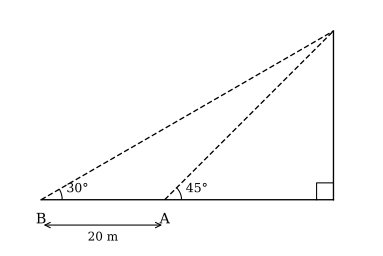
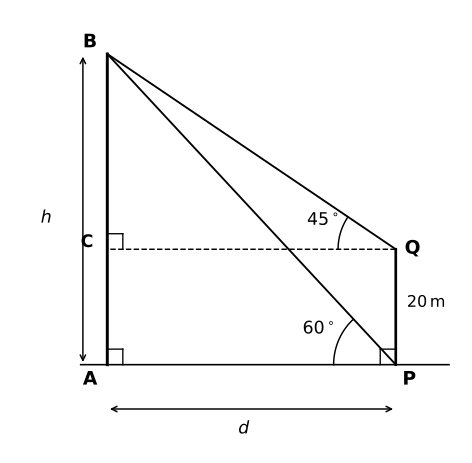
From the top of a vertical tower, the angles of depression of two points A and B on the horizontal ground are 45° and 30° respectively. The two points and the base of the tower are in the same straight line, and point A is closer to the tower. If AB = 20 m, find the height of the tower. (Use √3 = 1·73)

Diagram for question 12: Heights and Distances
Show answer
Diagram: [Vertical tower PQ; P = top, Q = base on ground; A and B on ground, B farther from tower; angles of depression from P to A and B are 45° and 30° respectively; AB = 20 m]

Let the height of the tower PQ = h m and QA = d m.

In △PAQ (angle of depression of A = 45°, so ∠PAQ = 45°):

tan 45° = PQ/QA

⟹ 1 = h/d

⟹ d = h …(i)

In △PBQ (angle of depression of B = 30°, so ∠PBQ = 30°):

tan 30° = PQ/QB

⟹ 1/√3 = h/(d + 20) [∵ QB = QA + AB = d + 20]

⟹ d + 20 = h√3 …(ii)

Substituting (i) in (ii):

⟹ h + 20 = h√3

⟹ h√3 − h = 20

⟹ h(√3 − 1) = 20

⟹ h = 20/(√3 − 1)

Rationalising:

⟹ h = 20(√3 + 1)/[(√3 − 1)(√3 + 1)]

⟹ h = 20(√3 + 1)/(3 − 1)

⟹ h = 20(√3 + 1)/2

⟹ h = 10(√3 + 1)

⟹ h = 10(1·73 + 1)

⟹ h = 10 × 2·73

∴ h = 27·3 m

∴ The height of the tower is 27·3 m.
Q13Short Answer3 marks

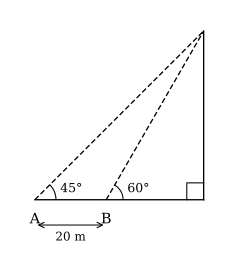
From a point P on the ground, the angle of elevation of the top of a tower is 45°. On walking 20 m towards the tower, the angle of elevation becomes 60°. Find the height of the tower.

Diagram for question 13: Heights and Distances
Show answer
Diagram:

Let AB be the tower of height h metres. Let Q be the point on the ground such that, from Q, the angle of elevation of A (top of tower) is 60°. P is a point 20 m further from Q (away from the tower), so PQ = 20 m, from which the angle of elevation is 45°.

Let BQ = x metres.

∴ PB = (x + 20) metres.

In △ABQ (angle of elevation = 60°):

tan 60° = AB/BQ

⟹ √3 = h/x

⟹ h = √3 x ...(i)

In △ABP (angle of elevation = 45°):

tan 45° = AB/PB

⟹ 1 = h/(x + 20)

⟹ h = x + 20 ...(ii)

From (i) and (ii):

√3 x = x + 20

⟹ √3 x − x = 20

⟹ x(√3 − 1) = 20

⟹ x = 20/(√3 − 1)

Rationalising:

⟹ x = 20(√3 + 1)/[(√3 − 1)(√3 + 1)]

⟹ x = 20(√3 + 1)/(3 − 1)

⟹ x = 20(√3 + 1)/2

⟹ x = 10(√3 + 1)

Substituting in (ii):

h = x + 20 = 10(√3 + 1) + 20

⟹ h = 10√3 + 10 + 20

⟹ h = 10√3 + 30

⟹ h = 10(√3 + 3)

∴ The height of the tower is 10(√3 + 3) m.
Q14Short Answer3 marks

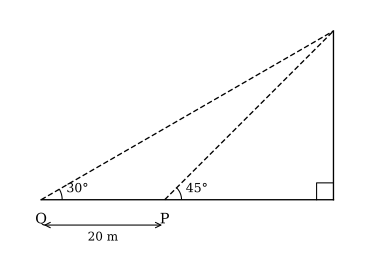
From the top of a vertical tower, the angles of depression of two points P and Q on the horizontal ground are 45° and 30° respectively. The two points P and Q are on the same side of the tower, and PQ = 20 m. Find the height of the tower.

Diagram for question 14: Heights and Distances
Show answer
Let AB be the vertical tower of height h metres, where B is the base of the tower on the ground. Let P and Q be the two points on the ground on the same side of the tower, with P being nearer to the tower.

Given: Angle of depression of P from the top = 45°, angle of depression of Q from the top = 30°, and PQ = 20 m.

Since alternate interior angles are equal (tower is vertical and ground is horizontal):
∠APB = 45° and ∠AQB = 30°

In right △ABP:
tan 45° = AB/BP
⟹ 1 = h/BP
⟹ BP = h …(i)

In right △ABQ:
tan 30° = AB/BQ
⟹ 1/√3 = h/BQ
⟹ BQ = h√3 …(ii)

Since P lies between B and Q on the ground:
BQ = BP + PQ
⟹ h√3 = h + 20 [using (i) and (ii)]
⟹ h√3 − h = 20
⟹ h(√3 − 1) = 20
⟹ h = 20/(√3 − 1)

Rationalising the denominator:
⟹ h = 20(√3 + 1)/[(√3 − 1)(√3 + 1)]
⟹ h = 20(√3 + 1)/(3 − 1)
⟹ h = 20(√3 + 1)/2
⟹ h = 10(√3 + 1)

∴ The height of the tower is 10(√3 + 1) m.
Q15Short Answer3 marks

From a point P on the ground, the angle of elevation of the top of a vertical tower is 30°. From a point Q, which is 20 m closer to the base of the tower along the same straight line, the angle of elevation of the top of the tower is 60°. Find the height of the tower and the distance PQ.

Diagram for question 15: Heights and Distances
Show answer
Diagram:
[Vertical tower AB; B is the base on ground. P and Q are points on the ground with Q between P and B. PQ = 20 m. Angle APB = 30°, angle AQB = 60°. AB = h (height). QB = d (distance of Q from base).]

Let AB = h m be the height of the tower and QB = d m.

Then PB = QB + PQ = (d + 20) m.

In △AQB, ∠AQB = 60°:

⟹ tan 60° = AB/QB

⟹ √3 = h/d

⟹ h = √3 d ...(i)

In △APB, ∠APB = 30°:

⟹ tan 30° = AB/PB

⟹ 1/√3 = h/(d + 20) ...(ii)

Substituting (i) in (ii):

⟹ 1/√3 = √3 d/(d + 20)

⟹ d + 20 = √3 × √3 d

⟹ d + 20 = 3d

⟹ 2d = 20

⟹ d = 10 m

Substituting d = 10 in (i):

⟹ h = √3 × 10 = 10√3 m

∴ The height of the tower is 10√3 m and the distance PQ = 20 m.
Q16Short Answer3 marks

From the top of a vertical tower, the angles of depression of two points P and Q on the horizontal ground are 30° and 60° respectively. The two points are on the same side of the tower and Q is closer to the tower. If the height of the tower is 90 m, find the distance PQ. (Use √3 = 1·73)

Diagram for question 16: Heights and Distances
Show answer
Let AB be the vertical tower where A is the base and B is the top.
Let P and Q be two points on the ground such that Q is closer to the tower.
Given: Height AB = 90 m, angle of depression of P = 30°, angle of depression of Q = 60°.

[Diagram: Tower AB with B at top. Points P and Q on ground, Q between A and P. Angles of depression from B to P and Q shown as 30° and 60° respectively.]

Let AP = x m and AQ = y m.

Since the angle of depression equals the angle of elevation (alternate interior angles, BP ∥ ground),
∠BPA = 30° and ∠BQA = 60°.

In △ABQ:
tan 60° = AB/AQ

⟹ √3 = 90/y

⟹ y = 90/√3 = 90√3/3 = 30√3 m ...(i)

In △ABP:
tan 30° = AB/AP

⟹ 1/√3 = 90/x

⟹ x = 90√3 m ...(ii)

Distance PQ = AP − AQ

⟹ PQ = x − y

⟹ PQ = 90√3 − 30√3

⟹ PQ = 60√3 m

⟹ PQ = 60 × 1·73

∴ PQ = 103·8 m
Q17Short Answer3 marks

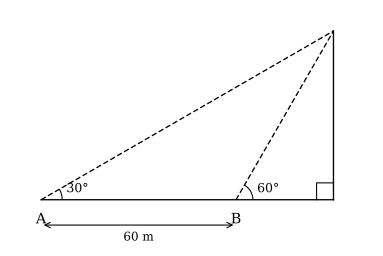
From a point P on the ground, the angle of elevation of the top of a vertical tower is 30°. On walking 20 m towards the base of the tower, the angle of elevation becomes 60°. Find the height of the tower and the original distance of point P from the base of the tower.

Diagram for question 17: Heights and Distances
Show answer
Diagram:
[Vertical tower AB of height h; P is original position on ground; Q is point after walking 20 m toward base; B is base of tower. ∠APB = 30°, ∠AQB = 60°. PQ = 20 m. QB = x m.]

Let the height of the tower AB = h m and the distance QB = x m.

∴ Distance PB = (x + 20) m.

In △AQB, using trigonometric ratio:

tan 60° = AB/QB

⟹ √3 = h/x

⟹ h = √3 x …(i)

In △APB, using trigonometric ratio:

tan 30° = AB/PB

⟹ 1/√3 = h/(x + 20) …(ii)

Substituting (i) in (ii):

⟹ 1/√3 = √3 x/(x + 20)

⟹ x + 20 = √3 · √3 x

⟹ x + 20 = 3x

⟹ 20 = 2x

⟹ x = 10 m

Substituting in (i):

⟹ h = √3 × 10 = 10√3 m

Original distance PB = x + 20 = 10 + 20 = 30 m

∴ The height of the tower is 10√3 m and the original distance of point P from the base of the tower is 30 m.
Q18Long Answer5 marks

From a point P on the ground, the angle of elevation of the top of a vertical tower AB is 60°. From a point Q, which is 20 m directly above P (on a vertical pole PQ), the angle of elevation of the top of the same tower AB is 45°. Find the height of the tower AB and the horizontal distance between the base of the pole and the base of the tower. (Use √3 = 1.732)

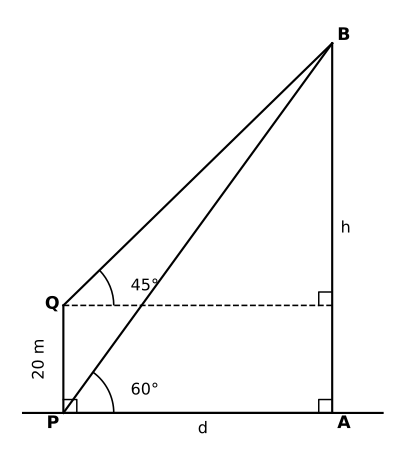
Diagram for question 18: Heights and Distances
Show answer
Diagram:

Let the base of the pole be at point P (ground level) and the base of the tower be at point A (ground level). The tower is AB, where B is the top. Q is a point 20 m directly above P on the vertical pole PQ. Let the horizontal distance PA = d metres and the height of the tower AB = h metres.

[Diagram: A right angle at A. Vertical tower AB of height h. Vertical pole PQ of height 20 m at P. Horizontal distance PA = d. Angle of elevation ∠BPA = 60° (from P to B). Angle of elevation ∠BQA' = 45° (from Q to B), where A' is the foot of the perpendicular from Q, i.e., QA' = d and the height difference = h − 20.]

Let the height of the tower AB = h metres and the horizontal distance between A and P = d metres.

In △APB (right-angled at A), using the angle of elevation from P:

tan 60° = AB/PA

⟹ √3 = h/d

⟹ h = √3 · d ...(i)

In △QRA where QR is horizontal from Q to a point R directly below B (i.e., QR = d, and the vertical difference = h − QP = h − 20):

From point Q, the angle of elevation to the top B of the tower is 45°. The horizontal distance from Q to the tower base is still d (since Q is directly above P), and the vertical height from Q to B = h − 20.

tan 45° = (h − 20)/d

⟹ 1 = (h − 20)/d

⟹ d = h − 20 ...(ii)

Substituting (ii) into (i):

h = √3 · (h − 20)

⟹ h = √3 h − 20√3

⟹ 20√3 = √3 h − h

⟹ 20√3 = h(√3 − 1)

⟹ h = 20√3 / (√3 − 1)

Rationalising the denominator:

⟹ h = 20√3 × (√3 + 1) / [(√3 − 1)(√3 + 1)]

⟹ h = 20√3 (√3 + 1) / (3 − 1)

⟹ h = 20√3 (√3 + 1) / 2

⟹ h = 10√3 (√3 + 1)

⟹ h = 10(3 + √3)

⟹ h = 30 + 10√3

⟹ h = 30 + 10 × 1.732

⟹ h = 30 + 17.32

⟹ h = 47.32 m

Finding d using (ii):

d = h − 20

⟹ d = 47.32 − 20

⟹ d = 27.32 m

∴ The height of the tower AB is 47.32 m and the horizontal distance between the base of the pole and the base of the tower is 27.32 m.
Q19Long Answer5 marks

From a point P on the ground, the angle of elevation of the top of a vertical tower AB is 60°. From another point Q, which is 20 m directly above P (i.e., Q is on a vertical pole of height 20 m erected at P), the angle of elevation of the top of the same tower is 45°. Find the height of the tower AB and the horizontal distance between the foot of the tower and point P.

Diagram for question 19: Heights and Distances
Show answer
Diagram:
[Vertical tower AB with foot A on ground. Point P on ground, horizontal distance AP = d. Point Q directly above P at height PQ = 20 m. From P: angle of elevation of B = 60°. From Q: angle of elevation of B = 45°. Horizontal distance from Q to A = d (same as PA, since Q is vertically above P).]

Let the height of the tower AB = h metres and the horizontal distance PA = d metres.

In right △APB (angle of elevation from P to top B = 60°):

tan 60° = AB/AP

⟹ √3 = h/d

⟹ h = √3 · d …(i)

In right △ formed at Q (angle of elevation from Q to top B = 45°):

The horizontal distance from Q to the foot A of the tower = d (since Q is vertically above P).

The vertical height from Q up to the top B = AB − PQ = h − 20 m.

tan 45° = (h − 20)/d

⟹ 1 = (h − 20)/d

⟹ d = h − 20 …(ii)

Solving equations (i) and (ii):

Substituting (ii) into (i):

h = √3 · (h − 20)

⟹ h = √3 h − 20√3

⟹ 20√3 = √3 h − h

⟹ 20√3 = h(√3 − 1)

⟹ h = 20√3 / (√3 − 1)

Rationalising the denominator by multiplying numerator and denominator by (√3 + 1):

⟹ h = 20√3 (√3 + 1) / [(√3 − 1)(√3 + 1)]

⟹ h = 20√3 (√3 + 1) / (3 − 1)

⟹ h = 20√3 (√3 + 1) / 2

⟹ h = 10√3 (√3 + 1)

⟹ h = 10(3 + √3)

⟹ h = 30 + 10√3

Finding d from (ii):

d = h − 20 = (30 + 10√3) − 20 = 10 + 10√3 = 10(1 + √3)

Height of the tower AB = (30 + 10√3) m = 10(3 + √3) m

Horizontal distance PA = 10(1 + √3) m
Q20Long Answer5 marks

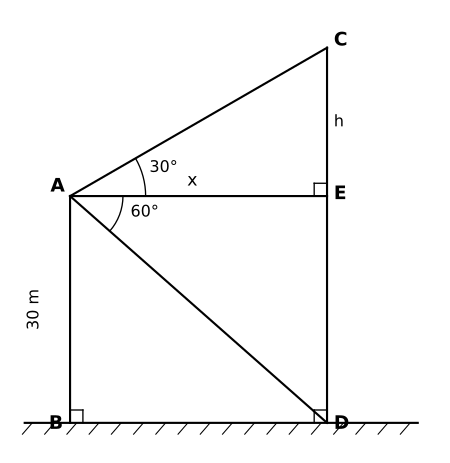
Two poles AB and CD are standing vertically on the same horizontal ground. From the top A of pole AB, the angle of depression of the foot D of pole CD is 60°, and the angle of elevation of the top C of pole CD is 30°. If the height of pole AB is 30 m, find: (i) the horizontal distance between the two poles, and (ii) the height of pole CD.

Diagram for question 20: Heights and Distances
Show answer
Diagram:

Let pole AB stand at point B on the ground with height AB = 30 m, and pole CD stand at point D on the ground with height CD = h m. Let BD = x m be the horizontal distance between the poles. Draw AE ∥ BD, so AE = BD = x and BE = AD = 30 m. Let CE = CD − ED = h − 30 m (assuming CD > AB; this will be verified).

[Diagram: Two vertical poles AB and CD on horizontal ground. A horizontal line AE drawn from A parallel to BD. Angle of depression of D from A = 60° (below AE). Angle of elevation of C from A = 30° (above AE). BD = x, AB = 30 m, CD = h m.]

Given:
Height of pole AB = 30 m
Angle of depression of foot D from top A = 60°
Angle of elevation of top C from top A = 30°

To Find:
(i) Horizontal distance BD = x
(ii) Height of pole CD = h

Solution:

Since AE ∥ BD, the angle of depression of D from A equals ∠DAE = 60° (alternate interior angles with the horizontal).

In △AED, ∠AED = 90°, ∠DAE = 60°, AE = x, ED = AB = 30 m:

tan 60° = ED/AE

⟹ √3 = 30/x

⟹ x = 30/√3

⟹ x = 30/√3 × √3/√3

⟹ x = 30√3/3

x = 10√3 m

In △AEC, ∠AEC = 90°, ∠CAE = 30°, AE = 10√3 m, CE = h − 30:

tan 30° = CE/AE

⟹ 1/√3 = (h − 30)/(10√3)

⟹ h − 30 = 10√3/√3

⟹ h − 30 = 10

⟹ h = 40

h = 40 m

Conclusion:

∴ (i) The horizontal distance between the two poles = 10√3 m.

∴ (ii) The height of pole CD = 40 m.
Q21Long Answer5 marks

From the top of a building 60 m high, the angles of depression of the top and the bottom of a vertical tower standing on the same horizontal ground are observed to be 30° and 60° respectively. Find (i) the horizontal distance between the building and the tower, and (ii) the height of the tower. (Use √3 = 1·73)

Diagram for question 21: Heights and Distances
Show answer
Diagram:

Let AB be the building of height 60 m and CD be the tower of height h m. Let BC = x m be the horizontal distance between them. Draw DE ⊥ AB, so AE = CD = h and BE = AB − AE = (60 − h) m.

[Diagram: A vertical segment AB (building, 60 m). A vertical segment CD (tower, height h) to the right of AB on the same ground level BC = x. A horizontal line from D meets AB at E, so DE ∥ BC and DE = x. Angle of depression from A to C = 60°; angle of depression from A to D = 30°. Right angles at B and C marked.]

---

Given:
Height of building AB = 60 m; angle of depression of top of tower (D) from A = 30°; angle of depression of bottom of tower (C) from A = 60°.

To find: (i) x = BC, (ii) h = CD.

---

Step 1 — Horizontal distance (using △ABC):

Since the angle of depression of C from A is 60°, by alternate interior angles (AC is a transversal between parallel horizontal lines), ∠CAB's corresponding angle in right △ABC gives:

tan 60° = AB/BC

⟹ √3 = 60/x

⟹ x = 60/√3

⟹ x = 60/√3 × √3/√3 = 60√3/3 = 20√3

⟹ x = 20 × 1·73

Horizontal distance BC = 34·6 m

---

Step 2 — Height of tower (using △AED):

Since DE ∥ BC, DE = BC = x = 20√3 m, and AE = AB − CD = (60 − h) m.

The angle of depression of D from A is 30°, so in right △AED:

tan 30° = AE/DE

⟹ 1/√3 = (60 − h)/(20√3)

⟹ 60 − h = 20√3/√3

⟹ 60 − h = 20

⟹ h = 60 − 20

Height of tower CD = 40 m

---

∴ (i) The horizontal distance between the building and the tower is 20√3 m ≈ 34·6 m, and (ii) the height of the tower is 40 m.
Q22Long Answer5 marks

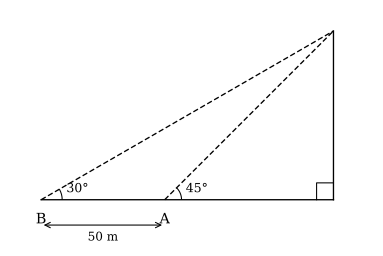
From the top of a vertical tower, the angles of depression of two points A and B on the horizontal ground are 45° and 30° respectively. The two points lie in the same vertical plane as the tower, with A closer to the base of the tower than B. If AB = 50 m, find the height of the tower and the distance of point A from the base of the tower. (Use √3 = 1.732)

Diagram for question 22: Heights and Distances
Show answer
Diagram:
Let PQ be the vertical tower of height h metres, where Q is the base on the ground.
Let A and B be two points on the ground such that A is closer to Q than B.
Angles of depression of A and B from P are 45° and 30° respectively.
Let QA = x metres. Then QB = QA + AB = (x + 50) metres.

[Diagram: Vertical tower PQ; horizontal line from P; angles of depression 45° to A and 30° to B; QA = x, AB = 50 m]

In △PQA:

tan 45° = PQ/QA

⟹ 1 = h/x

h = x …(i)

In △PQB:

tan 30° = PQ/QB

⟹ 1/√3 = h/(x + 50)

⟹ x + 50 = h√3 …(ii)

Substituting (i) into (ii):

h + 50 = h√3

⟹ 50 = h√3 − h

⟹ 50 = h(√3 − 1)

⟹ h = 50/(√3 − 1)

Rationalising the denominator:

h = 50(√3 + 1)/[(√3 − 1)(√3 + 1)]

⟹ h = 50(√3 + 1)/(3 − 1)

⟹ h = 50(√3 + 1)/2

⟹ h = 25(√3 + 1)

⟹ h = 25(1.732 + 1)

⟹ h = 25 × 2.732

h = 68.3 m

From (i): x = h = 68.3 m

∴ The height of the tower is 68.3 m and the distance of point A from the base of the tower is 68.3 m.

Want unlimited practice on Heights and Distances?

The full ClearSteps bank has 22+ reviewed questions on this chapter alone — with step-wise solutions, difficulty levels, and progress tracking. Verify your WhatsApp number and your free trial starts right here.

CBSE · CLASS 10
🎟️14-day free trial · code PRAC auto-applied
Mobile Number
+91
OTP will be sent to your WhatsApp

⭐ Trusted by 12,000+ students across India

Heights and Distances — Class 10 Maths Practice Questions