ClearStepsCLEARSTEPS AI
Teacher Login →Student Login →

Introduction to Trigonometry: Class 10 Maths Practice Questions

30 original exam-pattern questions with full answers, matched to the current CBSE Class 10 paper design, including case-based questions. Attempt each question before opening the answer — or start a free 14-day trial ↓ for the full bank.

Q1Case-based4 marks

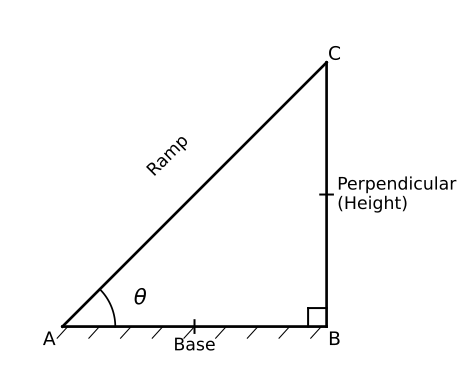
A civil engineer is designing a triangular support brace for a bridge. The brace forms a right angle at vertex B, with angle A = θ. During stress testing, the engineer uses trigonometric identities to verify consistency of structural calculations. Each sub-part below tests a different aspect of this verification.

A civil engineer is designing a triangular support brace for a bridge. The brace forms a right angle at vertex B, with angle A = θ. During stress testing, the engineer needs to verify an algebraic identity to ensure the structural calculations are consistent.

(i) If sin θ + cos θ = √2 cos θ, show that cos θ – sin θ = √2 sin θ. [1 mark]

(ii) If tan θ + sin θ = m and tan θ – sin θ = n, prove that m² – n² = 4√(mn). [2 marks]

(iii) Evaluate without using tables or a calculator:

2 tan² 45° + cos² 30° – sin² 60°
──────────────────────────────────────
tan² 60° – 2 sin² 30° – (3/4)

[1 mark]

Show answer
(i) Given: sin θ + cos θ = √2 cos θ

⟹ sin θ = √2 cos θ – cos θ

⟹ sin θ = (√2 – 1) cos θ

Multiplying both sides by (√2 + 1):

⟹ (√2 + 1) sin θ = (√2 + 1)(√2 – 1) cos θ

⟹ (√2 + 1) sin θ = (2 – 1) cos θ [∵ (a+b)(a–b) = a²–b²]

⟹ √2 sin θ + sin θ = cos θ

⟹ cos θ – sin θ = √2 sin θ

∴ Hence proved.

---

(ii) Given: tan θ + sin θ = m ...(i)
tan θ – sin θ = n ...(ii)

Step 1: Find m – n and m + n.

From (i) and (ii):
m + n = 2 tan θ ...(iii)
m – n = 2 sin θ ...(iv)

⟹ m² – n² = (m + n)(m – n) = (2 tan θ)(2 sin θ) = 4 tan θ sin θ ...(v)

Step 2: Find mn.

mn = (tan θ + sin θ)(tan θ – sin θ)

⟹ mn = tan²θ – sin²θ

⟹ mn = (sin²θ/cos²θ) – sin²θ

⟹ mn = sin²θ · (1/cos²θ – 1)

⟹ mn = sin²θ · (1 – cos²θ)/cos²θ

⟹ mn = sin²θ · sin²θ/cos²θ [∵ 1 – cos²θ = sin²θ]

⟹ mn = sin²θ · tan²θ

⟹ √(mn) = sin θ · tan θ ...(vi) [taking positive square root, θ is acute]

Step 3: Compare (v) and (vi).

4√(mn) = 4 sin θ tan θ

From (v): m² – n² = 4 tan θ sin θ = 4 sin θ tan θ

∴ m² – n² = 4√(mn). Hence proved.

---

(iii) Using the standard trigonometric ratio table:
tan 45° = 1, cos 30° = √3/2, sin 60° = √3/2, tan 60° = √3, sin 30° = 1/2

Numerator = 2 tan²45° + cos²30° – sin²60°

⟹ = 2(1)² + (√3/2)² – (√3/2)²

⟹ = 2 + 3/4 – 3/4

⟹ = 2

Denominator = tan²60° – 2 sin²30° – 3/4

⟹ = (√3)² – 2(1/2)² – 3/4

⟹ = 3 – 2(1/4) – 3/4

⟹ = 3 – 1/2 – 3/4

⟹ = 12/4 – 2/4 – 3/4

⟹ = 7/4

∴ Value = Numerator/Denominator = 2 ÷ (7/4) = 2 × (4/7) = 8/7
Q2Case-based4 marks

A mobile phone tower stands vertically on level ground. A network engineer uses trigonometric ratios at angle θ = 60° for signal analysis. She records: sin 60° = √3/2, cos 60° = 1/2, tan 60° = √3.

A mobile phone tower stands vertically on level ground. A network engineer is checking signal coverage at two points A and B on the ground. She uses a clinometer and notes that from point A, the angle of elevation to the top of the tower is 60°. She also measures that tan 60° = √3. She then records the following trigonometric data in her field notebook:

• sin 60° = √3/2
• cos 60° = 1/2
• tan 60° = √3

Using θ = 60° as the angle made by the signal beam with the horizontal, answer the following questions:

(i) Find the value of sin²60° + cos²60°. [1 mark]

(ii) Find the value of (1 + tan²60°). What trigonometric identity does this equal? [1 mark]

(iii) The engineer uses the expression E = (sin 60° + cos 60°)² to measure signal efficiency. Find the value of E.
[2 marks]

OR

(iii) The engineer uses the ratio R = (2tan 60°) / (1 − tan²60°) in her formula. Find the value of R. [2 marks]

Show answer
(i) Find the value of sin²60° + cos²60°.

sin²60° + cos²60°

⟹ (√3/2)² + (1/2)²

⟹ 3/4 + 1/4

∴ sin²60° + cos²60° = 1

(ii) Find the value of (1 + tan²60°).

1 + tan²60°

⟹ 1 + (√3)²

⟹ 1 + 3

∴ 1 + tan²60° = 4

By the trigonometric identity 1 + tan²θ = sec²θ, this equals sec²60°.

Verification: sec 60° = 1/cos 60° = 1/(1/2) = 2, so sec²60° = 4. ✓

(iii) [Main Option]
Find E = (sin 60° + cos 60°)².

Using the identity (a + b)² = a² + 2ab + b²:

E = (sin 60° + cos 60°)²

⟹ sin²60° + 2·sin 60°·cos 60° + cos²60°

⟹ (sin²60° + cos²60°) + 2·sin 60°·cos 60°

⟹ 1 + 2·(√3/2)·(1/2) [∵ sin²θ + cos²θ = 1]

⟹ 1 + 2·(√3/4)

⟹ 1 + √3/2

∴ E = (2 + √3)/2

[OR Option]
Find R = (2 tan 60°) / (1 − tan²60°).

R = (2 tan 60°) / (1 − tan²60°)

⟹ (2 × √3) / (1 − (√3)²)

⟹ 2√3 / (1 − 3)

⟹ 2√3 / (−2)

∴ R = −√3
Q3Case-based4 marks

A junior engineer is designing a wheelchair-access ramp at a community centre. The ramp makes an acute angle θ with the ground such that the horizontal distance (base) equals the vertical height (perpendicular) of the right triangle formed by the ramp.

A junior engineer is designing a ramp for wheelchair access at a community centre. The ramp makes an acute angle θ with the ground. During a site inspection, the engineer measures and confirms that the horizontal distance covered by the ramp equals the vertical height gained — that is, the base and the perpendicular of the right triangle formed are equal.

Based on the above situation, answer the following questions:

(i) Find the value of angle θ. [1 mark]

(ii) Using the value of θ found in part (i), find the value of sin θ + cos θ. [1 mark]

(iii) The engineer also needs to verify the load-bearing formula used in the design, which requires evaluating the following expression:

(sin²θ + cos²θ) + (tan θ × cot θ) + (2 sin θ × cosec θ)

Using the value of θ found in part (i), evaluate the above expression. [2 marks]

OR

(iii) The engineer uses a second formula involving the expression:

tan²θ + cot²θ – 2 tan θ · cot θ

Using the value of θ found in part (i), evaluate this expression and state what algebraic identity it illustrates. [2 marks]

Diagram for question 3: Introduction to Trigonometry
Show answer
(i) Finding the value of θ:

Since base = perpendicular,

⟹ tan θ = perpendicular/base = 1

⟹ tan θ = 1

∴ θ = 45°

---

(ii) Finding sin θ + cos θ:

Using θ = 45°,

sin 45° = 1/√2, cos 45° = 1/√2

⟹ sin 45° + cos 45° = 1/√2 + 1/√2 = 2/√2

∴ sin θ + cos θ = √2

---

(iii) [Main Option] Evaluating (sin²θ + cos²θ) + (tan θ × cot θ) + (2 sin θ × cosec θ):

Using the trigonometric identity sin²θ + cos²θ = 1 (stated first):

sin²45° + cos²45° = 1 ...(i)

Using tan θ × cot θ = tan θ × (1/tan θ) = 1:

tan 45° × cot 45° = 1 ...(ii)

Using sin θ × cosec θ = sin θ × (1/sin θ) = 1:

2 sin 45° × cosec 45° = 2 × 1 = 2 ...(iii)

Adding (i), (ii), (iii):

⟹ Expression = 1 + 1 + 2 = 4

∴ The value of the expression is 4.

---

(iii) [OR Option] Evaluating tan²θ + cot²θ – 2 tan θ · cot θ:

Using θ = 45°:

tan 45° = 1, cot 45° = 1

⟹ tan²45° + cot²45° – 2 tan 45° · cot 45°

⟹ (1)² + (1)² – 2 × 1 × 1

⟹ 1 + 1 – 2

⟹ 0

Observe: tan²45° + cot²45° – 2 tan 45° · cot 45° = (tan 45° – cot 45°)² = (1 – 1)² = 0

∴ The value of the expression is 0, and it illustrates the algebraic identity (a – b)² = a² – 2ab + b² with a = tan θ and b = cot θ.
Q4Case-based4 marks

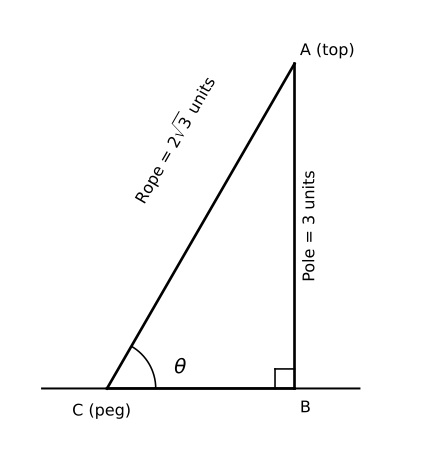
A school is organising a Sports Day on a rectangular ground. The physical education teacher sets up an inclined rope climb at one corner of the ground. The rope is tied from the top of a vertical pole to a peg fixed on the ground. The angle the rope makes with the ground is θ. The teacher records the following measurements:

• Height of the pole (opposite side) = 3 units
• Length of the rope (hypotenuse) = 2√3 units

A school is organising a Sports Day on a rectangular ground. The physical education teacher sets up an inclined rope climb at one corner of the ground. The rope is tied from the top of a vertical pole to a peg fixed on the ground. The angle the rope makes with the ground is θ. The teacher records the following measurements:

• Height of the pole (opposite side) = 3 units
• Length of the rope (hypotenuse) = 2√3 units

Using this information, answer the following questions:

(i) Find the value of sin θ. [1 mark]
(ii) Find the value of cos θ and tan θ. [1 mark]
(iii) The teacher wants to verify the identity: sin²θ + cos²θ = 1 using the values found above. Show the verification clearly. Also find the value of (tan²θ + 1). [2 marks]

Diagram for question 4: Introduction to Trigonometry
Show answer
(i) Finding sin θ:

By definition of sine ratio,

sin θ = Opposite side / Hypotenuse

⟹ sin θ = 3 / 2√3

⟹ sin θ = 3 / 2√3 × √3/√3 = 3√3 / 6

∴ sin θ = √3 / 2

(ii) Finding the adjacent side (base) using Pythagoras' Theorem:

Hypotenuse² = Opposite² + Adjacent²

⟹ (2√3)² = 3² + Adjacent²

⟹ 12 = 9 + Adjacent²

⟹ Adjacent² = 3

⟹ Adjacent = √3 units

By definition of cosine and tangent ratios,

cos θ = Adjacent / Hypotenuse = √3 / 2√3 = 1/2

tan θ = Opposite / Adjacent = 3 / √3 = √3

∴ cos θ = 1/2 and tan θ = √3

(iii) Verification of sin²θ + cos²θ = 1:

LHS = sin²θ + cos²θ

⟹ = (√3/2)² + (1/2)²

⟹ = 3/4 + 1/4

⟹ = 4/4

⟹ = 1 = RHS

∴ sin²θ + cos²θ = 1 is verified.

Finding (tan²θ + 1):

Using the identity 1 + tan²θ = sec²θ,

tan²θ + 1 = (√3)² + 1 = 3 + 1 = 4

Alternatively, sec θ = 1/cos θ = 1/(1/2) = 2 ⟹ sec²θ = 4

∴ tan²θ + 1 = 4
Q5Case-based4 marks

A civil engineer is designing a wheelchair ramp for a new community centre. The ramp must satisfy two accessibility conditions:

• Condition 1: The angle of inclination θ of the ramp satisfies 3 sin θ − cos θ = 0
• Condition 2: The engineer must verify that E = (sin θ + cos θ)² + (sin θ − cos θ)² is a constant.

A civil engineer is designing a wheelchair ramp for a new community centre. The ramp must satisfy two accessibility conditions:

• Condition 1: The angle of inclination θ of the ramp satisfies the relation: 3 sin θ − cos θ = 0
• Condition 2: The engineer must verify that the expression E = (sin θ + cos θ)² + (sin θ − cos θ)² equals a constant, regardless of θ, to confirm the ramp design is structurally consistent.

Based on the above information, answer the following:

(i) Find the value of tan θ from Condition 1. [1 mark]
(ii) Hence, find the exact value of (3 sin²θ − 2 cos²θ). [1 mark]
(iii) Evaluate the expression E = (sin θ + cos θ)² + (sin θ − cos θ)² and state the constant value it equals. Also verify that this value is independent of θ. [2 marks]

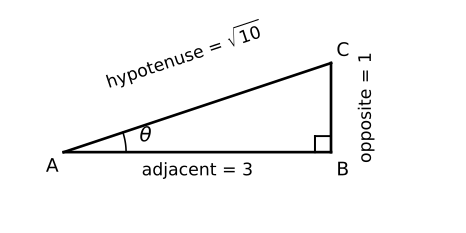
Diagram for question 5: Introduction to Trigonometry
Show answer
(i) From Condition 1:

3 sin θ − cos θ = 0

⟹ 3 sin θ = cos θ

⟹ sin θ / cos θ = 1/3

∴ tan θ = 1/3

(ii) Since tan θ = 1/3, draw a right triangle with opposite side = 1, adjacent side = 3.

Using the Pythagorean theorem:
Hypotenuse = √(1² + 3²) = √10

⟹ sin θ = 1/√10, cos θ = 3/√10

Now evaluate 3 sin²θ − 2 cos²θ:

= 3 × (1/√10)² − 2 × (3/√10)²

= 3 × (1/10) − 2 × (9/10)

= 3/10 − 18/10

= −15/10

∴ 3 sin²θ − 2 cos²θ = −3/2

(iii) Expanding E using the identity (a + b)² + (a − b)² = 2a² + 2b²:

E = (sin θ + cos θ)² + (sin θ − cos θ)²

= 2 sin²θ + 2 cos²θ

Using the fundamental identity sin²θ + cos²θ = 1:

= 2(sin²θ + cos²θ)

= 2 × 1

∴ E = 2

Verification: Since E = 2(sin²θ + cos²θ) = 2 × 1 = 2, this result holds for ALL values of θ and does not depend on the specific value of θ. Hence the expression E is a constant equal to 2, confirming structural consistency of the ramp design. Hence proved.
Q6Case-based4 marks

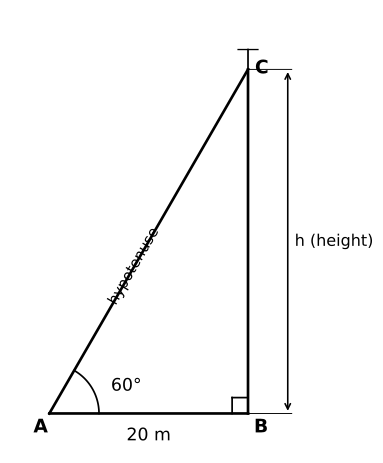
A mobile tower stands vertically on flat ground. A safety engineer visits the site and records the following: the angle of elevation of the top of the tower from a point on the ground is 60°, and the horizontal distance from that point to the base of the tower is 20 m. Known values: sin 60° = √3/2, cos 60° = 1/2, tan 60° = √3.

A mobile tower stands vertically on flat ground. A safety engineer visits the site and records the following information on her checklist:

• The angle of elevation of the top of the tower from a point on the ground is 60°.
• The horizontal distance from that point to the base of the tower is 20 m.
• The engineer also notes that sin 60° = √3/2, cos 60° = 1/2, tan 60° = √3.

Based on this information, answer the following questions:

(i) Using the trigonometric ratio that directly relates the opposite side (height of tower) and the adjacent side (horizontal distance), write the expression for the height of the tower. [1]

(ii) Calculate the height of the tower. [1]

(iii) The engineer wants to find the straight-line distance from the observation point to the top of the tower (i.e., the hypotenuse). Using the appropriate trigonometric ratio, calculate this distance.

OR

If the engineer moves 20 m closer to the base (so the new horizontal distance is also 20 m from the new point, making the total original distance 40 m from the base), and the angle of elevation from this new point becomes 60°, verify whether the height obtained from the new point is consistent with the original height calculated in part (ii). [2]

Diagram for question 6: Introduction to Trigonometry
Show answer
Part (i) [1 mark]

The trigonometric ratio that relates the opposite side (height, h) and the adjacent side (horizontal distance, d) is the tangent ratio.

∴ tan 60° = height of tower / horizontal distance = h / 20

⟹ The required expression is: h = 20 × tan 60°

Part (ii) [1 mark]

Using the expression from part (i):

h = 20 × tan 60°

⟹ h = 20 × √3

∴ The height of the tower is 20√3 m.

Part (iii) [2 marks] — MAIN OPTION

Let the straight-line distance from the observation point to the top of the tower be d (the hypotenuse).

The trigonometric ratio relating the opposite side (height = 20√3 m) and the hypotenuse is the sine ratio.

sin 60° = height / hypotenuse

⟹ √3/2 = 20√3 / d

⟹ d = 20√3 / (√3/2)

⟹ d = 20√3 × (2/√3)

⟹ d = 20 × 2

∴ The straight-line distance from the observation point to the top of the tower is 40 m.

— OR —

Part (iii) [2 marks] — OR OPTION

The engineer moves 20 m closer to the base, so the new horizontal distance from the base = 20 m.

Height of tower from the new observation point:

tan 60° = h' / 20

⟹ h' = 20 × tan 60°

⟹ h' = 20 × √3

⟹ h' = 20√3 m

Height calculated in part (ii) = 20√3 m.

Since h' = 20√3 m = height from part (ii),

∴ The height obtained from the new point is consistent with the original height. The tower has a unique fixed height of 20√3 m, confirming that the trigonometric calculation is correct regardless of which observation point is used, as long as the angle and corresponding distance are applied correctly. Hence verified.
Q7Case-based4 marks

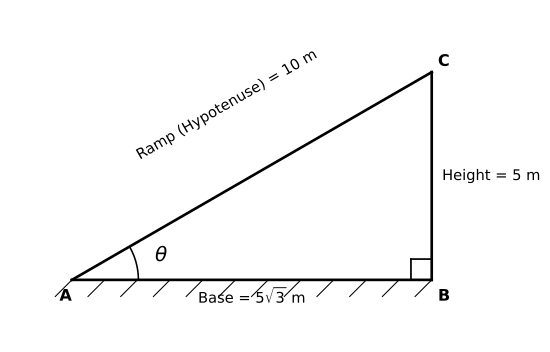
A group of Class 10 students is designing a ramp for a school science project. The ramp is modelled as a right triangle. The angle of inclination of the ramp with the ground is θ. The students record the following measurements: Length of the ramp (hypotenuse) = 10 m, Height of the ramp (perpendicular) = 5 m, Base of the ramp = 5√3 m.

A group of Class 10 students is designing a ramp for a school science project. The ramp is modelled as a right triangle. The angle of inclination of the ramp with the ground is θ. The students record the following measurements:
• Length of the ramp (hypotenuse) = 10 m
• Height of the ramp (perpendicular) = 5 m
• Base of the ramp = 5√3 m

Based on this information, answer the following questions:

(i) What is the value of sin θ? [1 mark]
(ii) What is the value of cos θ? [1 mark]
(iii) Show that sin²θ + cos²θ = 1 using the values found above. Also find the value of tan²θ − sec²θ. [2 marks]

Diagram for question 7: Introduction to Trigonometry
Show answer
(i) Finding sin θ:

sin θ = Perpendicular / Hypotenuse

⟹ sin θ = 5/10

∴ sin θ = 1/2

(ii) Finding cos θ:

cos θ = Base / Hypotenuse

⟹ cos θ = 5√3/10

∴ cos θ = √3/2

(iii) Part A — Showing sin²θ + cos²θ = 1:

Using sin θ = 1/2 and cos θ = √3/2 found above,

LHS = sin²θ + cos²θ

⟹ LHS = (1/2)² + (√3/2)²

⟹ LHS = 1/4 + 3/4

⟹ LHS = 4/4

⟹ LHS = 1 = RHS

Hence proved.

Part B — Finding tan²θ − sec²θ:

Using the identity: 1 + tan²θ = sec²θ

⟹ tan²θ − sec²θ = −1

∴ tan²θ − sec²θ = −1
Q8Case-based4 marks

A civil engineer is designing a ramp for a warehouse loading dock. The ramp makes an angle θ with the horizontal ground such that sin θ = 5/13.

A civil engineer is designing a ramp for a warehouse loading dock. The ramp makes an angle θ with the horizontal ground such that sin θ = 5/13.

(i) Find the value of cos θ and tan θ. [1]
(ii) Find the value of (sec²θ − 1)(cosec²θ − 1). [1]
(iii) The engineer needs to verify the following identity to ensure structural calculations are consistent:

(sin θ + cos θ)² + (sin θ − cos θ)² = 2

Prove this identity holds true for ALL values of θ. [2]

OR

(iii) The engineer uses the expression:

E = (1 + tan²θ) · cos²θ + (1 + cot²θ) · sin²θ

Using the value sin θ = 5/13, evaluate E and verify it equals 2. [2]

Show answer
(i) sin θ = 5/13

Using the identity sin²θ + cos²θ = 1:

⟹ cos²θ = 1 − sin²θ = 1 − (5/13)² = 1 − 25/169 = 144/169

⟹ cos θ = 12/13

⟹ tan θ = sin θ / cos θ = (5/13) / (12/13) = 5/12

∴ cos θ = 12/13 and tan θ = 5/12

---

(ii) Using the identities: sec²θ − 1 = tan²θ and cosec²θ − 1 = cot²θ

⟹ (sec²θ − 1)(cosec²θ − 1) = tan²θ · cot²θ

⟹ = tan²θ · (1/tan²θ)

⟹ = 1

∴ (sec²θ − 1)(cosec²θ − 1) = 1

---

(iii) [MAIN]

LHS = (sin θ + cos θ)² + (sin θ − cos θ)²

Using the identities (a + b)² = a² + 2ab + b² and (a − b)² = a² − 2ab + b²:

⟹ = (sin²θ + 2 sin θ cos θ + cos²θ) + (sin²θ − 2 sin θ cos θ + cos²θ)

⟹ = sin²θ + cos²θ + 2 sin θ cos θ + sin²θ + cos²θ − 2 sin θ cos θ

⟹ = (sin²θ + cos²θ) + (sin²θ + cos²θ)

⟹ = 1 + 1 [∵ sin²θ + cos²θ = 1]

⟹ = 2

= RHS. Hence proved.

---

(iii) [OR]

sin θ = 5/13, cos θ = 12/13, tan θ = 5/12, cot θ = 12/5

E = (1 + tan²θ) · cos²θ + (1 + cot²θ) · sin²θ

Using identities 1 + tan²θ = sec²θ and 1 + cot²θ = cosec²θ:

⟹ E = sec²θ · cos²θ + cosec²θ · sin²θ

⟹ = (1/cos²θ) · cos²θ + (1/sin²θ) · sin²θ

⟹ = 1 + 1

⟹ = 2

Verification using sin θ = 5/13, cos θ = 12/13, tan θ = 5/12, cot θ = 12/5:

1 + tan²θ = 1 + 25/144 = 169/144

1 + cot²θ = 1 + 144/25 = 169/25

⟹ E = (169/144) · (144/169) + (169/25) · (25/169)

⟹ = 1 + 1

∴ E = 2. Hence verified.
Q9MCQ1 mark

The value of (3 tan²30° + sin²60° − cos²30°) is equal to:

Show answer
Option (A) is correct.

Explanation: Using standard trigonometric ratio values, tan 30° = 1/√3, sin 60° = √3/2, cos 30° = √3/2.

⟹ 3 tan²30° + sin²60° − cos²30° = 3 × (1/√3)² + (√3/2)² − (√3/2)² = 3 × 1/3 + 3/4 − 3/4 = 1 + 0 = 1.

∴ The value of the given expression is 1.
Q10MCQ1 mark

The value of is:

Show answer
Option (A) is correct.

Explanation: Using the standard trigonometric ratio table, tan 60° = √3, cos 30° = √3/2, sin 30° = 1/2, cos 60° = 1/2. Numerator = √3 × (√3/2) = 3/2; Denominator = 1/2 + 1/2 = 1. ∴ the expression = (3/2) ÷ 1 = 3/2.
Q11MCQ1 mark

If sin²A = cos²A, then the value of (2 sin A · cos A) is:

Show answer
Option (B) is correct.

Explanation: Since sin²A = cos²A, dividing both sides by cos²A gives tan²A = 1 ⟹ tan A = 1 ⟹ A = 45°. Using the double-angle identity, 2 sin A · cos A = 2 sin 45° · cos 45° = 2 × (1/√2) × (1/√2) = 2 × ½ = 1.
Q12MCQ1 mark

The value of (sin²60° + cos²30° − tan²45°) is:

Show answer
Option (A) is correct.

Explanation: Using standard trigonometric values, sin 60° = √3/2 ⟹ sin²60° = 3/4; cos 30° = √3/2 ⟹ cos²30° = 3/4; tan 45° = 1 ⟹ tan²45° = 1. ∴ sin²60° + cos²30° − tan²45° = 3/4 + 3/4 − 1 = 6/4 − 1 = 1/2.
Q13MCQ1 mark

The value of is equal to:

Show answer
Option (B) is correct.

Explanation: Using tan 45° = 1, the expression gives 2×1 ÷ (1 + 1²) = 2 ÷ 2 = 1. This matches the identity sin 2θ = 2tan θ/(1 + tan²θ), so sin 2(45°) = sin 90° = 1, confirming the value is 1.
Q14MCQ1 mark

A triangle has one angle equal to 30°. The side opposite to this angle is 5 cm and the hypotenuse is 10 cm. The value of sin 30° is:

Show answer
Option (A) is correct.

Explanation: By definition, sin θ = opposite side / hypotenuse. Here, the side opposite to 30° is 5 cm and the hypotenuse is 10 cm, giving sin 30° = 5/10 = 1/2.
Q15Short Answer1 mark

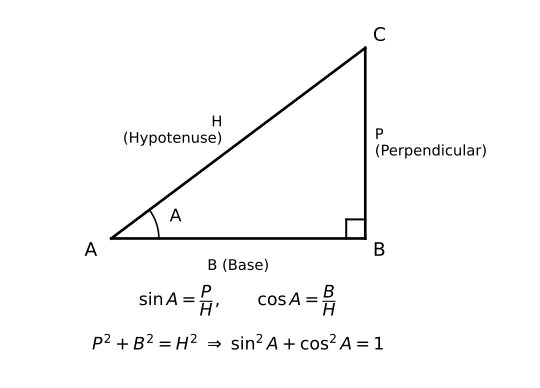
Assertion (A): sin²A + cos²A = 1 for all values of angle A.
Reason (R): This identity is derived from the definition of sin and cos using a right triangle and Pythagoras theorem.

Diagram for question 15: Introduction to Trigonometry
Show answer
Option (a) is correct.

Explanation: Assertion (A) is true: sin²A + cos²A = 1 is a fundamental Pythagorean trigonometric identity that holds for all values of angle A. Reason (R) is also true: in a right triangle with hypotenuse H, perpendicular P, and base B, sinA = P/H and cosA = B/H, so sin²A + cos²A = (P² + B²)/H² = H²/H² = 1, by the Pythagorean theorem (P² + B² = H²). Since R correctly and directly explains why A holds, R is the correct explanation of A.
Q16MCQ1 mark

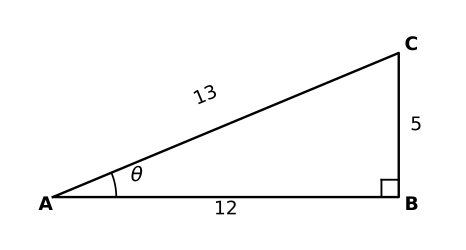
Given that tan θ = 5/12, find the value of (sin θ + cos θ).

Diagram for question 16: Introduction to Trigonometry
Show answer
Option (A) is correct.

Explanation: Given tan θ = 5/12, construct a right triangle with opposite = 5, adjacent = 12 ⟹ hypotenuse = √(5² + 12²) = √(25 + 144) = √169 = 13. ∴ sin θ = 5/13 and cos θ = 12/13 ⟹ sin θ + cos θ = 5/13 + 12/13 = 17/13.
Q17MCQ1 mark

If 2 cos 3x = 1, where 0° ≤ x ≤ 90°, then the value of x is:

Show answer
Option (A) is correct.

Explanation: From 2 cos 3x = 1 ⟹ cos 3x = 1/2. Using the standard trigonometric ratio cos 60° = 1/2, we get 3x = 60° ⟹ x = 20°. Since 0° ≤ 20° ≤ 90°, the value is valid.
Q18MCQ1 mark

The value of is equal to:

Show answer
Option (A) is correct.

Explanation: Using the standard trigonometric ratio tan 45° = 1, we get tan²45° = 1. Substituting, (1 − tan²45°)/(1 + tan²45°) = (1 − 1)/(1 + 1) = 0/2 = 0.
Q19MCQ1 mark

The value of (sin²30° + cot²45° − cos²60°) is:

Show answer
Option (A) is correct.

Explanation: Using standard trigonometric ratio values, sin 30° = 1/2, cot 45° = 1, cos 60° = 1/2. ⟹ sin²30° + cot²45° − cos²60° = (1/2)² + (1)² − (1/2)² = 1/4 + 1 − 1/4 = 1.
Q20MCQ1 mark

The value of (3tan²30° + 4sin²60° − cos²0°) is:

Show answer
Option (C) is correct.

Explanation: Using standard trigonometric values, tan 30° = 1/√3, sin 60° = √3/2, and cos 0° = 1. Substituting: 3tan²30° = 3 × (1/3) = 1; 4sin²60° = 4 × (3/4) = 3; cos²0° = 1. ∴ 3tan²30° + 4sin²60° − cos²0° = 1 + 3 − 1 = 3.
Q21MCQ1 mark

The value of is equal to:

Show answer
Option (A) is correct.

Explanation: Using standard trigonometric values, tan 60° = √3 ⟹ tan²60° = 3, and cot 30° = √3 ⟹ cot²30° = 3. Substituting, the expression = (1 + 3)/(1 + 3) = 4/4 = 1.
Q22MCQ1 mark

If 2 sin 2θ = √3, where 0° ≤ θ ≤ 90°, then the value of θ is:

Show answer
Option (C) is correct.

Explanation: From the given equation, 2 sin 2θ = √3 ⟹ sin 2θ = √3/2. Using the standard trigonometric ratio table, sin 60° = √3/2, so 2θ = 60° ⟹ θ = 30°.
Q23Short Answer1 mark

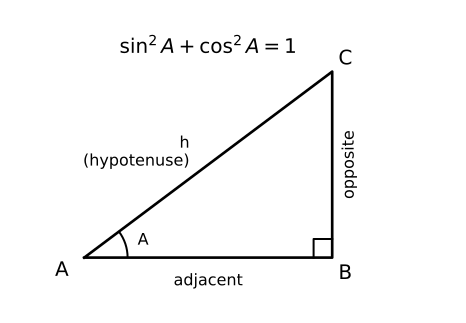
Assertion (A): sin²A + cos²A = 1 for all values of angle A.
Reason (R): This identity is derived from the definition of sin and cos using a right triangle and Pythagoras theorem.

Diagram for question 23: Introduction to Trigonometry
Show answer
Option (a) is correct.

Explanation: Assertion (A) is TRUE — sin²A + cos²A = 1 is the fundamental Pythagorean trigonometric identity, valid for all values of angle A. Reason (R) is also TRUE — in a right triangle with hypotenuse h, sinA = opposite/h and cosA = adjacent/h, so sin²A + cos²A = (opp² + adj²)/h² = h²/h² = 1, using the Pythagoras theorem. R is the correct explanation of A.
Q24MCQ1 mark

The value of [2sin²30° + 2cos²45° – tan²60°] is equal to:

Show answer
Option (D) is correct.

Explanation: Using standard trigonometric ratio values: sin 30° = 1/2 ⟹ sin²30° = 1/4; cos 45° = 1/√2 ⟹ cos²45° = 1/2; tan 60° = √3 ⟹ tan²60° = 3. Substituting, 2sin²30° + 2cos²45° − tan²60° = 2(1/4) + 2(1/2) − 3 = 1/2 + 1 − 3 = 3/2 − 3 = −3/2.
Q25MCQ1 mark

If sin A = √3/2, then the value of (4 cos³ A − 3 cos A) is:

Show answer
Option (A) is correct.

Explanation: Using the identity 4cos³A − 3cosA = cos 3A. Since sin A = √3/2, A = 60°. ⟹ cos 3A = cos(3 × 60°) = cos 180° = −1.
Q26MCQ1 mark

The value of is equal to:

Show answer
Option (A) is correct.

Explanation: Using standard trigonometric ratio values: sin 45° = 1/√2, cos 30° = √3/2, tan 60° = √3.

⟹ 2sin²45° = 2 × (1/2) = 1

⟹ cos²30° = (√3/2)² = 3/4

⟹ tan²60° = (√3)² = 3

∴ 2sin²45° + cos²30° − tan²60° = 1 + 3/4 − 3 = 7/4 − 3 = −5/4
Q27MCQ1 mark

If tan 60° = √3, then the value of 2 sin 60° · cos 30° is:

Show answer
Option (A) is correct.

Explanation: Using the standard trigonometric ratios, sin 60° = √3/2 and cos 30° = √3/2. ⟹ 2 sin 60° · cos 30° = 2 × (√3/2) × (√3/2) = 2 × (3/4) = 3/2.
Q28MCQ1 mark

If θ is an acute angle and 2cos θ − 1 = 0, then the value of θ is:

Show answer
Option (C) is correct.

Explanation: From the standard trigonometric ratio table, cos 60° = 1/2. Solving the given equation: 2cos θ − 1 = 0 ⟹ cos θ = 1/2 ⟹ cos θ = cos 60°. Since θ is acute, ∴ θ = 60°.
Q29Short Answer2 marks

If , find the value of in terms of .

Show answer
Using the identity sec²θ − tan²θ = 1:

(secθ + tanθ)(secθ − tanθ) = 1

⟹ p(secθ − tanθ) = 1

⟹ secθ − tanθ = 1/p

Adding (secθ + tanθ) = p and (secθ − tanθ) = 1/p:

2 secθ = p + 1/p = (p² + 1)/p ⟹ secθ = (p² + 1)/(2p)

Subtracting:

2 tanθ = p − 1/p = (p² − 1)/p ⟹ tanθ = (p² − 1)/(2p)

∴ secθ · tanθ = [(p² + 1)/(2p)] × [(p² − 1)/(2p)]

= (p² + 1)(p² − 1) / 4p²

= (p⁴ − 1) / 4p²
Q30Short Answer2 marks

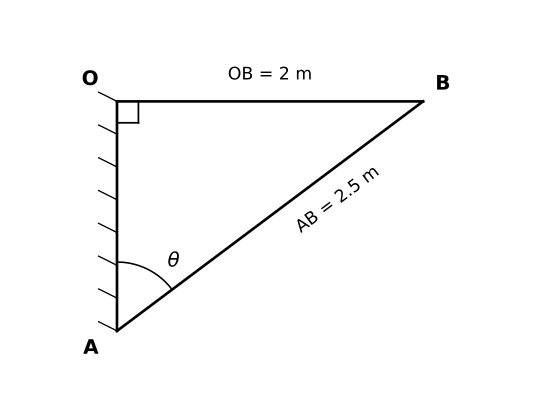
A horizontal beam OB is fixed to a wall at point O, and a diagonal support rod AB braces the beam from below, where A is a point on the wall directly below O. If OB = 2 m and AB = 2.5 m, and θ is the angle that the diagonal rod AB makes with the vertical wall OA, find: (i) sin θ (ii) cosec θ + tan θ

Diagram for question 30: Introduction to Trigonometry
Show answer
In right triangle OAB, the right angle is at O (OA is the vertical wall, OB is the horizontal beam).

By Pythagoras' Theorem:

OA = √(AB² − OB²) = √[(2.5)² − (2)²] = √[6.25 − 4] = √2.25 = 1.5 m

Here, θ is the angle AB makes with the vertical wall OA, i.e., ∠OAB = θ, where AB is the hypotenuse.

(i)

sin θ = OB/AB = 2/2.5

sin θ = 4/5

(ii)

cosec θ = AB/OB = 2.5/2 = 5/4

tan θ = OB/OA = 2/1.5 = 4/3

⟹ cosec θ + tan θ = 5/4 + 4/3 = 15/12 + 16/12

cosec θ + tan θ = 31/12

Want unlimited practice on Introduction to Trigonometry?

The full ClearSteps bank has 96+ reviewed questions on this chapter alone — with step-wise solutions, difficulty levels, and progress tracking. Verify your WhatsApp number and your free trial starts right here.

CBSE · CLASS 10
🎟️14-day free trial · code PRAC auto-applied
Mobile Number
+91
OTP will be sent to your WhatsApp

⭐ Trusted by 12,000+ students across India

Introduction to Trigonometry Class 10 Maths Questions