ClearStepsCLEARSTEPS AI
Teacher Login →Student Login →

Polynomials: Class 10 Maths Practice Questions

30 original exam-pattern questions with full answers, matched to the current CBSE Class 10 paper design, including case-based questions. Attempt each question before opening the answer — or start a free 14-day trial ↓ for the full bank.

Q1Case-based4 marks

A civil engineer is designing a parabolic arch for a bridge. The shape of the arch is modelled by the polynomial f(x) = –x² + 4x + 5, where x represents the horizontal distance (in metres) from one end of the bridge and f(x) represents the height (in metres) of the arch at that point.

A civil engineer is designing a parabolic arch for a bridge. The shape of the arch is modelled by the polynomial f(x) = –x² + 4x + 5, where x represents the horizontal distance (in metres) from one end of the bridge and f(x) represents the height (in metres) of the arch at that point.

(i) Find the zeroes of the polynomial f(x) and interpret their meaning in the context of the bridge. [1 mark]

(ii) Using the zeroes found in part (i), verify the relationship between zeroes and coefficients of f(x). [1 mark]

(iii) The engineer decides to raise the entire arch by 'k' metres so that the new polynomial becomes g(x) = –x² + 4x + 5 + k. For the new arch to just touch the ground at exactly one point (i.e., the arch has a single point of contact with the ground), find the value of k.

OR

(iii) A second arch of the same bridge is modelled by h(x) = 2x² + (3 – p)x – 6, where p is a constant. If one zero of h(x) is 3/2, find the other zero and the value of p. [2 marks]
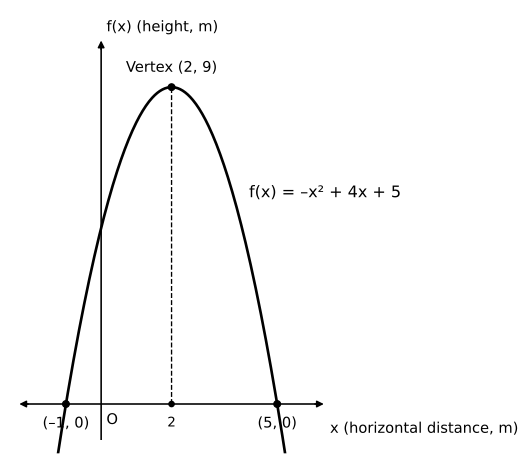
Diagram for question 1: Polynomials
Show answer
(i) To find the zeroes of f(x) = –x² + 4x + 5, set f(x) = 0:

⟹ –x² + 4x + 5 = 0
⟹ x² – 4x – 5 = 0
⟹ x² – 5x + x – 5 = 0
⟹ x(x – 5) + 1(x – 5) = 0
⟹ (x + 1)(x – 5) = 0
∴ x = –1 or x = 5

The zeroes of f(x) are –1 and 5.

Contextual interpretation: The zeroes represent the horizontal positions where the height of the arch is zero, i.e., the two points where the arch meets the ground. Since distance cannot be negative, x = 5 m is the meaningful point where the arch touches the ground on the far side; x = –1 is a mathematical zero outside the physical span.

∴ The zeroes are –1 and 5, representing the ground-level points of the arch.

---

(ii) For f(x) = –x² + 4x + 5, we have a = –1, b = 4, c = 5.
Let α = –1 and β = 5.

Verification of sum of zeroes:
α + β = –1 + 5 = 4
–b/a = –(4)/(–1) = 4 ✓

Verification of product of zeroes:
αβ = (–1)(5) = –5
c/a = 5/(–1) = –5 ✓

∴ Both relationships are verified. Hence proved.

---

(iii) [Main Option]

The new polynomial is g(x) = –x² + 4x + 5 + k.

For the arch to just touch the ground at exactly one point, g(x) = 0 must have exactly one (repeated) real root.

Setting g(x) = 0:
–x² + 4x + (5 + k) = 0
⟹ x² – 4x – (5 + k) = 0

For exactly one real root, the discriminant D = 0.

D = b² – 4ac = (–4)² – 4(1)(–(5 + k))
⟹ D = 16 + 4(5 + k)
⟹ D = 16 + 20 + 4k
⟹ D = 36 + 4k

Setting D = 0:
36 + 4k = 0
⟹ 4k = –36
∴ k = –9

The arch must be lowered by 9 metres (k = –9) so that the new arch just touches the ground at exactly one point.

---

(iii) [OR Option]

For h(x) = 2x² + (3 – p)x – 6, let α = 3/2 and β be the other zero.

Using the relationship: product of zeroes = c/a

αβ = c/a = –6/2 = –3

⟹ (3/2) · β = –3
⟹ β = –3 × (2/3)
∴ β = –2

The other zero is –2.

Now, using the relationship: sum of zeroes = –b/a

α + β = –(3 – p)/2

⟹ (3/2) + (–2) = –(3 – p)/2
⟹ 3/2 – 4/2 = –(3 – p)/2
⟹ –1/2 = –(3 – p)/2
⟹ –1 = –(3 – p)
⟹ 1 = 3 – p
⟹ p = 3 – 1
∴ p = 2

∴ The other zero is –2 and the value of p is 2.
Q2Case-based4 marks

A civil engineer is designing a parabolic arch for a bridge. The shape of the arch is modelled by the polynomial p(x) = 2x² – 7x + k, where x is the horizontal distance (in metres) from one end. The zeroes α and β represent the two ground-contact points of the arch.

A civil engineer is designing a parabolic arch for a bridge. The shape of the arch is modelled by the polynomial p(x) = 2x² – 7x + k, where x represents the horizontal distance (in metres) from one end of the arch and p(x) represents the height. The engineer knows that the arch meets the ground (height = 0) at two points whose horizontal distances from one end are α and β (the zeroes of p(x)).

Based on this scenario, answer the following:

(i) Find the sum and product of the zeroes α and β of p(x) in terms of k. (1 mark)

(ii) If the difference of the zeroes is 3/2 (i.e., α – β = 3/2), find the value of k. (1 mark)

(iii) Using the value of k found in part (ii), find a quadratic polynomial whose zeroes are (2α + β) and (α + 2β). (2 marks)

OR

(iii) Using the value of k found in part (ii), find the value of α² + β² and hence find (1/α² + 1/β²). (2 marks)

Show answer
For p(x) = 2x² – 7x + k, comparing with ax² + bx + c: a = 2, b = –7, c = k.

(i) Sum and Product of zeroes:

By the relationship between zeroes and coefficients of a quadratic polynomial:

α + β = –b/a = –(–7)/2 = 7/2

αβ = c/a = k/2

∴ Sum of zeroes = 7/2 and Product of zeroes = k/2.

---

(ii) Finding the value of k:

Given: α – β = 3/2

Using the identity (α – β)² = (α + β)² – 4αβ:

⟹ (3/2)² = (7/2)² – 4·(k/2)

⟹ 9/4 = 49/4 – 2k

⟹ 2k = 49/4 – 9/4

⟹ 2k = 40/4 = 10

⟹ k = 5

∴ The value of k is 5.

---

(iii) [Main Option] Quadratic polynomial with zeroes (2α + β) and (α + 2β):

From part (i) and (ii): α + β = 7/2 and αβ = k/2 = 5/2.

First, find the sum of the new zeroes:

(2α + β) + (α + 2β) = 3α + 3β = 3(α + β)

⟹ = 3 × 7/2 = 21/2

Next, find the product of the new zeroes:

(2α + β)(α + 2β) = 2α² + 4αβ + αβ + 2β²

= 2(α² + β²) + 5αβ

Now, α² + β² = (α + β)² – 2αβ = (7/2)² – 2(5/2) = 49/4 – 5 = 49/4 – 20/4 = 29/4

⟹ (2α + β)(α + 2β) = 2(29/4) + 5(5/2) = 29/2 + 25/2 = 54/2 = 27

Required quadratic polynomial = k[x² – (sum of zeroes)x + (product of zeroes)]

= k[x² – (21/2)x + 27]

Taking k = 2: 2x² – 21x + 54

∴ The required quadratic polynomial is 2x² – 21x + 54 (or any scalar multiple, e.g. x² – 21x/2 + 27).

---

(iii) [OR Option] Find α² + β² and hence 1/α² + 1/β²:

From part (i) and (ii): α + β = 7/2 and αβ = 5/2.

Step 1 — α² + β²:

α² + β² = (α + β)² – 2αβ

= (7/2)² – 2(5/2)

= 49/4 – 10/2

= 49/4 – 20/4

α² + β² = 29/4

Step 2 — 1/α² + 1/β²:

1/α² + 1/β² = (α² + β²)/(α²β²) = (α² + β²)/(αβ)²

= (29/4) ÷ (5/2)²

= (29/4) ÷ (25/4)

= 29/4 × 4/25

1/α² + 1/β² = 29/25
Q3Short Answer1 mark

Assertion (A): The sum of the zeroes of the polynomial x² - 5x + 6 is 5.
Reason (R): If α and β are zeroes of ax² + bx + c, then α + β = -b/a.

Show answer
Option (A) is correct.

Explanation: By the relationship between zeroes and coefficients, if α and β are zeroes of ax² + bx + c, then α + β = −b/a. For x² − 5x + 6, a = 1 and b = −5, so α + β = −(−5)/1 = 5. Thus Assertion (A) is true, Reason (R) is true, and R is the correct explanation of A.
Q4MCQ1 mark

If α and β are the zeroes of the polynomial p(x) = 5x² − 3√5 x, then the value of α·β is:

Show answer
Option (A) is correct.

Explanation: For a quadratic polynomial ax² + bx + c, the product of zeroes = c/a. Comparing p(x) = 5x² − 3√5 x + 0 with ax² + bx + c gives a = 5, b = −3√5, c = 0. ∴ α·β = c/a = 0/5 = 0.
Q5MCQ1 mark

A polynomial p(x) of degree 2 has its graph crossing the x-axis at exactly two points: x = −2 and x = 5. Which of the following could be p(x)?

Show answer
Option (A) is correct.

Explanation: For a degree-2 polynomial with zeroes α = −2 and β = 5, the polynomial is k[x² − (α + β)x + αβ]. Here α + β = −2 + 5 = 3 and αβ = (−2)(5) = −10, giving k[x² − 3x − 10]. For k = 1, p(x) = x² − 3x − 10, which matches Option (A). Option (B) gives x² + 3x − 10 = (x − 2)(x + 5), with zeroes at x = 2 and x = −5, not the required values.
Q6Short Answer1 mark

Assertion (A): The product of the zeroes of the polynomial 2x² - 8x + 6 is 3.
Reason (R): For ax² + bx + c, the product of zeroes is c/a.

Show answer
Option (A) is correct.

Explanation: For a quadratic polynomial ax² + bx + c, the product of zeroes = c/a. Here a = 2, c = 6, so product of zeroes = 6/2 = 3, confirming Assertion A is true. Reason R states exactly this standard result and is therefore true. Since applying R directly yields the value 3 stated in A, R is the correct explanation of A.
Q7Short Answer1 mark

Assertion (A): The product of the zeroes of the polynomial 2x² - 8x + 6 is 3.
Reason (R): For ax² + bx + c, the product of zeroes is c/a.

Show answer
Option (A) is correct.

Explanation: For a quadratic polynomial ax² + bx + c, the product of zeroes = c/a. Here, a = 2, c = 6, so product of zeroes = 6/2 = 3, confirming A is true. R states this exact formula and is true. Since R directly explains why the product equals 3, R is the correct explanation of A.
Q8MCQ1 mark

If −3 is a zero of the polynomial p(x) = x² + 5x + (2k + 4), then the value of k is:

Show answer
Option (A) is correct.

Explanation: If −3 is a zero of p(x), then p(−3) = 0. Substituting x = −3: (−3)² + 5(−3) + (2k + 4) = 0 ⟹ 9 − 15 + 2k + 4 = 0 ⟹ 2k − 2 = 0 ⟹ k = 1.
Q9MCQ1 mark

The zeroes of the quadratic polynomial 5x² + 6x − 8 are:

Show answer
Option (B) is correct.

Explanation: Factorising 5x² + 6x − 8: product = 5 × (−8) = −40, sum = 6 ⟹ split as 10 and −4 ⟹ 5x² + 10x − 4x − 8 = 5x(x + 2) − 4(x + 2) = (5x − 4)(x + 2). Setting each factor to zero: 5x − 4 = 0 ⟹ x = 4/5 and x + 2 = 0 ⟹ x = −2. ∴ the zeroes are −2 and 4/5.
Q10Short Answer1 mark

Assertion (A): The product of the zeroes of the polynomial 2x² - 8x + 6 is 3.
Reason (R): For ax² + bx + c, the product of zeroes is c/a.

Show answer
Option (A) is correct.

Explanation: For a quadratic polynomial ax² + bx + c, the product of zeroes = c/a. Here a = 2, b = −8, c = 6 ⟹ product of zeroes = 6/2 = 3, so Assertion (A) is true. Reason (R) states the correct formula (product of zeroes = c/a), which is true, and it directly explains why the product equals 3 in (A). ∴ Both A and R are true and R is the correct explanation of A.
Q11MCQ1 mark

The zeroes of the quadratic polynomial p(x) = 4x² − 4x − 3 are:

Show answer
Option (A) is correct.

Explanation: The zeroes of p(x) = 4x² − 4x − 3 are found by factorisation. Two numbers with product 4×(−3) = −12 and sum −4 are −6 and 2, giving 4x² − 6x + 2x − 3 = 2x(2x − 3) + 1(2x − 3) = (2x + 1)(2x − 3). Setting each factor to zero: 2x + 1 = 0 ⟹ x = −1/2, and 2x − 3 = 0 ⟹ x = 3/2. ∴ the zeroes are 3/2 and −1/2.
Q12MCQ1 mark

If p(x) = x² − 7x + 10, then the value of p(2) + p(5) is:

Show answer
Option (A) is correct.

Explanation: Substituting x = 2: p(2) = (2)² − 7(2) + 10 = 4 − 14 + 10 = 0. Substituting x = 5: p(5) = (5)² − 7(5) + 10 = 25 − 35 + 10 = 0. Since x = 2 and x = 5 are the zeroes of p(x), both values equal zero. ∴ p(2) + p(5) = 0 + 0 = 0.
Q13Short Answer1 mark

Assertion (A): The sum of the zeroes of the polynomial x² - 5x + 6 is 5.
Reason (R): If α and β are zeroes of ax² + bx + c, then α + β = -b/a.

Show answer
Option (A) is correct.

Explanation: By the relationship between zeroes and coefficients, if α and β are zeroes of ax² + bx + c, then α + β = −b/a. This confirms R is true. Applying R to x² − 5x + 6 (where a = 1, b = −5): α + β = −(−5)/1 = 5, confirming A is true. Since R directly explains why A holds, both A and R are true and R is the correct explanation of A.
Q14MCQ1 mark

The zeroes of the quadratic polynomial p(x) = 3x² − 5x − 2 are:

Show answer
Option (A) is correct.

Explanation: Factorising p(x) = 3x² − 5x − 2 by splitting the middle term (product = 3×(−2) = −6, sum = −5 ⟹ split as −6 and +1): 3x² − 6x + x − 2 = 3x(x − 2) + 1(x − 2) = (3x + 1)(x − 2). Setting each factor to zero gives x = 2 and x = −1/3, which matches Option (A). Verification: sum of zeroes = 2 + (−1/3) = 5/3 = −(−5)/3 ✓; product = 2×(−1/3) = −2/3 = −2/3 ✓.
Q15Short Answer1 mark

Assertion (A): The product of the zeroes of the polynomial 2x² - 8x + 6 is 3.
Reason (R): For ax² + bx + c, the product of zeroes is c/a.

Show answer
Option (A) is correct.

Explanation: For a quadratic polynomial ax² + bx + c, the product of zeroes = c/a. Applying this to 2x² − 8x + 6 (a = 2, c = 6): product of zeroes = 6/2 = 3, so Assertion (A) is true. Reason (R) correctly states the standard result "product of zeroes = c/a," which is true, and it is precisely the formula used to verify (A). ∴ Both A and R are true and R is the correct explanation of A.
Q16Short Answer1 mark

Assertion (A): The product of the zeroes of the polynomial 2x² - 8x + 6 is 3.
Reason (R): For ax² + bx + c, the product of zeroes is c/a.

Show answer
Option (A) is correct.

Explanation: For a quadratic polynomial ax² + bx + c, the product of zeroes = c/a. Here a = 2, b = −8, c = 6 ⟹ product of zeroes = 6/2 = 3, so Assertion (A) is true. Reason (R) states the correct formula (product of zeroes = c/a), so R is also true, and R directly explains why the product equals 3 in Assertion (A).
Q17MCQ1 mark

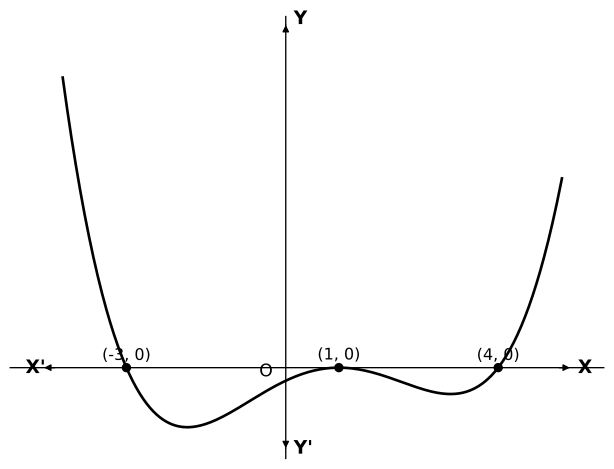
A polynomial p(x) is drawn on a coordinate plane. Its graph cuts the x-axis at x = −3 and x = 4, and touches the x-axis at x = 1. What is the total number of zeroes of p(x)?

Diagram for question 17: Polynomials
Show answer
Option (B) is correct.

Explanation: The total number of zeroes of a polynomial equals the number of distinct x-values where the graph meets the x-axis, whether it cuts or touches. The graph cuts the x-axis at x = −3 and x = 4, giving one zero each, and touches the x-axis at x = 1, giving one zero (of even multiplicity). Thus the total number of zeroes is 3.
Q18MCQ1 mark

If a polynomial p(x) = x² − 3x + 2, then the value of p(0) + p(3) is:

Show answer
Option (B) is correct.

Explanation: Substituting x = 0: p(0) = 0² − 3(0) + 2 = 2. Substituting x = 3: p(3) = 3² − 3(3) + 2 = 9 − 9 + 2 = 2. ∴ p(0) + p(3) = 2 + 2 = 4.
Q19MCQ1 mark

The zeroes of the polynomial are half the zeroes of the polynomial . The value of is:

Show answer
Option (C) is correct.

Explanation: For the polynomial 2x² + 8x − 10, dividing throughout by 2 gives x² + 4x − 5 = 0 ⟹ (x + 5)(x − 1) = 0, so the zeroes are −5 and 1. The zeroes of x² + px + q are half of these, i.e., −5/2 and 1/2. Using the relation sum of zeroes = −p/1, we get −5/2 + 1/2 = −p ⟹ −4/2 = −p ⟹ −2 = −p ∴ p = 2.
Q20Short Answer1 mark

Assertion (A): The sum of the zeroes of the polynomial x² - 5x + 6 is 5.
Reason (R): If α and β are zeroes of ax² + bx + c, then α + β = -b/a.

Show answer
Option (A) is correct.

Explanation: By the relationship between zeroes and coefficients, for ax² + bx + c, α + β = −b/a. For x² − 5x + 6, a = 1, b = −5 ⟹ α + β = −(−5)/1 = 5, so Assertion (A) is true. Reason (R) states exactly this formula, which is correct, and it directly explains why the sum equals 5 in (A). ∴ Both A and R are true and R is the correct explanation of A.
Q21MCQ1 mark

For what value of k, the sum of zeroes of the polynomial 3x² − kx + 6 is 4?

Show answer
Option (B) is correct.

Explanation: For a polynomial ax² + bx + c, sum of zeroes = −b/a. Here a = 3, b = −k, so sum of zeroes = −(−k)/3 = k/3. Setting k/3 = 4 ⟹ k = 12.
Q22MCQ1 mark

The zeroes of the quadratic polynomial 6x² + x − 12 are:

Show answer
Option (B) is correct.

Explanation: Factorising 6x² + x − 12 by splitting the middle term: product of coefficients = 6 × (−12) = −72, required pair = 9 and −8 (since 9 × (−8) = −72 and 9 + (−8) = 1). ⟹ 6x² + 9x − 8x − 12 = 3x(2x + 3) − 4(2x + 3) = (3x − 4)(2x + 3) = 0 ⟹ x = 4/3 or x = −3/2. ∴ The zeroes are −3/2 and 4/3.
Q23MCQ1 mark

In the quadratic polynomial p(x) = x² − 9, the product of the zeroes is:

Show answer
Option (B) is correct.

Explanation: For a quadratic polynomial ax² + bx + c, the product of the zeroes = c/a. Here p(x) = x² + 0x + (−9), so a = 1, c = −9 ⟹ product of zeroes = −9/1 = −9.
Q24Short Answer1 mark

Assertion (A): The sum of the zeroes of the polynomial x² - 5x + 6 is 5.
Reason (R): If α and β are zeroes of ax² + bx + c, then α + β = -b/a.

Show answer
Option (A) is correct.

Explanation: For the polynomial x² − 5x + 6, a = 1, b = −5, c = 6. By the relation α + β = −b/a, sum of zeroes = −(−5)/1 = 5, so Assertion A is true. The Reason states the standard result α + β = −b/a for a quadratic ax² + bx + c, which is true, and it is precisely this formula applied to the given polynomial that establishes the sum as 5. Hence R is the correct explanation of A.
Q25MCQ1 mark

A polynomial p(x) of degree 4 has its graph crossing the x-axis at x = −4 and x = 2, touching the x-axis at x = 0, and not intersecting the x-axis anywhere else. What is the total number of zeroes of p(x)?

Show answer
Option (B) is correct.

Explanation: When a graph crosses the x-axis at a point, that zero has odd multiplicity (minimum 1); when it touches the x-axis without crossing, that zero has even multiplicity (minimum 2). Here, x = −4 and x = 2 are crossing zeroes (multiplicity 1 each), and x = 0 is a touching zero (multiplicity 2). Total degree accounted for: 1 + 1 + 2 = 4, which equals the degree of p(x). ∴ The number of distinct zeroes of p(x) is 3.
Q26Short Answer1 mark

Assertion (A): The product of the zeroes of the polynomial 2x² - 8x + 6 is 3.
Reason (R): For ax² + bx + c, the product of zeroes is c/a.

Show answer
Option (A) is correct.

Explanation: For a quadratic polynomial ax² + bx + c, the product of zeroes = c/a. For p(x) = 2x² − 8x + 6, a = 2, c = 6 ⟹ product of zeroes = 6/2 = 3, so Assertion (A) is true. Reason (R) states the correct formula (product of zeroes = c/a), which is indeed the principle used to verify (A). ∴ Both A and R are true and R is the correct explanation of A.
Q27MCQ1 mark

The zeroes of the quadratic polynomial p(x) = x² − 5√5 x + 30 are:

Show answer
Option (A) is correct.

Explanation: For p(x) = x² − 5√5 x + 30, the zeroes α and β satisfy α + β = 5√5 and αβ = 30. Taking α = 3√5 and β = 2√5: product = 3√5 × 2√5 = 6 × 5 = 30 ✓ and sum = 3√5 + 2√5 = 5√5 ✓, so p(x) = (x − 3√5)(x − 2√5), giving zeroes 3√5 and 2√5.
Q28MCQ1 mark

The zeroes of the quadratic polynomial p(x) = x² − 4√3 x + 9 are:

Show answer
Option (A) is correct.

Explanation: For p(x) = x² − 4√3 x + 9, applying the quadratic formula x = [−b ± √(b²−4ac)] / 2a with a=1, b=−4√3, c=9: x = [4√3 ± √(48−36)] / 2 = [4√3 ± √12] / 2 = [4√3 ± 2√3] / 2, giving x = 3√3 or x = √3. Verification: sum of zeroes = 3√3 + √3 = 4√3 = −b/a ✓; product of zeroes = 3√3 × √3 = 9 = c/a ✓.
Q29MCQ1 mark

If one of the zeroes of the quadratic polynomial x² − 5x + k is 3, then the value of k is:

Show answer
Option (A) is correct.

Explanation: If 3 is a zero of x² − 5x + k, then substituting x = 3 must satisfy the polynomial: (3)² − 5(3) + k = 0 ⟹ 9 − 15 + k = 0 ⟹ k = 6.
Q30MCQ1 mark

If α and β are the zeroes of the polynomial p(x) = 3x² − 7x + 2, then the value of (1/α + 1/β) is:

Show answer
Option (A) is correct.

Explanation: For p(x) = 3x² − 7x + 2, using α + β = −b/a = 7/3 and αβ = c/a = 2/3, then 1/α + 1/β = (α + β)/(αβ) = (7/3)/(2/3) = 7/2.

Want unlimited practice on Polynomials?

The full ClearSteps bank has 55+ reviewed questions on this chapter alone — with step-wise solutions, difficulty levels, and progress tracking. Verify your WhatsApp number and your free trial starts right here.

CBSE · CLASS 10
🎟️14-day free trial · code PRAC auto-applied
Mobile Number
+91
OTP will be sent to your WhatsApp

⭐ Trusted by 12,000+ students across India

Polynomials — Class 10 Maths Practice Questions