ClearStepsCLEARSTEPS AI
Teacher Login →Student Login →

Quadratic Equations: Class 10 Maths Practice Questions

30 original exam-pattern questions with full answers, matched to the current CBSE Class 10 paper design, including case-based questions. Attempt each question before opening the answer — or start a free 14-day trial ↓ for the full bank.

Q1Case-based4 marks

A farmer wants to fence a rectangular vegetable garden such that its length is 3 m more than twice its breadth. The area of the garden is 90 sq. m. He also notes that the perimeter of the garden will determine how much fencing wire he needs to purchase.

A farmer wants to fence a rectangular vegetable garden such that its length is 3 m more than twice its breadth. The area of the garden is 90 sq. m. He also notes that the perimeter of the garden will determine how much fencing wire he needs to purchase.

Show answer
Let the breadth of the garden be x m.

∴ Length = (2x + 3) m.

(i)

According to the question, Area = length × breadth = 90

⟹ x(2x + 3) = 90

⟹ 2x<super>2</super> + 3x − 90 = 0

∴ The required quadratic equation is 2x<super>2</super> + 3x − 90 = 0.

---

(ii)

For 2x<super>2</super> + 3x − 90 = 0, we have a = 2, b = 3, c = −90.

D = b<super>2</super> − 4ac

⟹ D = (3)<super>2</super> − 4(2)(−90)

⟹ D = 9 + 720

D = 729

---

(iii)

Solving 2x<super>2</super> + 3x − 90 = 0 by splitting the middle term:

⟹ 2x<super>2</super> + 15x − 12x − 90 = 0

⟹ x(2x + 15) − 6(2x + 15) = 0

⟹ (x − 6)(2x + 15) = 0

⟹ x = 6 or x = −15/2

∵ breadth cannot be negative, x = −15/2 is rejected.

∴ Breadth = x = 6 m

∴ Length = 2(6) + 3 = 15 m

Perimeter (fencing wire required) = 2(l + b) = 2(15 + 6) = 2 × 21

Fencing wire required = 42 m
Q2Case-based4 marks

A school is organising a science fair and has booked a rectangular exhibition hall. The length of the hall is 3 m more than twice its breadth. A display partition divides the hall into two sections, and the total area of the hall is 90 sq. m. The organising committee needs to find the exact dimensions of the hall to plan the arrangement of stalls.

A school is organising a science fair and has booked a rectangular exhibition hall. The length of the hall is 3 m more than twice its breadth. A display partition divides the hall into two sections, and the total area of the hall is 90 sq. m. The organising committee needs to find the exact dimensions of the hall to plan the arrangement of stalls.

Show answer
(i)

Let the breadth of the hall be x metres.

⟹ Length = (2x + 3) metres.

According to the question, x(2x + 3) = 90

⟹ 2x<super>2</super> + 3x − 90 = 0

(ii)

For 2x<super>2</super> + 3x − 90 = 0, a = 2, b = 3, c = −90.

D = b<super>2</super> − 4ac = (3)<super>2</super> − 4(2)(−90) = 9 + 720 = 729

∴ D = 729 > 0, so the equation has two distinct real roots.

(iii)

Using the quadratic formula, x = (−b ± √D) / 2a

⟹ x = (−3 ± √729) / (2 × 2) = (−3 ± 27) / 4

⟹ x = (−3 + 27)/4 = 24/4 = 6 or x = (−3 − 27)/4 = −30/4

∵ breadth cannot be negative, x = −30/4 is rejected.

∴ Breadth = 6 m and Length = 2(6) + 3 = 15 m.
Q3Case-based4 marks

A group of friends planned a road trip from City A to City B, a total distance of 480 km. On the return journey, due to heavy traffic, their average speed decreased by 20 km/h compared to the onward journey, and as a result the return trip took 2 hours longer than the onward journey. Let the average speed during the onward journey be x km/h.

A group of friends planned a road trip from City A to City B, a total distance of 480 km. On the return journey, due to heavy traffic, their average speed decreased by 20 km/h compared to the onward journey, and as a result the return trip took 2 hours longer than the onward journey. Let the average speed during the onward journey be x km/h.

Show answer
(i)

Time taken for onward journey = 480/x hours.

Time taken for return journey = 480/(x − 20) hours.

---

(ii)

According to the question, the return journey took 2 hours longer than the onward journey:

480/(x − 20) − 480/x = 2

Taking LCM x(x − 20):

[480x − 480(x − 20)] / [x(x − 20)] = 2

⟹ [480x − 480x + 9600] / [x(x − 20)] = 2

⟹ 9600 / [x(x − 20)] = 2

Cross-multiplying:

9600 = 2x(x − 20)

⟹ 4800 = x² − 20x

x² − 20x − 4800 = 0

---

(iii)

Solving x² − 20x − 4800 = 0 by factorisation.

Two numbers whose product = −4800 and sum = −20 are −80 and 60.

⟹ x² − 80x + 60x − 4800 = 0

⟹ x(x − 80) + 60(x − 80) = 0

⟹ (x − 80)(x + 60) = 0

⟹ x = 80 or x = −60

∵ speed cannot be negative, x = −60 is rejected.

∴ The average speed during the onward journey is 80 km/h, and the average speed during the return journey is 80 − 20 = 60 km/h.
Q4Case-based4 marks

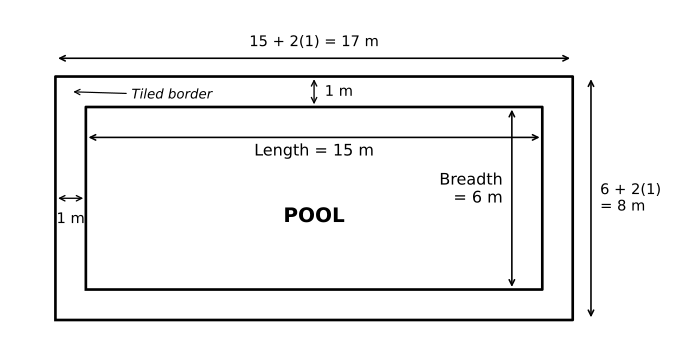
A rectangular swimming pool is being constructed in a community park. The length of the pool is 3 m more than twice its breadth. The area of the pool is 90 m². The construction team also plans to lay tiles along a uniform border of width 1 m around the pool, and they need to calculate various dimensions before ordering materials.

A rectangular swimming pool is being constructed in a community park. The length of the pool is 3 m more than twice its breadth. The area of the pool is 90 m². The construction team also plans to lay tiles along a uniform border of width 1 m around the pool, and they need to calculate various dimensions before ordering materials.

Diagram for question 4: Quadratic Equations
Show answer
(i)

Let breadth = x metres.

⟹ Length = (2x + 3) metres.

According to the question, length × breadth = 90

⟹ x(2x + 3) = 90

⟹ 2x² + 3x − 90 = 0

∴ The quadratic equation formed is 2x² + 3x − 90 = 0.

---

(ii)

Solving 2x² + 3x − 90 = 0 by splitting the middle term:

⟹ 2x² + 15x − 12x − 90 = 0

⟹ x(2x + 15) − 6(2x + 15) = 0

⟹ (x − 6)(2x + 15) = 0

⟹ x = 6 or x = −15/2

∵ breadth cannot be negative, x = −15/2 is rejected.

∴ Breadth of the pool = 6 m.

---

(iii)

From part (ii), breadth = 6 m.

⟹ Length = 2(6) + 3 = 15 m.

With a uniform border of width 1 m around the pool, the outer rectangle has:

⟹ Outer length = 15 + 2(1) = 17 m, Outer breadth = 6 + 2(1) = 8 m.

Area of tiled border = Area of outer rectangle − Area of pool

⟹ = (17 × 8) − (15 × 6)

⟹ = 136 − 90

∴ Area of the tiled border = 46 m².
Q5Case-based4 marks

A farmer wants to fence a rectangular vegetable plot in his field. The length of the plot is 3 metres more than twice its breadth. The area of the rectangular plot is 90 square metres. The farmer needs to find the dimensions of the plot to purchase the correct amount of fencing material.

A farmer wants to fence a rectangular vegetable plot in his field. The length of the plot is 3 metres more than twice its breadth. The area of the rectangular plot is 90 square metres. The farmer needs to find the dimensions of the plot to purchase the correct amount of fencing material.

Show answer
(i)

Let breadth = x metres.

∴ Length = (2x + 3) metres.

According to the question, Area = Length × Breadth

⟹ x(2x + 3) = 90

⟹ 2x<super>2</super> + 3x − 90 = 0

∴ The required quadratic equation is 2x<super>2</super> + 3x − 90 = 0.

---

(ii)

For the quadratic equation 2x<super>2</super> + 3x − 90 = 0, we have a = 2, b = 3, c = −90.

Discriminant D = b<super>2</super> − 4ac

⟹ D = (3)<super>2</super> − 4(2)(−90)

⟹ D = 9 + 720

D = 729

---

(iii)

Solving 2x<super>2</super> + 3x − 90 = 0 by factorisation:

⟹ 2x<super>2</super> + 15x − 12x − 90 = 0

⟹ x(2x + 15) − 6(2x + 15) = 0

⟹ (x − 6)(2x + 15) = 0

⟹ x = 6 or x = −15/2

∵ breadth cannot be negative, x = −15/2 is rejected.

∴ Breadth = 6 m and Length = 2(6) + 3 = 15 m.
Q6Case-based4 marks

A school garden club is designing a rectangular vegetable patch. The length of the patch is 3 metres more than twice its breadth. The area of the patch is 27 square metres. The club wants to find the exact dimensions before purchasing fencing material.

A school garden club is designing a rectangular vegetable patch. The length of the patch is 3 metres more than twice its breadth. The area of the patch is 27 square metres.

(i) If the breadth of the patch is x metres, write the quadratic equation representing the above situation.
(ii) Find the discriminant of the equation obtained in part (i). What does its value tell you about the roots?
(iii) Find the dimensions (length and breadth) of the vegetable patch.
OR
(iii) A second patch is to be designed such that its area is also 27 m², but this time the length equals twice the breadth. Using the discriminant, determine whether such a rectangular patch with integer dimensions is possible.

Show answer
(i) Let the breadth of the patch = x metres.
∴ Length = (2x + 3) metres.

According to the question,
x(2x + 3) = 27
⟹ 2x² + 3x = 27
⟹ 2x² + 3x − 27 = 0

∴ The required quadratic equation is 2x² + 3x − 27 = 0. [1 mark]

(ii) Comparing 2x² + 3x − 27 = 0 with ax² + bx + c = 0:
a = 2, b = 3, c = −27

Discriminant D = b² − 4ac
⟹ D = (3)² − 4(2)(−27)
⟹ D = 9 + 216
⟹ D = 225

∴ D = 225 > 0

Since D > 0, the equation has two distinct real roots, meaning the patch has a unique valid solution for its dimensions. [1 mark]

(iii) Solving 2x² + 3x − 27 = 0 by factorisation:

2x² + 3x − 27 = 0
⟹ 2x² + 9x − 6x − 27 = 0
⟹ x(2x + 9) − 3(2x + 9) = 0
⟹ (2x + 9)(x − 3) = 0

⟹ x = 3 or x = −9/2

∵ Breadth cannot be negative, x = −9/2 is rejected.

∴ Breadth = x = 3 metres
∴ Length = 2(3) + 3 = 9 metres [2 marks]

OR

(iii) Let the breadth of the second patch = x metres.
∴ Length = 2x metres.

According to the question,
x(2x) = 27
⟹ 2x² = 27
⟹ 2x² − 27 = 0

Comparing with ax² + bx + c = 0:
a = 2, b = 0, c = −27

D = b² − 4ac = (0)² − 4(2)(−27) = 0 + 216 = 216

∴ D = 216 > 0, so two distinct real roots exist.

x = √(27/2) = 3√(3/2) = (3√6)/2, which is irrational.

∵ The dimensions are irrational (not integers), such a rectangular patch with integer dimensions is NOT possible. [2 marks]
Q7Case-based4 marks

Arjun and his younger sister Priya are trying to figure out their ages using a fun number puzzle. Arjun's age is 5 years more than twice Priya's age. The product of their present ages is 75. Their mother, a mathematics teacher, turned this into a classroom activity to demonstrate quadratic equations.

Arjun and his younger sister Priya are trying to figure out their ages using a fun number puzzle. Arjun's age is 5 years more than twice Priya's age. The product of their present ages is 75. Their mother, a mathematics teacher, turned this into a classroom activity to demonstrate quadratic equations.

Show answer
(i)

Let Priya's present age = x years.

⟹ Arjun's present age = (2x + 5) years.

According to the question, product of their ages = 75:

x(2x + 5) = 75

⟹ 2x<super>2</super> + 5x = 75

⟹ 2x<super>2</super> + 5x − 75 = 0

∴ The required quadratic equation is 2x<super>2</super> + 5x − 75 = 0.

---

(ii)

For 2x<super>2</super> + 5x − 75 = 0, a = 2, b = 5, c = −75.

Discriminant D = b<super>2</super> − 4ac

⟹ D = (5)<super>2</super> − 4(2)(−75)

⟹ D = 25 + 600

D = 625

---

(iii)

Using the quadratic formula:

x = (−b ± √D) / 2a

⟹ x = (−5 ± √625) / (2 × 2)

⟹ x = (−5 ± 25) / 4

The two roots are:

x = (−5 + 25) / 4 = 20/4 = 5 or x = (−5 − 25) / 4 = −30/4 = −7.5

∵ age cannot be negative, x = −7.5 is rejected.

⟹ Priya's age = 5 years.

⟹ Arjun's age = 2(5) + 5 = 15 years.

Priya's present age = 5 years and Arjun's present age = 15 years.
Q8Case-based4 marks

A train travels a distance of 360 km at a uniform speed. Had the speed been 15 km/h more, the journey would have taken 3 hours less. A railway engineer uses this information to determine the original speed of the train and plan better scheduling for future routes.

A train travels a distance of 360 km at a uniform speed. Had the speed been 15 km/h more, the journey would have taken 3 hours less. A railway engineer uses this information to determine the original speed of the train and plan better scheduling for future routes.

Show answer
(i)

Let the original speed of the train be x km/h.

Time taken at original speed = 360/x hours.

Time taken at increased speed (x + 15) km/h = 360/(x + 15) hours.

According to the question,

360/x − 360/(x + 15) = 3

⟹ 360(x + 15) − 360x = 3x(x + 15)

⟹ 5400 = 3x² + 45x

⟹ x² + 15x − 1800 = 0

∴ The required quadratic equation is x² + 15x − 1800 = 0.

---

(ii)

For x² + 15x − 1800 = 0, here a = 1, b = 15, c = −1800.

Discriminant D = b² − 4ac

⟹ D = (15)² − 4(1)(−1800)

⟹ D = 225 + 7200

D = 7425

---

(iii)

Solving x² + 15x − 1800 = 0 by factorisation.

Two numbers whose product = −1800 and sum = 15 are 60 and −45.

⟹ x² + 60x − 45x − 1800 = 0

⟹ x(x + 60) − 45(x + 60) = 0

⟹ (x − 45)(x + 60) = 0

⟹ x = 45 or x = −60

∵ speed cannot be negative, x = −60 is rejected.

∴ The original speed of the train is 45 km/h.
Q9MCQ1 mark

For the quadratic equation 3x² + kx + 3 = 0 to have two real and equal roots, the value of k is:

Show answer
Option (A) is correct.

Explanation: For a quadratic equation to have two real and equal roots, the discriminant D = b² − 4ac = 0. Here a = 3, b = k, c = 3, so k² − 4(3)(3) = 0 ⟹ k² = 36 ⟹ k = ±6.
Q10MCQ1 mark

If the quadratic equation (k + 1)x² − 2(k − 1)x + 1 = 0 has equal roots, then the value of k is:

Show answer
Option (A) is correct.

Explanation: For equal roots, D = 0, where D = b² − 4ac. Here a = (k + 1), b = −2(k − 1), c = 1. ⟹ [−2(k − 1)]² − 4(k + 1)(1) = 0 ⟹ 4(k − 1)² − 4(k + 1) = 0 ⟹ (k − 1)² = k + 1 ⟹ k² − 2k + 1 = k + 1 ⟹ k² − 3k = 0 ⟹ k(k − 3) = 0 ∴ k = 0 or k = 3.
Q11MCQ1 mark

If x = −3 is a root of the quadratic equation 4x² + px + 3 = 0, then the value of p is:

Show answer
Option (C) is correct.

Explanation: Since x = −3 is a root of 4x² + px + 3 = 0, it must satisfy the equation. Substituting x = −3: 4(−3)² + p(−3) + 3 = 0 ⟹ 36 − 3p + 3 = 0 ⟹ 39 = 3p ⟹ p = 13.
Q12MCQ1 mark

A quadratic equation 2x² + kx + 3 = 0 has two equal roots. Find the value of k.

Show answer
Option (C) is correct.

Explanation: For a quadratic equation to have two equal roots, discriminant D = b² − 4ac = 0. Here a = 2, b = k, c = 3 ⟹ k² − 4(2)(3) = 0 ⟹ k² = 24 ⟹ k = ±√24 = ±2√6.
Q13MCQ1 mark

The least positive value of k for which the quadratic equation 5x² + kx − 20 = 0 has rational roots, is:

Show answer
Option (D) is correct.

Explanation: For rational roots, discriminant D = b² − 4ac must be a perfect square. Here D = k² − 4(5)(−20) = k² + 400. Testing the options in increasing order: k = 5 ⟹ 25 + 400 = 425 (not a perfect square); k = 10 ⟹ 100 + 400 = 500 (not a perfect square); k = 15 ⟹ 225 + 400 = 625 = 25², which is a perfect square. ∴ the least positive value of k is 15.
Q14MCQ1 mark

If the discriminant of the quadratic equation 5x² − 6x + m = 0 is 16, then the value of m is:

Show answer
Option (C) is correct.

Explanation: For a quadratic equation ax² + bx + c = 0, the discriminant is D = b² − 4ac. Here a = 5, b = −6, c = m, so D = (−6)² − 4(5)(m) = 36 − 20m. Setting D = 16 ⟹ 36 − 20m = 16 ⟹ 20m = 20 ⟹ m = 1.
Q15Short Answer1 mark

Assertion (A): The quadratic equation x² + x + 1 = 0 has no real roots.
Reason (R): The discriminant of x² + x + 1 is -3, which is negative.

Show answer
Option (a) is correct.

Explanation: For x² + x + 1 = 0, D = b² − 4ac = (1)² − 4(1)(1) = 1 − 4 = −3. Since D < 0, the equation has no real roots, so Assertion (A) is true. Reason (R) states D = −3, which is negative — this is mathematically correct, so R is also true. Since a negative discriminant is precisely the condition that guarantees no real roots, R is the correct explanation of A.
Q16Short Answer1 mark

Assertion (A): The quadratic equation x² + x + 1 = 0 has no real roots.
Reason (R): The discriminant of x² + x + 1 is -3, which is negative.

Show answer
Option (a) is correct.

Explanation: For x² + x + 1 = 0, D = b² − 4ac = (1)² − 4(1)(1) = 1 − 4 = −3 < 0. Since D < 0, the equation has no real roots, so A is true. R states D = −3, which is negative — this is true and directly explains why A holds (negative discriminant ⟹ no real roots). ∴ Both A and R are true and R is the correct explanation of A.
Q17MCQ1 mark

The roots of the quadratic equation 6x² − 7x + 3 = 0 are:

Show answer
Option (C) is correct.

Explanation: D = b² − 4ac = (−7)² − 4(6)(3) = 49 − 72 = −23. Since D < 0, the roots are not real.
Q18Short Answer1 mark

Assertion (A): The quadratic equation x² + x + 1 = 0 has no real roots.
Reason (R): The discriminant of x² + x + 1 is -3, which is negative.

Show answer
Option (a) is correct.

Explanation: D = b² − 4ac = (1)² − 4(1)(1) = 1 − 4 = −3. Since D < 0, the equation x² + x + 1 = 0 has no real roots, so Assertion (A) is true. Reason (R) correctly states D = −3 and identifies it as negative, which is precisely the criterion (D < 0 ⟹ no real roots), so R is the correct explanation of A.
Q19MCQ1 mark

For the quadratic equation 2x² + kx + 8 = 0 to have real and equal roots, the value of k is:

Show answer
Option (A) is correct.

Explanation: For a quadratic equation to have real and equal roots, the discriminant D = b² − 4ac = 0. Here a = 2, b = k, c = 8 ⟹ k² − 4(2)(8) = 0 ⟹ k² = 64 ∴ k = ±8.
Q20MCQ1 mark

If the quadratic equation x² + kx + 4 = 0 has two real and distinct roots, then the value of k can be:

Show answer
Option (C) is correct.

Explanation: For two real and distinct roots, discriminant D = b² − 4ac > 0. Here a = 1, b = k, c = 4, so D = k² − 16 > 0 ⟹ k² > 16 ⟹ |k| > 4. Checking: k = 4 gives D = 0 (equal roots); k = −4 gives D = 0 (equal roots); k = 2 gives D = 4 − 16 = −12 < 0 (no real roots); k = 6 gives D = 36 − 16 = 20 > 0 ∴ two real and distinct roots.
Q21MCQ1 mark

The value(s) of k for which the quadratic equation kx² + 6x + 1 = 0 has equal roots, is:

Show answer
Option (A) is correct.

Explanation: For equal roots, discriminant D = b² − 4ac = 0. Here a = k, b = 6, c = 1, so 36 − 4k = 0 ⟹ k = 9. Since k ≠ 0 (equation must remain quadratic), ∴ k = 9 only.
Q22MCQ1 mark

The discriminant of the quadratic equation 3x² − 5x + 2 = 0 is:

Show answer
Option (A) is correct.

Explanation: For a quadratic equation ax² + bx + c = 0, the discriminant is D = b² − 4ac. Here a = 3, b = −5, c = 2, so D = (−5)² − 4(3)(2) = 25 − 24 = 1.
Q23MCQ1 mark

If the quadratic equation 5x² − 6x + k = 0 has two real and equal roots, then the value of k is:

Show answer
Option (A) is correct.

Explanation: For two real and equal roots, discriminant D = b² − 4ac = 0. Here a = 5, b = −6, c = k, so D = (−6)² − 4(5)(k) = 36 − 20k = 0 ⟹ k = 36/20 = 9/5.
Q24MCQ1 mark

The value(s) of k for which the quadratic equation 4x² + kx + 9 = 0 has equal roots, is:

Show answer
Option (A) is correct.

Explanation: For a quadratic equation to have equal roots, D = 0. Here D = k² − 4(4)(9) = k² − 144 = 0 ⟹ k² = 144 ⟹ k = ±12.
Q25MCQ1 mark

If the discriminant of the quadratic equation 2x² − 3x + k = 0 is −7, then the value of k is:

Show answer
Option (A) is correct.

Explanation: For a quadratic equation ax² + bx + c = 0, the discriminant is D = b² − 4ac. Here a = 2, b = −3, c = k, so D = (−3)² − 4(2)(k) = 9 − 8k. Setting D = −7: 9 − 8k = −7 ⟹ 8k = 16 ⟹ k = 2.
Q26MCQ1 mark

The discriminant of the quadratic equation 2x² − 7x + 6 = 0 is:

Show answer
Option (A) is correct.

Explanation: For a quadratic equation ax² + bx + c = 0, D = b² − 4ac. Here a = 2, b = −7, c = 6, so D = (−7)² − 4(2)(6) = 49 − 48 = 1.
Q27MCQ1 mark

If the discriminant of the quadratic equation 4x² + 3x + p = 0 is 25, then the value of p is:

Show answer
Option (A) is correct.

Explanation: For a quadratic equation ax² + bx + c = 0, D = b² − 4ac. Here a = 4, b = 3, c = p, so D = 9 − 16p. Setting D = 25: 9 − 16p = 25 ⟹ −16p = 16 ⟹ p = −1.
Q28MCQ1 mark

If the quadratic equation x² + 2x + k = 0 has no real roots, then the value of k can be:

Show answer
Option (A) is correct.

Explanation: For a quadratic equation to have no real roots, the discriminant D < 0. Here D = b² − 4ac = (2)² − 4(1)(k) = 4 − 4k. Setting D < 0 ⟹ 4 − 4k < 0 ⟹ k > 1. Among the given options, only k = 2 satisfies k > 1; the remaining options k = 0, −1, −3 all give D ≥ 0, yielding real roots.
Q29MCQ1 mark

If the quadratic equation 9x² − 12x + (k + 2) = 0 has real and equal roots, then the value of k is:

Show answer
Option (A) is correct.

Explanation: For a quadratic equation to have real and equal roots, the discriminant D = b² − 4ac = 0. Here a = 9, b = −12, c = k + 2, so (−12)² − 4(9)(k + 2) = 0 ⟹ 144 − 36(k + 2) = 0 ⟹ k + 2 = 4 ⟹ k = 2.
Q30MCQ1 mark

If the quadratic equation 9x² − 12x + c = 0 has two real and equal roots, then the value of c is:

Show answer
Option (A) is correct.

Explanation: For a quadratic equation to have two real and equal roots, the discriminant D = b² − 4ac = 0. Here a = 9, b = −12, so D = (−12)² − 4(9)(c) = 144 − 36c = 0 ⟹ 36c = 144 ⟹ c = 4.

Want unlimited practice on Quadratic Equations?

The full ClearSteps bank has 63+ reviewed questions on this chapter alone — with step-wise solutions, difficulty levels, and progress tracking. Verify your WhatsApp number and your free trial starts right here.

CBSE · CLASS 10
🎟️14-day free trial · code PRAC auto-applied
Mobile Number
+91
OTP will be sent to your WhatsApp

⭐ Trusted by 12,000+ students across India

Quadratic Equations — Class 10 Maths Practice Questions