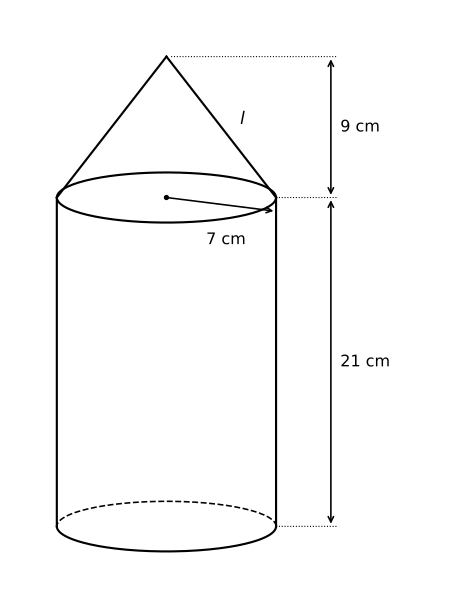
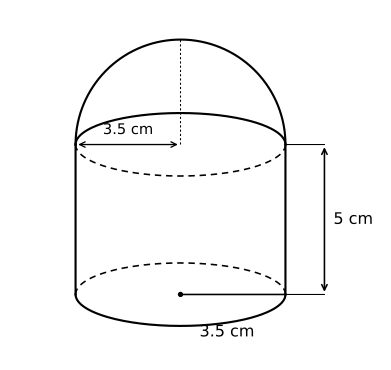
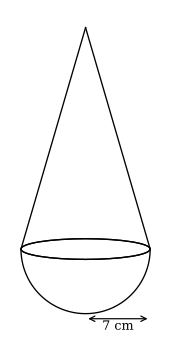
Riya, a craft teacher at a government school in Jaipur, prepared a decorative model for the annual science exhibition by joining a solid cone mounted on top of a solid hemisphere, both having the same base radius of 7 cm. The height of the cone is 24 cm and the radius of the hemisphere is also 7 cm. The model is to be painted and displayed as a showpiece representing a traditional lamp design.
Riya, a craft teacher at a government school in Jaipur, prepared a decorative model for the annual science exhibition by joining a solid cone mounted on top of a solid hemisphere, both having the same base radius of 7 cm. The height of the cone is 24 cm and the radius of the hemisphere is also 7 cm. The model is to be painted and displayed as a showpiece representing a traditional lamp design.
Show answerHide answer
Slant height of cone: l = √(r² + h²)
⟹ l = √(7² + 24²) = √(49 + 576) = √625
∴ Slant height of the cone = 25 cm
---
(ii)
Curved surface area of hemisphere = 2πr²
⟹ 2 × (22/7) × 7² = 2 × (22/7) × 49 = 2 × 154
∴ Curved surface area of hemisphere = 308 cm²
---
(iii)
Total surface area of the model = Curved surface area of cone + Curved surface area of hemisphere
(The base of the cone coincides with the flat face of the hemisphere; neither the base of the cone nor the flat base of the hemisphere is exposed.)
Curved surface area of cone = πrl = (22/7) × 7 × 25 = 22 × 25 = 550 cm²
Curved surface area of hemisphere = 2πr² = 308 cm² (calculated above)
⟹ Total surface area = 550 + 308
∴ Total surface area of the model = 858 cm²