Q1Case-based4 marks
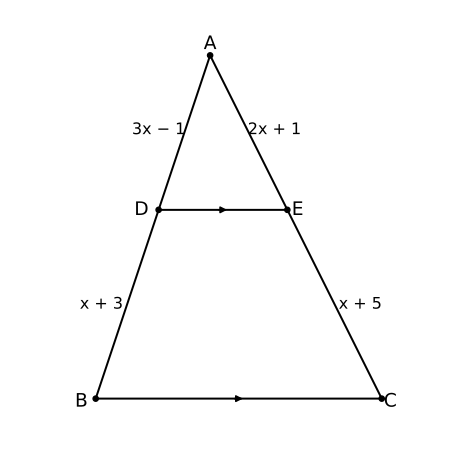
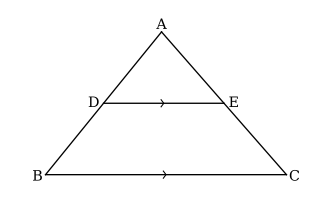
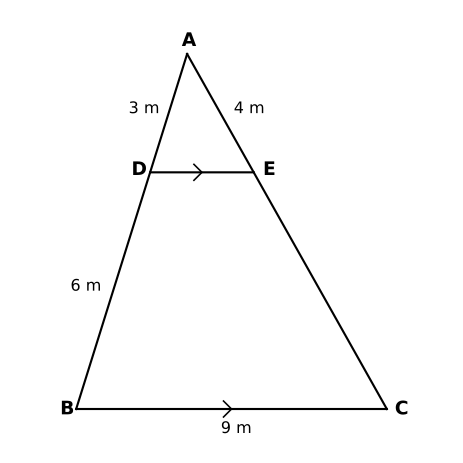
A school garden has a triangular flower bed ABC. The gardener places a wooden plank DE parallel to side BC, where D is a point on AB and E is a point on AC. The measurements are: AD = 3 m, DB = 6 m, and AE = 4 m. DE ∥ BC.
A school garden has a triangular flower bed ABC. The gardener places a wooden plank DE parallel to side BC, where D is a point on AB and E is a point on AC. The measurements are: AD = 3 m, DB = 6 m, and AE = 4 m.
(i) Find the length of EC. [1]
(ii) If BC = 9 m, find DE. [1]
(iii) The gardener wants to verify that △ADE ∼ △ABC. Prove that △ADE ∼ △ABC, clearly stating the similarity criterion used. [2]
Show answerHide answer
(i) By the Basic Proportionality Theorem (BPT), if a line is drawn parallel to one side of a triangle intersecting the other two sides in distinct points, it divides the two sides in the same ratio.
Since DE ∥ BC,
AD/DB = AE/EC
⟹ 3/6 = 4/EC
⟹ EC = (4 × 6)/3
∴ EC = 8 m
(ii) Since DE ∥ BC, △ADE ∼ △ABC (AA similarity — established in part iii).
Corresponding sides of similar triangles are proportional:
DE/BC = AD/AB
AB = AD + DB = 3 + 6 = 9 m
⟹ DE/9 = 3/9
⟹ DE = 3
∴ DE = 3 m
(iii) Given: DE ∥ BC, D on AB, E on AC.
To Prove: △ADE ∼ △ABC.
Proof:
Since DE ∥ BC,
∠ADE = ∠ABC (corresponding angles, DE ∥ BC with AB as transversal) …(i)
∠AED = ∠ACB (corresponding angles, DE ∥ BC with AC as transversal) …(ii)
In △ADE and △ABC,
∠DAE = ∠BAC (common angle) …(iii)
∠ADE = ∠ABC [from (i)]
⟹ △ADE ∼ △ABC (by AA similarity criterion)
Hence proved.
Since DE ∥ BC,
AD/DB = AE/EC
⟹ 3/6 = 4/EC
⟹ EC = (4 × 6)/3
∴ EC = 8 m
(ii) Since DE ∥ BC, △ADE ∼ △ABC (AA similarity — established in part iii).
Corresponding sides of similar triangles are proportional:
DE/BC = AD/AB
AB = AD + DB = 3 + 6 = 9 m
⟹ DE/9 = 3/9
⟹ DE = 3
∴ DE = 3 m
(iii) Given: DE ∥ BC, D on AB, E on AC.
To Prove: △ADE ∼ △ABC.
Proof:
Since DE ∥ BC,
∠ADE = ∠ABC (corresponding angles, DE ∥ BC with AB as transversal) …(i)
∠AED = ∠ACB (corresponding angles, DE ∥ BC with AC as transversal) …(ii)
In △ADE and △ABC,
∠DAE = ∠BAC (common angle) …(iii)
∠ADE = ∠ABC [from (i)]
⟹ △ADE ∼ △ABC (by AA similarity criterion)
Hence proved.