Meera works in a food quality testing laboratory. One day, she receives four different liquid samples labelled P, Q, R and S for identification. She is told that each sample is one of the following: ethanol, ethanoic acid, a soap solution, or a detergent solution. She performs a litmus test, a sodium bicarbonate test, and a hard water test on each sample, and records her observations in a table.
Read the following passage carefully and answer the questions that follow:
Meera works in a food quality testing laboratory. One day, she receives four different liquid samples labelled P, Q, R and S for identification. She is told that each sample is one of the following: ethanol, ethanoic acid, a soap solution, or a detergent solution. To identify them, she performs the following tests:
• Test 1 (Litmus test): She dips blue and red litmus paper into each sample.
• Test 2 (Sodium bicarbonate test): She adds a small amount of NaHCO₃ to each sample.
• Test 3 (Hard water test): She adds each sample to hard water (containing Ca²⁺ and Mg²⁺ ions) and shakes the mixture.
Her observations are summarised below:
| Sample | Litmus test | NaHCO₃ test | Hard water test |
|--------|-------------|-------------|------------------|
| P | Turns blue litmus red | Brisk effervescence, colourless gas evolved | Lather forms |
| Q | No change | No change | Lather forms freely, no scum |
| R | No change | No change | Lather forms, but white curdy precipitate forms |
| S | No change | No change | No lather, no precipitate |
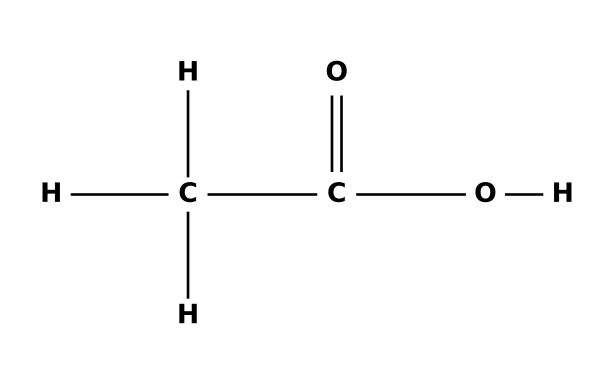
(a) Identify sample P and name the gas evolved in the NaHCO₃ test. [1 mark]
(b) Identify sample Q and explain why it forms lather freely even in hard water. [1 mark]
(c) Sample R forms a white curdy precipitate with hard water. Write the chemical equation for this reaction and state one advantage of sample Q over sample R in daily use. [2 marks]
OR
(c) Sample S is ethanol. Meera heats sample S gently with sample P in the presence of a few drops of concentrated H₂SO₄. Name the type of reaction that occurs, write the equation for this reaction, and state the role of concentrated H₂SO₄ in this reaction. [2 marks]
Show answerHide answer
The gas evolved in the NaHCO₃ test is carbon dioxide (CO₂).
[Award ½ mark for correct identification of P; ½ mark for naming CO₂]
(b) Sample Q is the detergent solution.
Detergents contain sulphonate (–SO₃Na) or sulphate (–OSO₃Na) groups. The calcium and magnesium salts of sulphonates are soluble in water, so they do not react with the Ca²⁺ and Mg²⁺ ions present in hard water. Therefore, no scum is formed and lather is produced freely even in hard water.
[Award ½ mark for correct identification of Q; ½ mark for correct explanation]
(c) Sample R is a soap solution. The white curdy precipitate is formed when soap reacts with Ca²⁺ ions in hard water to produce an insoluble calcium salt of the fatty acid (scum).
Chemical equation:
2C₁₇H₃₅COONa + CaCl₂ → (C₁₇H₃₅COO)₂Ca↓ + 2NaCl
(sodium stearate) (calcium stearate — white scum)
One advantage of sample Q (detergent) over sample R (soap) in daily use:
Detergent works effectively in hard water without forming scum, whereas soap reacts with Ca²⁺/Mg²⁺ ions in hard water to form an insoluble scum, wasting the soap and reducing its cleaning action.
[Award 1 mark for the correct balanced equation with precipitate symbol ↓; 1 mark for a correct stated advantage]
OR
(c) The type of reaction that occurs when ethanol (sample S) is heated with ethanoic acid (sample P) in the presence of concentrated H₂SO₄ is esterification (also called a condensation reaction).
Equation:
CH₃COOH + C₂H₅OH ⇌ CH₃COOC₂H₅ + H₂O
(ethanoic acid) (ethanol) (ethyl ethanoate) (water)
[Conditions: conc. H₂SO₄, heat — written above/below the reversible arrow]
Role of concentrated H₂SO₄: Concentrated H₂SO₄ acts as both a catalyst (speeds up the reaction) and a dehydrating agent (removes the water produced, helping to drive the equilibrium towards the formation of the ester).
[Award 1 mark for naming the reaction AND writing the correct balanced equation with reversible arrow and conditions; 1 mark for stating BOTH roles of conc. H₂SO₄ — catalyst AND dehydrating agent]