ClearStepsCLEARSTEPS AI
Teacher Login →Student Login →

Electricity: Class 10 Science Practice Questions

30 original exam-pattern questions with full answers, matched to the current CBSE Class 10 paper design, including case-based questions. Attempt each question before opening the answer — or start a free 14-day trial ↓ for the full bank.

Q1Case-based4 marks

A school science club has set up a small energy monitoring station. They connected three resistors — R₁ = 6 Ω, R₂ = 3 Ω, and R₃ = 9 Ω — in a circuit to study how power is distributed. R₁ and R₂ are connected in parallel, and this parallel combination is connected in series with R₃. The entire circuit is powered by a 12 V battery (internal resistance negligible).

A school science club has set up a small energy monitoring station. They connected three resistors — R₁ = 6 Ω, R₂ = 3 Ω, and R₃ = 9 Ω — in a circuit to study how power is distributed. R₁ and R₂ are connected in parallel, and this parallel combination is connected in series with R₃. The entire circuit is powered by a 12 V battery (internal resistance negligible).

On the basis of the above information, answer the following questions:

(a) Calculate the equivalent resistance of R₁ and R₂ in parallel.

(b) Calculate the total current drawn from the battery.

(c) The club members noticed that R₃ becomes noticeably warm after some time, while R₁ and R₂ remain comparatively cooler. Using the formula for power, calculate the power dissipated in R₃ and in the parallel combination (R₁ ∥ R₂), and explain why R₃ heats up more.
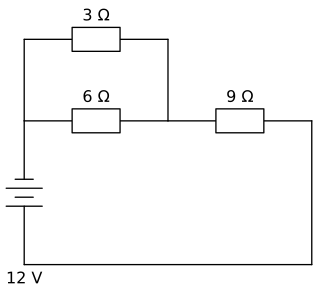
Diagram for question 1: Electricity
Show answer
(a) Equivalent resistance of R₁ and R₂ in parallel:

Formula: 1/R_parallel = 1/R₁ + 1/R₂

1/R_parallel = 1/6 + 1/3 = 1/6 + 2/6 = 3/6 = 1/2

∴ R_parallel = 2 Ω [1 mark]

(b) Total current drawn from the battery:

Total resistance of circuit = R_parallel + R₃ = 2 + 9 = 11 Ω

Using Ohm's Law: I = V/R_total

I = 12/11 ≈ 1.09 A

∴ Total current drawn from the battery = 12/11 A ≈ 1.09 A [1 mark]

(c) The same total current I = 12/11 A flows through R₃ (series element) and through the parallel combination.

Voltage across R₃:
V₃ = I × R₃ = (12/11) × 9 = 108/11 ≈ 9.82 V

Voltage across parallel combination:
V_p = I × R_parallel = (12/11) × 2 = 24/11 ≈ 2.18 V

Power dissipated in R₃:
P₃ = V₃²/R₃ = (108/11)²/9 = (11664/121)/9 = 11664/1089 ≈ 10.71 W

Alternatively: P₃ = I²R₃ = (12/11)² × 9 = (144/121) × 9 = 1296/121 ≈ 10.71 W

Power dissipated in parallel combination:
P_p = I²R_parallel = (144/121) × 2 = 288/121 ≈ 2.38 W

Explanation: In a series circuit, the same current flows through all elements. Power dissipated is given by P = I²R. Since R₃ = 9 Ω is much larger than R_parallel = 2 Ω, and the same current passes through both, R₃ dissipates far more power (≈ 10.71 W) than the parallel combination (≈ 2.38 W). By Joule's law of heating (H = I²Rt), more power dissipated means more heat produced per second — hence R₃ becomes noticeably warmer. [2 marks]
Q2Case-based4 marks

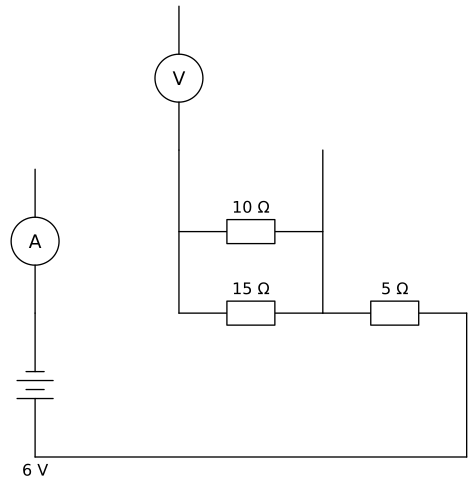
A 6 V battery is connected to Resistor P (15 Ω) and Resistor Q (10 Ω) in parallel. This parallel combination is connected in series with Resistor R (5 Ω). An ammeter is in the main line and a voltmeter is across the parallel combination of P and Q.

A student sets up the following circuit for a science project: A 6 V battery is connected to two resistors. Resistor P (15 Ω) and Resistor Q (10 Ω) are connected in parallel with each other. This parallel combination is then connected in series with Resistor R (5 Ω). An ammeter is connected in the main line (in series) and a voltmeter is connected across the parallel combination.

(a) What is the equivalent resistance of the parallel combination of P and Q? [1 mark]
(b) What is the total current drawn from the battery? [1 mark]
(c) (i) What is the reading of the voltmeter connected across the parallel combination? [1 mark]
(ii) What is the current flowing through Resistor P (15 Ω)? [1 mark]

OR (c)
(i) The student replaces Resistor R (5 Ω) with a wire of negligible resistance. State what happens to the total current drawn from the battery and give a reason. [1 mark]
(ii) If the material of Resistor R is used to make a new wire of the same resistance (5 Ω) but with double the length, what must be done to its area of cross-section compared to the original? Justify using the formula for resistance. [1 mark]

Diagram for question 2: Electricity
Show answer
(a) The equivalent resistance of P and Q in parallel:

1/R_PQ = 1/P + 1/Q = 1/15 + 1/10

1/R_PQ = 2/30 + 3/30 = 5/30 = 1/6

∴ R_PQ = 6 Ω [1 mark]

(b) Total resistance in the circuit:

R_total = R_PQ + R = 6 + 5 = 11 Ω

Using Ohm's Law: I = V / R_total

I = 6 / 11

∴ Total current drawn from battery = 6/11 A ≈ 0.55 A [1 mark]

(c)(i) The voltmeter is connected across the parallel combination (R_PQ = 6 Ω).

The same current (6/11 A) flows through R and then through the parallel combination.

Voltage across parallel combination:

V_PQ = I × R_PQ = (6/11) × 6 = 36/11 V ≈ 3.27 V

∴ Voltmeter reading = 36/11 V ≈ 3.3 V [1 mark]

(c)(ii) Current through Resistor P (15 Ω):

In a parallel combination, the voltage across each branch is the same = 36/11 V.

Using Ohm's Law for branch P:

I_P = V_PQ / P = (36/11) / 15 = 36 / 165 = 12/55 A ≈ 0.22 A

∴ Current through P = 12/55 A ≈ 0.22 A [1 mark]

---

OR (c)

(c)(i) When Resistor R (5 Ω) is replaced by a wire of negligible resistance:

The total resistance of the circuit decreases from 11 Ω to 6 Ω (only the parallel combination remains).

Since I = V/R and the battery voltage (6 V) remains the same, a lower resistance means a higher current.

∴ The total current drawn from the battery increases. This is because current is inversely proportional to resistance (Ohm's Law: I ∝ 1/R at constant V). [1 mark]

(c)(ii) The resistance of a wire is given by: R = ρl/A

For the original wire: R = ρl/A = 5 Ω

For the new wire: length = 2l, resistance must remain = 5 Ω.

5 = ρ(2l) / A_new

∴ A_new = ρ(2l) / 5 = 2 × (ρl/5) = 2 × A (since ρl/A = 5 → ρl = 5A)

∴ The area of cross-section must be doubled.

Justification: R = ρl/A. If length is doubled (l → 2l), resistance would double unless area is also doubled (A → 2A), which keeps R = ρ(2l)/(2A) = ρl/A = 5 Ω unchanged. [1 mark]
Q3Case-based4 marks

A housing society has three flats on the same floor, each connected to the main 220 V supply through separate circuits. Flat A uses a 1100 W air conditioner, a 60 W fan, and a 40 W lamp simultaneously. Flat B uses only a 550 W washing machine. Flat C uses a 2.2 kW geyser. Each flat's circuit is protected by its own fuse rated at 5 A.

Read the following passage and answer the questions that follow:

A housing society has three flats on the same floor, each connected to the main 220 V supply through separate circuits. Flat A uses a 1100 W air conditioner, a 60 W fan, and a 40 W lamp simultaneously. Flat B uses only a 550 W washing machine. Flat C uses a 2.2 kW geyser. Each flat's circuit is protected by its own fuse rated at 5 A.

(a) Calculate the total power consumed by Flat A when all three appliances are running simultaneously.

(b) The owner of Flat C switches on the geyser. Will the fuse in Flat C's circuit blow? Justify your answer with a calculation.

(c) The electrician suggests replacing fuses with MCBs (Miniature Circuit Breakers). State any TWO advantages of using MCBs over fuses in domestic circuits.

Show answer
(a) Total power consumed by Flat A:

P_total = P_AC + P_fan + P_lamp
∴ P_total = 1100 + 60 + 40
∴ P_total = 1200 W

[1 mark]

(b) Current drawn by the geyser in Flat C:

Formula: I = P / V

Given: P = 2.2 kW = 2200 W, V = 220 V

Substituting:
I = 2200 / 220
∴ I = 10 A

The current drawn by the geyser (10 A) is much greater than the rated value of the fuse (5 A). Hence, the fuse wire will melt and break the circuit. So the fuse in Flat C's circuit will blow when the geyser is switched on.

[1 mark]

(c) Two advantages of MCBs over fuses:

(i) An MCB can be reset (switched back on) after it trips, whereas a fuse wire melts and must be replaced every time it blows.

(ii) An MCB operates faster than a fuse — it trips almost instantly when excess current flows, providing quicker protection to appliances and the circuit.

[1 + 1 = 2 marks]
Q4Case-based4 marks

Riya's home has the following appliances running every day:
• 4 LED bulbs, each of 10 W, used for 5 hours
• 1 electric fan of 75 W, used for 8 hours
• 1 electric iron of 1000 W, used for 1 hour
Electricity charge: ₹6 per unit. Supply voltage: 220 V.

Riya's science teacher asked the class to investigate how household appliances consume electricity. Riya noted that her home has the following appliances running every day:

• 4 LED bulbs, each of 10 W, used for 5 hours
• 1 electric fan of 75 W, used for 8 hours
• 1 electric iron of 1000 W, used for 1 hour

The electricity board charges ₹6 per unit (1 unit = 1 kWh). The household is supplied at 220 V.

(a) Calculate the total electrical energy consumed by all the appliances in ONE day. Give your answer in kWh (units).

(b) What is the cost of electricity consumed in one day?

(c) Riya notices that the electric iron is connected to a 5 A fuse. Her mother says the fuse will blow when the iron is switched on. Is her mother correct? Justify your answer with a calculation.

OR

(c) If Riya replaces the four 10 W LED bulbs with four 40 W incandescent bulbs (keeping usage time the same), by how much does the total daily energy consumption increase? Also state ONE reason why LED bulbs are preferred over incandescent bulbs.

Show answer
(a) Total energy consumed in one day:

Formula: Energy (kWh) = Power (kW) × Time (h)

• 4 LED bulbs: E₁ = 4 × 10 W × 5 h = 200 Wh = 0.2 kWh
• Electric fan: E₂ = 75 W × 8 h = 600 Wh = 0.6 kWh
• Electric iron: E₃ = 1000 W × 1 h = 1000 Wh = 1.0 kWh

Total energy = 0.2 + 0.6 + 1.0 = 1.8 kWh

∴ Total electrical energy consumed per day = 1.8 units (kWh) [1 mark]

(b) Cost of electricity consumed in one day:

Formula: Cost = Total units × Rate per unit

Cost = 1.8 × ₹6 = ₹10.80

∴ Cost of electricity for one day = ₹10.80 [1 mark]

(c) Checking whether the 5 A fuse will blow when the iron is switched on:

Given: Power of electric iron P = 1000 W, Voltage V = 220 V

Formula: I = P/V

Substituting: I = 1000/220 ≈ 4.55 A

The current drawn by the iron (≈ 4.55 A) is less than the fuse rating (5 A).

∴ Riya's mother is NOT correct. The fuse will NOT blow because the current drawn by the iron (≈ 4.55 A) is below the rated fuse value of 5 A. The fuse melts only when current exceeds its rated value. [2 marks]

OR

(c) Energy consumed by 4 LED bulbs (original): E_LED = 4 × 10 W × 5 h = 200 Wh = 0.2 kWh

Energy consumed by 4 incandescent bulbs (40 W each): E_inc = 4 × 40 W × 5 h = 800 Wh = 0.8 kWh

Increase in daily energy consumption = 0.8 − 0.2 = 0.6 kWh

∴ The total daily energy consumption increases by 0.6 kWh (0.6 units).

Reason: LED bulbs are preferred because they consume much less electrical energy (power) than incandescent bulbs to produce the same amount of light, thus reducing electricity bills and heat loss. [2 marks]
Q5Case-based4 marks

Riya is helping her mother in the kitchen. She notices that the electric kettle (rated 1500 W, 230 V) and the electric toaster (rated 750 W, 230 V) are both plugged into the same power strip connected to a 230 V supply. The house has a 5 A fuse on that circuit.

Riya is helping her mother in the kitchen. She notices that the electric kettle (rated 1500 W, 230 V) and the electric toaster (rated 750 W, 230 V) are both plugged into the same power strip connected to a 230 V supply. The house has a 5 A fuse on that circuit. Read the situation carefully and answer the following questions:

(a) Write the formula that relates power (P), potential difference (V) and current (I). [1 mark]

(b) Calculate the current drawn by the electric kettle alone when connected to the 230 V supply. [1 mark]

(c) Riya's mother switches on both the kettle and the toaster at the same time. Will the 5 A fuse blow? Justify your answer with a calculation. [2 marks]

Show answer
(a) The formula that relates power, potential difference and current is:

P = V × I

[1 mark]

(b) Current drawn by the electric kettle:

Given: P = 1500 W, V = 230 V

Formula: P = V × I

⟹ I = P / V

⟹ I = 1500 / 230

∴ I = 6.52 A (approximately 6.5 A)

[1 mark]

(c) Current drawn by the toaster alone:

Given: P = 750 W, V = 230 V

I_toaster = P / V = 750 / 230 = 3.26 A (approximately 3.3 A)

Since both appliances are connected to the same 230 V supply (in parallel), the total current drawn is the sum of the individual currents:

I_total = I_kettle + I_toaster

⟹ I_total = 6.52 + 3.26

∴ I_total = 9.78 A (approximately 9.8 A)

The total current drawn (≈ 9.8 A) is much greater than the rated value of the fuse (5 A). Hence, the fuse will melt and break the circuit. So, both appliances cannot be used simultaneously on this circuit.

[2 marks — 1 mark for correct total current calculation; 1 mark for correct conclusion with justification]
Q6Case-based4 marks

A household in a village uses three electrical appliances: a water pump of power 1500 W, a room heater of power 2000 W, and a set of LED lights totalling 100 W. All appliances operate at 220 V and are connected in parallel to the domestic supply. The household has a single fuse of rating 15 A on the live wire. One evening, all three appliances are switched on simultaneously. The room heater has a nichrome heating element. The wiring in the house uses copper conductors.

Read the following passage and answer the questions that follow:

A household in a village uses three electrical appliances: a water pump of power 1500 W, a room heater of power 2000 W, and a set of LED lights totalling 100 W. All appliances operate at 220 V and are connected in parallel to the domestic supply. The household has a single fuse of rating 15 A on the live wire. One evening, all three appliances are switched on simultaneously. The room heater has a nichrome heating element. The wiring in the house uses copper conductors.

(a) Calculate the total current drawn from the supply when all three appliances are operating simultaneously. State whether the fuse will blow or not, giving a reason.

(b) The electrician suggests replacing the nichrome heating element with a copper wire of the same length and cross-sectional area. Give ONE reason why this suggestion is technically incorrect.

(c) The room heater (2000 W, 220 V) operates for 2 hours every day for 30 days. Calculate the electrical energy consumed by the heater in this period in kWh and find the cost of this energy at ₹6 per unit.

OR

(c) The resistance of the water pump's motor coil is 32.27 Ω. Calculate the current through it and the heat generated in the motor coil in 1 minute of operation. (Use V = 220 V)

Show answer
(a) Formula: I = P/V

Total power = 1500 + 2000 + 100 = 3600 W

Total current drawn:
I = P/V = 3600/220 ≈ 16.36 A

∴ Total current drawn ≈ 16.4 A

The fuse WILL blow. The current drawn (≈ 16.4 A) exceeds the rated fuse value of 15 A. Hence the fuse wire will melt and break the circuit, disconnecting the supply to protect the wiring and appliances.
[1 mark: correct calculation of current; 1 mark: correct conclusion with reason]

(b) Nichrome has a much higher resistivity than copper. If the heating element were replaced with a copper wire of the same dimensions (same length and same area of cross-section), its resistance would be far lower (since R = ρl/A and ρ of copper << ρ of nichrome). A lower resistance would draw a very large current (by Ohm's law, I = V/R), which could overheat the copper wire and damage the circuit. Moreover, copper has a low melting point compared to nichrome and would melt or oxidise rapidly at the high operating temperatures required for a heater. Nichrome is specifically used because it has high resistivity (so it generates adequate heat at safe current levels) and does not oxidise readily at high temperatures.
[Any ONE correct, complete reason earns 1 mark — e.g. high resistivity of nichrome OR nichrome does not oxidise at high temperature. Both may be stated; only 1 mark awarded for this part.]

(c) Energy consumed by room heater:

Formula: E = P × t

P = 2000 W = 2 kW
t = 2 hours/day × 30 days = 60 hours

E = 2 kW × 60 h = 120 kWh

∴ Energy consumed = 120 kWh (120 units)

Cost = 120 × ₹6 = ₹720

∴ Cost of electrical energy consumed = ₹720
[1 mark: correct energy in kWh; 1 mark: correct cost]

OR

(c) Formula: V = IR ⟹ I = V/R

I = 220/32.27 ≈ 6.82 A

Heat generated in motor coil in 1 minute:
Formula: H = I²Rt

t = 1 min = 60 s
R = 32.27 Ω
I ≈ 6.82 A

H = (6.82)² × 32.27 × 60
H = 46.51 × 32.27 × 60
H = 46.51 × 1936.2
H ≈ 90,045 J ≈ 9.0 × 10⁴ J

∴ Current through motor coil ≈ 6.82 A; Heat generated in 1 minute ≈ 9.0 × 10⁴ J
[1 mark: correct current; 1 mark: correct heat with formula and substitution shown]
Q7Case-based4 marks

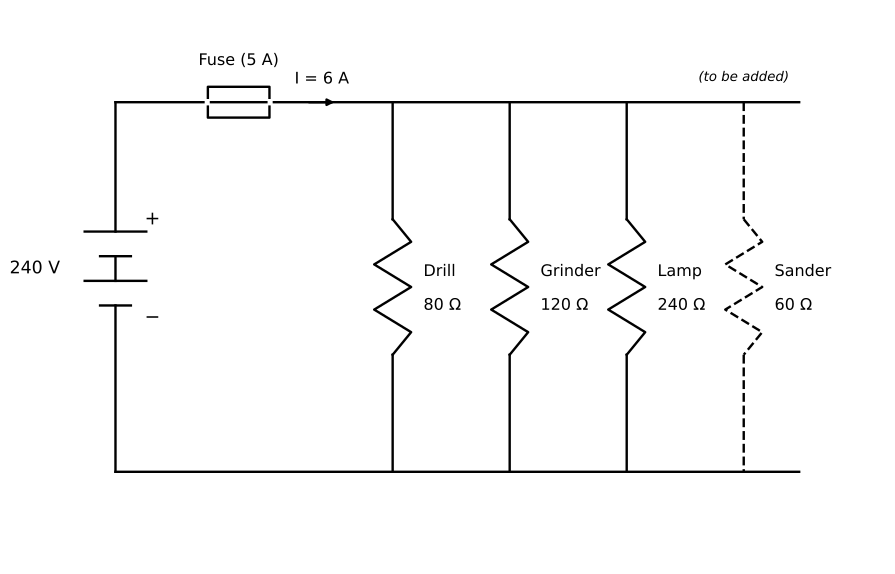
A household technician is designing an extension board for a small home workshop. The board has three power outlets, each connected in parallel. The technician connects the following tools simultaneously: an electric drill of resistance 80 Ω, a bench grinder of resistance 120 Ω, and a work lamp of resistance 240 Ω. The entire extension board is connected to the domestic supply of 240 V through a fuse rated at 5 A.

A household technician is designing an extension board for a small home workshop. The board has three power outlets, each connected in parallel. The technician connects the following tools simultaneously: an electric drill of resistance 80 Ω, a bench grinder of resistance 120 Ω, and a work lamp of resistance 240 Ω. The entire extension board is connected to the domestic supply of 240 V through a fuse rated at 5 A.

Answer the following:
(a) What is the equivalent resistance of the three tools connected in parallel?
(b) What is the total current drawn from the supply when all three tools are operating simultaneously?
(c) The technician wants to add a fourth tool — an electric sander of resistance 60 Ω — to the same extension board. Should the existing 5 A fuse be replaced before connecting the sander? Justify your answer with a calculation.

Diagram for question 7: Electricity
Show answer
(a) Equivalent resistance of the three tools:

Formula for resistors in parallel:
1/R_p = 1/R₁ + 1/R₂ + 1/R₃

1/R_p = 1/80 + 1/120 + 1/240

Taking LCM of 80, 120, 240 = 240:
1/R_p = 3/240 + 2/240 + 1/240
1/R_p = 6/240
1/R_p = 1/40

∴ R_p = 40 Ω

[1 mark]

(b) Total current drawn from the supply:

Using Ohm's Law: I = V/R

I = 240/40

∴ I = 6 A

[1 mark]

(c) Current drawn when the electric sander (60 Ω) is also connected in parallel:

New equivalent resistance:
1/R_new = 1/R_p + 1/R_sander
1/R_new = 1/40 + 1/60

Taking LCM of 40 and 60 = 120:
1/R_new = 3/120 + 2/120
1/R_new = 5/120
1/R_new = 1/24

∴ R_new = 24 Ω

New total current:
I_new = V/R_new = 240/24 = 10 A

The total current with all four tools is 10 A, which is much greater than the rated value of the fuse (5 A). Hence the fuse will melt and break the circuit.

Yes, the existing 5 A fuse must be replaced with a fuse of higher rating (at least 10 A) before connecting the sander. If the 5 A fuse is not replaced, it will blow immediately when the sander is switched on, cutting off power to the entire board.

[2 marks]
Q8Case-based4 marks

A household in a village has the following appliances running simultaneously on a 220 V supply: a ceiling fan rated 80 W, a refrigerator rated 200 W, two LED bulbs each rated 15 W, and an electric iron rated 1100 W. The house is protected by a 5 A fuse on the main supply line. The family notices that every time they switch on the electric iron along with the other appliances, the fuse blows.

Read the following scenario carefully and answer the questions that follow:

A household in a village has the following appliances running simultaneously on a 220 V supply:
• A ceiling fan rated 80 W
• A refrigerator rated 200 W
• Two LED bulbs, each rated 15 W
• An electric iron rated 1100 W

The house is protected by a 5 A fuse on the main supply line. The family notices that every time they switch on the electric iron along with the other appliances, the fuse blows.

(a) Calculate the total power consumed when ALL the appliances listed above are running simultaneously. [1 mark]

(b) Calculate the total current drawn from the 220 V supply when all appliances are running. Hence explain why the fuse blows when the electric iron is switched on. [1 mark]

(c) (i) The electric iron has a heating element made of an alloy (nichrome). State TWO reasons why an alloy is preferred over a pure metal for making heating elements.
(ii) If the heating element of the iron has resistance 44 Ω, calculate the heat produced in it in 2 minutes when connected to the 220 V supply. [2 marks]

OR

(c) A wireman suggests replacing the 5 A fuse with a 10 A fuse so that the fuse does not blow. Explain whether this is a safe suggestion. Also suggest TWO safe alternatives the family can adopt instead. [2 marks]

Show answer
(a) Total power consumed when all appliances are running:

P_total = P_fan + P_refrigerator + P_bulbs + P_iron
P_total = 80 + 200 + (2 × 15) + 1100
P_total = 80 + 200 + 30 + 1100
∴ P_total = 1410 W [1 mark]

(b) Total current drawn from the 220 V supply:

Using the formula: I = P / V

I = P_total / V = 1410 / 220
∴ I ≈ 6.4 A

The rated capacity of the fuse is 5 A. When all appliances including the electric iron are switched on, the total current drawn (≈ 6.4 A) exceeds the fuse rating (5 A). The fuse wire, having a low melting point, heats up due to the excess current and melts, breaking the circuit. This is why the fuse blows every time the electric iron is switched on along with the other appliances. [1 mark]

(c) (i) Two reasons why an alloy (nichrome) is preferred over a pure metal for heating elements:

(1) Alloys have higher resistivity than pure metals, so they produce more heat for the same current and dimensions (H = I²Rt; higher R → more heat produced).
(2) Alloys do not oxidise (burn) readily at high temperatures, making them durable for repeated heating. [1 mark]

(c) (ii) Heat produced in the heating element:

Given: R = 44 Ω, V = 220 V, t = 2 minutes = 2 × 60 = 120 s

First, find the current through the element:
I = V / R = 220 / 44 = 5 A

Using Joule's Law of Heating:
H = I²Rt
H = (5)² × 44 × 120
H = 25 × 44 × 120
H = 25 × 5280
∴ H = 1,32,000 J = 1.32 × 10⁵ J [1 mark]

—— OR ——

(c) The wireman's suggestion of replacing the 5 A fuse with a 10 A fuse is NOT safe.

A fuse is a safety device — it is designed to melt and break the circuit when the current exceeds a safe limit, thereby protecting the appliances and wiring from overheating, which could cause fire or electric shocks. If a 10 A fuse is installed, it will not blow even when the current drawn is 6.4 A, but it will also fail to protect the circuit if a fault causes a much larger dangerous current to flow. The wiring in the house is rated only for currents up to a safe value; allowing excess current to flow continuously can overheat the wires, melt their insulation, and cause a short circuit or fire. Replacing a lower-rated fuse with a higher-rated fuse defeats the purpose of the safety device entirely and is a serious hazard. [1 mark]

Two safe alternatives the family can adopt:
(1) Switch off one or more lower-power appliances (such as the refrigerator or fan) before switching on the electric iron, so that the total current drawn remains within 5 A.
(2) Install a separate higher-rated circuit (with appropriately rated wiring and a 10 A or 15 A MCB/fuse) specifically for high-power appliances like the electric iron, so each circuit is protected correctly. [1 mark]
Q9Short Answer1 mark

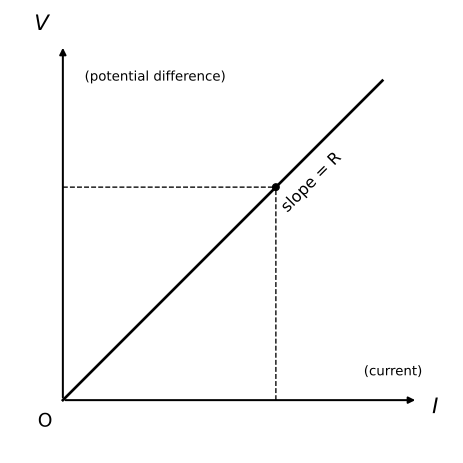
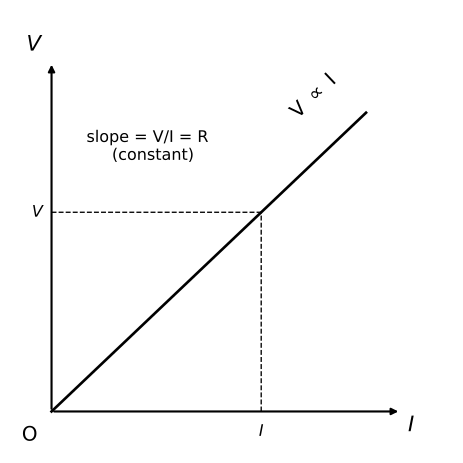
Assertion (A): The V-I graph for a resistor (at constant temperature) is a straight line passing through the origin.
Reason (R): According to Ohm's law, the potential difference across a conductor is directly proportional to the current flowing through it, provided the physical conditions such as temperature remain constant.

Diagram for question 9: Electricity
Show answer
Option (a) is correct.

The Assertion is true: for a resistor maintained at constant temperature, the V-I graph is a straight line passing through the origin, because the resistance R remains constant and V = IR gives a linear relationship. The Reason is also true: Ohm's law states that the potential difference across a conductor is directly proportional to the current flowing through it (V ∝ I), provided the temperature remains constant. The Reason is the correct explanation of the Assertion, because it is precisely this direct proportionality (V ∝ I, with R as the constant of proportionality) that produces a straight-line V-I graph passing through the origin.
Q10MCQ1 mark

A wire of resistance R is stretched uniformly so that its length becomes twice its original length. What is the new resistance of the wire?

Show answer
Option (D) is correct.

Explanation: Resistance is given by R = ρl/A, where ρ is the resistivity of the material, l is the length, and A is the area of cross-section. When the wire is stretched to double its length, its volume remains constant. Since volume = l × A, doubling the length means the area of cross-section becomes A/2. Substituting into the formula, new resistance = ρ(2l)/(A/2) = 4ρl/A = 4R.
Q11Short Answer1 mark

Assertion (A): A fuse wire is always connected in series with the live wire in a domestic electric circuit.
Reason (R): When excess current flows, the fuse wire melts and breaks the circuit, thereby protecting the appliances.

Show answer
Option (A) is correct.

Assertion A is true: a fuse wire is always connected in series with the live wire so that when it melts, the circuit breaks completely and no current can reach the appliance. Reason R is also true: the fuse wire is made of an alloy with a low melting point, so when the current exceeds the rated (safe) limit, the wire heats up rapidly due to Joule's heating effect (H = I²Rt) and melts, breaking the circuit and protecting the appliances from damage. R is the correct explanation of A because the very purpose of placing the fuse in series on the live wire is to ensure this protective melting action whenever excess current flows.
Q12Short Answer1 mark

Assertion (A): In household electric circuits, all appliances are connected in parallel with the main supply.
Reason (R): In a parallel connection, if one appliance fails or is switched off, the others continue to receive the same voltage and operate independently.

Show answer
Option (a) is correct.

Assertion (A) is true: in household electric circuits, all appliances are connected in parallel with the main supply so that each appliance receives the full supply voltage of 230 V. Reason (R) is also true: in a parallel connection, each appliance is on an independent branch, so if one appliance fails or is switched off, the remaining branches continue to receive the same voltage and operate without interruption. R is the correct explanation of A because it is precisely this property of parallel circuits — independent operation at constant voltage across each branch — that makes parallel connection the standard choice for domestic wiring.
Q13Short Answer1 mark

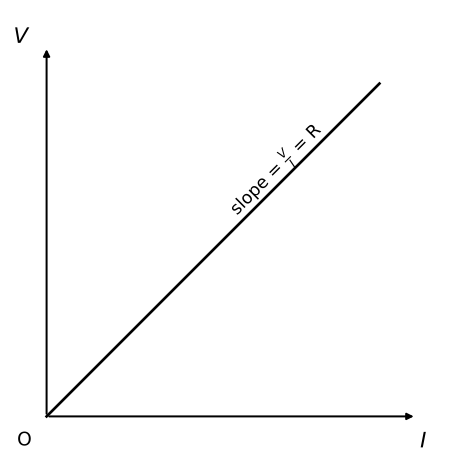
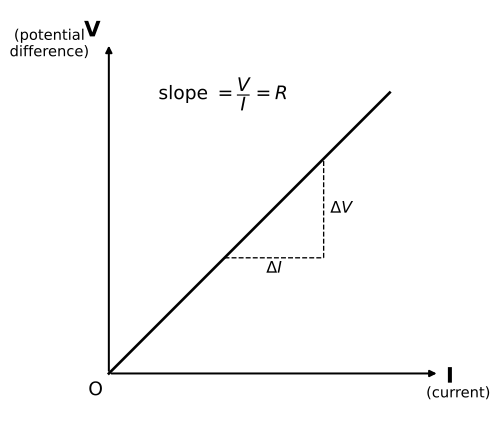
Assertion (A): The graph between potential difference (V) and current (I) for a metallic conductor at constant temperature is a straight line passing through the origin.
Reason (R): For a metallic conductor at constant temperature, the resistance remains constant and the ratio V/I is always fixed, which is the mathematical statement of Ohm's law.

Diagram for question 13: Electricity
Show answer
Option (A) is correct. Ohm's law states that for a metallic conductor at constant temperature, the potential difference V across it is directly proportional to the current I flowing through it, giving V = IR where R is constant. Since V ∝ I with R constant, the V–I graph is a straight line passing through the origin, making Assertion (A) true. The Reason (R) is also true: because resistance remains constant at constant temperature, the ratio V/I is always fixed — this is precisely the mathematical statement of Ohm's law — and this constancy of R is the direct cause of the linear V–I relationship described in the Assertion. Therefore R is the correct explanation of A.
Q14Short Answer1 mark

Assertion (A): In household electric circuits, all appliances are connected in parallel with the main supply line.
Reason (R): In a parallel connection, each appliance gets the same voltage as the supply voltage and can be operated independently without affecting other appliances.

Show answer
Option (a) is correct.

Explanation: The Assertion is true — in household electric circuits, all appliances are connected in parallel with the main supply line. The Reason is also true — in a parallel connection, each branch maintains the same potential difference as the supply voltage, and each appliance can be switched on or off independently without affecting the operation of other appliances. R is the correct explanation of A, because it is precisely these two properties of parallel connection — equal voltage across each appliance and independent operation — that make parallel connection the preferred arrangement for domestic circuits.
Q15MCQ1 mark

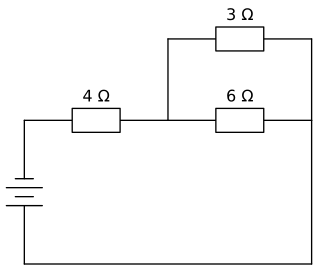
Two resistors of 6 Ω and 3 Ω are connected in parallel. The parallel combination is then connected in series with a 4 Ω resistor. What is the total equivalent resistance of the circuit?

Diagram for question 15: Electricity
Show answer
Option (B) is correct.

Explanation: For resistors in parallel, the equivalent resistance R_p is given by 1/R_p = 1/R₁ + 1/R₂. Here R₁ = 6 Ω and R₂ = 3 Ω, so 1/R_p = 1/6 + 1/3 = 1/6 + 2/6 = 3/6 = 1/2, giving R_p = 2 Ω. This parallel combination is in series with 4 Ω, so the total equivalent resistance R_total = R_p + 4 = 2 + 4 = 6 Ω.
Q16MCQ1 mark

In a resistor, if the potential difference across it is doubled, by what factor does the power dissipated in it change?

Show answer
Option (D) is correct.
Explanation: Power dissipated in a resistor is given by P = V²/R. If the potential difference V is doubled (V becomes 2V), then the new power P' = (2V)²/R = 4V²/R = 4P. Therefore, the power dissipated becomes four times the original value.
Q17MCQ1 mark

A wire of resistance R is stretched uniformly until its length becomes double. What is the new resistance of the wire?

Show answer
Option (D) is correct.

Explanation: Resistance is given by R = ρl/A, where ρ is the resistivity of the material, l is the length, and A is the area of cross-section. When the wire is stretched to double its length, its volume remains constant (volume = l × A). Since volume = l × A = 2l × A′, the new area of cross-section becomes A′ = A/2. Substituting into the formula, new resistance R′ = ρ(2l)/(A/2) = 4ρl/A = 4R.
Q18Short Answer1 mark

Assertion (A): Resistors connected in series have the same current flowing through each resistor.
Reason (R): In a series circuit, there is only one path for the current to flow, so the same amount of charge passes through each component per unit time.

Show answer
Option (a) is correct.

The Assertion is true: in a series circuit, the same current flows through every resistor because there is only one conducting path available. The Reason is also true and is the correct explanation of the Assertion — since there is only one path for current to flow, the same amount of charge must pass through each component per unit time, which by definition (I = Q/t) means the current is identical throughout the series combination. Thus R correctly and completely explains A.
Q19Short Answer1 mark

State Ohm's Law.

Show answer
The potential difference V across the ends of a given metallic wire in an electric circuit is directly proportional to the current I flowing through it, provided its temperature remains the same.

Formula: V ∝ I → V = IR
Q20Short Answer1 mark

Assertion (A): The graph between potential difference (V) and current (I) through a metallic conductor is a straight line passing through the origin.
Reason (R): For a metallic conductor at constant temperature, the ratio of potential difference to current remains constant, which is known as Ohm's law.

Diagram for question 20: Electricity
Show answer
Option (a) is correct.

The Assertion is true: for a metallic conductor at constant temperature, the potential difference V and current I are directly proportional, so the V–I graph is a straight line passing through the origin. The Reason is also true: Ohm's law states that the ratio V/I remains constant for a metallic conductor provided its temperature remains the same, which means V ∝ I — a constant ratio is precisely the condition that produces a straight-line graph through the origin. Therefore, R is the correct explanation of A.
Q21MCQ1 mark

A resistor of resistance 5 Ω is connected across a battery of 10 V. What is the current flowing through the resistor?

Show answer
Option (B) is correct.
Explanation: By Ohm's Law, the potential difference V across the ends of a given metallic wire is directly proportional to the current I flowing through it, provided its temperature remains the same, giving V = IR. Here V = 10 V and R = 5 Ω, so I = V/R = 10/5 = 2 A.
Q22MCQ1 mark

Three identical resistors, each of resistance 6 Ω, are connected in parallel. The equivalent resistance of the combination is:

Show answer
Option (D) is correct.

Explanation: For resistors connected in parallel, the reciprocal of the equivalent resistance equals the sum of the reciprocals of the individual resistances. Here, 1/R_p = 1/6 + 1/6 + 1/6 = 3/6 = 1/2, giving R_p = 2 Ω.
Q23Short Answer1 mark

Assertion (A): In household electric circuits, all appliances are connected in parallel with the mains supply.
Reason (R): In a parallel connection, if one appliance fails or is switched off, the others continue to operate independently, and each appliance receives the same voltage as the mains supply.

Show answer
Option (a) is correct.

Explanation: The Assertion is true — in household electric circuits, all appliances are connected in parallel with the mains supply. The Reason is also true — in a parallel connection, each appliance is on its own separate branch, so if one fails or is switched off, the circuit through all other branches remains complete and each branch receives the same voltage as the mains supply. This is precisely the reason why parallel connection is used in domestic wiring: it ensures independent operation of each appliance and equal voltage across all of them. Thus R is the correct explanation of A.
Q24Short Answer1 mark

Assertion (A): In household electric circuits, all appliances are connected in parallel with the main supply line.
Reason (R): In a parallel connection, if one appliance fails or is switched off, the others continue to receive the same voltage and operate independently.

Show answer
Option (a) is correct.

The Assertion is true: in household electric circuits, all appliances are connected in parallel with the main supply line, so each appliance receives the full supply voltage of 230 V. The Reason is also true: in a parallel connection, each appliance has an independent current path, so if one appliance fails or is switched off, the circuits of the remaining appliances remain complete and they continue to operate at the same voltage without interruption. The Reason is the correct explanation of the Assertion, because it is precisely this property of parallel connections — independent operation at the same voltage across each branch — that makes parallel wiring the standard arrangement for domestic electric circuits.
Q25Short Answer1 mark

Assertion (A): The graph between potential difference (V) and current (I) for a metallic conductor is a straight line passing through the origin.
Reason (R): For a metallic conductor at constant temperature, the ratio of potential difference to current remains constant, which is known as Ohm's law.

Diagram for question 25: Electricity
Show answer
Option (a) is correct.

The Assertion is true: since the potential difference V across a metallic conductor is directly proportional to the current I flowing through it (provided temperature remains constant), the V–I graph is a straight line passing through the origin. The Reason is also true: Ohm's law states that for a metallic conductor at constant temperature, V/I = R (constant), which is precisely the condition that produces a linear graph through the origin. Since the constant ratio V/I = R directly explains why the graph is a straight line passing through the origin, R is the correct explanation of A.
Q26Short Answer1 mark

Assertion (A): Alloys have higher resistivity than their constituent metals.
Reason (R): Resistivity of a material depends on its nature and temperature, and in alloys, the irregular arrangement of atoms causes more frequent collisions of electrons, increasing resistance.

Show answer
Option (a) is correct.

The Assertion is true: alloys such as nichrome, manganin, and constantan have significantly higher resistivity than their constituent pure metals. The Reason is also true: resistivity depends on the nature of the material and its temperature, and in alloys, the irregular arrangement of dissimilar atoms disrupts the regular metallic lattice, causing more frequent collisions of free electrons as they drift through the conductor, which increases the resistance and hence the resistivity. The Reason is the correct explanation of the Assertion, since it is precisely this irregular atomic arrangement — and the resulting increased electron scattering — that accounts for the higher resistivity observed in alloys compared to their pure constituent metals.
Q27Short Answer1 mark

Assertion (A): In household electric circuits, all appliances are connected in parallel with the power supply.
Reason (R): In a parallel connection, each appliance gets the same voltage as the supply voltage and can be operated independently without affecting other appliances.

Show answer
Option (A) is correct.

The Assertion is true: in household electric circuits, all appliances are connected in parallel with the power supply. The Reason is also true: in a parallel connection, each branch receives the same potential difference as the supply voltage, and each appliance can be switched on or off independently without affecting the operation of other appliances. The Reason directly and completely explains why the parallel arrangement is used in domestic wiring — it ensures every appliance operates at the full supply voltage (220 V in India) and can function independently. Therefore, R is the correct explanation of A.
Q28Short Answer1 mark

Assertion (A): Resistors connected in series have the same current flowing through each of them.
Reason (R): In a series circuit, there is only one path for the current to flow, so the same amount of charge passes through each resistor per unit time.

Show answer
Option (A) is correct.

The Assertion is true: in a series circuit, all resistors are connected end-to-end along a single conducting path, so the same current flows through each of them. The Reason is also true and is the correct explanation of the Assertion — because there is only one path available for current to flow, the same amount of charge passes through every resistor per unit time, which by the definition I = Q/t means the current is identical through each resistor. Since both A and R are true and R correctly explains A, option (A) applies.
Q29Short Answer1 mark

Assertion (A): In household electric circuits, all appliances are connected in parallel with the main power supply.
Reason (R): In a parallel connection, each appliance gets the same voltage as the supply voltage and can be operated independently without affecting other appliances.

Show answer
Option (a) is correct.

The Assertion is true: in household electric circuits, all appliances are connected in parallel with the main power supply. The Reason is also true: in a parallel connection, each branch receives the same voltage as the supply voltage, and each appliance can be switched on or off independently without affecting the operation of the other appliances. The Reason correctly and completely explains why parallel connection is used in household circuits — it ensures every appliance receives the full supply voltage (220 V in India) and functions independently. Therefore, R is the correct explanation of A.
Q30MCQ1 mark

The resistance of a wire is R. If the length of the wire is doubled by stretching it, keeping its volume constant, what happens to its resistance?

Show answer
Option (D) is correct.
Explanation: Using the formula R = ρl/A, resistance depends on length and area of cross-section. Since volume is constant, volume = l × A = constant. When length is doubled (l′ = 2l), the new area becomes A′ = A/2 (because l′ × A′ = l × A ⟹ 2l × A′ = lA ⟹ A′ = A/2). The new resistance is R′ = ρl′/A′ = ρ(2l)/(A/2) = 4ρl/A = 4R. Therefore the resistance becomes 4R.

Want unlimited practice on Electricity?

The full ClearSteps bank has 105+ reviewed questions on this chapter alone — with step-wise solutions, difficulty levels, and progress tracking. Verify your WhatsApp number and your free trial starts right here.

CBSE · CLASS 10
🎟️14-day free trial · code PRAC auto-applied
Mobile Number
+91
OTP will be sent to your WhatsApp

⭐ Trusted by 12,000+ students across India

Electricity — Class 10 Science Practice Questions