ClearStepsCLEARSTEPS AI
Teacher Login →Student Login →

Light - Reflection and Refraction: Class 10 Science Practice Questions

30 original exam-pattern questions with full answers, matched to the current CBSE Class 10 paper design, including case-based questions. Attempt each question before opening the answer — or start a free 14-day trial ↓ for the full bank.

Q1Case-based4 marks

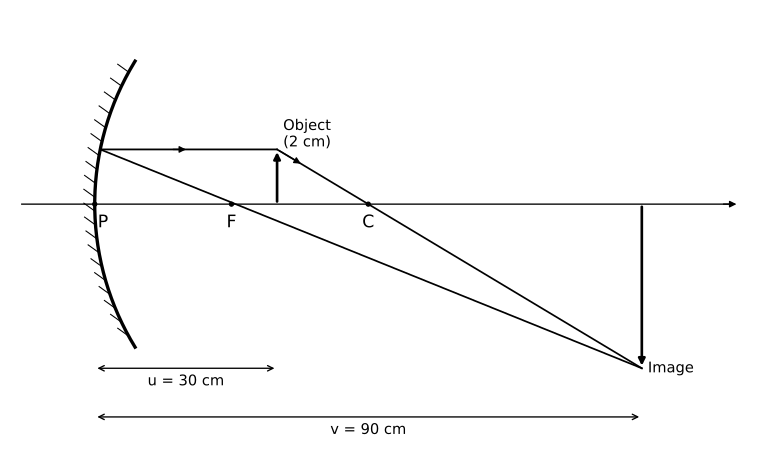
At the Jawaharlal Nehru Planetarium in Bengaluru, Karnataka, a technician named Arvind is inspecting a large concave mirror used in the projection system. The mirror has a radius of curvature of 40 cm. During a routine check, Arvind places a small luminous object at a distance of 30 cm in front of the mirror along its principal axis to verify the optical properties of the mirror before the evening show. The size of the object placed is 2 cm.
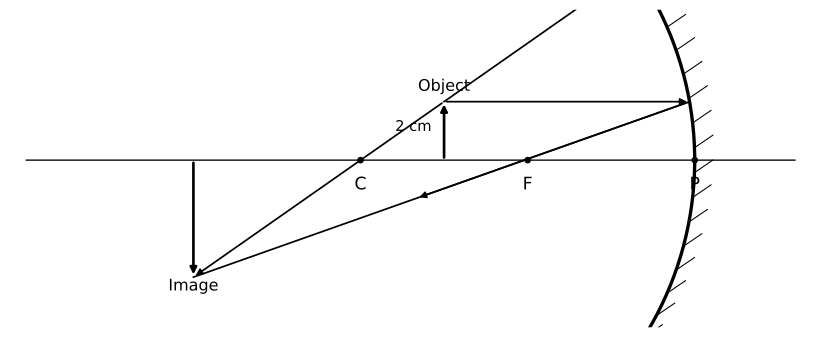
At the Jawaharlal Nehru Planetarium in Bengaluru, Karnataka, a technician named Arvind is inspecting a large concave mirror used in the projection system. The mirror has a radius of curvature of 40 cm. During a routine check, Arvind places a small luminous object at a distance of 30 cm in front of the mirror along its principal axis to verify the optical properties of the mirror before the evening show. The size of the object placed is 2 cm.

Diagram for question 1: Light - Reflection and Refraction
Show answer
(i)

Since f = R/2,

f = 40/2 = 20 cm

Applying the sign convention for a concave mirror, f = −20 cm.

---

(ii)

Given: u = −30 cm, f = −20 cm

Using the mirror formula:

1/v + 1/u = 1/f

⟹ 1/v + 1/(−30) = 1/(−20)

⟹ 1/v = −1/20 + 1/30 = (−3 + 2)/60 = −1/60

v = −60 cm

The negative sign indicates that the image is formed 60 cm in front of the mirror on the same side as the object. The image is real.

---

(iii)

Given: v = −60 cm, u = −30 cm, h₀ = 2 cm

Magnification: m = −v/u = −(−60)/(−30) = −2

Size of image: hᵢ = m × h₀ = −2 × 2 = −4 cm

The magnitude of the image size is 4 cm. The negative sign confirms the image is inverted. Since |m| = 2 > 1, the image is magnified.

∴ The image formed is real, inverted, and magnified, with a size of 4 cm, located 60 cm in front of the mirror.
Q2Case-based4 marks

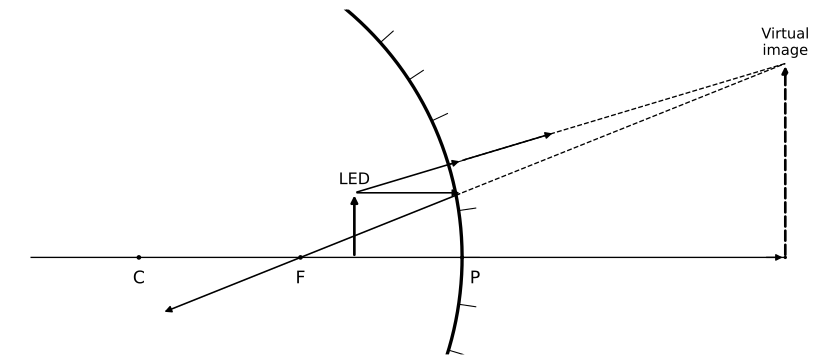
A science club at a school set up a demonstration using a concave mirror of radius of curvature 30 cm. They placed a bright LED bulb at different positions along the principal axis and recorded the nature of images formed on a screen. During one observation, the LED was placed 10 cm in front of the mirror. A junior student found no image on the screen and was confused. The teacher asked the junior student to remove the screen and look into the mirror directly.

A science club at a school set up a demonstration using a concave mirror of radius of curvature 30 cm. They placed a bright LED bulb at different positions along the principal axis and recorded the nature of images formed on a screen kept on the same side as the reflected rays. During one observation, the LED was placed 10 cm in front of the mirror. A junior student, looking at the screen, found no image on it and was confused. The teacher then asked the junior student to remove the screen and look into the mirror directly.

(a) What is the focal length of the concave mirror used in the demonstration?

(b) When the LED is placed 10 cm in front of the mirror, where does the image form, and why can it NOT be obtained on a screen?

(c) Calculate the position and magnification of the image when the LED is placed 45 cm in front of the same mirror. State the nature of the image formed.

OR

(c) The club then replaced the concave mirror with a convex mirror of the same radius of curvature (30 cm) and placed the LED 45 cm in front of it. Calculate the position of the image and state TWO characteristics of the image formed.

Diagram for question 2: Light - Reflection and Refraction
Show answer
(a) Focal length of the concave mirror:

Using the relation f = R/2,

f = 30/2 = 15 cm

Since the mirror is concave, f = −15 cm (using the New Cartesian Sign Convention).

[1 mark]

(b) Position of the image and reason it cannot be obtained on a screen:

The LED is placed 10 cm in front of the mirror, i.e., between the pole (P) and the focus (F), since f = 15 cm and the object distance is only 10 cm.

For a concave mirror, when the object is placed between P and F, the reflected rays diverge after reflection. These diverging rays, when extended behind the mirror, appear to meet at a point behind the mirror.

Therefore, the image is formed BEHIND the mirror (on the non-reflecting side).

The image cannot be obtained on a screen because it is a VIRTUAL image — the reflected rays do not actually meet at a point; they only appear to diverge from a point behind the mirror. A screen can only receive real images where rays actually converge.

[1 mark]

(c) Calculation when LED is placed 45 cm in front of the concave mirror:

Given:
Using sign convention: u = −45 cm, f = −15 cm

Using the mirror formula:
1/v + 1/u = 1/f

⟹ 1/v = 1/f − 1/u
⟹ 1/v = 1/(−15) − 1/(−45)
⟹ 1/v = −1/15 + 1/45
⟹ 1/v = (−3 + 1)/45
⟹ 1/v = −2/45
⟹ v = −22.5 cm

∴ The image is formed 22.5 cm in front of the mirror (on the same side as the object).

Magnification:
m = −v/u = −(−22.5)/(−45) = −22.5/45 = −0.5

Nature of the image:
- v is negative → image is in front of the mirror → REAL
- m is negative → image is INVERTED
- |m| = 0.5 < 1 → image is DIMINISHED

∴ The image is real, inverted and diminished.

[2 marks]

—————————————
OR
—————————————

(c) Calculation when the LED is placed 45 cm in front of a CONVEX mirror (R = 30 cm):

For a convex mirror:
f = +R/2 = +30/2 = +15 cm
Using sign convention: u = −45 cm, f = +15 cm

Using the mirror formula:
1/v + 1/u = 1/f

⟹ 1/v = 1/f − 1/u
⟹ 1/v = 1/15 − 1/(−45)
⟹ 1/v = 1/15 + 1/45
⟹ 1/v = (3 + 1)/45
⟹ 1/v = 4/45
⟹ v = +11.25 cm

∴ The image is formed 11.25 cm behind the mirror.

TWO characteristics of the image:
(i) The image is VIRTUAL and ERECT — v is positive, meaning the image forms behind the mirror where reflected rays cannot actually meet; the image can only be seen by looking into the mirror.
(ii) The image is DIMINISHED — for a convex mirror, the image is always smaller than the object regardless of object position.

[2 marks]
Q3Case-based4 marks

Riya is decorating her room and places a small decorative candle 30 cm in front of a concave mirror. She notices that the mirror produces a clear, sharp image of the candle flame on the wall behind her, exactly 90 cm from the mirror. She measures the height of the candle as 2 cm.

Riya is decorating her room and places a small decorative candle 30 cm in front of a concave mirror. She notices that the mirror produces a clear, sharp image of the candle flame on the wall behind her, exactly 90 cm from the mirror. She measures the height of the candle as 2 cm.

(a) What type of image is formed on the wall — real or virtual? Give one reason for your answer.

(b) Calculate the focal length of the concave mirror used.

(c) Calculate the size of the image of the candle formed on the wall. Also state whether the image is magnified or diminished.

Diagram for question 3: Light - Reflection and Refraction
Show answer
(a) The image formed on the wall is a REAL image.
Reason: The image is formed on a screen (the wall), which is on the same side as the object in front of the mirror. Only a real image can be obtained on a screen; a virtual image cannot be projected onto a screen.
[1 mark]

(b) Using the New Cartesian Sign Convention:
Object distance, u = −30 cm (object in front of mirror, against incident light)
Image distance, v = −90 cm (image is in front of mirror, on same side as object — real image)

Using the mirror formula:
1/f = 1/v + 1/u
1/f = 1/(−90) + 1/(−30)
1/f = −1/90 − 1/30
1/f = −1/90 − 3/90
1/f = −4/90
1/f = −2/45
∴ f = −45/2 = −22.5 cm

The focal length of the concave mirror is 22.5 cm.
[1 mark]

(c) Using the magnification formula for a mirror:
m = −v/u
m = −(−90)/(−30)
m = −90/30
m = −3

Size of image = m × size of object
Height of image = |m| × height of candle
Height of image = 3 × 2 = 6 cm

Since |m| = 3 > 1, the image is MAGNIFIED.
Since m is negative, the image is real and inverted.
∴ The image of the candle is 6 cm tall, real, inverted, and magnified.
[2 marks]
Q4Case-based4 marks

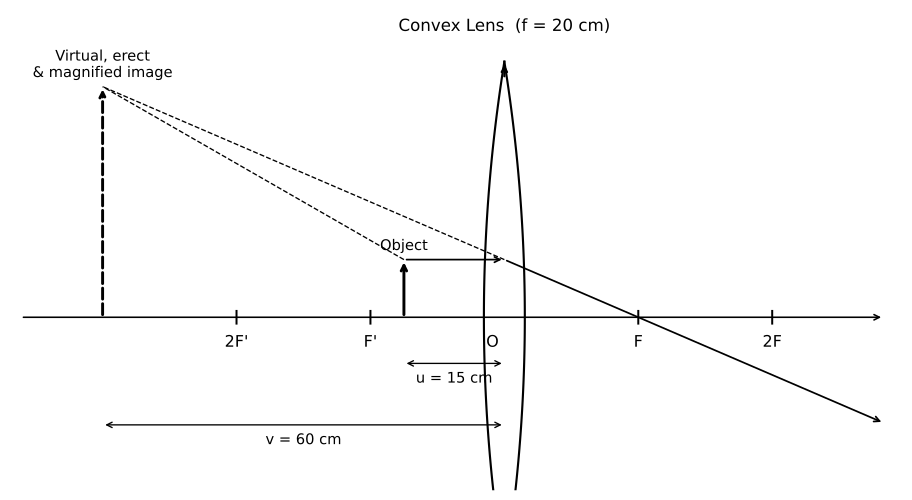
Rohan is sitting in a swimming pool and looks up at a coin placed on the edge of the pool deck. His friend Meera, standing outside the pool, looks at a fish swimming below the water surface. A lifeguard at the pool has placed a convex lens (focal length 20 cm) near the pool entrance to use as a magnifying glass to read fine-print safety notices.

Rohan is sitting in a swimming pool and looks up at a coin placed on the edge of the pool deck. His friend Meera, standing outside the pool, looks at a fish swimming below the water surface. A lifeguard at the pool has placed a convex lens (focal length 20 cm) near the pool entrance to use as a magnifying glass to read fine-print safety notices.

Based on this situation, answer the following:
(a) Meera looks at the fish which is actually 60 cm below the water surface. If the refractive index of water is 4/3, what is the apparent depth at which she sees the fish? [1 mark]
(b) Rohan notices that the coin on the pool deck appears to be at a different position than it actually is. State the phenomenon responsible for this observation and in which direction (closer or farther) does the coin appear to him. [1 mark]
(c) The lifeguard places the safety notice 15 cm in front of the convex lens (focal length 20 cm). Using the lens formula, find the position and nature of the image formed. [2 marks]

Diagram for question 4: Light - Reflection and Refraction
Show answer
(a) Apparent depth = Real depth / refractive index

Apparent depth = 60 / (4/3) = 60 × (3/4) = 45 cm

∴ Meera sees the fish at an apparent depth of 45 cm below the surface. [1 mark]

(b) The phenomenon responsible is Refraction of light. When light travels from a denser medium (water) to a rarer medium (air), it bends away from the normal. As a result, Rohan sees the coin appearing to be farther away (at a greater distance) than its actual position, because the refracted rays appear to diverge from a point higher up than the actual object. [1 mark]

(c) Given:
Object distance, u = −15 cm (using sign convention; object is on the left of lens)
Focal length of convex lens, f = +20 cm

Using the lens formula:
1/v − 1/u = 1/f

1/v = 1/f + 1/u
1/v = 1/20 + 1/(−15)
1/v = 1/20 − 1/15
1/v = (3 − 4)/60
1/v = −1/60

∴ v = −60 cm

The negative sign indicates that the image is formed on the same side as the object (i.e., to the left of the lens).

Magnification: m = v/u = (−60)/(−15) = +4

Positive magnification confirms the image is erect.

∴ The image is formed 60 cm on the same side as the object. It is virtual, erect, and magnified (4 times the size of the notice). [1 + 1 mark]
Q5Case-based4 marks

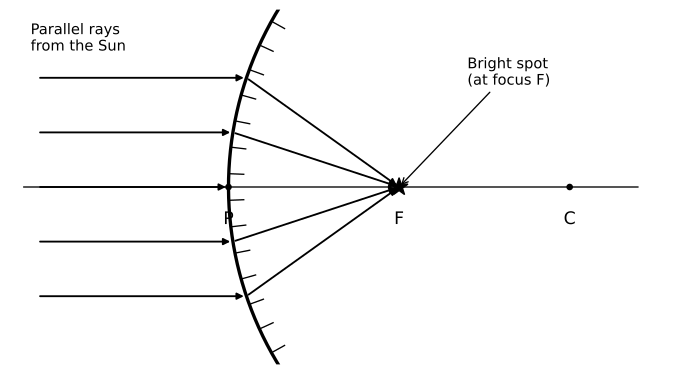
Riya is setting up a science project at home. She places a shiny steel spoon in front of her face and notices that when she looks at the concave side of the spoon, her face appears large and upright, but when she turns the spoon and looks at the convex side, her face appears small and upright. Curious, she then holds the concave side close to a wall on a sunny day and notices a bright spot of light on the wall.

Riya is setting up a science project at home. She places a shiny steel spoon in front of her face and notices that when she looks at the concave side of the spoon, her face appears large and upright, but when she turns the spoon and looks at the convex side, her face appears small and upright. Curious, she then holds the concave side close to a wall on a sunny day and notices a bright spot of light on the wall.

Based on the above situation, answer the following questions:
(a) Name the type of mirror that forms a virtual, erect and magnified image of an object placed close to it. [1]
(b) When Riya looks at the convex side of the spoon, the image of her face is always virtual, erect and diminished regardless of her distance from the spoon. Give one reason why this is so. [1]
(c) When Riya holds the concave side of the spoon towards sunlight and a bright spot forms on the wall, what is that bright spot called, and at what specific point does it form? Also explain why parallel rays from the Sun converge to this point after reflection. [2]

Diagram for question 5: Light - Reflection and Refraction
Show answer
(a) Concave mirror forms a virtual, erect and magnified image when the object is placed between the pole (P) and the principal focus (F) of the mirror.

(b) A convex mirror always diverges the reflected rays. The reflected rays, when extended behind the mirror, appear to meet at a point behind the mirror. Since the reflected rays never actually meet in front of the mirror, the image is always virtual and erect. The diverging nature of a convex mirror means the image is always formed between the pole and the principal focus (behind the mirror), and is always smaller than the object — regardless of the object's distance from the mirror.

(c) The bright spot formed on the wall is called the Principal Focus (or Focal Point) of the concave mirror. It forms at a point in front of the mirror at a distance equal to the focal length (f) from the pole.

The Sun is approximately 150 million km away, so rays coming from it are effectively parallel to the principal axis when they reach the spoon. According to the property of a concave mirror, all rays travelling parallel to the principal axis, after reflection, converge at the principal focus. This is because the concave mirror is a part of a hollow sphere; each point on the mirror reflects the incident ray according to the law of reflection (∠i = ∠r), and the geometry of the curved surface is such that all these reflected rays pass through the single point F on the principal axis. Hence, all the parallel rays from the Sun converge at the principal focus, forming a bright, intense spot of light on the wall placed at that position.
Q6Case-based4 marks

A student sets up an optical bench experiment with a concave mirror (f = 15 cm) and records image nature at four object positions (u = 45, 30, 20, 10 cm). She then uses a convex mirror of the same focal length (f = 15 cm) with the object at 30 cm.

Read the following passage and answer the questions that follow:

A student is setting up an optical bench experiment. She places a concave mirror of focal length 15 cm on the bench. She then places a bright object (a lit candle) at different positions in front of the mirror and records her observations in the table below:

| Trial | Object distance (u) | Nature of image observed |
|-------|--------------------|--------------------------|
| P | 45 cm | Real, inverted, diminished |
| Q | 30 cm | Real, inverted, same size |
| R | 20 cm | Real, inverted, magnified |
| S | 10 cm | Virtual, erect, magnified |

The student then replaces the concave mirror with a convex mirror of the same focal length (15 cm) and places the candle at a distance of 30 cm in front of it.

(a) Using the mirror formula, verify whether Trial Q gives the correct image position for the concave mirror. Show your working. [1 mark]

(b) In Trial S, the student claims the image cannot be caught on a screen. Justify her claim using the nature of the image formed. [1 mark]

(c) Calculate the image distance and magnification when the candle is placed 30 cm in front of the convex mirror (f = +15 cm). Hence state the nature and position of the image. [2 marks]

OR

(c) Between Trial P and Trial R (concave mirror), in which trial is the magnitude of magnification greater than 1? Justify your answer using the mirror formula. Also state one practical application that uses the image-forming property demonstrated in Trial R. [2 marks]

Diagram for question 6: Light - Reflection and Refraction
Show answer
(a) Verification for Trial Q (concave mirror, u = −30 cm, f = −15 cm):

Using sign convention: u = −30 cm, f = −15 cm

Mirror formula: 1/v + 1/u = 1/f

⟹ 1/v = 1/f − 1/u

⟹ 1/v = 1/(−15) − 1/(−30)

⟹ 1/v = −1/15 + 1/30

⟹ 1/v = (−2 + 1)/30 = −1/30

∴ v = −30 cm

The image is formed at 30 cm in front of the mirror (same side as object), confirming it is real, inverted, and the same size as the object. ✓ Trial Q is verified correct. [1 mark]

---

(b) In Trial S, the object is placed between the pole and the focus (u = −10 cm, f = −15 cm). The image formed by a concave mirror when the object is between P and F is virtual and erect — it forms behind the mirror. Since the reflected rays diverge after reflection and only appear to meet behind the mirror, they do not actually converge at any point in front of the mirror. A screen can only capture an image where rays actually meet (real image). Because the rays never actually intersect in front of the mirror, the image cannot be projected onto a screen. [1 mark]

---

(c) MAIN OPTION:

For convex mirror: using sign convention, u = −30 cm, f = +15 cm (convex mirror has positive focal length).

Mirror formula: 1/v + 1/u = 1/f

⟹ 1/v = 1/f − 1/u

⟹ 1/v = 1/(+15) − 1/(−30)

⟹ 1/v = 1/15 + 1/30

⟹ 1/v = (2 + 1)/30 = 3/30 = 1/10

∴ v = +10 cm [1 mark]

Magnification: m = −v/u = −(+10)/(−30) = +1/3 ≈ +0.33

Since v is positive → image is formed behind the mirror (virtual).
Since m is positive → image is erect.
Since |m| < 1 → image is diminished.

∴ The image is formed 10 cm behind the convex mirror. It is virtual, erect, and diminished. [1 mark]

---

(c) OR OPTION:

In Trial P: u = −45 cm, f = −15 cm.
1/v = 1/(−15) − 1/(−45) = −1/15 + 1/45 = (−3 + 1)/45 = −2/45
∴ v = −22.5 cm
m = −v/u = −(−22.5)/(−45) = −0.5
|m| = 0.5 < 1 → image is diminished.

In Trial R: u = −20 cm, f = −15 cm.
1/v = 1/(−15) − 1/(−20) = −1/15 + 1/20 = (−4 + 3)/60 = −1/60
∴ v = −60 cm
m = −v/u = −(−60)/(−20) = −3
|m| = 3 > 1 → image is magnified. [1 mark]

Therefore, Trial R has magnification of magnitude greater than 1, because the object is placed between F and C (u = −20 cm, which is between f = −15 cm and 2f = −30 cm), producing a real, inverted, magnified image beyond C.

Practical application of Trial R: A concave mirror used as a reflector in a cinema projector or as a doctor's head mirror (or dentist's mirror), where a magnified real image of an illuminated object is required. [1 mark]
Q7Case-based4 marks

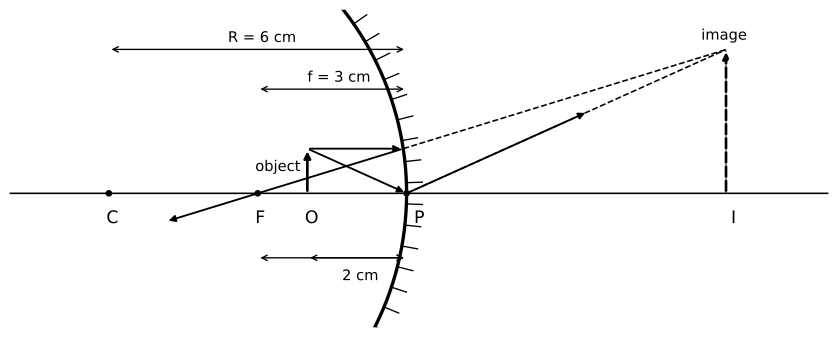
At a dental clinic in Pune, Maharashtra, Dr. Anjali uses a small concave mirror to examine a patient's teeth. She holds the mirror at a distance of 2 cm from a tooth so that an erect and magnified image of the tooth is formed behind the mirror. The focal length of the dental mirror is 3 cm. During a school visit to the clinic, Class 10 student Aryan observes this procedure and is curious about the optical principles involved.

At a dental clinic in Pune, Maharashtra, Dr. Anjali uses a small concave mirror to examine a patient's teeth. She holds the mirror at a distance of 2 cm from a tooth so that an erect and magnified image of the tooth is formed behind the mirror. The focal length of the dental mirror is 3 cm. During a school visit to the clinic, Class 10 student Aryan observes this procedure and is curious about the optical principles involved.

Diagram for question 7: Light - Reflection and Refraction
Show answer
(a)

The mirror formula for a spherical mirror is:


where *v* = image distance, *u* = object distance, and *f* = focal length, all measured from the pole of the mirror.

(b)

Since f = R/2, the radius of curvature R = 2f.


∴ The radius of curvature of the dental mirror is 6 cm.

(c)

Using the New Cartesian Sign Convention: u = −2 cm (object in front of mirror), f = −3 cm (concave mirror).

Applying the mirror formula:


Magnification:


Since m = +3 is positive, the image is erect and virtual, formed 6 cm behind the mirror. The magnitude 3 indicates the image is 3 times magnified compared to the object. This confirms the use of a concave mirror as a dental mirror — when the tooth (object) is placed between the pole and focus, it produces a virtual, erect, and magnified image.
Q8Case-based4 marks

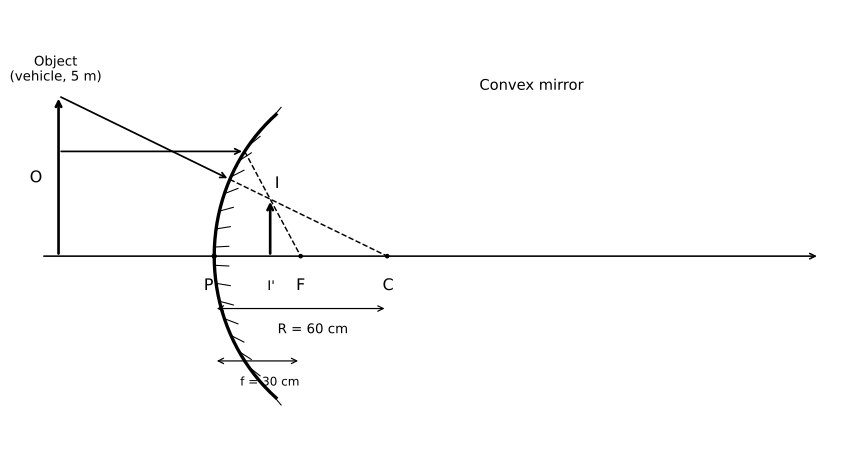
A traffic surveillance camera is mounted at a busy intersection. The camera uses a convex mirror as a wide-angle reflector to capture vehicles approaching from a large field of view. The security officer notices that in the mirror's image, all vehicles — whether 5 metres away or 50 metres away — appear smaller than their actual size, and the image always appears to be located close to the mirror. The officer then replaces the convex mirror with a concave mirror of the same radius of curvature, hoping to get a larger image. However, he finds that the concave mirror is not suitable for this purpose.

A traffic surveillance camera is mounted at a busy intersection. The camera uses a convex mirror as a wide-angle reflector to capture vehicles approaching from a large field of view. The security officer notices that in the mirror's image, all vehicles — whether 5 metres away or 50 metres away — appear smaller than their actual size, and the image always appears to be located close to the mirror. The officer then replaces the convex mirror with a concave mirror of the same radius of curvature, hoping to get a larger image. However, he finds that the concave mirror is not suitable for this purpose.

(a) State the nature (real/virtual), orientation (erect/inverted), and size (magnified/diminished) of the image formed by the convex mirror used in the surveillance system. [1 mark]

(b) The radius of curvature of the convex mirror is 60 cm. A vehicle is 5 m away from the mirror. Using the mirror formula, find the position of the image of the vehicle. [2 marks]

(c) Explain why the concave mirror is NOT suitable as a replacement for the wide-angle surveillance mirror, even though it can form a magnified image under certain conditions.
OR
(c) The officer wants to use a mirror that gives an upright image of a vehicle at all positions of the object. Name the type of mirror and state any TWO properties of the image it always forms, giving a reason for each property. [1 mark]

Diagram for question 8: Light - Reflection and Refraction
Show answer
(a) The image formed by the convex mirror is: virtual, erect (upright), and diminished (smaller than the object). [1 mark]

(b) Given:
Radius of curvature, R = 60 cm (convex mirror → R is positive)
Using the relation f = R/2:
f = +60/2 = +30 cm

Object distance, u = −500 cm (object is 5 m = 500 cm in front of mirror; u is always negative by sign convention)

Using mirror formula:
1/v + 1/u = 1/f
⟹ 1/v + 1/(−500) = 1/(+30)
⟹ 1/v = 1/30 + 1/500
⟹ 1/v = 500/(30 × 500) + 30/(30 × 500)
⟹ 1/v = (500 + 30)/15000
⟹ 1/v = 530/15000
⟹ v = 15000/530
⟹ v ≈ +28.3 cm

∴ The image is formed approximately 28.3 cm behind the mirror (positive sign confirms the image is virtual, formed behind the mirror). [2 marks]

(c) The concave mirror is NOT suitable as a wide-angle surveillance mirror for the following reasons:

(i) A concave mirror converges light — it has a limited field of view, capturing only a narrow region in front of it. A surveillance system requires a wide field of view to monitor vehicles from many directions simultaneously. The convex mirror diverges reflected rays and therefore has a much wider field of view than a concave mirror of the same size.

(ii) The image formed by a concave mirror changes its nature, position, and size drastically depending on where the object (vehicle) is placed relative to the focal point. When the vehicle is beyond the centre of curvature, the image is real, inverted, and beyond the mirror — it cannot be seen directly in the mirror. When the vehicle is between F and P, the image is virtual but magnified — showing only a small region. The image is therefore inconsistent and unpredictable for surveillance purposes. The convex mirror always forms a virtual, erect, and diminished image regardless of the object's position, giving a consistent, complete view at all times. [1 mark]

OR

(c) The type of mirror that always gives an upright image at all positions of the object is a CONVEX mirror.

Property 1 — The image is always virtual.
Reason: A convex mirror is a diverging mirror. The reflected rays always diverge after reflection and never actually meet in front of the mirror. They appear to meet behind the mirror when extended backwards. Since the rays do not actually converge, the image cannot be obtained on a screen — it is always virtual.

Property 2 — The image is always diminished (smaller than the object).
Reason: The principal focus and centre of curvature of a convex mirror lie behind the mirror. For any position of the object in front of the mirror, the image is always formed between the pole (P) and the principal focus (F), i.e., within a very small region behind the mirror. This means the image is always compressed into a smaller space than the object occupies, making it diminished for all object positions. [1 mark]
Q9MCQ1 mark

The absolute refractive index of kerosene and turpentine oil are 1.44 and 1.47 respectively. If the speed of light in vacuum is 3 × 10⁸ m/s, the speed of light in kerosene is approximately:

Show answer
Option (A) is correct.

Explanation: The absolute refractive index of a medium is defined as n = c/v, where c is the speed of light in vacuum and v is the speed of light in the medium. For kerosene, n = 1.44 and c = 3 × 10⁸ m/s, so v = c/n = (3 × 10⁸)/1.44 ≈ 2.08 × 10⁸ m/s. The refractive index of turpentine oil (1.47) is not required for this calculation.
Q10MCQ1 mark

The radius of curvature of a concave mirror is 24 cm. What is its focal length?

Show answer
Option (B) is correct.
Explanation: For any spherical mirror, the focal length f is related to the radius of curvature R by the relation f = R/2. Here, R = 24 cm, so f = 24/2 = 12 cm. Since the mirror is concave, by the New Cartesian Sign Convention the focal length is taken as negative (f = −12 cm), but the magnitude of the focal length is 12 cm.
Q11MCQ1 mark

The absolute refractive index of ethanol and ruby are 1.36 and 1.76 respectively. If the speed of light in ethanol is 2.21 × 10⁸ m/s, what is the speed of light in ruby?

Show answer
Option (A) is correct.

Explanation: The absolute refractive index of a medium is defined as n = c/v, where c is the speed of light in vacuum and v is the speed of light in that medium. First, c is calculated using the data for ethanol: c = n_ethanol × v_ethanol = 1.36 × 2.21 × 10⁸ = 3.00 × 10⁸ m/s. Then, applying the same relation to ruby: v_ruby = c / n_ruby = (3.00 × 10⁸) / 1.76 ≈ 1.71 × 10⁸ m/s. Since ruby has a higher refractive index than ethanol (1.76 > 1.36), light travels more slowly in ruby, which is consistent with this result.
Q12MCQ1 mark

The absolute refractive indices of diamond and glass are 2.42 and 1.50 respectively. Which of the following statements correctly compares these two media?

Show answer
Option (A) is correct.

Explanation: The absolute refractive index of a medium is defined as n = c/v, where c is the speed of light in vacuum and v is the speed of light in that medium. A higher refractive index indicates greater optical density and a lower speed of light. Since the refractive index of diamond (2.42) is greater than that of glass (1.50), diamond is optically denser than glass. Consequently, the speed of light in diamond (v = c/2.42) is less than the speed of light in glass (v = c/1.50), meaning light travels slower in diamond than in glass.
Q13MCQ1 mark

A telescope objective consists of two thin lenses placed in contact. The first lens is a converging lens of focal length 10 cm and the second lens is a diverging lens of focal length 25 cm. What is the net power of this lens combination?

Show answer
Option (A) is correct.

Explanation: The power of a lens is given by P = 1/f, where f must be in metres. For the converging lens, f₁ = +10 cm = +0.10 m, so P₁ = 1/0.10 = +10 D. For the diverging lens, f₂ = −25 cm = −0.25 m (negative because diverging), so P₂ = 1/(−0.25) = −4 D. For lenses placed in contact, the net power is P = P₁ + P₂ = +10 + (−4) = +6 D.
Q14MCQ1 mark

When white light passes through a glass prism, it splits into a band of colours. Which of the following correctly identifies the colour that bends the MOST and the colour that bends the LEAST during dispersion?

Show answer
Option (A) is correct.

Explanation: During dispersion of white light through a glass prism, each colour has a different wavelength and therefore a different refractive index in glass. Shorter wavelengths have a higher refractive index and bend more, while longer wavelengths have a lower refractive index and bend less. Violet light has the shortest wavelength among all visible colours and therefore bends the most, while red light has the longest wavelength and therefore bends the least. This produces the spectrum VIBGYOR, with violet at one end and red at the other. Options (B), (C), and (D) are incorrect because (B) reverses the correct order, and (C) and (D) cite intermediate colours that do not represent the extremes of bending.
Q15MCQ1 mark

A student uses two thin lenses in contact to make a compound lens system. The first lens has a focal length of +25 cm and the second lens has a focal length of −50 cm. What is the net power of this combination?

Show answer
Option (A) is correct.

Explanation: The power of a lens is given by P = 1/f, where f is the focal length in metres. For the first lens, f₁ = +25 cm = +0.25 m, so P₁ = 1/0.25 = +4 D. For the second lens, f₂ = −50 cm = −0.50 m, so P₂ = 1/(−0.50) = −2 D. For two thin lenses in contact, the net power is P = P₁ + P₂ = +4 + (−2) = +2 D.
Q16MCQ1 mark

The power of a lens is +2.0 D. What type of lens is it and what is its focal length?

Show answer
Option (B) is correct.
Explanation: The power of a lens is given by P = 1/f, where f is the focal length in metres. Since P = +2.0 D, the focal length f = 1/P = 1/2.0 = 0.5 m = 50 cm. A positive power indicates a converging (convex) lens. Therefore, the lens is a convex lens with focal length 50 cm.
Q17MCQ1 mark

The absolute refractive index of glycerine and flint glass are 1.47 and 1.65 respectively. If the speed of light in glycerine is 2.04 × 10⁸ m/s, what is the speed of light in flint glass?

Show answer
Option (A) is correct.

Explanation: The absolute refractive index of a medium is defined as n = c/v, where c is the speed of light in vacuum and v is the speed of light in that medium. First, the speed of light in vacuum is found using the data for glycerine: c = n_glycerine × v_glycerine = 1.47 × 2.04 × 10⁸ = 3.0 × 10⁸ m/s. The speed of light in flint glass is then v_flint = c/n_flint = (3.0 × 10⁸)/1.65 = 1.82 × 10⁸ m/s, which matches Option (A).
Q18MCQ1 mark

An object is placed 30 cm in front of a convex mirror of focal length 15 cm. The image formed is:

Show answer
Option (B) is correct.

Explanation: A convex mirror always forms a virtual, erect and diminished image, regardless of the position of the object in front of it. This can be confirmed using the mirror formula. Using sign convention, u = −30 cm and f = +15 cm (focal length of a convex mirror is positive). Applying 1/v + 1/u = 1/f gives 1/v = 1/15 − 1/30 = (2 − 1)/30 = 1/30, so v = +30 cm... wait — recalculating: 1/v = 1/f − 1/u = 1/15 − 1/(−30) = 1/15 + 1/30 = 2/30 + 1/30 = 3/30 = 1/10, so v = +10 cm. Since v is positive, the image is formed behind the mirror, confirming it is virtual and erect. Magnification m = −v/u = −(+10)/(−30) = +1/3, which is positive (erect) and less than 1 (diminished). Hence the image is virtual, erect and diminished.
Q19MCQ1 mark

A convex lens has a focal length of 25 cm. What is the power of this lens?

Show answer
Option (A) is correct.
Explanation: The power of a lens is given by P = 1/f, where f must be expressed in metres. A convex lens has a positive focal length, so f = +25 cm = +0.25 m. Therefore, P = 1/0.25 = +4 D. A convex (converging) lens always has positive power, which rules out options (B) and (D). Option (C) is incorrect because 25 D would require a focal length of only 4 cm, not 25 cm.
Q20MCQ1 mark

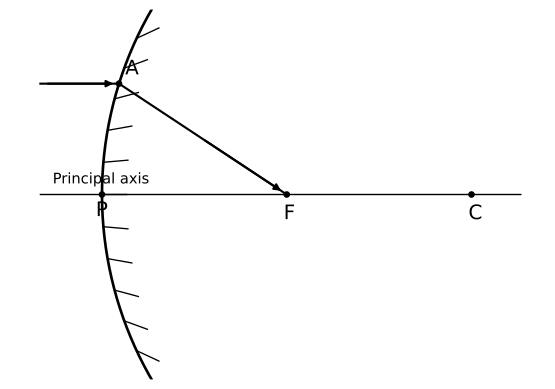
A ray of light travelling parallel to the principal axis strikes a concave mirror. After reflection, through which point does this ray pass?

Diagram for question 20: Light - Reflection and Refraction
Show answer
Option (B) is correct.

Explanation: For a concave mirror, any ray of light travelling parallel to the principal axis, after reflection, passes through the principal focus (F). This is the defining property of the principal focus of a concave mirror — it is the point on the principal axis where all rays parallel to the principal axis converge after reflection.
Q21MCQ1 mark

The absolute refractive index of ice and crown glass are 1.31 and 1.52 respectively. If the speed of light in crown glass is 1.97 × 10⁸ m/s, what is the speed of light in ice?

Show answer
Option (A) is correct.

Explanation: The absolute refractive index of a medium is defined as n = c/v, where c is the speed of light in vacuum and v is the speed of light in that medium. Using the crown glass data first: c = n_glass × v_glass = 1.52 × 1.97 × 10⁸ = 2.9944 × 10⁸ ≈ 3.0 × 10⁸ m/s. Applying the same relation to ice: v_ice = c/n_ice = (3.0 × 10⁸)/1.31 ≈ 2.29 × 10⁸ m/s.
Q22MCQ1 mark

A camera lens system uses two thin lenses placed in contact. The first lens is a converging lens of focal length 20 cm and the second is a diverging lens of focal length 50 cm. What is the net power of this lens combination?

Show answer
Option (A) is correct.

Explanation: The power of a lens is given by P = 1/f, where f is the focal length in metres. For two thin lenses placed in contact, the net power equals the algebraic sum of their individual powers: P<sub>net</sub> = P<sub>1</sub> + P<sub>2</sub>. The converging lens has f<sub>1</sub> = +20 cm = +0.20 m, so P<sub>1</sub> = 1/0.20 = +5.0 D. The diverging lens has f<sub>2</sub> = −50 cm = −0.50 m, so P<sub>2</sub> = 1/(−0.50) = −2.0 D. Therefore P<sub>net</sub> = +5.0 + (−2.0) = +3.0 D.
Q23MCQ1 mark

A concave mirror has a radius of curvature of 40 cm. What is its focal length?

Show answer
Option (B) is correct.
Explanation: For any spherical mirror, the focal length f is related to the radius of curvature R by the relation f = R/2. Here R = 40 cm, so f = 40/2 = 20 cm. Since the mirror is concave, the focal length is 20 cm (negative by sign convention, but the magnitude is 20 cm).
Q24MCQ1 mark

The absolute refractive indices of medium A and medium B are 5/4 and 3/2 respectively. A ray of light travels from medium A into medium B. If the angle of incidence in medium A is 45°, what is the sine of the angle of refraction in medium B? (sin 45° = 1/√2)

Show answer
Option (B) is correct.

Explanation: By Snell's Law, when light travels from medium A to medium B, n_A sin θ_A = n_B sin θ_B. Substituting n_A = 5/4, n_B = 3/2, and sin 45° = 1/√2: (5/4) × (1/√2) = (3/2) × sin θ_B ⟹ sin θ_B = (5/4√2) × (2/3) = 10/12√2 = 5/6√2 = 5√2/12.
Q25MCQ1 mark

A primary rainbow is formed in the sky after a rain shower. Which of the following correctly lists the phenomena of light responsible for the formation of a rainbow?

Show answer
Option (A) is correct.

Explanation: A primary rainbow is formed when sunlight enters a spherical raindrop and refracts at the air-water interface; since different wavelengths of light have different refractive indices in water, this refraction also causes dispersion — the separation of white light into its constituent colours (VIBGYOR). The refracted light then strikes the back surface of the raindrop at an angle greater than the critical angle and undergoes total internal reflection, after which it refracts again as it exits the droplet into air. All three phenomena — refraction, total internal reflection, and dispersion — are therefore essential to primary rainbow formation. Diffraction and scattering play no role in this process, making options (C) and (D) incorrect, and option (B) is incomplete as it omits dispersion.
Q26MCQ1 mark

An optician prescribes a corrective lens of power +0.50 D to a patient. Which of the following correctly describes this lens and its focal length?

Show answer
Option (A) is correct.

Explanation: The power of a lens is given by P = 1/f (where f is in metres), and its sign indicates the lens type — positive power corresponds to a convex (converging) lens, while negative power corresponds to a concave (diverging) lens. Since the prescribed power is +0.50 D (positive), the lens is a convex (converging) lens. The focal length is f = 1/P = 1/0.50 = 2 m = 200 cm. Therefore, this is a convex lens with focal length 200 cm.
Q27MCQ1 mark

A ray of light travels from medium P to medium Q. The absolute refractive index of medium P is 3/2 and that of medium Q is 5/4. If the angle of incidence in medium P is 30°, which of the following gives the correct value of sin(angle of refraction) in medium Q?

Show answer
Option (A) is correct.

Explanation: By Snell's Law, when light travels from medium P to medium Q, n<sub>P</sub> sin i = n<sub>Q</sub> sin r. Substituting n<sub>P</sub> = 3/2, n<sub>Q</sub> = 5/4, and sin 30° = 1/2: (3/2) × (1/2) = (5/4) × sin r ⟹ 3/4 = (5/4) sin r ⟹ sin r = (3/4) × (4/5) = 3/5.
Q28MCQ1 mark

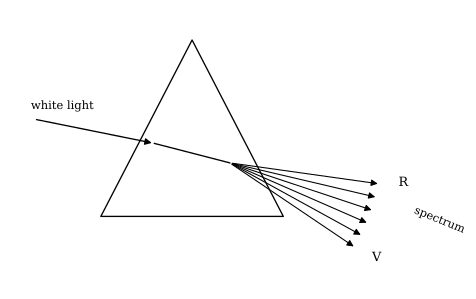
A narrow beam of white sunlight enters a triangular glass prism and emerges as a coloured band on a white screen. A student notices that one colour appears at the top of the band and violet appears at the bottom. Which colour appears at the TOP of the spectrum, and what does this arrangement tell us about that colour's deviation through the prism?

Diagram for question 28: Light - Reflection and Refraction
Show answer
Option (A) is correct.

Explanation: When white light passes through a glass prism, it undergoes dispersion — different colours have different refractive indices in glass, so they bend by different amounts. Red light has the longest wavelength and the lowest refractive index in glass; it therefore deviates the least and emerges closest to the original direction of the incident beam, appearing at the top of the spectrum. Violet light has the shortest wavelength and the highest refractive index; it deviates the most and appears at the bottom — consistent with what the student observes. The colour at the top is therefore red, and its position there confirms that it undergoes the least deviation through the prism because of its longest wavelength.
Q29MCQ1 mark

A scientist directs a narrow beam of white light through a glass prism onto a white screen. She observes a spectrum of colours. She then places an opaque screen with a narrow slit in the path of only the green band, blocking all other colours. The isolated green light then passes through a second identical glass prism. What will she observe on the white screen after the second prism?

Diagram for question 29: Light - Reflection and Refraction
Show answer
Option (B) is correct.

Explanation: Dispersion occurs because white light is a mixture of seven colours (VIBGYOR), each having a different wavelength and therefore a different refractive index in glass, causing each colour to bend by a different amount. When the green band is isolated by the opaque screen, the light passing through the second prism is a single colour (monochromatic light) with one fixed wavelength. Since there are no other wavelengths present to separate, the second prism simply refracts the green light as a whole — it does not split further. The green band emerges from the second prism as a single green band displaced from its original direction, with no dispersion into any spectrum.
Q30MCQ1 mark

A student observes that when sunlight passes through a glass prism, a spectrum is formed on a white screen. She then places a second identical prism in an inverted position immediately after the first prism. What will she observe on the screen?

Diagram for question 30: Light - Reflection and Refraction
Show answer
Option (A) is correct.

Explanation: When white light passes through a glass prism, dispersion occurs because different colours (wavelengths) have different refractive indices in glass — violet bends most and red bends least — producing a VIBGYOR spectrum. When a second identical prism is placed in an inverted position immediately after the first, it produces equal and opposite deviations for each colour, recombining all the dispersed colours back into a single beam. Since all seven colours reunite, white light is restored on the screen. This is Newton's classic recombination experiment, which proves that white light is a mixture of all colours of the visible spectrum.

Want unlimited practice on Light - Reflection and Refraction?

The full ClearSteps bank has 109+ reviewed questions on this chapter alone — with step-wise solutions, difficulty levels, and progress tracking. Verify your WhatsApp number and your free trial starts right here.

CBSE · CLASS 10
🎟️14-day free trial · code PRAC auto-applied
Mobile Number
+91
OTP will be sent to your WhatsApp

⭐ Trusted by 12,000+ students across India

Light - Reflection and Refraction Class 10 Science Questions