Arjun is a class 10 student working on a science project. He builds a simple electromagnet by wrapping 50 turns of insulated copper wire around a soft iron nail and connecting it to a 6V battery. He tests its strength by counting how many iron pins it can pick up. He then modifies his setup in different ways and records his observations.
Observation 1: When he doubles the number of turns to 100, the electromagnet picks up significantly more pins.
Observation 2: When he replaces the soft iron nail with a steel rod (keeping everything else the same), the electromagnet picks up fewer pins during operation, but retains some magnetism even after the current is switched off.
Observation 3: When he reverses the terminals of the battery, the electromagnet still picks up iron pins.
Observation 4: When he removes the iron nail entirely and uses only the air-core coil, the electromagnet picks up far fewer pins than before.
Arjun is a class 10 student working on a science project. He builds a simple electromagnet by wrapping 50 turns of insulated copper wire around a soft iron nail and connecting it to a 6V battery. He tests its strength by counting how many iron pins it can pick up. He then modifies his setup in different ways and records his observations.
Observation 1: When he doubles the number of turns to 100, the electromagnet picks up significantly more pins.
Observation 2: When he replaces the soft iron nail with a steel rod (keeping everything else the same), the electromagnet picks up fewer pins during operation, but retains some magnetism even after the current is switched off.
Observation 3: When he reverses the terminals of the battery, the electromagnet still picks up iron pins.
Observation 4: When he removes the iron nail entirely and uses only the air-core coil, the electromagnet picks up far fewer pins than before.
(a) Based on Observation 1, state the relationship between the number of turns of the coil and the strength of an electromagnet. [1 mark]
(b) Arjun's friend suggests that a steel rod would make a better electromagnet core than soft iron. Based on Observation 2, do you agree? Give one reason to support your answer. [1 mark]
(c) Explain the science behind Observation 3 and Observation 4. [2 marks]
Show answerHide answer
(b) No, a steel rod does not make a better electromagnet core than soft iron. Although steel becomes magnetised in the presence of current, it retains its magnetism even after the current is switched off (it is a permanent magnet material). Soft iron, on the other hand, is easily magnetised when current flows and loses its magnetism almost completely when the current is switched off — this makes it ideal for an electromagnet, which must be switchable. [1 mark]
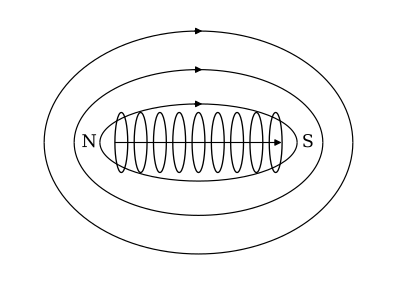
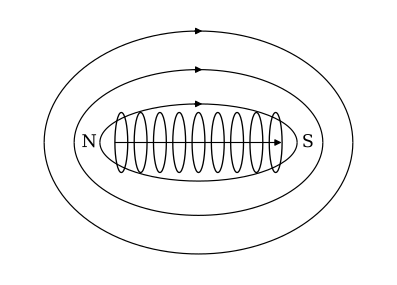
(c) Explanation of Observation 3: When the terminals of the battery are reversed, the direction of current through the coil reverses. This reverses the direction of the magnetic field produced by the electromagnet — the North and South poles of the electromagnet are interchanged. However, the electromagnet can still attract iron pins because iron is a ferromagnetic material and is attracted to both poles of any magnet, regardless of polarity. Therefore, reversing the current reverses the poles but does not stop the electromagnet from picking up iron pins. [1 mark]
Explanation of Observation 4: The soft iron core plays a critical role in strengthening the magnetic field of the electromagnet. When current flows through the coil, it magnetises the soft iron core. The magnetic field of the core adds to the magnetic field produced by the current-carrying coil, resulting in a much stronger combined field. Without the iron core (air-core coil), only the relatively weak magnetic field of the current-carrying coil is present, and no additional magnetisation occurs — hence the electromagnet picks up far fewer pins. [1 mark]