ClearStepsCLEARSTEPS AI
Teacher Login →Student Login →

The Human Eye and the Colourful World: Class 10 Science Practice Questions

30 original exam-pattern questions with full answers, matched to the current CBSE Class 10 paper design, including case-based questions. Attempt each question before opening the answer — or start a free 14-day trial ↓ for the full bank.

Q1Case-based4 marks

Dr. Meena, an ophthalmologist, is conducting vision screening at a school. She tests four students: Arjun (age 12) can read the blackboard clearly from the back row but struggles to read his textbook held at 25 cm; his near point has shifted to 45 cm. Bela (age 14) can read her textbook easily but cannot read the blackboard from the back row; her far point is only 2 m away. Chetan (age 13) has been prescribed lenses of power +2.5 D for one eye and −1.5 D for the other. Deepa (age 70) can neither read her phone clearly nor see distant objects sharply without her bifocal glasses.

Read the following passage and answer the questions that follow.

Dr. Meena, an ophthalmologist, is conducting vision screening at a school. She tests four students:

• Arjun (age 12) can read the blackboard clearly from the back row but struggles to read his textbook held at 25 cm. His near point has shifted to 45 cm.
• Bela (age 14) can read her textbook easily but cannot read the blackboard from the back row. Her far point is only 2 m away.
• Chetan (age 13) has been prescribed lenses of power +2.5 D for one eye and −1.5 D for the other.
• Deepa (age 70, a teacher accompanying the group) tells Dr. Meena that she can neither read her phone clearly nor see distant objects sharply without her bifocal glasses.

(a) Identify the defect of vision that Arjun has, and name the type of lens Dr. Meena will prescribe for him.

(b) What is the far point of a normal eye? Using this information, calculate the focal length of the corrective lens required by Bela.

(c) State the defect Deepa suffers from. Explain TWO reasons why this defect develops, and state the type of lens used in the UPPER and LOWER halves of her bifocal glasses.

OR

(c) The two eyes of Chetan have been prescribed lenses of power +2.5 D and −1.5 D respectively. Name the defect in each eye and calculate the focal length of each corrective lens. State what property of lenses allows the doctor to simply add their powers when combining lenses.

Show answer
(a) Arjun can see distant objects clearly but cannot see near objects clearly — his near point has shifted beyond 25 cm. This is the defect of HYPERMETROPIA (far-sightedness).
Dr. Meena will prescribe a CONVEX (converging) lens.
[1 mark: defect identified correctly + correct lens named]

(b) The far point of a NORMAL eye is at INFINITY.

For Bela, the corrective lens must form a virtual image of a distant object (at infinity) at her far point of 2 m, so that her eye can then form a clear image on the retina.

Using the lens formula: 1/v − 1/u = 1/f

Here, object is at infinity: u = −∞
Image must be formed at Bela's far point: v = −2 m (virtual image, on same side as object)

⟹ 1/f = 1/v − 1/u = 1/(−2) − 1/(−∞)
⟹ 1/f = −1/2 − 0
⟹ 1/f = −1/2
∴ f = −2 m = −200 cm

The focal length of the corrective lens required by Bela is −200 cm (i.e., −2 m).
(This is a concave/diverging lens, consistent with myopia correction.)
[1 mark: far point of normal eye stated as infinity + correct calculation with sign convention + answer with unit]

(c) Deepa suffers from PRESBYOPIA.

This defect develops due to the following TWO reasons:
(i) The ciliary muscles weaken with age, reducing their ability to change the curvature of the eye lens.
(ii) The crystalline lens of the eye loses its flexibility and becomes less elastic with age, so it can no longer adjust its focal length for near or far objects.

In Deepa's bifocal glasses:
— UPPER half: CONCAVE (diverging) lens — to correct the inability to see distant objects clearly.
— LOWER half: CONVEX (converging) lens — to correct the inability to see near objects clearly.
[2 marks: defect named (½) + both causes stated (½ each) + both halves of bifocal lens correctly identified (½)]

---
OR (c)

Chetan's eye with +2.5 D lens:
Positive power → CONVEX lens → corrects HYPERMETROPIA (far-sightedness).

Focal length: f = 1/P = 1/+2.5 = +0.4 m = +40 cm

Chetan's eye with −1.5 D lens:
Negative power → CONCAVE lens → corrects MYOPIA (near-sightedness).

Focal length: f = 1/P = 1/(−1.5) = −0.67 m ≈ −67 cm

The property that allows the doctor to simply add the powers of lenses is:
"When two thin lenses are placed in contact, the effective power of the combination is equal to the algebraic sum of their individual powers."
i.e., P_total = P₁ + P₂
This holds because power (P = 1/f) is additive for lenses in contact, making it convenient for prescribing combined corrections.
[2 marks: both defects correctly named (½ each) + both focal lengths calculated correctly with units (½ each) + property of additive powers stated (½) — total adjusted to 2 marks]
Q2Case-based4 marks

During a school trip to a hill station, Meera noticed several interesting optical phenomena. At sunrise, she saw the sun appearing reddish-orange on the horizon, even though it appeared white when overhead. Later, when the group entered a dense forest after light rain, a teacher shone a torch through a jar of diluted milk and the beam became clearly visible inside the jar. In the evening, Meera observed a beautiful rainbow in the sky after a brief shower. Her science teacher explained that all three phenomena — reddish sunrise, the visible beam, and the rainbow — involve different interactions of light with matter, and are related to concepts studied in Chapter: The Human Eye and the Colourful World.

Read the following passage carefully and answer the questions that follow:

During a school trip to a hill station, Meera noticed several interesting optical phenomena. At sunrise, she saw the sun appearing reddish-orange on the horizon, even though it appeared white when overhead. Later, when the group entered a dense forest after light rain, a teacher shone a torch through a jar of diluted milk and the beam became clearly visible inside the jar. In the evening, Meera observed a beautiful rainbow in the sky after a brief shower. Her science teacher explained that all three phenomena — reddish sunrise, the visible beam, and the rainbow — involve different interactions of light with matter, and are related to concepts studied in Chapter: The Human Eye and the Colourful World.

(a) Name the optical phenomenon responsible for the reddish appearance of the sun at sunrise.

(b) Name the phenomenon demonstrated when the torch beam became visible inside the jar of diluted milk. What type of mixture is diluted milk?

(c) Explain, with reasoning, why the sun appears red at sunrise but white when overhead. Also state the order of colours in the rainbow from top to bottom and name the phenomenon responsible for its formation.

Show answer
(a) The optical phenomenon responsible for the reddish appearance of the sun at sunrise is scattering of light (Rayleigh scattering / Tyndall effect by atmospheric particles). [1 mark]

(b) The phenomenon demonstrated when the torch beam became visible inside the jar of diluted milk is the Tyndall effect — scattering of light by colloidal particles suspended in the medium. Diluted milk is a colloid (colloidal solution). [1 mark]

(c) At sunrise (and sunset), sunlight has to travel a much longer path through the Earth's atmosphere to reach the observer's eyes compared to when the sun is overhead.

During this long path, fine atmospheric particles (dust, smoke, water droplets) scatter the shorter wavelengths of light — violet, indigo, and blue — strongly in all directions. These shorter wavelengths are almost completely scattered away before the light reaches the observer.

Only the longer wavelengths — red and orange — are scattered the least and are able to travel through the long atmospheric path to reach the observer's eyes. Therefore, the sun appears reddish-orange at sunrise and sunset.

When the sun is overhead, sunlight travels through a much shorter path in the atmosphere. Scattering of shorter wavelengths is comparatively less. All colours reach the observer together, and the sun appears white (mixture of all colours of visible light).

Rainbow: The colours of the rainbow from top to bottom are: Red, Orange, Yellow, Green, Blue, Indigo, Violet (ROYGBIV). The phenomenon responsible for the formation of the rainbow is dispersion of sunlight by tiny water droplets present in the atmosphere. The water droplets act like small prisms — they refract and disperse the incident sunlight, then reflect it internally, and finally refract it again when it comes out of the raindrop, separating white light into its seven constituent colours. [2 marks]
Q3Case-based4 marks

Astronaut Sunita is aboard a space station orbiting Earth at an altitude of 400 km. Looking out of the porthole, she notices that the sky surrounding the station appears completely black, even though the Sun is shining brightly nearby. Her colleague, Dr. Aryan, who has just returned from a high-altitude trek in the Himalayas at 5,500 m, mentions that the sky appeared a deeper, darker blue at that altitude compared to sea level. Back on Earth, Sunita's young nephew Rohan is diagnosed with a vision defect — he can read a book held 15 cm from his eyes quite clearly, but cannot read the school blackboard from 6 metres away. His doctor prescribes corrective lenses of power −2.5 D.

Read the following passage carefully and answer the questions that follow:

Astronaut Sunita is aboard a space station orbiting Earth at an altitude of 400 km. Looking out of the porthole, she notices that the sky surrounding the station appears completely black, even though the Sun is shining brightly nearby. Her colleague, Dr. Aryan, who has just returned from a high-altitude trek in the Himalayas at 5,500 m, mentions that the sky appeared a deeper, darker blue at that altitude compared to sea level. Back on Earth, Sunita's young nephew Rohan is diagnosed with a vision defect — he can read a book held 15 cm from his eyes quite clearly, but cannot read the school blackboard from 6 metres away. His doctor prescribes corrective lenses of power −2.5 D.

Diagram for question 3: The Human Eye and the Colourful World
Show answer
(a) The sky appears black to Sunita in space because there is no atmosphere (no air molecules or dust particles) at that altitude. On Earth, the blue colour of the sky is caused by scattering of sunlight by atmospheric molecules — a phenomenon called Rayleigh scattering, in which shorter wavelengths (blue light) are scattered much more than longer wavelengths (red light). In the absence of an atmosphere in space, there are no particles to scatter sunlight, so no scattered light reaches the eyes from any direction other than the Sun itself. Hence the surrounding sky appears completely black. [1 mark]

(b) The part of the human eye that controls the amount of light entering it is the iris. The iris is a muscular diaphragm that regulates the size of the pupil — the opening through which light enters the eye. In bright light, the iris contracts to make the pupil smaller, reducing the amount of light entering. In dim light, the iris expands to make the pupil larger, allowing more light to enter. [1 mark]

(c) Rohan is suffering from myopia (short-sightedness / near-sightedness).

Two causes of myopia:
(i) Excessive curvature of the eye lens, which decreases its focal length and causes the image of distant objects to form in front of the retina instead of on it.
(ii) Elongation of the eyeball, which increases the distance between the lens and retina so that parallel rays from distant objects converge before reaching the retina.

The doctor has prescribed a concave (diverging) lens of power −2.5 D.

Focal length of the corrective lens:
P = 1/f ⟹ f = 1/P = 1/(−2.5) = −0.4 m = −40 cm

A concave lens of focal length 40 cm diverges the incoming parallel rays from distant objects so that they appear to come from the far point of Rohan's eye. After refraction through the eye lens, the image is then formed exactly on the retina, giving clear vision of distant objects. [2 marks]

OR (c) Dr. Aryan observed a deeper, darker blue sky at 5,500 m altitude compared to sea level. This is because at higher altitudes, the atmosphere is thinner — there are fewer air molecules and dust particles available to scatter sunlight. Since the intensity of scattering (especially of longer wavelengths like red and orange) is greatly reduced, almost all the scattered light that does reach the eye is the more strongly scattered blue light. With less atmosphere above and less total scattering overall, the sky appears a more saturated, darker blue rather than the pale, whitish-blue seen at sea level where light has been scattered multiple times through a denser, thicker atmosphere before reaching the observer. In space (zero atmosphere), this scattering falls to zero entirely, making the sky black. [2 marks]
Q4Case-based4 marks

Rahul is a 16-year-old student who loves astronomy. He uses a telescope to observe stars at night without any difficulty. However, during a routine eye check-up, his ophthalmologist discovered that Rahul cannot read the text in his textbook clearly unless he holds it at least 40 cm away from his eyes. The doctor also told him that one of his eyes has developed a condition where the cornea is not perfectly spherical — its curvature is unequal in different planes — causing blurring of vision at all distances. His younger sister Priya, aged 10, was also examined. The doctor found that Priya's eyeball has become slightly elongated. She struggles to read the blackboard clearly from the back of the classroom but can read her book comfortably. Both siblings were prescribed corrective lenses.

Read the following passage carefully and answer the questions that follow:

Rahul is a 16-year-old student who loves astronomy. He uses a telescope to observe stars at night without any difficulty. However, during a routine eye check-up, his ophthalmologist discovered that Rahul cannot read the text in his textbook clearly unless he holds it at least 40 cm away from his eyes. The doctor also told him that one of his eyes has developed a condition where the cornea is not perfectly spherical — its curvature is unequal in different planes — causing blurring of vision at all distances.

His younger sister Priya, aged 10, was also examined. The doctor found that Priya's eyeball has become slightly elongated. She struggles to read the blackboard clearly from the back of the classroom but can read her book comfortably.

Both siblings were prescribed corrective lenses.

(a) Name the defect of vision that Rahul's ophthalmologist detected in terms of his near vision. What is the least distance of distinct vision for a normal adult eye?

(b) Name the defect of vision that Priya is suffering from. State the nature (converging/diverging) and sign of the power of the lens used to correct her defect.

(c) Name the second eye defect mentioned for Rahul's eye (affecting vision at all distances due to unequal corneal curvature). State the type of corrective lens used for it. Also, for Priya's defect, state the TWO possible causes that can lead to this defect.

Show answer
(a) The defect of vision that Rahul has in terms of his near vision is Hypermetropia (far-sightedness). He cannot see near objects clearly because his near point has shifted beyond 25 cm — he needs to hold the book at 40 cm, which is farther than the normal near point.

The least distance of distinct vision for a normal adult eye is 25 cm.

[1 mark: name of defect (Hypermetropia) + 1 mark: 25 cm]

(b) Priya is suffering from Myopia (near-sightedness / short-sightedness). She can see nearby objects (her book) clearly but cannot see distant objects (the blackboard) clearly. Her elongated eyeball causes the image of distant objects to form in front of the retina instead of on it.

The corrective lens used is a Concave (diverging) lens. A concave lens has negative power (P < 0).

[1 mark: name of defect (Myopia) + nature: concave/diverging + sign of power: negative]

(c) The second defect mentioned for Rahul is Astigmatism. It is caused by unequal curvature of the cornea, which means light rays in different planes are focused at different points, causing blurring at all distances. It is corrected by using Cylindrical lenses (toric lenses).

The TWO causes of Myopia (Priya's defect) are:
(i) Excessive curvature (increased converging power) of the eye lens.
(ii) Elongation of the eyeball — the eyeball becomes too long along the axis, so the image of distant objects is formed in front of the retina instead of on it.

[1 mark: Astigmatism + cylindrical lens]
[1 mark: both causes of Myopia stated]

OR (for part c — alternative accepted answer):
Astigmatism is corrected using cylindrical lenses (which have curvature in only one plane, compensating for the unequal curvature of the cornea).
Causes of myopia: (i) High converging power of the eye lens due to its excess curvature. (ii) The eyeball is elongated from front to back, shifting the retina farther from the lens.
Q5Case-based4 marks

Rahul is a 14-year-old student who loves reading books and playing video games for hours. Lately, his teacher noticed that he was squinting to read what was written on the blackboard, though he could read his textbook clearly when it was held close to him. His parents took him to an ophthalmologist. The doctor shone a light into his eyes, asked him to read an eye chart, and then held different lenses in front of his eyes. After the examination, the doctor told Rahul that he had a common vision defect and prescribed him spectacles.

Read the following passage and answer the questions that follow:

Rahul is a 14-year-old student who loves reading books and playing video games for hours. Lately, his teacher noticed that he was squinting to read what was written on the blackboard, though he could read his textbook clearly when it was held close to him. His parents took him to an ophthalmologist. The doctor shone a light into his eyes, asked him to read an eye chart, and then held different lenses in front of his eyes. After the examination, the doctor told Rahul that he had a common vision defect and prescribed him spectacles.

(a) Name the vision defect that Rahul is most likely suffering from. [1 mark]
(b) State one possible cause of this defect that relates to the shape of the eyeball. [1 mark]
(c) What type of lens will the doctor prescribe for Rahul, and how does it help him see distant objects clearly? Explain in two points. [2 marks]

OR

(c) Name the part of the eye that controls the amount of light entering it, and explain what happens to this part in bright light and in dim light. [2 marks]

Diagram for question 5: The Human Eye and the Colourful World
Show answer
(a) Rahul is suffering from Myopia (near-sightedness / short-sightedness). [1 mark]

(b) One possible cause: The eyeball has become elongated (too long from front to back), due to which the image of a distant object is formed in front of the retina instead of on it. [1 mark]

(c) The doctor will prescribe a concave (diverging) lens of appropriate power (negative power).

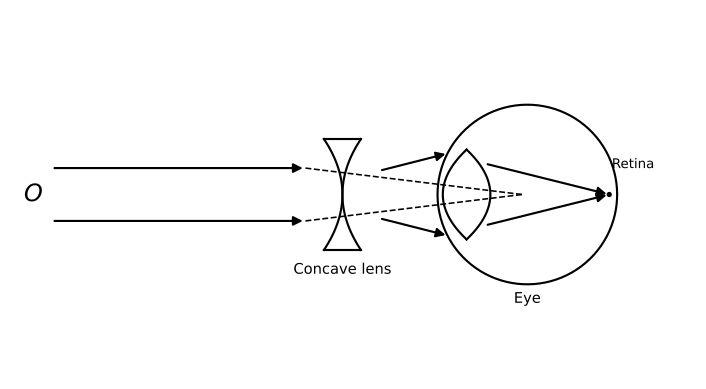
(i) A concave lens diverges the parallel rays of light coming from a distant object before they enter the eye. This shifts the point where the rays converge backward, so that the image falls exactly on the retina instead of in front of it.

(ii) The concave lens effectively moves the image of the distant object to the far point of Rahul's myopic eye, which lies closer than infinity, so his eye lens can then focus it clearly on the retina. [1 + 1 = 2 marks]

OR

(c) The part of the eye that controls the amount of light entering it is the Iris.

(i) In bright light, the iris expands (contracts the pupil — the opening becomes smaller) so that less light enters the eye, protecting the retina from damage.

(ii) In dim light, the iris contracts (dilates the pupil — the opening becomes larger) so that more light enters the eye, allowing us to see in low-light conditions. [1 + 1 = 2 marks]
Q6Case-based4 marks

Riya is a 13-year-old student who loves reading books. Lately, she has been complaining that she cannot read the text written on the blackboard clearly from the back row of her classroom, although she can read her textbook perfectly when it is held close to her eyes. Her mother took her to an eye doctor, who examined her eyes and prescribed spectacles with lenses of power −2.0 D.

Riya is a 13-year-old student who loves reading books. Lately, she has been complaining that she cannot read the text written on the blackboard clearly from the back row of her classroom, although she can read her textbook perfectly when it is held close to her eyes. Her mother took her to an eye doctor, who examined her eyes and prescribed spectacles with lenses of power −2.0 D.

Based on the above information, answer the following questions:

(a) Name the defect of vision Riya is suffering from.

(b) Name the type of lens prescribed by the doctor and state one characteristic of the image formed by this lens.

(c) State any two causes of this defect. Also state the function of the ciliary muscles in a normal human eye.

Diagram for question 6: The Human Eye and the Colourful World
Show answer
(a) Riya is suffering from Myopia (short-sightedness / near-sightedness). [1 mark]

(b) The doctor has prescribed a Concave (diverging) lens. [½ mark]
A concave lens always forms a virtual, erect and diminished image of an object. [½ mark]

(c) The two causes of myopia are: [1 mark]
(i) Excessive curvature of the eye lens — the eye lens becomes too curved (converging), causing light rays from a distant object to converge at a point in front of the retina instead of on it.
(ii) Elongation of the eyeball — the eyeball becomes too long from front to back, so the retina is farther from the lens than normal, and the image of a distant object falls in front of the retina.

Function of ciliary muscles in a normal human eye: [1 mark]
The ciliary muscles control the curvature and thickness of the eye lens, thereby adjusting its focal length. When viewing a nearby object, the ciliary muscles contract, making the lens thicker and increasing its converging power (shorter focal length). When viewing a distant object, the ciliary muscles relax, making the lens thinner and decreasing its converging power (longer focal length). This ability to adjust focal length is called the power of accommodation.
Q7Case-based4 marks

Rahul, a 14-year-old student, noticed that he could read his textbook clearly when it was placed close to his eyes, but the writing on the classroom blackboard appeared blurred from his seat. His optometrist examined his eyes and found that the image of distant objects was forming in front of his retina instead of on it. The doctor prescribed corrective lenses for him.

His classmate Priya, on the other hand, could see the blackboard clearly but had difficulty reading a book unless she held it at arm's length. The optometrist told her that the image of near objects was forming behind her retina.

Read the following passage and answer the questions that follow:

Rahul, a 14-year-old student, noticed that he could read his textbook clearly when it was placed close to his eyes, but the writing on the classroom blackboard appeared blurred from his seat. His optometrist examined his eyes and found that the image of distant objects was forming in front of his retina instead of on it. The doctor prescribed corrective lenses for him.

His classmate Priya, on the other hand, could see the blackboard clearly but had difficulty reading a book unless she held it at arm's length. The optometrist told her that the image of near objects was forming behind her retina.

(a) Name the defect of vision Rahul is suffering from.
(b) Name the type of lens prescribed for Rahul and state how it corrects his vision.
(c) Name the defect of vision Priya is suffering from. State any TWO possible causes of this defect.

Diagram for question 7: The Human Eye and the Colourful World
Show answer
(a) Rahul is suffering from Myopia (near-sightedness / short-sightedness). [1 mark]

(b) A concave (diverging) lens is prescribed for Rahul. [½ mark]

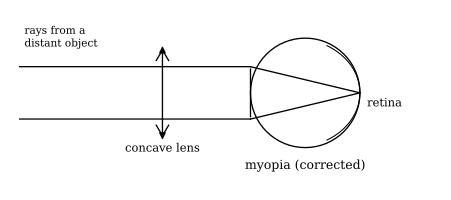
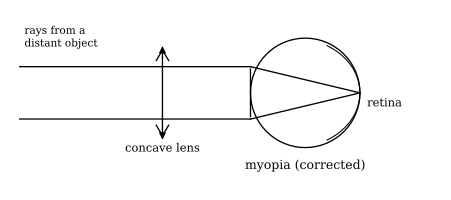
A concave lens diverges the incoming parallel rays from a distant object before they enter the eye. This shifts the point where the rays finally converge backward, so that the image now falls exactly on the retina instead of in front of it, allowing Rahul to see distant objects clearly. [½ mark]

(c) Priya is suffering from Hypermetropia (far-sightedness / long-sightedness). [1 mark]

Two possible causes of hypermetropia: [1 mark — ½ each]

(i) The eyeball is too short (shorter than normal), so the distance between the eye lens and the retina is reduced.

(ii) The focal length of the eye lens is too large (the eye lens becomes too thin / the ciliary muscles are too weak to increase the curvature of the lens sufficiently), so it cannot converge rays from near objects onto the retina.
Q8Case-based4 marks

Riya is a 14-year-old student who sits in the last row of her classroom. Her teacher notices that Riya always squints her eyes when reading what is written on the board, but she reads her textbook without any difficulty. Riya's mother takes her to an eye doctor, who examines her and prescribes spectacles with lenses of power −2.0 D.

Riya is a 14-year-old student who sits in the last row of her classroom. Her teacher notices that Riya always squints her eyes when reading what is written on the board, but she reads her textbook without any difficulty. Riya's mother takes her to an eye doctor, who examines her and prescribes spectacles with lenses of power −2.0 D.

(a) Name the eye defect Riya is suffering from.
(b) What type of lens has been prescribed to Riya? State one property of this lens that makes it suitable for correcting her defect.
(c) (i) State any TWO causes of this eye defect.
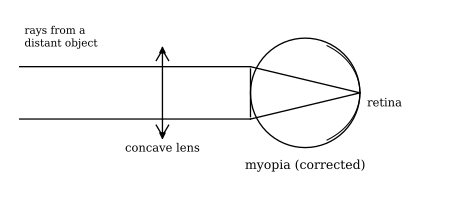
(ii) Draw a labelled ray diagram to show how the prescribed lens corrects Riya's vision.

Diagram for question 8: The Human Eye and the Colourful World
Show answer
(a) Riya is suffering from Myopia (near-sightedness / short-sightedness). [1 mark]

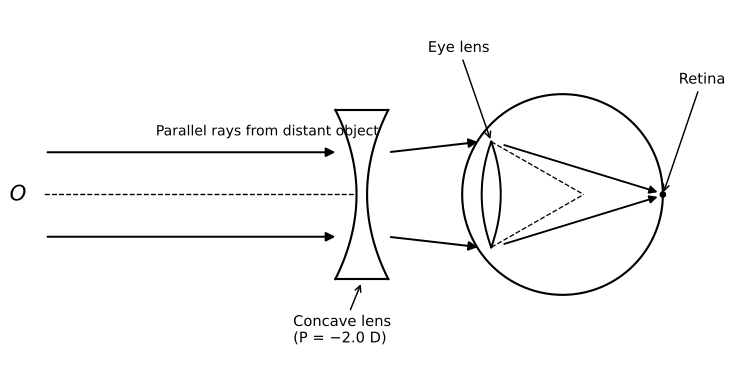
(b) A concave (diverging) lens has been prescribed to Riya. This lens has a negative power (P = −2.0 D), which means it diverges the incoming light rays before they enter the eye. As a result, the parallel rays from a distant object, after passing through this lens, appear to come from the far point of Riya's eye, allowing the eye lens to form the image exactly on the retina. [1 mark]

(c)(i) The two causes of myopia are:
(I) Excessive curvature of the eye lens — the eye lens becomes too curved (too convex), which increases its converging power, causing the image to form in front of the retina.
(II) Elongation of the eyeball — the eyeball becomes longer than normal, so the retina moves farther from the lens, and the image of a distant object falls in front of the retina instead of on it. [1 mark — both causes required]

(c)(ii) Ray diagram for correction of myopia:

[Diagram description: Draw a concave lens on the left. Show two parallel rays from a distant object (arrows pointing right) entering the concave lens. After refraction, the diverged rays appear to come from point F (the far point of the myopic eye), shown by dashed lines extending back to F on the left of the lens. Draw a simplified eye (with eye lens and retina) to the right of the concave lens. Show the diverged rays entering the eye lens and converging exactly on the retina. Label: Concave lens, Parallel rays from distant object, F (far point / virtual image), Eye lens, Retina, Image on retina. Arrowheads must be shown on ALL rays.] [1 mark — ½ mark deducted if arrowheads missing]
Q9MCQ1 mark

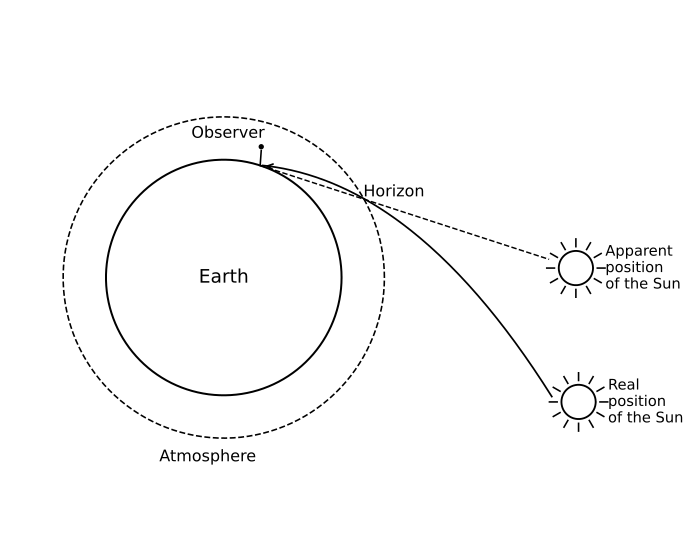
A student reads in a science journal that the total duration of daylight on Earth is slightly longer than what would be expected if the Earth had no atmosphere. Which of the following is the correct reason for this increase in the duration of daylight?

Diagram for question 9: The Human Eye and the Colourful World
Show answer
Option (A) is correct.

Explanation: The Earth's atmosphere acts as a refracting medium whose density increases gradually from the upper layers down to the surface. When sunlight enters this atmosphere at the shallow angles characteristic of sunrise and sunset, it is continuously refracted (bent) towards the Earth's surface. This bending causes the Sun to appear above the horizon even when it is geometrically below it — the Sun becomes visible approximately 2 minutes before it actually crosses the horizon at sunrise, and remains visible for approximately 2 minutes after it has actually dipped below the horizon at sunset. This phenomenon of atmospheric refraction therefore adds roughly 4 minutes of extra daylight each day, making the total duration of daylight on Earth slightly longer than it would be on an atmosphere-free planet.
Q10MCQ1 mark

A photographer on a mountain expedition captures an image of the night sky and notices that stars close to the horizon appear as short streaks rather than sharp points of light, indicating that their apparent positions shift slightly over a short exposure time. A nearby bright planet, however, appears as a sharp dot. Which of the following is the most correct reason why stars near the horizon show this shifting and twinkling effect while the planet does not?

Show answer
Option (A) is correct.

Explanation: Stars are extremely distant and behave as point sources of light. When starlight passes through the Earth's atmosphere near the horizon, it traverses a greater thickness of atmosphere consisting of multiple layers of continuously changing optical density (refractive index). This causes the light to be refracted by varying amounts at different instants, making the apparent position of the star shift continuously — a phenomenon called atmospheric refraction or twinkling (scintillation). A planet, although also very far away, is much closer than stars and subtends a small but finite angular disc as seen from Earth. The planet acts as a collection of many point sources; the varying refraction effects across different parts of its disc average out, so no net twinkling or apparent position shift is observed. Option (B) is incorrect because twinkling is caused by refraction due to varying atmospheric density, not by intensity differences or scattering by dust. Option (C) is incorrect because the Doppler effect due to Earth's rotation causes a change in frequency (colour), not the positional twinkling described. Option (D) is incorrect because planets do not emit their own light — they reflect sunlight — and atmospheric absorption is not the cause of twinkling.
Q11Short Answer1 mark

The sky appears blue on a clear day. Name the phenomenon responsible for this observation.

Show answer
The sky appears blue due to scattering of light (Tyndall effect / Rayleigh scattering). [1 mark]

The molecules of the atmosphere scatter shorter wavelengths of sunlight (blue light) much more than longer wavelengths (red light). This scattered blue light reaches our eyes from all directions, making the sky appear blue.
Q12Short Answer1 mark

Assertion (A) : A person suffering from hypermetropia cannot see nearby objects clearly.
Reason (R) : In hypermetropia, the image of a nearby object is formed in front of the retina.

Show answer
Option (C) is correct.

The Assertion is true: a person with hypermetropia (far-sightedness) cannot see nearby objects clearly, because nearby objects appear blurred while distant objects are seen clearly. The Reason, however, is false: in hypermetropia, the image of a nearby object is formed behind the retina, not in front of it. This happens because the eyeball is too short or the eye lens is too thin (less curved), so the converging power of the eye is insufficient to bring the image of a close object onto the retina. Therefore, while A is correct, R gives the wrong location of image formation and is hence false. R is not the correct explanation of A.
Q13MCQ1 mark

The ability of the human eye to adjust its focal length to see objects at different distances is called:

Show answer
Option (B) is correct.
Explanation: The power of accommodation is the ability of the eye lens to adjust its focal length by changing its curvature, allowing the eye to form clear images of objects at varying distances. When viewing a near object, the ciliary muscles contract, making the lens thicker and reducing its focal length. When viewing a distant object, the ciliary muscles relax, making the lens thinner and increasing its focal length. This adjustment is called the power of accommodation.
Q14MCQ1 mark

A student observes the night sky from a hilltop and notices that stars near the horizon appear to change their position slightly and flicker in brightness, whereas the Moon, also visible near the horizon at the same time, appears steady and does not flicker. Which of the following is the most correct reason why the Moon does not twinkle even when it is near the horizon?

Show answer
Option (A) is correct.

Explanation: Stars are point sources of light — they subtend essentially zero angular diameter at Earth — so atmospheric turbulence causes random, rapid bending of their light rays, making the star appear to shift position and flicker in brightness (scintillation). The Moon, being much closer to Earth, subtends a finite disc of approximately 0.5°. It can be treated as a very large collection of point sources; the random atmospheric refractions acting on different parts of this disc occur simultaneously and average out, so the net brightness and position remain steady to the observer. Option (B) is incorrect because the Moon does not emit its own light — it only reflects sunlight — and reflected light is equally subject to atmospheric refraction. Option (C) is incorrect because physical size alone does not prevent refraction. Option (D) is incorrect because the Moon's reflected light spans the same visible spectrum as starlight and is refracted by the atmosphere in the same way.
Q15MCQ1 mark

A 72-year-old retired school teacher finds that she can neither read the fine print in a newspaper held at normal reading distance nor recognise the faces of students standing far away. Her optometrist confirms that her ciliary muscles have lost their ability to adjust the curvature of the eye lens due to ageing. Which type of corrective lens is most suitable for her condition, and what is the name of the vision defect she is suffering from?

Show answer
Option (A) is correct.

Explanation: The patient cannot see clearly at either near or far distances, and the optometrist confirms that her ciliary muscles have lost the ability to adjust the curvature of the eye lens due to ageing. This is the defining characteristic of Presbyopia — an age-related defect in which the ciliary muscles weaken and the crystalline lens loses its flexibility, so the eye loses its power of accommodation entirely. Since both near and far vision are impaired simultaneously, the corrective lens must address both defects at once; a bifocal lens is used for this purpose, with its upper half being a concave (diverging) lens for clear distant vision and its lower half being a convex (converging) lens for clear near vision. Options (B) and (C) are incorrect because myopia and hypermetropia are single defects affecting only far or only near vision respectively, and neither involves complete loss of accommodation due to ageing. Option (D) is incorrect because astigmatism arises from unequal curvature of the cornea and is corrected by a cylindrical lens, which is unrelated to the condition described.
Q16MCQ1 mark

A 65-year-old accountant notices that he must hold his ledger books at arm's length to read the entries clearly, and he also struggles to see the wall clock across the room. His eye specialist tells him that his ciliary muscles have weakened due to ageing, reducing the flexibility of his eye lens. Which type of lens is used to correct this condition, and what defect of vision does it address?

Show answer
Option (A) is correct.

Explanation: The accountant cannot see clearly at either near distance (ledger books) or far distance (wall clock), and his specialist has attributed this to weakening of ciliary muscles and reduced lens flexibility due to ageing. This is the defining description of Presbyopia — an age-related defect in which the eye loses its power of accommodation and can no longer focus clearly at both near and far distances. Presbyopia is corrected using bifocal lenses, whose upper half is concave (for clear distant vision) and lower half is convex (for clear near vision), thus addressing both problems simultaneously. Options (B), (C), and (D) each describe single-defect conditions — myopia, hypermetropia, and astigmatism respectively — none of which matches a condition where both near and far vision are impaired due to age-related loss of accommodation.
Q17MCQ1 mark

A student observes that during sunset, the sky near the horizon appears red or orange, while the sky overhead appears blue. A classmate claims this happens because the atmosphere scatters different colours of light by different amounts. Which of the following correctly states the relationship between the wavelength of light and the extent to which it is scattered by fine particles in the atmosphere?

Show answer
Option (A) is correct.

Explanation: The extent to which fine atmospheric particles scatter light is inversely proportional to the fourth power of the wavelength (Rayleigh scattering: scattering ∝ 1/λ⁴). Shorter wavelengths such as violet and blue (~400–450 nm) are therefore scattered much more than longer wavelengths such as red and orange (~620–750 nm). Overhead, this scattered blue light reaches our eyes from all directions, making the sky appear blue. At sunset, sunlight travels a much longer path through the atmosphere, so blue light is almost completely scattered away; only the least-scattered red and orange wavelengths reach the observer, making the horizon appear red or orange. Options (B) and (D) reverse the correct relationship, and Option (C) incorrectly treats all wavelengths as equivalent in scattering.
Q18MCQ1 mark

An astronaut aboard a space station orbiting Earth at a very high altitude looks out at the surrounding space. Unlike observers on Earth's surface, the astronaut sees the background of space appearing completely black even during the period when the Sun is visible. Which of the following is the most accurate scientific reason for this observation?

Show answer
Option (A) is correct.

Explanation: On Earth, the atmosphere contains gas molecules and dust particles that scatter sunlight in all directions through Rayleigh scattering — blue light (shorter wavelength) is scattered most, which is why the daytime sky appears blue. In space, there is no atmosphere and therefore no particles to scatter sunlight. Light from the Sun travels only in straight lines and enters the astronaut's eyes solely when they look directly at the Sun or at an illuminated surface. Since no scattering occurs in any other direction, the surrounding space appears completely black even when the Sun is visible. Options (B), (C), and (D) are incorrect because sunlight intensity at orbital altitudes is actually greater than at Earth's surface, the ozone layer is part of Earth's lower atmosphere and has no relevance to observations from space, and gravity does not bend light away from an observer's line of sight under these conditions.
Q19Short Answer1 mark

A person can see nearby objects clearly but is unable to see distant objects. Name the defect of vision the person is suffering from. Name the type of lens used to correct it.

Show answer
(a) The defect of vision is Myopia (near-sightedness).

(b) A concave (diverging) lens is used to correct it.
Q20MCQ1 mark

A person cannot see objects clearly beyond a distance of 4 m. Which type of lens should be used to correct this defect? Name the defect.

Show answer
Option (B) is correct.

Explanation: The person cannot see objects beyond 4 m, which means distant objects appear blurred. This is the defect called Myopia (near-sightedness). In myopia, the eyeball is elongated or the eye lens is too curved, causing the image of a distant object to form in front of the retina. A concave (diverging) lens of appropriate power is used to correct this defect — it diverges the rays before they enter the eye so that the image is shifted back onto the retina.
Q21MCQ1 mark

The far point of a myopic person is 2 m from his eyes. Which type of lens is used to correct this defect?

Show answer
Option (B) is correct.
Explanation: Myopia is a defect in which a person can see near objects clearly but cannot see distant objects clearly. It is corrected by using a concave (diverging) lens. The required lens must form the image of a distant object (at infinity) at the person's far point, i.e., at 2 m. Using the lens formula with v = −2 m and u = −∞, the power P = 1/f = 1/(−2) = −0.5 D. Therefore, a concave lens of power −0.5 D is needed.
Q22MCQ1 mark

A 63-year-old librarian finds that she must hold books very close to her face to read, yet she also struggles to identify the titles on shelves at the far end of the room. Her optometrist diagnoses her with presbyopia. Which of the following best describes the type of lens prescribed to correct this condition?

Show answer
Option (A) is correct.

Explanation: Presbyopia is an age-related defect of vision in which the ciliary muscles weaken and the crystalline lens loses its flexibility, reducing the eye's power of accommodation. As a result, the affected person cannot see clearly at either near or far distances. To correct this condition, a bifocal lens is prescribed: the upper portion is concave (diverging) to correct the difficulty in seeing distant objects, and the lower portion is convex (converging) to correct the difficulty in reading or seeing near objects. A single concave or convex lens can correct only one defect at a time, and a cylindrical lens is used to correct astigmatism — a different defect caused by unequal curvature of the cornea — not presbyopia.
Q23Short Answer1 mark

Name the defect of vision in which a person can see nearby objects clearly but cannot see distant objects clearly. Name the type of lens used to correct this defect.

Show answer
The defect of vision is Myopia (near-sightedness). [½ mark]

It is corrected by using a Concave (diverging) lens. [½ mark]
Q24MCQ1 mark

A meteorologist studying atmospheric optics observes that when white sunlight passes through a thick layer of the Earth's atmosphere containing suspended fine dust and gas molecules, one particular colour is scattered far more than the others by these tiny particles. Which colour of sunlight is scattered the MOST by the fine particles and molecules present in the Earth's atmosphere?

Show answer
Option (C) is correct.

Explanation: According to Rayleigh's law of scattering, the amount of scattering of light by fine particles and molecules is inversely proportional to the fourth power of its wavelength (scattering ∝ 1/λ⁴). Among all colours of the visible spectrum, violet light has the shortest wavelength (approximately 380–400 nm) and is therefore scattered the most by fine dust particles and gas molecules present in the Earth's atmosphere. Although the sky appears blue to our eyes — because human eyes are more sensitive to blue light and some violet is absorbed in the upper atmosphere — the colour that is actually scattered to the greatest extent is violet.
Q25MCQ1 mark

A science teacher tells students that when white sunlight passes through the Earth's atmosphere, shorter wavelengths of light are scattered much more strongly than longer wavelengths. Based on this principle, which colour of light is scattered the LEAST by the atmospheric particles, making it suitable for use in fog lights of vehicles to maximise visibility?

Show answer
Option (A) is correct.

Explanation: According to Rayleigh scattering, the intensity of scattering of light by atmospheric particles is inversely proportional to the fourth power of the wavelength (scattering ∝ 1/λ⁴), meaning shorter wavelengths are scattered far more strongly than longer wavelengths. Among the given options, red light has the longest wavelength (~700 nm) compared to green (~550 nm), blue (~450 nm), and violet (~400 nm), so red light is scattered the least as it passes through the atmosphere or fog. Because red light undergoes minimal scattering, it penetrates through fog with the least loss of intensity and travels the greatest distance, maximising visibility for drivers. This is why red light is used in fog lamps of vehicles.
Q26MCQ1 mark

A 66-year-old retired pilot mentions to his ophthalmologist that he struggles to read the instrument manual placed on his lap, and at the same time cannot clearly see the runway markings at a distance. The doctor explains that this happens because ageing has caused his ciliary muscles to weaken and his eye lens to lose flexibility, reducing the power of accommodation. Which type of corrective lens is prescribed to help him see both near and distant objects clearly?

Show answer
Option (A) is correct.

Explanation: The patient is unable to see both near objects and distant objects clearly simultaneously, which is the defining feature of presbyopia — a defect of vision caused by weakening of ciliary muscles and loss of flexibility of the eye lens due to old age. Presbyopia requires correction for both near and distant vision. A bifocal lens serves this purpose: its upper portion is concave, which diverges light to correct the inability to see distant objects, while its lower portion is convex, which converges light to correct the inability to see near objects. A single concave or convex lens can correct only one defect at a time, and a cylindrical lens is prescribed for astigmatism caused by irregular curvature of the cornea — neither is appropriate for presbyopia.
Q27MCQ1 mark

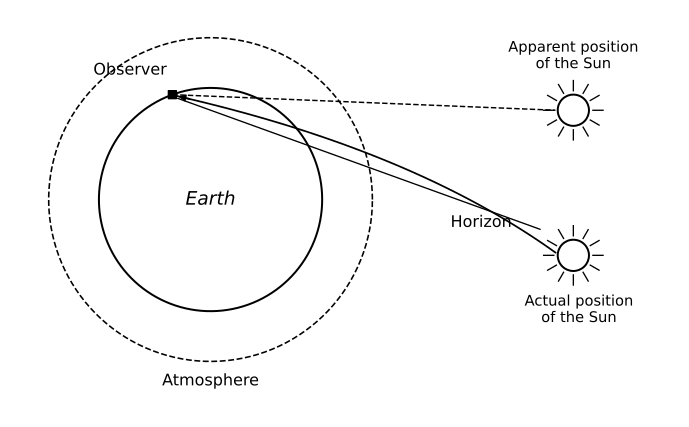
The Sun is visible to an observer on Earth approximately 2 minutes before it actually rises above the horizon. Which of the following correctly explains this phenomenon?

1. The Earth's atmosphere absorbs sunlight and re-emits it earlier.
2. The continuous refraction of sunlight by the atmosphere, which gradually increases in density towards the Earth's surface, bends the rays of light towards the normal, making the Sun appear higher than its actual position.
3. Scattering of blue light by atmospheric particles causes the Sun's image to shift upward before actual sunrise.
4. Reflection of sunlight by clouds near the horizon makes the Sun visible before it rises.

Diagram for question 27: The Human Eye and the Colourful World
Show answer
Option (B) is correct.

Explanation: As sunlight travels from outer space into the Earth's atmosphere, it passes through layers of progressively increasing optical density. This causes continuous refraction of light, bending the rays gradually towards the normal at each layer. Due to this continuous bending, the apparent position of the Sun is raised above its actual geometric position — an observer sees the Sun along the direction of the emergent refracted ray, which makes the Sun appear to be above the horizon even when it is still geometrically below it. This phenomenon of atmospheric refraction is responsible for the Sun being visible approximately 2 minutes before it actually rises. Options (A), (C), and (D) — absorption and re-emission, scattering of blue light, and reflection by clouds — do not cause any shift in the apparent position of the Sun and are therefore incorrect.
Q28MCQ1 mark

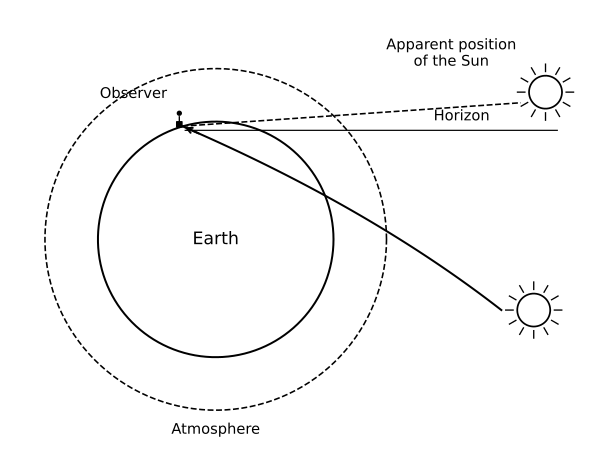
A student studying atmospheric optics learns that when sunlight travels through the Earth's atmosphere, the path of light rays continuously bends as they pass through layers of varying optical density. Due to this bending, the Sun becomes visible to an observer on Earth even when the Sun is actually still below the true horizon. Which of the following physical phenomena is solely responsible for the Sun appearing above the horizon before it has geometrically risen?

Diagram for question 28: The Human Eye and the Colourful World
Show answer
Option (A) is correct.

Explanation: Atmospheric refraction occurs when sunlight passes through successive layers of the Earth's atmosphere, each with a progressively increasing optical density from the top downward. As light travels from a rarer layer to a denser layer, it bends toward the normal at each interface, so the ray continuously curves as it descends through the atmosphere. This bending causes the apparent position of the Sun to be higher than its true geometric position. Consequently, an observer on Earth sees the Sun above the horizon even when the Sun is still geometrically below it, making the Sun visible approximately 2 minutes before it actually rises. Total internal reflection cannot occur here because light is travelling from a rarer medium to a denser medium, which does not satisfy the condition of going from denser to rarer. Scattering by dust and gas molecules changes the direction and intensity of individual wavelengths but does not shift the apparent position of the Sun above the horizon. Dispersion separates white light into its constituent colours but does not alter the apparent elevation of the Sun. Therefore, atmospheric refraction through layers of varying optical density is solely responsible for this phenomenon.
Q29MCQ1 mark

A 70-year-old retired judge finds that he can neither read the fine print of a legal document placed at normal reading distance nor see the courtroom clock clearly on the wall. His ophthalmologist explains that with advancing age, his ciliary muscles have weakened and the flexibility of his eye lens has decreased. Which of the following correctly identifies his condition and the type of corrective lens prescribed?

Show answer
Option (A) is correct.

Explanation: Presbyopia is an age-related condition in which the ciliary muscles weaken and the crystalline lens loses its flexibility, causing a progressive loss of the eye's power of accommodation. As a result, the affected person can neither see nearby objects clearly nor distant objects clearly. Since the patient cannot read fine print at normal reading distance (near vision defect) and cannot see the wall clock clearly (far vision defect), he is suffering from presbyopia. The corrective lens prescribed is a bifocal lens: the upper (concave) portion corrects the distant vision defect, and the lower (convex) portion corrects the near vision defect. Options (B) and (C) address only one defect each and are therefore incomplete; Option (D) describes astigmatism, which arises from unequal curvature of the cornea and is an entirely different condition unrelated to the symptoms described.
Q30Short Answer1 mark

Name the part of the human eye that is responsible for its power of accommodation.

Show answer
The ciliary muscles are responsible for the power of accommodation of the human eye. They control the curvature (thickness) of the eye lens, allowing it to adjust its focal length to form clear images of objects at different distances.

Want unlimited practice on The Human Eye and the Colourful World?

The full ClearSteps bank has 96+ reviewed questions on this chapter alone — with step-wise solutions, difficulty levels, and progress tracking. Verify your WhatsApp number and your free trial starts right here.

CBSE · CLASS 10
🎟️14-day free trial · code PRAC auto-applied
Mobile Number
+91
OTP will be sent to your WhatsApp

⭐ Trusted by 12,000+ students across India

The Human Eye and the Colourful World Class 10 Questions