ClearStepsCLEARSTEPS AI
Teacher Login →Student Login →

Biotechnology and Its Applications: Class 12 Biology Practice Questions

23 original exam-pattern questions with full answers, matched to the current CBSE Class 12 paper design, including case-based questions. Attempt each question before opening the answer — or start a free 14-day trial ↓ for the full bank.

Q1Case-based4 marks

Dr. Priya, a molecular biologist at a research institute in Pune, is working on producing a therapeutic protein — human insulin — using recombinant DNA technology. She isolates the human insulin gene from a cDNA library and clones it into plasmid pMI322 (which carries amp^R and tet^R genes) by inserting the insulin gene within the tet^R gene using EcoRI. Transformed E. coli cells are plated on ampicillin-only and tetracycline-only plates. Plate A (ampicillin) shows many colonies; Plate B (tetracycline) shows very few colonies.

Read the following passage carefully and answer the questions that follow:

Dr. Priya, a molecular biologist at a research institute in Pune, is working on producing a therapeutic protein — human insulin — using recombinant DNA technology. She isolates the human insulin gene (comprising A-chain and B-chain coding sequences) from a cDNA library. She clones this gene into a plasmid vector called pMI322, which contains an ampicillin resistance gene (amp^R) and a tetracycline resistance gene (tet^R). The insulin gene is inserted within the tet^R gene using the restriction enzyme EcoRI. The recombinant plasmid is then introduced into E. coli cells by treating them with CaCl₂ solution followed by heat shock. The transformed bacteria are plated on two sets of agar plates — one containing ampicillin only, and another containing tetracycline only.

Dr. Priya observes the following results after overnight incubation:

| Plate | Antibiotic | Colonies observed |
|-------|------------|------------------|
| Plate A | Ampicillin only | Many colonies |
| Plate B | Tetracycline only | Very few colonies |

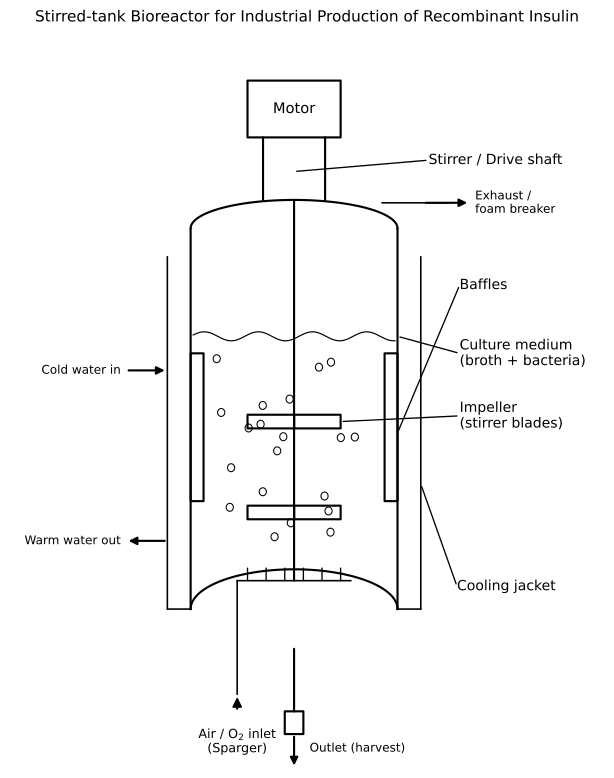
She then transfers the bacteria to a large stirred-tank bioreactor for large-scale production of insulin.

(a) Why did Dr. Priya use cDNA rather than genomic DNA to clone the human insulin gene into E. coli? (1 mark)

(b) Identify which colonies on Plate A contain the recombinant plasmid (with the insulin gene inserted) and which contain the non-recombinant plasmid. Justify your answer using the principle of insertional inactivation. (2 marks)

(c) Name ONE essential feature that the plasmid pMI322 must possess (other than antibiotic resistance genes) to ensure successful cloning, and state its function. (1 mark)

Show answer
CBSE MARKING SCHEME — CASE STUDY (4 marks)

━━━━━━━━━━━━━━━━━━━━━━━━━━━━━━━━
(a) Why cDNA instead of genomic DNA? (1 mark)
━━━━━━━━━━━━━━━━━━━━━━━━━━━━━━━━
• cDNA (complementary DNA) is synthesised from mature mRNA using reverse transcriptase and therefore contains NO INTRONS (non-coding intervening sequences). (1)
— Genomic DNA contains introns; E. coli (a prokaryote) lacks the RNA-splicing machinery (spliceosome) to remove introns from pre-mRNA → the correct functional protein would NOT be produced if genomic DNA were used.
— cDNA represents only the coding sequence → E. coli can directly transcribe and translate it to produce functional human insulin.

[Award 1 mark for: 'cDNA has no introns / E. coli cannot process introns / cDNA made from mRNA has only coding sequences' — any one of these phrasings accepted]

━━━━━━━━━━━━━━━━━━━━━━━━━━━━━━━━
(b) Identifying recombinant vs non-recombinant colonies using insertional inactivation (2 marks)
━━━━━━━━━━━━━━━━━━━━━━━━━━━━━━━━
PRINCIPLE OF INSERTIONAL INACTIVATION:
• The insulin gene is inserted INTO the tet^R gene → this disrupts/inactivates the tet^R gene → bacteria carrying the recombinant plasmid CANNOT grow on tetracycline.
• The amp^R gene remains intact in ALL transformed bacteria (recombinant and non-recombinant) → ALL transformed bacteria grow on ampicillin (Plate A).

IDENTIFICATION:
• Colonies on Plate A that ALSO grow on tetracycline (Plate B) = NON-RECOMBINANT (tet^R gene intact; no insert). (1)
• Colonies on Plate A that do NOT grow on tetracycline (Plate B) = RECOMBINANT (tet^R gene disrupted by insulin gene insert; these carry the insulin gene). (1)

[REPLICA PLATING METHOD — acceptable additional detail, not required for marks]
To identify recombinant colonies: replica plate all colonies from Plate A onto a tetracycline plate → colonies that fail to appear on the tetracycline replica are the recombinant (insulin-gene-containing) transformants.

SUMMARY TABLE (for clarity):
| Colony type | Grows on Amp (Plate A) | Grows on Tet (Plate B) | Conclusion |
|-------------|----------------------|----------------------|------------|
| Non-recombinant | YES | YES | tet^R intact; no insert |
| Recombinant (with insulin gene) | YES | NO | tet^R disrupted by insert |

[Award 1 mark for correctly identifying recombinant colonies as those that grow on Plate A but NOT on Plate B]
[Award 1 mark for correctly explaining the principle: insulin gene insertion disrupts tet^R → tetracycline sensitivity]

━━━━━━━━━━━━━━━━━━━━━━━━━━━━━━━━
(c) One essential vector feature (other than antibiotic resistance) and its function (1 mark)
━━━━━━━━━━━━━━━━━━━━━━━━━━━━━━━━
• Origin of Replication (ori): the specific DNA sequence from which replication of the plasmid is initiated inside the host cell. It ensures the recombinant plasmid replicates autonomously within E. coli and is maintained in daughter cells during cell division. (1)

[Acceptable alternatives for 1 mark — any ONE of the following]
• Cloning site / Multiple Cloning Site (MCS) / Restriction site: the specific recognition sequence where the restriction enzyme cuts to allow insertion of the foreign gene.
• Promoter sequence: required for transcription of the cloned insulin gene in the host bacterium.

[Do NOT award mark for 'selectable marker' — the question explicitly excludes antibiotic resistance genes]

━━━━━━━━━━━━━━━━━━━━━━━━━━━━━━━━
MARK SUMMARY: (a) 1 + (b) 2 + (c) 1 = 4 marks
━━━━━━━━━━━━━━━━━━━━━━━━━━━━━━━━
Q2Case-based4 marks

A biotechnology company was developing a genetically modified variety of brinjal (Bt brinjal) to protect it from the fruit and shoot borer — a major pest that causes significant crop loss. Scientists introduced a specific gene from the soil bacterium Bacillus thuringiensis into the brinjal genome. When the insect larvae feed on the modified plant, the protein encoded by the introduced gene is activated in the alkaline pH of the insect's midgut, creating pores in the epithelial cells, leading to the death of the larva. Before releasing this GM crop commercially in India, the company had to obtain approval from a statutory body.

Read the following passage and answer the questions that follow:

A biotechnology company was developing a genetically modified variety of brinjal (Bt brinjal) to protect it from the fruit and shoot borer — a major pest that causes significant crop loss. Scientists introduced a specific gene from the soil bacterium Bacillus thuringiensis into the brinjal genome. When the insect larvae feed on the modified plant, the protein encoded by the introduced gene is activated in the alkaline pH of the insect's midgut, creating pores in the epithelial cells, leading to the death of the larva. Before releasing this GM crop commercially in India, the company had to obtain approval from a statutory body.

(i) Name the gene introduced into brinjal from Bacillus thuringiensis that confers resistance against the fruit and shoot borer. (1 mark)

(ii) Explain the mechanism by which the protein encoded by this gene kills the insect larva. (2 marks)

(iii) Name the statutory body in India that is responsible for approving the release of genetically modified organisms for commercial use. (1 mark)

Show answer
CBSE Marking Scheme — Biotechnology and Its Applications (Case Study)

(i) Name of the gene: (1 mark)

• cry1Ac (accept: cry gene / Bt toxin gene)

(1 × 1 = 1 mark)

---

(ii) Mechanism by which the Bt toxin protein kills the insect larva: (2 marks)

Value points (any 2 of the following, each worth 1 mark):

• The cry gene in Bacillus thuringiensis produces a protein called Bt toxin, which exists as an INACTIVE protoxin (protoxin form) inside the bacterial cell / in the plant tissue. (1)

• When the insect larva ingests the plant material, the protoxin is solubilised and activated by the ALKALINE pH of the larval midgut, converting it into the active toxic form. (1)

• The activated toxin binds to the epithelial cells lining the midgut of the insect, creating pores / holes in the cell membrane, causing cell swelling and lysis, leading to the death of the larva. (1)

(Award any 2 value points; 1 × 2 = 2 marks)

---

(iii) Name of the statutory body: (1 mark)

• GEAC — Genetic Engineering Appraisal Committee

(Accept full form or abbreviation; 1 × 1 = 1 mark)

---

Total: 4 marks
Q3Case-based4 marks

A biotechnology company is producing human insulin using recombinant DNA technology. Scientists isolated the insulin gene from human pancreatic cells and inserted it into a plasmid vector. The recombinant plasmid was then introduced into Escherichia coli bacteria. The bacteria were grown in large fermenters, and the insulin protein was extracted and purified for medical use. Before the availability of this recombinant human insulin, diabetic patients were treated with insulin extracted from the pancreas of slaughtered cattle and pigs, which sometimes caused allergic reactions in patients.

Read the following passage and answer the questions that follow:

A biotechnology company is producing human insulin using recombinant DNA technology. Scientists isolated the insulin gene from human pancreatic cells and inserted it into a plasmid vector. The recombinant plasmid was then introduced into Escherichia coli bacteria. The bacteria were grown in large fermenters, and the insulin protein was extracted and purified for medical use. Before the availability of this recombinant human insulin, diabetic patients were treated with insulin extracted from the pancreas of slaughtered cattle and pigs, which sometimes caused allergic reactions in patients.

(a) Name the type of plasmid used as a vector in recombinant DNA technology and state ONE property that makes it suitable as a vector. (1 mark)

(b) Draw a labelled diagram showing the structure of a recombinant plasmid after insertion of the human insulin gene. Label any THREE essential features. (2 marks)

(c) State ONE advantage of using recombinant human insulin over animal-derived insulin for treating diabetes. (1 mark)

Show answer
MARKING SCHEME — CASE STUDY (4 marks)

─────────────────────────────────────
(a) Name and ONE property of the vector (1 mark)
─────────────────────────────────────
• Name: pBR322 / any plasmid (e.g., pUC19) — accept 'plasmid' [½ mark]
• Property (any ONE of the following): [½ mark]
– Has an origin of replication (ori) — allows autonomous replication inside the host cell
– Has a selectable marker (antibiotic resistance gene) — helps identify transformed cells
– Has restriction enzyme recognition sites (cloning sites / MCS) — allows insertion of foreign DNA

(Award 1 mark for any correct name + one correct property; accept equivalent NCERT phrasing)

─────────────────────────────────────
(b) Labelled diagram of recombinant plasmid (2 marks)
─────────────────────────────────────
• Correct diagram showing circular plasmid with insulin gene inserted: [1 mark]
• Any THREE correct labels (½ mark each, up to 1 mark for labels): [1 mark]

DIAGRAM (draw in answer book):

Origin of replication (ori)

_______________
/ \
| RECOMBINANT |
| PLASMID |
| |
| [Insulin gene] |←── Foreign DNA / Human insulin gene (inserted at restriction site)
| |
\_______________/
|

Selectable marker
(e.g., amp^R gene)

Required labels (any THREE for full label mark):
1. Origin of replication (ori)
2. Selectable marker / antibiotic resistance gene (amp^R / tet^R)
3. Human insulin gene / foreign gene / insert
4. Restriction site / cloning site
5. Plasmid DNA (circular double-stranded DNA)

(Award 1 mark for a correctly drawn circular plasmid with the insulin gene shown as an insert; award 1 mark for any three correctly placed labels. An unlabelled diagram earns 0 marks for the label component.)

─────────────────────────────────────
(c) ONE advantage of recombinant human insulin (1 mark)
─────────────────────────────────────
Any ONE of the following (award 1 mark):
• Recombinant human insulin is identical in structure to natural human insulin, so it does NOT cause allergic reactions / immune reactions in patients. [1 mark]
• It is produced in large quantities and is not dependent on slaughter of animals (ethical advantage / sustainable supply). [1 mark]
• It is purer than animal-derived insulin and carries no risk of animal pathogens / contaminants. [1 mark]

─────────────────────────────────────
TOTAL: 4 marks
─────────────────────────────────────
(a) 1 mark + (b) 2 marks + (c) 1 mark = 4 marks
Q4Case-based4 marks

A biotechnology company is developing a genetically engineered bacterium to produce human insulin. The team extracts mRNA from human pancreatic beta cells and uses reverse transcriptase to synthesise cDNA. This cDNA is then inserted into a plasmid vector (pBR322) and introduced into Escherichia coli. However, the team faces two challenges:

Challenge 1: When the foreign gene is inserted into the tetracycline-resistance gene (tet^R) of pBR322, the scientists need a reliable method to identify which bacterial colonies have successfully taken up the recombinant plasmid.

Challenge 2: The team realises that if they had used the original genomic DNA (with introns) from human cells instead of cDNA, the bacteria would NOT have produced functional insulin.

Read the passage given below and answer the questions that follow:

A biotechnology company is developing a genetically engineered bacterium to produce human insulin. The team extracts mRNA from human pancreatic beta cells and uses reverse transcriptase to synthesise cDNA. This cDNA is then inserted into a plasmid vector (pBR322) and introduced into Escherichia coli. However, the team faces two challenges:

Challenge 1: When the foreign gene is inserted into the tetracycline-resistance gene (tet^R) of pBR322, the scientists need a reliable method to identify which bacterial colonies have successfully taken up the recombinant plasmid.

Challenge 2: The team realises that if they had used the original genomic DNA (with introns) from human cells instead of cDNA, the bacteria would NOT have produced functional insulin.

(a) Why did the scientists use mRNA from pancreatic beta cells to make cDNA, rather than using genomic DNA directly? Give ONE reason. [1]
(b) Explain the principle of insertional inactivation used in Challenge 1 to identify recombinant colonies. [2]
(c) Name the enzyme used to synthesise cDNA from mRNA, and state ONE property of this enzyme that makes it unique. [1]

Show answer
MARKING SCHEME — Total: 4 marks

─────────────────────────────────────
(a) [1 mark]

Bacteria lack the cellular machinery (spliceosomes) to remove introns from pre-mRNA / eukaryotic genomic DNA contains non-coding sequences (introns) that cannot be processed by prokaryotic cells.
cDNA is made from mature mRNA (already processed — introns removed), so it contains ONLY the coding sequence (exons), allowing bacteria to produce functional insulin protein directly.

(Award 1 mark for any ONE of the above equivalent points)

─────────────────────────────────────
(b) [2 marks]

Principle of Insertional Inactivation (pBR322):

pBR322 carries TWO antibiotic resistance genes: ampicillin-resistance gene (amp^R) and tetracycline-resistance gene (tet^R). … (1 mark)

When the foreign DNA (cDNA insert) is ligated into the tet^R gene, the tet^R gene is disrupted and becomes non-functional.

Identification steps:
• All bacteria are first plated on ampicillin-containing medium → only transformed bacteria (those that have taken up the plasmid) survive, because they carry the intact amp^R gene.
• Surviving colonies are then replica-plated onto tetracycline-containing medium.
• Non-recombinant colonies (plasmid with no insert — tet^R intact) → grow on tetracycline medium.
• Recombinant colonies (insert disrupts tet^R) → do NOT grow on tetracycline medium (tetracycline-sensitive). … (1 mark)

Conclusion: Colonies that grow on ampicillin but FAIL to grow on tetracycline are identified as recombinant (transformed with recombinant plasmid).

─────────────────────────────────────
(c) [1 mark]

Enzyme: Reverse transcriptase (also called RNA-dependent DNA polymerase). … (½ mark)

Unique property: It synthesises DNA using RNA as a template — i.e., it catalyses the reverse of the normal transcription process (RNA → DNA), which is opposite to the central dogma's usual direction (DNA → RNA). … (½ mark)

(Award 1 mark for correct name + correct unique property; accept either ½+½ or 1 mark for a complete combined statement)

─────────────────────────────────────
SUMMARY OF VALUE POINTS:
(a) cDNA has no introns / bacteria cannot splice introns — 1 mark
(b) Disruption of tet^R gene identified by replica plating (grows on amp, fails on tet) — 1 + 1 mark
(c) Reverse transcriptase / synthesises DNA from RNA template — 1 mark
Total: 4 marks (1 + 2 + 1)
Q5Case-based5 marks

A biotechnology company is working on producing human insulin for diabetic patients. Scientists isolated the human insulin gene and inserted it into a plasmid vector. The recombinant plasmid was then introduced into Escherichia coli bacteria. The bacteria were grown in large fermentation tanks (bioreactors) to produce insulin on an industrial scale. The insulin produced was then extracted, purified, and made available as 'Humulin' for patients.

Read the following passage and answer the questions that follow:

A biotechnology company is working on producing human insulin for diabetic patients. Scientists isolated the human insulin gene and inserted it into a plasmid vector. The recombinant plasmid was then introduced into Escherichia coli bacteria. The bacteria were grown in large fermentation tanks (bioreactors) to produce insulin on an industrial scale. The insulin produced was then extracted, purified, and made available as 'Humulin' for patients.

(a) Name the type of insulin produced by this method and state ONE advantage it has over insulin extracted from animals. (1 mark)
(b) Name the two polypeptide chains that make up the human insulin molecule. Why was human insulin produced as two separate chains in bacteria and then combined? (2 marks)
(c) Name any TWO features that the plasmid used as a vector in the above process must possess. (2 marks)

Show answer
MARKING SCHEME — Total: 5 marks

─────────────────────────────────────
(a) [1 mark]

Type of insulin: Recombinant human insulin / Humulin (produced by rDNA technology). (1)

Advantage (any one acceptable):
• Does not cause allergic reactions / immune reactions in patients (unlike animal insulin which is slightly different in amino acid sequence).
• Identical to natural human insulin in structure and function.
• Can be produced in large quantities without depending on animal sources.

─────────────────────────────────────
(b) [2 marks]

Two polypeptide chains of human insulin:
• Chain A
• Chain B
(Award 1 mark for naming BOTH chains correctly.) (1)

Reason they were produced separately in bacteria:
Mature human insulin has a C-peptide (connecting peptide) that is present in the precursor pro-insulin but is removed during processing. Bacteria (prokaryotes) lack the cellular machinery to carry out this post-translational processing. Therefore, the A chain and B chain were produced separately in E. coli and then combined / linked by disulphide bonds outside the bacterial cell to form functional insulin. (1)

─────────────────────────────────────
(c) [2 marks]

Any TWO features a plasmid vector must possess (1 mark each):

1. Origin of replication (ori): A specific DNA sequence that allows the plasmid to replicate autonomously inside the host cell, independent of the host chromosome. (1)

2. Selectable marker: A gene (e.g., antibiotic resistance gene such as ampicillin resistance — amp^R) that allows identification and selection of transformed host cells that have taken up the recombinant plasmid. (1)

[Other acceptable answers: Cloning sites / Multiple Cloning Site (MCS) / Restriction sites where foreign DNA can be inserted; low copy number / high copy number as appropriate.]

─────────────────────────────────────
SUMMARY OF VALUE POINTS:
(a) Name of insulin + advantage = 1 mark
(b) Names of both chains (A and B) = 1 mark; reason for separate production = 1 mark
(c) Any two vector features, 1 mark each = 2 marks
Total = 5 marks (1 + 2 + 2)
Q6Short Answer1 mark

Assertion (A): In the production of recombinant insulin, the A and B chains are produced separately in E. coli and then combined to form functional insulin.
Reason (R): Eukaryotic genes expressed in bacteria produce mRNA that cannot be translated without introns being removed by the bacterial machinery.

Show answer
Correct option: (C) A is true, but R is false.

Explanation:
• Assertion (A) is TRUE: Recombinant human insulin (Humulin) is produced by separately expressing the A-chain and B-chain genes in E. coli. After extraction, the two chains are combined in vitro and disulphide bonds are formed to produce functional insulin. (1 mark)
• Reason (R) is FALSE: Bacteria do NOT possess the splicing machinery (spliceosomes) to remove introns from eukaryotic pre-mRNA. Therefore, to express a eukaryotic gene in bacteria, cDNA (complementary DNA, made from mature mRNA using reverse transcriptase and hence intron-free) is used — NOT the genomic DNA with introns. The Reason incorrectly implies bacteria can remove introns, which they cannot.
Q7MCQ1 mark

A farmer in Punjab grows Bt cotton (carrying the cry1Ac gene) to protect against bollworm. However, he notices that the same crop is severely damaged by whitefly, a phloem-sucking insect. He concludes that Bt cotton cannot protect against all types of insect pests. Which of the following best explains why Bt cotton fails to control the whitefly?

(A) The whitefly does not feed on plant tissue, so it is never exposed to the Bt toxin.
(B) The whitefly's midgut is acidic, so the inactive protoxin is not converted to its active toxic form.
(C) The whitefly lacks the specific receptors on its midgut epithelial cells that bind the activated Bt toxin.
(D) The cry1Ac gene is expressed only in the roots of Bt cotton and not in the phloem.

Show answer
Correct Option: (C)

The Bt toxin (cry1Ac) is a protoxin that, once activated in the alkaline midgut of susceptible insects, must bind to specific receptors on the midgut epithelial cells to exert its toxic effect (pore formation and cell lysis). The whitefly lacks these specific receptor proteins on its midgut epithelial cells that recognise and bind the activated Bt toxin. Without receptor binding, the toxin cannot insert into the membrane, cannot form pores, and therefore cannot kill the insect. This is the primary molecular reason why Bt cotton fails to control phloem-sucking pests like whitefly, regardless of whether the toxin is ingested.

(1 mark)
Q8MCQ1 mark

A farmer notices that his cotton crop is being severely damaged by bollworm infestation every season. His neighbour, who planted Bt cotton, has no such problem. Which of the following correctly explains why Bt cotton is resistant to bollworm?

Show answer
Correct answer: (B)

The cry1Ac gene from Bacillus thuringiensis is expressed in Bt cotton, producing a Bt toxin (protoxin). In the alkaline pH of the bollworm's midgut, the protoxin is activated → forms pores in the epithelial cells of the midgut → cell lysis → insect (bollworm) dies. (1 mark)

Why the other options are incorrect:
- (A) Bt cotton does NOT spray any chemical; the toxin is encoded in the plant's own genome and expressed internally.
- (C) Cell wall thickness is not the mechanism of resistance in Bt cotton.
- (D) Bt cotton does not produce egg-digesting enzymes.
Q9MCQ1 mark

A researcher isolates a gene from a thermophilic bacterium and wants to express it in E. coli to produce the encoded enzyme commercially. She constructs a recombinant plasmid and transforms E. coli cells. However, the enzyme produced in E. coli is non-functional. Which of the following is the MOST likely reason for this outcome?

Show answer
Correct Answer: (B)

The thermophilic enzyme requires high temperatures to fold correctly, and E. coli's cytoplasmic environment (37°C) does not support proper protein folding.

Reasoning (for examiner reference):
• Thermophilic bacteria (e.g., Thermus aquaticus) live at 60–80°C; their enzymes are adapted to fold and function at these high temperatures.
• When the gene is expressed in E. coli (optimum temperature 37°C), transcription and translation occur correctly — the mRNA and polypeptide are produced — but the polypeptide cannot attain its native (functional) three-dimensional conformation at 37°C.
• This is a classic post-translational problem: the primary structure (amino acid sequence) is correct, but the tertiary/quaternary structure (required for enzyme activity) is not achieved under mesophilic conditions.
• Option A is incorrect: E. coli does possess restriction endonucleases, but in practice, the recombinant plasmid is propagated in a methylation-deficient strain or the plasmid is protected; restriction of the plasmid would prevent transformation entirely, not produce a non-functional enzyme.
• Option C is incorrect for the same reason as A — if restriction degraded all foreign DNA, no protein would be produced at all, not a non-functional one.
• Option D is incorrect: a plasmid lacking ori would not replicate and no enzyme would be produced; the question states enzyme IS produced but is non-functional.

(1 mark)
Q10MCQ1 mark

A farmer notices that his Bt cotton crop is resistant to bollworm attack, while the neighbouring non-Bt cotton crop is heavily damaged. The reason for this resistance in Bt cotton is that it produces a toxin derived from:

Show answer
Correct answer: (B)

Bt cotton contains the cry gene from Bacillus thuringiensis. The cry gene encodes a protoxin (Bt toxin). In the alkaline pH of the bollworm's midgut, the protoxin is activated → forms pores in the epithelial cells of the insect's gut → cell lysis → death of the insect.

The toxin is species-specific and harmless to humans and other non-target organisms. (1 mark)
Q11MCQ1 mark

A crop scientist observes that a particular transgenic cotton variety suffers no damage from bollworm larvae, even though the adult bollworm moths can lay eggs on its leaves. She notes that the plant produces a protein that is inactive at neutral pH but becomes toxic only inside the alkaline gut of the bollworm larva. Which of the following conclusions is best supported by this observation?

Show answer
Correct Answer: (B)

Value point (1 mark):
The transgenic cotton carries a cry gene (from Bacillus thuringiensis) that encodes a protoxin. The protoxin is inactive at neutral pH but is solubilised and activated in the alkaline pH of the bollworm larva's midgut → binds to epithelial cells → creates pores → cell lysis → larva dies. This explains why adult moths (neutral gut) are unaffected while larvae are killed — directly supported by the observation that damage occurs only at the larval stage and that the toxic protein requires alkaline conditions for activation.
Q12Short Answer2 marks

A scientist inserts a foreign gene into the tetracycline-resistance gene (tet^R) of the plasmid pBR322 and transforms it into E. coli. The bacterial colonies are then replica-plated onto two plates: one containing ampicillin and one containing tetracycline. (i) On which plate will the recombinant colonies FAIL to grow? (ii) Give ONE reason why.

Show answer
(i) Recombinant colonies will FAIL to grow on the tetracycline-containing plate. (1 mark)

(ii) Reason: Insertion of foreign DNA into the tet^R gene disrupts (inactivates) it — this is called insertional inactivation — so the recombinant bacteria lose tetracycline resistance and cannot survive in the presence of tetracycline. (1 mark)

[Note: The recombinant colonies DO grow on the ampicillin plate because the amp^R gene (on pBR322) remains intact and uninterrupted, confirming successful uptake of the plasmid.]

(1 × 2 = 2 marks)
Q13Short Answer2 marks

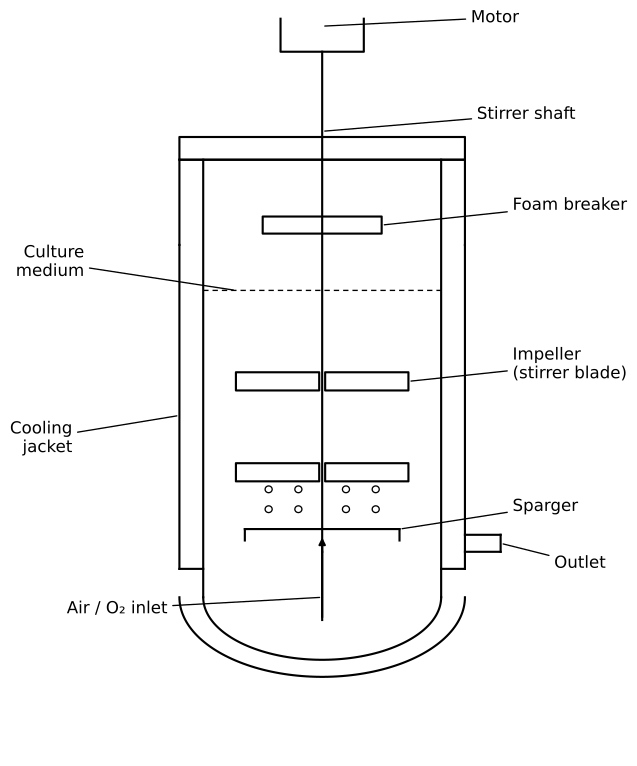
Draw a labelled diagram of the stirred-tank bioreactor used for large-scale production of biological products. Label any two important structural features.

Diagram for question 13: Biotechnology and Its Applications
Show answer
Stirred-tank bioreactor — labelled diagram:

```
┌─────────────────────────┐
│ Foam Breaker │ ← (antifoam impeller)
│ │
──────┤ ┌──────────────────┐ ├──────
Temp. │ │ │ │ pH
Jacket │ │ Culture │ │ Sensor
──────┤ │ Medium │ ├──────
│ │ │ │
│ │ ┌──┐ ┌──┐ │ │
│ │ │ │ │ │ │ │
│ └────┴──┴──┴──┘───┘ │
│ STIRRER │
│ (Impeller) │
│ │
│ ════════════════════ │
│ SPARGER │
│ (air/O₂ inlet) │
└─────────────────────────┘

Sterile air in
```

Fully labelled diagram of stirred-tank bioreactor showing:

• Stirrer / Impeller — agitates the culture medium to ensure uniform mixing of nutrients and oxygen throughout the vessel. (1 mark — diagram with any two correct labels)

• Sparger — introduces sterile air or oxygen as fine bubbles into the culture medium to maintain aerobic conditions for microbial/cell growth. (1 mark — brief function of labelled parts)

(Award 1 mark for a correctly drawn and labelled diagram showing at least two structural features; award 1 mark for stating the function of any two labelled parts.)
(1 + 1 = 2)
Q14Short Answer2 marks

Distinguish between 'Insertional inactivation' and 'Antibiotic resistance' as selectable markers used in recombinant DNA technology. Give one example of each.

Show answer
Antibiotic resistance as a selectable marker: A gene conferring resistance to an antibiotic (e.g., ampicillin resistance gene — amp^R in pBR322) is present in the vector. Transformed cells (those that have taken up the recombinant plasmid) survive on a medium containing that antibiotic, while non-transformed cells die. This allows selection of transformed cells. (1 mark)

Insertional inactivation as a selectable marker: A foreign DNA fragment is inserted into the middle of a marker gene, disrupting (inactivating) it. Example: in pBR322, if the insert is cloned into the tet^R (tetracycline resistance) gene, the recombinant colonies lose tetracycline resistance but retain ampicillin resistance. Non-recombinant colonies remain resistant to both antibiotics. Recombinant colonies are thus identified by their inability to grow on tetracycline medium (while growing on ampicillin medium). (1 mark)

(1 × 2 = 2)
Q15Short Answer3 marks

Draw a well-labelled diagram of the lac operon in the ABSENCE of lactose (repressed state). Name the molecule that acts as the inducer of the lac operon and state what happens to the operon when this inducer is present.

Show answer
Answer:

Part 1 — Labelled Diagram of lac Operon (Repressed State / Absence of Lactose) [1 mark for correct, labelled diagram]

```
Regulator Promoter Operator Structural genes
gene (i) (P) (O) z y a
┌──────────┐ ┌──────┐ ┌──────┐ ┌──────┬──────┬──────┐
│ │ │ │ │ │ │ │ │ │
│ i gene │────▶│ P │ │ O │ │ z │ y │ a │
│ │ │ │ │ │ │ │ │ │
└──────────┘ └──────┘ └──────┘ └──────┴──────┴──────┘
│ ▲
│ (transcription) │
▼ │ BLOCKS
Repressor protein ─────────────┘
(ACTIVE — binds operator)

∴ RNA polymerase CANNOT proceed past operator
∴ Structural genes z, y, a are NOT transcribed
∴ No β-galactosidase, permease, or transacetylase produced
```

Labels required on diagram:
- Regulator gene (i)
- Promoter (P)
- Operator (O)
- Structural genes: z (β-galactosidase), y (permease), a (transacetylase)
- Active repressor protein (bound to operator)
- Arrow showing RNA polymerase is blocked

---

Part 2 — Name of the Inducer [1 mark]

The inducer of the lac operon is allolactose (a metabolite of lactose; formed when lactose enters the cell in small amounts).

*(Note: Lactose / allolactose — both are accepted; NCERT uses 'lactose' as the inducer in common reference.)*

---

Part 3 — What happens when the inducer is present [1 mark]

When lactose (allolactose) is present:
- It binds to the active repressor protein, converting it into an inactive repressor.
- The inactive repressor cannot bind to the operator.
- RNA polymerase moves freely past the operator and transcribes the structural genes z, y, and a.
- The structural genes produce the enzymes β-galactosidase, permease, and transacetylase, which metabolise lactose.
- The lac operon is thus said to be in the induced (de-repressed) state.

Marking Scheme: 1 (diagram) + 1 (inducer name) + 1 (effect of inducer) = 3 marks
Q16Short Answer3 marks

A biotech company has developed a genetically modified (GM) brinjal variety by introducing a cry1Ab gene from Bacillus thuringiensis into its genome. Before this variety can be released for commercial cultivation in India, it must pass through a mandatory regulatory body.

(i) Name the regulatory body that approves the release of GM crops for commercial use in India.
(ii) The cry1Ab gene produces a protoxin inside the transgenic brinjal plant. Explain how this protoxin becomes lethal specifically to the target insect pest (fruit and shoot borer) but does NOT harm humans who eat the brinjal.
(iii) A farmer argues: 'If the Bt brinjal plant already produces the insecticidal protein in every cell, why should I still follow Integrated Pest Management (IPM) practices?' Give ONE scientifically valid reason to counter this argument.

Show answer
Answer:

(i) Regulatory body:
GEAC — Genetic Engineering Appraisal Committee (under the Ministry of Environment, Forest and Climate Change, Government of India).
(1 mark)

(ii) Why the Bt toxin is lethal to the insect but harmless to humans:

The cry1Ab gene codes for a protoxin (inactive form of Bt toxin) that is present in the transgenic brinjal plant.

When the insect pest (fruit and shoot borer) ingests the plant tissue:
• The alkaline pH of the insect's midgut gut activates the protoxin, converting it into the active toxin form.
• The active toxin binds to specific receptor proteins on the epithelial cells lining the insect's midgut.
• This causes lysis (rupture) of the epithelial cells → the insect stops feeding and dies.

In humans, the toxin is NOT activated because:
• The human digestive system has an acidic pH (stomach pH ≈ 2), and the protoxin is denatured/digested by proteases before it reaches the intestine.
• Human gut epithelial cells lack the specific receptor proteins to which the activated toxin can bind.
• Therefore, the toxin is harmless to humans.
(1 mark — any TWO of the above points together constitute 1 mark: activation requires alkaline pH + specific receptors absent in humans)

(iii) Scientific counter-argument to the farmer:
Any ONE of the following (1 mark):

• Insect resistance development: Continuous and exclusive exposure to Bt toxin exerts strong selection pressure on the pest population. Individuals with mutations that confer resistance to the Bt toxin survive and reproduce, leading to the evolution of resistant pest populations over time. IPM practices (such as refuge planting with non-Bt brinjal) reduce this selection pressure and delay resistance development.

OR

• Non-target pests: The cry1Ab gene is specific to lepidopteran pests (fruit and shoot borer). Other pest species (e.g., aphids, mites, fungal pathogens) that attack brinjal are NOT controlled by the Bt toxin, and IPM practices are still required to manage these.

(1 mark for any one valid scientific reason with explanation)
Q17Short Answer3 marks

A biotechnology company developed a transgenic tobacco plant by introducing a nematode-specific gene using Agrobacterium tumefaciens as a vector. The gene introduced produces double-stranded RNA (dsRNA) in the plant cells. When the nematode Meloidogyne incognita feeds on the roots of this plant, it dies, but the tobacco plant itself is unharmed.

(i) Name the molecular mechanism by which the nematode is killed after ingesting the dsRNA.
(ii) Identify the specific enzyme that is activated inside the nematode cell and describe its role in silencing the nematode's own gene.
(iii) Why does this mechanism NOT harm the tobacco plant itself, even though the same dsRNA is present in its cells?

Show answer
Answer:

(i) The molecular mechanism is RNA interference (RNAi) / gene silencing.
— The dsRNA introduced into the plant is complementary to the mRNA of a specific, essential gene of the nematode Meloidogyne incognita.
(1 mark)

(ii) The enzyme activated is Dicer (an RNase/endonuclease).
— Dicer cleaves the ingested dsRNA into short fragments called siRNA (small interfering RNA).
— The siRNA then associates with the RISC (RNA-Induced Silencing Complex), which uses the siRNA as a guide to bind and degrade the complementary mRNA of the nematode's own vital gene.
— This prevents translation of the essential nematode protein, leading to the death of the nematode.
(1 mark)

(iii) The dsRNA introduced is specifically designed to be complementary ONLY to a nematode-specific gene sequence that has NO counterpart / homologous sequence in the tobacco plant genome.
— Therefore, the RISC complex in the tobacco plant cells finds no matching mRNA to degrade, and the plant's own gene expression remains unaffected.
— RNAi is sequence-specific — it silences only the gene whose mRNA matches the siRNA sequence.
(1 mark)

[Total: 1 × 3 = 3 marks]
Q18Short Answer3 marks

Explain the steps involved in the production of a recombinant protein using a bioreactor. Name any one protein produced by this method and state its use.

Show answer
Steps in production of recombinant protein using a bioreactor: (1×3=3)

1. The desired gene (e.g., gene for human insulin) is introduced into a suitable host organism (e.g., Escherichia coli / yeast) using recombinant DNA technology to create a recombinant organism.

2. The recombinant host is grown in a bioreactor — a large vessel that provides optimal conditions (temperature, pH, O₂ supply via sparger, agitation via stirrer) for large-scale growth and production of the desired protein.

3. After biosynthesis, the protein is extracted from the bioreactor and subjected to downstream processing — separation, isolation, and purification (e.g., by chromatography) — to obtain the pure recombinant protein.

Example of recombinant protein and its use:
• Human insulin (Humulin) — used in the treatment of diabetes mellitus.
OR
• Human growth hormone — used to treat growth deficiencies in children.
(Any one correct example with use: 1 mark — included within the 3 value points above; if question is interpreted as 3 steps only, the example is an additional acceptable value point in place of any one step.)

[Marking: 1 mark each for any three of the above value points = 1×3=3]
Q19Short Answer3 marks

A biotechnology company is developing a recombinant insulin product. The gene encoding human insulin (preproinsulin) was isolated from a human pancreatic cell. However, when this genomic DNA was directly inserted into an E. coli expression system, no functional insulin protein was produced.

(i) Explain why the direct use of genomic DNA failed to produce functional insulin in E. coli. (1 mark)

(ii) Suggest the correct form of DNA that should be used and describe how it is prepared. (1 mark)

(iii) Draw a labelled diagram showing the steps involved in the preparation of this correct form of DNA from mRNA. (1 mark)

Show answer
(i) Reason for failure of genomic DNA in E. coli: (1 mark)

Human insulin gene (genomic DNA) contains introns (non-coding intervening sequences). E. coli (a prokaryote) lacks the RNA splicing machinery (spliceosomes) required to remove introns from pre-mRNA. Therefore, the mRNA produced from genomic DNA cannot be correctly processed, and no functional insulin protein is translated.

(Award 1 mark for: introns present in genomic DNA / E. coli cannot remove introns / E. coli lacks splicing machinery — any one correct reason)

---

(ii) Correct DNA form and its preparation: (1 mark)

cDNA (complementary DNA) should be used.

Preparation: Mature mRNA (already processed — introns removed, exons joined) is isolated from human pancreatic beta cells → reverse transcriptase enzyme is used to synthesise a single-stranded cDNA → DNA polymerase converts it into double-stranded cDNA.

cDNA has NO introns, so E. coli can directly translate it into functional insulin protein.

(Award 1 mark for: naming cDNA AND stating it is made using reverse transcriptase from mRNA)

---

(iii) Labelled diagram — preparation of cDNA from mRNA: (1 mark)

(Award 1 mark for a correct, labelled diagram showing the steps below)

```
STEP 1: Isolation of mature mRNA

5'—[Exon 1]—[Exon 2]—[Exon 3]—3'
(mature mRNA — introns already removed)

↓ Reverse Transcriptase
(uses mRNA as template, synthesises DNA strand)

STEP 2: mRNA–cDNA hybrid

5'—mRNA————————————————3'
3'—cDNA (single-stranded)——5'

↓ RNase H
(degrades the mRNA strand)

STEP 3: Single-stranded cDNA

3'—cDNA (single-stranded)——5'

↓ DNA Polymerase
(synthesises complementary strand)

STEP 4: Double-stranded cDNA (ds cDNA)

5'————ds cDNA————3'
3'————ds cDNA————5'
(NO introns — ready for expression in E. coli)
```

Required labels for full credit:
• mature mRNA (template)
• Reverse transcriptase
• Single-stranded cDNA
• DNA Polymerase
• Double-stranded cDNA (ds cDNA)

(1 × 3 = 3 marks)
Q20Short Answer3 marks

A pharmaceutical company is producing human insulin using recombinant DNA technology. The gene for human insulin was isolated from human pancreatic cells and inserted into a bacterial expression system. However, the scientists found that when the same insulin gene was directly cloned from genomic DNA and expressed in E. coli, the bacteria failed to produce functional insulin protein. When cDNA was used instead, the bacteria successfully produced functional insulin.

(a) Why did the bacteria fail to produce functional insulin when genomic DNA was used as the source of the insulin gene? (1 mark)
(b) How is cDNA prepared from the insulin mRNA? Name the enzyme involved. (1 mark)
(c) Name the brand of the first recombinant human insulin approved for human use and the company that developed it. (1 mark)

Show answer
Answer:

(a) Bacteria (E. coli) are prokaryotes and lack the cellular machinery (spliceosomes) to remove introns from pre-mRNA. The human insulin gene cloned from genomic DNA contains non-coding sequences called introns. When expressed in E. coli, the introns are NOT spliced out, resulting in a non-functional or truncated insulin protein. (1 mark)

(b) cDNA (complementary DNA) is prepared using the enzyme Reverse transcriptase (RNA-dependent DNA polymerase).
Steps: Mature insulin mRNA (already processed, intron-free) is used as a template → Reverse transcriptase synthesises a single-stranded cDNA strand → DNA polymerase converts it into double-stranded cDNA. Since cDNA is made from processed mRNA, it contains NO introns and can be directly expressed in E. coli. (1 mark)

(c) Brand name: Humulin
Developed by: Eli Lilly (in association with Genentech) — first approved recombinant human insulin, 1982. (1 mark)

(1 × 3 = 3 marks)
Q21Long Answer5 marks

A research team working on insulin production for diabetic patients used recombinant DNA technology to produce human insulin in bacteria. They isolated the human insulin gene from a human pancreatic cell and inserted it into a bacterial plasmid. The bacteria were then cultured in large bioreactors to produce insulin on an industrial scale.

(a) Name the type of insulin produced by this method and state ONE advantage it has over insulin extracted from animals. (1 mark)

(b) Draw a neat, labelled diagram of a stirred-tank bioreactor used for industrial production of recombinant insulin, showing at least FOUR labelled parts. (2 marks)

(c) Human insulin consists of two polypeptide chains A and B. Explain how scientists overcame the challenge of producing functional human insulin in bacteria, given that the insulin gene produces a precursor called pro-insulin. (2 marks)

Diagram for question 21: Biotechnology and Its Applications
Show answer
MARKING SCHEME — Total: 5 marks

─────────────────────────────────────────
Part (a): 1 mark
─────────────────────────────────────────
• Name: Humulin (recombinant human insulin) / eli lilly's recombinant insulin. (½)
• Advantage (any ONE acceptable):
– It is non-allergenic / does not cause immune reactions unlike animal (porcine/bovine) insulin. (½)
OR
– It is identical in amino acid sequence to human insulin, so it is more effective.
OR
– It can be produced in large quantities without depending on animal sources.

(1 × 1 = 1 mark)

─────────────────────────────────────────
Part (b): 2 marks — DIAGRAM REQUIRED
─────────────────────────────────────────
Candidates must draw and label a stirred-tank bioreactor.
Award 1 mark for a recognisable diagram of the bioreactor vessel with internal components shown.
Award 1 mark for correctly labelling ANY FOUR of the following parts:

ACCEPTABLE LABELS (any 4):
1. Stirrer / Agitator (impeller) — for mixing and aeration
2. Sparger — introduces sterile air / O₂ into the medium
3. Temperature control jacket / Water jacket — maintains optimal temperature
4. pH sensor / electrode — monitors pH of the culture medium
5. Foam control / Antifoam impeller — prevents excess foaming
6. Sampling port — for withdrawing culture samples
7. Inlet for nutrients / medium
8. Outlet for product harvest

(Diagram: 1 mark + 4 correct labels: 1 mark = 2 marks)

DIAGRAM (to be drawn in answer book):

┌─────────────────────────┐
│ STIRRED-TANK │
│ BIOREACTOR │
─────┤ Nutrient inlet │
│ │ │
[pH │ ┌────┴────┐ │ ]Water
sensor│ │ Stirrer │ │ jacket
│ │(Agitator│ │ (temp
│ └────┬────┘ │ control)
│ │ │
─────┤ Sparger (air/O₂ in) │
│ │
─────┤ Sampling port │
│ │
─────┤ Product outlet │
└─────────────────────────┘

Full diagram description: A tall cylindrical vessel with a central rotating stirrer/agitator (impeller blades shown), a sparger at the bottom introducing air bubbles, a surrounding water jacket for temperature control, a pH sensor probe inserted into the vessel wall, a sampling port on the side, a nutrient/medium inlet at the top, and a product harvest outlet at the bottom. All four (or more) parts clearly labelled with leader lines.

─────────────────────────────────────────
Part (c): 2 marks
─────────────────────────────────────────
Value points (any 2, each worth 1 mark):

• Pro-insulin (the precursor) contains an extra connecting peptide called the C-peptide between chain A and chain B, making it inactive. (1)

• Scientists produced chain A and chain B separately in bacteria (as two separate recombinant proteins), then extracted and combined them in vitro using biochemical processes to form functional insulin with correct disulphide bonds between the two chains. (1)

OR

• The C-peptide / connecting peptide was removed by biochemical treatment after the pro-insulin was produced, yielding active insulin with chains A and B held together by disulphide bonds. (1)

• This was achieved because bacteria cannot naturally process eukaryotic pre-proteins / remove the C-peptide on their own, so the processing step had to be done outside the bacterial cell (in vitro). (1)

(1 × 2 = 2 marks)

─────────────────────────────────────────
SUMMARY OF MARKS:
─────────────────────────────────────────
(a) Name + advantage = 1 mark
(b) Bioreactor diagram + labels = 2 marks
(c) Pro-insulin explanation = 2 marks
TOTAL = 5 marks
Q22Long Answer5 marks

A research team isolated a gene encoding human insulin and wanted to express it in Escherichia coli to produce recombinant human insulin. They used the restriction enzyme EcoRI to cut both the human insulin gene and the cloning vector pBR322. The recombinant plasmid was then introduced into E. coli cells.

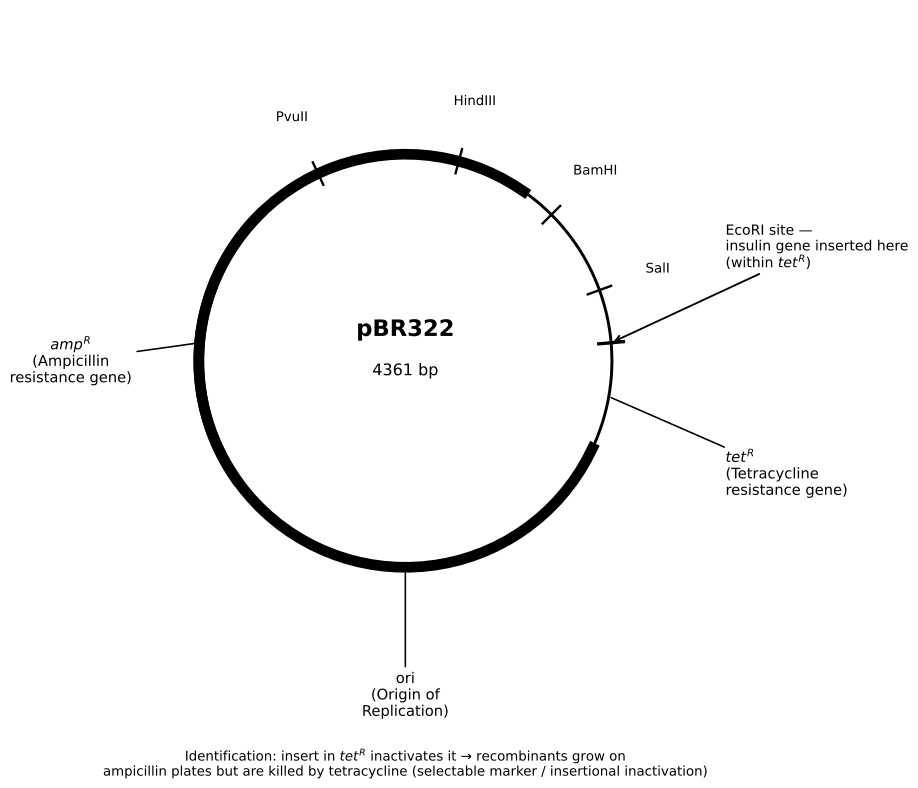
(a) Draw a labelled diagram of the cloning vector pBR322, showing all essential features. Indicate clearly where the foreign gene (insulin gene) was inserted and how you would identify transformed colonies carrying the recombinant plasmid. (3 marks)

(b) The researchers found that when they directly cloned the human insulin gene (isolated from genomic DNA) into E. coli, no functional insulin protein was produced, even though the gene was successfully inserted. Suggest TWO reasons for this failure and explain how cDNA technology overcomes these problems. (2 marks)

Diagram for question 22: Biotechnology and Its Applications
Show answer
PART (a) — Labelled diagram of pBR322 + identification of recombinant colonies (3 marks)

[DIAGRAM — pBR322 Cloning Vector]

ori
(Origin of
Replication)
|
_____________|_____________
/ \
/ pBR322 (4361 bp) \
| |
ampR | | tetR
(Ampicillin (Tetracycline
resistance resistance
gene) gene)
| |
\ /
\___________________________/
|
BamHI, SalI
cloning sites within
tetR gene
|
[EcoRI site also
present — used
here for insulin
gene insertion]

Label key (must be present for full credit):
→ ori (Origin of Replication): allows autonomous replication of plasmid in host E. coli
→ ampR gene (Ampicillin resistance gene): selectable marker — used to identify transformed cells
→ tetR gene (Tetracycline resistance gene): selectable marker — site of foreign gene insertion (insertional inactivation)
→ EcoRI restriction site: where insulin gene is inserted using EcoRI
→ pBR322 label with size (4361 bp)

Identification of recombinant colonies — Insertional Inactivation method:

Step 1: Insulin gene inserted into the tetR gene at EcoRI site → tetR gene is disrupted (inactivated). (1 mark)

Step 2 — Replica plating:
• Plate all transformed E. coli on Ampicillin medium first.
→ Colonies that grow = transformed cells (have taken up plasmid, carry ampR).
→ Colonies that do NOT grow = non-transformed (no plasmid).

• From ampicillin-surviving colonies, replica plate onto Tetracycline medium.
→ Colonies that grow on tetracycline = NON-recombinant (tetR gene intact → no insert).
→ Colonies that do NOT grow on tetracycline = RECOMBINANT (tetR disrupted by insulin gene insert). ✓ (1 mark)

[Identification summary table]

| Medium | Non-transformed | Non-recombinant | Recombinant (desired) |
|-----------------|-----------------|-----------------|----------------------|
| Ampicillin | ✗ (dies) | ✓ (grows) | ✓ (grows) |
| Tetracycline | ✗ (dies) | ✓ (grows) | ✗ (does NOT grow) ← SELECT THESE |

Conclusion: Colonies that grow on ampicillin but NOT on tetracycline are the recombinant colonies carrying the insulin gene. (Confirmed = 1 mark for diagram with all 5 labels; 1 mark for insertional inactivation logic)

─────────────────────────────────────────────────────
PART (b) — TWO reasons for failure + how cDNA overcomes them (2 marks)

Reason 1 — Presence of introns in genomic DNA:
The human insulin gene isolated from genomic DNA contains non-coding sequences called introns. E. coli (a prokaryote) lacks the RNA splicing machinery (spliceosomes) needed to remove introns from pre-mRNA. Therefore, the mRNA produced in E. coli contains intron sequences → aberrant/non-functional protein is produced. (1 mark)

Reason 2 — Incompatible post-translational processing:
The human insulin gene encodes preproinsulin (with signal peptide and C-peptide). E. coli lacks the eukaryotic enzymes required to cleave the signal peptide and C-peptide to generate mature insulin. Therefore, even if some protein is made, it is not processed into functional insulin. (Award this OR: E. coli cannot perform disulphide bond formation / glycosylation required for functional insulin.) (1 mark)

How cDNA overcomes these problems:
cDNA (complementary DNA) is synthesised from mature mRNA (after intron splicing has already occurred in human cells) using the enzyme reverse transcriptase.
• mRNA (processed, intron-free) → [reverse transcriptase] → single-stranded cDNA → [DNA polymerase] → double-stranded cDNA.
• cDNA has NO INTRONS → E. coli can directly transcribe and translate it without splicing machinery.
• For insulin specifically: cDNA for A-chain and B-chain were synthesised separately, expressed separately in E. coli, then the two chains were combined chemically with disulphide bonds to produce functional human insulin (Humulin).

[Mark allocation summary]
(a) Labelled pBR322 diagram with ori, ampR, tetR, restriction site, plasmid name = 1 mark
Insertional inactivation logic (ampR selects transformed; tetR-sensitive selects recombinant) = 1 mark
Replica plating / identification conclusion stated = 1 mark
(b) Reason 1 (introns / no splicing in E. coli) = 1 mark
Reason 2 (no post-translational processing / C-peptide cleavage) + cDNA solution = 1 mark
Total = 5 marks (1×5=5)
Q23Long Answer5 marks

Describe the steps involved in the production of a recombinant DNA molecule. Draw a labelled diagram showing the action of a restriction endonuclease on a DNA molecule with a palindromic sequence, resulting in sticky ends.

Show answer
Answer:

Steps in the Production of a Recombinant DNA Molecule: (1×3 = 3 marks)

(i) Cutting of DNA using Restriction Endonuclease:
Restriction endonucleases (molecular scissors) recognise specific palindromic sequences on the DNA and cut both strands at specific positions, producing sticky ends (short, single-stranded overhangs).
- Example: EcoRI recognises the palindromic sequence 5'–GAATTC–3' and cuts between G and A on both strands.

(ii) Joining of DNA fragments using DNA Ligase:
The foreign DNA fragment (insert) with compatible sticky ends is mixed with the cut vector (e.g., plasmid). The enzyme DNA ligase joins the complementary sticky ends by forming phosphodiester bonds, producing a recombinant DNA (rDNA) molecule.

(iii) Introduction into a Host Cell (Transformation):
The recombinant DNA molecule is introduced into a suitable host cell (e.g., *Escherichia coli*) made competent (able to take up foreign DNA) by treatment with CaCl₂. The host cell replicates the rDNA along with its own DNA.

---

Labelled Diagram — Action of EcoRI on a Palindromic DNA Sequence: (2 marks for drawing and labelling)

```
ORIGINAL DOUBLE-STRANDED DNA
5'— G A A T T C —3'
3'— C T T A A G —5'
↑ ↑
EcoRI cuts here (between G↓AATTC on each strand)

AFTER CUTTING BY EcoRI:

Fragment 1 Fragment 2
5'— G A A T T C —3'
3'— C T T A A G —5'

Represented as:

5'— G 3' 5' A A T T C —3'
3'— C T T A A 5' 3' G —5'
↑ ↑
Sticky end Sticky end
(5' overhang: (5' overhang:
–AATT–) –AATT–)
```

Labels required on diagram:
1. Palindromic recognition sequence (5'–GAATTC–3')
2. Cut site / point of cleavage (↓ between G and A)
3. Sticky ends / 5' overhangs (–AATT–)
4. 5'→3' polarity indicated on both strands

---

Key Terms (for full credit):
- Palindromic sequence: A sequence of base pairs that reads the same on both strands in the 5'→3' direction.
- e.g., 5'–GAATTC–3' (top strand) and 3'–CTTAAG–5' (bottom strand, read 5'→3' = GAATTC).
- Sticky ends: Short, single-stranded overhangs produced after restriction enzyme cutting; allow annealing with complementary sequences.
- DNA Ligase: Enzyme that seals the nicks between sticky ends to form a continuous recombinant DNA molecule.

Marking Scheme Summary:
| Component | Marks |
|---|---|
| Step 1 — Cutting by restriction endonuclease (with EcoRI/palindrome) | 1 |
| Step 2 — Joining by DNA ligase (sticky ends + ligation) | 1 |
| Step 3 — Introduction into host / transformation | 1 |
| Diagram — drawing showing palindromic cut and sticky ends | 1 |
| Diagram — correct labelling (sticky ends, cut site, polarity, sequence) | 1 |
| Total | 5 |

Want unlimited practice on Biotechnology and Its Applications?

The full ClearSteps bank has 23+ reviewed questions on this chapter alone — with step-wise solutions, difficulty levels, and progress tracking. Verify your WhatsApp number and your free trial starts right here.

CBSE · CLASS 12
🎟️14-day free trial · code PRAC auto-applied
Mobile Number
+91
OTP will be sent to your WhatsApp

⭐ Trusted by 12,000+ students across India

Biotechnology and Its Applications Class 12 Questions