ClearStepsCLEARSTEPS AI
Teacher Login →Student Login →

Biotechnology: Principles and Processes: Class 12 Biology Practice Questions

23 original exam-pattern questions with full answers, matched to the current CBSE Class 12 paper design, including case-based questions. Attempt each question before opening the answer — or start a free 14-day trial ↓ for the full bank.

Q1Case-based4 marks

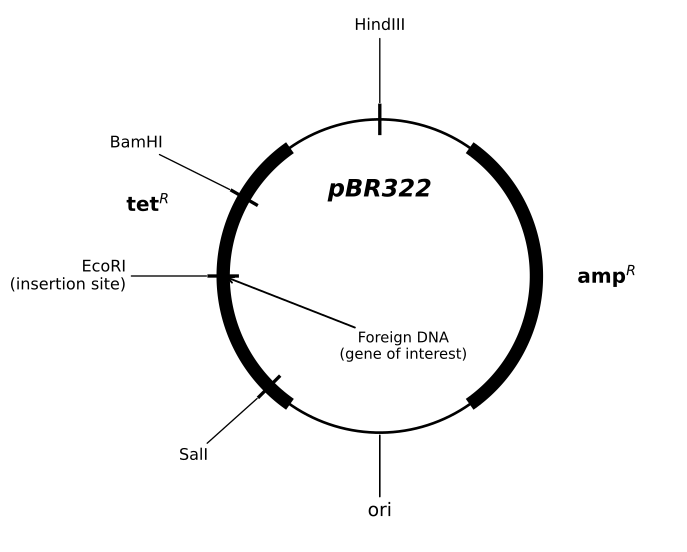
A research team at a biotechnology institute wanted to clone a human insulin gene into bacteria for large-scale production. They isolated the gene of interest and selected a plasmid vector called pBR322. The team used the restriction enzyme EcoRI to cut both the plasmid and the human DNA fragment carrying the insulin gene. After ligation, the recombinant plasmid was introduced into E. coli cells. The transformed cells were then plated on a medium containing ampicillin. Colonies that survived were picked and replica-plated onto a medium containing tetracycline.

Read the following passage and answer the questions that follow:

A research team at a biotechnology institute wanted to clone a human insulin gene into bacteria for large-scale production. They isolated the gene of interest and selected a plasmid vector called pBR322. The team used the restriction enzyme EcoRI to cut both the plasmid and the human DNA fragment carrying the insulin gene. After ligation, the recombinant plasmid was introduced into E. coli cells. The transformed cells were then plated on a medium containing ampicillin. Colonies that survived were picked and replica-plated onto a medium containing tetracycline.

(a) Why did the researchers use the SAME restriction enzyme (EcoRI) to cut both the plasmid and the human DNA fragment? [1]
(b) The team noticed that some colonies grew on ampicillin medium but did NOT grow on tetracycline medium. What does this indicate about these colonies? [1]
(c) Name and explain the principle behind the method used above to identify transformed colonies carrying the recombinant plasmid. [2]

Show answer
MARKING SCHEME — Total: 4 marks

(a) [1 mark]
EcoRI cuts both the plasmid and the human DNA fragment at the SAME palindromic recognition sequence (5'-GAATTC-3'), producing COMPLEMENTARY STICKY ENDS on both molecules.
These complementary sticky ends allow the human insulin gene fragment and the linearised plasmid to join (anneal) precisely, after which DNA ligase seals the phosphodiester bonds to form a stable recombinant plasmid.
(Award 1 mark for: complementary/compatible sticky ends formed → allow joining of insert and vector)

(b) [1 mark]
pBR322 carries TWO antibiotic resistance genes: ampicillin resistance (amp^R) and tetracycline resistance (tet^R).
The EcoRI cloning site in pBR322 lies WITHIN the tet^R gene.
When the insulin gene is inserted at this site, the tet^R gene is disrupted (insertional inactivation) → the colony can no longer grow on tetracycline.
Colonies that grow on ampicillin (amp^R intact → they have taken up the plasmid) BUT do NOT grow on tetracycline (tet^R disrupted → insert is present) are RECOMBINANT (transformed with recombinant plasmid carrying the insulin gene).
(Award 1 mark for: tet^R gene disrupted by insertion → recombinant colonies identified / insertional inactivation)

(c) [2 marks]
Name of method: Insertional Inactivation (also accept: replica plating combined with insertional inactivation)
(1 mark for correct name)

Principle:
pBR322 has two selectable marker genes — amp^R and tet^R. The foreign DNA (insulin gene) is inserted into the tet^R gene using EcoRI, disrupting its function. Transformed cells (those that have taken up any plasmid) are first selected by plating on ampicillin — only cells with plasmid survive. These surviving colonies are then replica-plated onto tetracycline medium:
• Colonies that grow on BOTH ampicillin AND tetracycline → non-recombinant (plasmid present but no insert; tet^R gene intact).
• Colonies that grow on ampicillin but NOT on tetracycline → RECOMBINANT (insert has disrupted tet^R gene).
Thus, the inactivation of the tet^R selectable marker by the inserted gene allows identification of recombinant colonies.
(1 mark for explanation of principle: disruption of tet^R by insert → loss of tetracycline resistance → recombinants identified by failure to grow on tetracycline)

Summary of value points:
(a) Complementary sticky ends produced by same enzyme allow joining of insert and vector — 1 mark
(b) tet^R gene disrupted by insertion (insertional inactivation) → these are recombinant colonies — 1 mark
(c) Name: Insertional inactivation — 1 mark
Principle: amp^R selects transformed cells; loss of tet^R identifies recombinants — 1 mark
(1×4 = 4 marks)
Q2Case-based4 marks

A biotechnology laboratory is working on the production of human insulin using recombinant DNA technology. The scientists isolate mRNA from human pancreatic β-cells and use reverse transcriptase to synthesise the insulin gene. This gene is then inserted into a plasmid vector called pBR322 at a specific restriction site. The recombinant plasmid is introduced into E. coli cells, which are then plated on a medium containing ampicillin. After incubation, colonies are observed and further screened.

Read the following passage and answer the questions that follow:

A biotechnology laboratory is working on the production of human insulin using recombinant DNA technology. The scientists isolate mRNA from human pancreatic β-cells and use reverse transcriptase to synthesise the insulin gene. This gene is then inserted into a plasmid vector called pBR322 at a specific restriction site. The recombinant plasmid is introduced into E. coli cells, which are then plated on a medium containing ampicillin. After incubation, colonies are observed and further screened.

(i) Why did the scientists use mRNA from β-cells to synthesise the insulin gene rather than isolating the insulin gene directly from the human genome? [1 mark]
(ii) The insulin gene was inserted into the tetracycline-resistance gene (tet^R) of pBR322. How will the scientists identify recombinant colonies from non-recombinant colonies? Describe the method. [2 marks]
(iii) Once recombinant E. coli cells successfully produce the insulin protein inside inclusion bodies, what are the steps involved in obtaining active, functional insulin from these cells? [1 mark]

Show answer
(i) The mRNA isolated from β-cells is already processed (mature mRNA) — introns have been removed. When reverse transcriptase is used to synthesise cDNA from this mRNA, the resulting gene has NO INTRONS. Since E. coli (a prokaryote) lacks the splicing machinery to remove introns, using the genomic insulin gene directly would result in a non-functional protein. The cDNA (intron-free) can therefore be correctly expressed in E. coli to produce functional insulin. (Award 1 mark for: cDNA/mRNA-derived gene has no introns / E. coli cannot remove introns / prokaryote lacks splicing machinery — any one correct reason)

(ii) The method used is INSERTIONAL INACTIVATION: [2 marks]

Value Point 1 (1 mark): All transformed E. coli cells (both recombinant and non-recombinant) are first plated on ampicillin-containing medium. Since the amp^R gene of pBR322 is intact in all transformed cells, all transformed colonies grow on this medium; non-transformed cells (without plasmid) are killed. This selects for transformed cells.

Value Point 2 (1 mark): The surviving colonies are then replica-plated onto tetracycline-containing medium. In recombinant cells, the insulin gene has been inserted INTO the tet^R gene, disrupting it (insertional inactivation) — so recombinant cells CANNOT grow on tetracycline medium. Non-recombinant cells have an intact tet^R gene and GROW on tetracycline medium. Therefore, colonies that grow on AMPICILLIN but FAIL TO GROW on TETRACYCLINE are identified as RECOMBINANT colonies.

(iii) Steps to obtain active, functional insulin from inclusion bodies: [1 mark]

1. The E. coli cells are lysed (broken open) and inclusion bodies (insoluble aggregates of insulin protein) are isolated by centrifugation.
2. The inclusion bodies are solubilised using denaturing agents (e.g., urea or guanidine hydrochloride) to extract the insulin protein.
3. The denatured insulin is then renatured/refolded under controlled conditions to allow it to attain its correct three-dimensional (active) conformation.
4. The insulin is then treated to remove any extra sequences (e.g., the C-peptide is excised if proinsulin was produced), purified, and validated to obtain the final active, functional insulin.

(Award 1 mark for: isolation of inclusion bodies by cell lysis → solubilisation → renaturation/refolding to obtain active insulin — any correct sequence of steps covering extraction and refolding)
Q3Case-based4 marks

A research team at a biotechnology laboratory is working on producing a recombinant insulin protein in bacteria. They isolate the human insulin gene from a cDNA library and wish to clone it into a plasmid vector called pBR322. They use the restriction enzyme EcoRI to cut both the plasmid and the insulin gene insert. After ligation, the recombinant plasmid is introduced into Escherichia coli cells. The transformed cells are plated on a medium containing ampicillin. The team notices that some colonies grow on the ampicillin plate. To identify which of these colonies actually contain the recombinant plasmid (with the insulin gene insert), they replica-plate the ampicillin-resistant colonies onto a medium containing tetracycline.

Read the following passage carefully and answer the questions that follow.

A research team at a biotechnology laboratory is working on producing a recombinant insulin protein in bacteria. They isolate the human insulin gene from a cDNA library and wish to clone it into a plasmid vector called pBR322. They use the restriction enzyme EcoRI to cut both the plasmid and the insulin gene insert. After ligation, the recombinant plasmid is introduced into Escherichia coli cells. The transformed cells are plated on a medium containing ampicillin. The team notices that some colonies grow on the ampicillin plate. To identify which of these colonies actually contain the recombinant plasmid (with the insulin gene insert), they replica-plate the ampicillin-resistant colonies onto a medium containing tetracycline.

(i) Why did the researchers use cDNA of the insulin gene rather than the genomic DNA for expression in E. coli? (1 mark)

(ii) EcoRI cuts the sequence 5'-GAATTC-3'. What type of ends are produced after EcoRI digestion, and why are these ends useful in cloning? (1 mark)

(iii) The team finds that some colonies grow on ampicillin medium but do NOT grow on tetracycline medium. What does this result indicate about these colonies, and which feature of pBR322 makes this identification possible? (1 mark)

(iv) After successful transformation and expression, the recombinant insulin protein is collected from the bioreactor culture. Name and briefly describe any TWO steps of downstream processing that must be performed before this insulin can be used as a drug. (1 mark)

Show answer
MARKING SCHEME — Total: 4 marks (1 mark each sub-part)

(i) Why cDNA rather than genomic DNA for expression in E. coli? (1 mark)

Value point:
• cDNA is made from mRNA using reverse transcriptase and therefore contains NO INTRONS (no non-coding sequences). Bacteria (E. coli) lack the RNA splicing machinery (spliceosomes) to remove introns from pre-mRNA. If genomic DNA (which contains introns) were used, the introns would remain in the mRNA transcript and a non-functional/incorrect protein would be produced. cDNA represents only the coding sequence (exons) and can be directly expressed in a prokaryotic host. (1 mark)

[Acceptable alternative: cDNA has no introns; bacteria cannot process introns; hence cDNA is used for correct expression in E. coli.]

---

(ii) Type of ends produced by EcoRI and their usefulness in cloning: (1 mark)

Value point:
• EcoRI produces STICKY ENDS (also called cohesive ends).
EcoRI cuts between G and A on both strands:

5'—G AATTC—3'
3'—CTTAA G—5'

This leaves single-stranded overhangs: 5'—AATT—3' (on each cut end).
• Sticky ends are useful because they can form hydrogen bonds (base-pair) with complementary sticky ends of the insert DNA cut with the same enzyme, facilitating efficient joining (ligation) by DNA ligase to form a recombinant DNA molecule. (1 mark)

[Acceptable alternative: Sticky/cohesive ends; single-stranded complementary overhangs; allow annealing with complementary ends before ligation.]

---

(iii) Significance of colonies growing on ampicillin but NOT on tetracycline, and the pBR322 feature responsible: (1 mark)

Value point:
• Colonies that grow on ampicillin but do NOT grow on tetracycline are RECOMBINANT colonies — they contain the insulin gene insert.
• Explanation (Insertional Inactivation): In pBR322, the EcoRI cloning site is located WITHIN the tetracycline-resistance gene (tet^R). When the insulin gene insert is ligated into this site, it disrupts (inactivates) the tet^R gene. Therefore:
— Grows on ampicillin → plasmid is present (amp^R gene is intact) → transformed cell.
— Does NOT grow on tetracycline → tet^R gene is disrupted by insert → recombinant plasmid.
• The feature of pBR322 that makes this possible is INSERTIONAL INACTIVATION of the tet^R selectable marker. (1 mark)

[Acceptable alternative: Recombinant colonies; tet^R gene disrupted by insert; insertional inactivation; pBR322 has two antibiotic resistance genes (amp^R and tet^R) serving as selectable markers.]

---

(iv) Any TWO steps of downstream processing: (1 mark — ½ mark per step, OR award 1 mark for any two correct steps with brief description)

Any TWO of the following (½ + ½ = 1 mark, or 1 mark for two correct named and described steps):

1. Separation / Extraction: The cells from the bioreactor are separated by centrifugation or filtration; the cells are then disrupted (lysed) to release the recombinant insulin protein.

2. Purification (Chromatography): The crude protein extract is passed through chromatography columns (e.g., ion-exchange chromatography, affinity chromatography, or gel filtration) to isolate pure insulin from other cellular proteins and contaminants.

3. Quality control / Formulation: The purified protein is tested for biological activity, correct folding, and absence of pyrogens/contaminants; it is then formulated into the appropriate pharmaceutical preparation (e.g., sterile solution for injection). (1 mark)

[Award 1 mark for any two correctly named and briefly described steps. Steps must be named AND described for full credit.]

---

SUMMARY OF VALUE POINTS:
(i) cDNA has no introns; bacteria cannot splice introns → correct expression — 1 mark
(ii) Sticky/cohesive ends produced; allow base-pairing and ligation with complementary ends — 1 mark
(iii) Recombinant colonies identified; tet^R disrupted by insert (insertional inactivation of pBR322) — 1 mark
(iv) Any two downstream steps named + described (separation/extraction; purification; quality control) — 1 mark

TOTAL: 4 marks
Q4Case-based4 marks

A research team at a biotechnology institute is working on producing a therapeutic human protein using recombinant DNA technology. They isolated the gene of interest from human mRNA, cloned it into a plasmid vector (pBR322), and then transformed it into E. coli cells. After transformation, the bacterial colonies were plated on ampicillin-containing medium. The scientist then picked colonies from the ampicillin plate and replica-plated them onto tetracycline-containing medium. The results are shown below:

Ampicillin plate: Colonies A, B, C, D, E — all five grow.
Tetracycline plate: Colonies A, C, E grow; Colonies B and D do NOT grow.

The scientist identified colonies B and D as the ones of interest. Later, when attempting to express the cloned human protein in E. coli, the protein was found to be non-functional despite the correct DNA sequence being confirmed.

Read the following scenario and answer the questions that follow:

A research team at a biotechnology institute is working on producing a therapeutic human protein using recombinant DNA technology. They isolated the gene of interest from human mRNA, cloned it into a plasmid vector (pBR322), and then transformed it into E. coli cells. After transformation, the bacterial colonies were plated on ampicillin-containing medium. The scientist then picked colonies from the ampicillin plate and replica-plated them onto tetracycline-containing medium. The results are shown below:

[Schematic representation]

Ampicillin plate: Colonies A, B, C, D, E all grow (5 colonies visible)
Tetracycline plate: Colonies A, C, E grow; Colonies B, D do NOT grow

The scientist identified colonies B and D as the ones of interest. Later, when attempting to express the cloned human protein in E. coli, the protein was found to be non-functional despite the correct DNA sequence being confirmed.

(i) Why did the scientist clone the gene from mRNA rather than directly from genomic DNA? [1 mark]

(ii) Explain the molecular basis of why colonies B and D are identified as the ones containing the recombinant plasmid. Name this technique. [2 marks]

(iii) Suggest ONE reason, with explanation, why the human protein expressed in E. coli was non-functional despite the correct DNA sequence. [1 mark]

Show answer
MARKING SCHEME — Total: 4 marks

─────────────────────────────────────────
(i) Why was cDNA (from mRNA) used instead of genomic DNA? [1 mark]
─────────────────────────────────────────
• The human gene of interest contains INTRONS (non-coding intervening sequences) in the genomic DNA.
• E. coli lacks the eukaryotic RNA splicing machinery (no spliceosomes) and therefore CANNOT remove introns from pre-mRNA.
• When mRNA is used as a template, reverse transcriptase synthesises complementary DNA (cDNA), which is a copy of the MATURE mRNA — it contains ONLY EXONS (no introns).
• cDNA can therefore be correctly transcribed and translated in the prokaryotic host (E. coli) to give the functional protein.
[Award 1 mark for: cDNA has no introns / E. coli cannot process introns / cDNA is made from mature mRNA via reverse transcriptase — any one complete point]

─────────────────────────────────────────
(ii) Molecular basis of selecting colonies B and D; name of technique [2 marks]
─────────────────────────────────────────
Technique: INSERTIONAL INACTIVATION [½ mark]

Molecular basis [1½ marks]:
• pBR322 carries TWO antibiotic resistance genes: ampicillin resistance (amp^R) and tetracycline resistance (tet^R).
• The foreign DNA (gene of interest) was inserted INTO the tet^R gene (at a restriction site within tet^R), disrupting its reading frame/function.
• Result for recombinant colonies (B and D):
– amp^R gene is INTACT → bacteria survive on ampicillin medium ✓
– tet^R gene is DISRUPTED by insert → bacteria cannot survive on tetracycline medium ✗
• Result for non-recombinant colonies (A, C, E):
– Both amp^R and tet^R are intact → bacteria survive on BOTH media.
• Therefore, colonies that grow on ampicillin BUT NOT on tetracycline (i.e., B and D) contain the recombinant plasmid with the insert.

[Award ½ mark: correct name 'insertional inactivation'
Award 1 mark: explanation — foreign DNA inserted into tet^R inactivates it, so recombinants lose tet resistance
Award ½ mark: correct interpretation — colonies growing on amp but NOT tet = recombinants]

─────────────────────────────────────────
(iii) Reason for non-functional protein despite correct DNA sequence [1 mark]
─────────────────────────────────────────
Accept ANY ONE of the following well-explained reasons:

(A) Post-translational modifications absent:
• Many human therapeutic proteins (e.g., insulin, erythropoietin) require POST-TRANSLATIONAL MODIFICATIONS such as glycosylation, disulfide bond formation, or phosphorylation for correct folding and function.
• E. coli is a prokaryote and LACKS the endoplasmic reticulum (ER) and Golgi apparatus required for these modifications.
• The protein is produced but remains non-functional/misfolded.

OR

(B) Incorrect protein folding / inclusion bodies:
• E. coli may produce the recombinant protein as insoluble INCLUSION BODIES (aggregated, misfolded protein) in the cytoplasm.
• The protein has the correct amino acid sequence (correct DNA) but lacks the correct three-dimensional conformation required for biological activity.

[Award 1 mark for: naming the specific reason (post-translational modification OR inclusion bodies/misfolding) AND a brief explanation linking it to the absence of eukaryotic cellular machinery in E. coli]
Q5Short Answer1 mark

Assertion (A): When a foreign gene is inserted into the tetracycline-resistance (tet^R) gene of plasmid pBR322, the recombinant colonies can be identified by plating transformants on ampicillin-containing medium followed by replica plating on tetracycline-containing medium.
Reason (R): Insertion of foreign DNA into the tet^R gene disrupts it, so recombinant cells lose tetracycline resistance but retain ampicillin resistance encoded by the intact amp^R gene.

Show answer
Correct option: (A) Both A and R are true, and R is the correct explanation of A.

Explanation (for examiner reference):
• pBR322 (4361 bp) carries two selectable marker genes: amp^R (ampicillin resistance) and tet^R (tetracycline resistance).
• Insertional inactivation: foreign DNA cloned into the tet^R gene disrupts the reading frame / coding sequence of that gene → tet^R gene is non-functional → recombinant cell CANNOT grow on tetracycline medium.
• The amp^R gene remains intact → all transformants (both recombinant and non-recombinant) grow on ampicillin medium.
• Identification protocol:
Step 1 — Plate all transformants on ampicillin medium → all transformed colonies grow (both recombinant + non-recombinant); non-transformed cells die.
Step 2 — Replica plate onto tetracycline medium → non-recombinant colonies grow (tet^R intact); recombinant colonies do NOT grow (tet^R disrupted).
Step 3 — Compare the two plates → colonies present on amp plate but absent on tet plate = recombinant colonies.
• Therefore, R correctly and completely explains the molecular basis of the strategy described in A.
• Award 1 mark for option (A) only.
Q6MCQ1 mark

A biotechnology student isolates a plasmid vector pBR322 and digests it with the restriction enzyme BamHI. She then inserts a foreign gene into the BamHI site within the tet^R gene of pBR322 and transforms E. coli cells with the resulting recombinant plasmid. She plates the transformed bacteria on two sets of nutrient agar plates — one containing ampicillin (Amp) and one containing tetracycline (Tet). After incubation, she observes colonies on the Amp plate and replica-plates them onto the Tet plate. Which of the following correctly describes the expected result and the principle behind it?

Show answer
Correct answer: (B)

Reason (for examiner's reference / 1-mark value point):
• pBR322 carries two antibiotic resistance genes: amp^R (ampicillin resistance) and tet^R (tetracycline resistance).
• BamHI cuts within the tet^R gene. Insertion of foreign DNA at this site disrupts the tet^R gene → insertional inactivation → the recombinant bacteria LOSE tetracycline resistance.
• The amp^R gene is undisturbed → recombinant bacteria RETAIN ampicillin resistance.
• Therefore: colonies appear on Amp plates (all transformed cells, both recombinant and non-recombinant) but recombinant colonies (those with insert in tet^R) do NOT grow on Tet plates.
• Non-recombinant colonies (plasmid re-ligated without insert, tet^R intact) will grow on BOTH Amp and Tet plates.
• This replica-plating strategy identifies recombinants as 'Amp-resistant but Tet-sensitive' colonies — this is the principle of insertional inactivation used for recombinant selection.

Why other options are wrong:
(A) Incorrect — the insert into tet^R does disrupt its function.
(C) Incorrect — there is no compensatory activation; logic is reversed.
(D) Incorrect — the ori (origin of replication) is intact on pBR322; the plasmid replicates normally in the host.
Q7MCQ1 mark

A biotechnology student is setting up a PCR reaction in the laboratory. She adds all the required components — template DNA, primers, dNTPs, and buffer — into the reaction tube. However, she accidentally omits Taq polymerase and instead uses a DNA polymerase isolated from E. coli. When she runs the PCR thermocycler programme (94°C denaturation → 55°C annealing → 72°C extension), she observes NO amplification of the target DNA. Which of the following BEST explains why amplification failed?

Show answer
Correct Answer: (B) E. coli DNA polymerase is a thermolabile enzyme and gets permanently denatured at the 94°C denaturation step.

Reason: PCR requires repeated cycles of heating to ~94°C (denaturation step) to separate the double-stranded DNA. E. coli DNA polymerase is a thermolabile enzyme — it loses its activity (gets irreversibly denatured) at such high temperatures. Therefore, fresh enzyme would need to be added after every denaturation cycle, making the process impractical and resulting in failed amplification.

Taq polymerase (from Thermus aquaticus, a thermophilic bacterium) is thermostable — it remains active even at 94°C — which is why it revolutionised PCR by allowing the reaction to proceed through multiple automated cycles without enzyme loss.
Q8MCQ1 mark

A student inserts a foreign gene into the tetracycline-resistance gene (tet^R) of plasmid pBR322 and transforms it into E. coli. The transformed bacteria are first plated on ampicillin-containing medium, then replica-plated on tetracycline-containing medium. Which of the following correctly describes the outcome and the principle involved?

Show answer
Correct answer: (B)

Reason (value points for 1 mark — any one credited):

• pBR322 carries two selectable markers: amp^R (ampicillin-resistance gene) and tet^R (tetracycline-resistance gene).

• When foreign DNA is inserted INTO the tet^R gene, the gene is disrupted → the recombinant bacterium LOSES tetracycline resistance but RETAINS ampicillin resistance (amp^R is unaffected).

• This strategy is called INSERTIONAL INACTIVATION.

• Selection scheme:
Step 1 — Plate on ampicillin medium → only transformed cells (carrying pBR322) survive and form colonies; non-transformed cells die.
Step 2 — Replica-plate on tetracycline medium → recombinants (insert in tet^R) do NOT grow; non-recombinant transformants (intact tet^R) DO grow.

• Colonies that grow on ampicillin plates but FAIL to grow on tetracycline plates = recombinant clones carrying the foreign insert.

Why other options are wrong:
(A) Incorrect — insertion into tet^R does inactivate tetracycline resistance.
(C) Incorrect — insertion into tet^R does not activate amp^R; ampicillin resistance is retained, not newly acquired.
(D) Incorrect — the ori (origin of replication) is a separate region of pBR322 and is not affected by insertion into tet^R; bacteria can still replicate the plasmid.
Q9MCQ1 mark

Which of the following correctly describes the cut made by restriction endonuclease EcoRI in the sequence 5'-GAATTC-3' / 3'-CTTAAG-5'?

Show answer
Correct answer: (B)

Explanation (for examiner reference):

• EcoRI recognises the palindromic sequence:

5'— G ↓ A A T T C —3'
3'— C T T A A ↑ G —5'

• It cuts the 5'→3' strand between G and A, and the 3'→5' strand between A and G (i.e., between C T T A A and G), producing:

5'— G A A T T C —3'
3'— C T T A A G —5'

This generates two fragments each carrying a single-stranded overhanging sequence: 5'—AATT—3' (4-nucleotide 5' protruding/sticky ends).

• These are called 5' sticky ends (5' overhangs), NOT blunt ends and NOT 3' overhangs.

• Option A is incorrect: EcoRI does NOT produce blunt ends.
• Option C is incorrect: the cut is not between A and T; EcoRI does not produce 3' overhangs.
• Option D is incorrect: restriction endonucleases cut BOTH strands (they are double-strand cutters).

[1 mark for selecting option B]
Q10MCQ1 mark

A researcher inserts a human insulin gene into a plasmid vector at the BamHI restriction site, which lies within the tetracycline resistance gene (tet^R) of the plasmid. The plasmid also carries an ampicillin resistance gene (amp^R) with no insert. Transformed bacterial colonies are first plated on ampicillin-containing medium, and replica-plated onto tetracycline-containing medium. Which combination correctly identifies the colony type and the conclusion drawn?

Show answer
Correct answer: (B)

Reasoning (insertional inactivation principle — pBR322):

• The plasmid pBR322 carries two selectable marker genes: amp^R (ampicillin resistance) and tet^R (tetracycline resistance).

• The foreign DNA (insulin gene) is inserted at the BamHI site located WITHIN the tet^R gene → this disrupts/inactivates the tet^R gene (insertional inactivation).

• The amp^R gene is UNAFFECTED by the insertion.

Selective screening outcome:

| Colony type | amp plate | tet plate | Conclusion |
|---|---|---|---|
| Recombinant (insert in tet^R) | GROWS ✓ | DOES NOT GROW ✗ | Carries insulin gene insert |
| Non-recombinant (intact plasmid, no insert) | GROWS ✓ | GROWS ✓ | No insert; tet^R intact |
| Non-transformed | DOES NOT GROW ✗ | DOES NOT GROW ✗ | No plasmid taken up |

• Colonies that grow on ampicillin but FAIL to grow on tetracycline = recombinant colonies (tet^R inactivated by insert).

• This two-step replica-plating is the standard method to distinguish recombinant from non-recombinant transformants.

Why other options are wrong:
• (A) Growing on BOTH media → non-recombinant (tet^R still functional, no insert present).
• (C) Growing only on tet medium → impossible for a transformed colony, since the plasmid carries amp^R; also contradicts insertional inactivation logic.
• (D) Not growing on either medium → non-transformed cell (did not take up the plasmid at all).
Q11Short Answer2 marks

A biotechnology student cuts a circular plasmid (vector) and a human insulin gene using the same restriction enzyme, EcoRI. She then mixes the two cut fragments together in a test tube.

(a) Name the enzyme she must add next to join the insulin gene into the plasmid, and state its exact function.
(b) Why is it essential that BOTH the plasmid and the insulin gene are cut with the SAME restriction enzyme (EcoRI) in this procedure?

Show answer
(a) Enzyme: DNA Ligase (1/2 mark)
Function: DNA ligase seals/joins the nicks in the sugar-phosphate backbone between the sticky ends of the plasmid and the insulin gene, forming a covalent phosphodiester bond to produce a continuous, intact recombinant DNA molecule. (1/2 mark)

(b) When both the plasmid and the insulin gene are cut with the same restriction enzyme (EcoRI), both produce identical complementary sticky ends (5'–AATTC–3' overhangs). These compatible sticky ends are able to base-pair with each other by hydrogen bonding, allowing the insulin gene to anneal precisely into the plasmid before DNA ligase seals the bond. If different restriction enzymes were used, the sticky ends would be incompatible and the two fragments could not join. (1 mark)
Q12Short Answer2 marks

A scientist wishes to express a human insulin gene in E. coli bacteria. She isolates the insulin gene from a human pancreatic cell and also from a human pancreatic cell's mRNA.

(a) Which source (genomic DNA or mRNA) should she prefer to obtain the insulin gene for expression in E. coli, and why?
(b) Name the enzyme she would use to convert mRNA into DNA.

Show answer
(a) She should prefer mRNA as the source (to make cDNA — complementary DNA).
Reason: The human insulin gene obtained directly from genomic DNA contains introns (non-coding sequences). Since E. coli (a prokaryote) lacks the RNA-splicing machinery to remove introns, it cannot process the primary transcript into functional mRNA. cDNA made from mature mRNA has NO introns, so E. coli can directly transcribe and translate it into functional insulin protein. (1 mark)

(b) Reverse transcriptase (RNA-dependent DNA polymerase). (1 mark)
Q13Short Answer2 marks

Name the two components of a restriction enzyme recognition sequence that make it 'palindromic'. Give one example of such a sequence as recognised by EcoRI, showing both strands (5'→3').

Show answer
A palindromic recognition sequence has two components that make it palindromic:

(i) The sequence read 5'→3' on one strand (first component/strand). [1 mark]

(ii) The same sequence read 5'→3' on the complementary antiparallel strand (second component/strand) — because the two strands are antiparallel, reading the complementary strand in its own 5'→3' direction gives the identical sequence. [1 mark]

Example — EcoRI recognition sequence:

5' — G A A T T C — 3'
3' — C T T A A G — 5'

Top strand read 5'→3': G-A-A-T-T-C
Bottom (complementary, antiparallel) strand read 5'→3': G-A-A-T-T-C

Both strands, read in their respective 5'→3' directions, give the same sequence (GAATTC), confirming the palindromic nature of the recognition sequence.
Q14Short Answer2 marks

A researcher wants to express a human insulin gene (a eukaryotic gene containing introns) directly in E. coli to produce functional insulin protein. However, the experiment fails — no insulin protein is detected. Identify the reason for failure and suggest ONE modification the researcher must make to the gene before inserting it into the bacterial expression vector.

Show answer
Reason for failure (1 mark):
E. coli (prokaryote) lacks the cellular machinery (RNA splicing enzymes/spliceosomes) required to remove introns from eukaryotic pre-mRNA. Therefore, even if the human insulin gene is transcribed, the mRNA produced will contain unspliced introns → ribosome cannot translate it correctly → no functional insulin protein is produced.

Modification required (1 mark):
The researcher must use cDNA (complementary DNA) of the insulin gene instead of the genomic DNA.
cDNA is prepared by: isolating mature insulin mRNA (already processed, intron-free) → using reverse transcriptase to synthesise single-stranded cDNA → converting to double-stranded cDNA using DNA polymerase.
cDNA contains only the coding sequence (exons), has NO introns, and can be directly transcribed and translated by E. coli's machinery to produce functional insulin protein.
Q15Short Answer3 marks

A recombinant plasmid was constructed by inserting a foreign gene into the BamHI site of the tetracycline-resistance gene (tet^R) of plasmid pBR322. The recombinant plasmid was then introduced into E. coli host cells.

(i) Name the process by which the recombinant plasmid enters the E. coli host cell, and state ONE method used to make the host cells competent for this process. (1 mark)

(ii) How would you distinguish transformed colonies (carrying the recombinant plasmid) from non-transformed colonies and from colonies carrying the non-recombinant plasmid, using replica plating on two selective media? Explain the basis of this selection. (2 marks)

Show answer
CBSE Marking Scheme — 3 Marks

──────────────────────────────
(i) Process and competence method: [1 mark]

• Process: Transformation — the process by which foreign/recombinant DNA (plasmid) is taken up by a competent host bacterial cell.

• Method to make cells competent (any ONE):
– Chemical method: Host cells (E. coli) incubated with ice-cold CaCl₂ solution → divalent Ca²⁺ ions destabilise the bacterial cell membrane → increases its permeability to DNA. Cells are then heat-shocked briefly at 42°C to facilitate DNA entry.
OR
– Electroporation: Brief high-voltage electric pulse applied to cells → creates transient pores in membrane → DNA enters through pores.

──────────────────────────────
(ii) Distinguishing colonies by replica plating — basis and result: [2 marks]

Background (structural basis of pBR322): [½ mark]
• pBR322 has TWO antibiotic-resistance genes: amp^R (ampicillin resistance) and tet^R (tetracycline resistance).
• The foreign gene has been inserted into the BamHI site WITHIN the tet^R gene → this disrupts (inactivates) tet^R by insertional inactivation.
• The amp^R gene remains intact in ALL transformed cells (recombinant and non-recombinant).

Replica plating procedure: [½ mark]
• Plate 1: Ampicillin-containing medium → selects for ALL transformed cells (those that have taken up any plasmid — recombinant OR non-recombinant).
• Plate 2 (replica): Tetracycline-containing medium → selects for cells with INTACT tet^R gene.

Interpretation of results: [1 mark]

| Colony type | Grows on Amp medium? | Grows on Tet medium? | Conclusion |
|---|---|---|---|
| Non-transformed (no plasmid) | ✗ No | ✗ No | Eliminated on Amp plate itself |
| Non-recombinant plasmid (intact tet^R) | ✓ Yes | ✓ Yes | Both resistances intact |
| Recombinant plasmid (tet^R disrupted) | ✓ Yes | ✗ No | tet^R inactivated by insert |

• Colonies that grow on Amp medium BUT FAIL TO GROW on Tet medium are the recombinant transformants (carrying the foreign gene insert).
• This phenomenon is called insertional inactivation of the selectable marker.

──────────────────────────────
Key CBSE value points summary:
1. Transformation / CaCl₂ treatment (or electroporation) → 1 mark
2. Insertional inactivation: foreign DNA in tet^R → tet^R non-functional → 1 mark
3. Correct interpretation: grows on Amp, fails on Tet = recombinant → 1 mark
Q16Short Answer3 marks

A biotechnology student wants to produce human insulin using recombinant DNA technology. She has isolated the human insulin gene (foreign DNA) and has chosen the plasmid pBR322 as her vector. She plans to insert the foreign DNA into the tetracycline resistance gene (tet^R) of pBR322 using restriction enzyme BamHI, and then transfer the recombinant plasmid into E. coli.

Study the following partial flow diagram and answer the questions:

Step 1: pBR322 plasmid (cut with BamHI at tet^R gene) + Human insulin gene (cut with BamHI) → [Enzyme X] → Recombinant pBR322
Step 2: Recombinant pBR322 transferred into E. coli host cells
Step 3: E. coli cells plated on ampicillin-containing medium → All surviving colonies picked → Replica plated on tetracycline-containing medium
Step 4: Colonies that grow on ampicillin plates but NOT on tetracycline plates are selected

(i) Identify Enzyme X in Step 1 and state its role. (1 mark)
(ii) Why do all colonies in Step 3 survive on ampicillin medium but only SOME survive on tetracycline medium? (1 mark)
(iii) In Step 4, what do the colonies that fail to grow on tetracycline medium represent, and why are THESE colonies selected for insulin production? (1 mark)

Show answer
MARKING SCHEME (3 marks — 1 mark each)

(i) Enzyme X = DNA ligase (½ mark)
Role: DNA ligase seals/joins the sticky ends of the foreign DNA (human insulin gene) with the cut ends of the linearised pBR322 plasmid, forming covalent phosphodiester bonds to produce the intact recombinant DNA molecule. (½ mark)
[Award 1 mark total for correct name + role]

(ii) The plasmid pBR322 carries TWO selectable marker genes — amp^R (ampicillin resistance) and tet^R (tetracycline resistance). (½ mark)
• All surviving colonies on ampicillin medium = cells that have taken up the plasmid (transformed cells); the amp^R gene is intact in ALL recombinant plasmids since insertion was made into tet^R, NOT amp^R — so all transformed cells resist ampicillin. (½ mark)
• The foreign DNA (insulin gene) was inserted INTO the tet^R gene → this gene is disrupted (insertional inactivation) → cells carrying recombinant plasmid CANNOT resist tetracycline → they do not grow on tetracycline medium.
• Non-transformed cells (no plasmid) die on BOTH media.
[Award 1 mark for correctly explaining insertional inactivation of tet^R while amp^R remains intact]

(iii) Colonies that grow on ampicillin but NOT on tetracycline = recombinant colonies / transformants carrying the recombinant plasmid (with insulin gene inserted into tet^R). (½ mark)
These are selected because the failure to grow on tetracycline CONFIRMS that the foreign DNA (human insulin gene) has been successfully inserted into the tet^R gene, disrupting it — meaning the plasmid they carry is the desired recombinant pBR322 containing the insulin gene. Non-recombinant transformants (plasmid re-ligated without insert) would have intact tet^R and would SURVIVE on tetracycline. (½ mark)
[Award 1 mark for identifying recombinant colonies + correct reasoning based on insertional inactivation]

Key CBSE terminology to reward:
• 'Insertional inactivation' — full credit if used correctly
• 'Selectable marker' — credit if used
• 'Recombinant' vs 'non-recombinant transformant' — distinction credited
• 'Phosphodiester bond' for DNA ligase role — credit

Alternative acceptable answer for (i):
→ DNA ligase; joins/stitches the compatible sticky ends (5'–GATC–3' overhangs produced by BamHI) of vector and insert to form a stable recombinant DNA molecule.
Q17Short Answer3 marks

Explain the role of restriction endonucleases in recombinant DNA technology. Using EcoRI as an example, describe (i) the palindromic sequence it recognises, (ii) the type of cuts it makes, and (iii) how the resulting ends are used to form a recombinant DNA molecule.

Show answer
Role of Restriction Endonucleases in Recombinant DNA Technology:
Restriction endonucleases are molecular scissors that cut DNA at specific sites, producing fragments that can be joined with vector DNA to produce recombinant DNA molecules.
• They recognise specific palindromic nucleotide sequences and cleave the DNA at or near those sequences.
• Different restriction enzymes cut at different sites, allowing selective cutting of donor and vector DNA.
[1 mark — role of restriction endonucleases]

(i) Palindromic Sequence Recognised by EcoRI:
EcoRI recognises the following palindromic sequence:

```
5' — G A A T T C — 3'
3' — C T T A A G — 5'
```

• A palindromic sequence reads the same on both strands in the 5'→3' direction.
• On the top strand (5'→3'): G-A-A-T-T-C
• On the bottom strand (5'→3'): G-A-A-T-T-C (same)
[½ mark — palindrome definition + ½ mark — correct sequence]

(ii) Type of Cuts Made by EcoRI:
EcoRI makes STAGGERED cuts (not straight cuts) between the bases G and A on each strand:

```
5' — G A A T T C — 3'
3' — C T T A A G — 5'
↑ ↑
cut sites (staggered)
```

This produces sticky ends (also called cohesive ends) — single-stranded overhangs (5'-AATT-3') on each cut fragment.
[½ mark — staggered cut + ½ mark — sticky/cohesive ends]

(iii) Use of Sticky Ends to Form Recombinant DNA:
Diagram:

```
Donor DNA fragment (cut with EcoRI):
5'...G AATTC...3'
3'...CTTAA G...5'

Vector DNA (cut with same EcoRI):
5'...G AATTC...3'
3'...CTTAA G...5'

↓ Mix + DNA ligase

Recombinant DNA molecule:
5'...G AATTC...[insert]...G AATTC...3'
3'...CTTAA G...[insert]...CTTAA G...5'
```

• The complementary sticky ends (5'-AATT overhangs) of donor and vector DNA anneal (hydrogen bond) together by complementary base pairing.
• DNA ligase then forms phosphodiester bonds to seal the nicks, producing a covalently closed recombinant DNA molecule.
• Use of the same restriction enzyme for both donor DNA and vector ensures compatible sticky ends.
[1 mark — complementary base pairing of sticky ends + sealing by DNA ligase]

Note: EcoRI nomenclature — E = Escherichia, co = coli, R = RY13 strain, I = first enzyme isolated from this strain.
Q18Short Answer3 marks

A researcher wants to amplify a specific 500 bp region from a bacterial genomic DNA sample for cloning purposes. She sets up a PCR reaction but after 30 cycles, gel electrophoresis shows a smear instead of a distinct band at 500 bp. Her lab partner suggests that the annealing temperature used (37°C) was too low.

(i) Explain why a low annealing temperature would produce a smear rather than a specific 500 bp band in PCR.
(ii) The researcher also used a thermostable DNA polymerase (Taq polymerase) in the reaction. Why is a thermostable polymerase essential specifically for PCR, and which organism is it isolated from?
(iii) In each PCR cycle, the extension step is carried out at 72°C. Why is this specific temperature used for the extension step?

Show answer
ANSWER (3 marks — 1 mark per part)

(i) Why low annealing temperature causes a smear: [1 mark]
• Annealing temperature determines the specificity of primer binding to the template DNA.
• At too low an annealing temperature (e.g., 37°C), primers bind NON-SPECIFICALLY — they hybridise to multiple partially complementary sequences across the entire genome, not just the target 500 bp region.
• This results in amplification of many different, non-specific DNA fragments of varying sizes → produces a SMEAR on gel instead of a single distinct band at 500 bp.
• (Correct annealing temperature is typically 50–65°C, depending on primer G+C content and length.)

(ii) Why thermostable DNA polymerase is essential for PCR + source organism: [1 mark]
• PCR requires repeated denaturation at 94–95°C (high temperature) to separate the double-stranded DNA.
• Ordinary DNA polymerases (e.g., E. coli DNA polymerase) are irreversibly denatured/destroyed at this high temperature.
• Taq polymerase is heat-stable — it retains activity even after repeated exposure to 94–95°C, eliminating the need to add fresh enzyme after each denaturation step.
• Source organism: Thermus aquaticus — a thermophilic bacterium isolated from hot springs.

(iii) Why extension is carried out at 72°C: [1 mark]
• 72°C is the OPTIMUM TEMPERATURE for Taq DNA polymerase activity — at this temperature the enzyme works most efficiently to synthesise the new DNA strand.
• Taq polymerase synthesises the new strand in the 5'→3' direction by extending from the 3' end of each primer, using dNTPs (deoxyribonucleoside triphosphates) as building blocks.
• This temperature is high enough to prevent non-specific primer re-annealing yet low enough that Taq polymerase retains full catalytic activity.

SUMMARY OF PCR STEPS (for reference):
┌─────────────────┬──────────────┬──────────────────────────────────────────────┐
│ Step │ Temperature │ Event │
├─────────────────┼──────────────┼──────────────────────────────────────────────┤
│ Denaturation │ 94–95°C │ H-bonds break; dsDNA → two ssDNA strands │
│ Annealing │ 50–65°C │ Primers bind specifically to template strands │
│ Extension │ 72°C │ Taq polymerase synthesises new strand 5'→3' │
└─────────────────┴──────────────┴──────────────────────────────────────────────┘

After n = 30 cycles: 2³⁰ ≈ 10⁹ copies of the target sequence are produced.

NOTE TO EXAMINER: Award 1 mark for each correct, complete explanation. Do not penalise if student gives additional correct information.
Q19Short Answer3 marks

A researcher wants to clone a human insulin gene into a bacterial plasmid. She uses the restriction enzyme EcoRI to cut both the insulin gene from human genomic DNA and the plasmid vector pBR322. After ligation and transformation into E. coli cells, she plates the transformed bacteria on ampicillin-containing medium. She notices that ALL surviving colonies grow on ampicillin plates, but NONE of them show the expected result when replica-plated on tetracycline medium.

(i) Explain why all surviving colonies grow on ampicillin medium. (1 mark)
(ii) Why do none of the recombinant colonies grow on tetracycline medium? What does this tell the researcher? (1 mark)
(iii) The researcher realises she should have inserted the gene into a different site. If she had inserted the insulin gene into the ampicillin resistance gene instead, how would she distinguish recombinant colonies from non-recombinant ones? Give the expected results on BOTH antibiotic plates for each type of colony. (1 mark)

Show answer
ANSWER (CBSE Marking Scheme Style) — 3 Marks

─────────────────────────────────────
Background Concept (not separately marked but required for context):

pBR322 has TWO selectable marker genes:
• amp^R gene → confers resistance to ampicillin
• tet^R gene → confers resistance to tetracycline

The insulin gene was inserted INTO the tet^R gene (EcoRI site lies within tet^R in pBR322).

─────────────────────────────────────
(i) [1 mark]

All surviving colonies grow on ampicillin medium because:
• All colonies (both recombinant AND non-recombinant) have taken up the plasmid pBR322 successfully.
• The plasmid carries the intact amp^R gene (the insulin gene was inserted into the tet^R gene, NOT the amp^R gene).
• Therefore, ALL transformed cells produce β-lactamase enzyme → break down ampicillin → survive on ampicillin plates.
• Non-transformed cells (no plasmid) are killed on ampicillin plates and do not appear as colonies.

[Award 1 mark for: plasmid taken up → amp^R gene intact → all colonies are ampicillin-resistant]

─────────────────────────────────────
(ii) [1 mark]

None of the recombinant colonies grow on tetracycline medium because:
• The insulin gene has been inserted INTO the tet^R gene at the EcoRI restriction site.
• Insertion disrupts (inactivates) the tet^R gene → the enzyme conferring tetracycline resistance is no longer produced.
• This is called INSERTIONAL INACTIVATION of the tet^R marker.
• Therefore, recombinant colonies CANNOT grow on tetracycline medium.

What this tells the researcher:
• All colonies that grow on ampicillin but FAIL to grow on tetracycline = RECOMBINANT (carry inserted gene).
• If ALL colonies fail on tetracycline → ALL surviving transformants are recombinant — the ligation and transformation were successful.

[Award 1 mark for: insertional inactivation of tet^R gene + recombinants identified as Amp^R / Tet^S]

─────────────────────────────────────
(iii) [1 mark]

If the insulin gene is inserted INTO the amp^R gene instead:

| Colony Type | Ampicillin Plate | Tetracycline Plate |
|---|---|---|
| Recombinant (gene inserted into amp^R) | Does NOT grow (Amp^S — amp^R disrupted by insertional inactivation) | GROWS (tet^R gene intact) |
| Non-recombinant (plasmid re-ligated without insert) | GROWS (Amp^R — amp^R gene intact) | GROWS (tet^R gene intact) |

Method to distinguish:
• First plate all colonies on tetracycline medium → all transformants (recombinant + non-recombinant) grow.
• Replica-plate onto ampicillin medium.
• Colonies that GROW on tetracycline but FAIL on ampicillin → RECOMBINANT (insertional inactivation of amp^R).
• Colonies that grow on BOTH → non-recombinant.

[Award 1 mark for: correct result table OR correct description — recombinant: Amp^S / Tet^R; non-recombinant: Amp^R / Tet^R]

─────────────────────────────────────
SUMMARY VALUE POINTS (3 marks total):
✓ (i) amp^R intact → all transformed cells survive on ampicillin [1]
✓ (ii) Insertional inactivation of tet^R → recombinants identified as Tet^S [1]
✓ (iii) Correct results for BOTH colony types on BOTH antibiotic plates [1]
Q20Long Answer5 marks

A research team is attempting to produce a recombinant human insulin protein using bacteria. They isolate the human insulin mRNA from pancreatic β-cells and use it to create a DNA construct. This construct is then ligated into the plasmid pBR322 at a specific restriction site, and the recombinant plasmid is introduced into Escherichia coli cells. After plating the transformed bacteria on selective media, the team needs to identify which colonies actually contain the recombinant plasmid carrying the insulin gene.

(a) Why did the scientists use mRNA from β-cells rather than directly using the human insulin gene isolated from genomic DNA, to produce insulin in bacteria? Explain the process by which the working DNA construct was made from this mRNA. (2 marks)

(b) The team inserted the insulin gene construct into the BamHI restriction site within the tet^R gene of pBR322. After transformation into E. coli, they plated the bacteria on ampicillin-containing medium. All surviving colonies were then replica-plated onto tetracycline-containing medium. Draw and explain how this strategy helps identify recombinant colonies. (3 marks)

Show answer
PART (a) — 2 marks

Reason for using mRNA instead of genomic DNA (1 mark):
• The human insulin gene in genomic DNA contains non-coding intervening sequences called INTRONS.
• Bacteria lack the RNA splicing machinery (spliceosome) needed to remove introns from pre-mRNA.
• Therefore, if genomic DNA were used directly, bacteria would produce a non-functional or incorrect protein.
• The mRNA isolated from pancreatic β-cells is already processed — introns have been removed — and contains only the coding sequence (exons), making it suitable for expression in bacteria.
(Award 1 mark for correctly stating that genomic DNA contains introns which bacteria cannot splice out, so processed/intron-free mRNA is used instead.)

Process of making the DNA construct — cDNA synthesis (1 mark):
Step 1: The processed mRNA isolated from pancreatic β-cells is used as a template.
Step 2: The enzyme REVERSE TRANSCRIPTASE (RNA-dependent DNA polymerase) synthesises a complementary single-stranded cDNA using the mRNA as template, producing an mRNA–cDNA hybrid.
Step 3: The mRNA strand of the hybrid is degraded (by RNase H activity).
Step 4: DNA POLYMERASE then synthesises the second complementary DNA strand, producing double-stranded cDNA (ds-cDNA).
Step 5: This ds-cDNA contains NO INTRONS and represents only the coding sequence of the insulin gene. It is then ligated into the vector (pBR322) at the BamHI site for expression in E. coli.
(Award 1 mark for naming reverse transcriptase and correctly describing the two-step synthesis yielding intron-free ds-cDNA.)

─────────────────────────────────────────────────────────
PART (b) — 3 marks

Diagram — Insertional Inactivation using pBR322 (1 mark for diagram):

pBR322 (non-recombinant) pBR322 (recombinant)
┌─────────────────────────┐ ┌──────────────────────────────┐
│ ori │ │ ori │
│ ampR gene ✓ (intact) │ │ ampR gene ✓ (intact) │
│ tetR gene ✓ (intact) │ │ tetR gene ✗ (DISRUPTED by │
│ │ │ insulin gene insert at │
│ │ │ BamHI site) │
└─────────────────────────┘ └──────────────────────────────┘

MASTER PLATE (Ampicillin): REPLICA PLATE (Tetracycline):
All transformed colonies grow Non-recombinants GROW (tetR intact)
(Colony A ●, Colony B ●, Recombinants DO NOT GROW (tetR disrupted)
Colony C ●, Colony D ●) (Colony A ●, Colony B ●, Colony D ●)
Colony C — ABSENT on tetracycline plate
∴ Colony C = RECOMBINANT

(Award 1 mark for a correctly drawn and labelled diagram showing: non-recombinant pBR322 with intact ampR and tetR; recombinant pBR322 with intact ampR but disrupted tetR due to insulin insert; and the two plates with appropriate colony growth pattern.)

Explanation — Value Point 1: Role of Ampicillin Master Plate (1 mark):
• After transformation, bacteria are plated on AMPICILLIN-containing medium.
• Only those E. coli cells that have taken up the plasmid pBR322 (recombinant OR non-recombinant) will survive and form colonies, because pBR322 carries the ampR (ampicillin resistance) gene which is INTACT in both types of plasmid.
• Cells that did not take up any plasmid (non-transformants) are KILLED by ampicillin and do not form colonies.
• Thus, the ampicillin plate selects for ALL transformed cells and eliminates non-transformants.
(Award 1 mark for correctly explaining that the ampicillin plate selects only transformed cells carrying pBR322, eliminating non-transformants.)

Explanation — Value Points 2 & 3: Role of Tetracycline Replica Plate and Identification of Recombinants (1 mark):
• All surviving colonies from the ampicillin master plate are then REPLICA-PLATED onto tetracycline-containing medium.
• NON-RECOMBINANT colonies (plasmid without insert): their tetR gene is INTACT, so they can grow on BOTH the ampicillin plate AND the tetracycline plate.
• RECOMBINANT colonies (plasmid with insulin gene inserted at BamHI site within tetR): the insulin gene insert has DISRUPTED the tetR gene by insertional inactivation, so these bacteria are SENSITIVE to tetracycline. They grow on the ampicillin master plate but FAIL TO GROW on the tetracycline replica plate.
• IDENTIFICATION STEP: By comparing the two plates, colonies that are PRESENT on the ampicillin master plate but ABSENT (missing) on the tetracycline replica plate are identified as RECOMBINANT colonies carrying the insulin gene insert. These colonies are then picked from the ampicillin master plate for further analysis and culture.
(Award 1 mark for correctly explaining that recombinants grow only on ampicillin and not on tetracycline due to insertional inactivation of tetR, and that comparison of the two plates identifies recombinant colonies.)
Q21Long Answer5 marks

Recombinant DNA technology involves a series of carefully coordinated steps to produce a desired protein product at an industrial scale. A biotechnology company wishes to produce human insulin using Escherichia coli as the host organism.

(a) Name the type of vector most suitable for introducing the insulin gene into E. coli. State any TWO essential features that this vector must possess for the process to succeed.

(b) The insulin gene (cDNA) is used instead of the genomic DNA for expression in bacteria. Give TWO reasons why cDNA is preferred over genomic DNA for this purpose.

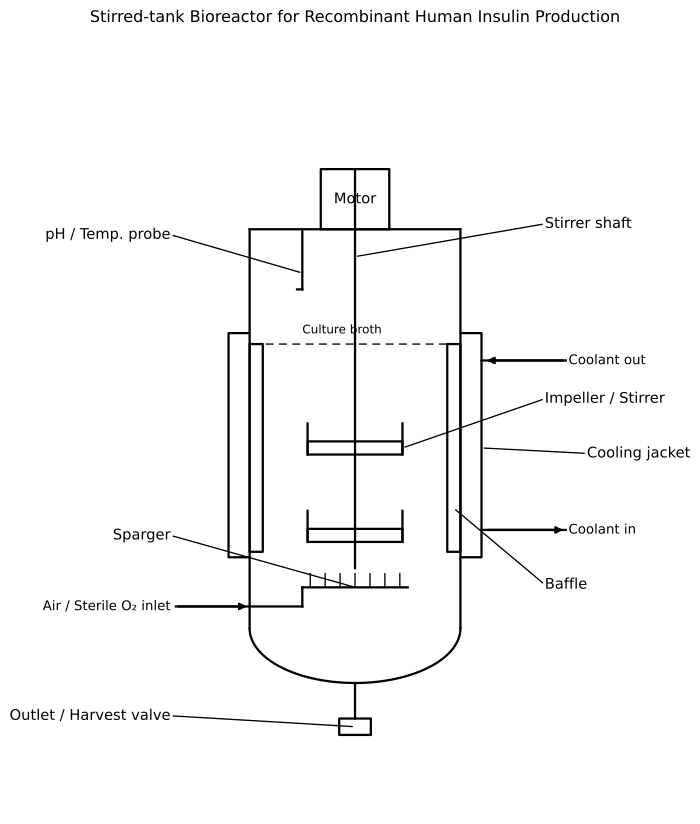
(c) Draw a neat, labelled diagram of the stirred-tank bioreactor used for large-scale production of recombinant human insulin, labelling any FOUR essential components.

(d) After biosynthesis in the bioreactor, the insulin protein must be processed before it can be used as a drug. Name this set of steps collectively and mention any ONE specific step involved.

Diagram for question 21: Biotechnology: Principles and Processes
Show answer
MARKING SCHEME — 5 Marks

─────────────────────────────────────────
(a) Suitable vector + TWO essential features [1 + 1 = 2 marks]
─────────────────────────────────────────

• Suitable vector: Plasmid (e.g., pBR322 or any E. coli expression plasmid) [½ mark]

• Any TWO essential features (½ mark each):

1. Origin of replication (ori) — allows the vector to replicate autonomously inside the host cell independently of the chromosomal DNA.

2. Selectable marker — (e.g., antibiotic resistance gene such as amp^R) enables identification and selection of transformed host cells from non-transformed cells.

3. Cloning site / Multiple Cloning Site (MCS) — has restriction enzyme recognition sites where the foreign (insulin cDNA) gene can be inserted.

4. Suitable promoter — a strong, inducible promoter (e.g., lac promoter) to drive high-level expression of the insulin gene in E. coli.

(Award any TWO × ½ = 1 mark)

─────────────────────────────────────────
(b) TWO reasons cDNA is preferred over genomic DNA [1 mark]
─────────────────────────────────────────

1. cDNA has NO INTRONS (non-coding intervening sequences). Bacteria (prokaryotes) lack the RNA splicing machinery (spliceosomes) required to remove introns from pre-mRNA; if genomic DNA with introns is used, a non-functional protein results. [½ mark]

2. cDNA is made from mature mRNA (after splicing) using reverse transcriptase, so it represents ONLY the coding sequence — a smaller, processable molecule that allows direct, correct translation into insulin protein in E. coli. [½ mark]

─────────────────────────────────────────
(c) Labelled diagram of stirred-tank bioreactor [1 mark]
─────────────────────────────────────────

Draw diagram HERE — must be large, neat and fully labelled.

┌─────────────────────────────────────┐
│ MOTOR DRIVE │
│ │ │
│ ┌─────▼──────┐ │
│ │ IMPELLER │ ← Stirrer │
│ │ (Agitator) │ │
│ └─────┬──────┘ │
│ │ │
│ ─────────────│───────────────── │
│ CULTURE │ ↑ pH SENSOR │
│ MEDIUM │ (probe) │
│ │ │
│ SPARGER →○○○○ (bubbles) │
│ (air inlet at base) │
│ │
│ WATER JACKET ← Temperature control │
│ (heating / cooling) │
│ │
│ FOAM BREAKER / ANTIFOAM SYSTEM │
│ │
│ SAMPLING PORT ← │
│ OUTLET VALVE ← │
└─────────────────────────────────────┘

Four essential labelled components (any four from the list below, ½ × 4 but entire diagram sub-part carries 1 mark — award 1 mark if diagram is correct with at least 4 correct labels):

1. Stirrer / Impeller — agitates culture medium ensuring uniform mixing of nutrients, cells and dissolved O₂.
2. Sparger — introduces sterile air / O₂ into the culture medium from the bottom.
3. Temperature control jacket / Water jacket — maintains optimum temperature for microbial growth.
4. pH sensor / probe — monitors and helps maintain optimum pH of the culture.
5. Foam control / Antifoam system — prevents excessive foaming that could damage cells.
6. Sampling port — for withdrawing culture samples at intervals without contamination.
7. Outlet / Harvest valve — for removing the final product.

(Award 1 mark for a correct, neat diagram with a minimum of 4 correctly labelled components.)

─────────────────────────────────────────
(d) Downstream processing — collective name + ONE specific step [1 mark]
─────────────────────────────────────────

• Collective name: DOWNSTREAM PROCESSING [½ mark]

• Any ONE specific step (½ mark):

(i) Separation / Isolation — centrifugation or filtration to separate cells or cell debris from the product.
(ii) Purification — chromatography (ion-exchange / gel-filtration / affinity chromatography) to obtain the pure insulin protein.
(iii) Formulation / Quality control — testing for correct biological activity, sterility and safety before the product is made suitable for clinical / therapeutic use.

(Award ½ mark for any ONE correctly stated step.)

─────────────────────────────────────────
MARK SUMMARY
─────────────────────────────────────────
(a) Vector named + two features → 1 + 1 = 2 marks
(b) Two reasons for cDNA → ½ + ½ = 1 mark
(c) Labelled bioreactor diagram → 1 mark
(d) Downstream processing + one step → ½ + ½ = 1 mark
TOTAL = 5 marks
Q22Long Answer5 marks

A biotechnology student is setting up a recombinant DNA experiment. She isolates a plasmid vector (pBR322) and a gene of interest from human tissue. She uses EcoRI to cut both the plasmid and the gene insert, then mixes them together with DNA ligase.

(i) Explain the convention used for naming the restriction enzyme EcoRI. What type of ends does EcoRI produce, and why are these ends important in forming recombinant DNA?

(ii) The student inserts her gene of interest into the tetracycline resistance gene (tet^R) of pBR322. Draw a labelled diagram of pBR322 showing: origin of replication (ori), amp^R gene, tet^R gene, and at least two restriction enzyme cut sites. Show where the foreign gene has been inserted.

(iii) After transformation into E. coli, how will the student identify recombinant colonies from non-recombinant colonies? Name the technique used.

Diagram for question 22: Biotechnology: Principles and Processes
Show answer
ANSWER (5 marks)

─────────────────────────────────────
PART (i): Naming convention + sticky ends + role [2 marks]
─────────────────────────────────────

Convention for naming EcoRI:
EcoRI is named after the organism from which it was first isolated:
• E → Escherichia (genus)
• co → coli (species)
• R → RY13 (strain)
• I → first restriction enzyme isolated from this organism
(1 mark — any 3 of the 4 components correctly identified)

Type of ends produced:
EcoRI cuts the DNA asymmetrically at its palindromic recognition sequence, producing STICKY ENDS (also called cohesive ends) — single-stranded overhanging stretches of DNA.

Recognition site and cut:
5'—G ↓ A A T T C—3'
3'—C T T A A ↑ G—5'

After cutting:
5'—G A A T T C—3'
3'—C T T A A G—5'
(overhang: 5'–AATT–3' on each end)

Role of sticky ends in forming rDNA:
The single-stranded overhangs (sticky ends) of the vector and the insert are COMPLEMENTARY to each other → they hydrogen-bond together by base pairing → DNA ligase then seals the phosphodiester bonds → forms the recombinant DNA molecule.
(1 mark — sticky ends are complementary, base-pair, and are joined by ligase)

─────────────────────────────────────
PART (ii): Labelled diagram of pBR322 [2 marks]
─────────────────────────────────────

Diagram of pBR322 (circular plasmid, ~4361 bp):

ori
(origin of
replication)
*
___________
/ \
| pBR322 |
EcoRI→ | (4361 bp) | ←BamHI
site | | site
| |
\_______________/
/ \
amp^R gene tet^R gene
(ampicillin (tetracycline
resistance) resistance)
|
[FOREIGN GENE
INSERTED HERE
at BamHI site
within tet^R]

FULL LABELLED DIAGRAM (draw as a circle with the following labels):

┌─────────────────────────────────────────┐
│ DIAGRAM OF pBR322 │
│ │
│ ori │
│ │ │
│ ┌──────┴──────┐ │
│ / \ │
│ │ pBR322 │ │
│ │ (circular │ │
│ │ plasmid) │ │
│ amp^R tet^R │
│ gene gene │
│ (amp^R │ │
│ intact) ╔════╧════╗ │
│ ║ FOREIGN ║ │
│ ←EcoRI site ║ GENE ║ ←BamHI │
│ (in amp^R) ║INSERTED ║ site │
│ ╚═════════╝ │
│ (disrupts tet^R) │
└─────────────────────────────────────────┘

Required labels for full credit:
• ori (origin of replication) — allows autonomous replication in host
• amp^R gene (ampicillin resistance gene) — selectable marker (intact)
• tet^R gene (tetracycline resistance gene) — site of foreign gene insertion (disrupted)
• At least 2 restriction enzyme sites (e.g., EcoRI, BamHI, PstI, SalI)
• Foreign gene inserted within tet^R gene
(1 mark — correct circular diagram with ori, both resistance genes, and cut sites labelled)
(1 mark — foreign gene shown inserted within tet^R gene specifically)

─────────────────────────────────────
PART (iii): Identifying recombinant colonies [1 mark]
─────────────────────────────────────

Technique: INSERTIONAL INACTIVATION

Procedure:
• Step 1: Plate all transformed E. coli colonies on medium containing AMPICILLIN.
→ Only transformed cells (those that took up pBR322) will grow (amp^R is intact).
→ Non-transformed cells die.

• Step 2: Replica-plate surviving colonies onto medium containing TETRACYCLINE.
→ Non-recombinant cells (plasmid without insert — tet^R intact) → GROW on tetracycline.
→ Recombinant cells (foreign gene inserted into tet^R — gene disrupted) → DO NOT GROW on tetracycline.

Identification:
• Colonies that grow on ampicillin BUT DO NOT grow on tetracycline = RECOMBINANT colonies (contain foreign gene insert).
• Colonies that grow on BOTH ampicillin and tetracycline = non-recombinant.
(1 mark — correct identification: grows on amp, fails on tet = recombinant; technique named as insertional inactivation)

─────────────────────────────────────
MARKING SUMMARY
─────────────────────────────────────
(i) Naming convention of EcoRI (any 3 components) .............. 1 mark
Sticky ends produced + role in rDNA formation .............. 1 mark
(ii) Labelled diagram of pBR322 (ori, both genes, cut sites) ... 1 mark
Foreign gene inserted within tet^R shown correctly ........ 1 mark
(iii) Insertional inactivation — correct identification method .. 1 mark
TOTAL = 5 marks
Q23Long Answer5 marks

A biotechnology student is working on a project to produce a recombinant human insulin protein using Escherichia coli as the host organism. She isolates the human insulin gene from a cDNA library, plans to clone it into a plasmid vector (pBR322), and wants to confirm successful transformation before scaling up production in a bioreactor.

(a) Why did the student use a cDNA library rather than a genomic DNA library to isolate the human insulin gene for expression in E. coli? (1 mark)

(b) She digests both the insulin cDNA and pBR322 with the restriction enzyme EcoRI. Explain the molecular basis by which EcoRI cuts DNA, and state what type of ends are produced. (2 marks)

(c) After transformation of E. coli with the recombinant pBR322 (insulin gene inserted into the tetracycline resistance gene), she plates the bacteria on two types of media:
• Plate 1: Medium containing ampicillin
• Plate 2: Medium containing tetracycline

She finds colonies growing on Plate 1 but NOT on Plate 2. What does this result indicate? Name the technique being used here. (2 marks)

Show answer
MARKING SCHEME (5 marks total)

─────────────────────────────────────
(a) Why cDNA library? [1 mark]
─────────────────────────────────────
• cDNA (complementary DNA) is synthesised from mature mRNA using reverse transcriptase, so it contains NO INTRONS (no non-coding intervening sequences). (1)

[Acceptable alternative: E. coli lacks the RNA splicing machinery (spliceosome) to remove introns from pre-mRNA; therefore, if genomic DNA were used, the introns would not be removed and a non-functional/incorrect protein would be produced. cDNA, derived from processed mRNA, contains only the coding sequence (exons) and can be correctly expressed in a prokaryotic host.]

─────────────────────────────────────
(b) Molecular basis of EcoRI cutting + type of ends [2 marks]
─────────────────────────────────────
• EcoRI is a restriction endonuclease that recognises a specific palindromic sequence on double-stranded DNA:

5' — G ↓ A A T T C — 3'
3' — C T T A A ↑ G — 5'

Recognition sequence: 5'-GAATTC-3' (same sequence read 5'→3' on both strands — palindrome). (1)

• EcoRI cuts between G and A on both strands but at STAGGERED positions, producing STICKY ENDS (also called cohesive ends) — short, single-stranded overhangs (5'-AATT-3' overhang) that can hydrogen-bond with complementary sticky ends of another DNA fragment cut by the same enzyme. (1)

─────────────────────────────────────
(c) Interpretation of plate results + technique name [2 marks]
─────────────────────────────────────
• pBR322 carries two selectable marker genes: ampicillin resistance (amp^R) and tetracycline resistance (tet^R).
• The insulin cDNA was inserted INTO the tet^R gene → the tet^R gene is disrupted/inactivated.
• Therefore:
– Colonies on Plate 1 (ampicillin): These bacteria have taken up the recombinant plasmid (they are TRANSFORMED — amp^R gene is intact). (1)
– No colonies on Plate 2 (tetracycline): The tet^R gene is non-functional due to insertion of the foreign gene → bacteria cannot survive on tetracycline → these colonies contain the RECOMBINANT plasmid (with insulin insert). (1)

• Interpretation: Colonies that grow on ampicillin but NOT on tetracycline are confirmed recombinants (successfully transformed with the insulin gene inserted into pBR322).

• Technique name: Insertional inactivation (also accept: replica plating when used in conjunction with colony transfer).

─────────────────────────────────────
SUMMARY OF VALUE POINTS
─────────────────────────────────────
(a) cDNA has no introns / derived from processed mRNA / E. coli cannot splice introns — 1 mark
(b) Palindromic sequence recognition by EcoRI — 1 mark
Staggered cuts → sticky/cohesive ends produced — 1 mark
(c) Colonies on amp plate = transformed (plasmid taken up) AND no colonies on tet plate = tet^R disrupted = recombinant confirmed — 1 mark
Name of technique: Insertional inactivation — 1 mark

Total: 1 + 2 + 2 = 5 marks

Want unlimited practice on Biotechnology: Principles and Processes?

The full ClearSteps bank has 23+ reviewed questions on this chapter alone — with step-wise solutions, difficulty levels, and progress tracking. Verify your WhatsApp number and your free trial starts right here.

CBSE · CLASS 12
🎟️14-day free trial · code PRAC auto-applied
Mobile Number
+91
OTP will be sent to your WhatsApp

⭐ Trusted by 12,000+ students across India

Biotechnology: Principles and Processes Class 12 Questions