ClearStepsCLEARSTEPS AI
Teacher Login →Student Login →

Human Health and Disease: Class 12 Biology Practice Questions

24 original exam-pattern questions with full answers, matched to the current CBSE Class 12 paper design, including case-based questions. Attempt each question before opening the answer — or start a free 14-day trial ↓ for the full bank.

Q1Case-based4 marks

Rahul, a 19-year-old college student, started experiencing repeated episodes of cold, fever, and diarrhoea over the past several months. His doctor noticed that despite treatment, infections kept recurring. A blood test revealed a very low count of CD4⁺ T-lymphocytes (helper T-cells). The doctor explained that Rahul's immune system was being progressively destroyed by a virus that had entered his body through an infected blood transfusion he had received two years ago. The virus was using his own helper T-cells to replicate, ultimately leading to destruction of these cells. The doctor also mentioned that at this early stage, a specific molecular diagnostic test could have detected the virus even before antibodies had formed in Rahul's body.

Read the following passage carefully and answer the questions that follow:

Rahul, a 19-year-old college student, started experiencing repeated episodes of cold, fever, and diarrhoea over the past several months. His doctor noticed that despite treatment, infections kept recurring. A blood test revealed a very low count of CD4⁺ T-lymphocytes (helper T-cells). The doctor explained that Rahul's immune system was being progressively destroyed by a virus that had entered his body through an infected blood transfusion he had received two years ago. The virus was using his own helper T-cells to replicate, ultimately leading to destruction of these cells. The doctor also mentioned that at this early stage, a specific molecular diagnostic test could have detected the virus even before antibodies had formed in Rahul's body.

(a) Name the virus responsible for Rahul's condition and identify the disease he is suffering from. Also state the full form of CD4⁺ cells and explain why their destruction leads to repeated infections. [2 marks]

(b) (i) Name the molecular diagnostic technique the doctor referred to, which can detect the virus before antibodies are formed. State ONE advantage of this technique over ELISA in early diagnosis. [1 mark]

(c) The doctor confirmed that Rahul's virus has an RNA genome and uses a special enzyme for replication inside the host cell. Name this enzyme and explain the steps by which the virus uses Rahul's helper T-cells to produce new viral copies. [1 mark]

Show answer
MARKING SCHEME — 4 Marks Total

━━━━━━━━━━━━━━━━━━━━━━━━━━━━━━
Part (a) — 2 marks
━━━━━━━━━━━━━━━━━━━━━━━━━━━━━━

• Virus: HIV (Human Immunodeficiency Virus) [½ mark]
• Disease: AIDS (Acquired Immuno Deficiency Syndrome) [½ mark]

• Full form of CD4⁺ T-lymphocytes:
CD4⁺ = Cluster of Differentiation 4 positive Helper T-lymphocytes [½ mark]

• Reason why their destruction leads to repeated infections:
Helper T-cells (CD4⁺) are central to BOTH humoral immunity (they activate
B-cells to produce antibodies) AND cell-mediated immunity (they activate
cytotoxic T-cells). When HIV progressively destroys helper T-cells, the
count falls from ~500 cells/mm³ to below 200 cells/mm³, severely
compromising the body's ability to mount any immune response.
Therefore, even opportunistic pathogens (e.g. Mycobacterium, Candida)
that a healthy immune system would easily eliminate cause repeated,
life-threatening infections. [½ mark]

━━━━━━━━━━━━━━━━━━━━━━━━━━━━━━
Part (b) — 1 mark
━━━━━━━━━━━━━━━━━━━━━━━━━━━━━━

• Technique: PCR (Polymerase Chain Reaction) / Molecular diagnosis
using PCR [½ mark]

• Advantage over ELISA:
PCR can detect HIV RNA/DNA even during the WINDOW PERIOD
(the period after infection but before the body has produced detectable
antibodies). ELISA detects antibodies against HIV — if antibodies have
not yet formed, ELISA gives a FALSE NEGATIVE result. PCR can detect
as few as ONE copy of viral nucleic acid, allowing much earlier and
more accurate diagnosis. [½ mark]

━━━━━━━━━━━━━━━━━━━━━━━━━━━━━━
Part (c) — 1 mark
━━━━━━━━━━━━━━━━━━━━━━━━━━━━━━

• Enzyme: Reverse Transcriptase [½ mark]

• Steps by which HIV replicates inside helper T-cells:
(1) HIV (retrovirus) carries single-stranded RNA genome + reverse
transcriptase enzyme.
(2) HIV attaches to CD4 receptor on helper T-cell → enters the cell →
releases its RNA genome into the cytoplasm.
(3) Reverse transcriptase uses viral RNA as template to synthesise
complementary DNA (cDNA) → double-stranded DNA (proviral DNA).
(4) Proviral DNA integrates into the host cell's chromosome
(using integrase enzyme).
(5) Integrated proviral DNA is transcribed → new viral RNA produced
→ translated → new viral proteins assembled into new HIV particles.
(6) New viruses bud off → infect more CD4⁺ T-cells → progressive
destruction of helper T-cells. [½ mark]

━━━━━━━━━━━━━━━━━━━━━━━━━━━━━━
EXAMINER NOTES
━━━━━━━━━━━━━━━━━━━━━━━━━━━━━━
• Accept any correct biological equivalent phrasing for part (a) reason.
• For part (b), 'PCR-based diagnosis' or 'nucleic acid amplification test'
is acceptable; examiner must ensure the window period advantage is stated.
• For part (c), reverse transcriptase must be named; marks for steps are
awarded if at least the RNA→DNA step and integration into host chromosome
are both mentioned.
• Do NOT award marks if the student writes 'DNA polymerase' instead of
reverse transcriptase.
Q2Case-based4 marks

A 28-year-old healthcare worker, Priya, visited a diagnostic centre for a routine check-up. Her blood report showed a low CD4+ T-lymphocyte count. She was advised further diagnostic tests. The immunologist explained that her immune system was compromised and that a specific retrovirus might be responsible. Priya recalled that she had received a blood transfusion 6 years ago after a road accident. An ELISA test was performed and came back positive. She was then counselled about the nature of her condition, how the virus operates inside the body, and what precautions she and her family should take.

Read the following case and answer the questions that follow:

A 28-year-old healthcare worker, Priya, visited a diagnostic centre for a routine check-up. Her blood report showed a low CD4+ T-lymphocyte count. She was advised further diagnostic tests. The immunologist explained that her immune system was compromised and that a specific retrovirus might be responsible. Priya recalled that she had received a blood transfusion 6 years ago after a road accident. An ELISA test was performed and came back positive. She was then counselled about the nature of her condition, how the virus operates inside the body, and what precautions she and her family should take.

(a) Identify the virus likely responsible for Priya's condition. Why is a low CD4+ T-lymphocyte count considered a hallmark indicator of this infection? (1 mark)

(b) Explain, step by step, how the virus identified in (a) replicates inside a host cell and destroys the immune system. (2 marks)

(c) The immunologist told Priya: 'ELISA can be negative in the early weeks after infection even if the virus is present.' Name the period referred to and suggest ONE molecular diagnostic technique that would be more reliable during this period, giving a reason for your answer. (1 mark)

Show answer
MARKING SCHEME (Total: 4 marks)

─────────────────────────────────────
Part (a) [1 mark]
─────────────────────────────────────
• Virus: HIV (Human Immunodeficiency Virus) — a retrovirus. [½ mark]
• Reason: HIV specifically infects and destroys CD4+ T-helper lymphocytes (also called T4 cells). These cells are central coordinators of the entire adaptive immune response — they activate B cells (humoral immunity) and cytotoxic T cells (cell-mediated immunity). A progressive fall in CD4+ T cell count (normal: ~500–1500 cells/μL; AIDS defined as <200 cells/μL) therefore indicates collapse of immune surveillance, making this count the primary clinical indicator of HIV progression and AIDS. [½ mark]

─────────────────────────────────────
Part (b) [2 marks]
─────────────────────────────────────
Step-by-step replication and immune destruction:

(1) Entry: HIV enters the body (here via contaminated blood transfusion) → virus particles (virions) bind to CD4 receptors on helper T-lymphocytes via viral glycoprotein gp120. [½ mark]

(2) Fusion and uncoating: Viral envelope fuses with host cell membrane → RNA genome of HIV is released into the cytoplasm of the host T cell. [½ mark — any 2 steps below earn remaining 1 mark]

(3) Reverse transcription: HIV carries the enzyme REVERSE TRANSCRIPTASE → viral RNA genome is transcribed into single-stranded cDNA → then converted to double-stranded DNA (proviral DNA).

(4) Integration: Proviral DNA enters the nucleus → integrates into the host chromosome with the help of integrase enzyme → now called PROVIRUS. Provirus remains dormant (latent) for months to years.

(5) Active replication: Provirus is activated → host cell machinery transcribes proviral DNA → viral mRNA produced → translated into viral proteins → new HIV particles assembled, bud off from host cell.

(6) Immune destruction: Each replication cycle destroys the host T-helper cell → CD4+ count declines progressively → immune system fails → patient becomes susceptible to opportunistic infections (e.g., Pneumocystis pneumonia, Toxoplasma) and cancers (e.g., Kaposi's sarcoma) → this stage is called AIDS (Acquired Immunodeficiency Syndrome).

[Award 1 mark for correct steps 1–2 (entry + reverse transcription) and 1 mark for integration/replication + immune destruction consequence. Full credit requires mention of reverse transcriptase by name.]

─────────────────────────────────────
Part (c) [1 mark]
─────────────────────────────────────
• Period referred to: WINDOW PERIOD — the interval (typically 3–12 weeks) between initial HIV infection and the appearance of detectable antibodies in the blood. During this period, ELISA is negative because it detects anti-HIV antibodies (not yet formed), even though the virus is actively replicating. [½ mark]

• More reliable technique: PCR (Polymerase Chain Reaction) [½ mark]
Reason: PCR detects viral RNA/DNA directly (not antibodies), so it can identify HIV infection even during the window period when antibody levels are too low for ELISA to detect — it can detect as few as 1 viral copy. This makes PCR the gold-standard early diagnostic tool.

[Award ½ mark for correctly naming 'window period'; ½ mark for naming PCR with a valid reason. Accept 'RT-PCR' or 'nucleic acid amplification test (NAAT)'.]

─────────────────────────────────────
EXAMINER'S NOTE:
• Deduct no marks if student writes 'AIDS virus' instead of HIV provided context is clear.
• 'Reverse transcriptase' must be named for full credit in part (b).
• In part (c), 'Western blot' alone is NOT accepted as the answer — it is a confirmatory antibody test, not a nucleic acid-based early detection method.
Q3Case-based4 marks

Rahul, a 10-year-old boy living in a village near a stagnant pond, was brought to the doctor with complaints of high fever occurring every 48–72 hours, chills, and headache. Blood smear examination revealed ring-shaped structures inside red blood cells (RBCs). The doctor diagnosed him with malaria caused by Plasmodium vivax and explained to his parents how the parasite enters the human body and completes its life cycle involving two hosts.

Read the following case and answer the questions that follow:

Rahul, a 10-year-old boy living in a village near a stagnant pond, was brought to the doctor with complaints of high fever occurring every 48–72 hours, chills, and headache. Blood smear examination revealed ring-shaped structures inside red blood cells (RBCs). The doctor diagnosed him with malaria caused by Plasmodium vivax and explained to his parents how the parasite enters the human body and completes its life cycle involving two hosts.

(a) Name the stage of Plasmodium that enters Rahul's body when the female Anopheles mosquito bites him. In which cells of Rahul's body does the parasite first multiply? [1]

(b) The doctor explained that the periodic fever every 48–72 hours is directly linked to a specific event in the parasite's life cycle inside RBCs. Identify this event and explain how it causes fever. [1]

(c) After several asexual cycles in Rahul's blood, some merozoites develop into a different form. Name this form and state its significance in continuing the parasite's life cycle. [1]

(d) A female Anopheles mosquito bites Rahul (the infected boy). Trace the sexual phase of Plasmodium's life cycle inside the mosquito, starting from the ingestion of gametocytes up to the formation of the infective stage. [1]

Show answer
MARKING SCHEME — 4 marks (1 mark each sub-part)

━━━━━━━━━━━━━━━━━━━━━━━━━━━━━━━━
(a) [1 mark]
• Infective stage that enters Rahul's body = Sporozoites [½]
• First site of multiplication = Liver cells (hepatocytes) — where primary exo-erythrocytic schizogony (asexual multiplication) occurs [½]

━━━━━━━━━━━━━━━━━━━━━━━━━━━━━━━━
(b) [1 mark]
• Event = Rupture of infected RBCs releasing merozoites (erythrocytic schizogony / haemolysis of RBCs) [½]
• This releases merozoites along with toxic haemozoin (malarial pigment / metabolic waste) into the bloodstream → stimulates the immune system → periodic high fever and chills [½]

(Note: Plasmodium vivax — fever every 48 h = tertian malaria; P. malariae — every 72 h = quartan malaria. Full credit if student correctly links rupture of RBCs and toxin release to fever.)

━━━━━━━━━━━━━━━━━━━━━━━━━━━━━━━━
(c) [1 mark]
• Form = Gametocytes (micro-gametocytes = male; macro-gametocytes = female) [½]
• Significance: Gametocytes are the sexual forms; they cannot develop further inside the human host. They are ingested by a female Anopheles mosquito during a blood meal, where they undergo the sexual phase of the life cycle, thereby CONTINUING/COMPLETING the life cycle of Plasmodium [½]

━━━━━━━━━━━━━━━━━━━━━━━━━━━━━━━━
(d) [1 mark — all steps required for full credit; accept any 3 correct sequential steps]

Sexual phase of Plasmodium inside female Anopheles mosquito:

Ingestion of gametocytes from Rahul's blood

Gametocytes mature into gametes inside mosquito's gut
(microgametocyte → microgametes by exflagellation;
macrogametocyte → macrogamete)

Fertilisation: microgamete + macrogamete → Zygote

Zygote becomes motile → Ookinete

Ookinete penetrates gut wall → develops into Oocyst

Oocyst undergoes sporogony → thousands of Sporozoites formed

Oocyst ruptures → Sporozoites migrate to salivary glands

Infective stage (Sporozoites) stored in salivary glands
→ injected into next human host during bite

[Award 1 mark if student correctly mentions: gametocytes ingested → gamete formation → fertilisation → zygote → ookinete/oocyst → sporozoites in salivary glands, in logical sequence]

━━━━━━━━━━━━━━━━━━━━━━━━━━━━━━━━
EXAMINER NOTES:
• CBSE accepts 'liver parenchyma cells' or 'hepatocytes' for (a) second part.
• For (b), 'haemozoin' or 'toxic substances released' both acceptable.
• For (d), 'ookinete' may be omitted if remaining steps are correct — do not penalise.
• Two hosts: Sexual phase in female Anopheles mosquito (definitive host); Asexual phase in human (intermediate host).
Q4Case-based4 marks

Rahul, a 19-year-old college student, was brought to a hospital with fever, swollen lymph nodes, and persistent cough lasting three weeks. On further investigation, it was found that his CD4+ T-lymphocyte count had dropped to 180 cells/μL (normal: 500–1500 cells/μL). A confirmatory ELISA test came back positive, but his doctor ordered a PCR-based test as well. The doctor explained that Rahul's immediate threat was not the viral infection itself, but a fungal lung infection (Pneumocystis jirovecii pneumonia) that had established itself due to his severely compromised immune system. The doctor also counselled Rahul about the importance of early detection and the window period of the infection.

Read the following passage carefully and answer the questions that follow:

Rahul, a 19-year-old college student, was brought to a hospital with fever, swollen lymph nodes, and persistent cough lasting three weeks. On further investigation, it was found that his CD4+ T-lymphocyte count had dropped to 180 cells/μL (normal: 500–1500 cells/μL). A confirmatory ELISA test came back positive, but his doctor ordered a PCR-based test as well. The doctor explained that Rahul's immediate threat was not the viral infection itself, but a fungal lung infection (Pneumocystis jirovecii pneumonia) that had established itself due to his severely compromised immune system. The doctor also counselled Rahul about the importance of early detection and the window period of the infection.

(a) Why did Rahul's doctor order a PCR-based test in addition to the ELISA test? What specific advantage does PCR offer over ELISA in such cases? (1 mark)

(b) Explain, step by step, the mechanism by which the causative agent of Rahul's primary infection leads to the destruction of CD4+ T-lymphocytes, ultimately resulting in immunodeficiency. (2 marks)

(c) Rahul's immediate life-threatening condition is caused by Pneumocystis jirovecii, not by the primary virus. What immunological principle does this illustrate? Name ONE other type of infection (with its causative organism) that similarly becomes life-threatening in patients with the same primary condition. (1 mark)

Show answer
MARKING SCHEME — Total: 4 marks

─────────────────────────────────────────
Part (a) — 1 mark
─────────────────────────────────────────
Value point 1 (½ mark):
ELISA detects antibodies produced AGAINST HIV in the patient's blood. During the WINDOW PERIOD (the gap between actual HIV infection and the appearance of detectable antibodies — typically 3–12 weeks), ELISA gives a FALSE NEGATIVE result because antibodies have not yet been formed in sufficient quantities.

Value point 2 (½ mark):
PCR (Polymerase Chain Reaction) can detect the actual HIV RNA/DNA (viral genetic material) even during the window period, because it amplifies and detects as few as ONE copy of viral nucleic acid. Therefore, PCR confirms infection earlier and eliminates false negatives due to the window period.

[Award ½ + ½ for both points; accept any equivalent correct scientific statement]

─────────────────────────────────────────
Part (b) — 2 marks
─────────────────────────────────────────
Causative agent: HIV (Human Immunodeficiency Virus) — a retrovirus.

Step-by-step mechanism (award ½ mark per step, any 4 steps = 2 marks):

Step 1: HIV enters the body (via infected blood/semen/breast milk) → viral gp120 envelope protein binds to CD4 receptor on helper T-lymphocytes (CD4+ T-cells). [½]

Step 2: After entry, HIV releases its RNA genome and the enzyme REVERSE TRANSCRIPTASE inside the host cell. Reverse transcriptase catalyses:
RNA → single-stranded cDNA → double-stranded viral DNA. [½]

Step 3: Viral DNA integrates into the HOST CELL'S CHROMOSOME using the enzyme integrase → becomes a PROVIRUS. It may remain latent for months to years. [½]

Step 4: When provirus is activated → viral RNA and proteins are synthesised → new HIV particles bud off → the host CD4+ T-cell is DESTROYED in the process. [½]

Consequence: Progressive destruction of CD4+ T-lymphocytes → T-cell count falls drastically (as in Rahul: 180 cells/μL) → loss of cell-mediated immunity AND impaired activation of B-cells → patient CANNOT mount an effective immune response against even ordinarily harmless pathogens → IMMUNODEFICIENCY (AIDS).

─────────────────────────────────────────
Part (c) — 1 mark
─────────────────────────────────────────
Immunological principle illustrated (½ mark):
This illustrates OPPORTUNISTIC INFECTION — pathogens (fungi, bacteria, viruses, parasites) that do NOT cause disease in individuals with a healthy immune system are able to establish life-threatening infections in immunocompromised patients (such as AIDS patients) because their T-cell mediated immunity is severely depleted.

One other example of an opportunistic infection in AIDS patients (½ mark) — any ONE of the following:
• Toxoplasma gondii (protozoan) → toxoplasmic encephalitis (brain infection)
• Mycobacterium tuberculosis (bacterium) → tuberculosis
• Candida albicans (fungus) → oesophageal/oral candidiasis
• Cytomegalovirus — CMV (virus) → retinitis / pneumonitis
• Cryptococcus neoformans (fungus) → cryptococcal meningitis

[Award ½ for correctly naming the principle and ½ for any ONE correct organism + disease]

─────────────────────────────────────────
EXAMINER'S NOTE:
• Do NOT deduct marks if student writes 'immunodeficiency' instead of 'opportunistic infection' in part (c), provided they correctly explain the concept.
• In part (b), full marks may be awarded if student gives 4 correct, distinct mechanistic steps even if sequence slightly varies.
• For PCR in part (a): accept 'detects viral nucleic acid / viral genome' — do not require student to specify RNA vs DNA.
─────────────────────────────────────────
Q5MCQ1 mark

Which one of the following organisms is correctly matched with the disease it causes AND the diagnostic test used to confirm that disease?

Show answer
Correct answer: (B) Salmonella typhi — Typhoid — Widal test

Reason: Salmonella typhi is the bacterium that causes typhoid fever. The Widal test is a serological test that detects agglutinins (antibodies) in the patient's serum against Salmonella O and H antigens — a positive Widal test confirms typhoid infection.

Why the other options are incorrect:
• (A) Plasmodium vivax causes malaria — confirmed by blood smear examination (not Widal test).
• (C) Streptococcus pneumoniae causes pneumonia — diagnosed by sputum culture/chest X-ray, not ELISA as a routine diagnostic.
• (D) Entamoeba histolytica causes amoebiasis — diagnosed by stool examination, not Widal test.
Q6MCQ1 mark

A patient recently diagnosed with HIV infection visits a diagnostic centre. The technician advises the patient to undergo PCR-based testing rather than ELISA. Which of the following BEST justifies this recommendation at this early stage of infection?

Show answer
Correct answer: (B) PCR can detect viral RNA/DNA even during the window period when antibodies have not yet been produced.

Reason: During the window period (early HIV infection), the immune system has not yet produced sufficient antibodies against HIV. ELISA (Enzyme Linked Immunosorbent Assay) detects antibodies — since these are absent or below detectable levels during this phase, ELISA gives a FALSE NEGATIVE result.

PCR (Polymerase Chain Reaction) directly detects viral nucleic acid (HIV RNA/DNA) and can identify even as few as 1 copy of viral genetic material in the blood. Therefore, PCR is recommended for early/confirmatory diagnosis.

Why other options are wrong:
- (A) is incorrect: PCR does NOT detect antibodies; it detects nucleic acids.
- (C) is incorrect: ELISA can detect HIV at later stages when antibodies are present; it is not limited to bacterial antigens.
- (D) is incorrect: PCR amplifies DNA/RNA sequences, NOT antibodies.
Q7MCQ1 mark

Which of the following correctly matches the drug with its source plant AND its primary effect on the human body?

Show answer
Correct answer: (B) Heroin (smack) — Papaver somniferum — Acts as a depressant; slows down body functions.

Explanation (for examiner reference):
• Heroin (diacetylmorphine / smack) is derived from the latex of Papaver somniferum (poppy plant).
• It is a depressant — binds to opioid receptors in the CNS and gut, slowing down body functions, causing sedation, euphoria, and respiratory depression.

Why the distractors are wrong:
(A) Morphine is also from Papaver somniferum (correct source) but is NOT from Cannabis sativa — source plant is mismatched; also its primary action is depressant/analgesic, not stimulant.
(C) Cocaine is from Erythroxylum coca, NOT Papaver somniferum — source plant is wrong.
(D) Cannabinoids are from Cannabis sativa, NOT Erythroxylum coca — both source plant and effect description are wrong.
Q8MCQ1 mark

Rohan, a 10-year-old boy, was prescribed a course of antibiotics by his doctor after being diagnosed with typhoid fever. After completing the full course, he recovered completely. Two years later, Rohan was accidentally exposed to Salmonella typhi again but did NOT develop typhoid. Which of the following BEST explains why Rohan did not fall ill the second time?

Show answer
Correct answer: (B)

Rohan's body produced memory B-cells and memory T-cells during the first infection, enabling a faster and stronger secondary immune response.

Explanation (for examiner reference):
• During the PRIMARY immune response (first exposure to Salmonella typhi), the acquired immune system produced specific antibodies AND generated long-lived memory lymphocytes (memory B-cells and memory T-cells).
• These memory cells persist in the body for years after the infection has cleared.
• On SECONDARY exposure to the same antigen (Salmonella typhi), the memory cells mount a rapid, amplified secondary immune response — producing high titres of antibodies far more quickly than the primary response.
• The pathogen is eliminated before it can proliferate to disease-causing levels, so Rohan does not develop typhoid symptoms.

Why the other options are wrong:
(A) Antibiotics are not stored in the body; they are metabolised and excreted within days. Protection here is immunological, not pharmacological.
(C) Salmonella typhi does not lose pathogenicity after one host infection — it can still infect other unimmunised individuals.
(D) Innate immunity (skin, mucus, cilia, lysozyme) is non-specific and does not improve or become 'permanently stronger' due to a previous specific infection. The protection Rohan has is acquired (adaptive) immunity, not innate immunity.
Q9Short Answer1 mark

Assertion (A): A person infected with HIV may test negative on an ELISA-based diagnostic test even when the virus is actively replicating in the body.
Reason (R): ELISA detects HIV-specific antibodies in the patient's serum, and there is a 'window period' during which antibodies have not yet been produced in detectable quantities.

Show answer
Correct Answer: (A) — Both A and R are true, and R is the correct explanation of A.

Explanation (for examiner reference):

• Assertion is TRUE: HIV actively replicates inside helper T-lymphocytes (CD4⁺ T-cells) immediately after entry. During the early weeks of infection, viral load is rising but the immune system has not yet mounted a detectable antibody response. An ELISA test performed during this period gives a FALSE-NEGATIVE result.

• Reason is TRUE and correctly explains the Assertion:
— ELISA (Enzyme Linked Immunosorbent Assay) works on the principle of antigen–antibody interaction detected by an enzyme-linked colour change.
— It detects anti-HIV antibodies in the patient's serum, NOT the virus particles directly.
— The 'window period' (typically 3–12 weeks post-infection) is the interval between initial HIV infection and the appearance of detectable levels of antibodies.
— Because ELISA relies on antibody detection, any test done within the window period will be negative despite active viral replication — this is precisely why A is true.

• Why NOT option (B): R is not merely an associated true fact; it is the direct mechanistic explanation for A. The false-negative ELISA result IS caused by the absence of antibodies during the window period.

Key value points at a glance:
1. ELISA principle = antigen–antibody interaction → enzyme → colour change.
2. ELISA detects antibodies (not viral RNA/DNA).
3. Window period → antibodies absent/below detection threshold → ELISA negative.
4. PCR-based tests can detect HIV nucleic acid during the window period (positive even when ELISA is negative) — this distinction underlies the Hard-level challenge of the question.
Q10MCQ1 mark

A 16-year-old student was found to be frequently absent from school, showed a dramatic drop in academic performance, and was observed to have constricted pupils, slowed breathing, and extreme drowsiness. On investigation, it was found that he had been using a drug derived from the latex of a plant. Which of the following correctly identifies the drug AND its mechanism of action?

Show answer
Correct answer: (C) Heroin (diacetylmorphine) — binds to opioid receptors in the CNS, acting as a depressant and slowing body functions.

Reasoning (for examiner reference):
• The drug is derived from the latex of Papaver somniferum (opium poppy).
• Heroin (diacetylmorphine) is an opioid — classified as a depressant.
• Clinical signs described (constricted pupils, slowed/depressed breathing, extreme drowsiness) are hallmark features of opioid intoxication.
• Heroin binds to opioid receptors in the CNS and gastrointestinal tract, depressing CNS activity.

Why other options are incorrect:
• (A) Cannabinoids come from Cannabis sativa, not latex; signs differ (altered perception, not respiratory depression).
• (B) Cocaine comes from Erythroxylum coca and is a STIMULANT, not a depressant; produces dilated pupils and euphoria.
• (D) LSD is a synthetic hallucinogen; not derived from plant latex.
Q11Short Answer2 marks

A 10-year-old child who had chickenpox last year was recently exposed to the same virus (Varicella zoster) at school. His doctor confirmed that he will NOT develop the disease again. Based on this observation, explain the type of immunity involved and the specific cells responsible for this protection.

Show answer
The child is protected by Acquired Active Immunity (specifically, naturally acquired active immunity). (1 mark)

During the first infection, B-lymphocytes differentiated into plasma cells (which produced antibodies against Varicella zoster) AND into long-lived Memory B-cells and Memory T-cells. On second exposure to the same pathogen, these memory cells rapidly proliferate and produce a large quantity of antibodies in a shorter time (anamnestic/secondary immune response), neutralising the pathogen before disease symptoms can develop. (1 mark)
Q12Short Answer2 marks

Name the type of immunity acquired after recovery from a natural infection. How is it different from the immunity provided by vaccination?

Show answer
Type of immunity after natural infection: Active immunity (naturally acquired active immunity). [½ mark]

Difference:
• Naturally acquired active immunity: develops when a pathogen (live/virulent) enters the body during actual infection → immune system produces antibodies and memory cells in response to real antigens. [½ mark]
• Vaccination-induced (artificially acquired active immunity): attenuated (weakened) or killed pathogens / antigenic proteins are introduced into the body → immune system mounts a response and forms memory cells WITHOUT the person suffering from the disease. [½ mark]

In BOTH cases, the body produces its OWN antibodies and memory cells (hence both are 'active'), and protection is long-lasting. The key difference is the SOURCE of antigen — natural infection vs deliberate immunisation. [½ mark]
Q13Short Answer2 marks

A young athlete was found to be regularly injecting himself with a substance derived from Papaver somniferum to manage pain after training. His coach noticed that over time, the athlete required increasing doses to achieve the same effect, and experienced severe anxiety and nausea whenever he missed a dose.

(i) Name the class of drug the athlete is abusing and identify ONE specific compound from this plant that causes the above effects.
(ii) Name the TWO physiological phenomena demonstrated by the athlete's behaviour described above.

Show answer
(i) Class of drug: Opioids. (½ mark)
Specific compound: Heroin (diacetylmorphine) / Morphine. (½ mark)

(ii) The two physiological phenomena are:
• Tolerance — the body adapts to the drug, requiring progressively higher doses to produce the same effect. (½ mark)
• Dependence (physical/drug dependence) — the body becomes accustomed to the drug's presence; its absence causes withdrawal symptoms such as anxiety and nausea. (½ mark)

[Total: 2 marks]
Q14Short Answer2 marks

A student suffering from a cold recovered after a few days without any medication. Later, when exposed to the same virus again, the student did not fall ill.
(i) Name the type of immunity responsible for this protection during the second exposure.
(ii) Name the cells that retain the 'memory' of the first infection.

Show answer
(i) Acquired immunity (specifically, active immunity) — the student's immune system produced antibodies and memory cells during the first infection; on second exposure to the same pathogen, a rapid and heightened secondary immune response is mounted, preventing illness. [1 mark]

(ii) Memory B-lymphocytes (memory B-cells) and memory T-lymphocytes (memory T-cells). [1 mark]

[Award ½ + ½ if student names only memory B-cells OR only memory T-cells; award full 1 mark if both are named OR if 'memory lymphocytes / memory cells' is written as a combined acceptable answer.]
Q15Short Answer3 marks

A 35-year-old healthcare worker tested negative for HIV on a standard ELISA test conducted two weeks after a needle-stick injury involving an HIV-positive patient. The hospital counsellor advised her not to consider herself safe yet and recommended a repeat test after 3 months.

(i) Why was the ELISA result negative despite the possible exposure to HIV? Name the specific period referred to here. (1 mark)
(ii) If HIV infection is confirmed later, describe the step-by-step mechanism by which HIV destroys the immune system, leading to AIDS. (2 marks)

Show answer
Answer:

(i) ELISA is based on antigen–antibody interaction. After HIV infection, the body takes time to produce detectable levels of anti-HIV antibodies. During this initial period — called the WINDOW PERIOD — antibodies are not yet formed (or present in amounts too low to be detected), so ELISA gives a FALSE NEGATIVE result.
• Term: Window Period (1 mark — ½ for reason + ½ for naming the period)

(ii) Step-by-step mechanism of HIV destroying the immune system (2 marks):

Step 1 — Entry: HIV (a retrovirus — RNA genome + reverse transcriptase enzyme) enters the body via infected blood/semen and specifically targets helper T-lymphocytes (CD4⁺ / TH cells).

Step 2 — Reverse transcription: Inside the host CD4⁺ cell, viral RNA is converted to viral DNA by reverse transcriptase (RNA → DNA).

Step 3 — Integration: Viral DNA integrates into the host cell's chromosome and remains latent (incubation period — may last several years).

Step 4 — Replication and lysis: Viral DNA is transcribed and translated → new virus particles bud off → host CD4⁺ cell is destroyed.

Step 5 — Progressive immunodeficiency: Repeated cycles of infection and lysis progressively reduce the number of helper T-cells → immune response collapses → patient becomes vulnerable to opportunistic infections (e.g., Toxoplasma, Mycobacterium, fungal infections) and certain cancers (e.g., Kaposi's sarcoma).

This condition of collapsed immunity = AIDS (Acquired Immuno Deficiency Syndrome).

(Award 1 mark for steps 1–3 correctly described; 1 mark for steps 4–5 with mention of CD4⁺ cell destruction and opportunistic infections/AIDS.)

Diagnostic note: After the window period, ELISA is used for detection; Western blot is used for confirmation.
Q16Short Answer3 marks

A person returning from a malaria-endemic region complains of recurring high fever with chills, headache, and nausea. The doctor suspects malaria caused by Plasmodium vivax.
(i) Name the vector responsible for transmission of malaria and state which sex of the vector is responsible for transmission. (1 mark)
(ii) Describe the events that occur inside the human body from the entry of the parasite to the appearance of fever symptoms. (2 marks)

Show answer
MARKING SCHEME (3 marks total)

─────────────────────────────────────
Part (i) — 1 mark
─────────────────────────────────────
• Vector: Female Anopheles mosquito [½ mark]
• Only the FEMALE Anopheles transmits malaria because only females are blood-feeders (require blood for egg development); males feed only on plant sap. [½ mark]

─────────────────────────────────────
Part (ii) — 2 marks
─────────────────────────────────────
Step-by-step events inside the human body:

1. ENTRY OF SPOROZOITES:
Infected female Anopheles bites human → injects sporozoites (the infective stage) into bloodstream. [½ mark]

2. LIVER PHASE (Pre-erythrocytic cycle):
Sporozoites enter liver cells (hepatocytes) → multiply asexually → form merozoites → liver cells rupture and release merozoites into blood. [½ mark]

3. RBC PHASE (Erythrocytic cycle):
Merozoites enter Red Blood Cells (RBCs) → feed on haemoglobin → multiply → RBCs burst, releasing more merozoites + toxic substances (haemozoin). [½ mark]

4. FEVER SYMPTOMS:
Rupture of RBCs releases haemozoin (malarial pigment/toxin) into blood → stimulates immune system → characteristic recurring fever with chills.
(In P. vivax — fever recurs every 48 hours = Benign tertian malaria.) [½ mark]

─────────────────────────────────────
NOTE TO EXAMINER:
• Accept 'Anopheles mosquito' for part (i) if sex not specified — award ½ mark only.
• In part (ii), award marks for any 4 correct sequential points @ ½ mark each.
• 'Haemozoin' OR 'toxic substances released from ruptured RBCs' both acceptable for the fever-trigger point.
─────────────────────────────────────
Q17Short Answer3 marks

With reference to the immune system in humans, answer the following:
(i) Differentiate between active immunity and passive immunity. (2 marks)
(ii) Give ONE example of a vaccine that provides active immunity. (1 mark)

Show answer
Answer:

(i) Difference between Active Immunity and Passive Immunity: (1 + 1 = 2 marks)

| Feature | Active Immunity | Passive Immunity |
|---|---|---|
| Definition | Immunity produced when the host's own immune system responds to an antigen (pathogen/vaccine) and produces antibodies. | Immunity acquired by direct transfer of ready-made antibodies from an external source into the host. |
| Example | Immunity after vaccination or after recovering from an infection. | Antibodies transferred from mother to foetus through placenta; IgA in colostrum (mother's milk). |
| Duration | Long-lasting (memory cells formed). | Short-lived (no memory cells formed). |
| Speed | Slow — takes time for the immune system to respond. | Immediate — ready-made antibodies act at once. |

*(Any ONE clear difference stated point-wise earns 1 mark; a second distinct difference earns the second mark. The first two rows above are the most important.)*

(ii) Example of a vaccine providing active immunity: (1 mark)

- BCG vaccine (against tuberculosis — *Mycobacterium tuberculosis*)

*(Other acceptable answers: Polio vaccine / MMR vaccine / Hepatitis B vaccine / DPT vaccine — any ONE correct vaccine name earns the mark.)*

---
Examiner's Note on Marking:
- Part (i): Award 1 mark for correctly stating what active immunity is AND 1 mark for correctly stating what passive immunity is (or give 1+1 for any one valid distinguishing feature stated for each). Do NOT penalise if the student writes a table or bullet points — both are acceptable.
- Part (ii): Award 1 mark for any correct, named vaccine. A general statement like 'vaccination' without a specific name = 0 marks.
Q18Short Answer3 marks

HIV is called a retrovirus. (i) Justify this statement by explaining the molecular mechanism HIV uses to replicate inside a host cell. (ii) Why is HIV infection considered an immunodeficiency condition rather than a direct cytotoxic infection? Name the specific host cells targeted by HIV.

Show answer
Answer (CBSE Marking Scheme Style — 3 marks)

(i) HIV as a retrovirus — molecular mechanism: [1½ marks]

- HIV is a retrovirus because its genetic material is RNA (not DNA), and it replicates using the enzyme reverse transcriptase. ½ mark
- Step-by-step mechanism:
1. HIV enters the host cell and releases its RNA genome into the cytoplasm. ½ mark
2. Reverse transcriptase catalyses synthesis of DNA from the RNA template (RNA → DNA) — this is the reverse of the normal flow of genetic information (Central Dogma: DNA → RNA), hence the name *retrovirus*. ½ mark
3. The viral DNA integrates into the host cell's chromosome and is called a provirus.
4. Proviral DNA is transcribed → viral RNA → new virus particles are assembled and released.

(ii) Why HIV causes immunodeficiency (not direct cytotoxicity): [1 mark]

- HIV specifically infects and destroys Helper T-lymphocytes (CD4⁺ T-cells). ½ mark
- Helper T-cells are the central coordinators of the immune response — they activate both humoral (B-cells → antibodies) and cell-mediated (cytotoxic T-cells) immunity.
- As HIV replication destroys more and more Helper T-cells, the total count of CD4⁺ T-cells falls progressively.
- The patient does not die from HIV directly, but becomes unable to mount an immune response against even ordinary pathogens → opportunistic infections (e.g., *Pneumocystis jirovecii* pneumonia, toxoplasmosis) and certain cancers (Kaposi's sarcoma) become fatal. ½ mark

Specific host cells targeted by HIV:
- Helper T-lymphocytes (CD4⁺ T-cells) — primary target
- Also infects macrophages and dendritic cells (serve as reservoirs)

---
Value-point summary for examiner:
| Value Point | Marks |
|---|---|
| HIV = retrovirus because RNA genome + reverse transcriptase | ½ |
| Reverse transcriptase: RNA → DNA (reverse of normal flow) | ½ |
| Viral DNA integrates into host chromosome (provirus) | ½ |
| Helper T-cells (CD4⁺) are primary target; their destruction collapses immunity | ½ |
| Leads to opportunistic infections (not direct HIV killing) | ½ |
| Macrophages/dendritic cells also infected (any one acceptable) | ½ |
Total: 3 marks
Q19Short Answer3 marks

Rohan, a 17-year-old student, began showing a gradual decline in academic performance over the past few months. His parents noticed he was sleeping unusually long hours, had lost interest in cricket (his favourite sport), and was frequently absent from school. One day, his teacher found him in a confused and drowsy state. On investigation, it was found that he had been regularly using a substance obtained from the dried leaves and flowering tops of Cannabis sativa.

(i) Identify the drug Rohan was using and name the cannabinoid receptors it acts upon in the human body.
(ii) List any TWO warning signs of substance abuse evident from Rohan's case.
(iii) Suggest any ONE reason why adolescents are especially vulnerable to drug abuse, and name ONE rehabilitation measure that can help Rohan.

Show answer
(i) Drug identification and receptor: [1 mark]
• The drug is Cannabis (marijuana/hashish/charas/ganja) — obtained from Cannabis sativa.
• It contains cannabinoids (THC — tetrahydrocannabinol) which act on cannabinoid receptors present in the brain (especially in the cerebral cortex, hippocampus, cerebellum and basal ganglia).
[Award 1 mark for naming cannabis/cannabinoids AND mentioning cannabinoid receptors in the brain.]

(ii) Any TWO warning signs evident from Rohan's case: [1 mark — ½ mark each]
• Drop in academic performance (gradual decline in studies). ✓
• Loss of interest in hobbies / activities previously enjoyed (quit cricket). ✓
• Unexplained/frequent absence from school. ✓
• Change in sleeping pattern (sleeping unusually long hours). ✓
• Confused and drowsy state / behavioural change. ✓
[Award ½ mark for each correct warning sign cited from the scenario; any two accepted.]

(iii) Reason for adolescent vulnerability + ONE rehabilitation measure: [1 mark — ½ + ½]
• Reason (any one): Adolescence is a period of significant physical, psychological and social changes → peer pressure, curiosity, stress, need for excitement, or unstable emotional state make adolescents susceptible to experimenting with drugs. [½ mark]
• Rehabilitation measure (any one): Counselling by trained psychologists / de-addiction programmes in hospitals / support from family and friends / yoga and meditation / motivational therapy. [½ mark]
Q20Short Answer3 marks

A 10-year-old girl was brought to a paediatrician with complaints of high fever recurring every 48 hours, chills, and severe anaemia. Her blood smear report revealed ring-shaped trophozoites inside red blood cells (RBCs). The doctor confirmed it was a case of malaria.
(i) Name the species of Plasmodium most likely responsible for this 48-hour fever cycle and state the specific term for this type of fever.
(ii) Explain how the destruction of RBCs by Plasmodium leads to the symptoms of fever and anaemia in the patient.
(iii) Suggest ONE personal protection measure and ONE community-level measure to prevent the spread of malaria.

Show answer
Answer (CBSE Marking Scheme Style — 3 marks)

---

(i) Species and fever type: [1 mark]

- Species: Plasmodium vivax (causes benign tertian malaria with a 48-hour cycle)
- Fever type: Benign Tertian Fever (fever recurs every 48 hours / every third day)

*(Award ½ mark for correct species + ½ mark for correct fever name)*

---

(ii) How RBC destruction causes fever and anaemia: [1 mark]

- Inside the RBCs, merozoites multiply rapidly → RBCs rupture and release merozoites + toxic haemozoin pigment into the bloodstream.
- Release of haemozoin (malarial pigment/toxin) triggers the body's immune response → fever and chills.
- Massive and repeated destruction of RBCs reduces the number of circulating red blood cells → less haemoglobin → anaemia.

*(Award ½ mark for linking RBC rupture/haemozoin to fever + ½ mark for linking RBC destruction to anaemia)*

---

(iii) Prevention measures: [1 mark]

| Level | Measure |
|---|---|
| Personal protection | Use of mosquito nets / repellents / full-sleeve clothing to prevent mosquito bites; OR taking antimalarial prophylactic drugs |
| Community-level | Elimination of stagnant water (breeding sites of female Anopheles) / spraying of insecticides (e.g., DDT) / biological control using *Gambusia* fish (larvivorous fish that eat mosquito larvae) |

*(Award ½ mark for any ONE valid personal measure + ½ mark for any ONE valid community measure)*

---

Key Value Points Summary:
- Plasmodium vivax — 48 hr cycle — Benign Tertian Fever
- Haemozoin released on RBC rupture → fever; RBC destruction → anaemia
- Personal: mosquito net/repellent; Community: stagnant water elimination/insecticides/Gambusia
Q21Long Answer5 marks

Rohan, a 19-year-old college student, received a tetanus booster vaccine during a health camp. Two weeks later, he accidentally cut his hand on a rusty nail and visited a doctor. The doctor said, 'You are protected because of your booster shot — your body will respond much faster and more effectively this time than it did during your primary vaccination.' Meanwhile, Rohan's younger sister had been suffering from severe allergic reactions to dust and was found to have unusually high levels of a particular type of antibody in her blood.

(a) What type of immunity is conferred by the tetanus vaccine? Name the cells responsible for the 'memory' that the doctor referred to. [2 marks]

(b) Compare the primary immune response with the secondary immune response in terms of: (i) antibody titre, (ii) time taken to produce antibodies, and (iii) type of antibody produced first. [2 marks]

(c) Identify the antibody found in elevated levels in Rohan's sister. Describe the mechanism by which this antibody causes allergic symptoms upon re-exposure to the allergen. [1 mark]

Show answer
MARKING SCHEME (Total: 5 marks)

─────────────────────────────────────
Part (a): [2 marks]
─────────────────────────────────────
• The tetanus vaccine confers ACTIVE ACQUIRED IMMUNITY — because the vaccine introduces an antigen (inactivated tetanus toxoid) that stimulates the body to produce its own antibodies and immunological memory. [1 mark]

• The cells responsible for immunological memory are MEMORY B-LYMPHOCYTES (memory B cells) and MEMORY T-LYMPHOCYTES (memory T cells). These long-lived cells are produced during the primary immune response and persist in the body. Upon re-exposure to the same antigen, they proliferate rapidly and differentiate to mount a faster and stronger secondary immune response. [1 mark]

─────────────────────────────────────
Part (b): Comparison — Primary vs Secondary Immune Response [2 marks]
─────────────────────────────────────
(i) Antibody titre:
• Primary immune response — LOW antibody titre; only a small quantity of antibodies is produced.
• Secondary immune response — HIGH antibody titre; a much larger quantity of antibodies is produced. [1 mark]

(ii) Time taken to produce antibodies:
• Primary immune response — SLOW; there is a long lag period of approximately 10–14 days before detectable antibody levels appear.
• Secondary immune response — FAST; antibodies appear within 2–3 days due to the presence of memory cells (shorter lag period). [1 mark]

(iii) Type of antibody produced first:
• Primary immune response — IgM is the first antibody class produced (short-lived, low affinity).
• Secondary immune response — IgG predominates (long-lived, high affinity, produced in large amounts).
[Note: Any two of the three comparison points correctly stated earn the 2 marks — 1 mark per correct comparison point.]

─────────────────────────────────────
Part (c): [1 mark]
─────────────────────────────────────
• The antibody found in elevated levels in Rohan's sister is IgE.

• Mechanism of IgE-mediated allergic response:
— SENSITISATION (First exposure): The allergen (e.g., dust) enters the body → B cells are activated and differentiate into plasma cells → IgE antibodies are produced → IgE molecules bind to the surface of MAST CELLS (in tissues) and BASOPHILS (in blood), sensitising these cells.
— ELICITATION (Re-exposure / Second exposure): The same allergen enters the body again → it binds to and cross-links the IgE antibodies already attached to mast cells and basophils → this triggers DEGRANULATION of these cells → large amounts of HISTAMINE and other chemicals (e.g., serotonin, leukotrienes) are released → these chemicals cause smooth muscle contraction, increased vascular permeability, mucus secretion, and other inflammatory responses that manifest as allergic symptoms (e.g., sneezing, watery eyes, skin rashes, bronchoconstriction). [1 mark]
Q22Long Answer5 marks

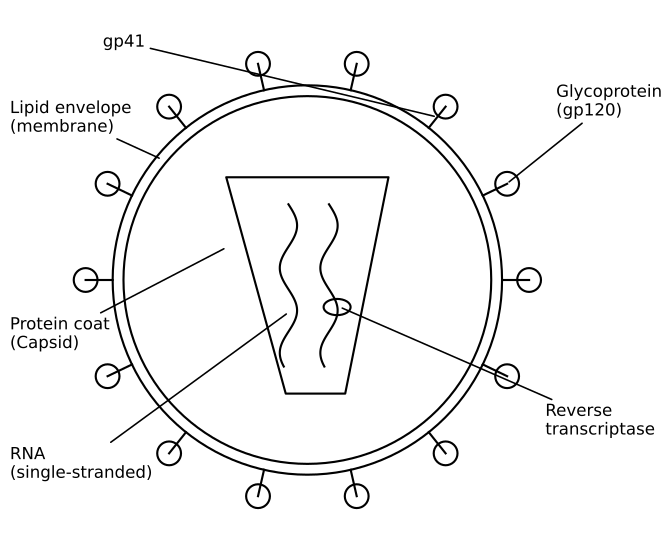
Describe the mechanism by which HIV causes AIDS in an infected individual. Why does the infected person suffer from repeated infections even by normally non-lethal pathogens? Draw a labelled diagram of the structure of HIV.

Diagram for question 22: Human Health and Disease
Show answer
MECHANISM BY WHICH HIV CAUSES AIDS AND STRUCTURE OF HIV

─────────────────────────────────────────────
STEP 1 — ENTRY OF HIV INTO THE BODY
─────────────────────────────────────────────
HIV (Human Immunodeficiency Virus) is a retrovirus whose genetic material is single-stranded RNA. It enters the human body through:
• Sexual contact with an infected person
• Transfusion of infected blood / blood products
• Sharing of contaminated needles/syringes (intravenous drug users)
• From infected mother to child — transplacentally, during childbirth, or through breast milk

─────────────────────────────────────────────────────────────────
STEP 2 — ATTACHMENT TO AND ENTRY INTO HELPER T-LYMPHOCYTES
─────────────────────────────────────────────────────────────────
• The glycoprotein spikes (gp120) on the HIV envelope recognise and bind to CD4 receptors present on the surface of Helper T-lymphocytes (TH cells / CD4⁺ T cells).
• HIV also infects macrophages and dendritic cells that carry CD4 receptors.
• After binding, the viral envelope fuses with the host cell membrane and the viral core (RNA + reverse transcriptase) enters the cytoplasm.

─────────────────────────────────────────────────────────────────
STEP 3 — REVERSE TRANSCRIPTION AND INTEGRATION
─────────────────────────────────────────────────────────────────
• Inside the host cell, the enzyme Reverse Transcriptase (carried by HIV) converts the single-stranded viral RNA genome into complementary DNA (cDNA).
• The cDNA is then converted into double-stranded DNA (dsDNA).
• This viral dsDNA is integrated into the host cell's chromosome by the enzyme Integrase, forming a PROVIRUS.
• The provirus may remain latent for several years (asymptomatic / window period — the infected person appears healthy but is infectious).

─────────────────────────────────────────────────────────────────
STEP 4 — ACTIVE REPLICATION AND DESTRUCTION OF CD4⁺ T-CELLS
─────────────────────────────────────────────────────────────────
• When the provirus is activated, it is transcribed by the host cell's machinery to produce new viral RNA (genome) and mRNA.
• mRNA is translated to produce viral proteins (envelope glycoproteins, capsid proteins, reverse transcriptase, integrase, etc.).
• New HIV particles are assembled and bud off from the host T-helper cell, destroying it in the process.
• These new virions infect more CD4⁺ T-helper cells, repeating the cycle.
• Over time (months to years), the count of helper T-lymphocytes (CD4⁺ T cells) in the blood progressively and drastically decreases.

─────────────────────────────────────────────────────────────────
STEP 5 — IMMUNODEFICIENCY AND OPPORTUNISTIC INFECTIONS (AIDS)
─────────────────────────────────────────────────────────────────
• As HIV progressively destroys CD4⁺ T-helper cells, the immune system becomes severely compromised (immunodeficiency / immunosuppression).
• Helper T-cells are central to both cell-mediated and humoral immunity — they activate cytotoxic T-cells, stimulate B-cells to produce antibodies, and coordinate the overall immune response.
• With a drastically reduced CD4⁺ T-cell count, the body can no longer mount effective immune responses against pathogens.
• The infected person therefore becomes highly susceptible to OPPORTUNISTIC INFECTIONS — infections caused by pathogens that are normally non-lethal (harmless to healthy individuals) but become life-threatening in an immunocompromised host.
• Examples of such opportunistic infections include: Mycobacterium tuberculosis (tuberculosis), Toxoplasma gondii (toxoplasmosis), Candida (fungal infections / thrush), Pneumocystis jirovecii (pneumonia), and certain cancers such as Kaposi's sarcoma.
• This stage of severe immunodeficiency with opportunistic infections is called AIDS (Acquired Immuno Deficiency Syndrome).

─────────────────────────────────────────────────────────────────
LABELLED DIAGRAM OF THE STRUCTURE OF HIV
─────────────────────────────────────────────────────────────────
[See diagram below]

Description of diagram (for visually impaired candidates):
HIV is a roughly spherical enveloped virus approximately 120 nm in diameter. Its structure from outside to inside is as follows:

1. ENVELOPE (Lipid Bilayer): The outermost layer is a phospholipid bilayer derived from the host cell membrane when the virus buds out.

2. GLYCOPROTEIN SPIKES — gp120 and gp41: Projecting outward from the envelope are glycoprotein spikes. Each spike consists of:
• gp120 (surface unit) — the outer knob that binds to CD4 receptors on host T-helper cells.
• gp41 (transmembrane unit) — anchors gp120 to the lipid envelope and mediates membrane fusion.

3. MATRIX PROTEIN (p17): Lies just beneath the lipid envelope, lining the inner surface.

4. CAPSID / CORE (p24): A cone-shaped or icosahedral protein shell (capsid) made of p24 protein that encloses the viral genome and enzymes.

5. GENOME — Two copies of single-stranded RNA: Inside the capsid are TWO identical copies of the single-stranded RNA genome (HIV is a diploid retrovirus).

6. REVERSE TRANSCRIPTASE: An enzyme enclosed within the capsid that converts viral RNA into DNA inside the host cell.

7. INTEGRASE: An enzyme enclosed within the capsid that integrates the viral DNA into the host chromosome.

8. PROTEASE: An enzyme that cleaves viral polyproteins into functional proteins during maturation.
Q23Long Answer5 marks

A 28-year-old man is diagnosed with AIDS after repeated infections by opportunistic pathogens. His physician explains that his CD4+ T-lymphocyte count has dropped to critically low levels.

(a) Describe, step by step, the mechanism by which HIV replicates inside a helper T-lymphocyte after entering the human body. Include the role of reverse transcriptase and the final outcome for the host cell. (3 marks)

(b) Distinguish between 'active immunity' and 'passive immunity' with one example of each. State which type is conferred by vaccination and why it is long-lasting. (2 marks)

Show answer
PART (a) — HIV Replication Mechanism inside Helper T-lymphocyte [3 marks]

Step 1 — Entry:
HIV (a retrovirus) enters the human body through infected blood, semen, or breast milk. The glycoprotein (gp120) on the HIV envelope binds to CD4 receptors on the surface of helper T-lymphocytes (CD4+ T-cells). The viral envelope fuses with the host cell membrane and the viral core — containing two copies of single-stranded RNA genome and the enzyme reverse transcriptase — is released into the cytoplasm.

Step 2 — Reverse Transcription:
The enzyme reverse transcriptase (an RNA-dependent DNA polymerase) uses the viral RNA as a template to synthesise a complementary DNA (cDNA) strand, forming an RNA–DNA hybrid. The RNA strand is then degraded and a second DNA strand is synthesised, producing double-stranded viral DNA (proviral DNA).
[Viral RNA → (Reverse transcriptase) → cDNA → dsDNA (Provirus)]

Step 3 — Integration:
The double-stranded proviral DNA enters the nucleus and is integrated into the host cell's chromosomal DNA by the viral enzyme integrase. The provirus may remain latent for months to years (accounting for the 'window period' of HIV infection).

Step 4 — Transcription and Translation:
When the host T-lymphocyte is activated, the host cell's own RNA polymerase transcribes the integrated proviral DNA to produce new viral RNA molecules. Host ribosomes translate these viral RNA transcripts to synthesise viral proteins (envelope glycoproteins, reverse transcriptase, integrase, protease, and structural proteins).

Step 5 — Assembly, Budding, and Release:
New viral RNA genomes and proteins assemble near the host cell membrane. Immature viral particles bud off from the host cell, acquiring a lipid envelope derived from the host cell membrane. The viral protease cleaves precursor proteins to produce mature, infectious HIV particles that go on to infect more CD4+ T-lymphocytes.

Final Outcome for the Host Cell:
As HIV replicates repeatedly, the number of helper T-lymphocytes (CD4+ T-cells) progressively declines. When the CD4+ count falls to critically low levels (below ~200 cells/µL), the patient's cell-mediated immunity is severely compromised. The patient becomes highly susceptible to opportunistic infections (e.g., Pneumocystis jirovecii pneumonia, Candida infections) and certain cancers — a condition diagnosed as AIDS (Acquired Immuno Deficiency Syndrome). The host helper T-cell is ultimately destroyed in the process.

---

PART (b) — Active Immunity vs. Passive Immunity [2 marks]

Active Immunity: Active immunity is the immunity in which the host's own immune system produces antibodies (and activates lymphocytes) in response to an antigen (pathogen or vaccine). It develops slowly but is long-lasting.
Example: Immunity developed after recovery from chickenpox, or after vaccination against polio (OPV/IPV).

Passive Immunity: Passive immunity is the immunity in which ready-made antibodies produced in another organism (or donor) are directly transferred into the body of the recipient. The recipient's immune system does not actively produce these antibodies. It provides immediate protection but is short-lived because no immunological memory is generated.
Example: Injection of preformed antibodies (antitoxin/antiserum) given to a person bitten by a snake (snake anti-venom), or transfer of maternal antibodies (IgG) to the foetus through the placenta.

Vaccination confers Active Immunity.
Reason: A vaccine introduces a weakened, killed, or antigenic form of the pathogen into the body. The immune system responds by producing specific antibodies and, importantly, generating memory B-cells and memory T-cells. Upon subsequent exposure to the same pathogen, these memory cells mount a rapid and stronger secondary immune response, neutralising the pathogen before disease develops. Because memory cells are long-lived, the protection conferred by vaccination is long-lasting.
Q24Long Answer5 marks

A 10-year-old boy was brought to a paediatrician with complaints of high fever with chills occurring in a regular cyclic pattern every 48 hours, severe headache, nausea, and anaemia. A blood smear examination revealed the presence of ring-stage parasites inside red blood cells (RBCs). The doctor confirmed a diagnosis of malaria.

(i) Name the causative organism and the specific species responsible for the most severe, life-threatening form of malaria. (1 mark)
(ii) Name the vector involved and state which sex of the vector is responsible for transmission. Explain why RBCs are destroyed in this disease. (2 marks)
(iii) With the help of a labelled flow diagram, describe the complete life cycle of the malarial parasite in the human host, clearly mentioning the stage that enters the human body and the stage responsible for the cyclic fever. (2 marks)

Show answer
MARKING SCHEME — Total: 5 marks

─────────────────────────────────────────
PART (i) — 1 mark
─────────────────────────────────────────
• Causative organism: Plasmodium (a protozoan parasite) [½ mark]
• Species responsible for most severe/life-threatening malaria: Plasmodium falciparum [½ mark]

(Note: Plasmodium vivax — benign tertian; P. malariae — quartan; P. ovale — mild tertian; P. falciparum — malignant/cerebral malaria — MOST DANGEROUS)

─────────────────────────────────────────
PART (ii) — 2 marks
─────────────────────────────────────────
• Vector: Female Anopheles mosquito [½ mark]
– Only the FEMALE Anopheles mosquito is responsible for transmission (requires blood meal for egg development). [½ mark]

• Reason for RBC destruction:
– When merozoites infect RBCs and multiply inside them, the RBCs burst (lyse) to release a new batch of merozoites. [½ mark]
– This rupture of large numbers of RBCs simultaneously releases toxic haemozoin (malarial pigment) into the blood, causing the characteristic cyclic fever and chills; repeated lysis leads to anaemia. [½ mark]

─────────────────────────────────────────
PART (iii) — 2 marks
─────────────────────────────────────────
LIFE CYCLE OF Plasmodium IN HUMAN HOST
(Draw flow diagram as below; labels in [ ] must be present)

Female Anopheles mosquito bites human


[SPOROZOITES] (n) enter human bloodstream
— infective stage entering human body —


Travel to LIVER CELLS (hepatocytes)
— Pre-erythrocytic / Exo-erythrocytic schizogony —
Sporozoites → multiply → [MEROZOITES] (n)


MEROZOITES released from liver → enter RBCs
— Erythrocytic schizogony —
Merozoites develop inside RBC:
Ring stage → Trophozoite → Schizont


RBC BURSTS → releases new batch of MEROZOITES
╔══════════════════════════════╗
║ Simultaneous RBC rupture ║
║ + release of HAEMOZOIN ║ ← CYCLIC FEVER & CHILLS
║ (malarial pigment/toxin) ║ (every 48 h for P. vivax
╚══════════════════════════════╝ & P. falciparum)


Some merozoites → differentiate into
[GAMETOCYTES] (sexual stage)
— taken up by female Anopheles in next blood meal —
(sexual cycle continues in mosquito gut)

Key value points for marks:
• Sporozoites named as the stage entering human body [½ mark]
• Liver stage (exo-erythrocytic multiplication to merozoites) correctly shown [½ mark]
• Erythrocytic schizogony — RBC rupture, merozoites released, haemozoin responsible for cyclic fever [½ mark]
• Gametocyte stage shown as the link back to mosquito vector [½ mark]

─────────────────────────────────────────
EXAMINER'S NOTE (value points summary)
─────────────────────────────────────────
(i) Plasmodium + P. falciparum — 1 mark
(ii) Female Anopheles + RBC lysis + haemozoin/anaemia — 2 marks
(iii) Sporozoites (entry stage) → liver → merozoites → RBC cycle → haemozoin = cyclic fever → gametocytes — 2 marks

Any biologically correct equivalent wording acceptable. Diagram MUST be drawn for full marks in part (iii); unlabelled diagram = 0 for label marks.

Want unlimited practice on Human Health and Disease?

The full ClearSteps bank has 24+ reviewed questions on this chapter alone — with step-wise solutions, difficulty levels, and progress tracking. Verify your WhatsApp number and your free trial starts right here.

CBSE · CLASS 12
🎟️14-day free trial · code PRAC auto-applied
Mobile Number
+91
OTP will be sent to your WhatsApp

⭐ Trusted by 12,000+ students across India

Human Health and Disease Class 12 Biology Questions