ClearStepsCLEARSTEPS AI
Teacher Login →Student Login →

Molecular Basis of Inheritance: Class 12 Biology Practice Questions

23 original exam-pattern questions with full answers, matched to the current CBSE Class 12 paper design, including case-based questions. Attempt each question before opening the answer — or start a free 14-day trial ↓ for the full bank.

Q1Case-based4 marks

A research team studying gene expression in bacteria observed that when they grew Escherichia coli in a medium containing ONLY lactose as the carbon source, the bacteria began producing β-galactosidase enzyme within minutes. When they switched the bacteria to a glucose-rich medium (removing lactose), β-galactosidase production stopped almost immediately. The team also noted that a mutant strain of E. coli, in which the operator region had a structural alteration, produced β-galactosidase continuously — even in the complete absence of lactose.

Read the following passage and answer the questions that follow:

A research team studying gene expression in bacteria observed that when they grew Escherichia coli in a medium containing ONLY lactose as the carbon source, the bacteria began producing β-galactosidase enzyme within minutes. When they switched the bacteria to a glucose-rich medium (removing lactose), β-galactosidase production stopped almost immediately. The team also noted that a mutant strain of E. coli, in which the operator region had a structural alteration, produced β-galactosidase continuously — even in the complete absence of lactose.

(a) Name the regulatory model that explains the above observation in wild-type E. coli. Who proposed this model? (1 mark)

(b) Explain, with reference to the structural components of this system, why β-galactosidase is produced when lactose is the ONLY carbon source but NOT when glucose is present. (2 marks)

(c) Account for the continuous production of β-galactosidase in the mutant strain even in the absence of lactose. (1 mark)

Show answer
MARKING SCHEME — CASE STUDY (4 marks)

─────────────────────────────────────────
(a) Name the regulatory model and its proposer: (1 mark)
─────────────────────────────────────────
• The regulatory model is the lac operon (lactose operon). (½)
• It was proposed by François Jacob and Jacques Monod (1961). (½)
[1 × 1 = 1 mark]

─────────────────────────────────────────
(b) Mechanism of β-galactosidase production in presence of lactose vs. absence (glucose present): (2 marks)
─────────────────────────────────────────

STATE A — Lactose present as ONLY carbon source (β-galactosidase IS produced):

• The lac operon consists of: regulator gene (i) → promoter (p) → operator (o) → structural genes z (β-galactosidase), y (permease), a (transacetylase).
• In the ABSENCE of lactose: the regulator gene (i) produces an ACTIVE repressor protein that binds to the operator → blocks RNA polymerase from transcribing structural genes → NO β-galactosidase produced.
• When lactose is the ONLY carbon source: lactose is converted to ALLOLACTOSE (the inducer) by a small amount of pre-existing β-galactosidase. (1)
• Allolactose binds to the active repressor → repressor changes shape (allosteric change) → repressor can NO LONGER bind the operator → operator is free → RNA polymerase transcribes z, y, a genes → β-galactosidase (and permease, transacetylase) are synthesised. (1)

STATE B — Glucose present (β-galactosidase production STOPS):
• When glucose is available, E. coli preferentially uses glucose (catabolite repression).
• Glucose lowers cAMP levels → CAP (catabolite activator protein) cannot bind the promoter → even if operator is free, transcription efficiency is very low → β-galactosidase production effectively stops.

[Award 1 mark for correct explanation of allolactose as inducer releasing repressor from operator; 1 mark for stating glucose/catabolite repression stops transcription. Accept explanation of either mechanism for 1 mark each.]
[1 + 1 = 2 marks]

DIAGRAM (embedded, labelled — for full credit):

STATE A: lac operon WITH lactose (INDUCED — ON state)

Regulator Promoter Operator z y a
gene (i) (p) (o) (β-gal) (permease) (transacetylase)
───────────────────────────────────────────────────────────

Repressor
protein
(inactive —
bound to
allolactose)
[Operator FREE]

RNA polymerase → transcribes z, y, a

mRNA → β-galactosidase + permease + transacetylase

Allolactose ──binds──→ Repressor (inactive form — cannot bind operator)

STATE B: lac operon WITHOUT lactose (REPRESSED — OFF state)

Regulator Promoter Operator z y a
gene (i) (p) (o) (β-gal) (permease) (transacetylase)
───────────────────────────────────────────────────────────

Active
Repressor ──────────────→ BINDS OPERATOR

RNA polymerase BLOCKED

NO transcription → NO β-galactosidase

─────────────────────────────────────────
(c) Continuous β-galactosidase production in the operator-mutant strain: (1 mark)
─────────────────────────────────────────
• In the mutant strain, the operator region has a structural alteration (mutation) → the active repressor protein CANNOT recognise or bind to the mutated operator. (½)
• Since the repressor can never block the operator, RNA polymerase transcribes the structural genes (z, y, a) CONSTITUTIVELY — continuously and regardless of whether lactose is present or absent. (½)
• This is called a constitutive mutant (operator-constitutive mutation).
[1 × 1 = 1 mark]

─────────────────────────────────────────
TOTAL: 4 marks
─────────────────────────────────────────
NOTE TO EXAMINER:
• Award full marks for any biologically equivalent correct explanation.
• For part (b): if student explains only one state (lactose present OR glucose present) correctly, award 1 out of 2.
• For part (c): accept 'repressor cannot bind mutated operator' as the complete answer for 1 mark.
Q2Case-based4 marks

A group of students was studying gene expression in a bacterium. They isolated mRNA from the bacterium and noticed that the mRNA had the following sequence (partial, 5'→3'):

5' – AUG – CGA – UUU – UAA – GCU – AGC – UGA – 3'

The students also noted that:
• The bacterium has a mutation in its tRNA synthetase gene, causing the tRNA that normally recognises the codon CGA to now carry alanine (Ala) instead of arginine (Arg).
• A second strain of the same bacterium was treated with a drug that causes the ribosome to misread UAA as a sense codon (coding for glutamine, Gln).

Read the following passage and answer the sub-questions that follow:

A group of students was studying gene expression in a bacterium. They isolated mRNA from the bacterium and noticed that the mRNA had the following sequence (partial, 5'→3'):

5' – AUG – CGA – UUU – UAA – GCU – AGC – UGA – 3'

The students also noted that:
• The bacterium has a mutation in its tRNA synthetase gene, causing the tRNA that normally recognises the codon CGA to now carry alanine (Ala) instead of arginine (Arg).
• A second strain of the same bacterium was treated with a drug that causes the ribosome to misread UAA as a sense codon (coding for glutamine, Gln).

(a) How many amino acids will be incorporated into the polypeptide in the NORMAL (unmutated, untreated) bacterium when the above mRNA is translated? Name the amino acids in order. Justify your answer using the concepts of start codon and stop codon. (2 marks)

(b) In the tRNA synthetase mutant strain, what will be the sequence of amino acids in the polypeptide? Compare it with the normal polypeptide and state the type of molecular change this represents. (1 mark)

(c) In the drug-treated second strain (where UAA is misread as Gln), how many amino acids will be incorporated and what will be the last amino acid added? Justify your answer by identifying which stop codon finally terminates translation. (1 mark)

Show answer
MARKING SCHEME — CASE STUDY (4 marks)

Codon reference (CBSE genetic code):
• AUG = Methionine (Met) — START codon
• CGA = Arginine (Arg)
• UUU = Phenylalanine (Phe)
• UAA = STOP codon (ochre) — terminates translation
• GCU = Alanine (Ala)
• AGC = Serine (Ser)
• UGA = STOP codon (opal) — terminates translation

─────────────────────────────────────────────
Part (a) — 2 marks
─────────────────────────────────────────────

mRNA (read 5'→3' in triplets):
5'–[AUG]–[CGA]–[UUU]–[UAA]–[GCU]–[AGC]–[UGA]–3'
Codon 1 Codon 2 Codon 3 STOP

Step-wise:
1. AUG = START codon → ribosome assembles; Met incorporated. (½ mark)
2. CGA → Arg incorporated. (½ mark)
3. UUU → Phe incorporated. (½ mark)
4. UAA = STOP codon (ochre) → no tRNA recognises stop codon; release factor binds; translation TERMINATES. Codons GCU, AGC, UGA downstream are NOT translated. (½ mark)

∴ Number of amino acids incorporated = 3
Order: Met – Arg – Phe

Justification:
• Genetic code is non-overlapping and read as continuous triplets from AUG.
• UAA is one of three stop codons (UAA, UAG, UGA); no aminoacyl-tRNA carries an anticodon for stop codons — they are recognised by protein release factors, causing polypeptide chain release.

─────────────────────────────────────────────
Part (b) — 1 mark
─────────────────────────────────────────────

In the tRNA synthetase mutant:
• The tRNA with anticodon for CGA is now charged with Alanine (Ala) instead of Arginine (Arg).
• All other codons translate normally; stop codon UAA still terminates translation.

Polypeptide sequence in mutant:
Met – Ala – Phe (instead of Met – Arg – Phe)

Comparison:
• Position 2 changes from Arg → Ala; positions 1 and 3 are unchanged.

Type of molecular change:
This is a missense/mischarging mutation (suppressor tRNA effect) — the codon sequence in mRNA is UNCHANGED, but the wrong amino acid is delivered by the mutant aminoacyl-tRNA synthetase. This is an example of translational-level error / tRNA mischarging. (Not a point mutation in DNA; the change occurs at the level of aminoacylation.)

[Award 1 mark for: correct mutant sequence Met–Ala–Phe AND identifying it as a mischarging / translational-level / suppressor-tRNA type change]

─────────────────────────────────────────────
Part (c) — 1 mark
─────────────────────────────────────────────

In the drug-treated strain, UAA is read as Gln (not a stop codon):

mRNA codons:
5'–[AUG]–[CGA]–[UUU]–[UAA]–[GCU]–[AGC]–[UGA]–3'
Met Arg Phe Gln Ala Ser STOP

• AUG → Met
• CGA → Arg
• UUU → Phe
• UAA → Gln (misread as sense codon due to drug; read-through occurs)
• GCU → Ala
• AGC → Ser
• UGA = STOP codon (opal) — this stop codon is NOT affected by the drug (drug only suppresses UAA); translation TERMINATES here.

∴ Number of amino acids incorporated = 6
Last amino acid added = Serine (Ser) [added at AGC, just before UGA stop]
Translation is finally terminated by UGA (opal stop codon).

[Award 1 mark for: 6 amino acids AND UGA as the terminating stop codon, OR correct last amino acid Ser with correct justification]

─────────────────────────────────────────────
KEY CONCEPTS TESTED:
• Genetic code — triplet, non-overlapping, degenerate, non-ambiguous (Universal)
• Start codon (AUG) and three stop codons (UAA/ochre, UAG/amber, UGA/opal)
• Translation: initiation at AUG, elongation, termination at stop codon
• Role of aminoacyl-tRNA synthetase in translation fidelity
• Read-through suppression of stop codons
• Central dogma: DNA → mRNA → Protein
Q3Case-based4 marks

A molecular biology student was studying gene expression in E. coli. She observed that when E. coli is grown in a medium containing only glucose, a particular set of three structural genes (lacZ, lacY, lacA) remains switched OFF. However, when glucose is removed and lactose is provided as the sole carbon source, these genes are rapidly switched ON, and the bacteria begin producing enzymes to metabolise lactose. She also noted that even in the presence of lactose, if glucose is simultaneously added back to the medium, transcription of these genes is significantly reduced.

Read the following passage and answer the questions that follow:

A molecular biology student was studying gene expression in E. coli. She observed that when E. coli is grown in a medium containing only glucose, a particular set of three structural genes (lacZ, lacY, lacA) remains switched OFF. However, when glucose is removed and lactose is provided as the sole carbon source, these genes are rapidly switched ON, and the bacteria begin producing enzymes to metabolise lactose. She also noted that even in the presence of lactose, if glucose is simultaneously added back to the medium, transcription of these genes is significantly reduced.

(a) Name the regulatory system described in the passage. Who proposed this model? [1 mark]
(b) Explain the molecular mechanism by which the presence of lactose switches ON the transcription of the structural genes. [2 marks]
(c) The student noticed that lacZ, lacY, and lacA are always transcribed together as a single mRNA molecule. State ONE advantage of this arrangement for the bacterial cell. [1 mark]

Show answer
MARKING SCHEME — Case Study (4 marks)

──────────────────────────────────────
(a) Name the regulatory system and its proposer: [1 mark]
──────────────────────────────────────
• The regulatory system is the lac operon (lactose operon). [½ mark]
• It was proposed by François Jacob and Jacques Monod (1961). [½ mark]

(Award 1 mark for both parts correct; accept 'Jacob and Monod' without first names)

──────────────────────────────────────
(b) Molecular mechanism by which lactose switches ON transcription: [2 marks]
──────────────────────────────────────
State of lac operon WITHOUT lactose (repressed state):
• The regulator gene (i) is continuously expressed and produces an active repressor protein. [1 mark]
• The active repressor binds to the operator sequence → blocks RNA polymerase from moving along the structural genes → NO transcription of lacZ, lacY, lacA.

State of lac operon WITH lactose (induced state):
• Lactose (the inducer) enters the cell and is converted to allolactose. [1 mark]
• Allolactose binds to the repressor protein → repressor changes shape (becomes inactive) → repressor CANNOT bind to the operator → RNA polymerase moves freely → transcription of lacZ, lacY, lacA occurs → enzymes (β-galactosidase, permease, transacetylase) are produced to metabolise lactose.

Diagram (embedded — award marks for labelled diagram if drawn):

WITHOUT LACTOSE (repressed):
┌──────────┐ ┌────────────┐ ┌──────────┐ ┌─────────────────────────┐
│Regulator │ │ Promoter │ │ Operator │ │ lacZ │ lacY │ lacA │
│ gene(i) │ │ (p) │ │ (o) │ │ │ │ │
└──────────┘ └────────────┘ └──────────┘ └─────────────────────────┘
│ ↑
↓ │
Active repressor ──────────── binds operator → TRANSCRIPTION BLOCKED

WITH LACTOSE (induced):
┌──────────┐ ┌────────────┐ ┌──────────┐ ┌─────────────────────────┐
│Regulator │ │ Promoter │ │ Operator │ │ lacZ │ lacY │ lacA │
│ gene(i) │ │ (p) │ │ (o) │ │ │ │ │
└──────────┘ └────────────┘ └──────────┘ └─────────────────────────┘
│ (FREE) ↑
↓ │
Repressor + Allolactose → Inactive repressor RNA polymerase
(cannot bind operator) TRANSCRIBES lacZ, lacY, lacA
→ mRNA → Enzymes produced

(Value points: 1 mark for repressor–operator mechanism in absence of lactose; 1 mark for allolactose inactivating repressor allowing transcription)

──────────────────────────────────────
(c) Advantage of lacZ, lacY, lacA being transcribed as a single mRNA: [1 mark]
──────────────────────────────────────
• All three structural genes are under the control of a single promoter and operator, so they are co-ordinately regulated — all three enzymes needed for lactose metabolism are produced simultaneously in a single response. [1 mark]
(Accept: 'Polycistronic mRNA allows co-ordinate expression of all enzymes needed for one metabolic pathway in a single regulatory event' / 'Economical regulation — one control switch controls all three genes together')

──────────────────────────────────────
SUMMARY OF MARKS:
(a) lac operon + Jacob and Monod = 1 mark
(b) Mechanism (repressor blocks in absence + allolactose inactivates repressor in presence) = 2 marks (1+1)
(c) Co-ordinate/simultaneous expression of all enzymes in one regulatory event = 1 mark
TOTAL = 4 marks
──────────────────────────────────────
Q4MCQ1 mark

Which of the following correctly matches the enzyme with its function during DNA replication in prokaryotes?

(a) Helicase — (i) Synthesises new DNA strand in 5'→3' direction
(b) Primase — (ii) Unwinds the double helix by breaking hydrogen bonds
(c) DNA Polymerase III — (iii) Synthesises a short RNA primer
(d) DNA Ligase — (iv) Joins Okazaki fragments on the lagging strand

Show answer
Correct answer: (A) — (a)–(ii), (b)–(iii), (c)–(i), (d)–(iv)

Correct matching:
• Helicase → (ii) Unwinds the double helix by breaking hydrogen bonds between the two strands at the replication fork.
• Primase → (iii) Synthesises a short RNA primer (complementary to the template strand) required because DNA polymerase cannot initiate a new strand de novo.
• DNA Polymerase III → (i) Synthesises the new DNA strand in the 5'→3' direction only; this directionality explains why the lagging strand is synthesised discontinuously as Okazaki fragments.
• DNA Ligase → (iv) Joins (seals) the Okazaki fragments on the lagging strand by forming phosphodiester bonds, producing a continuous strand.
Q5Short Answer1 mark

Assertion (A): In a prokaryotic cell, when lactose is absent in the medium, the structural genes z, y, and a of the lac operon are not transcribed.
Reason (R): In the absence of lactose, the active repressor protein binds to the operator region, thereby preventing RNA polymerase from transcribing the structural genes.

Show answer
Correct option: (A) — Both Assertion (A) and Reason (R) are true, and Reason (R) is the correct explanation of Assertion (A).

Explanation (for examiner reference):
• The lac operon is an INDUCIBLE operon — structural genes are normally switched OFF.
• The regulator gene (i) continuously produces the repressor protein.
• When lactose is ABSENT: the repressor remains active (no inducer present) → binds to the operator → blocks RNA polymerase from moving to structural genes z (β-galactosidase), y (permease), a (transacetylase) → NO transcription.
• When lactose IS present: allolactose (inducer, a metabolite of lactose) binds to the repressor → repressor becomes inactive (changes shape) → repressor cannot bind operator → RNA polymerase transcribes z, y, a → enzymes produced to metabolise lactose.
• Therefore, Assertion (A) correctly states the observed phenomenon (no transcription without lactose), and Reason (R) correctly and completely explains the molecular mechanism (active repressor + operator binding). Option (A) is correct.
Q6Short Answer1 mark

Assertion (A): In eukaryotes, the mRNA produced immediately after transcription cannot be directly used for translation.
Reason (R): The primary transcript (hnRNA) undergoes processing that includes capping at the 5' end, polyadenylation at the 3' end, and splicing out of introns before it is exported from the nucleus.

Show answer
Correct option: (A) Both A and R are true and R is the correct explanation of A.

Explanation:
• Assertion is TRUE: In eukaryotes, the gene contains non-coding sequences called introns interspersed with coding sequences called exons. The initial transcript is called heterogeneous nuclear RNA (hnRNA) — it is not directly translatable.
• Reason is TRUE and CORRECTLY EXPLAINS the assertion:
– 5' Capping: 7-methyl guanosine cap added to the 5' end → protects mRNA from degradation and assists ribosome recognition.
– 3' Polyadenylation (Poly-A tail): 200–300 adenine nucleotides added to 3' end → stability and export.
– Splicing: introns removed; exons joined by spliceosomes → continuous coding sequence (mature mRNA).
• Only after all three post-transcriptional modifications does the mature mRNA leave the nucleus via nuclear pores to be translated on ribosomes.
• In prokaryotes, transcription and translation are coupled (no nuclear envelope, no introns), so this processing step is absent — reinforcing why the assertion applies specifically to eukaryotes.

[1 mark for choosing option A]
Q7MCQ1 mark

A molecular biologist is studying gene expression in E. coli. She isolates a strand of mRNA with the sequence: 5'-AUGCCAUGCUAA-3'. She then treats the bacterial cells with a drug that causes the ribosome to misread the stop codon (UAA) as a sense codon for an amino acid. Which of the following outcomes is MOST likely to occur in these treated cells?

Show answer
Correct Answer: (B) A longer polypeptide than normal will be produced as translation continues past the usual termination point.

Reasoning (for examiner reference):
• UAA is one of the three STOP codons (UAA, UAG, UGA) — they do NOT code for any amino acid under normal conditions; no aminoacyl-tRNA recognises them; instead, release factors (RF1/RF2 in prokaryotes) bind and terminate translation.
• The mRNA sequence 5'-AUGCCAUGCUAA-3' is read as: AUG (Met/Start) – CCA (Pro) – UGC (Cys) – UAA (Stop). Normally, translation terminates at UAA, releasing a tripeptide (Met-Pro-Cys).
• When the drug causes the ribosome to misread UAA as a sense codon, the release factor can no longer terminate translation at that position. Instead, an aminoacyl-tRNA is recruited at UAA, adding an extra amino acid, and the ribosome continues translating downstream sequences until it encounters another stop codon (or runs off the mRNA).
• This phenomenon is called READTHROUGH (suppression of stop codon), producing a LONGER (extended) polypeptide.

Why other options are wrong:
• (A) is incorrect — AUG is present at the 5' end; initiation proceeds normally.
• (C) is incorrect — the ribosome does not stall; it reads through, producing a longer product.
• (D) is incorrect — translation and transcription are not directly coupled in this way; the drug acts on the ribosome during translation, not on RNA polymerase during transcription.
Q8MCQ1 mark

A molecular biologist is studying protein synthesis in a bacterial cell. She observes that the mRNA sequence 5'-AUG-UUU-CCG-UAA-3' is being translated. She notes that the ribosome stops adding amino acids after reading the third codon.

Which of the following best explains why translation stops after the third codon?

Show answer
Correct Answer: (B)

UAA is a stop codon (termination codon) that does not code for any amino acid and signals release of the polypeptide.

Explanation (for examiner reference):
• The mRNA sequence is: 5'-AUG-UUU-CCG-UAA-3'
— AUG = start codon → Methionine (Met)
— UUU = codes for Phenylalanine (Phe)
— CCG = codes for Proline (Pro)
— UAA = STOP codon (termination codon) → NO amino acid added
• UAA is one of the three stop/nonsense codons: UAA, UAG, UGA.
• When the ribosome encounters UAA at the A-site, no aminoacyl-tRNA recognises it; instead, a release factor binds → polypeptide chain is released → ribosome dissociates.
• This is a property of the genetic code: non-ambiguous and includes 3 termination codons out of 64 total codons.

Why other options are wrong:
(A) Incorrect — UUU codes for Phenylalanine; it is NOT a stop codon.
(C) Incorrect — ribosomes do not fall off simply by reaching the 3' end; termination requires a specific stop codon.
(D) Incorrect — no amino acid terminates translation by bonding with the ribosome; this is biologically inaccurate.
Q9MCQ1 mark

A researcher is studying transcription in a eukaryotic cell. She observes that the template strand of a gene reads 3′-TACGGATCC-5′. She then treats the cell with a drug that specifically blocks the addition of the 5′ methyl-guanosine (7-methyl guanosine) cap to the nascent mRNA. Which of the following consequences is MOST likely to occur?

Show answer
Correct Answer: (B)

The mRNA will be rapidly degraded and will not be efficiently translated by ribosomes.

Reasoning (value points):
• In eukaryotes, the primary transcript (hnRNA) undergoes post-transcriptional processing — one key modification is the addition of a 5′ methyl-guanosine (m7G) cap (capping).
• The 5′ cap serves TWO critical functions:
(1) Protects the mRNA from degradation by 5′→3′ exonucleases in the cytoplasm.
(2) Is recognised by ribosomes to initiate translation (cap-dependent translation initiation).
• If capping is blocked, the mRNA lacks protection at its 5′ end → it is rapidly degraded by exonucleases → even if some mRNA survives, ribosomes cannot recognise it efficiently → translation is severely reduced.

Why the other options are WRONG:
• (A) Incorrect — capping occurs AFTER transcription; it does not affect the template strand or the codon sequence of the mRNA.
• (C) Incorrect — capping is a post-transcriptional event in the nucleus; blocking the cap does not interfere with RNA polymerase binding to the promoter or with transcription itself.
• (D) Incorrect — poly-A tail addition is a separate, independent processing event at the 3′ end; it does not shift position in response to loss of the 5′ cap.
Q10Short Answer2 marks

A molecular biology student observes that during DNA replication in E. coli, one newly synthesised strand is continuous while the other is made as short fragments that are later joined together.
(i) Name the enzyme responsible for joining these fragments.
(ii) Why can the second strand NOT be synthesised continuously?

Show answer
(i) The enzyme that joins the short fragments (Okazaki fragments) is DNA Ligase. (1 mark)

(ii) DNA polymerase III can synthesise a new DNA strand only in the 5'→3' direction. Since the two strands of the parental DNA are antiparallel, one template strand runs 3'→5' (allowing continuous synthesis of the leading strand in 5'→3' direction), while the other template strand runs 5'→3'. On this second template, synthesis must proceed away from the replication fork in short discontinuous fragments (Okazaki fragments), each initiated by a new RNA primer, because the polymerase cannot work in the 3'→5' direction. (1 mark)
Q11Short Answer2 marks

A molecular biologist isolates a double-stranded DNA molecule and subjects it to complete denaturation followed by analysis. She finds that the denatured sample contains 22% thymine. She then uses one of the separated strands as a template to synthesise a complementary RNA strand using RNA polymerase.

(i) What percentage of uracil will be present in the newly synthesised RNA strand?
(ii) If the total number of nucleotides in the RNA strand is 500, how many of them will be purine ribonucleotides? Show your reasoning.

Show answer
Part (i): Percentage of Uracil in the RNA strand

• In the original double-stranded DNA, by Chargaff's rule: %T (one strand) + %T (other strand) together average to the overall %T of dsDNA.
• Since the denatured sample shows 22% Thymine — this represents the thymine content of the TEMPLATE strand (the strand used for RNA synthesis).
• RNA polymerase reads the template strand 3'→5' and synthesises RNA 5'→3', incorporating A opposite T (template).
• Therefore, wherever T exists on the template strand, A is incorporated into RNA.
• The newly synthesised RNA strand is complementary to the template strand.
• % Uracil in RNA = % Adenine in template strand.
• By Chargaff's rule applied to the template (single) strand: %A (template) = %T (coding/non-template strand) = %T of the overall dsDNA.

Key reasoning:
• In dsDNA: overall %T = 22% ∴ overall %A = 22% (A=T across both strands).
• The template strand has %A = 22% (since A pairs with T in dsDNA; complementary strand of T-rich template is A-rich, but the template itself: its T = 22% means the mRNA will have A = 22%, and its A = 22% means mRNA will have U = 22%).
• ∴ % Uracil in RNA = 22%

*(½ mark for applying Chargaff's rule; ½ mark for correct answer = 22%)*

---

Part (ii): Number of purine ribonucleotides in the RNA strand

• Purine ribonucleotides in RNA = Adenine (A) + Guanine (G) ribonucleotides.
• From dsDNA: %A = %T = 22%, so %G = %C = (100 − 22 − 22)/2 = 28% each.
• The RNA strand is complementary to the template DNA strand:
— %U in RNA = %A (template) = 22%
— %A in RNA = %T (template) = 22%
— %G in RNA = %C (template) = 28%
— %C in RNA = %G (template) = 28%
• % Purine ribonucleotides = %A + %G = 22% + 28% = 50%
• Total nucleotides in RNA = 500
• Number of purine ribonucleotides = 50% × 500 = 250

*(½ mark for correct %G derivation; ½ mark for final answer = 250)*

Answer summary:
(i) Uracil = 22%
(ii) Purine ribonucleotides = 250 (= 22% A + 28% G = 50% of 500)
Q12Short Answer2 marks

A researcher isolates a double-stranded DNA fragment and finds that guanine constitutes 22% of the total nucleotide bases. (i) What percentage of the total bases is adenine in this fragment? (ii) Name the rule/principle you used to arrive at this answer.

Show answer
According to Chargaff's Rule: in a double-stranded DNA molecule, the amount of purine = amount of pyrimidine, i.e., A = T and G = C.

(i) Calculation:
• G = 22% ∴ C = 22% (since G = C)
• G + C = 22 + 22 = 44%
• Therefore, A + T = 100 − 44 = 56%
• Since A = T, adenine = 56 ÷ 2 = 28%

∴ Adenine = 28% [1 mark]

(ii) The principle used is Chargaff's Rule (Base Complementarity Rule / Base Pairing Rule). [1 mark]
Q13Short Answer2 marks

Name the two strands of a DNA double helix on the basis of their role in transcription. State the direction in which each strand is read/synthesised during this process.

Show answer
The two strands of DNA are:

(i) Template strand (antisense strand): read by RNA polymerase in the 3′ → 5′ direction. [1 mark]

(ii) Coding strand (sense strand): has the same sequence as the mRNA (with T replaced by U); it runs 5′ → 3′ and is NOT directly read during transcription. The mRNA is synthesised in the 5′ → 3′ direction, complementary to the template strand. [1 mark]
Q14Short Answer3 marks

A molecular biology student is analysing two DNA strands from a human gene. She labels one strand as the 'template strand' (3′→5′) and the other as the 'coding strand' (5′→3′). A short segment of the template strand reads: 3′-TACGAACTT-5′.

(i) Write the sequence of the mRNA synthesised from this template strand, indicating the 5′→3′ direction. (1 mark)
(ii) The student notices that one of the codons in the mRNA above corresponds to a start codon. Identify it and state the amino acid it codes for. (1 mark)
(iii) During mRNA processing in eukaryotes, the student finds that the primary transcript (hnRNA) is longer than the final mRNA. Explain the TWO modifications that account for this difference. (1 mark)

Show answer
Answer:

(i) mRNA sequence synthesised from the template strand: (1 mark)

Template strand (read 3′→5′): 3′ – T A C G A A C T T – 5′

RNA polymerase reads the template strand in the 3′→5′ direction and synthesises mRNA in the 5′→3′ direction, replacing T with U:

mRNA (5′→3′): 5′ – A U G C U U G A A – 3′

*(Note: The coding/sense strand has the same sequence as mRNA, with T replaced by U.)*

---

(ii) Identification of start codon and amino acid: (1 mark)

- The mRNA sequence 5′–AUG–CUU–GAA–3′ contains AUG as the first codon.
- AUG is the start codon (initiation codon).
- It codes for the amino acid Methionine (Met).

*(AUG also signals the start of translation on the ribosome.)*

---

(iii) TWO modifications during hnRNA → mRNA processing in eukaryotes: (1 mark)

The hnRNA (primary transcript) undergoes the following two modifications before becoming functional mRNA:

1. Splicing — Non-coding intervening sequences called introns are removed; the coding sequences called exons are joined together. This removes large stretches of sequence, making the mature mRNA shorter than the hnRNA.

2. Capping and Tailing — A 7-methyl guanosine cap is added at the 5′ end (for ribosome recognition and mRNA stability), and a poly-A tail (~200 adenine nucleotides) is added at the 3′ end (for nuclear export and protection from degradation). *(These additions are counted as processing but do not increase coding length.)*

> [Award ½ mark each for any TWO correctly named and briefly explained modifications; splicing + removal of introns is the primary reason for size reduction.]

---

Marking Scheme Summary:

| Part | Value Point | Mark |
|------|------------|------|
| (i) | Correct mRNA: 5′-AUGCUUGAA-3′ (must show 5′→3′) | 1 |
| (ii) | AUG identified as start codon + Methionine named | 1 |
| (iii) | Any two of: splicing/intron removal (½) + capping or poly-A tailing (½) | 1 |
| Total | | 3 |
Q15Short Answer3 marks

A student is studying the lac operon in E. coli. She observes two different conditions in two separate culture flasks:

• Flask A: E. coli grown in a medium containing ONLY glucose (no lactose present)
• Flask B: E. coli grown in a medium containing ONLY lactose (no glucose present)

(i) In which flask (A or B) will the structural genes z, y, and a of the lac operon be actively transcribed? Give one reason. (1 mark)
(ii) Draw a labelled diagram of the lac operon showing the condition in Flask B (with lactose, genes active). Label the following parts: Regulator gene (i), Promoter (P), Operator (O), and Structural genes (z, y, a). (2 marks)

Show answer
Answer:

(i) Flask B (with lactose) — structural genes z, y, and a will be actively transcribed. (1 mark)
Reason: Lactose acts as an inducer; it binds to the repressor protein, inactivating it. The inactivated repressor cannot bind to the operator, so RNA polymerase can move along the structural genes and transcription occurs.

(ii) Labelled diagram of lac operon in the INDUCED state (Flask B — lactose present): (2 marks)

[Diagram — draw and label the following in sequence along the DNA]

Regulatory Promoter Operator Structural genes
region (P) (O) z y a
┌──────────┐ ┌───┐ ┌───┐ ┌───┐ ┌───┐ ┌───┐
│ i gene │ │ P │ │ O │ │ z │ │ y │ │ a │
└──────────┘ └───┘ └───┘ └───┘ └───┘ └───┘
│ ↑
↓ (Operator is FREE —
Repressor protein repressor NOT bound)
(inactive — bound
to allolactose/inducer)
══════════════════════════════►
RNA polymerase moves freely →
mRNA transcribed (z, y, a expressed)

Key labels required on diagram:
• Regulator gene (i) — produces repressor
• Promoter (P) — RNA polymerase binding site
• Operator (O) — control switch; repressor binding site
• Structural genes — z (β-galactosidase), y (permease), a (transacetylase)
• Inactive repressor (bound to allolactose/inducer)
• Arrow showing RNA polymerase transcribing z, y, a

Note: In Flask A (glucose only, no lactose) — the repressor is ACTIVE, binds the operator, and blocks RNA polymerase → NO transcription of z, y, a.

(Marking: 1 mark for correct identification of Flask B with valid reason; 1 mark for correct diagram with DNA regions shown in sequence; 1 mark for correct labelling of all four required parts and showing repressor as inactive/not bound to operator)
Q16Short Answer3 marks

A researcher is studying a newly discovered bacterium. During molecular analysis, she finds that when she adds a radioactively labelled uracil nucleotide to the culture medium, it gets incorporated into the bacterial genetic material. However, when she treats the extracted genetic material with RNase (an enzyme that degrades RNA), the radioactive label is still retained. She also observes that the genetic material shows base pairing between complementary strands.

(i) Identify the type of genetic material present in this bacterium. (1 mark)
(ii) The coding strand of one gene in this organism reads 5'–ATGCCATAG–3'. Write the sequence of the mRNA transcript produced from this gene, clearly marking the 5' and 3' ends. (1 mark)
(iii) Identify the start codon and stop codon present in the mRNA sequence you wrote in part (ii). State what each signals during translation. (1 mark)

Show answer
MODEL ANSWER

(i) Identification of genetic material: (1 mark)

The genetic material is double-stranded RNA (dsRNA).

Reasoning from the three clues given:
• Uracil is incorporated into the genetic material → the genetic material contains uracil, which is a defining feature of RNA (RNA uses uracil in place of thymine).
• Treatment with RNase does NOT degrade the genetic material (radioactive label is retained) → the material is resistant to RNase. RNase A (the standard RNase used) specifically degrades single-stranded RNA; double-stranded RNA (dsRNA) is resistant to RNase A under standard conditions, so the label is retained.
• Shows complementary base pairing between two strands → the genetic material is double-stranded.

All three clues together — uracil incorporation + RNase resistance + double-stranded complementary base pairing — are consistent with double-stranded RNA (dsRNA).

∴ The genetic material is double-stranded RNA (dsRNA).

[Award 1 mark for 'double-stranded RNA' or 'dsRNA'.]

---

(ii) mRNA transcript sequence: (1 mark)

Given coding strand: 5'–ATGCCATAG–3'

The template strand is antiparallel and complementary to the coding strand:
Coding strand: 5'–A T G C C A T A G–3'
Template strand: 3'–T A C G G T A T C–5'

RNA polymerase reads the template strand in the 3'→5' direction and synthesises mRNA in the 5'→3' direction. The mRNA sequence is identical to the coding strand but with Uracil (U) replacing Thymine (T):

mRNA: 5'–AUG CCA UAG–3'

[Award 1 mark for the correct sequence 5'–AUGCCAUAG–3' with 5' and 3' ends clearly marked. Do not award mark if T is written instead of U, or if polarity is missing or reversed.]

---

(iii) Start codon and stop codon: (1 mark)

mRNA: 5'–AUG | CCA | UAG–3'

• Start codon: AUG
→ Signals the initiation of translation; the ribosome assembles at this codon and translation begins; it codes for the amino acid Methionine (Met).

• Stop codon: UAG
→ Signals the termination of translation; no aminoacyl-tRNA recognises this codon; release factors bind, causing the completed polypeptide chain to be released from the ribosome.

[Award 1 mark for correctly identifying AUG as the start codon (signalling initiation of translation) AND UAG as the stop codon (signalling termination of translation). Both must be identified with their signals for full credit.]
Q17Short Answer3 marks

A molecular biology researcher is studying gene expression in E. coli. She isolates a segment of DNA and determines that the template strand (3'→5') has the following base sequence:

3'— T A C G G A A T T C G A —5'

Using this information, answer the following:
(i) Write the sequence of the mRNA that would be transcribed from this template strand, indicating its polarity. (1 mark)
(ii) The researcher then treats the bacterial culture with rifampicin, a drug that specifically inhibits the initiation of transcription by blocking RNA polymerase. She observes that translation also stops soon after. Explain why translation stops even though ribosomes themselves are unaffected by the drug. (1 mark)
(iii) After removing rifampicin, the researcher introduces a single nucleotide deletion at position 4 of the template strand (deleting the G). Predict the type of mutation this causes in the resulting protein and explain its effect compared to a single nucleotide substitution at the same position. (1 mark)

Show answer
MARKING SCHEME — SA, 3 marks (1 + 1 + 1)

─────────────────────────────────────────
(i) mRNA sequence from the given template strand:

Template strand (3'→5'): 3'— T A C G G A A T T C G A —5'

Rule: mRNA is synthesised 5'→3', complementary to template (3'→5') with U replacing T.

mRNA (5'→3'): 5'— A U G C C U U A A G C U —3'

• Polarity of mRNA: 5' → 3' ✓
• Correct complementary sequence with U in place of T ✓

[Award 1 mark for correct mRNA sequence AND correct polarity stated. Deduct if T is written instead of U or polarity is absent.]

─────────────────────────────────────────
(ii) Why translation stops when rifampicin blocks transcription:

• In prokaryotes (E. coli), transcription and translation are coupled — translation begins on the mRNA even while it is still being transcribed.
• Rifampicin blocks RNA polymerase → no new mRNA molecules are synthesised.
• Existing mRNA molecules are rapidly degraded (short half-life in prokaryotes — typically 2–3 minutes).
• With no new mRNA being produced and old mRNA degraded, ribosomes have no template to translate → translation stops.

[Award 1 mark for: 'no new mRNA synthesised' + 'existing mRNA degraded / short-lived' → ribosomes have no template. Both ideas needed for full credit.]

─────────────────────────────────────────
(iii) Effect of single nucleotide DELETION vs SUBSTITUTION:

Deletion (at position 4 of template strand):
• Removing one nucleotide causes a FRAMESHIFT MUTATION.
• All codons downstream of the deletion site are shifted by one position → completely altered amino acid sequence from that point onwards.
• A truncated or non-functional protein is almost always produced; often a premature stop codon appears.

Comparison with substitution:
• A single nucleotide substitution causes a POINT MUTATION (base-pair substitution).
• Due to degeneracy of the genetic code, it may be SILENT (same amino acid — no change in protein), MISSENSE (one amino acid changed — may or may not affect function), or NONSENSE (premature stop codon).
• Only ONE codon is affected; the reading frame of all downstream codons is preserved.
• Therefore, deletion is generally FAR MORE DAMAGING than substitution because it disrupts the reading frame of the entire downstream sequence, whereas substitution alters at most one amino acid.

[Award 1 mark for: correctly naming frameshift mutation for deletion AND stating reading frame is disrupted for all downstream codons, compared to point/missense mutation for substitution where only one codon/amino acid is affected.]

─────────────────────────────────────────
SUMMARY OF VALUE POINTS:
✓ (i) 5'—AUGCCUUAAGCU—3' [1]
✓ (ii) No new mRNA + existing mRNA degraded → no template for ribosomes [1]
✓ (iii) Deletion = frameshift (entire downstream reading frame altered) vs substitution = point mutation (one codon affected, frame preserved) [1]
Q18Short Answer3 marks

List any three properties of the genetic code.

Show answer
Any THREE of the following properties (1 mark each):

1. Triplet: The genetic code consists of three nucleotide bases (a codon) that code for one specific amino acid.

2. Non-overlapping: Each nucleotide in the mRNA is read only once; codons do not overlap.

3. Degenerate (Redundant): More than one codon can code for the same amino acid (e.g., UUU and UUC both code for Phenylalanine). This is because there are 64 codons but only 20 amino acids.

4. Universal: The same codon codes for the same amino acid in almost ALL organisms, from bacteria to humans — indicating a common evolutionary origin. (Exception: mitochondrial codons differ slightly.)

5. Non-ambiguous: Each codon codes for ONE and only ONE amino acid — a single codon never codes for two different amino acids.

6. Commaless (Continuous): The mRNA is read continuously without any 'punctuation' or gaps between codons during translation.

7. Nearly universal exceptions: UGA (opal), UAA (ochre), UAG (amber) are the three STOP (nonsense/termination) codons — they do not code for any amino acid. AUG is the START codon (codes for Methionine / N-formyl methionine in prokaryotes).

[Award 1 mark for each correct, clearly stated property — maximum 3 marks. Accept any three from the list above.]
Q19Short Answer3 marks

The following is a partial mRNA sequence transcribed from a structural gene:

5'— A U G — C C U — G A A — U G A —3'

(a) How many amino acids will be incorporated into the polypeptide chain during translation of the above mRNA? Give reason for your answer. (1)
(b) A point mutation occurs in the DNA template strand such that the codon GAA in the mRNA becomes GAG. What type of mutation is this, and what effect will it have on the polypeptide produced? Name the property of genetic code responsible for this outcome. (1)
(c) If a single nucleotide (adenine) is inserted after the AUG start codon in the above mRNA, what will happen to the reading frame of all subsequent codons? Name this type of mutation and state one disease in humans caused by such a mechanism. (1)

Show answer
CBSE Model Answer — SA (3 marks)

(a) 3 amino acids will be incorporated into the polypeptide chain.

Reason: The mRNA sequence contains four codons:
• AUG → Methionine (start codon; incorporated)
• CCU → Proline (incorporated)
• GAA → Glutamic acid (incorporated)
• UGA → Stop codon (non-sense codon; does NOT code for any amino acid — translation terminates here)

Since UGA is a stop/termination codon, translation stops after 3 amino acids are added. Hence, only 3 amino acids are incorporated into the polypeptide chain.
[1 mark: correct number (3) with valid reason identifying UGA as a stop codon]

─────────────────────────────────────────

(b) Type of mutation: Silent mutation (synonymous point mutation / point substitution).

Effect on polypeptide: The codon GAA changes to GAG. Both GAA and GAG code for the same amino acid — Glutamic acid. Therefore, there is NO change in the amino acid sequence of the polypeptide. The polypeptide produced remains identical to the original.

Property of genetic code responsible: Degeneracy (redundancy) of the genetic code — a single amino acid can be coded by more than one codon (e.g., both GAA and GAG code for Glutamic acid).
[1 mark: silent/synonymous mutation named + no change in polypeptide stated + degeneracy of genetic code named]

─────────────────────────────────────────

(c) Effect on reading frame: Insertion of a single adenine nucleotide after the AUG start codon shifts the reading frame of all subsequent codons downstream of the insertion site by one nucleotide position. Every codon after the insertion point is read incorrectly, resulting in a completely different and usually non-functional amino acid sequence in the polypeptide.

Type of mutation: Frame-shift mutation (insertion mutation).

Human disease caused by such a frame-shift mechanism: Beta-Thalassaemia (caused by insertion or deletion frame-shift mutations in the β-globin gene) OR Duchenne Muscular Dystrophy / DMD (caused by frame-shift deletion mutations in the dystrophin gene).
[Accept any one correct example: Beta-Thalassaemia / Duchenne Muscular Dystrophy]
[1 mark: altered/shifted reading frame described + frame-shift mutation named + one correct human disease named]
Q20Long Answer5 marks

A molecular biology student is studying a diagram of the lac operon in Escherichia coli. She observes the operon under two different conditions — Condition A: no lactose is present in the growth medium; Condition B: lactose is added to the growth medium.

(i) Draw a labelled diagram of the lac operon showing its state under Condition A (absence of lactose). Label all key components.
(ii) What change occurs at the molecular level when the bacterium is shifted to Condition B (presence of lactose)? Name the molecule that acts as the inducer and state its exact origin inside the cell.
(iii) Name the three structural genes of the lac operon and state the function of the enzyme encoded by the z gene.

Show answer
Answer:

(i) Labelled Diagram — lac operon under Condition A (NO lactose present): [2 marks]

```
DNA:
|--i--|--P--|--O--|--z--|--y--|--a--|
Reg Pro Ope β-gal Per Trans
gene motr tor (z) (y) (a)


Regulator gene (i)
transcribes

Active REPRESSOR protein

Binds to OPERATOR (O)

RNA polymerase BLOCKED at Promoter (P)

Structural genes z, y, a — NOT transcribed
(NO mRNA produced → NO enzymes made)
```

Labelled Diagram (draw in answer book):

```
5'————————————————————————————————————————3' (DNA)
[i] [P] [O] [z] [y] [a]
↑ ↑ ↑ ↑ ↑ ↑
Reg Pro- Oper- β-galac- Permease Trans-
gene moter ator tosidase acetylase
gene gene gene

↓ (Repressor binds Operator)

[Repressor]──────► binds [O] ◄── blocks RNA polymerase

(Active, no inducer present)

∴ Structural genes z, y, a: SWITCHED OFF
```

*Award 1 mark for correct diagram showing all components (i, P, O, z, y, a) with labels.*
*Award 1 mark for showing active repressor bound to operator blocking transcription.*

---

(ii) Molecular change in Condition B (lactose present): [2 marks]

- When lactose is added to the medium, a metabolic product of lactose called allolactose is formed inside the cell by the action of few pre-existing β-galactosidase molecules. (1 mark)
- Allolactose acts as the inducer — it binds to the active repressor protein and changes its shape (allosteric change), making the repressor inactive. (1 mark)
- The inactive repressor can no longer bind to the operator.
- RNA polymerase is now free to bind to the promoter and transcribe the structural genes z, y, and a.
- Result: mRNA is produced → β-galactosidase, permease, and transacetylase enzymes are synthesised → lactose is metabolised.

Name of inducer: Allolactose
Origin of allolactose: It is formed inside the bacterial cell from lactose (the substrate), catalysed by a small amount of β-galactosidase already present in the cell. It is NOT directly obtained from outside.

---

(iii) Three structural genes and function of z gene product: [1 mark]

The three structural genes of the lac operon are:

| Gene | Enzyme Encoded | Function |
|------|---------------|----------|
| z | β-galactosidase | Cleaves lactose (a disaccharide) into glucose + galactose |
| y | Permease | Increases permeability of the cell membrane to lactose (lactose uptake) |
| a | Transacetylase | Transfers acetyl group (exact role in lac operon less defined) |

Function of enzyme encoded by z gene: β-galactosidase hydrolyses/cleaves lactose into glucose and galactose. (1 mark)

---

Marking Scheme Summary:

| Part | Value Points | Marks |
|------|-------------|-------|
| (i) | Correct labelled diagram with i, P, O, z, y, a; active repressor bound to operator | 1+1 = 2 |
| (ii) | Allolactose as inducer formed from lactose inside cell; repressor inactivated → operator free → transcription proceeds | 1+1 = 2 |
| (iii) | Names of z, y, a genes; function of β-galactosidase (z gene) | 1 |
| Total | | 5 |
Q21Long Answer5 marks

A team of students is designing an artificial genetic system for a fictional organism. They propose that instead of DNA, a molecule called 'SynA' should serve as the genetic material in this organism. SynA is a double-stranded polymer with the following properties:
(i) It stores information in a sequence-dependent manner.
(ii) It is highly reactive and undergoes spontaneous chemical changes frequently.
(iii) It can be faithfully duplicated before every cell division.
(iv) It can direct the synthesis of functional proteins.
(v) However, it CANNOT undergo any mutations under any circumstances.

Based on your understanding of the molecular basis of inheritance:
(a) State the four essential criteria that any molecule must satisfy to act as genetic material. (2 marks)
(b) Evaluate each of the five properties of 'SynA' listed above and determine whether SynA qualifies as a suitable genetic material. Give reasons for your evaluation. (2 marks)
(c) Why is the inability to mutate at all (property v) considered a disadvantage for a genetic material in the context of evolution? (1 mark)

Show answer
PART (a) — Four essential criteria for a molecule to act as genetic material: (2 marks; any TWO of the four criteria listed below earn full marks — 1 mark each, i.e., 1×2=2)

1. It must be able to replicate faithfully — i.e., produce identical copies of itself before every cell division (replication).
2. It must be chemically and structurally stable — so that genetic information is preserved accurately and is not altered between generations.
3. It must be able to express itself in the form of 'Mendelian characters' — i.e., it must be able to direct the synthesis of RNA and proteins (transcription and translation).
4. It must have the ability to mutate slowly — i.e., allow rare, heritable changes that provide raw material for evolution, but not change so frequently as to destroy stored information.

(Any two of the above four criteria, correctly stated, earn 1 mark each = 2 marks total.)

---

PART (b) — Evaluation of SynA against the four criteria: (2 marks)

Property (i) — Stores information in a sequence-dependent manner:
✔ SATISFIES the criterion of information storage/expression. Sequence-dependent information storage is the molecular basis for directing protein synthesis, which is essential for any genetic material.

Property (ii) — Highly reactive; undergoes spontaneous chemical changes frequently:
✘ DOES NOT SATISFY the criterion of chemical stability. Frequent spontaneous chemical changes would corrupt the stored genetic information between generations, making inheritance unreliable. This disqualifies SynA as a suitable genetic material.

Property (iii) — Can be faithfully duplicated before every cell division:
✔ SATISFIES the criterion of replication. Faithful duplication ensures continuity of genetic information from parent to daughter cells across generations.

Property (iv) — Can direct the synthesis of functional proteins:
✔ SATISFIES the criterion of expression. The ability to direct protein synthesis allows the genetic material to express Mendelian characters and perform biological functions.

Property (v) — Cannot undergo mutations under any circumstances:
✘ DOES NOT SATISFY the criterion of mutability. Although too-frequent mutation is harmful, the complete inability to mutate means SynA cannot provide heritable variation, which is the raw material for evolution and adaptation.

OVERALL CONCLUSION: SynA does NOT qualify as a suitable genetic material. It violates two essential criteria — chemical stability (property ii: it is too reactive and undergoes frequent spontaneous changes) and mutability (property v: it cannot mutate at all). Despite satisfying replication, information storage, and expression, these two critical failures disqualify SynA as a suitable genetic material. (1 mark for correctly identifying property ii as a disqualifying feature + 1 mark for correctly identifying property v as a disqualifying feature = 2 marks)

---

PART (c) — Why the inability to mutate at all is a disadvantage for evolution: (1 mark)

Mutations are the ultimate source of heritable variation in a population. Natural selection acts on this variation to favour individuals better adapted to their environment — this is the fundamental mechanism of evolution. If SynA cannot undergo any mutations under any circumstances, no new heritable variations can ever arise in the organism. Without variation, natural selection has no raw material to act upon, and the organism cannot adapt to changing environmental conditions. As a result, evolution becomes impossible, and the species would be unable to survive long-term environmental changes, making the complete inability to mutate a serious evolutionary disadvantage. (1 mark)
Q22Long Answer5 marks

With reference to the lac operon in Escherichia coli:
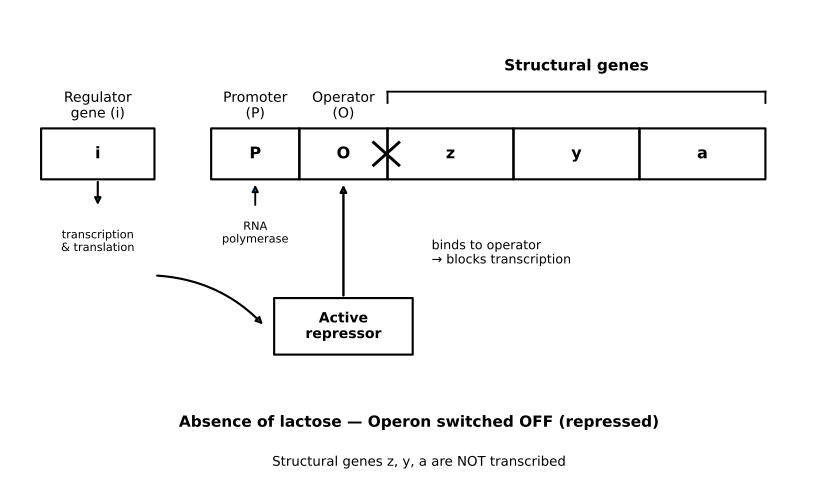
(a) Draw a neat, labelled diagram showing the lac operon in the ABSENCE of lactose (repressed state). (2 marks)
(b) Explain the molecular events that occur when lactose is introduced into the medium, leading to transcription of structural genes. (2 marks)
(c) Name the type of regulation shown by the lac operon and state ONE key difference between an inducible operon and a repressible operon, giving one example of each. (1 mark)

Diagram for question 22: Molecular Basis of Inheritance
Show answer
PART (a) — 2 marks

Labelled diagram of lac operon in the ABSENCE of lactose (Repressed / OFF state):

[DIAGRAM — draw exactly as shown below]

Regulator Promoter Operator Structural Genes
gene (i) (P) (O) z y a
┌─────────┐ ┌─────┐ ┌─────┐ ┌───────┬───────┬───────┐
│ i │──────▶│ P │ │ O │ │ z │ y │ a │
└─────────┘ └─────┘ └─────┘ └───────┴───────┴───────┘
│ ▲
▼ │
┌──────────┐ binds and
│ Active │────────────BLOCKS RNA
│ Repressor│ polymerase
└──────────┘
(RNA polymerase CANNOT proceed)

Mandatory labels (award ½ mark each for any 4 correct labels):
• Regulator gene (i) — produces repressor mRNA → Active Repressor protein
• Promoter (P) — binding site for RNA polymerase
• Operator (O) — binding site for repressor; blocked in repressed state
• Structural genes z (β-galactosidase), y (permease), a (transacetylase)
• Active Repressor bound to Operator
• RNA polymerase shown unable to progress past operator

(Full 2 marks: correct layout + at least 4 labels clearly shown)

---

PART (b) — 2 marks

Molecular events when lactose is introduced (Induced / ON state):

① Lactose (the inducer) enters the cell via a small amount of permease already present.

② Lactose is converted to ALLOLACTOSE (its isomeric form) by β-galactosidase.
• Allolactose is the actual inducer molecule.

③ Allolactose binds to the Active Repressor protein → causes a conformational change → repressor becomes INACTIVE (cannot bind DNA).

④ Inactive repressor dissociates from the Operator.

⑤ RNA polymerase is now FREE to bind the Promoter and move along the structural genes.

⑥ Transcription of z, y, a proceeds → polycistronic mRNA is produced → translated into:
• β-galactosidase (gene z) — cleaves lactose → glucose + galactose
• Permease (gene y) — transports lactose into cell
• Transacetylase (gene a) — acetylation function

[Award 1 mark for allolactose / repressor inactivation step; 1 mark for RNA polymerase binding + transcription proceeding]

---

PART (c) — 1 mark

Type of regulation: NEGATIVE regulation (repressor-controlled); the operon is INDUCIBLE.

| Feature | Inducible Operon | Repressible Operon |
|---|---|---|
| Default state | OFF (genes not transcribed) | ON (genes transcribed) |
| Regulation | Inducer molecule inactivates repressor → genes switch ON | Co-repressor molecule activates repressor → genes switch OFF |
| Example | lac operon (E. coli) | trp operon (tryptophan biosynthesis, E. coli) |

(Award 1 mark for correctly naming inducible AND stating that repressible operon has genes ON by default / co-repressor activates repressor, with one example each)

---

MARKING SUMMARY:
(a) Labelled diagram — repressed state: 2 marks
(b) Allolactose formation + repressor inactivation + RNA polymerase freed + transcription: 2 marks
(c) Inducible named + inducible vs repressible distinction + examples: 1 mark
Total: 5 marks
Q23Long Answer5 marks

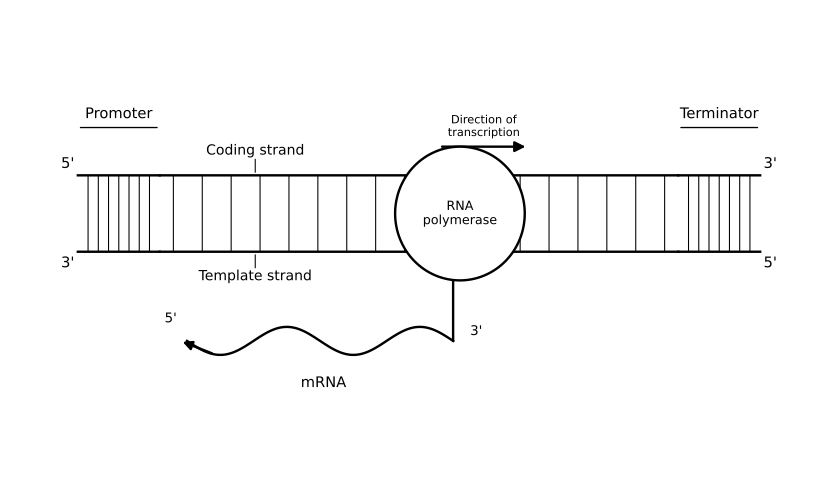
The diagram below represents a segment of a DNA molecule undergoing transcription in a prokaryotic cell. Study the information provided and answer the questions that follow.

Template strand (3'→5'): 3'–TAC–GGG–AAA–ATT–ACG–5'
Coding strand (5'→3'): 5'–ATG–CCC–TTT–TAA–TGC–3'

Codon table:
AUG — Methionine (Start)
CCC — Proline
UUU — Phenylalanine
UAA — Stop codon
UGC — Cysteine

(i) Write the sequence of mRNA transcribed from the template strand given above. (1 mark)
(ii) State the property of the genetic code demonstrated by the codon UUU, given that UUC also codes for Phenylalanine. Name this property. (1 mark)
(iii) Using the codon table above, write the sequence of amino acids in the polypeptide produced. (1 mark)
(iv) Draw a neat, labelled diagram of the transcription unit showing: template strand, coding strand, RNA polymerase, mRNA, promoter, and terminator. (2 marks)

Diagram for question 23: Molecular Basis of Inheritance
Show answer
CBSE MARKING SCHEME — 5 marks

(i) mRNA sequence transcribed from template strand: (1 mark)

Template strand read 3'→5': 3'–TAC–GGG–AAA–ATT–ACG–5'
mRNA synthesised 5'→3': 5'–AUG–CCC–UUU–UAA–UGC–3'

✦ Award 1 mark for correct complete mRNA sequence.
(Note: mRNA has the same sequence as the coding strand with T replaced by U.)

─────────────────────────────────────
(ii) Property demonstrated: (1 mark)

Both UUU and UUC code for the same amino acid — Phenylalanine.
This property is called DEGENERACY (or redundancy) of the genetic code.
→ Definition: One amino acid can be coded by more than one codon.

✦ Award ½ mark for naming the property (degeneracy) + ½ mark for correct explanation.

─────────────────────────────────────
(iii) Amino acid sequence of the polypeptide: (1 mark)

mRNA: 5'–AUG–CCC–UUU–UAA–UGC–3'

Codon 1: AUG → Methionine (Start)
Codon 2: CCC → Proline
Codon 3: UUU → Phenylalanine
Codon 4: UAA → Stop (translation terminates here)
Codon 5: UGC → NOT translated

Polypeptide produced: Met – Pro – Phe

✦ Award 1 mark for the correct three-amino acid sequence; UGC must NOT be included.
(If student writes all five including UGC — award ½ mark only.)

─────────────────────────────────────
(iv) Labelled diagram of the Transcription Unit: (2 marks)

RNA polymerase

PROMOTER ┌─────────────────────────────┐ TERMINATOR
─────────────────────────┤ Transcription Unit ├───────────────
└─────────────────────────────┘

Coding strand 5'════════════════════════════════════3'
||||||| (unwound region)
Template strand 3'════════════════════════════════════5'

RNA polymerase moves →
↓ (newly synthesised)
5'───────mRNA───────►3'

Full diagram with all labels:

PROMOTER TERMINATOR
│ │
5'──────────┼──────────────────────────────────────┼──────3' ← Coding strand (non-template)
3'──────────┼──────────────────────────────────────┼──────5' ← Template strand (antisense)
╔══════════╗
║ RNA Pol ║ → direction of transcription
╚══════════╝

5'──────▼──────3' ← mRNA (newly synthesised)

Required labels (check all present):
[1] Template strand (antisense / 3'→5')
[2] Coding strand (sense / 5'→3')
[3] RNA polymerase
[4] mRNA with polarity (5'→3')
[5] Promoter (upstream, where RNA polymerase binds)
[6] Terminator (downstream, where transcription ends)

✦ Award 1 mark for a correctly drawn diagram showing template and coding strands with polarity marked AND RNA polymerase positioned.
✦ Award 1 mark for all remaining labels: mRNA (5'→3' polarity), promoter, and terminator correctly placed.
(Accept any neat, recognisable diagram; penalise only if polarity is absent or labels are wrong.)

─────────────────────────────────────
SUMMARY OF MARKS:
(i) mRNA sequence — 1 mark
(ii) Degeneracy — name + explanation — 1 mark
(iii) Polypeptide: Met–Pro–Phe — 1 mark
(iv) Transcription unit diagram + labels — 2 marks
TOTAL = 5 marks

Want unlimited practice on Molecular Basis of Inheritance?

The full ClearSteps bank has 23+ reviewed questions on this chapter alone — with step-wise solutions, difficulty levels, and progress tracking. Verify your WhatsApp number and your free trial starts right here.

CBSE · CLASS 12
🎟️14-day free trial · code PRAC auto-applied
Mobile Number
+91
OTP will be sent to your WhatsApp

⭐ Trusted by 12,000+ students across India

Molecular Basis of Inheritance Class 12 Biology Questions