ClearStepsCLEARSTEPS AI
Teacher Login →Student Login →

Sexual Reproduction in Flowering Plants: Class 12 Biology Practice Questions

29 original exam-pattern questions with full answers, matched to the current CBSE Class 12 paper design, including case-based questions. Attempt each question before opening the answer — or start a free 14-day trial ↓ for the full bank.

Q1Case-based4 marks

Dr. Meera, a plant biologist, was studying pollination and fertilisation in a flowering plant species. She observed that when pollen grains from the same plant were placed on the stigma, the pollen tubes failed to penetrate the style and degenerated within minutes. However, when pollen from a different plant of the same species was used, successful pollen tube growth occurred, leading to seed formation. She also noted that the central cell of the embryo sac contained two nuclei that participated in one of the two fertilisation events. After successful fertilisation, she tracked the development of various structures within the ovule.

Read the following passage and answer the questions that follow:

Dr. Meera, a plant biologist, was studying pollination and fertilisation in a flowering plant species. She observed that when pollen grains from the same plant were placed on the stigma, the pollen tubes failed to penetrate the style and degenerated within minutes. However, when pollen from a different plant of the same species was used, successful pollen tube growth occurred, leading to seed formation. She also noted that the central cell of the embryo sac contained two nuclei that participated in one of the two fertilisation events. After successful fertilisation, she tracked the development of various structures within the ovule.

(i) Name the phenomenon Dr. Meera observed when pollen from the same plant failed to germinate on the stigma. What is the biological significance of this phenomenon? (1 mark)

(ii) The two nuclei present in the central cell of the embryo sac participated in triple fusion. Name the product formed and state its ploidy. How does this product develop into a nutritive tissue? (1 mark)

(iii) After successful double fertilisation, Dr. Meera tracked two simultaneous developmental events. Complete the following table showing the fate of different structures post-fertilisation: (2 marks)

| Structure Before Fertilisation | Structure/Product After Fertilisation |
|---|---|
| Zygote (2n) | ? |
| Primary Endosperm Nucleus (3n) | ? |
| Integuments | ? |
| Ovule | ? |

Show answer
MARKING SCHEME — 4 Marks Total

─────────────────────────────────────
Sub-part (i) [1 mark]
─────────────────────────────────────
• Name of phenomenon: Self-incompatibility (SI) [½ mark]

• Biological significance: Self-incompatibility prevents self-fertilisation (inbreeding) and promotes cross-pollination between genetically different individuals, thereby maintaining genetic diversity within the population. [½ mark]

Note: Mechanism — The pistil recognises pollen via S-alleles (S-proteins on pollen coat interact with S-glycoproteins in pistil). If pollen and pistil share the same S-allele, an incompatible reaction is triggered → pollen tube growth is inhibited.

─────────────────────────────────────
Sub-part (ii) [1 mark]
─────────────────────────────────────
• Triple fusion: One male gamete (n) + two polar nuclei (n + n) → Primary Endosperm Nucleus (PEN) [½ mark]

• Ploidy of PEN = 3n (triploid) [½ mark — award if stated anywhere in the answer]

• Development into nutritive tissue: PEN undergoes repeated mitotic divisions to form the endosperm (3n), which stores food (starch, proteins, lipids) and nourishes the developing embryo.
(Award the ½ mark for 'triploid' even if stated here rather than separately.)

─────────────────────────────────────
Sub-part (iii) [2 marks — ½ mark per correct entry]
─────────────────────────────────────

| Structure Before Fertilisation | Structure/Product After Fertilisation |
|---|---|
| Zygote (2n) | Embryo (2n) — by repeated mitotic divisions; forms radicle, plumule, and cotyledon(s) |
| Primary Endosperm Nucleus (3n) | Endosperm (3n) — nourishes the developing embryo |
| Integuments (outer + inner) | Seed coat — testa (from outer integument) + tegmen (from inner integument) |
| Ovule | Seed |

• Zygote → Embryo [½ mark]
• PEN → Endosperm [½ mark]
• Integuments → Seed coat (testa + tegmen) [½ mark]
• Ovule → Seed [½ mark]

─────────────────────────────────────
ADDITIONAL EXAMINER NOTE (value points for full credit)
─────────────────────────────────────
• Overall post-fertilisation summary:
— Ovary → Fruit (pericarp from ovary wall)
— Ovule → Seed
— Zygote → Embryo (2n)
— PEN → Endosperm (3n)
— Integuments → Seed coat

• Double fertilisation recap (for context):
(1) Syngamy: Male gamete (n) + Egg cell (n) → Zygote (2n)
(2) Triple fusion: Male gamete (n) + 2 Polar nuclei (n + n) → PEN (3n)
Both events occur simultaneously — this is called double fertilisation (unique to angiosperms, discovered by Nawaschin).

─────────────────────────────────────
FULL MARKS BREAKDOWN
─────────────────────────────────────
Sub-part (i): 1 mark (½ + ½)
Sub-part (ii): 1 mark (½ + ½)
Sub-part (iii): 2 marks (½ × 4)
Total: 4 marks
Q2Case-based4 marks

A botanist studying pollination biology in a greenhouse observed two flowering plant species — Species X and Species Y. In Species X, the pollen grains are large, sticky, and brightly coloured, while the flowers produce nectar. In Species Y, the pollen grains are small, light, and produced in enormous quantities, but the flowers are inconspicuous and lack nectar. When the botanist examined the pistil of Species X under a microscope after pollination, she observed that pollen grains had germinated on the stigma, but only pollen from the same plant had failed to form a functional pollen tube, whereas cross-pollen tubes grew normally and reached the ovule.

Read the following case and answer the questions that follow:

A botanist studying pollination biology in a greenhouse observed two flowering plant species — Species X and Species Y. In Species X, the pollen grains are large, sticky, and brightly coloured, while the flowers produce nectar. In Species Y, the pollen grains are small, light, and produced in enormous quantities, but the flowers are inconspicuous and lack nectar. When the botanist examined the pistil of Species X under a microscope after pollination, she observed that pollen grains had germinated on the stigma, but only pollen from the same plant had failed to form a functional pollen tube, whereas cross-pollen tubes grew normally and reached the ovule.

(i) Identify the likely pollinating agent for Species X and Species Y respectively. Give one structural feature from the passage to justify each identification. (1 + 1 = 2 marks)

(ii) Name the phenomenon observed in Species X where self-pollen fails to germinate/form a functional pollen tube on the stigma of the same plant. State one advantage this phenomenon provides to the species. (1 + 1 = 2 marks)

Show answer
MARKING SCHEME — Case Study (4 marks)

─────────────────────────────────────────
Sub-part (i): Pollinating agents with justification (1 + 1 = 2 marks)
─────────────────────────────────────────

Species X — Pollinating agent: Insect (entomophily) [1 mark]
Justification (any one accepted):
• Pollen grains are large and sticky — adhere to the body of visiting insects.
• Flowers produce nectar — attracts insects as a reward/incentive for pollination.
• Brightly coloured pollen / conspicuous flowers — visual attractant for insects.

Species Y — Pollinating agent: Wind (anemophily) [1 mark]
Justification (any one accepted):
• Pollen grains are small and light — easily carried/dispersed by wind currents.
• Pollen produced in enormous quantities — compensates for the random, non-directional nature of wind dispersal.
• Flowers are inconspicuous and lack nectar — no need to attract animal pollinators; wind is the vector.

(Award 1 mark for each correct agent + justification drawn from the passage. Agent alone without justification = 0 marks for that part.)

─────────────────────────────────────────
Sub-part (ii): Phenomenon name and advantage (1 + 1 = 2 marks)
─────────────────────────────────────────

Name of phenomenon:
Self-incompatibility (also accept: Self-sterility) [1 mark]

• It is a genetic mechanism by which the pistil of a flower recognises and rejects pollen from the same plant (or genetically identical plants), preventing self-fertilisation.
• It is controlled by the S-gene (S-allele / S-locus); when the S-allele of the pollen matches the S-allele of the pistil, the pollen tube growth is inhibited.

Advantage: [1 mark] (any one of the following accepted)
• It prevents inbreeding / self-fertilisation, thereby avoiding inbreeding depression.
• It promotes outbreeding / cross-pollination, leading to greater genetic variation in the offspring.
• It ensures combination of genetic material from two different parents, increasing adaptability of the population.

─────────────────────────────────────────
FINAL MARK SUMMARY
─────────────────────────────────────────
(i) Agent for Species X + justification = 1 mark
Agent for Species Y + justification = 1 mark
(ii) Name of phenomenon = 1 mark
Advantage = 1 mark
Total = 4 marks (1 × 4 = 4)
Q3Case-based4 marks

A botany student was examining a mature angiosperm ovule under the microscope. She observed a flask-shaped structure at the micropylar end containing three cells, a large central cell with two nuclei, and three cells grouped at the opposite end. She drew the structure and labelled it as the 'female gametophyte'. Her teacher told her that this structure is central to the process of double fertilisation — a unique and defining feature of angiosperms.

Read the following passage and answer the questions that follow:

A botany student was examining a mature angiosperm ovule under the microscope. She observed a flask-shaped structure at the micropylar end containing three cells, a large central cell with two nuclei, and three cells grouped at the opposite end. She drew the structure and labelled it as the 'female gametophyte'. Her teacher told her that this structure is central to the process of double fertilisation — a unique and defining feature of angiosperms.

(i) Name the structure the student observed. State the total number of cells and nuclei present in it at maturity. (1)
(ii) Draw a neat, labelled diagram of the mature female gametophyte as described above, showing the correct position of all its constituent cells/nuclei. (2)
(iii) Explain how double fertilisation occurs in this structure. Name the two products formed and state the ploidy of each. (1)

Show answer
MARKING SCHEME — Total: 4 marks

─────────────────────────────────────
(i) Name and composition of the structure: (1 mark)

• The structure is the Embryo sac (female gametophyte / megagametophyte). (½)
• It is 7-celled and 8-nucleate at maturity. (½)
[Award 1 mark for both parts correct]

─────────────────────────────────────
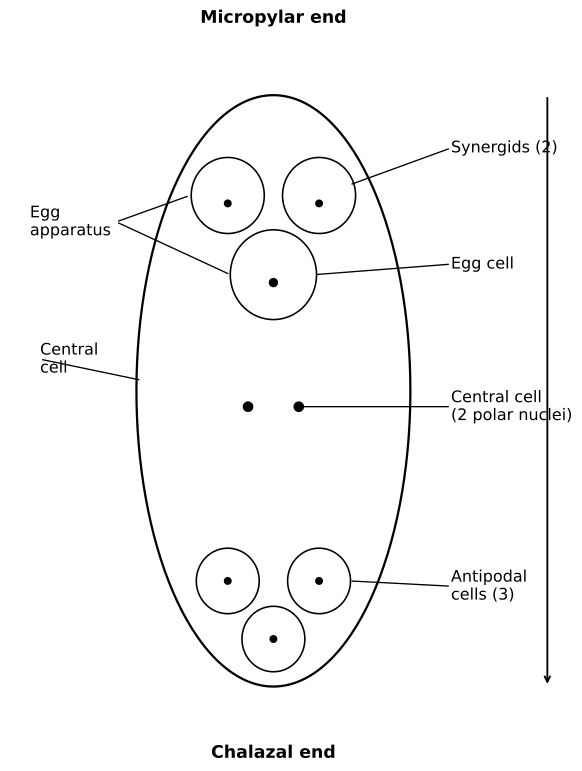
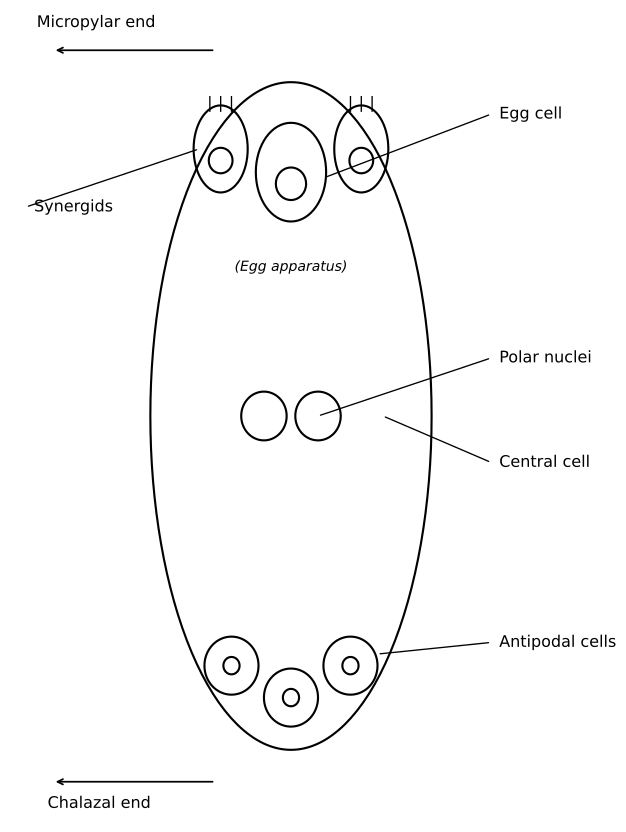
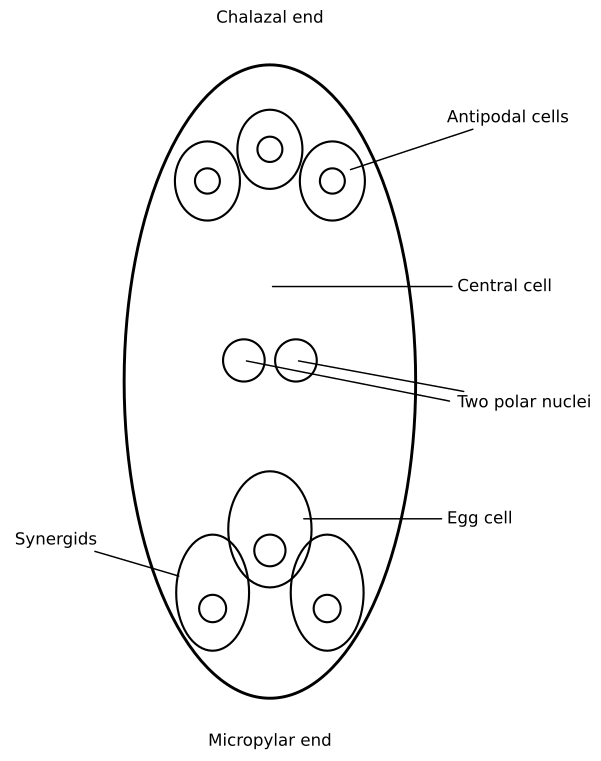
(ii) Labelled diagram of the mature embryo sac: (2 marks)

Diagram (draw and label as below — 2 marks for correct diagram with all labels):


MICROPYLAR END (top)
┌─────────────────────┐
│ Filiform apparatus │
│ ┌───┐ ┌───┐ │
│ │ S₁│ │ S₂│ │ ← Synergids (2 cells)
│ └───┘ └───┘ │
│ ┌───┐ │
│ │ E │ │ ← Egg cell (1 cell)
│ └───┘ │
│ ─ ─ ─ ─ ─ ─ ─ ─ │
│ │
│ ┌─────────────┐ │
│ │Central cell │ │ ← Central cell with
│ │ PN₁ PN₂ │ │ 2 Polar nuclei (1 cell)
│ └─────────────┘ │
│ ─ ─ ─ ─ ─ ─ ─ ─ │
│ ┌───┐ ┌───┐ ┌───┐ │
│ │A₁ │ │A₂ │ │A₃ │ │ ← Antipodal cells (3 cells)
│ └───┘ └───┘ └───┘ │
└─────────────────────┘
CHALAZAL END (bottom)

Key labels required (award 2 marks if all 5 label groups correct; award 1 mark if any 3–4 correct):
1. Synergids (2 cells) — micropylar end, flanking the egg cell; filiform apparatus present
2. Egg cell (1 cell) — micropylar end, between the two synergids
3. Central cell (1 cell) — middle of embryo sac, containing 2 polar nuclei
4. Polar nuclei (2 nuclei) — inside the central cell
5. Antipodal cells (3 cells) — chalazal end

[Note to examiner: Visually impaired candidates may write:
"Embryo sac has 7 cells and 8 nuclei. Micropylar end: egg apparatus = 2 synergids + 1 egg cell. Middle: 1 central cell with 2 polar nuclei. Chalazal end: 3 antipodal cells." — award 2 marks for complete correct description.]

─────────────────────────────────────
(iii) Double fertilisation — mechanism, products and ploidy: (1 mark)

Steps and products (award 1 mark for any TWO of the following three points; all three given here for examiner reference):

• The pollen tube enters the embryo sac through the micropyle and releases two male gametes (n).
• Syngamy: one male gamete (n) fuses with the egg cell (n) → Zygote (2n) → develops into embryo.
• Triple fusion: the second male gamete (n) fuses with the two polar nuclei (n + n) inside the central cell → Primary Endosperm Nucleus / PEN (3n, triploid) → develops into endosperm.
• The occurrence of two fusion events together is called double fertilisation — unique to angiosperms.

Products and ploidy:
— Zygote: 2n (diploid)
— Primary Endosperm Nucleus (PEN): 3n (triploid)

[Award 1 mark for: correctly naming BOTH products AND stating BOTH ploidy levels. If only one product/ploidy given, award ½ — but note this board does not use ½ marks; award 1 mark only if both products with correct ploidy are stated.]

─────────────────────────────────────
MARK SUMMARY:
(i) Name + composition = 1 mark
(ii) Labelled diagram = 2 marks
(iii) Double fertilisation + products + ploidy = 1 mark
TOTAL = 4 marks (1+2+1)
Q4MCQ1 mark

A researcher studying pollen-pistil interactions observes that when pollen from Plant X is dusted onto the stigma of Plant Y (a different but closely related species), the pollen germinates successfully and the pollen tube begins to grow through the style. However, fertilisation never occurs — the pollen tube invariably stops growing before it reaches the ovule. Which of the following is the MOST likely explanation for this observation?

Show answer
Correct answer: (B)

Reasoning (examiner's value points):

1. Pollen-pistil interaction operates at TWO distinct levels:
• Stigma-level recognition: determines whether pollen germinates (compatible = germinates; incompatible = does not germinate). In this scenario, germination DID occur → stigma accepted the pollen as compatible at the surface-recognition level.
• Post-germination / stylar barrier: a second, independent recognition checkpoint operates as the pollen tube grows through the style. Chemotropic signals (Ca²⁺ gradients, proteins secreted by the transmitting tissue) guide the tube; if interspecific molecular signals are mismatched, the tube loses directional guidance or is actively arrested within the style tissue.

2. This two-phase mechanism explains the observation perfectly: initial compatibility (germination occurs) followed by a stylar/post-germination incompatibility barrier (tube growth arrested before reaching the ovule).

Why the other options are incorrect:
• Option A: Apertures are structural features of the mature pollen grain wall; their absence would prevent tube emergence entirely — tube growth would not begin at all. This contradicts the observation that the tube DID grow.
• Option C: Fusion of polar nuclei into the secondary nucleus is a normal, pre-fertilisation event that occurs in ALL embryo sacs; it is a prerequisite for triple fusion, not a signal to arrest incoming pollen tubes. No such arrest mechanism exists.
• Option D: Sporopollenin forms the tough outer exine wall of the pollen grain (produced by the tapetum); it protects pollen during transfer and has no role in sustaining pollen tube wall integrity during growth (the tube wall is primarily pectin and callose). A sporopollenin deficiency would affect pollen viability/desiccation resistance, not mid-style tube collapse.
Q5MCQ1 mark

In a typical angiosperm embryo sac, the two polar nuclei are located in the:

Show answer
Correct answer: (B) Central cell

The mature female gametophyte (embryo sac) of a typical angiosperm is 7-celled and 8-nucleate. Its organisation is as follows:

• Micropylar end — Egg apparatus: 1 egg cell + 2 synergids (3 cells)
• Centre — Central cell: contains 2 polar nuclei (these later fuse with a male gamete during triple fusion to form the Primary Endosperm Nucleus, PEN, which is 3n)
• Chalazal end — 3 antipodal cells

The two polar nuclei are therefore located in the CENTRAL CELL, not in the egg apparatus, synergids, or antipodal cells.
Q6MCQ1 mark

A botanist observes that in a particular flowering plant species, pollen grains germinate readily on the stigma of the same flower but the pollen tube growth arrests and degenerates within the style before reaching the ovule. Which of the following best explains this observation?

Show answer
Correct answer: (B)

The pistil recognises the pollen as incompatible due to matching S-alleles, triggering self-incompatibility.

Reason:
• Pollen–pistil interaction involves recognition of compatible/incompatible pollen via S-alleles (self-incompatibility alleles).
• When pollen carries the SAME S-allele as the pistil (i.e., self-pollen), the pistil identifies it as incompatible.
• Although germination on the stigma may begin, incompatibility response causes pollen tube growth to arrest/degenerate within the style — exactly as described in the scenario.
• This self-incompatibility mechanism prevents self-fertilisation and promotes out-crossing, maintaining genetic diversity.

Why other options are wrong:
(A) Absence of a generative cell would prevent formation of male gametes, but would not cause pollen tube arrest specifically within the style.
(C) Tapetum nourishes pollen during development in the anther; it has no role in pollen tube growth in the style.
(D) Fusion of polar nuclei is independent of pollen tube arrival and does not cause pollen tube degeneration.
Q7MCQ1 mark

In the embryo sac of a typical angiosperm, which of the following correctly describes the position and number of nuclei in the central cell?

Diagram for question 7: Sexual Reproduction in Flowering Plants
Show answer
Correct answer: (B) Two polar nuclei located in the large central vacuolate cell.

Reason: The mature female gametophyte (embryo sac) of a typical angiosperm is 7-celled and 8-nucleate. The central cell is the largest cell of the embryo sac and contains two polar nuclei (hence contributing 2 of the 8 total nuclei). During double fertilisation, one male gamete (n) fuses with the two polar nuclei (n + n) in the central cell → Triple fusion → Primary Endosperm Nucleus (PEN, 3n).

Why others are wrong:
- (A) is incorrect: the micropylar end contains the egg apparatus (1 egg cell + 2 synergids), not the central cell nucleus.
- (C) is incorrect: the chalazal end contains 3 antipodal cells (3 nuclei), not the central cell.
- (D) is incorrect: the description matches the Primary Endosperm Nucleus (PEN) formed AFTER triple fusion, not the central cell before fertilisation.
Q8Short Answer1 mark

Assertion (A): In a developing angiosperm seed, the endosperm of an albuminous seed is partially consumed by the time the seed reaches maturity, while in an ex-albuminous seed the endosperm is completely consumed and food is stored in the cotyledons.
Reason (R): Endosperm develops from the Primary Endosperm Nucleus (PEN) formed by triple fusion and is triploid (3n); it provides nutrition to the developing embryo during seed development.

Show answer
Correct answer: (B) Both A and R are true, but R is NOT the correct explanation of A.

Explanation (for examiner reference):

• Assertion is TRUE:
– Albuminous seeds (e.g., wheat, maize, castor) retain endosperm at maturity — it is only partially consumed during embryo development.
– Ex-albuminous seeds (e.g., pea, bean, groundnut) have endosperm completely consumed during embryo development; food reserves are transferred to and stored in the cotyledons.

• Reason is TRUE:
– Triple fusion: one male gamete (n) + two polar nuclei (n + n) → Primary Endosperm Nucleus, PEN (3n).
– PEN divides repeatedly → endosperm (3n = triploid), which nourishes the developing embryo — this is a correct and important biological fact.

• Why R does NOT explain A:
– The ploidy of endosperm (3n) and its nutritive role are true but do not explain WHY endosperm is completely consumed in ex-albuminous seeds versus partially retained in albuminous seeds.
– The actual explanation for the distinction in A is the RATE and EXTENT of mobilisation of endosperm reserves into the embryo/cotyledons during seed development — a developmental/physiological difference, not a ploidy-based one.
– Therefore, although both statements are independently correct, R is not the correct explanation of A.

[1 mark — award full 1 mark for option B only; no partial marking for MCQ/AR in Section A]
Q9MCQ1 mark

In a typical angiosperm embryo sac, which of the following correctly describes the position and ploidy of the central cell?

Show answer
Correct answer: (C) Located in the centre of the embryo sac; contains two haploid (n) polar nuclei.

Reasoning (for examiner reference):
• The mature embryo sac (female gametophyte) is 7-celled and 8-nucleate.
• Cell positions: 3 antipodal cells (chalazal end) + egg apparatus [1 egg cell + 2 synergids] (micropylar end) + 1 large central cell (occupying the centre).
• The central cell contains 2 polar nuclei, each haploid (n). These two polar nuclei later fuse with one male gamete (n) during triple fusion → Primary Endosperm Nucleus (PEN), which is triploid (3n).
• Option (A) is incorrect: micropylar end = egg apparatus (egg cell + 2 synergids), not central cell.
• Option (B) is incorrect: chalazal end = antipodal cells, not central cell.
• Option (D) is incorrect: before triple fusion, the central cell has two separate polar nuclei (each n), not a single pre-fused diploid nucleus — the secondary nucleus (2n) forms only after the two polar nuclei fuse (which may occur just before or during fertilisation); CBSE NCERT describes the central cell as having 2 polar nuclei.

[1 mark — award for selecting option C only]
Q10Short Answer1 mark

Assertion (A): In a mature embryo sac of a flowering plant, the central cell contains two polar nuclei and is the largest cell.
Reason (R): After double fertilisation, the central cell (with two polar nuclei) fuses with one male gamete to form the primary endosperm nucleus (PEN), which is triploid (3n).

Show answer
Correct option: (B) Both A and R are true, but R is NOT the correct explanation of A.

Explanation:
• Assertion (A) is TRUE: The central cell of the mature embryo sac contains two polar nuclei (n + n) and is indeed the largest cell of the 7-celled, 8-nucleate female gametophyte.
• Reason (R) is also TRUE: During triple fusion (a component of double fertilisation), one male gamete (n) fuses with the two polar nuclei (n + n) in the central cell → Primary Endosperm Nucleus (PEN) with ploidy 3n (triploid). This is correct.
• However, R does NOT explain A. The large size of the central cell is a structural/organisational feature of the embryo sac present BEFORE fertilisation; it is NOT caused by or explained by the post-fertilisation event of triple fusion described in R.
• Therefore, both statements are independently true but R is not the correct explanation for A.

[Note: Embryo sac organisation — 3 antipodal cells at chalazal end + 2 synergids + 1 egg cell at micropylar end (egg apparatus) + 1 large central cell with 2 polar nuclei = 7 cells, 8 nuclei total.]
Q11MCQ1 mark

A fruit orchard owner notices that mango trees grown from seeds show great variation in fruit quality, but trees propagated vegetatively (by grafting) produce fruits identical to the parent. He wants to develop mango seedlings that ALWAYS breed true AND can be grown from seeds (without grafting). Which of the following biological strategies, if incorporated into mango, would best fulfill BOTH his requirements simultaneously?

Show answer
Correct answer: (B) Apomixis — seeds develop without fertilisation, producing offspring genetically identical to the mother plant.

Reason (for examiner reference / value point):
• Apomixis = production of seeds WITHOUT fertilisation (no meiosis + syngamy involved); the embryo develops from the nucellus (a 2n somatic cell) or directly from an unreduced egg — hence the offspring is GENETICALLY IDENTICAL to the mother plant.
• This satisfies BOTH conditions the orchard owner needs:
(i) True-breeding / genetically uniform offspring (no variation) — because no sexual recombination occurs.
(ii) Propagation through seeds — no grafting required.

Why the other options are WRONG:
(A) Triploid trees are sterile — they cannot produce viable seeds, so seed-based propagation fails.
(C) Cross-pollination between two varieties produces hybrid seeds — offspring show VARIATION (not true-breeding); fails condition (i).
(D) Xenogamy maximises outcrossing and genetic recombination — produces maximum variation; directly opposite to what is required.

[Note: This is the same biological principle behind why farmers prefer apomictic seeds in crops like Citrus and Mangifera — hybrid vigour is fixed permanently without annual hybrid seed production.]
Q12MCQ1 mark

In an angiosperm embryo sac, the correct positional arrangement of cells from the micropylar end to the chalazal end is:

Diagram for question 12: Sexual Reproduction in Flowering Plants
Show answer
Correct answer: (B) Synergids + Egg cell → Central cell → Antipodal cells

Rationale (for examiner reference):
• Micropylar end: Egg apparatus = 1 egg cell + 2 synergids (total 3 cells)
• Middle: Central cell containing 2 polar nuclei
• Chalazal end: 3 antipodal cells

The mature embryo sac is 7-celled, 8-nucleate:
– 3 cells at micropylar end (egg apparatus)
– 1 large central cell with 2 polar nuclei
– 3 cells at chalazal end (antipodals)

Mnemonic: '3 (micropylar) + 2 polar nuclei (centre) + 3 (chalazal)' = 7 cells, 8 nuclei.

Award: 1 mark for choosing option (B).
Q13MCQ1 mark

A botanist observes that in a flowering plant species, the pollen grains deposited on the stigma germinate readily and pollen tubes begin to grow. However, the pollen tubes stop growing midway through the style and never reach the ovule. Which of the following best explains this observation?

Show answer
Correct answer: (B)

Explanation (for examiner reference / 1 mark):

• Pollen–pistil interaction involves a molecular recognition system between the pollen (male gametophyte) and the pistil.
• The pistil can distinguish COMPATIBLE pollen (cross-pollen, different S-alleles) from INCOMPATIBLE pollen (self-pollen, same S-alleles) using S-gene products (glycoproteins) present on the pollen surface and the stigma/style.
• In self-incompatibility (SI): the pollen germinates on the stigma (initial germination is possible) but the style rejects it — pollen tube growth is arrested within the style before reaching the ovule.
• This is precisely what the scenario describes: germination occurs, but the tube is stopped midway through the style.

Why the other options are wrong:
(A) Transmitting tissue is PRESENT in the style — it provides nutrients and a directional chemical gradient (chemotropic signals) for pollen tube growth; its absence would prevent ANY germination/growth, not arrest midway.
(C) Double fertilisation requires a pollen tube to reach the embryo sac first; it cannot have occurred if the tube has not yet reached the ovule. Post-fertilisation inhibitory signals are not a recognised mechanism.
(D) Trinucleate pollen (e.g., grasses) is fully functional and capable of complete pollen tube growth; ploidy/nuclei number of pollen does not cause mid-style arrest.

Key NCERT terms: pollen–pistil interaction, self-incompatibility, S-alleles, transmitting tissue, compatible/incompatible pollen.
Q14Short Answer2 marks

The embryo sac of a typical flowering plant is described as '7-celled but 8-nucleate'. (a) Which cell of the embryo sac contains two nuclei, and what is it called? (b) What happens to this cell after double fertilisation?

Show answer
(a) The central cell (also called the secondary nucleus cell) contains two nuclei called the polar nuclei. It is located at the centre of the embryo sac. [1 mark]

(b) During double fertilisation, one male gamete (n) fuses with the two polar nuclei (n + n) of the central cell in a process called triple fusion → this forms the Primary Endosperm Nucleus (PEN), which is triploid (3n). The central cell subsequently develops into the endosperm, which nourishes the developing embryo. [1 mark]
Q15Short Answer2 marks

Write the names of the two types of cells that together constitute the 'egg apparatus' in a mature embryo sac. State the position (end) at which the egg apparatus is located.

Show answer
The egg apparatus is located at the micropylar end of the mature embryo sac.

It consists of two types of cells:
1. One egg cell (female gamete) — centrally placed within the egg apparatus.
2. Two synergids — one on either side of the egg cell; they possess finger-like projections called filiform apparatus that help in guiding the pollen tube into the egg apparatus.

[Award 1 mark for correctly naming both cell types (egg cell + synergids); award 1 mark for correctly stating the micropylar end position.]
Q16Short Answer2 marks

A fruit orchard manager notices that mango trees grown from seeds show great variation in fruit quality, while trees propagated by grafting produce fruits identical to the parent tree. He decides to use apomixis as an alternative strategy for mango cultivation. (i) What cellular process is bypassed in apomixis that leads to identical offspring? (ii) State one agricultural advantage this gives the orchard manager over seed-grown trees.

Show answer
(i) In apomixis, fertilisation (syngamy) is bypassed — seeds are produced without fusion of male and female gametes, so no genetic recombination occurs. The offspring develop from the diploid cells of the nucellus or from the unfertilised egg cell (agamospermy), maintaining the exact genotype of the mother plant. (1 mark)

(ii) Advantage: The orchard manager can maintain consistent, high-quality fruit traits across all trees generation after generation without the risk of genetic variation (segregation of desirable characters) that occurs in sexually produced seeds. (1 mark)

[Examiner note: Accept any one valid agricultural advantage, e.g. 'no loss of hybrid vigour in subsequent generations' or 'uniform fruit size/flavour guaranteed'.]
Q17Short Answer2 marks

A botanist observes that in a certain flowering plant, the pollen tube always enters the ovule through the chalazal end rather than the micropyle. (i) Name this type of pollen tube entry. (ii) In such a plant, the male gametes are released near the antipodal cells. Will fertilisation still be successful? Give a reason.

Show answer
(i) The type of pollen tube entry through the chalazal end is called Chalazogamy. (1 mark)

(ii) Yes, fertilisation will still be successful. (½ mark)
Reason: The antipodal cells (3 cells at the chalazal end) are NOT the functional female gametes. Even though the pollen tube enters near the antipodals, the male gametes released will still migrate through the embryo sac toward the egg cell (at the micropylar end) and the two polar nuclei in the central cell, completing both syngamy (male gamete + egg cell → zygote, 2n) and triple fusion (male gamete + 2 polar nuclei → PEN → endosperm, 3n). The antipodals degenerate and play no role in fertilisation. (½ mark)

[Award 1 mark for correct term 'Chalazogamy' in part (i). Award 1 mark for part (ii): ½ mark for 'Yes' with correct reasoning that antipodals are not the functional female gametes + ½ mark for stating that male gametes still reach egg cell/polar nuclei to complete double fertilisation. Do NOT penalise if student writes 'Chalazogamy' without capitalisation.]
Q18Short Answer3 marks

A botanist studying pollen-pistil interaction in a self-incompatible species noticed the following: When pollen from the same plant was dusted on the stigma, pollen tubes failed to grow beyond the style. However, when cross-pollen (from a different plant of the same species) was used, pollen tubes successfully reached the ovules and fertilisation occurred. Based on this observation, answer the following:

(i) Identify the type of incompatibility being described. Name the genetic basis responsible for this recognition mechanism. (1 mark)

(ii) Trace the complete path of a compatible pollen tube from stigma to the embryo sac, naming each structure it passes through. State what is released from the pollen tube at the end of this journey and where exactly it enters the embryo sac. (1 mark)

(iii) Once both male gametes are released inside the embryo sac, describe what happens to EACH of them. Name the two products formed, state the ploidy of each, and explain the significance of one of these products for the developing embryo. (1 mark)

Show answer
COMPLETE MODEL ANSWER (3 marks total)

─────────────────────────────────────
Part (i) — 1 mark
─────────────────────────────────────
Type of incompatibility: Self-incompatibility (SI).
Genetic basis: It is controlled by a multiallelic S-gene (S-locus / S-alleles). The pistil recognises the S-allele carried by the pollen; if the pollen S-allele matches any S-allele present in the pistil, the pollen is rejected and the pollen tube fails to grow. Cross-pollen carries a different S-allele that is not recognised as 'self', so the pollen tube grows successfully.
(Accept: 'S-gene / S-allele recognition system' or 'recognition by S-proteins'.)

─────────────────────────────────────
Part (ii) — 1 mark
─────────────────────────────────────
Complete path of the compatible pollen tube (in correct sequence):
Stigma (pollen germinates; pollen tube emerges from the germ pore) → Style (pollen tube grows chemotropically through the transmitting tissue) → Ovary → Ovule → Micropyle (pollen tube enters the ovule through the micropyle — porogamy) → Synergid (pollen tube penetrates one of the two synergids via the filiform apparatus and ruptures there).

What is released: Two male gametes are discharged from the pollen tube.
Exact site of entry into embryo sac: The pollen tube enters the embryo sac through the MICROPYLE end and bursts inside one SYNERGID, releasing the two male gametes into the embryo sac.

─────────────────────────────────────
Part (iii) — 1 mark [DOUBLE FERTILISATION]
─────────────────────────────────────
Fate of EACH male gamete:

• First male gamete fuses with the egg cell (syngamy) → forms the ZYGOTE (ploidy: 2n / diploid).
• Second male gamete fuses with the two polar nuclei (or the already-formed secondary nucleus / central cell nucleus) → forms the PRIMARY ENDOSPERM NUCLEUS / PEN (ploidy: 3n / triploid).

This simultaneous occurrence of syngamy and triple fusion is called DOUBLE FERTILISATION — a characteristic feature of angiosperms.

Two products formed:
1. Zygote (2n) — develops into the embryo.
2. Primary Endosperm Nucleus / PEN (3n) — develops into the endosperm.

Significance of the endosperm (one product) for the developing embryo:
The primary endosperm nucleus (3n) divides repeatedly to form the ENDOSPERM, which is a nutritive tissue that provides nourishment (food/nutrients) to the developing embryo during seed development, ensuring its proper growth and germination.
Q19Short Answer3 marks

Fill in the blanks A, B, C and D in the table given below, which relates to the structures formed after double fertilisation and their origins in a flowering plant:

Structure | Develops from
A | Zygote (2n)
Endosperm | B
Seed coat (Testa + Tegmen) | C
D | Remains of the nucellus

Show answer
A — Embryo
(The zygote (2n), formed by syngamy between male gamete (n) and egg cell (n), undergoes mitotic divisions to develop into the embryo.) [½ mark]

B — Primary Endosperm Nucleus / PEN (3n)
(The primary endosperm nucleus, formed by triple fusion — male gamete (n) + two polar nuclei (n + n) = 3n — divides repeatedly to form the endosperm.) [½ mark]

C — Integuments (outer integument → testa; inner integument → tegmen)
(After fertilisation, both integuments of the ovule harden and differentiate to form the seed coat — the outer integument becomes the testa and the inner integument becomes the tegmen.) [1 mark]

D — Perisperm
(Perisperm is the residual, persistent nucellus tissue that remains in the seed. It is seen in seeds of Black pepper (Piper nigrum) and beet.) [1 mark]

[Total: 3 marks]
Q20Short Answer3 marks

Attempt either option (A) or (B).

(A) (i) Draw a neat, labelled diagram of a mature embryo sac (female gametophyte) of an angiosperm. (Any four labels)
(ii) State the ploidy of any two of the labelled structures.

OR

(B) (i) Arrange the following events of double fertilisation in the correct sequence:
Pollen tube reaches embryo sac → Two male gametes released → Syngamy → Triple fusion → Formation of endosperm → Formation of zygote
(ii) State the ploidy of the products formed in syngamy and triple fusion respectively.

Diagram for question 20: Sexual Reproduction in Flowering Plants
Show answer
OPTION (A)

(i) Labelled diagram of mature embryo sac (female gametophyte):

← MICROPYLAR END →
┌─────────────────────────────────┐
│ [Synergid] [Egg cell] [Synergid] │
│ (egg apparatus) │
│ ─ ─ ─ ─ ─ ─ ─ ─ ─ ─ ─ ─ ─ ─ ─ │
│ │
│ [Central cell] │
│ (contains 2 polar nuclei) │
│ │
│ ─ ─ ─ ─ ─ ─ ─ ─ ─ ─ ─ ─ ─ ─ ─ │
│ [Antipodal] [Antipodal] [Antipodal] │
└─────────────────────────────────┘
← CHALAZAL END →

Notes on structure (for examiner):
• 7-celled, 8-nucleate structure
• Micropylar end: 2 Synergids + 1 Egg cell (= egg apparatus)
• Centre: 1 Central cell with 2 polar nuclei
• Chalazal end: 3 Antipodal cells

Accept ANY FOUR of the following labels for full credit (½ mark per correct label = 2 marks):
1. Egg cell
2. Synergids (filiform apparatus may be noted)
3. Central cell / Secondary nucleus
4. Polar nuclei (2 polar nuclei within central cell)
5. Antipodal cells
6. Nucellus (surrounding the embryo sac)
7. Micropyle (if shown)

[2 marks — ½ per correct label, up to 4 labels]

(ii) Ploidy of any two labelled structures: [1 mark — ½ per correct ploidy]

| Structure | Ploidy |
|---|---|
| Egg cell | Haploid (n) |
| Synergids | Haploid (n) |
| Antipodal cells | Haploid (n) |
| Polar nuclei / Central cell | Haploid (n) each; central cell considered as 2n when both polar nuclei fuse |

(Award ½ mark for each correct ploidy stated against a named structure, any two.)

─────────────────────────────────────
OPTION (B)

(i) Correct sequence of events in double fertilisation: [1 mark — full sequence correct]

1. Pollen tube reaches embryo sac
2. Two male gametes released
3. Syngamy (male gamete + egg cell)
AND
Triple fusion (male gamete + 2 polar nuclei) — steps 3 and 4 occur simultaneously
4. Formation of zygote (product of syngamy)
5. Formation of endosperm (product of triple fusion)

Corrected linear sequence for marking:
Pollen tube reaches embryo sac → Two male gametes released → Syngamy AND Triple fusion (simultaneously) → Formation of zygote + Formation of endosperm

[Award 1 mark if the student correctly places 'Pollen tube → Two male gametes released' before both fusion events, and both fusion events before their respective products. Deduct ½ mark if syngamy and triple fusion are placed sequentially rather than simultaneously, but award ½ if rest is correct.]

(ii) Ploidy of products: [2 marks — 1 per product]

• Product of Syngamy:
Male gamete (n) + Egg cell (n) → Zygote (2n) = DIPLOID

• Product of Triple fusion:
Male gamete (n) + 2 Polar nuclei (n + n) → Primary Endosperm Nucleus / PEN (3n) = TRIPLOID

[1 mark for zygote = 2n/diploid; 1 mark for PEN = 3n/triploid]

─────────────────────────────────────
VALUE POINTS SUMMARY (for both options — 3 marks total):
Option A: Diagram with 4 correct labels = 2 marks + Ploidy of any 2 structures = 1 mark
Option B: Correct sequence = 1 mark + Ploidy of zygote (2n) = 1 mark + Ploidy of PEN (3n) = 1 mark
Q21Short Answer3 marks

A botany student observes that when pollen grains of Species A are placed on the stigma of Species B, the pollen grains fail to germinate, even though both species belong to the same family. However, when pollen grains of Species A are placed on the stigma of Species A, germination occurs readily and pollen tubes grow successfully.

(i) Identify the phenomenon responsible for the failure of pollen germination in the first case. Name the molecules involved in this recognition.
(ii) Once a compatible pollen grain successfully germinates on the stigma of Species A, describe the pathway of the pollen tube from stigma to the egg cell, naming the structures it passes through.
(iii) How many male gametes are released by the pollen tube inside the embryo sac, and what is the fate of each? Name the phenomenon.

Show answer
MARKING SCHEME (3 marks total)

(i) Phenomenon and molecules involved: [1 mark]

• The phenomenon is Pollen-Pistil Interaction / Self-incompatibility (interspecific incompatibility).
• The pistil recognises pollen as incompatible through chemical signalling involving S-allele encoded proteins (glycoproteins) present on the pollen surface and the stigma surface.
• Incompatible pollen is rejected — pollen tube either fails to germinate or its growth is inhibited.

[Award 1 mark for correctly naming the phenomenon and mentioning chemical/protein recognition]

(ii) Pathway of the pollen tube: [1 mark]

Pollen grain germinates on stigma → pollen tube grows chemotropically through the style (transmitting tissue) → enters the ovary → reaches the ovule → enters through the micropyle (porogamy — most common route) → penetrates one of the synergids in the embryo sac → releases its contents.

Route summary:
Stigma → Style → Ovary → Ovule (via micropyle) → Synergid → Egg apparatus

[Award 1 mark for correctly naming: style / transmitting tissue, micropyle, and synergid — at least 3 structures required]

(iii) Male gametes, their fate, and the phenomenon: [1 mark]

• The pollen tube releases TWO (2) male gametes into the synergid.

Fate of each male gamete:
• First male gamete (n) + Egg cell (n) → Zygote (2n) [Syngamy / Fertilisation]
• Second male gamete (n) + Two polar nuclei (n + n) → Primary Endosperm Nucleus / PEN (3n) [Triple fusion]

• The phenomenon in which BOTH acts of fusion occur is called DOUBLE FERTILISATION (first described by Nawaschin).

[Award 1 mark for: 2 male gametes + both correct fusion products + the term Double Fertilisation]

──────────────────────────────
VALUE POINTS SUMMARY
──────────────────────────────
(i) Pollen-pistil interaction / incompatibility + S-allele glycoprotein recognition → 1 mark
(ii) Correct pathway with ≥3 structures named in correct order → 1 mark
(iii) 2 male gametes + syngamy (→ zygote 2n) + triple fusion (→ PEN 3n) + Double fertilisation → 1 mark
Q22Short Answer3 marks

A botanist is studying two mango varieties in an orchard. She observes that Variety A produces plump, fully developed seeds with abundant fleshy endosperm, while Variety B consistently produces seedless fruits with no endosperm, even though both varieties flower normally and are visited by pollinators. She also notices that in Variety A, the ovule has a persistent, starchy tissue surrounding the embryo sac even after fertilisation.

(a) Identify the process by which Variety B produces fruits without fertilisation. Name ONE other example of such a fruit. (1 mark)

(b) Name the 'persistent starchy tissue surrounding the embryo sac' seen in Variety A. From which part of the ovule does it develop, and what is its ploidy level? (1 mark)

(c) The endosperm in Variety A is rich and persistent. State the ploidy of endosperm and explain the sequence of events — from triple fusion to endosperm formation — that accounts for its nutritive function for the embryo. (1 mark)

Show answer
MARKING SCHEME — 3 marks (1 + 1 + 1)

─────────────────────────────────────
(a) [1 mark]

• The process is Parthenocarpy — development of fruit from the ovary WITHOUT fertilisation, so no seeds are formed.
• Example (any ONE acceptable NCERT example): Banana / Pineapple / Grapes (seedless varieties).

[Award ½ mark for correct process name + ½ mark for correct example]

─────────────────────────────────────
(b) [1 mark]

• The persistent starchy tissue is called Perisperm.
• It develops from the Nucellus (the nutritive tissue of the ovule that surrounds the embryo sac).
• Ploidy: 2n (diploid) — it is maternal sporophytic tissue and is NOT a product of fertilisation.

[Award ½ mark for 'perisperm' + ¼ mark for 'nucellus' + ¼ mark for '2n / diploid']

─────────────────────────────────────
(c) [1 mark]

Sequence of events:

1. Triple fusion: One male gamete (n) + Two polar nuclei (n + n) of the central cell → Primary Endosperm Nucleus / PEN (3n = triploid).

2. The PEN undergoes repeated mitotic divisions → forms the Endosperm (3n).

3. Nutritive function: Endosperm cells accumulate starch, proteins, and fats → serve as the nutrient reserve that nourishes the developing embryo during seed germination.

Ploidy of endosperm = 3n (Triploid).

[Award ½ mark for correctly stating ploidy = 3n AND triple fusion equation (n + 2n → 3n) + ½ mark for nutritive function statement]

─────────────────────────────────────
KEY CBSE TERMINOLOGY TO AWARD MARKS:
• 'Parthenocarpy' (not just 'without fertilisation')
• 'Perisperm' (not 'pericarp' — common confusion)
• 'Nucellus' as origin of perisperm
• 'Primary Endosperm Nucleus (PEN)'
• '3n / triploid' for endosperm
• 'Triple fusion' (not just 'second fertilisation')
─────────────────────────────────────
Q23Short Answer3 marks

During post-fertilisation development in a flowering plant, the following events were observed:
(i) The zygote divides to form a proembryo, and subsequently a globular, heart-shaped, and then a torpedo-shaped embryo.
(ii) The primary endosperm nucleus divides repeatedly before the zygote begins to divide.
(iii) The integuments of the ovule harden and become the seed coat.

Answer the following:
(a) Name the two components that constitute the 'embryo axis' in a dicot embryo, and state what each gives rise to in the germinating seedling. (1 mark)
(b) Identify the correct ploidy of (i) zygote, (ii) primary endosperm nucleus, and (iii) cells of the seed coat. Justify why the endosperm develops before the embryo in most angiosperms. (2 marks)

Show answer
MARKING SCHEME — SA, 3 marks

─────────────────────────────────────
Part (a) — 1 mark
─────────────────────────────────────
The embryo axis has two components:

• Radicle (root apex / root tip end of the embryo axis)
→ gives rise to the primary root (radicle grows into the root system) in the germinating seedling.

• Plumule (shoot apex / shoot tip end of the embryo axis)
→ gives rise to the shoot / first leaves (epicotyl region) in the germinating seedling.

[Award ½ mark for correctly naming both components; ½ mark for correctly stating what each gives rise to.]

─────────────────────────────────────
Part (b) — 2 marks
─────────────────────────────────────
(i) Ploidy of the zygote: 2n (diploid)
• Formed by syngamy: male gamete (n) + egg cell (n) → zygote (2n).

(ii) Ploidy of the primary endosperm nucleus (PEN): 3n (triploid)
• Formed by triple fusion: male gamete (n) + two polar nuclei (n + n) → PEN (3n).

(iii) Ploidy of seed coat cells: 2n (diploid)
• Seed coat develops from the integuments of the ovule, which are maternal (sporophytic) tissue → 2n.

[Award ½ mark for each correct ploidy — max 1½ marks for all three.]

Justification for endosperm developing before embryo: (½ mark)
• The endosperm is nutritive tissue that provides nourishment (organic nutrients, stored food) to the developing embryo.
• Since the embryo requires a nutrient supply right from the very early stages of its development, endosperm must be formed and accumulate food reserves before or concurrently with embryo development — ensuring the embryo is not nutrient-deficient at any critical developmental stage.

─────────────────────────────────────
SUMMARY OF VALUE POINTS
─────────────────────────────────────
1. Radicle → primary root ½
2. Plumule → shoot / first leaves ½
3. Zygote = 2n (diploid) ½
4. PEN = 3n (triploid) ½
5. Seed coat = 2n (diploid) ½
6. Endosperm nourishes embryo, hence develops first ½
TOTAL = 3 marks
Q24Long Answer5 marks

A botanist is studying post-pollination events in two flowering plant species: Species A (self-incompatible) and Species B (self-compatible). In Species A, when self-pollen lands on the stigma, the pollen grain germinates but the pollen tube fails to reach the ovule. In Species B, cross-pollination results in successful fertilisation. The botanist observes the mature female gametophyte of Species B and notes 7 cells and 8 nuclei before fertilisation.

(i) Draw a neat, labelled diagram of the mature female gametophyte (embryo sac) of Species B, showing the correct position of all 7 cells and 8 nuclei. [2 marks]
(ii) Describe the events of double fertilisation that follow, clearly stating the chromosome number (ploidy) of each product formed. [2 marks]
(iii) With reference to Species A, explain the biological significance of self-incompatibility and name the molecular basis by which the pistil distinguishes self-pollen from cross-pollen. [1 mark]

Show answer
PART (i): Labelled diagram of the mature female gametophyte (embryo sac) of Species B [2 marks]

DIAGRAM:

MICROPYLAR END
┌─────────────────────────┐
│ [Filiform apparatus] │
│ ┌────────┐ ┌────────┐ │
│ │Synergid│ │Synergid│ │ ← 2 Synergids (n)
│ └────────┘ └────────┘ │
│ ┌──────────┐ │
│ │ Egg cell │ │ ← 1 Egg cell (n)
│ └──────────┘ │
│ │
│ ┌─────────────────┐ │
│ │ Central Cell │ │ ← 1 Central cell
│ │ (2 Polar Nuclei)│ │ with 2 polar nuclei (n + n)
│ └─────────────────┘ │
│ │
│ ┌──────┐┌──────┐┌──────┐│
│ │Anti- ││Anti- ││Anti- ││ ← 3 Antipodal cells (n)
│ │podal ││podal ││podal ││
│ │cell 1││cell 2││cell 3││
│ └──────┘└──────┘└──────┘│
└─────────────────────────┘
CHALAZAL END

Mandatory labels for full credit:
• 3 Antipodal cells — at chalazal end (n)
• 2 Synergids — at micropylar end, with filiform apparatus (n)
• 1 Egg cell — at micropylar end, flanked by synergids (together forming the egg apparatus) (n)
• 1 Central cell — large, centrally placed, containing 2 polar nuclei (n + n)

[1 mark: correct diagram with all 7 cells drawn and named]
[1 mark: correct positional placement — antipodals at chalazal end; egg apparatus (egg cell + 2 synergids) at micropylar end; central cell in the middle — AND ploidy indicated]

Total cells = 7 (3 antipodals + 2 synergids + 1 egg cell + 1 central cell)
Total nuclei = 8 (3 + 2 + 1 + 2 polar nuclei)

──────────────────────────────────────
PART (ii): Events of double fertilisation with ploidy [2 marks]
──────────────────────────────────────

• The pollen tube (carrying 2 male gametes, each haploid = n) enters the embryo sac through the micropyle and releases both male gametes into the embryo sac.

• First fertilisation — SYNGAMY:
One male gamete (n) fuses with the egg cell (n).
Product: Zygote (2n / diploid), which develops into the embryo.

• Second fertilisation — TRIPLE FUSION:
The other male gamete (n) fuses with the two polar nuclei (n + n) present in the central cell.
Product: Primary Endosperm Nucleus / PEN (3n / triploid), which develops into the endosperm.

• Because two acts of fertilisation occur simultaneously — syngamy and triple fusion — the entire process is called DOUBLE FERTILISATION. It is a unique feature of angiosperms.

[1 mark: correct description of syngamy — male gamete (n) + egg cell (n) → zygote (2n)]
[1 mark: correct description of triple fusion — male gamete (n) + 2 polar nuclei (n + n) → Primary Endosperm Nucleus (3n)]

──────────────────────────────────────
PART (iii): Biological significance of self-incompatibility in Species A and its molecular basis [1 mark]
──────────────────────────────────────

• Biological significance: Self-incompatibility prevents self-fertilisation (inbreeding), thereby promoting cross-pollination and outbreeding. This maintains genetic diversity within the population and prevents the harmful effects of inbreeding depression.

• Molecular basis: The pistil recognises and rejects self-pollen through S-gene (S-locus) mediated recognition. The pistil produces specific S-proteins (encoded by S-alleles) that interact with matching S-proteins on the pollen coat/tube. When the S-allele of the pollen matches that of the pistil (self-pollen), a rejection response is triggered — inhibiting pollen tube growth — so the tube fails to reach the ovule. This molecular recognition system is called the S-locus (self-incompatibility locus) / S-gene product interaction.

[1 mark: biological significance — prevents self-fertilisation / promotes outbreeding / maintains genetic diversity AND molecular basis — S-gene / S-locus / S-proteins mediate recognition and rejection of self-pollen by the pistil]
Q25Long Answer5 marks

With reference to the post-fertilisation events in a flowering plant, answer the following:
(i) Draw a neat, labelled diagram of a mature embryo sac (female gametophyte) of a typical angiosperm. (2 marks)
(ii) Describe the events of double fertilisation, clearly stating the chromosome number of each cell/nucleus involved. (2 marks)
(iii) What is the ploidy of the endosperm formed after double fertilisation? Name any one type of endosperm on the basis of development and give an example. (1 mark)

Show answer
PART (i) — Labelled Diagram of a Mature Embryo Sac [2 marks]

Draw a neat diagram of the mature embryo sac (female gametophyte) of a typical angiosperm and label the following structures:

MICROPYLAR END
┌──────────────────────────┐
│ Synergid Synergid │ ← EGG APPARATUS
│ cell 1 cell 2 │
│ Egg cell │
│ │
│ Central Cell │
│ [ Polar nucleus (n) ] │
│ │
│ Antipodal Antipodal │
│ cell 1 cell 2 │
│ Antipodal cell 3 │
└──────────────────────────┘
CHALAZAL END

Required labels:
• Egg cell — at micropylar end
• 2 Synergid cells — flanking the egg cell at micropylar end (together forming the Egg Apparatus)
• Central cell containing 2 Polar nuclei — in the centre of the embryo sac
• 3 Antipodal cells — at the chalazal end
• Nucellus — tissue surrounding the embryo sac
• Micropyle — opening at the micropylar end

Key fact: The mature embryo sac is 7-celled and 8-nucleate.

(1 mark for correct drawing; 1 mark for correct labelling of all key structures)

━━━━━━━━━━━━━━━━━━━━━━━━━━━━━

PART (ii) — Events of Double Fertilisation [2 marks]

After pollination, the pollen tube germinates on the stigma and grows through the style, entering the embryo sac through the micropyle. The pollen tube releases two male gametes (each haploid, n) into the embryo sac.

Event 1 — SYNGAMY (First Fertilisation):
• One male gamete (n) fuses with the egg cell (n)
• Product: Zygote (2n)
• The zygote subsequently develops into the embryo.

Event 2 — TRIPLE FUSION (Second Fertilisation):
• The other male gamete (n) fuses with the two polar nuclei (n + n) present in the central cell
• Product: Primary Endosperm Nucleus / PEN (3n)
• The PEN subsequently develops into the endosperm.

Since two acts of fertilisation occur simultaneously — syngamy and triple fusion — the entire process is called DOUBLE FERTILISATION. This phenomenon was first reported by Nawaschin (S.G. Navashin) in angiosperms.

(1 mark for correctly describing syngamy with chromosome numbers; 1 mark for correctly describing triple fusion with chromosome numbers)

━━━━━━━━━━━━━━━━━━━━━━━━━━━━━

PART (iii) — Ploidy of Endosperm and Type [1 mark]

• Ploidy of endosperm: The endosperm is TRIPLOID (3n), as it develops from the Primary Endosperm Nucleus formed by the fusion of one male gamete (n) with two polar nuclei (n + n).

• Type of endosperm (on the basis of development): CELLULAR ENDOSPERM — In this type, cell wall formation accompanies each nuclear division right from the beginning, so that each nucleus is enclosed within its own cell from the very first division onward. Example: Adoxa (or Peperomia).

(Accept any one correctly named type — Nuclear, Cellular, or Helobial — with a valid example for full credit)
Q26Long Answer5 marks

A botanist studying a flowering plant notices that each flower produces a large number of pollen grains but only a few seeds are formed per fruit. She collects a mature anther and observes its cross-section under a microscope, then traces the journey of a single pollen grain from its formation to the completion of double fertilisation inside the ovule.

(i) Draw a neat, labelled diagram of a transverse section (T.S.) of a young anther showing all four wall layers. Name the wall layer most important for pollen nourishment and state its function. (3 marks)

(ii) Describe the events of double fertilisation, clearly stating the ploidy of all nuclei involved and the structures formed. (2 marks)

Show answer
PART (i) — T.S. of Young Anther with Wall Layers (3 marks)

Diagram (2 marks): [See diagram_description — must be drawn and labelled in answer book]

Required labels for full credit:
• Epidermis (outermost layer)
• Endothecium
• Middle layers
• Tapetum (innermost layer)
• Pollen grains / Microspore mother cells (inside microsporangium)
• Microsporangium / Pollen sac

Most important wall layer: Tapetum (1 mark)

Function of Tapetum: It is the innermost, nutritive layer of the anther wall; it nourishes the developing pollen grains (microspores) by providing essential nutrients, enzymes, and sporopollenin precursors. (1 mark)

[Note: Award 2 marks for correctly drawn and labelled diagram showing all four wall layers in correct outer-to-inner order: Epidermis → Endothecium → Middle layers → Tapetum. Award 1 mark for naming Tapetum as most important + its function.]

---

PART (ii) — Events of Double Fertilisation (2 marks)

Step 1 — Pollen tube entry and release:
The pollen tube enters the ovule through the micropyle and releases two male gametes (n = haploid) into the embryo sac.

Step 2 — Syngamy (first fertilisation):
One male gamete (n) fuses with the egg cell (n) → forms the zygote (2n = diploid).
The zygote later develops into the embryo. (1 mark)

Step 3 — Triple fusion (second fertilisation):
The second male gamete (n) fuses with the two polar nuclei (n + n) present in the central cell → forms the Primary Endosperm Nucleus / PEN (3n = triploid).
The PEN develops into the endosperm, which nourishes the developing embryo. (1 mark)

Because two fertilisation events occur simultaneously — syngamy and triple fusion — this phenomenon is called DOUBLE FERTILISATION. It is unique to angiosperms.

[Ploidy summary for examiner:
• Male gametes: n
• Egg cell: n
• Zygote: 2n
• Polar nuclei: n each (2 total)
• PEN / Primary Endosperm Nucleus: 3n]

(1×2 = 2 marks for Part ii; 1×1 + diagram 2 = 3 marks for Part i; Total = 5 marks)
Q27Long Answer5 marks

A botanist is studying the reproductive cycle of a flowering plant (Hibiscus rosa-sinensis) in the laboratory. She carefully isolates a mature embryo sac from the ovule and also collects pollen grains from mature anthers of the same plant. She observes that after pollination and pollen tube entry, two male gametes are discharged and participate in two separate fusion events. Subsequently, the ovule undergoes a series of developmental changes to finally form a seed.

(i) Draw a neat, labelled diagram of the mature embryo sac, clearly showing the position of all the cells/nuclei. [2 marks]
(ii) Describe, step by step, the two fusion events that occur inside the embryo sac. Mention the ploidy of the products formed. [2 marks]
(iii) The botanist notices that the mature seed she obtains has a hard seed coat, fleshy endosperm, and a well-differentiated embryo. Identify the embryonic structures that give rise to: (a) seed coat, (b) endosperm, (c) embryo, and also state the ploidy of the endosperm nucleus before it begins to divide. [1 mark]

Show answer
PART (i) — Labelled Diagram of Mature Embryo Sac [2 marks]

The mature embryo sac (female gametophyte) of a flowering plant is 7-celled and 8-nucleate. A neat labelled diagram must show the following:

MICROPYLAR END
┌──────────────────────────┐
│ [Filiform apparatus] │
│ ┌─────────┐ ┌─────────┐ │
│ │Synergid │ │Synergid │ │
│ └─────────┘ └─────────┘ │
│ ┌───────────┐ │
│ │ Egg cell │ │
│ └───────────┘ │
│ (= EGG APPARATUS) │
│ │
│ ┌──────────────────┐ │
│ │ Central Cell │ │
│ │ (2 Polar Nuclei)│ │
│ └──────────────────┘ │
│ │
│ ┌───────┐┌───────┐┌─────┐│
│ │Antip. ││Antip. ││Antip.││
│ └───────┘└───────┘└─────┘│
└──────────────────────────┘
CHALAZAL END

Required Labels:
• Synergids (2) — at micropylar end; show filiform apparatus
• Egg cell (1) — at micropylar end; together with synergids forms the Egg apparatus
• Central cell (1) — occupies the large central region; contains 2 Polar nuclei
• Antipodal cells (3) — at chalazal end

[1 mark for correct overall structure with correct positioning of cells at micropylar and chalazal ends; 1 mark for correct labelling of all key components — synergids, egg cell/egg apparatus, central cell with polar nuclei, antipodal cells]

---

PART (ii) — Two Fusion Events inside the Embryo Sac (Double Fertilisation) [2 marks]

Step-by-step description:

Step 1: The pollen tube, after growing through the style, enters the embryo sac through the MICROPYLE (porogamy).

Step 2: The tip of the pollen tube disintegrates and releases TWO male gametes (each haploid, n) into the cytoplasm of one of the synergids.

Step 3 — FIRST FUSION EVENT: SYNGAMY (Generative Fertilisation)
• One male gamete (n) fuses with the Egg cell (n).
• Product formed: ZYGOTE (2n — diploid).
• The zygote subsequently develops into the EMBRYO.

Step 4 — SECOND FUSION EVENT: TRIPLE FUSION
• The second male gamete (n) fuses with the two polar nuclei (n + n) present in the central cell.
• Product formed: PRIMARY ENDOSPERM NUCLEUS (PEN) (3n — triploid).
• The primary endosperm nucleus subsequently develops into the ENDOSPERM.

Together, these two fusion events constitute DOUBLE FERTILISATION — a characteristic feature of angiosperms, first described by Nawaschin.

[1 mark for correct description of syngamy — male gamete + egg cell → zygote (2n); 1 mark for correct description of triple fusion — second male gamete + two polar nuclei → primary endosperm nucleus (3n)]

---

PART (iii) — Origin of Seed Structures and Ploidy of Endosperm Nucleus [1 mark]

(a) Seed coat — develops from the INTEGUMENTS of the ovule.
(b) Endosperm — develops from the PRIMARY ENDOSPERM NUCLEUS (PEN), which is formed by triple fusion.
(c) Embryo — develops from the ZYGOTE (formed by syngamy).

Ploidy of the endosperm nucleus (PEN) before it begins to divide: 3n (TRIPLOID).

[1 mark for correctly identifying all three origins AND stating the ploidy of PEN as 3n/triploid — award 1 mark if at least the ploidy of endosperm nucleus (3n) is correctly stated along with correct identification of any two of the three structures]
Q28Long Answer5 marks

A botanist collected a mature angiosperm flower and observed its anther under a microscope. She noticed that the anther had a distinct wall with multiple layers and contained structures that would eventually give rise to pollen grains.

(a) Draw a neat, labelled diagram of a T.S. of a mature anther (microsporangium), showing all four wall layers and the pollen grains inside.
(b) Name the four wall layers of the microsporangium from outermost to innermost and state the function of each layer.
(c) The botanist also noticed that the innermost wall layer was nutritive in nature. Name this layer and explain how it helps in pollen grain development.

Show answer
ANSWER (Total: 5 marks)

─────────────────────────────────────────
(a) Labelled diagram of T.S. of a mature anther (microsporangium): [2 marks]
─────────────────────────────────────────

Diagram (draw in answer book):

┌─────────────────────────────────┐
│ T.S. OF MATURE ANTHER │
│ (Microsporangium) │
└─────────────────────────────────┘

╔═══════════════════════╗
║ Epidermis (outermost)║ ←── Label 1
║ ┌─────────────────┐ ║
║ │ Endothecium │ ║ ←── Label 2
║ │ ┌─────────────┐ │ ║
║ │ │Middle layers│ │ ║ ←── Label 3
║ │ │ ┌─────────┐ │ │ ║
║ │ │ │ Tapetum │ │ │ ║ ←── Label 4
║ │ │ │ ┌─────┐ │ │ │ ║
║ │ │ │ │Pollen│ │ │ │ ║ ←── Label 5
║ │ │ │ │grains│ │ │ │ ║
║ │ │ │ └─────┘ │ │ │ ║
║ │ │ └─────────┘ │ │ ║
║ │ └─────────────┘ │ ║
║ └─────────────────┘ ║
╚═══════════════════════╝

REQUIRED LABELS:
1. Epidermis
2. Endothecium
3. Middle layers
4. Tapetum
5. Pollen grains (microspores)
6. Anther locule (pollen sac)

[Award 1 mark for correct diagram structure + 1 mark for minimum 4 correct labels]

─────────────────────────────────────────
(b) Four wall layers — names and functions (outermost to innermost): [2 marks]
─────────────────────────────────────────

Layer | Function
────────────────────────────────────────────────────────────
1. Epidermis | Outermost protective layer; protects the anther from mechanical damage and desiccation.
2. Endothecium | Responsible for dehiscence (opening/splitting) of the anther at maturity to release pollen grains; has hygroscopic fibrous thickenings.
3. Middle layers | Nutritive during early development; crushed and degenerate as the anther matures.
4. Tapetum | Innermost layer; nourishes the developing pollen grains; provides essential nutrients, enzymes, and sporopollenin precursors.
────────────────────────────────────────────────────────────

[Award ½ mark per correct layer name + ½ mark per correct function = 2 marks]
(Any 4 correct name-function pairs accepted; 4 × ½ = 2 marks)

Note: Full credit awarded for naming all four layers correctly in order (1 mark) AND stating the function of each (1 mark).

─────────────────────────────────────────
(c) Tapetum — name and role in pollen development: [1 mark]
─────────────────────────────────────────

• The innermost nutritive layer is called the Tapetum. (½ mark)

• It nourishes the developing microspores/pollen grains by:
– Providing nutrients and enzymes directly to the developing pollen grains inside the locule.
– Supplying precursors for sporopollenin, which forms the tough outer wall (exine) of pollen grains.
– Secreting pollenkitt (oily coating) in entomophilous plants, which helps pollen adhere to pollinators.
– The tapetal cells eventually degenerate, releasing their contents to feed the maturing pollen. (½ mark)

[Award ½ mark for correctly naming Tapetum + ½ mark for any one correct function stated clearly]

─────────────────────────────────────────
MARK SUMMARY:
(a) Diagram with labels → 2 marks
(b) Four layers + functions → 2 marks
(c) Tapetum + explanation → 1 mark
TOTAL = 5 marks
─────────────────────────────────────────
Q29Long Answer5 marks

A botanist is studying sexual reproduction in a flowering plant species. She observes the following structures and events during her investigation:

(i) A structure with 7 cells and 8 nuclei is found inside the ovule.
(ii) Two male gametes are released from the pollen tube into this structure.
(iii) One male gamete fuses with the egg cell; the other fuses with the central cell.
(iv) The ovule eventually develops into a seed, and the ovary develops into a fruit.

Based on the above observations, answer the following questions:

(a) Name the 7-celled, 8-nucleate structure mentioned in observation (i). Where exactly is it located within the ovule? (1 mark)

(b) Identify the two fusion events described in observation (iii). Name the products formed and state the ploidy (chromosome number) of each product. (2 marks)

(c) What is the significance of the event described in observation (iii) that makes it unique to angiosperms? (1 mark)

(d) Name any ONE structure in the embryo sac, other than the egg cell and central cell, and state its position within the embryo sac. (1 mark)

Show answer
MARKING SCHEME — Total: 5 marks (1 × 5)

(a) Name and location of the 7-celled, 8-nucleate structure: (1 mark)

• Name: Embryo sac (female gametophyte) (½)
• Location: It is located inside the nucellus of the ovule, towards the micropylar end. (½)

[Award 1 mark for both name AND location correctly stated. Accept 'megagametophyte' as an alternative for embryo sac.]

---

(b) Two fusion events, products, and ploidy: (2 marks)

Fusion Event 1 — Syngamy:
• Male gamete (n) + Egg cell (n) → Zygote (2n) (1 mark)
[Award ½ for naming 'syngamy' OR correctly identifying the fusing cells; award ½ for naming the product 'zygote' with correct ploidy '2n'.]

Fusion Event 2 — Triple fusion:
• Male gamete (n) + Two polar nuclei (n + n) → Primary Endosperm Nucleus / PEN (3n) (1 mark)
[Award ½ for naming 'triple fusion' OR correctly identifying the fusing nuclei; award ½ for naming the product 'Primary Endosperm Nucleus (PEN)' with correct ploidy '3n'.]

[Note to examiner: Both products and both ploidy values must be present for full 2 marks. Accept 'triploid' for 3n and 'diploid' for 2n.]

---

(c) Significance / uniqueness of double fertilisation: (1 mark)

• The simultaneous occurrence of BOTH syngamy AND triple fusion is called Double Fertilisation. (½)
• It is unique to angiosperms (flowering plants). The second fusion (triple fusion) leads to the formation of the triploid Primary Endosperm Nucleus (PEN), which develops into the nutritive endosperm that nourishes the developing embryo. (½)

[Award 1 mark for: correctly naming 'double fertilisation' AND stating it is unique to angiosperms AND linking the second fusion to endosperm formation / nourishment of embryo. Accept any two of these three points for full credit.]

---

(d) Any ONE other structure in the embryo sac and its position: (1 mark)

Any ONE of the following (award 1 mark):

• Synergids (2 cells) — located at the micropylar end, flanking the egg cell (together they form the egg apparatus). (1 mark)
OR
• Antipodal cells (3 cells) — located at the chalazal end (opposite end to the micropyle) of the embryo sac. (1 mark)

[Award 1 mark only if BOTH the name AND the correct position are stated. Do NOT award mark for position alone or name alone.]

---

SUMMARY OF VALUE POINTS:
(a) Embryo sac + inside nucellus / micropylar end = 1 mark
(b) Syngamy → Zygote (2n) = 1 mark; Triple fusion → PEN (3n) = 1 mark
(c) Double fertilisation, unique to angiosperms, endosperm nourishes embryo = 1 mark
(d) Synergids (micropylar end) OR Antipodal cells (chalazal end) = 1 mark

TOTAL = 5 marks

Want unlimited practice on Sexual Reproduction in Flowering Plants?

The full ClearSteps bank has 29+ reviewed questions on this chapter alone — with step-wise solutions, difficulty levels, and progress tracking. Verify your WhatsApp number and your free trial starts right here.

CBSE · CLASS 12
🎟️14-day free trial · code PRAC auto-applied
Mobile Number
+91
OTP will be sent to your WhatsApp

⭐ Trusted by 12,000+ students across India

Sexual Reproduction in Flowering Plants Class 12 Questions