ClearStepsCLEARSTEPS AI
Teacher Login →Student Login →

Applications of Derivatives: Class 12 Maths Practice Questions

30 original exam-pattern questions with full answers, matched to the current CBSE Class 12 paper design, including case-based questions. Attempt each question before opening the answer — or start a free 14-day trial ↓ for the full bank.

Q1Case-based4 marks

A spherical balloon is being inflated by pumping air into it at a constant rate of 150π cm³/s.

A spherical balloon is being inflated by pumping air into it at a constant rate of 150π cm³/s. At the instant when the radius of the balloon is 5 cm, answer the following:

(i) Find the rate of change of the radius of the balloon with respect to time at that instant.

(ii) Find the rate of change of the surface area of the balloon with respect to time at that instant.

(iii) A child observes that the balloon will burst when its volume reaches 972π cm³. At what radius will the balloon burst? Also find the rate of change of surface area at that instant.

OR

(iii) If instead the air is being pumped in such that the radius increases at a constant rate of 2 cm/s, find the rate at which the volume is increasing when the radius is 6 cm.

Show answer
Given: dV/dt = 150π cm³/s.

For a sphere: V = (4/3)πr³ and S = 4πr².

(i) Differentiating V = (4/3)πr³ w.r.t. t,

dV/dt = 4πr² · dr/dt

⟹ 150π = 4π(5)² · dr/dt

⟹ 150π = 100π · dr/dt

∴ dr/dt = 3/2 cm/s

(ii) Differentiating S = 4πr² w.r.t. t,

dS/dt = 8πr · dr/dt

At r = 5 cm and dr/dt = 3/2 cm/s,

dS/dt = 8π(5)(3/2)

∴ dS/dt = 60π cm²/s

(iii) The balloon bursts when V = 972π cm³.

Putting V = 972π in V = (4/3)πr³,

972π = (4/3)πr³

⟹ r³ = (972π × 3)/(4π) = 729

∴ r = 9 cm

At r = 9 cm, differentiating V = (4/3)πr³ w.r.t. t,

dV/dt = 4πr² · dr/dt

⟹ 150π = 4π(9)² · dr/dt

⟹ 150π = 324π · dr/dt

⟹ dr/dt = 150/324 = 25/54 cm/s

Now, dS/dt = 8πr · dr/dt = 8π(9)(25/54)

= 8π × 225/54 = 8π × 25/6

∴ dS/dt = 100π/3 cm²/s

OR

(iii) Given: dr/dt = 2 cm/s, r = 6 cm.

Differentiating V = (4/3)πr³ w.r.t. t,

dV/dt = 4πr² · dr/dt

At r = 6 cm and dr/dt = 2 cm/s,

dV/dt = 4π(6)²(2) = 4π × 36 × 2

∴ dV/dt = 288π cm³/s
Q2Case-based4 marks

A manufacturer produces cylindrical tin cans (closed at both ends) with a fixed volume of 54π cm³. The cost of material for the curved (lateral) surface is ₹2 per cm², while the cost for each of the two circular ends is ₹3 per cm². The manufacturer wants to determine the dimensions that minimise the total material cost.

A manufacturer produces cylindrical tin cans (closed at both ends) with a fixed volume of 54π cm³. The cost of material for the curved surface is ₹2 per cm², and the cost for each circular end is ₹3 per cm².

(i) Express the total cost C (in ₹) of material as a function of the radius r of the base.
(ii) Find the value of r that minimises the total cost.
(iii)(a) Verify that the value of r found in part (ii) gives a minimum, and state the minimum cost.
OR
(iii)(b) Find the ratio of height to radius (h : r) at minimum cost and comment on what this tells us about the optimal shape of the can.

Show answer
Solution:

(i) Let the radius of the base be r cm and the height be h cm.

Volume of cylinder: πr²h = 54π
⟹ h = 54/r² ...(i)

Areas:
• Curved surface area = 2πrh
• Area of each circular end = πr², and there are 2 ends.

∴ Total cost:
C(r) = 2 × (2πrh) + 3 × (2πr²)
= 4πrh + 6πr²

Substituting h = 54/r² from (i),
C(r) = 4πr · (54/r²) + 6πr²
= 216π/r + 6πr²

∴ C(r) = 6πr² + 216π/r, r > 0

(ii) To minimise cost, differentiate C(r) w.r.t. r:

C'(r) = 12πr − 216π/r²

Setting C'(r) = 0:
12πr − 216π/r² = 0
⟹ 12πr = 216π/r²
⟹ r³ = 216/12 = 18
⟹ r = ∛18 = 18^(1/3) cm

∴ The cost is minimised at r = 18^(1/3) cm (i.e., r = ∛18 cm).

(iii)(a) Verification and minimum cost:

C''(r) = 12π + 432π/r³

Since r > 0, both terms of C''(r) are positive.
∴ C''(r) > 0 for all r > 0.

In particular, C''(∛18) > 0.
∴ By the second derivative test, r = ∛18 cm gives a minimum.

Minimum cost:
At r = ∛18, r³ = 18, so r² = 18^(2/3).

C(∛18) = 6π · 18^(2/3) + 216π / 18^(1/3)
= 6π · 18^(2/3) + 216π · 18^(−1/3)
= 6π · 18^(2/3) + 12π · 18 · 18^(−1/3)

Note: 216/18^(1/3) = 216 · 18^(−1/3).
Since 216 = 12 × 18:
216 · 18^(−1/3) = 12 × 18^(1 − 1/3) = 12 × 18^(2/3)

∴ C(∛18) = 6π · 18^(2/3) + 12π · 18^(2/3)
= 18π · 18^(2/3)
= 18π · 18^(2/3)
= 18^(1 + 2/3) · π
= 18^(5/3) · π

∴ Minimum cost = 18^(5/3) · π ₹ (≈ 18π × 18^(2/3) ₹)

OR

(iii)(b) Ratio h : r at minimum cost:

From (i): h = 54/r².
At r = ∛18 = 18^(1/3):
h = 54 / (18^(2/3))
= 54 · 18^(−2/3)
= 3 × 18 × 18^(−2/3)
= 3 × 18^(1 − 2/3)
= 3 × 18^(1/3)
∴ h = 3 · 18^(1/3)

∴ h/r = 3 · 18^(1/3) / 18^(1/3) = 3

∴ h : r = 3 : 1

Interpretation: At minimum cost, the height of the can is 3 times its radius. Since the top and bottom are costlier material, the optimal can is taller and narrower than a cube-like cylinder, reducing the area of the expensive circular ends while spreading area onto the cheaper curved surface.
Q3Case-based4 marks

A solar-panel installation company manufactures circular panels. The radius of each panel increases at a constant rate of 0.5 cm/min due to a thermal expansion process. The company also models its daily revenue as R(x) = 3000x − 15x², where x is the number of panels sold per day.

A solar-panel installation company manufactures circular panels. The radius of each panel increases at a constant rate of 0.5 cm/min due to a thermal expansion process. The company's quality control team monitors two quantities simultaneously:

(i) At what rate (in cm²/min) is the area of the panel increasing when the radius is 14 cm? [1]

(ii) The team also tracks the rate of change of the perimeter of the panel. Show that the rate of change of area equals the product of the current radius and the rate of change of perimeter. [1]

(iii) The company charges a price P (in ₹) per panel, and the daily revenue R is given by
R(x) = 3000x − 15x²
where x is the number of panels sold per day. The marginal revenue function is dR/dx. Find the value of x at which the marginal revenue is zero, and determine whether the revenue is maximum or minimum at that point. Also find the maximum daily revenue. [2]

Show answer
(i) Let the radius of the circular panel at time t minutes be r cm and its area be A cm².

Given: dr/dt = 0.5 cm/min.

Since A = πr², differentiating both sides w.r.t. t,

dA/dt = 2πr · dr/dt

At r = 14 cm,

dA/dt = 2π × 14 × 0.5 = 14π cm²/min

∴ The area is increasing at the rate of 14π cm²/min.

(ii) Let the perimeter of the circular panel be C = 2πr.

Differentiating both sides w.r.t. t,

dC/dt = 2π · dr/dt

Now, the product r · dC/dt = r · 2π · dr/dt = 2πr · dr/dt = dA/dt.

∴ dA/dt = r · dC/dt. Hence proved.

(iii) Given: R(x) = 3000x − 15x²

Marginal revenue = dR/dx = 3000 − 30x

Setting dR/dx = 0:

3000 − 30x = 0 ⟹ x = 100

Now, d²R/dx² = −30 < 0

∵ d²R/dx² < 0 at x = 100, revenue R is maximum at x = 100.

Maximum daily revenue:

R(100) = 3000(100) − 15(100)² = 300000 − 150000 = ₹ 1,50,000

∴ Marginal revenue is zero at x = 100, revenue is maximum at x = 100, and the maximum daily revenue is ₹ 1,50,000.
Q4Case-based4 marks

A city planner models the daily traffic flow (in thousands of vehicles) on a new bypass road by the function f(t) = t³ − 6t² + 9t + 2, 0 ≤ t ≤ 5, where t represents the number of hours after 6:00 AM.

A city planner models the daily traffic flow (in thousands of vehicles) on a new bypass road by the function

f(t) = t³ − 6t² + 9t + 2, 0 ≤ t ≤ 5

where t represents the number of hours after 6:00 AM.

(i) Find f′(t) and determine the critical points of f in [0, 5]. [1]
(ii) Find the intervals in which traffic flow is increasing and decreasing. [1]
(iii) Find the absolute maximum and absolute minimum values of f(t) on [0, 5], and state at what time (after 6:00 AM) each occurs. [2]

Show answer
(i)

Differentiating f(t) = t³ − 6t² + 9t + 2 w.r.t. t,

f′(t) = 3t² − 12t + 9 = 3(t² − 4t + 3) = 3(t − 1)(t − 3)

For critical points, set f′(t) = 0:

3(t − 1)(t − 3) = 0 ⟹ t = 1 or t = 3

Both t = 1 and t = 3 lie in [0, 5].

∴ The critical points of f in [0, 5] are t = 1 and t = 3. [1]

(ii)

Sign analysis of f′(t) = 3(t − 1)(t − 3):

| Interval | Sign of (t−1) | Sign of (t−3) | Sign of f′(t) | Nature |
|-------------|---------------|---------------|---------------|----------------|
| (0, 1) | − | − | + | Increasing |
| (1, 3) | + | − | − | Decreasing |
| (3, 5) | + | + | + | Increasing |

∴ f is increasing on (0, 1) and (3, 5), and decreasing on (1, 3). [1]

(iii)

For the absolute maximum and minimum on the closed interval [0, 5], we evaluate f at the critical points and at the endpoints:

f(0) = (0)³ − 6(0)² + 9(0) + 2 = 2

f(1) = (1)³ − 6(1)² + 9(1) + 2 = 1 − 6 + 9 + 2 = 6

f(3) = (3)³ − 6(3)² + 9(3) + 2 = 27 − 54 + 27 + 2 = 2

f(5) = (5)³ − 6(5)² + 9(5) + 2 = 125 − 150 + 45 + 2 = 22

Comparing all values:

| t | f(t) |
|----|------|
| 0 | 2 |
| 1 | 6 |
| 3 | 2 |
| 5 | 22 | ← Absolute Maximum

Absolute maximum value = 22 (thousands of vehicles) at t = 5, i.e., at 11:00 AM.

Absolute minimum value = 2 (thousands of vehicles) at t = 0 and t = 3, i.e., at 6:00 AM and 9:00 AM. [2]

∴ The absolute maximum traffic flow is 22 thousand vehicles, occurring 5 hours after 6:00 AM (at 11:00 AM), and the absolute minimum traffic flow is 2 thousand vehicles, occurring at t = 0 (6:00 AM) and t = 3 (9:00 AM).
Q5Case-based4 marks

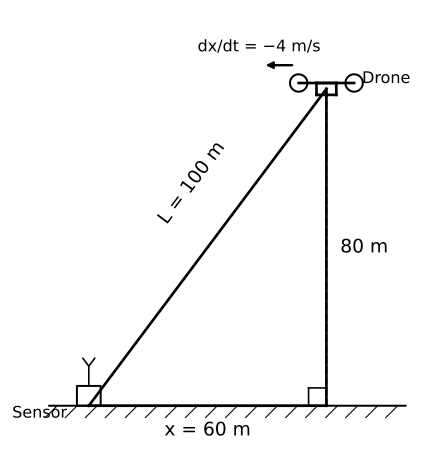
A drone flies horizontally at a constant height of 80 m. A ground sensor tracks the horizontal distance x between the drone and the sensor. The slant distance L between the drone and the sensor satisfies L² = x² + 80² = x² + 6400. At the instant x = 60 m, the drone approaches the sensor at dx/dt = −4 m/s. Signal strength S = k/L², where k > 0.

A drone delivery company is testing a new package-drop mechanism. The drone flies horizontally at a constant height of 80 m above the ground. A ground sensor tracks the horizontal distance x (in metres) between the drone and the sensor at time t (in seconds). At a particular instant, x = 60 m and the drone is approaching the sensor at 4 m/s (i.e., dx/dt = −4 m/s).

(i) Find the distance L between the drone and the sensor at the instant when x = 60 m.
(ii) Find the rate at which L is decreasing at that instant.
(iii) The signal strength S received by the sensor varies inversely as the square of the distance L, i.e., S = k/L², where k is a positive constant. Find the rate of change of S with respect to time at the instant when x = 60 m. Is S increasing or decreasing at that instant?

Diagram for question 5: Applications of Derivatives
Show answer
Sub-part (i) [1 mark]

By the Pythagorean relation,

L² = x² + 80²

Substituting x = 60 m,

L² = 60² + 80² = 3600 + 6400 = 10000

∴ L = 100 m

Sub-part (ii) [1 mark]

Differentiating L² = x² + 6400 with respect to t,

2L · dL/dt = 2x · dx/dt

⟹ dL/dt = (x/L) · dx/dt

Substituting x = 60, L = 100, dx/dt = −4,

dL/dt = (60/100) × (−4) = −12/5

∴ dL/dt = −12/5 = −2·4 m/s

∴ The distance L is decreasing at the rate of 2·4 m/s at that instant.

Sub-part (iii) [2 marks]

Given S = k/L² = k · L<super>−2</super>.

Differentiating with respect to t,

dS/dt = k · (−2) · L<super>−3</super> · dL/dt

⟹ dS/dt = −(2k/L³) · dL/dt

Substituting L = 100 and dL/dt = −12/5,

dS/dt = −(2k/100³) × (−12/5)

⟹ dS/dt = (2k × 12)/(100³ × 5)

⟹ dS/dt = 24k / 50000000

∴ dS/dt = 3k/6250000 = 12k/(25 × 10<super>6</super>) > 0

∵ dS/dt > 0 and k > 0, the signal strength S is increasing at that instant.

(Physically, as the drone approaches the sensor, L decreases, so S = k/L² increases — consistent with the positive rate.)
Q6Case-based4 marks

A water tank in the shape of a closed right circular cylinder has a fixed volume of 54π cubic metres. The authorities want to minimise the total surface area of the tank so that the material cost of construction is kept as low as possible.

A water tank in the shape of a closed right circular cylinder has a fixed volume of 54π cubic metres. The total surface area S (in square metres) of the tank is to be minimised to reduce material cost.

(i) If r is the radius and h is the height of the cylinder, express h in terms of r using the volume constraint. [1]
(ii) Write S as a function of r alone. [1]
(iii) Find the value of r that minimises the total surface area. Also verify it is a minimum. [2]

Show answer
(i) Volume of the cylinder = πr²h = 54π
⟹ r²h = 54
∴ h = 54/r²

(ii) Total surface area of a closed cylinder:
S = 2πr² + 2πrh
Substituting h = 54/r²,
S(r) = 2πr² + 2πr · (54/r²)
∴ S(r) = 2πr² + 108π/r

(iii) Differentiating S w.r.t. r,
S'(r) = 4πr − 108π/r²

For critical points, set S'(r) = 0:
4πr − 108π/r² = 0
⟹ 4πr = 108π/r²
⟹ r³ = 108/4 = 27
∴ r = 3 m

Verification (second derivative test):
S''(r) = 4π + 216π/r³
At r = 3: S''(3) = 4π + 216π/27 = 4π + 8π = 12π > 0
∵ S''(3) > 0, S is minimum at r = 3.

∴ The total surface area is minimised when r = 3 m.
Q7Case-based4 marks

A farmer has 80 metres of fencing wire to enclose a rectangular vegetable garden. He wants to fence three sides of the garden, while the fourth side (the longer side) is already bordered by a wall and needs no fencing. Let the side parallel to the wall have length x metres and the two sides perpendicular to the wall each have length y metres.

A farmer has 80 metres of fencing wire to enclose a rectangular vegetable garden. He wants to fence three sides of the garden, while the fourth side (the longer side) is already bordered by a wall and needs no fencing.

(i) If the side parallel to the wall has length x metres, express the area A(x) of the garden in terms of x.
(ii) Find the value of x for which the area is maximum.
(iii) Hence, find the maximum area of the garden. Also verify that the value of x found in part (ii) gives a maximum and not a minimum.

Show answer
(i) Since three sides are fenced and the total fencing available is 80 m,

the two sides perpendicular to the wall each have length y metres, and the side parallel to the wall has length x metres.

∴ x + 2y = 80

⟹ y = (80 − x)/2 = 40 − x/2

Area of the garden,

A(x) = x · y = x(40 − x/2)

∴ A(x) = 40x − x²/2

(ii) Differentiating A(x) w.r.t. x,

A'(x) = 40 − x

Setting A'(x) = 0,

40 − x = 0 ⟹ x = 40

∴ The area is maximum (or minimum) at x = 40 m.

(iii) A''(x) = −1

∵ A''(40) = −1 < 0, the function A(x) has a maximum at x = 40.

∴ x = 40 gives a maximum area, not a minimum.

Maximum area = A(40) = 40(40) − (40)²/2

= 1600 − 800

= 800

∴ Maximum area of the garden = 800 sq. metres.
Q8Case-based4 marks

A manufacturing company produces cylindrical tin cans (closed at both ends) with fixed volume 54π cm³. Cost of top and bottom faces: ₹2 per cm². Cost of curved lateral surface: ₹1 per cm².

A manufacturing company produces cylindrical tin cans (closed at both ends) for packaging. Each can must have a fixed volume of 54π cm³. The material used for the top and bottom circular faces costs ₹2 per cm², while the material for the curved lateral surface costs ₹1 per cm².

Based on the above information, answer the following questions:

(i) If the radius of the base is r cm and height is h cm, express h in terms of r using the volume constraint.

(ii) Write the total cost C (in ₹) of material as a function of r alone.

(iii) Find the value of r that minimises the total cost. Also find the minimum cost.

OR

(iii) Verify that the value of r obtained in part (ii) indeed gives a minimum (not maximum) of the cost function.

Show answer
(i) Volume of a closed cylinder = πr²h

Given: πr²h = 54π

⟹ r²h = 54

∴ h = 54/r²

(ii) Area of two circular faces (top + bottom) = 2πr²

Area of curved lateral surface = 2πrh

Total cost C = 2 × (2πr²) + 1 × (2πrh)

Substituting h = 54/r²,

C(r) = 4πr² + 2πr · (54/r²)

= 4πr² + 108π/r

∴ C(r) = 4πr² + 108π/r, r > 0

(iii) Differentiating C(r) w.r.t. r,

C'(r) = 8πr − 108π/r²

Setting C'(r) = 0,

8πr − 108π/r² = 0

⟹ 8πr = 108π/r²

⟹ 8r³ = 108

⟹ r³ = 108/8 = 27/2

∴ r = ∛(27/2) = 3/∛2 cm

To confirm this is a minimum, C''(r) = 8π + 216π/r³

Since r > 0, C''(r) > 0 for all r > 0.

∴ C''(3/∛2) > 0 ⟹ C is minimum at r = 3/∛2 cm.

Minimum cost:

C = 4π(3/∛2)² + 108π/(3/∛2)

= 4π · 9/∛4 + 108π · ∛2/3

= 36π/∛4 + 36π∛2

= 36π · (1/∛4 + ∛2)

Now 1/∛4 = ∛2/∛8 = ∛2/2, so:

= 36π (∛2/2 + ∛2)

= 36π · ∛2 · (1/2 + 1)

= 36π · ∛2 · 3/2

= 54π∛2

∴ Minimum cost = 54π∛2 ≈ 54π × 1.26 ≈ 213.9 ₹

OR

(iii) From part (ii), C(r) = 4πr² + 108π/r

C'(r) = 8πr − 108π/r²

C'(r) = 0 gives r³ = 27/2, i.e., r = 3/∛2 cm ...(i)

To verify this is a minimum, we use the second derivative test:

C''(r) = d/dr (8πr − 108π/r²)

= 8π + 216π/r³

At r = 3/∛2:

r³ = 27/2

⟹ C''(3/∛2) = 8π + 216π/(27/2)

= 8π + 216π × 2/27

= 8π + 16π

= 24π > 0

∵ C''(3/∛2) > 0, by the second derivative test, C has a local minimum at r = 3/∛2.

∵ C(r) → ∞ as r → 0⁺ and as r → ∞, this local minimum is also the global (absolute) minimum.

∴ The value r = 3/∛2 cm gives the minimum cost of material.
Q9MCQ1 mark

The function f(x) = 2x³ − 9x² + 12x + 5 is strictly decreasing in the interval:

Show answer
Option (A) is correct.

Explanation: A function is strictly decreasing where f'(x) < 0.

f'(x) = 6x² − 18x + 12 = 6(x² − 3x + 2) = 6(x − 1)(x − 2).

f'(x) < 0 when (x − 1)(x − 2) < 0, i.e., when 1 < x < 2.

∴ f(x) is strictly decreasing on (1, 2).
Q10MCQ1 mark

The function f(x) = 2x³ − 9x² + 12x − 5 is strictly decreasing in the interval:

Show answer
Option (A) is correct.

Explanation: A function is strictly decreasing on an interval if f'(x) < 0 for all x in that interval.

Differentiating both sides w.r.t. x,
f'(x) = 6x² − 18x + 12 = 6(x² − 3x + 2) = 6(x − 1)(x − 2)

For f'(x) < 0: 6(x − 1)(x − 2) < 0 ⟹ (x − 1)(x − 2) < 0 ⟹ 1 < x < 2

∴ f(x) is strictly decreasing in (1, 2).
Q11MCQ1 mark

The function f(x) = 2x³ − 9x² + 12x − 5 is strictly increasing in which of the following intervals?

Show answer
Option (C) is correct.

Explanation: A function is strictly increasing on an interval where f'(x) > 0.
f'(x) = 6x² − 18x + 12 = 6(x − 1)(x − 2).
f'(x) > 0 ⟹ (x − 1)(x − 2) > 0 ⟹ x < 1 or x > 2.
∴ f is strictly increasing on (−∞, 1) ∪ (2, ∞).
Q12MCQ1 mark

The function f(x) = x³ − 3x + 5 is strictly decreasing on the interval:

Show answer
Option (B) is correct.

Explanation: f(x) = x³ − 3x + 5 ⟹ f'(x) = 3x² − 3 = 3(x² − 1) = 3(x − 1)(x + 1).

For strictly decreasing, f'(x) < 0 ⟹ 3(x − 1)(x + 1) < 0 ⟹ (x − 1)(x + 1) < 0 ⟹ x ∈ (−1, 1).
Q13Short Answer2 marks

The radius of a spherical balloon is increasing at the rate of 3 cm/s. Find the rate at which its volume is increasing when the radius is 4 cm.

Show answer
Volume of a sphere: V = (4/3)πr³

Differentiating both sides w.r.t. t,

dV/dt = 4πr² · dr/dt

Given dr/dt = 3 cm/s and r = 4 cm,

dV/dt = 4π(4)² × 3 = 4π × 16 × 3 = 192π cm³/s

∴ The volume of the balloon is increasing at the rate of 192π cm³/s.
Q14Short Answer2 marks

Find the intervals in which the function f(x) = x² − 4x + 3 is (i) increasing, (ii) decreasing.

Show answer
Differentiating f(x) = x² − 4x + 3 w.r.t. x,

f'(x) = 2x − 4 = 2(x − 2)

Setting f'(x) = 0 ⟹ x = 2

Sign of f'(x):

| Interval | Sign of f'(x) | Nature |
|---------------|---------------|--------------|
| x < 2 | negative | Decreasing |
| x > 2 | positive | Increasing |

∴ f is strictly increasing on (2, ∞) and strictly decreasing on (−∞, 2).
Q15Short Answer2 marks

Show that the function f(x) = x³ − 3x² + 3x − 5 is strictly increasing on ℝ.

Show answer
Differentiating f(x) w.r.t. x,

f'(x) = 3x² − 6x + 3 = 3(x² − 2x + 1) = 3(x − 1)²

Now, (x − 1)² ≥ 0 for all x ∈ ℝ, and (x − 1)² = 0 only at x = 1 (an isolated point).

∴ f'(x) = 3(x − 1)² ≥ 0 for all x ∈ ℝ, and f'(x) is not identically zero on any open interval.

∴ f is strictly increasing on ℝ. Hence proved.
Q16Short Answer2 marks

The radius of a circle is increasing at the rate of 3 cm/s. Find the rate at which its area is increasing when the radius is 4 cm.

Show answer
Let r be the radius and A be the area of the circle at time t.

Given: dr/dt = 3 cm/s, r = 4 cm.

Since A = πr², differentiating both sides w.r.t. t,

dA/dt = 2πr · dr/dt

Substituting r = 4 and dr/dt = 3,

dA/dt = 2π(4)(3) = 24π

∴ The area is increasing at the rate of 24π cm²/s.
Q17Short Answer3 marks

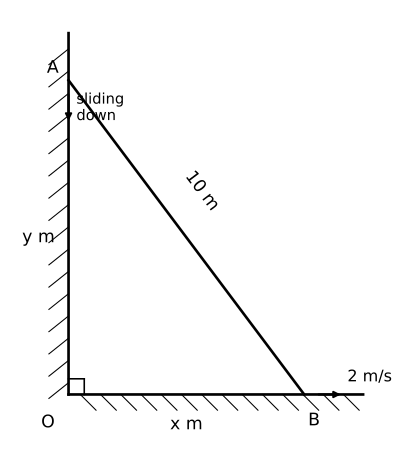
A ladder 10 m long is leaning against a vertical wall. The bottom of the ladder is being pulled along the ground away from the wall at the rate of 2 m/s. Find the rate at which the top of the ladder is sliding down the wall when the bottom of the ladder is 6 m away from the wall.

Diagram for question 17: Applications of Derivatives
Show answer
Let x m be the distance of the bottom of the ladder from the wall and y m be the height of the top of the ladder on the wall at time t seconds.

Since the ladder, wall and ground form a right triangle,

x² + y² = 10² = 100 ...(i)

Differentiating both sides w.r.t. t,

2x · dx/dt + 2y · dy/dt = 0

⟹ x · dx/dt + y · dy/dt = 0 ...(ii)

It is given that dx/dt = 2 m/s and x = 6 m.

From (i), when x = 6:

6² + y² = 100

⟹ y² = 100 − 36 = 64

⟹ y = 8 m (∵ y > 0)

Substituting x = 6, y = 8, dx/dt = 2 in (ii),

6 × 2 + 8 · dy/dt = 0

⟹ 8 · dy/dt = −12

⟹ dy/dt = −3/2 m/s

∴ The top of the ladder is sliding down the wall at the rate of 3/2 m/s.
Q18Short Answer3 marks

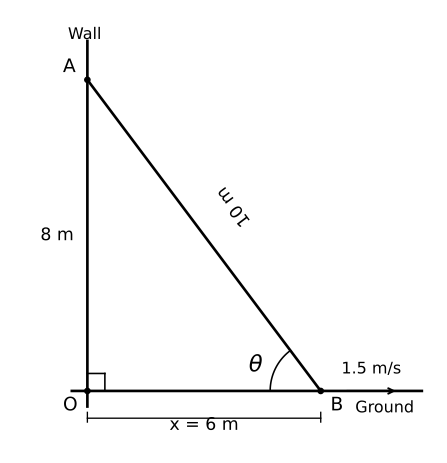
A ladder 10 m long rests against a vertical wall. If the foot of the ladder slides away from the wall at a rate of 1.5 m/s, find the rate at which the angle θ, made by the ladder with the ground, is decreasing when the foot of the ladder is 6 m away from the wall.

Diagram for question 18: Applications of Derivatives
Show answer
Let x m be the distance of the foot of the ladder from the wall and θ be the angle made by the ladder with the ground at any time t.

Then, cos θ = x/10

∴ x = 10 cos θ ...(i)

Differentiating both sides of (i) w.r.t. t,

dx/dt = −10 sin θ · dθ/dt ...(ii)

It is given that dx/dt = 1.5 m/s.

When x = 6 m:

cos θ = 6/10 = 3/5 ⟹ sin θ = 4/5

Substituting in (ii),

1.5 = −10 · (4/5) · dθ/dt

⟹ 1.5 = −8 · dθ/dt

⟹ dθ/dt = −1.5/8 = −3/16 rad/s

∴ The angle θ is decreasing at the rate of 3/16 rad/s.
Q19Short Answer3 marks

Find the intervals in which the function f(x) = 2x³ − 9x² + 12x − 5 is (a) strictly increasing, (b) strictly decreasing.

Show answer
f(x) = 2x³ − 9x² + 12x − 5

Differentiating both sides w.r.t. x,

f'(x) = 6x² − 18x + 12 = 6(x² − 3x + 2) = 6(x − 1)(x − 2)

For critical points, set f'(x) = 0:

6(x − 1)(x − 2) = 0 ⟹ x = 1 or x = 2

These divide ℝ into three intervals: (−∞, 1), (1, 2), (2, ∞).

Sign of f'(x) in each interval:

| Interval | Sign of (x−1) | Sign of (x−2) | Sign of f'(x) | Nature |
|---------------|---------------|---------------|---------------|--------------|
| (−∞, 1) | − | − | + | Increasing |
| (1, 2) | + | − | − | Decreasing |
| (2, ∞) | + | + | + | Increasing |

(a) f'(x) > 0 for x ∈ (−∞, 1) ∪ (2, ∞).

∴ f is strictly increasing on (−∞, 1) ∪ (2, ∞).

(b) f'(x) < 0 for x ∈ (1, 2).

∴ f is strictly decreasing on (1, 2).
Q20Short Answer3 marks

Find the absolute maximum and absolute minimum values of the function f(x) = x³ − 3x² − 9x + 7 on the interval [−2, 4].

Show answer
f(x) = x³ − 3x² − 9x + 7

Differentiating both sides w.r.t. x,
f'(x) = 3x² − 6x − 9 = 3(x² − 2x − 3) = 3(x − 3)(x + 1)

For critical points, set f'(x) = 0:
3(x − 3)(x + 1) = 0
⟹ x = 3 or x = −1

Both x = 3 and x = −1 lie in [−2, 4]. ∴ we evaluate f at the critical points and at the endpoints x = −2 and x = 4.

At x = −2:
f(−2) = (−2)³ − 3(−2)² − 9(−2) + 7 = −8 − 12 + 18 + 7 = 5

At x = −1:
f(−1) = (−1)³ − 3(−1)² − 9(−1) + 7 = −1 − 3 + 9 + 7 = 12

At x = 3:
f(3) = (3)³ − 3(3)² − 9(3) + 7 = 27 − 27 − 27 + 7 = −20

At x = 4:
f(4) = (4)³ − 3(4)² − 9(4) + 7 = 64 − 48 − 36 + 7 = −13

Comparing all values:
f(−2) = 5, f(−1) = 12, f(3) = −20, f(4) = −13

∴ Absolute maximum value of f on [−2, 4] is 12 at x = −1, and absolute minimum value is −20 at x = 3.
Q21Short Answer3 marks

Determine the intervals in which the function f(x) = 2x³ − 9x² + 12x − 5 is (a) strictly increasing, and (b) strictly decreasing.

Show answer
f(x) = 2x³ − 9x² + 12x − 5

Differentiating both sides w.r.t. x,

f′(x) = 6x² − 18x + 12

⟹ f′(x) = 6(x² − 3x + 2)

⟹ f′(x) = 6(x − 1)(x − 2)

Setting f′(x) = 0:

6(x − 1)(x − 2) = 0 ⟹ x = 1 or x = 2

These critical points divide ℝ into three intervals: (−∞, 1), (1, 2), and (2, +∞).

Sign of f′(x) in each interval:

| Interval | (x − 1) | (x − 2) | f′(x) = 6(x−1)(x−2) | Nature |
|--------------|---------|---------|----------------------|--------------|
| (−∞, 1) | −ve | −ve | +ve | Increasing |
| (1, 2) | +ve | −ve | −ve | Decreasing |
| (2, +∞) | +ve | +ve | +ve | Increasing |

∴ f(x) is strictly increasing on (−∞, 1) ∪ (2, +∞).

∴ f(x) is strictly decreasing on (1, 2).
Q22Short Answer3 marks

The surface area of a spherical soap bubble is increasing at the rate of 2 cm²/s. Find the rate at which the radius and the volume of the bubble are increasing when its radius is 6 cm.

Show answer
Let r be the radius of the spherical bubble at time t.

Surface area of sphere: S = 4πr²

Differentiating both sides w.r.t. t,

dS/dt = 8πr · dr/dt

Given: dS/dt = 2 cm²/s and r = 6 cm.

∴ 2 = 8π(6) · dr/dt

⟹ dr/dt = 2/(48π) = 1/(24π) cm/s

∴ Rate of increase of radius = 1/(24π) cm/s.

Now, Volume of sphere: V = (4/3)πr³

Differentiating both sides w.r.t. t,

dV/dt = 4πr² · dr/dt

Substituting r = 6 and dr/dt = 1/(24π),

dV/dt = 4π(6)² · 1/(24π)

⟹ dV/dt = 4π · 36 · 1/(24π)

⟹ dV/dt = 144π/(24π) = 6 cm³/s

∴ Rate of increase of volume = 6 cm³/s.
Q23Case-based4 marks

A spherical balloon is being inflated by pumping air into it. The surface area S (in cm²) and volume V (in cm³) of the balloon are given by S = 4πr² and V = (4/3)πr³, where r is the radius in cm. At a certain instant, r = 5 cm and dr/dt = 0.3 cm/s.

A spherical balloon is being inflated by pumping air into it. The surface area S of the balloon (in cm²) at any instant is related to its radius r (in cm) by S = 4πr². At a certain instant, the radius of the balloon is 5 cm and it is increasing at the rate of 0.3 cm/s.

(i) Find the rate at which the surface area of the balloon is increasing at that instant. [1]
(ii) Find the rate at which the volume of the balloon is increasing at that instant. [1]
(iii) At the same instant, find the rate at which the ratio S/V (surface area to volume) is changing, where V = (4/3)πr³. State whether this ratio is increasing or decreasing. [2]

Show answer
(i) Given: S = 4πr², r = 5 cm, dr/dt = 0.3 cm/s.

Differentiating S = 4πr² with respect to t,

dS/dt = 8πr · dr/dt

Substituting r = 5 and dr/dt = 0.3,

dS/dt = 8π × 5 × 0.3 = 12π cm²/s

∴ The surface area of the balloon is increasing at the rate of 12π cm²/s.

(ii) Given: V = (4/3)πr³.

Differentiating with respect to t,

dV/dt = 4πr² · dr/dt

Substituting r = 5 and dr/dt = 0.3,

dV/dt = 4π × 25 × 0.3 = 30π cm³/s

∴ The volume of the balloon is increasing at the rate of 30π cm³/s.

(iii) Let R = S/V. Then:

R = 4πr² / ((4/3)πr³) = 3/r

Differentiating R = 3/r with respect to t,

dR/dt = −(3/r²) · dr/dt

Substituting r = 5 and dr/dt = 0.3,

dR/dt = −(3/25) × 0.3 = −0.9/25 = −9/250

∴ dR/dt = −9/250 cm⁻¹/s

∵ dR/dt < 0, the ratio S/V is decreasing at that instant.

∴ The rate of change of the ratio S/V is −9/250 cm⁻¹/s, and this ratio is decreasing.
Q24Case-based4 marks

A drone delivery company designs a closed cylindrical package. The sum of the height and the circumference of its circular base is fixed at 120 cm. The company wants to maximise the volume of the package to carry the largest possible payload.

A drone delivery company designs a closed cylindrical package such that the sum of its height and the circumference of its circular base is fixed at 120 cm. The package is manufactured to maximise its volume.

(i) If the radius of the base is r cm, express the height h in terms of r.
(ii) Show that the volume V is given by V = πr²(120 − 2πr).
(iii) Find the radius r for which the volume is maximum. Also verify that it is indeed a maximum.

OR

(iii) The company also considers a cylindrical package (open at the top) with the same constraint: height + circumference = 120 cm. Find the value of r that maximises this open-top volume and determine whether it gives a greater or lesser maximum volume than the closed cylinder.

Show answer
(i) [1 mark]

Constraint: height + circumference of base = 120 cm

∴ h + 2πr = 120

∴ h = 120 − 2πr

(ii) [1 mark]

Volume of a closed cylinder: V = πr²h

Substituting h = 120 − 2πr from (i),

V = πr²(120 − 2πr)

∴ V = πr²(120 − 2πr) Hence shown.

(iii) [2 marks]

V = πr²(120 − 2πr) = 120πr² − 2π²r³

Differentiating V w.r.t. r,

dV/dr = 240πr − 6π²r²

For critical points, set dV/dr = 0:

240πr − 6π²r² = 0

⟹ 6πr(40 − πr) = 0

⟹ r = 0 or r = 40/π

∵ r = 0 gives no physical package, ∴ r = 40/π cm.

Verification (Second Derivative Test):

d²V/dr² = 240π − 12π²r

At r = 40/π,

d²V/dr² = 240π − 12π²·(40/π) = 240π − 480π = −240π < 0

∴ V is maximum at r = 40/π cm.

∴ The radius that maximises the volume is r = 40/π cm.

OR

(iii) [2 marks]

For the open-top cylinder, Volume = πr²h (same formula, no lid change to volume).

Constraint is same: h + 2πr = 120 ⟹ h = 120 − 2πr.

∴ V_open = πr²(120 − 2πr) … (same expression)

∵ The volume formula and the constraint are identical whether the cylinder is open or closed (the lid does not appear in the volume expression),

dV_open/dr = 240πr − 6π²r² = 0

⟹ r = 40/π cm (same critical point)

d²V_open/dr² = 240π − 12π²r

At r = 40/π, d²V_open/dr² = −240π < 0 ∴ maximum.

Maximum volume in both cases:

At r = 40/π: h = 120 − 2π·(40/π) = 120 − 80 = 40 cm

V_max = π·(40/π)²·40 = π·(1600/π²)·40 = 64000/π cm³

∴ The open-top cylinder yields the same maximum volume = 64000/π cm³, which is equal to (not greater or lesser than) that of the closed cylinder, since the constraint and volume expression are identical in both cases.
Q25Case-based4 marks

A city planner is designing a straight road along which the traffic flow rate (in thousands of vehicles per hour) at a distance x km from the city centre is modelled by the function f(x) = 2x³ − 9x² + 12x + 1, x ∈ [0, 3].

A city planner is designing a straight road along which the traffic flow rate (in thousands of vehicles per hour) at a distance x km from the city centre is modelled by the function

f(x) = 2x³ − 9x² + 12x + 1, x ∈ [0, 3].

Based on the above information, answer the following:
(i) Find f′(x) and determine the critical points of f(x) in [0, 3].
(ii) Find the intervals in which f(x) is strictly increasing or strictly decreasing.
(iii) (a) Find the absolute maximum and absolute minimum values of f(x) on [0, 3].
OR
(b) At which point in [0, 3] does the traffic flow rate change from increasing to decreasing? Justify using the first derivative test.

Show answer
(i) Differentiating f(x) = 2x³ − 9x² + 12x + 1 w.r.t. x,

f′(x) = 6x² − 18x + 12
= 6(x² − 3x + 2)
= 6(x − 1)(x − 2)

For critical points, set f′(x) = 0:
6(x − 1)(x − 2) = 0
⟹ x = 1 or x = 2

∴ The critical points of f(x) in [0, 3] are x = 1 and x = 2. [1 mark]

(ii) Sign analysis of f′(x) = 6(x − 1)(x − 2):

| Interval | Sign of (x−1) | Sign of (x−2) | Sign of f′(x) | Nature |
|--------------|---------------|---------------|---------------|--------------|
| (0, 1) | − | − | + | Increasing |
| (1, 2) | + | − | − | Decreasing |
| (2, 3) | + | + | + | Increasing |

∴ f(x) is strictly increasing on (0, 1) and (2, 3), and strictly decreasing on (1, 2). [1 mark]

(iii)(a) To find the absolute maximum and minimum on [0, 3], evaluate f at the critical points and at the endpoints:

f(0) = 2(0)³ − 9(0)² + 12(0) + 1 = 1

f(1) = 2(1)³ − 9(1)² + 12(1) + 1 = 2 − 9 + 12 + 1 = 6

f(2) = 2(2)³ − 9(2)² + 12(2) + 1 = 16 − 36 + 24 + 1 = 5

f(3) = 2(3)³ − 9(3)² + 12(3) + 1 = 54 − 81 + 36 + 1 = 10

Comparing all values: f(0)=1, f(1)=6, f(2)=5, f(3)=10.

∴ Absolute maximum value of f(x) on [0, 3] is 10 (thousand vehicles/hour), attained at x = 3 km.
∴ Absolute minimum value of f(x) on [0, 3] is 1 (thousand vehicles/hour), attained at x = 0 km. [2 marks]

OR

(iii)(b) From part (i), the critical points in [0, 3] are x = 1 and x = 2.

First derivative test at x = 1:
• For x slightly less than 1 (e.g. x ∈ (0,1)): f′(x) > 0 (increasing)
• For x slightly greater than 1 (e.g. x ∈ (1,2)): f′(x) < 0 (decreasing)
∵ f′(x) changes sign from positive to negative at x = 1,
∴ f has a local maximum at x = 1.

First derivative test at x = 2:
• For x slightly less than 2 (e.g. x ∈ (1,2)): f′(x) < 0 (decreasing)
• For x slightly greater than 2 (e.g. x ∈ (2,3)): f′(x) > 0 (increasing)
∵ f′(x) changes sign from negative to positive at x = 2,
∴ f has a local minimum at x = 2.

∴ The traffic flow rate changes from increasing to decreasing at x = 1 km (local maximum), with a flow rate of f(1) = 6 thousand vehicles per hour. [2 marks]
Q26Case-based4 marks

A solar energy company is designing a cylindrical storage tank (closed at both ends) to hold 54π cubic metres of water. The curved surface is made of a special solar-reflective material costing ₹200 per square metre, while each circular end-cap costs ₹300 per square metre to manufacture. Let r metres be the radius of the base and h metres be the height of the cylinder.

A solar energy company is designing a cylindrical storage tank (closed at both ends) to hold 54π cubic metres of water. The curved surface is made of a special solar-reflective material costing ₹200 per square metre, while each circular end-cap costs ₹300 per square metre to manufacture.

Let r metres be the radius of the base and h metres be the height of the cylinder.

(i) Express the total manufacturing cost C (in ₹) in terms of r alone, using the volume constraint.
(ii) Find the value of r that minimises the total cost C.
(iii) (a) Verify, using the second derivative test, that the value of r found in part (ii) indeed gives a minimum cost. Also state the minimum cost.
OR
(iii) (b) The company later decides that, for structural reasons, the height of the tank must satisfy h ≥ 4 m. Determine whether the unconstrained optimal radius found in part (ii) is still feasible. If not, find the radius that minimises cost subject to h ≥ 4 m, and compare this constrained minimum cost with the unconstrained minimum.

Show answer
(i) [1 mark]

Volume constraint: πr²h = 54π ⟹ h = 54/r².

Cost of curved surface = 200 × 2πrh = 400πrh.
Cost of two end-caps = 300 × 2πr² = 600πr².

Substituting h = 54/r²,

C(r) = 400πr · (54/r²) + 600πr²

∴ C(r) = 21600π/r + 600πr² (r > 0)

(ii) [1 mark]

Differentiating w.r.t. r,

C'(r) = −21600π/r² + 1200πr.

For critical point, set C'(r) = 0:

−21600π/r² + 1200πr = 0

⟹ 1200πr = 21600π/r²

⟹ r³ = 21600/1200 = 18

∴ r = ∛18 = (18)<super>1/3</super> metres.

(iii)(a) [2 marks — Second Derivative Test + Minimum Cost]

C''(r) = 43200π/r³ + 1200π.

At r = (18)<super>1/3</super>:

C''((18)<super>1/3</super>) = 43200π/18 + 1200π = 2400π + 1200π = 3600π > 0.

∵ C''(r) > 0 at r = (18)<super>1/3</super>, by the second derivative test, C has a local minimum at r = (18)<super>1/3</super> m.

Minimum cost:

C((18)<super>1/3</super>) = 21600π/(18)<super>1/3</super> + 600π · (18)<super>2/3</super>

= π(18)<super>2/3</super>[21600/(18) + 600]

= π(18)<super>2/3</super>[1200 + 600]

= 1800π(18)<super>2/3</super>

∴ Minimum manufacturing cost = 1800π(18)<super>2/3</super> ₹ (≈ ₹ 58,230, to the nearest rupee).

— OR —

(iii)(b) [2 marks — Constrained Optimisation]

At the unconstrained optimum r = (18)<super>1/3</super> m:

h = 54/r² = 54/(18)<super>2/3</super> = 54 · (18)<super>−2/3</super>.

Now (18)<super>2/3</super> = (18)<super>2/3</super> ≈ 6.87, so h ≈ 54/6.87 ≈ 7.86 m > 4 m.

∵ h ≈ 7.86 ≥ 4, the constraint h ≥ 4 is satisfied at the unconstrained optimal point.

∴ The unconstrained optimal radius r = (18)<super>1/3</super> m is feasible under the constraint h ≥ 4 m.

Hence the constrained minimum cost equals the unconstrained minimum cost = 1800π(18)<super>2/3</super> ₹, achieved at r = (18)<super>1/3</super> m, h ≈ 7.86 m.

(No separate constrained optimum is needed since the structural restriction is not binding.)
Q27Case-based4 marks

A water tank in the shape of a closed circular cylinder is to be manufactured for a housing society. The total surface area of the cylinder is fixed at 54π cm².

A water tank in the shape of a closed circular cylinder is to be manufactured for a housing society. The total surface area of the cylinder is fixed at 54π cm². Based on the above information, answer the following questions:

(i) If r cm is the radius and h cm is the height of the cylinder, express h in terms of r.

(ii) Express the volume V of the cylinder as a function of r alone.

(iii) Find the value of r for which the volume V is maximum.

OR

(iii) Verify that the value of r obtained gives a maximum (not minimum) volume.

Show answer
(i) Total surface area of a closed cylinder = 2πr² + 2πrh

Given: 2πr² + 2πrh = 54π

⟹ 2r² + 2rh = 54

⟹ 2rh = 54 − 2r²

∴ h = (27 − r²)/r ...(i)

[1 mark]

(ii) Volume of cylinder: V = πr²h

Substituting h from (i),

V = πr² · (27 − r²)/r

∴ V(r) = π(27r − r³) ...(ii)

[1 mark]

(iii) Differentiating V(r) w.r.t. r,

V'(r) = π(27 − 3r²)

Setting V'(r) = 0,

π(27 − 3r²) = 0

⟹ 3r² = 27

⟹ r² = 9

∴ r = 3 cm (∵ r > 0)

[2 marks]

OR

(iii) From part (ii), V'(r) = π(27 − 3r²)

Differentiating again w.r.t. r,

V''(r) = π(−6r)

At r = 3:

V''(3) = π(−6 × 3) = −18π < 0

∵ V''(3) < 0, the volume V is maximum at r = 3 cm.

∴ The value r = 3 cm gives a maximum volume. Hence verified.

[2 marks]
Q28Case-based4 marks

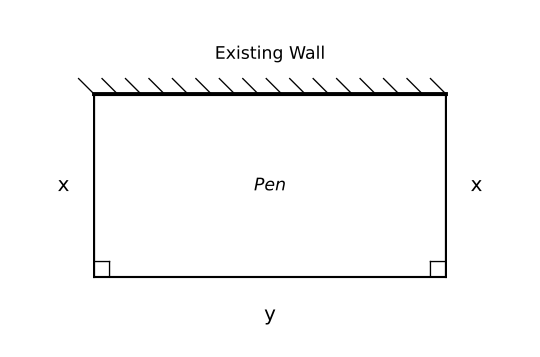
A farmer wants to build a rectangular pen (enclosure) for his cattle using 120 metres of fencing wire. One side of the pen will be along an existing wall, so fencing is needed only for the other three sides. Let the side of the pen perpendicular to the wall have length x metres each, and the side parallel to the wall have length y metres.

A farmer wants to build a rectangular pen (enclosure) for his cattle using 120 metres of fencing wire. One side of the pen will be along an existing wall, so fencing is needed only for the other three sides.

Based on the above information, answer the following questions:

Diagram for question 28: Applications of Derivatives
Show answer
(i) Express y in terms of x.

Since fencing is needed for two sides of length x and one side of length y,

2x + y = 120

∴ y = 120 − 2x

(ii) Express the area A of the pen as a function of x only.

Area of the rectangular pen,

A(x) = x · y = x(120 − 2x)

∴ A(x) = 120x − 2x²

(iii) Find the value of x for which the area is maximum. Also find the maximum area.

OR

(iii) Find the value of x for which A'(x) = 0, and verify using the second derivative test that it gives a maximum.

Main option:

Differentiating A(x) w.r.t. x,

A'(x) = 120 − 4x

Setting A'(x) = 0,

120 − 4x = 0 ⟹ x = 30

Differentiating again,

A''(x) = −4

∵ A''(30) = −4 < 0, A(x) is maximum at x = 30.

∴ y = 120 − 2(30) = 60 m

Maximum area = 30 × 60 = 1800 m²

∴ The area is maximum when x = 30 m, and the maximum area of the pen is 1800 m².

OR option:

Differentiating A(x) w.r.t. x,

A'(x) = 120 − 4x

Setting A'(x) = 0,

120 − 4x = 0 ⟹ x = 30

Now, A''(x) = d/dx(120 − 4x) = −4

∵ A''(30) = −4 < 0,

by the second derivative test, A(x) is maximum at x = 30.

∴ x = 30 m gives the maximum area, and the maximum area = 30 × (120 − 60) = 30 × 60 = 1800 m².
Q29Case-based4 marks

A drone delivery company is designing a closed cylindrical container (with top and bottom lids) to carry packages. The container must have a fixed volume of 54π cm³. The total surface area of a closed cylinder of radius r and height h is S = 2πr² + 2πrh, and its volume is V = πr²h.

A drone delivery company is designing a closed cylindrical container (with top and bottom lids) to carry packages. The container must have a fixed volume of 54π cm³.

(i) If the radius of the base is r cm and height is h cm, express h in terms of r.
(ii) Show that the total surface area S of the container is given by S = 2πr² + 108π/r.
(iii) Find the value of r that minimises the total surface area. Also find the minimum surface area.

OR

(iii) The radius of the base of the container is increasing at the rate of 0.5 cm/s at the instant when r = 3 cm and h is adjusted to always maintain the volume at 54π cm³. Find the rate at which the total surface area is changing at that instant.

Show answer
(i) Volume of the closed cylinder:
V = πr²h = 54π
⟹ r²h = 54
∴ h = 54/r²

(ii) Total surface area:
S = 2πr² + 2πrh
Substituting h = 54/r²,
S = 2πr² + 2πr · (54/r²)
S = 2πr² + 108π/r
∴ S = 2πr² + 108π/r Hence proved.

(iii) To minimise S, differentiate w.r.t. r:
dS/dr = 4πr − 108π/r²
Setting dS/dr = 0,
4πr − 108π/r² = 0
⟹ 4πr = 108π/r²
⟹ r³ = 108/4 = 27
∴ r = 3 cm

Verification using second derivative:
d²S/dr² = 4π + 216π/r³
At r = 3: d²S/dr² = 4π + 216π/27 = 4π + 8π = 12π > 0
∴ S is minimum at r = 3 cm.

Minimum surface area:
S = 2π(3)² + 108π/3
= 18π + 36π
∴ Minimum surface area = 54π cm²

OR

(iii) Given: V = πr²h = 54π (constant), so h = 54/r² at all times.
From part (ii): S = 2πr² + 108π/r
Differentiating both sides w.r.t. time t,
dS/dt = 4πr · dr/dt − 108π/r² · dr/dt
= (4πr − 108π/r²) · dr/dt

Given dr/dt = 0.5 cm/s and r = 3 cm:
dS/dt = (4π(3) − 108π/(3)²) × 0.5
= (12π − 108π/9) × 0.5
= (12π − 12π) × 0.5
= 0 × 0.5
∴ dS/dt = 0 cm²/s

∴ The total surface area is not changing at that instant (rate of change = 0 cm²/s).
Q30Case-based4 marks

A delivery company is analysing the fuel efficiency of its fleet. The fuel consumption F (litres per 100 km) of a delivery van at speed V (km/h) is modelled by the relation:

F = V²/500 − V/4 + 14, where 0 < V ≤ 150.

A delivery company is analysing the fuel efficiency of its fleet. The fuel consumption F (litres per 100 km) of a delivery van at speed V (km/h) is modelled by the relation:

F = V²/500 − V/4 + 14, where 0 < V ≤ 150.

Based on the above information, answer the following questions:

(i) Find dF/dV.

(ii) At what speed V is the fuel consumption minimum? Verify that it is indeed a minimum.

(iii) (a) Find the minimum fuel consumption (in litres per 100 km).

OR

(iii) (b) A driver claims that driving at V = 60 km/h gives lower fuel consumption than driving at V = 100 km/h. Using the model, verify whether the driver's claim is correct.

Show answer
(i) Differentiating F = V²/500 − V/4 + 14 w.r.t. V,

dF/dV = 2V/500 − 1/4 = V/250 − 1/4

∴ dF/dV = V/250 − 1/4 [1 mark]

──────────────────────────────────────

(ii) For minimum fuel consumption, set dF/dV = 0.

V/250 − 1/4 = 0

⟹ V/250 = 1/4

⟹ V = 250/4 = 62.5 km/h

Verification (second derivative test):

d²F/dV² = 1/250 > 0

∵ d²F/dV² > 0, the fuel consumption F is minimum at V = 62.5 km/h.

∴ The fuel consumption is minimum at V = 62.5 km/h. [1 mark]

──────────────────────────────────────

(iii)(a) Minimum fuel consumption:

Substituting V = 62.5 in F = V²/500 − V/4 + 14,

F = (62.5)²/500 − (62.5)/4 + 14

= 3906.25/500 − 62.5/4 + 14

= 7.8125 − 15.625 + 14

= 6.1875

∴ Minimum fuel consumption = 6.1875 litres per 100 km. [2 marks]

──────────────────────────────────────

OR

(iii)(b) Fuel consumption at V = 60 km/h:

F(60) = (60)²/500 − 60/4 + 14

= 3600/500 − 15 + 14

= 7.2 − 15 + 14

= 6.2 litres per 100 km

Fuel consumption at V = 100 km/h:

F(100) = (100)²/500 − 100/4 + 14

= 10000/500 − 25 + 14

= 20 − 25 + 14

= 9 litres per 100 km

∵ F(60) = 6.2 < F(100) = 9,

∴ The driver's claim is correct — driving at 60 km/h consumes less fuel (6.2 l/100 km) than driving at 100 km/h (9 l/100 km). [2 marks]

Want unlimited practice on Applications of Derivatives?

The full ClearSteps bank has 39+ reviewed questions on this chapter alone — with step-wise solutions, difficulty levels, and progress tracking. Verify your WhatsApp number and your free trial starts right here.

CBSE · CLASS 12
🎟️14-day free trial · code PRAC auto-applied
Mobile Number
+91
OTP will be sent to your WhatsApp

⭐ Trusted by 12,000+ students across India

Applications of Derivatives Class 12 Maths Questions