ClearStepsCLEARSTEPS AI
Teacher Login →Student Login →

Integrals: Class 12 Maths Practice Questions

30 original exam-pattern questions with full answers, matched to the current CBSE Class 12 paper design, including case-based questions. Attempt each question before opening the answer — or start a free 14-day trial ↓ for the full bank.

Q1Case-based4 marks

A civil engineer is designing a curved water channel whose cross-sectional area is modelled by the definite integral A = ∫₀^π x · sin x / (1 + cos²x) dx, where x is measured in metres. The engineer uses properties of definite integrals to evaluate this integral analytically.

A civil engineer is designing a curved water channel whose cross-sectional area is modelled by the definite integral

A = ∫₀^π x · sin x / (1 + cos²x) dx

where x is measured in metres.

(i) Using the property ∫ₐᵇ f(x) dx = ∫ₐᵇ f(a+b−x) dx, show that A = (π/2) ∫₀^π sin x / (1 + cos²x) dx. [2]

(ii) Hence evaluate A and state the cross-sectional area of the channel in sq. metres. [2]

Show answer
Part (i) — [2 marks]

Let I = ∫₀^π x sin x / (1 + cos²x) dx … (i)

Applying King's property ∫ₐᵇ f(x) dx = ∫ₐᵇ f(a + b − x) dx with a = 0, b = π,

I = ∫₀^π (π − x) sin(π − x) / (1 + cos²(π − x)) dx

∵ sin(π − x) = sin x and cos(π − x) = −cos x, so cos²(π − x) = cos²x,

⟹ I = ∫₀^π (π − x) sin x / (1 + cos²x) dx … (ii)

Adding (i) and (ii),

2I = ∫₀^π [x sin x + (π − x) sin x] / (1 + cos²x) dx

⟹ 2I = π ∫₀^π sin x / (1 + cos²x) dx

∴ I = (π/2) ∫₀^π sin x / (1 + cos²x) dx Hence shown.

─────────────────────────────────────────────
Part (ii) — [2 marks]

Let J = ∫₀^π sin x / (1 + cos²x) dx

Put t = cos x ⟹ dt = −sin x dx.

When x = 0, t = 1; when x = π, t = −1.

J = ∫₁^(−1) (−dt) / (1 + t²) = ∫₋₁^1 dt / (1 + t²)

⟹ J = [tan⁻¹t]₋₁¹ = tan⁻¹(1) − tan⁻¹(−1)

⟹ J = π/4 − (−π/4) = π/2

∴ A = I = (π/2) · J = (π/2) · (π/2) = π²/4

∴ The cross-sectional area of the channel is π²/4 sq. metres.
Q2Case-based4 marks

A civil engineer is designing a water channel whose cross-sectional area must be computed to determine water flow capacity. The cross-section is bounded above by the curve y = (x² + 4)/(x² + 3x + 2) along the horizontal axis from x = 0 to x = 1. To find the cross-sectional area, the engineer sets up the integral I = ∫₀¹ (x² + 4)/(x² + 3x + 2) dx.

A civil engineer is designing a water channel whose cross-sectional area must be computed to determine water flow capacity. The cross-section is bounded above by the curve y = (x² + 4)/(x² + 3x + 2) along the horizontal axis from x = 0 to x = 1.

To find the cross-sectional area, the engineer sets up the integral:

I = ∫₀¹ (x² + 4)/(x² + 3x + 2) dx

(i) Show that (x² + 4)/(x² + 3x + 2) can be written as 1 + A/(x+1) + B/(x+2) for some constants A and B. Find A and B. [1 mark]

(ii) Hence evaluate I = ∫₀¹ (x² + 4)/(x² + 3x + 2) dx and find the cross-sectional area of the channel. [3 marks]

Show answer
Part (i) [1 mark]

Since degree of numerator = degree of denominator, perform polynomial division first.

(x² + 4) ÷ (x² + 3x + 2):

(x² + 4)/(x² + 3x + 2) = 1 + (−3x + 2)/(x² + 3x + 2)

Now factorise the denominator: x² + 3x + 2 = (x + 1)(x + 2).

∴ (x² + 4)/(x² + 3x + 2) = 1 + (−3x + 2)/((x+1)(x+2))

Decompose the remainder into partial fractions:

(−3x + 2)/((x+1)(x+2)) = A/(x+1) + B/(x+2) ...(i)

⟹ −3x + 2 = A(x+2) + B(x+1)

Put x = −1: −3(−1) + 2 = A(1) ⟹ A = 5

Put x = −2: −3(−2) + 2 = B(−1) ⟹ B = −8

∴ (x² + 4)/(x² + 3x + 2) = 1 + 5/(x+1) − 8/(x+2)

Hence A = 5 and B = −8.


Part (ii) [3 marks]

Using the result from Part (i),

I = ∫₀¹ [1 + 5/(x+1) − 8/(x+2)] dx

Integrating term by term,

I = [x + 5 log|x+1| − 8 log|x+2|]₀¹

Applying the limits,

I = [1 + 5 log 2 − 8 log 3] − [0 + 5 log 1 − 8 log 2]

⟹ I = 1 + 5 log 2 − 8 log 3 − 0 + 8 log 2

⟹ I = 1 + 13 log 2 − 8 log 3

⟹ I = 1 + log 2¹³ − log 3⁸

⟹ I = 1 + log(8192/6561)

∴ Cross-sectional area of the channel = (1 + 13 log 2 − 8 log 3) sq. units.
Q3Case-based4 marks

A physicist studying wave interference models the intensity variation along a screen using the function I(x) = sin x · cos³x. The total energy contribution over a half-cycle [0, π/2] is E = ∫₀^(π/2) sin x · cos³x dx. A colleague proposes that J = ∫₀^(π/2) sin³x · cos x dx also equals E by King's property.

A physicist studying wave interference models the intensity variation along a screen using the function:

I(x) = sin x · cos³x

The total 'energy contribution' over a half-cycle [0, π/2] is computed as:

E = ∫₀^(π/2) sin x · cos³x dx

However, a colleague suggests that by symmetry, the same result can be obtained via the substitution u = cos x, and further proposes that a related integral:

J = ∫₀^(π/2) sin³x · cos x dx

also equals E, by applying the King's property (replacing x with π/2 − x).

Answer the following:
(i) Evaluate E = ∫₀^(π/2) sin x · cos³x dx using substitution. [1]
(ii) Evaluate J = ∫₀^(π/2) sin³x · cos x dx using substitution. [1]
(iii) Verify analytically that E = J by applying King's property to E, i.e., show that ∫₀^(π/2) sin x · cos³x dx = ∫₀^(π/2) sin³x · cos x dx, and hence find the value of E + J. [2]

Show answer
(i) Evaluation of E = ∫₀^(π/2) sin x · cos³x dx

Put u = cos x ⟹ du = −sin x dx, i.e., sin x dx = −du.

When x = 0: u = cos 0 = 1; when x = π/2: u = cos(π/2) = 0.

∴ E = ∫₁⁰ u³ · (−du) = ∫₀¹ u³ du

= [u⁴/4]₀¹ = 1/4 − 0

∴ E = 1/4

(ii) Evaluation of J = ∫₀^(π/2) sin³x · cos x dx

Put v = sin x ⟹ dv = cos x dx.

When x = 0: v = 0; when x = π/2: v = 1.

∴ J = ∫₀¹ v³ dv

= [v⁴/4]₀¹ = 1/4 − 0

∴ J = 1/4

(iii) Verification using King's property and value of E + J

Applying King's property to E:

∫₀^(π/2) f(x) dx = ∫₀^(π/2) f(π/2 − x) dx

Let f(x) = sin x · cos³x. Replacing x with (π/2 − x):

f(π/2 − x) = sin(π/2 − x) · cos³(π/2 − x)
= cos x · sin³x
= sin³x · cos x

∴ ∫₀^(π/2) sin x · cos³x dx = ∫₀^(π/2) sin³x · cos x dx

i.e., E = J. Hence verified analytically.

Since E = 1/4 and J = 1/4,

∴ E + J = 1/4 + 1/4 = 1/2
Q4Case-based4 marks

A student is analysing the energy stored in a circuit, modelled by the integral I = ∫ (2x + 3)/((x + 1)(x² + 1)) dx. To evaluate this integral, the student attempts to decompose the integrand using partial fractions.

A student is analysing the energy stored in a circuit, modelled by the integral I = ∫ (2x + 3)/((x + 1)(x² + 1)) dx. To evaluate this integral, the student attempts to decompose the integrand using partial fractions.

(i) Write the partial fraction decomposition of (2x + 3)/((x + 1)(x² + 1)) in the standard form A/(x + 1) + (Bx + C)/(x² + 1). Find the values of A, B, and C. [1]

(ii) Hence evaluate I = ∫ (2x + 3)/((x + 1)(x² + 1)) dx. [3]

Show answer
Part (i) [1 mark]

Write the partial fraction decomposition:

(2x + 3)/((x + 1)(x² + 1)) = A/(x + 1) + (Bx + C)/(x² + 1) ...(i)

Multiplying both sides by (x + 1)(x² + 1),

2x + 3 = A(x² + 1) + (Bx + C)(x + 1) ...(ii)

Putting x = −1 in (ii):
2(−1) + 3 = A(1 + 1) + 0
⟹ 1 = 2A
⟹ A = 1/2

On comparing coefficients of x² on both sides of (ii):
0 = A + B ⟹ B = −A = −1/2

On comparing constant terms on both sides of (ii):
3 = A + C ⟹ C = 3 − 1/2 = 5/2

∴ A = 1/2, B = −1/2, C = 5/2

─────────────────────────────────────
Part (ii) [3 marks]

Using the values obtained in part (i),

(2x + 3)/((x + 1)(x² + 1)) = (1/2)/(x + 1) + (−(1/2)x + 5/2)/(x² + 1)

∴ I = ∫ (1/2)/(x + 1) dx + ∫ (−(1/2)x + 5/2)/(x² + 1) dx

Splitting the second integral:

I = (1/2) ∫ 1/(x + 1) dx − (1/2) ∫ x/(x² + 1) dx + (5/2) ∫ 1/(x² + 1) dx ...(iii)

Evaluating each integral in (iii) using standard forms:

∫ 1/(x + 1) dx = log|x + 1| + C₁

For ∫ x/(x² + 1) dx: Put u = x² + 1 ⟹ du = 2x dx,
∫ x/(x² + 1) dx = (1/2) ∫ du/u = (1/2) log|x² + 1| + C₂ = (1/2) log(x² + 1) + C₂

∫ 1/(x² + 1) dx = tan⁻¹x + C₃

Substituting back in (iii):

I = (1/2) log|x + 1| − (1/2) · (1/2) log(x² + 1) + (5/2) tan⁻¹x + C

∴ I = (1/2) log|x + 1| − (1/4) log(x² + 1) + (5/2) tan⁻¹x + C
Q5Case-based4 marks

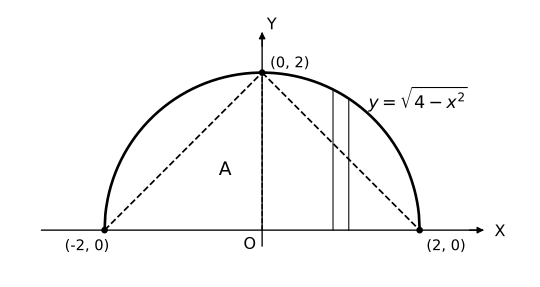
A civil engineer models the decorative arch of a bridge using the curve y = √(4 − x²) for x ∈ [−2, 2]. The area between this arch and the x-axis represents the inner decorative panel that needs to be painted. The engineer uses both exact integration and a numerical approximation to estimate this area.

A civil engineer is designing a curved arch for a bridge. The profile of the arch above the base is modelled by the curve y = √(4 − x²) for x ∈ [−2, 2]. To estimate the paint required for the arch's decorative inner panel, the engineer needs to compute the exact area enclosed between the arch and the x-axis.

(i) Identify the curve y = √(4 − x²) and state the limits of integration needed to find the enclosed area. [1]

(ii) Using the standard result ∫√(a² − x²) dx = (x/2)√(a² − x²) + (a²/2) sin⁻¹(x/a) + C, evaluate the definite integral to find the exact area of the panel. [2]

(iii) The engineer also considers a trapezoidal approximation using only the values at x = −2, 0, 2. Find the percentage error introduced by this approximation compared to the exact area (use π ≈ 3.14). [1]

Diagram for question 5: Integrals
Show answer
(i) The curve y = √(4 − x²) can be written as x² + y² = 4, y ≥ 0, which is the upper semicircle of radius a = 2, centred at the origin.

∴ The required area is given by A = ∫<sub>−2</sub><sup>2</sup> √(4 − x²) dx

The limits of integration are x = −2 and x = 2. [1]

(ii) Let I = ∫<sub>−2</sub><sup>2</sup> √(4 − x²) dx

Using the standard result ∫√(a² − x²) dx = (x/2)√(a² − x²) + (a²/2) sin<sup>−1</sup>(x/a) + C, with a = 2,

I = [ (x/2)√(4 − x²) + (4/2) sin<sup>−1</sup>(x/2) ]<sub>−2</sub><sup>2</sup>

I = [ (x/2)√(4 − x²) + 2 sin<sup>−1</sup>(x/2) ]<sub>−2</sub><sup>2</sup>

At x = 2: (2/2)√(4 − 4) + 2 sin<sup>−1</sup>(1) = 0 + 2 · (π/2) = π

At x = −2: (−2/2)√(4 − 4) + 2 sin<sup>−1</sup>(−1) = 0 + 2 · (−π/2) = −π

∴ I = π − (−π) = 2π

∴ Exact area of the panel = 2π sq. units [2]

(iii) The trapezoidal approximation uses the three points x = −2, x = 0, x = 2, with h = 2.

y(−2) = √(4 − 4) = 0, y(0) = √(4 − 0) = 2, y(2) = √(4 − 4) = 0

Trapezoidal area = (h/2)[y(−2) + 2·y(0) + y(2)]

= (2/2)[0 + 2(2) + 0] = 1 × 4 = 4 sq. units

Exact area = 2π ≈ 2 × 3.14 = 6.28 sq. units

Percentage error = |(6.28 − 4)/6.28| × 100

= (2.28/6.28) × 100 ≈ 36.31%

∴ The percentage error introduced by the trapezoidal approximation is approximately 36.31%. [1]
Q6Case-based4 marks

A city engineer is designing a solar panel installation. The power output (in kilowatts) of a solar panel at time t hours after sunrise is modelled by the function P(t) = sin t + cos t, for 0 ≤ t ≤ π. The total energy output over a time interval [a, b] is given by ∫ₐᵇ P(t) dt kilowatt-hours.

A city engineer is designing a solar panel installation. The power output (in kilowatts) of a solar panel at time t hours after sunrise is modelled by the function P(t) = sin t + cos t, for 0 ≤ t ≤ π.

Based on this model, answer the following:
(i) Find the value of P(0) and P(π/2). [1]
(ii) Find the time t ∈ [0, π] at which P(t) is maximum, and state that maximum value. [1]
(iii) Find the total energy output (in kilowatt-hours) from t = 0 to t = π, i.e., evaluate ∫₀^π (sin t + cos t) dt. [2]

Show answer
(i) P(0) = sin 0 + cos 0 = 0 + 1 = 1 kW.
P(π/2) = sin(π/2) + cos(π/2) = 1 + 0 = 1 kW.
∴ P(0) = 1 kW and P(π/2) = 1 kW.

(ii) P(t) = sin t + cos t = √2 sin(t + π/4).
This is maximum when sin(t + π/4) = 1, i.e., t + π/4 = π/2 ⟹ t = π/4.
∴ P(t) is maximum at t = π/4, and the maximum value is √2 kW.

(iii) Let I = ∫₀^π (sin t + cos t) dt.

I = [−cos t + sin t]₀^π

= (−cos π + sin π) − (−cos 0 + sin 0)

= (−(−1) + 0) − (−1 + 0)

= (1) − (−1)

= 2.

∴ Total energy output = 2 kilowatt-hours.
Q7Case-based4 marks

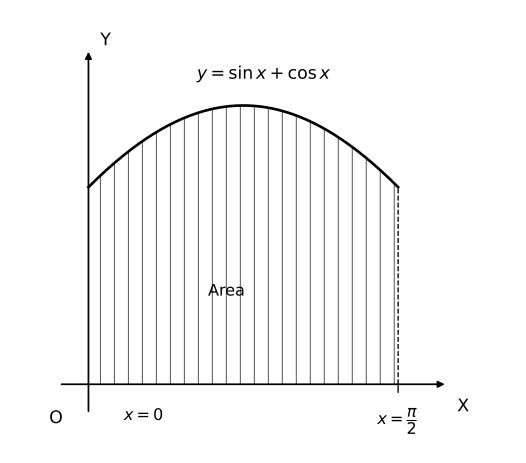
A civil engineer is designing a curved archway for a garden gate. The shape of the arch is modelled by the curve y = sin x + cos x for x ∈ [0, π/2]. To calculate the total area enclosed between the arch and the ground (x-axis), the engineer needs to evaluate a definite integral.

A civil engineer is designing a curved archway for a garden gate. The shape of the arch is modelled by the curve y = sin x + cos x for x ∈ [0, π/2]. To calculate the total area enclosed between the arch and the ground (x-axis), the engineer needs to evaluate a definite integral.

(i) Find the value of (sin x + cos x) at x = π/4.
(ii) Write the definite integral that represents the area under the arch from x = 0 to x = π/2.
(iii) Evaluate the integral to find the total area enclosed between the arch and the x-axis over [0, π/2].

OR

(iii) The engineer realises that the indefinite integral ∫(sin x + cos x) dx is needed for a related calculation. Evaluate ∫(sin x + cos x) dx.

Diagram for question 7: Integrals
Show answer
(i) At x = π/4,

y = sin(π/4) + cos(π/4) = 1/√2 + 1/√2 = 2/√2 = √2

∴ The value of (sin x + cos x) at x = π/4 is √2.

[1 mark]

(ii) Since y = sin x + cos x ≥ 0 for all x ∈ [0, π/2], the area under the arch from x = 0 to x = π/2 is given by:

Area = ∫₀^(π/2) (sin x + cos x) dx

∴ Required integral = ∫₀^(π/2) (sin x + cos x) dx

[1 mark]

(iii) Let I = ∫₀^(π/2) (sin x + cos x) dx

Integrating term by term,

I = [−cos x + sin x]₀^(π/2)

Applying limits,

I = (−cos(π/2) + sin(π/2)) − (−cos 0 + sin 0)

I = (−0 + 1) − (−1 + 0)

I = 1 − (−1)

I = 2

∴ Total area enclosed between the arch and the x-axis = 2 sq. units

[2 marks]

OR

(iii) Let I = ∫(sin x + cos x) dx

Integrating term by term,

I = ∫sin x dx + ∫cos x dx

I = −cos x + sin x + C

∴ ∫(sin x + cos x) dx = sin x − cos x + C

[2 marks]
Q8Case-based4 marks

A civil engineer is designing a water channel whose cross-sectional area (in m²) at a point x metres from one end is modelled by A(x) = ∫ [2x/(x² + 4) + 3/√(16 − x²)] dx, 0 ≤ x ≤ 4. The engineer uses standard integral results to find the general expression A(x) and then applies an initial condition to determine the channel's specific dimensions.

A civil engineer is designing a water channel whose cross-sectional area at a point x metres from one end is modelled by the function

A(x) = ∫ [2x / (x² + 4) + 3 / √(16 − x²)] dx, 0 ≤ x ≤ 4.

The engineer needs to find the general expression A(x) to plan the channel dimensions.

(i) Identify the standard integral form used to evaluate ∫ 2x/(x² + 4) dx and hence find its value. [1 mark]

(ii) Identify the standard integral form used to evaluate ∫ 3/√(16 − x²) dx and hence find its value. [1 mark]

(iii) Using parts (i) and (ii), write the complete expression for A(x). Given that A(0) = 2, find the particular value of the constant of integration and hence state the particular expression for A(x). [2 marks]

Show answer
Solution:

(i) The standard form used is: ∫ f '(x)/f(x) dx = log|f(x)| + C.

Here, f(x) = x² + 4, f '(x) = 2x.

∴ ∫ 2x/(x² + 4) dx = log|x² + 4| + C₁

(ii) The standard form used is: ∫ dx/√(a² − x²) = sin⁻¹(x/a) + C.

Here, a = 4.

∴ ∫ 3/√(16 − x²) dx = 3 sin⁻¹(x/4) + C₂

(iii) Combining parts (i) and (ii),

A(x) = log|x² + 4| + 3 sin⁻¹(x/4) + C

Applying the initial condition A(0) = 2:

2 = log|0 + 4| + 3 sin⁻¹(0/4) + C

2 = log 4 + 3 × 0 + C

∴ C = 2 − log 4

∴ The particular expression for the cross-sectional area is:

A(x) = log|x² + 4| + 3 sin⁻¹(x/4) + 2 − log 4

or equivalently, A(x) = log|(x² + 4)/4| + 3 sin⁻¹(x/4) + 2
Q9MCQ1 mark

The value of ∫ eˣ (tan x + sec²x) dx is:

Show answer
Option (A) is correct.

Explanation: Using the standard result ∫ eˣ [f(x) + f'(x)] dx = eˣ f(x) + C, identify f(x) = tan x so that f'(x) = sec²x. Since the integrand is eˣ (tan x + sec²x) = eˣ [f(x) + f'(x)], we get ∴ ∫ eˣ (tan x + sec²x) dx = eˣ tan x + C.
Q10MCQ1 mark

If ∫ (log x)/x dx = k(log x)² + C, then k is equal to:

Show answer
Option (c) is correct.

Explanation: Let I = ∫ (log x)/x dx. Put t = log x ⟹ dt = (1/x)dx.

∴ I = ∫ t dt = t²/2 + C = (1/2)(log x)² + C.

Comparing with k(log x)² + C, we get k = 1/2.
Q11MCQ1 mark

If ∫ sec²(7 − 4x) dx = f(x) + C, then f(x) is :

Show answer
Option (A) is correct.

Explanation: Using the standard form ∫ sec²(ax + b) dx = (1/a) tan(ax + b) + C,

Here a = −4, b = 7, so ∫ sec²(7 − 4x) dx = (1/(−4)) tan(7 − 4x) + C = −(1/4) tan(7 − 4x) + C.

∴ f(x) = −(1/4) tan(7 − 4x).
Q12MCQ1 mark

∫ dx / (1 + cos 2x) is equal to :

Show answer
Option (A) is correct.

Explanation: Using the identity 1 + cos 2x = 2 cos²x,

∫ dx / (1 + cos 2x) = ∫ dx / (2 cos²x) = (1/2) ∫ sec²x dx = (1/2) tan x + C
Q13Short Answer2 marks

Evaluate: ∫<sub>0</sub><sup>π/2</sup> dx / (1 + √tan x)

Show answer
Let I = ∫<sub>0</sub><sup>π/2</sup> dx / (1 + √tan x) ...(i)

Applying King's property: ∫<sub>a</sub><sup>b</sup> f(x) dx = ∫<sub>a</sub><sup>b</sup> f(a + b − x) dx, with a = 0, b = π/2,

I = ∫<sub>0</sub><sup>π/2</sup> dx / (1 + √tan(π/2 − x))

⟹ I = ∫<sub>0</sub><sup>π/2</sup> dx / (1 + √cot x) ...(ii)

Adding (i) and (ii):

2I = ∫<sub>0</sub><sup>π/2</sup> [ 1/(1 + √tan x) + 1/(1 + √cot x) ] dx

⟹ 2I = ∫<sub>0</sub><sup>π/2</sup> [ (1 + √cot x + 1 + √tan x) / ((1 + √tan x)(1 + √cot x)) ] dx

Now, (1 + √tan x)(1 + √cot x) = 1 + √cot x + √tan x + √(tan x · cot x) = 1 + √cot x + √tan x + 1 = 2 + √tan x + √cot x

⟹ 2I = ∫<sub>0</sub><sup>π/2</sup> (2 + √tan x + √cot x) / (2 + √tan x + √cot x) dx

⟹ 2I = ∫<sub>0</sub><sup>π/2</sup> 1 dx = [ x ]<sub>0</sub><sup>π/2</sup> = π/2

∴ I = π/4
Q14Short Answer2 marks

Find : ∫ 1/(√x · (1 + x)) dx

Show answer
Let I = ∫ 1/(√x · (1 + x)) dx

Put √x = t ⟹ x = t² ⟹ dx = 2t dt

Substituting,

I = ∫ 1/(t · (1 + t²)) · 2t dt = 2∫ 1/(1 + t²) dt

Using the standard form ∫ 1/(1 + t²) dt = tan⁻¹t + C,

I = 2 tan⁻¹t + C

Back-substituting t = √x,

∴ I = 2 tan⁻¹(√x) + C
Q15Short Answer2 marks

Find: ∫ dx / (x² + 4x + 8)

Show answer
Let I = ∫ dx / (x² + 4x + 8)

Completing the square in the denominator:

x² + 4x + 8 = (x + 2)² + 4 = (x + 2)² + 2²

Using the standard form ∫ dx / (x² + a²) = (1/a) tan⁻¹(x/a) + C, with x replaced by (x + 2) and a = 2,

∴ I = (1/2) tan⁻¹((x + 2)/2) + C
Q16Short Answer2 marks

Find : ∫ (e^(3x) + 1) / e^(3x) dx

Show answer
Let I = ∫ (e<super>3x</super> + 1) / e<super>3x</super> dx

Splitting the integrand,

I = ∫ [1 + e<super>−3x</super>] dx

I = x + e<super>−3x</super>/(−3) + C

∴ I = x − (1/3)e<super>−3x</super> + C
Q17Short Answer3 marks

Find: ∫ (x² + 5) / [(x² + 1)(x² + 4)] dx

Show answer
Let I = ∫ (x² + 5) / [(x² + 1)(x² + 4)] dx

We decompose the integrand using partial fractions. Put t = x², so we write:

(t + 5) / [(t + 1)(t + 4)] = A / (t + 1) + B / (t + 4)

⟹ t + 5 = A(t + 4) + B(t + 1) ...(i)

On comparing coefficients of t: A + B = 1 ...(ii)
On comparing constant terms: 4A + B = 5 ...(iii)

From (iii) − (ii): 3A = 4 ⟹ A = 4/3
Substituting in (ii): B = 1 − 4/3 = −1/3

∴ (x² + 5) / [(x² + 1)(x² + 4)] = (4/3) / (x² + 1) + (−1/3) / (x² + 4)

Now integrating term by term,

I = (4/3) ∫ 1/(x² + 1) dx − (1/3) ∫ 1/(x² + 4) dx

Using the standard form ∫ dx/(x² + a²) = (1/a) tan⁻¹(x/a) + C,

I = (4/3) · tan⁻¹(x) − (1/3) · (1/2) tan⁻¹(x/2) + C

∴ I = (4/3) tan⁻¹x − (1/6) tan⁻¹(x/2) + C
Q18Short Answer3 marks

Find : ∫ 1 / [sin(x − a) sin(x − b)] dx

Show answer
Let I = ∫ 1 / [sin(x − a) sin(x − b)] dx

Multiplying and dividing by sin(a − b),

I = (1/sin(a − b)) · ∫ sin(a − b) / [sin(x − a) sin(x − b)] dx ...(i)

Now, sin(a − b) = sin[(x − b) − (x − a)]
= sin(x − b)cos(x − a) − cos(x − b)sin(x − a)

Substituting in (i),

I = (1/sin(a − b)) · ∫ [sin(x − b)cos(x − a) − cos(x − b)sin(x − a)] / [sin(x − a) sin(x − b)] dx

= (1/sin(a − b)) · ∫ [cos(x − a)/sin(x − a) − cos(x − b)/sin(x − b)] dx

= (1/sin(a − b)) · ∫ [cot(x − a) − cot(x − b)] dx

Integrating both terms using ∫cot u du = log|sin u| + C,

I = (1/sin(a − b)) · [log|sin(x − a)| − log|sin(x − b)|] + C

∴ I = (1/sin(a − b)) · log|sin(x − a)/sin(x − b)| + C
Q19Short Answer3 marks

Find : ∫ (2x + 5) / (x² + 4x + 8) dx

Show answer
Let I = ∫ (2x + 5) / (x² + 4x + 8) dx

Write the numerator as:
2x + 5 = A · d/dx(x² + 4x + 8) + B
2x + 5 = A(2x + 4) + B

On comparing coefficients of x: 2 = 2A ⟹ A = 1
On comparing constant terms: 5 = 4A + B ⟹ B = 5 − 4 = 1

∴ I = ∫ [(2x + 4) + 1] / (x² + 4x + 8) dx

⟹ I = ∫ (2x + 4) / (x² + 4x + 8) dx + ∫ 1 / (x² + 4x + 8) dx

⟹ I = I₁ + I₂ ...(i)

For I₁:
I₁ = ∫ (2x + 4) / (x² + 4x + 8) dx

Put t = x² + 4x + 8 ⟹ dt = (2x + 4) dx

∴ I₁ = ∫ dt / t = log|t| + C₁ = log|x² + 4x + 8| + C₁

For I₂:
I₂ = ∫ 1 / (x² + 4x + 8) dx

Complete the square: x² + 4x + 8 = (x + 2)² + 4 = (x + 2)² + 2²

Using the standard form ∫ dx / (x² + a²) = (1/a) tan⁻¹(x/a) + C,

∴ I₂ = (1/2) tan⁻¹((x + 2)/2) + C₂

From (i):

∴ I = log|x² + 4x + 8| + (1/2) tan⁻¹((x + 2)/2) + C
Q20Short Answer3 marks

Find ∫ e^(tan⁻¹x) · (1 + x + x²) / (1 + x²) dx.

Show answer
Let I = ∫ e<super>tan⁻¹x</super> · (1 + x + x²) / (1 + x²) dx.

We split the numerator to separate a known derivative:

(1 + x + x²) / (1 + x²) = x + (1 + x²) / (1 + x²) / ...

Rewrite: 1 + x + x² = (1 + x²) + x

∴ (1 + x + x²) / (1 + x²) = 1 + x / (1 + x²)

So I = ∫ e<super>tan⁻¹x</super> · [1 + x/(1 + x²)] dx …(i)

Now write this in the form ∫ e<super>tan⁻¹x</super> [f(x) + f′(x)] dx.

Let f(x) = x. Then f′(x) = 1, but that gives [x + 1], not [1 + x/(1+x²)].

Instead, try f(x) = x · e<super>tan⁻¹x</super> approach via split:

Write I = ∫ e<super>tan⁻¹x</super> dx + ∫ e<super>tan⁻¹x</super> · x/(1 + x²) dx …(ii)

Apply integration by parts to the second integral:

Let u = e<super>tan⁻¹x</super>, dv = x/(1 + x²) dx
⟹ du = e<super>tan⁻¹x</super> · 1/(1 + x²) dx, v = ½ log(1 + x²)

But this leads to a more complex chain. Use the standard result directly:

Standard form: ∫ e<super>g(x)</super> [f(x) + f′(x)] dx = e<super>g(x)</super> f(x) + C when g′(x) = 1/(1+x²).

Here g(x) = tan⁻¹x, g′(x) = 1/(1 + x²).

Rewrite the integrand:

e<super>tan⁻¹x</super> · (1 + x + x²)/(1 + x²)
= e<super>tan⁻¹x</super> · [x + 1/(1+x²) · (1+x²) + x²/(1+x²)]

Let us try f(x) = x, so f′(x) = 1. We need:

e<super>tan⁻¹x</super>[f(x)·g′(x) + f′(x)] = e<super>tan⁻¹x</super>[x/(1+x²) + 1]

That equals e<super>tan⁻¹x</super>(1 + x/(1+x²)), which equals e<super>tan⁻¹x</super>(1+x+x²)/(1+x²). ✓

The applicable standard result is:

d/dx [e<super>tan⁻¹x</super> · f(x)] = e<super>tan⁻¹x</super> [f′(x) + f(x)/(1+x²)]

So ∫ e<super>tan⁻¹x</super> [f′(x) + f(x)·1/(1+x²)] dx = e<super>tan⁻¹x</super> f(x) + C.

Comparing with I = ∫ e<super>tan⁻¹x</super> [1 + x/(1+x²)] dx:

f′(x) = 1 and f(x)/(1+x²) = x/(1+x²) ⟹ f(x) = x. ✓ (Consistent: f′(x)=1.)

∴ I = e<super>tan⁻¹x</super> · x + C
Q21Short Answer3 marks

Evaluate: ∫₁⁵ |x − 3| dx

Show answer
Let I = ∫₁⁵ |x − 3| dx.

Since the integrand contains a modulus, we split at the break-point x = 3:

|x − 3| = −(x − 3) = 3 − x, when 1 ≤ x < 3
|x − 3| = (x − 3), when 3 ≤ x ≤ 5

∴ I = ∫₁³ (3 − x) dx + ∫₃⁵ (x − 3) dx

Evaluating the first integral:

∫₁³ (3 − x) dx = [3x − x²/2]₁³
= (9 − 9/2) − (3 − 1/2)
= 9/2 − 5/2
= 4/2 = 2

Evaluating the second integral:

∫₃⁵ (x − 3) dx = [x²/2 − 3x]₃⁵
= (25/2 − 15) − (9/2 − 9)
= (25/2 − 30/2) − (9/2 − 18/2)
= (−5/2) − (−9/2)
= −5/2 + 9/2
= 4/2 = 2

∴ I = 2 + 2 = 4
Q22Short Answer3 marks

Find : ∫ (x³ + x + 2) / ((x² + 1)(x + 1)) dx

Show answer
Let I = ∫ (x³ + x + 2) / ((x² + 1)(x + 1)) dx

Step 1 — Check degree and factorise numerator.

Degree of numerator = 3, degree of denominator = 3, so the fraction is improper. Perform polynomial long division:

x³ + x + 2 ÷ (x² + 1)(x + 1) = x³ + x + 2 ÷ (x³ + x² + x + 1)

Dividing: x³ + x + 2 = 1·(x³ + x² + x + 1) + (−x² + 1)

∴ (x³ + x + 2) / ((x² + 1)(x + 1)) = 1 + (−x² + 1) / ((x² + 1)(x + 1))

∴ I = ∫ 1 dx + ∫ (−x² + 1) / ((x² + 1)(x + 1)) dx

Step 2 — Partial fraction decomposition of (−x² + 1) / ((x² + 1)(x + 1)).

Let (−x² + 1) / ((x² + 1)(x + 1)) = A/(x + 1) + (Bx + C)/(x² + 1) …(i)

∴ −x² + 1 = A(x² + 1) + (Bx + C)(x + 1) …(ii)

Putting x = −1 in (ii):
−1 + 1 = A(1 + 1) ⟹ 0 = 2A ⟹ A = 0

Comparing coefficients of x² in (ii):
−1 = A + B ⟹ −1 = 0 + B ⟹ B = −1

Comparing constant terms in (ii):
1 = A + C ⟹ 1 = 0 + C ⟹ C = 1

∴ (−x² + 1) / ((x² + 1)(x + 1)) = (−x + 1)/(x² + 1)

Step 3 — Integrate.

I = ∫ 1 dx + ∫ (−x + 1)/(x² + 1) dx

= ∫ 1 dx − ∫ x/(x² + 1) dx + ∫ 1/(x² + 1) dx

For ∫ x/(x² + 1) dx: Put u = x² + 1 ⟹ du = 2x dx, so x dx = du/2

∴ ∫ x/(x² + 1) dx = (1/2) ∫ du/u = (1/2) log|x² + 1|

∴ I = x − (1/2) log|x² + 1| + tan⁻¹x + C
Q23Long Answer4 marks

A physics student is modelling the energy dissipated in a circuit. While computing the total energy, she needs to evaluate the integral

∫₀^(π/2) [x sin x cos x] / [sin⁴x + cos⁴x] dx

Using properties of definite integrals and appropriate substitutions, help the student evaluate this integral. Also state which property of definite integrals you used and why it simplifies the computation.

Show answer
Let I = ∫₀^(π/2) [x sin x cos x] / [sin⁴x + cos⁴x] dx ...(i)

Applying King's property: ∫₀^a f(x) dx = ∫₀^a f(a − x) dx, with a = π/2,

Replace x by (π/2 − x):

sin x → cos x, cos x → sin x

∴ I = ∫₀^(π/2) [(π/2 − x) cos x sin x] / [cos⁴x + sin⁴x] dx ...(ii)

Adding (i) and (ii):

2I = ∫₀^(π/2) [(x + π/2 − x) sin x cos x] / [sin⁴x + cos⁴x] dx

⟹ 2I = (π/2) ∫₀^(π/2) [sin x cos x] / [sin⁴x + cos⁴x] dx

Divide numerator and denominator by cos⁴x:

2I = (π/2) ∫₀^(π/2) [tan x sec²x] / [tan⁴x + 1] dx

Put t = tan²x ⟹ dt = 2 tan x sec²x dx ⟹ tan x sec²x dx = dt/2

When x = 0, t = 0; when x = π/2, t → ∞

∴ 2I = (π/2) · (1/2) ∫₀^∞ dt / (t² + 1)

⟹ 2I = (π/4) [tan⁻¹t]₀^∞

⟹ 2I = (π/4) · (π/2 − 0)

⟹ 2I = π²/8

∴ I = π²/16

∴ The required value of the integral = π²/16.
Q24Case-based4 marks

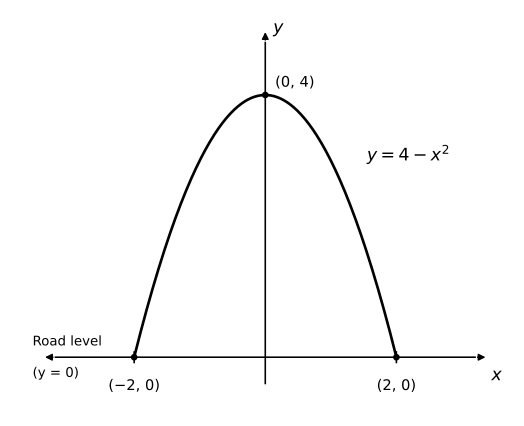
A civil engineer is designing a parabolic arch for a bridge. The vertical cross-section of the arch above the road level is modelled by the curve y = 4 − x², where y is the height (in metres) and x is the horizontal distance (in metres) from the centre of the arch. The road corresponds to the x-axis (y = 0).

A civil engineer is designing a parabolic arch for a bridge. The vertical cross-section of the arch above the road level is modelled by the curve y = 4 − x², where y is the height (in metres) and x is the horizontal distance (in metres) from the centre of the arch. The road corresponds to the x-axis (y = 0).

Based on this context, answer the following:

(i) Find the points where the arch meets the road level.

(ii) The engineer needs to check a symmetry property. Using the substitution x = −t, verify that
∫₋₂² (4 − x²) dx = 2 ∫₀² (4 − x²) dx.

(iii) Using the result from part (ii), evaluate the total cross-sectional area of the arch above the road, i.e., compute ∫₋₂² (4 − x²) dx.

OR

(iii) The engineer also considers the function f(x) = (4 − x²) + x³ over [−2, 2]. Using properties of definite integrals, evaluate ∫₋₂² [(4 − x²) + x³] dx.

Diagram for question 24: Integrals
Show answer
(i) The arch meets the road level where y = 0.

∴ 4 − x² = 0

⟹ x² = 4 ⟹ x = ±2

∴ The arch meets the road at x = −2 and x = 2, i.e., at the points (−2, 0) and (2, 0). [1 mark]

---

(ii) Let I = ∫₋₂² (4 − x²) dx.

Put x = −t ⟹ dx = −dt.

When x = −2, t = 2; when x = 2, t = −2.

∴ I = ∫₂⁻² (4 − (−t)²)(−dt) = ∫₂⁻² (4 − t²)(−dt)

⟹ I = ∫₋₂² (4 − t²) dt

Since the variable of integration is a dummy variable, this shows I = ∫₋₂² (4 − x²) dx, confirming f(−x) = 4 − (−x)² = 4 − x² = f(x).

∵ f(x) = 4 − x² is an even function on [−2, 2], the property of even functions gives:

∫₋₂² (4 − x²) dx = 2 ∫₀² (4 − x²) dx

∴ The symmetry property is verified. [1 mark]

---

(iii) Using the result from part (ii):

∫₋₂² (4 − x²) dx = 2 ∫₀² (4 − x²) dx

= 2 [4x − x³/3]₀²

= 2 [(4(2) − (2)³/3) − (0)]

= 2 [8 − 8/3]

= 2 × (24 − 8)/3

= 2 × 16/3

= 32/3

∴ Total cross-sectional area of the arch = 32/3 sq. metres. [2 marks]

---

OR

(iii) Let I = ∫₋₂² [(4 − x²) + x³] dx.

Write I = ∫₋₂² (4 − x²) dx + ∫₋₂² x³ dx.

Now, let g(x) = 4 − x².

g(−x) = 4 − (−x)² = 4 − x² = g(x) ∴ g(x) is an even function.

∴ ∫₋₂² (4 − x²) dx = 2 ∫₀² (4 − x²) dx [by property of even functions]

= 2 [4x − x³/3]₀²

= 2 [(8 − 8/3) − 0] = 2 × 16/3 = 32/3.

Now, let h(x) = x³.

h(−x) = (−x)³ = −x³ = −h(x) ∴ h(x) is an odd function.

∴ ∫₋₂² x³ dx = 0 [by property of odd functions]

∴ I = 32/3 + 0 = 32/3.

∴ ∫₋₂² [(4 − x²) + x³] dx = 32/3. [2 marks]
Q25Case-based4 marks

A civil engineer is designing curved arches for a bridge. The cross-sectional areas under different arch profiles are modelled by definite integrals of polynomial functions over the interval [0, 2]. The engineer needs to evaluate these integrals accurately to ensure structural safety.

A civil engineer is designing a curved arch for a bridge. The cross-sectional area under the arch is modelled by the definite integral

∫₀² (3x² − 4x + 5) dx square metres.

(i) Using the power rule of integration, find the antiderivative F(x) of f(x) = 3x² − 4x + 5. [1 mark]
(ii) Hence evaluate the definite integral ∫₀² (3x² − 4x + 5) dx and state the cross-sectional area. [1 mark]
(iii) The engineer now considers a modified arch whose cross-section is given by

∫₀² |x² − 3x + 2| dx square metres.

Find the cross-sectional area of the modified arch. [2 marks]

Show answer
(i) Using the power rule of integration,

F(x) = ∫(3x² − 4x + 5) dx = x³ − 2x² + 5x + C

∴ F(x) = x³ − 2x² + 5x + C

(ii) Applying the limits,

∫₀² (3x² − 4x + 5) dx = [x³ − 2x² + 5x]₀²

= (2³ − 2·2² + 5·2) − (0 − 0 + 0)

= (8 − 8 + 10) − 0

= 10

∴ Cross-sectional area = 10 sq. metres

(iii) Let I = ∫₀² |x² − 3x + 2| dx.

First, factorising: x² − 3x + 2 = (x − 1)(x − 2).

For x ∈ [0, 1): (x − 1) < 0 and (x − 2) < 0, so (x−1)(x−2) > 0 ⟹ |x² − 3x + 2| = x² − 3x + 2.

For x ∈ (1, 2]: (x − 1) > 0 and (x − 2) < 0, so (x−1)(x−2) < 0 ⟹ |x² − 3x + 2| = −(x² − 3x + 2).

Splitting the integral at the sign-change point x = 1,

I = ∫₀¹ (x² − 3x + 2) dx + ∫₁² −(x² − 3x + 2) dx

= [x³/3 − 3x²/2 + 2x]₀¹ + [−x³/3 + 3x²/2 − 2x]₁²

Evaluating the first part:

[x³/3 − 3x²/2 + 2x]₀¹ = (1/3 − 3/2 + 2) − 0 = 1/3 − 3/2 + 2

= 2/6 − 9/6 + 12/6 = 5/6

Evaluating the second part:

[−x³/3 + 3x²/2 − 2x]₁² = (−8/3 + 6 − 4) − (−1/3 + 3/2 − 2)

= (−8/3 + 2) − (−1/3 − 1/2)

= (−8/3 + 6/3) − (−2/6 − 3/6)

= (−2/3) − (−5/6)

= −4/6 + 5/6 = 1/6

∴ I = 5/6 + 1/6 = 1

∴ Cross-sectional area of the modified arch = 1 sq. metre
Q26Case-based4 marks

A physicist models the intensity distribution of a laser beam cross-section along a radial axis using the function f(x) = x · e^(2x), where x (in cm) is the distance from the centre. The total intensity contribution from the centre to a point x = 1 cm is modelled by the integral I = ∫₀¹ x · e^(2x) dx.

A physicist models the intensity distribution of a laser beam cross-section along a radial axis using the function

f(x) = x · e^(2x)

where x (in cm) is the distance from the centre. The total intensity contribution from the centre to a point x = 1 cm is modelled by the integral

I = ∫₀¹ x · e^(2x) dx

(i) Identify the appropriate method to evaluate this integral and write down the ILATE choice. [1 mark]
(ii) Evaluate the indefinite integral ∫ x · e^(2x) dx. [1 mark]
(iii) Hence, evaluate I = ∫₀¹ x · e^(2x) dx and find its exact value. [2 marks]

Show answer
(i) The integral ∫ x · e^(2x) dx involves a product of two functions. We use Integration by Parts (ILATE rule).

ILATE choice:
u = x (Algebraic — first in ILATE)
dv = e^(2x) dx (Exponential — second in ILATE)

∴ The method is Integration by Parts with u = x and dv = e^(2x) dx.

[1 mark]

(ii) Let I₁ = ∫ x · e^(2x) dx.

Using Integration by Parts: ∫u · v dx = u∫v dx − ∫(u' · ∫v dx) dx,

u = x ⟹ du/dx = 1
dv = e^(2x) dx ⟹ ∫e^(2x) dx = e^(2x)/2

Substituting,

I₁ = x · (e^(2x)/2) − ∫ 1 · (e^(2x)/2) dx

= (x · e^(2x))/2 − (1/2) · ∫ e^(2x) dx

= (x · e^(2x))/2 − (1/2) · (e^(2x)/2) + C

= (x · e^(2x))/2 − e^(2x)/4 + C

∴ ∫ x · e^(2x) dx = (x · e^(2x))/2 − e^(2x)/4 + C

[1 mark]

(iii) Using the result from (ii),

I = ∫₀¹ x · e^(2x) dx = [(x · e^(2x))/2 − e^(2x)/4]₀¹

Applying the limits,

= [(1 · e²)/2 − e²/4] − [(0 · e⁰)/2 − e⁰/4]

= [e²/2 − e²/4] − [0 − 1/4]

= e²/4 + 1/4

= (e² + 1)/4

∴ I = (e² + 1)/4

[2 marks]
Q27Case-based4 marks

A civil engineer is designing a curved arch for a bridge. The cross-sectional profile of the arch is modelled by the curve y = sin x + cos x for x ∈ [0, π/2], where x is measured in metres along the base and y is the height of the arch at position x. The engineer needs to compute the exact area under this curve to plan the quantity of filling material required.

A civil engineer is designing a curved arch for a bridge. The cross-sectional area under the arch is modelled by the function f(x) = sin x + cos x over the interval [0, π/2] (in metres). The engineer needs to compute the exact area under this curve to determine the material requirement.

(i) Write the definite integral that represents the area under the arch from x = 0 to x = π/2.
(ii) Evaluate the integral ∫₀^(π/2) sin x dx.
(iii) Hence, find the total area under the arch, i.e., evaluate ∫₀^(π/2) (sin x + cos x) dx. Also verify that your answer is consistent with the physical requirement that the area must be positive.

Show answer
(i) The definite integral representing the area under the arch from x = 0 to x = π/2 is:

Area = ∫₀^(π/2) (sin x + cos x) dx

∴ Required integral = ∫₀^(π/2) (sin x + cos x) dx …(1 mark)

(ii) Using the standard result ∫sin x dx = −cos x + C,

∫₀^(π/2) sin x dx = [−cos x]₀^(π/2)

= (−cos π/2) − (−cos 0)

= (−0) − (−1)

= 1

∴ ∫₀^(π/2) sin x dx = 1 …(1 mark)

(iii) Using the standard result ∫cos x dx = sin x + C,

∫₀^(π/2) cos x dx = [sin x]₀^(π/2)

= sin π/2 − sin 0

= 1 − 0 = 1

Now, combining both results from (ii) and above,

∫₀^(π/2) (sin x + cos x) dx = ∫₀^(π/2) sin x dx + ∫₀^(π/2) cos x dx

= 1 + 1

= 2

Verification: Since sin x ≥ 0 and cos x ≥ 0 for all x ∈ [0, π/2], we have (sin x + cos x) ≥ 0 throughout the interval. Therefore the area is necessarily positive, which is consistent with the computed value of 2.

∴ Total area under the arch = 2 sq. metres …(2 marks)
Q28Case-based4 marks

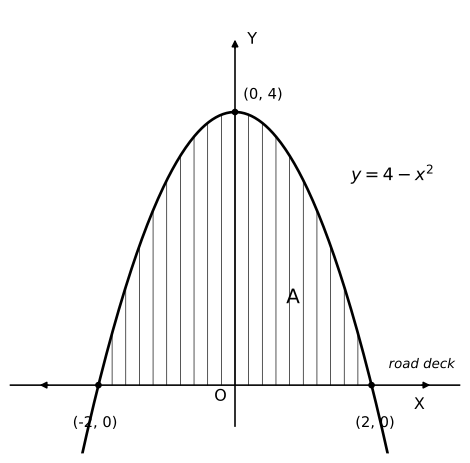
A civil engineer is designing a parabolic arch bridge modelled by the curve y = 4 − x², where the road deck lies along the x-axis. The arch spans from x = −2 to x = 2 (where the curve meets the x-axis). During structural analysis, various integrals arise in computing cross-sectional areas, centroids, and stress distributions modelled by Fourier-type expressions.

A civil engineer is designing a parabolic arch bridge. The arch is modelled by the curve y = 4 − x², and the road deck runs along the x-axis. During a load-stress analysis, the engineer needs to evaluate the following two integrals:

(i) Find the total cross-sectional area (in sq. units) enclosed between the arch y = 4 − x² and the road deck (x-axis).

(ii) To compute the centroid height of the arch, the engineer must evaluate:
∫₋₂² (4 − x²) dx / (Total area found in part (i))

However, before that, evaluate the definite integral:
∫₀^(π/2) x · sin x dx
using integration by parts, which appears in the Fourier stress model for the bridge.

(iii) Using the property of definite integrals, evaluate:
∫₀^π x · sin x / (1 + cos²x) dx

Diagram for question 28: Integrals
Show answer
Sub-part (i) [1 mark]

The arch y = 4 − x² meets the x-axis where 4 − x² = 0 ⟹ x = ±2.

Since y = 4 − x² ≥ 0 for x ∈ [−2, 2],

Area = ∫₋₂² (4 − x²) dx

= [4x − x³/3]₋₂²

= (8 − 8/3) − (−8 + 8/3)

= (16/3) + (16/3)

∴ Total cross-sectional area = 32/3 sq. units

---

Sub-part (ii) [1 mark]

Let I = ∫₀^(π/2) x · sin x dx

Using integration by parts (ILATE: u = x, dv = sin x dx):

I = x · (−cos x)]₀^(π/2) − ∫₀^(π/2) (−cos x) dx

= [−x cos x]₀^(π/2) + ∫₀^(π/2) cos x dx

= (−(π/2)·cos(π/2) + 0·cos 0) + [sin x]₀^(π/2)

= (0 − 0) + (sin(π/2) − sin 0)

= 0 + (1 − 0)

∴ ∫₀^(π/2) x · sin x dx = 1

---

Sub-part (iii) [2 marks]

Let I = ∫₀^π x · sin x / (1 + cos²x) dx ...(i)

Applying King's property: ∫₀^a f(x) dx = ∫₀^a f(a − x) dx, with a = π,

I = ∫₀^π (π − x) · sin(π − x) / (1 + cos²(π − x)) dx

Since sin(π − x) = sin x and cos(π − x) = −cos x ⟹ cos²(π − x) = cos²x,

I = ∫₀^π (π − x) · sin x / (1 + cos²x) dx ...(ii)

Adding (i) and (ii):

2I = ∫₀^π π · sin x / (1 + cos²x) dx

2I = π ∫₀^π sin x / (1 + cos²x) dx

Put t = cos x ⟹ dt = −sin x dx.
When x = 0, t = 1; when x = π, t = −1.

2I = π ∫₁^(−1) (−dt) / (1 + t²)

2I = π ∫₋₁^1 dt / (1 + t²)

2I = π [tan⁻¹t]₋₁^1

2I = π (tan⁻¹1 − tan⁻¹(−1))

2I = π (π/4 − (−π/4))

2I = π · π/2

2I = π²/2

∴ I = π²/4

∴ ∫₀^π x · sin x / (1 + cos²x) dx = π²/4
Q29Case-based4 marks

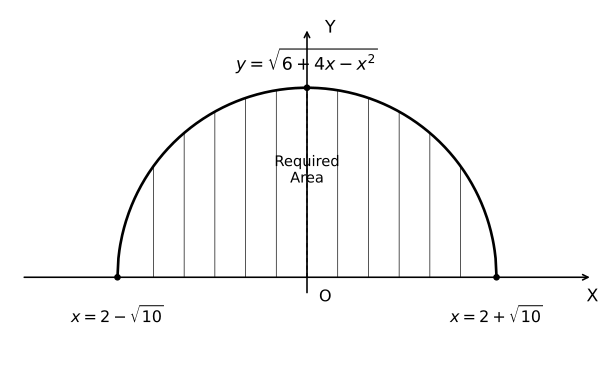
A civil engineer is designing a decorative arch for a park entrance. The arch is modelled by the curve y = √(6 + 4x − x²) above the x-axis. The engineer needs to calculate the exact area enclosed between the arch and the x-axis to determine the amount of material required.

A civil engineer is designing a decorative arch for a park entrance. The arch is modelled by the curve y = √(6 + 4x − x²) above the x-axis. The engineer needs to calculate the exact area (in square units) enclosed between the arch and the x-axis to determine the amount of material required.

(i) Express 6 + 4x − x² in the form a² − (x − b)² and identify the values of a and b. [1]
(ii) Write down the limits of integration (the x-intercepts of the arch) and set up the definite integral for the required area. [1]
(iii) Hence evaluate the integral and find the exact area enclosed between the arch and the x-axis. [2]

Diagram for question 29: Integrals
Show answer
(i) Complete the square:

6 + 4x − x² = −(x² − 4x − 6) = −(x² − 4x + 4 − 4 − 6) = −((x − 2)² − 10)

∴ 6 + 4x − x² = (√10)² − (x − 2)²

∴ a = √10 and b = 2. [1]

(ii) The x-intercepts (limits) are found by setting y = 0:

6 + 4x − x² = 0 ⟹ (√10)² − (x − 2)² = 0 ⟹ x − 2 = ±√10

∴ x = 2 − √10 and x = 2 + √10

Required area = ∫<sub>2−√10</sub><sup>2+√10</sup> √(6 + 4x − x²) dx = ∫<sub>2−√10</sub><sup>2+√10</sup> √((√10)² − (x − 2)²) dx [1]

(iii) Let u = x − 2 ⟹ du = dx.

When x = 2 − √10, u = −√10; when x = 2 + √10, u = √10.

Using the standard result ∫√(a² − u²) du = (u/2)√(a² − u²) + (a²/2) sin⁻¹(u/a) + C with a = √10,

Area = [(u/2)√(10 − u²) + (10/2) sin⁻¹(u/√10)]<sub>−√10</sub><sup>√10</sup>

At u = √10: (√10/2)·√(10 − 10) + 5 sin⁻¹(√10/√10) = 0 + 5 sin⁻¹(1) = 5 · (π/2) = 5π/2

At u = −√10: (−√10/2)·√(10 − 10) + 5 sin⁻¹(−1) = 0 + 5·(−π/2) = −5π/2

∴ Area = 5π/2 − (−5π/2) = 5π/2 + 5π/2 = 5π

∴ Required area enclosed between the arch and the x-axis = 5π sq. units. [2]
Q30Long Answer4 marks

A civil engineer is designing a curved garden wall whose cross-sectional area (in square metres) is modelled by the definite integral

∫₀¹ x · tan⁻¹x dx

Using integration by parts, find the exact cross-sectional area. Also verify that the result lies between 1/4 and 1/2 (i.e., 1/4 < Area < 1/2), justifying your reasoning.

Show answer
Let I = ∫₀¹ x · tan⁻¹x dx

Applying integration by parts (ILATE: take u = tan⁻¹x, dv = x dx),

I = [tan⁻¹x · x²/2]₀¹ − ∫₀¹ (x²/2) · 1/(1 + x²) dx

⟹ I = [tan⁻¹x · x²/2]₀¹ − (1/2)∫₀¹ x²/(1 + x²) dx ...(i)

Evaluating the bracket term:
[tan⁻¹x · x²/2]₀¹ = (tan⁻¹1 · 1/2) − (tan⁻¹0 · 0) = (π/4)(1/2) − 0 = π/8 ...(ii)

For the remaining integral, write:
x²/(1 + x²) = 1 − 1/(1 + x²)

∴ ∫₀¹ x²/(1 + x²) dx = ∫₀¹ [1 − 1/(1 + x²)] dx

= [x − tan⁻¹x]₀¹

= (1 − tan⁻¹1) − (0 − tan⁻¹0)

= (1 − π/4) − 0

= 1 − π/4 ...(iii)

Substituting (ii) and (iii) into (i):

I = π/8 − (1/2)(1 − π/4)

= π/8 − 1/2 + π/8

= π/4 − 1/2

∴ Cross-sectional Area = π/4 − 1/2 sq. metres

─────────────────────────────────
Verification that 1/4 < Area < 1/2:

Using π ≈ 3.14159:
Area = π/4 − 1/2 ≈ 0.7854 − 0.5 = 0.2854

∵ 0.25 < 0.2854 < 0.5,

∴ 1/4 < (π/4 − 1/2) < 1/2 Hence verified.

Alternatively (analytical justification):
Lower bound: π/4 − 1/2 > 1/4 ⟺ π/4 > 3/4 ⟺ π > 3, which is true ∵ π > 3.14.
Upper bound: π/4 − 1/2 < 1/2 ⟺ π/4 < 1 ⟺ π < 4, which is true ∵ π < 3.15 < 4.

∴ The cross-sectional area = (π/4 − 1/2) sq. metres, and 1/4 < (π/4 − 1/2) < 1/2. Hence verified.

Want unlimited practice on Integrals?

The full ClearSteps bank has 43+ reviewed questions on this chapter alone — with step-wise solutions, difficulty levels, and progress tracking. Verify your WhatsApp number and your free trial starts right here.

CBSE · CLASS 12
🎟️14-day free trial · code PRAC auto-applied
Mobile Number
+91
OTP will be sent to your WhatsApp

⭐ Trusted by 12,000+ students across India

Integrals — Class 12 Maths Practice Questions