ClearStepsCLEARSTEPS AI
Teacher Login →Student Login →

Current Electricity: Class 12 Physics Practice Questions

30 original exam-pattern questions with full answers, matched to the current CBSE Class 12 paper design, including case-based questions. Attempt each question before opening the answer — or start a free 14-day trial ↓ for the full bank.

Q1Case-based4 marks

Resistance of a conductor depends on its material, geometry, and temperature. The resistance is given by R = ρL/A, where ρ is the resistivity, L is the length, and A is the cross-sectional area. For metallic conductors, resistivity varies with temperature as ρ = ρ₀(1 + αΔT), where α is the temperature coefficient of resistivity (positive for metals).

A technician is testing two resistors from a hardware store. Resistor P has a length of 2 m, cross-sectional area 1×10⁻⁶ m², and resistivity 1×10⁻⁶ Ω m. Resistor Q is made of the same material but has double the length and half the cross-sectional area of P.

(i) Calculate the resistance of resistor P.
(ii) Find the ratio of resistance of Q to resistance of P.
(iii) The two resistors P and Q are connected in parallel across a 6 V battery of negligible internal resistance. Find the total current drawn from the battery.
(iv) If the temperature of resistor P is increased, state and explain how its resistance changes, given it is a metallic conductor.

Show answer
(i) Resistance of resistor P:

Using the formula R = ρL/A,

R_P = (1×10⁻⁶ × 2) / (1×10⁻⁶)

∴ R_P = 2 Ω

(ii) Ratio of resistance of Q to resistance of P:

For resistor Q: length L_Q = 2L = 4 m, area A_Q = A/2 = 0.5×10⁻⁶ m², same ρ.

R_Q = ρ × (2L) / (A/2) = ρ × 4L/A = 4 × (ρL/A) = 4 R_P

∴ R_Q / R_P = 4 (i.e., R_Q = 8 Ω)

(iii) Total current from the battery:

P and Q are in parallel across V = 6 V.

Current through P: I_P = V/R_P = 6/2 = 3 A

Current through Q: I_Q = V/R_Q = 6/8 = 0.75 A

By Kirchhoff's Current Law (KCL), total current I = I_P + I_Q = 3 + 0.75

∴ I = 3.75 A

(iv) Effect of temperature on resistance of metallic resistor P:

For metallic conductors, resistivity increases with temperature: ρ = ρ₀(1 + αΔT), where α > 0 for metals.

Since R = ρL/A and L, A remain practically unchanged, resistance R_P increases as temperature rises.

This is because increasing temperature causes more frequent collisions between free electrons and the vibrating lattice ions, reducing the relaxation time (τ), hence increasing resistivity and resistance.
Q2Case-based4 marks

A materials testing laboratory uses a long cylindrical nichrome resistor (ρ = 1.0 × 10⁻⁶ Ω m, length = 80 cm, cross-sectional area = 2.0 × 10⁻⁶ m²) connected to a battery (EMF = 6 V, internal resistance r = 1 Ω). The resistor is tapped at its midpoint, and the two equal halves are reconnected in parallel across the same battery.

A materials testing laboratory uses a long cylindrical resistor of length 80 cm and cross-sectional area 2.0 × 10⁻⁶ m² to calibrate precision instruments. The resistor is made of nichrome (resistivity ρ = 1.0 × 10⁻⁶ Ω m). During a test, it is connected to a battery of EMF 6 V and internal resistance 1 Ω. Midway along its length, a thin wire of negligible resistance is tapped off, dividing the resistor into two equal halves. These two halves are reconnected in parallel between the battery terminals (internal resistance still 1 Ω, EMF still 6 V).

(i) Calculate the resistance of the full cylindrical resistor.
(ii) Find the equivalent external resistance when the two halves are connected in parallel.
(iii) Calculate the current drawn from the battery in the parallel arrangement.
(iv) A technician claims that connecting the two halves in parallel (instead of using the full resistor in series) will double the power dissipated in the external circuit. Verify whether this claim is correct, showing your calculation.

Show answer
▌ Sub-part (i) — Resistance of full resistor [1 mark]

By the relation R = ρL/A,

R = (1.0 × 10⁻⁶ × 0.80) / (2.0 × 10⁻⁶)

∴ R = 0.40 Ω

▌ Sub-part (ii) — Equivalent resistance of two halves in parallel [1 mark]

Each half has resistance R/2 = 0.40/2 = 0.20 Ω.

For two equal resistors R₁ = R₂ = 0.20 Ω in parallel:

1/R_eq = 1/0.20 + 1/0.20 = 10

∴ R_eq = 0.10 Ω

▌ Sub-part (iii) — Current drawn from battery in parallel arrangement [1 mark]

By Ohm's law, total EMF drives current through (R_eq + r):

I = E / (R_eq + r) = 6 / (0.10 + 1) = 6 / 1.10

∴ I ≈ 5.45 A

▌ Sub-part (iv) — Verification of technician's claim [1 mark]

Power dissipated in external resistance P = I²R_ext.

Case 1 (full resistor R = 0.40 Ω in series with r = 1 Ω):
I₁ = 6 / (0.40 + 1) = 6 / 1.40 ≈ 4.286 A
P₁ = I₁² × R = (4.286)² × 0.40 ≈ 18.37 × 0.40 ≈ 7.35 W

Case 2 (parallel halves R_eq = 0.10 Ω):
I₂ = 5.45 A (from part iii)
P₂ = I₂² × R_eq = (5.45)² × 0.10 ≈ 29.70 × 0.10 ≈ 2.97 W

P₂ / P₁ ≈ 2.97 / 7.35 ≈ 0.40

∴ The power dissipated in the external circuit actually DECREASES (by a factor ≈ 0.40), not doubles. The technician's claim is incorrect. Although R_eq is reduced (drawing more current from the battery), the dominant effect is that the very low R_eq means most of the terminal voltage is dropped across the internal resistance, so external power is less.
Q3Case-based4 marks

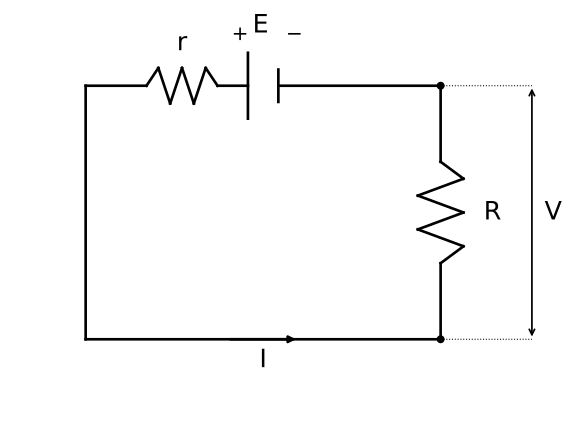
A battery pack for a solar lantern has an EMF (ε) and an internal resistance (r). The terminal voltage V of a battery is related to its EMF ε, current I, and internal resistance r by:

ε = V + Ir

When no current flows (open circuit), the terminal voltage equals the EMF. When current flows, the terminal voltage is less than the EMF due to the voltage drop across the internal resistance.

A technician tests a battery pack used in a solar lantern. In an open circuit, the terminal voltage of the battery reads 6.0 V. When the lantern (resistance 2 Ω) is switched ON, the terminal voltage drops to 5.0 V.

(i) Find the internal resistance of the battery.
(ii) Find the current drawn by the lantern when it is ON.
(iii) Calculate the power dissipated inside the battery due to its internal resistance.
(iv) If the same battery is accidentally short-circuited (R = 0), what will be the short-circuit current? Comment on why this is dangerous.

Show answer
(i) Finding the internal resistance:

By the terminal voltage relation: ε = V + Ir

In open circuit, terminal voltage = EMF:
∴ ε = 6.0 V

When lantern is ON, terminal voltage V = 5.0 V

First, find current using Ohm's law for external resistance:
I = V/R = 5.0/2 = 2.5 A

Substituting in ε = V + Ir:
6.0 = 5.0 + 2.5 × r
→ r = 1.0/2.5

∴ r = 0.4 Ω

(ii) Finding the current drawn by the lantern:

Using I = V/R (already calculated above):
I = 5.0/2

∴ I = 2.5 A

(iii) Power dissipated inside the battery:

Using P = I²r:
P = (2.5)² × 0.4
P = 6.25 × 0.4

∴ P = 2.5 W

This energy is lost as heat inside the battery, reducing the efficiency of the lantern.

(iv) Short-circuit current (R = 0):

Using I_sc = ε/r (when R = 0, entire EMF drives current through internal resistance):
I_sc = 6.0/0.4

∴ I_sc = 15 A

This is dangerous because: the short-circuit current (15 A) is 6 times the normal operating current (2.5 A). Such a large current causes excessive heating (P = I²r = 225 × 0.4 = 90 W) inside the battery, which can cause the battery to overheat, swell, leak, or even catch fire, permanently damaging the battery pack.
Q4Short Answer1 mark

Assertion (A) : When the temperature of a metallic conductor increases, its electrical resistance increases.
Reason (R) : With rise in temperature, the number density of free electrons in a metal decreases.

Show answer
Option (c) is correct.

Explanation: Assertion (A) is TRUE. For metals, resistivity varies as ρ = ρ₀(1 + αΔT), where α > 0. Hence resistance R = ρL/A increases with rising temperature because increased thermal agitation causes more frequent collisions of free electrons with lattice ions, reducing drift velocity.

Reason (R) is FALSE. The number density (n) of free electrons in a metal remains essentially constant with temperature; it is the relaxation time (τ) that decreases with increasing temperature, thereby increasing resistivity. Since R = ρL/A and ρ = m/ne²τ, a decrease in τ directly increases ρ and hence R.

∴ A is true, R is false → Option (c).
Q5MCQ1 mark

Two resistors of resistances R₁ = 4 Ω and R₂ = 12 Ω are connected in parallel. What is the equivalent resistance of the combination?

Show answer
Option (C) is correct.

Explanation: For resistors in parallel, the equivalent resistance R<sub>eq</sub> is given by:

1/R<sub>eq</sub> = 1/R₁ + 1/R₂

→ 1/R<sub>eq</sub> = 1/4 + 1/12 = 3/12 + 1/12 = 4/12

∴ R<sub>eq</sub> = 12/4 = 3 Ω
Q6MCQ1 mark

The resistivity of a metallic conductor increases with rise in temperature. This is because, with rise in temperature:

Show answer
Option (B) is correct.

Explanation: Resistivity is given by ρ = m/(ne²τ), where τ is the relaxation time. With rise in temperature, lattice ions vibrate more vigorously, increasing the frequency of electron–ion collisions and thus decreasing the relaxation time τ. Since ρ ∝ 1/τ, resistivity increases. The number density n, mass m, and charge e of electrons remain essentially unchanged with temperature.
Q7MCQ1 mark

The resistivity of a metallic conductor increases with rise in temperature. This is because, with increase in temperature, the

Show answer
Option (B) is correct.

Explanation: Resistivity is given by ρ = m / (n e² τ), where τ is the relaxation time. As temperature rises, lattice ions vibrate more vigorously, causing more frequent collisions of free electrons with the lattice. This decreases the relaxation time τ, and since ρ ∝ 1/τ, the resistivity increases.
Q8MCQ1 mark

A wire of resistance R is stretched uniformly so that its length becomes double. What is the new resistance of the wire?

Show answer
Option (d) is correct.

Explanation: Using R = ρL/A, when a wire is stretched to double its length, its volume (V = AL) remains constant.

Since A·L = A'·L' → A·L = A'·(2L) → A' = A/2.

∴ New resistance R' = ρ(2L)/(A/2) = 4ρL/A = 4R.
Q9MCQ1 mark

A metallic conductor carries a steady current. If the number density of free electrons in the conductor is n, their drift velocity is v<sub>d</sub>, charge on electron is e, and cross-sectional area is A, which one of the following correctly expresses the electric current I through the conductor?

Show answer
Option (B) is correct.

Explanation: By the relation between drift velocity and current, the current through a conductor is given by I = nAev<sub>d</sub>, where n is the number density of free electrons, A is the cross-sectional area, e is the magnitude of electron charge, and v<sub>d</sub> is the drift speed. This follows from the fact that in time Δt, all electrons in the volume AΔx = A(v<sub>d</sub>Δt) cross a given section, giving charge ΔQ = nAev<sub>d</sub>Δt, and hence I = ΔQ/Δt = nAev<sub>d</sub>.
Q10Short Answer2 marks

The resistance of a tungsten filament at 20°C is 20 Ω. Find the resistance of the filament at 120°C. (Temperature coefficient of resistance of tungsten at 20°C is 4.5 × 10⁻³ K⁻¹.)

Show answer
The resistance of a conductor at temperature T is given by:

R<sub>T</sub> = R<sub>0</sub> [1 + α (T − T<sub>0</sub>)]

where R<sub>0</sub> = resistance at reference temperature T<sub>0</sub>, and α = temperature coefficient of resistance.

Here: R<sub>0</sub> = 20 Ω, T<sub>0</sub> = 20°C, T = 120°C, α = 4.5 × 10<sup>−3</sup> K<sup>−1</sup>

Substituting:

R<sub>T</sub> = 20 × [1 + (4.5 × 10<sup>−3</sup>) × (120 − 20)]

R<sub>T</sub> = 20 × [1 + (4.5 × 10<sup>−3</sup>) × 100]

R<sub>T</sub> = 20 × [1 + 0.45]

R<sub>T</sub> = 20 × 1.45

∴ R<sub>T</sub> = 29 Ω
Q11Short Answer2 marks

Two cells, each of emf ε and internal resistance r, are connected in parallel to an external resistance R. Using Kirchhoff's laws, find an expression for the current through R.

Show answer
Let the current supplied by each cell be I₁ and I₂, and the current through R be I.

By Kirchhoff's Current Law (KCL): I = I₁ + I₂

Applying Kirchhoff's Voltage Law (KVL) to the loop containing cell 1 and R:
ε − I₁r − IR = 0 … (1)

Applying KVL to the loop containing cell 2 and R:
ε − I₂r − IR = 0 … (2)

From (1) and (2): I₁ = I₂ (since both cells are identical)
∴ I = 2I₁

From equation (1): ε − (I/2)r − IR = 0
→ ε = I(r/2 + R)

∴ I = ε / (R + r/2)
Q12Short Answer2 marks

A nichrome wire of length 2 m and cross-sectional area 0·5 mm² has a resistance of 4·4 Ω. Calculate the resistivity of nichrome. Also state how resistivity of a metallic conductor changes with rise in temperature.

Show answer
The resistivity ρ of a material is related to resistance R, length L, and cross-sectional area A by:

R = ρL/A → ρ = RA/L

Given: R = 4·4 Ω, A = 0·5 mm² = 0·5 × 10⁻⁶ m², L = 2 m

Substituting:

ρ = (4·4 × 0·5 × 10⁻⁶) / 2

∴ ρ = 1·1 × 10⁻⁶ Ω m

Effect of temperature: For a metallic conductor, resistivity increases with rise in temperature, as ρ = ρ₀(1 + αΔT), where α > 0 for metals (increased lattice vibrations cause more frequent collisions of free electrons).
Q13Short Answer2 marks

A nichrome wire of length 2 m and cross-sectional area 0·5 mm² has a resistance of 4·4 Ω. Calculate the resistivity of nichrome.

Show answer
The resistivity of a material is given by:

R = ρL/A → ρ = RA/L

Given: R = 4·4 Ω, L = 2 m, A = 0·5 mm² = 0·5 × 10⁻⁶ m²

Substituting:

ρ = (4·4 × 0·5 × 10⁻⁶) / 2

ρ = 2·2 × 10⁻⁶ / 2

∴ ρ = 1·1 × 10⁻⁶ Ω m
Q14Short Answer3 marks

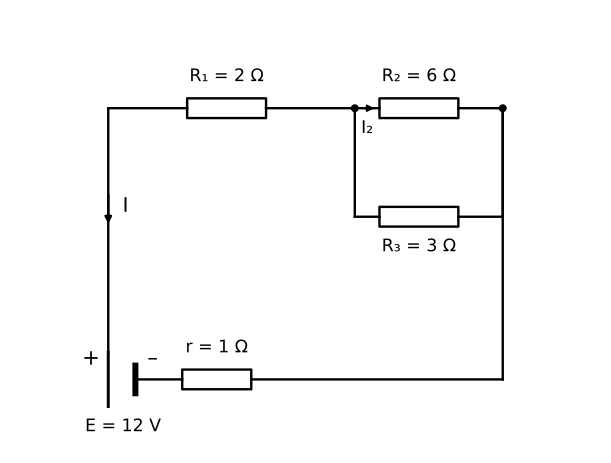
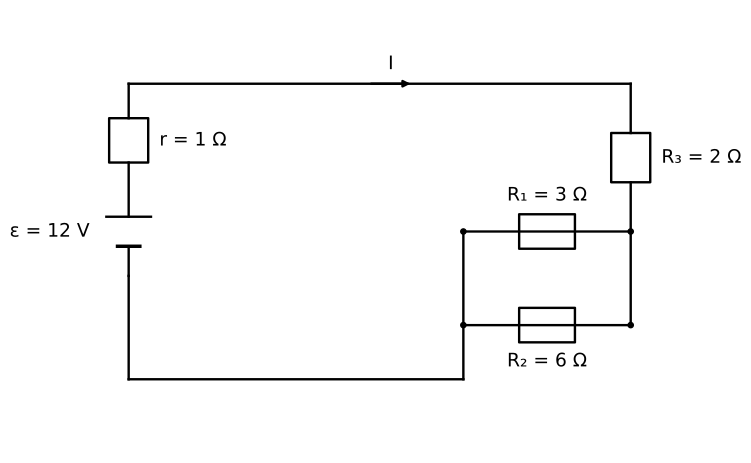
In the circuit shown below, a battery of EMF 12 V and internal resistance 1 Ω is connected to three resistors. Resistors R₁ = 3 Ω and R₂ = 6 Ω are connected in parallel, and this parallel combination is connected in series with R₃ = 2 Ω and the battery. (a) Find the equivalent resistance of the external circuit. (b) Find the current through R₃. (c) Find the potential difference across the parallel combination (R₁ and R₂).

Diagram for question 14: Current Electricity
Show answer
(a) Finding the equivalent external resistance:

R₁ and R₂ are in parallel:

1/R_parallel = 1/R₁ + 1/R₂ = 1/3 + 1/6 = 2/6 + 1/6 = 3/6

∴ R_parallel = 2 Ω

This parallel combination is in series with R₃:

R_ext = R_parallel + R₃ = 2 + 2 = 4 Ω

∴ Equivalent external resistance = 4 Ω [1 mark]

(b) Finding the current through R₃:

By Ohm's law, the current delivered by the battery is:

I = EMF / (R_ext + r)

where r = 1 Ω is the internal resistance.

I = 12 / (4 + 1) = 12 / 5

∴ Current through R₃, I = 2.4 A [1 mark]

(c) Finding the potential difference across the parallel combination:

The potential difference across the parallel combination equals the terminal voltage minus the voltage drop across R₃:

V_parallel = I × R_parallel

V_parallel = 2.4 × 2

∴ Potential difference across parallel combination = 4.8 V [1 mark]
Q15Short Answer3 marks

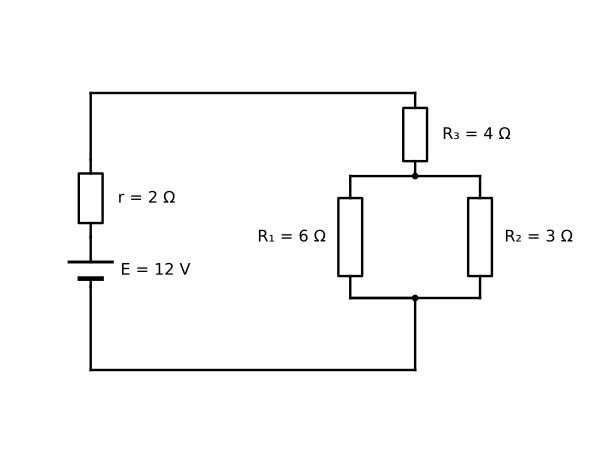
A technician is designing a battery-backup circuit for a small sensor module. Three resistors of resistances R₁ = 6 Ω, R₂ = 3 Ω and R₃ = 4 Ω are connected in a network along with a battery of emf 12 V and internal resistance r = 2 Ω. R₁ and R₂ are connected in parallel with each other, and this parallel combination is connected in series with R₃ and the battery.

(i) Find the equivalent resistance of the external circuit.
(ii) Find the current drawn from the battery.
(iii) Find the terminal voltage of the battery.
(iv) The technician now replaces R₃ with a wire of negligible resistance. Predict what happens to the terminal voltage of the battery and justify your answer.

Diagram for question 15: Current Electricity
Show answer
(i) Equivalent resistance of external circuit:

For R₁ and R₂ in parallel:

1/R_parallel = 1/R₁ + 1/R₂ = 1/6 + 1/3 = 1/6 + 2/6 = 3/6

∴ R_parallel = 2 Ω

This parallel combination is in series with R₃:

∴ R_ext = R_parallel + R₃ = 2 + 4 = 6 Ω

∴ Equivalent external resistance R_ext = 6 Ω [1 mark]

(ii) Current drawn from the battery:

By Ohm's law, total resistance in circuit = R_ext + r = 6 + 2 = 8 Ω

Current I = E / (R_ext + r)

→ I = 12 / 8

∴ I = 1.5 A [1 mark]

(iii) Terminal voltage of the battery:

The terminal voltage is given by:

V_terminal = E − I·r

→ V_terminal = 12 − (1.5)(2) = 12 − 3

∴ V_terminal = 9 V [1 mark]

(iv) Effect on terminal voltage when R₃ is replaced by a wire of negligible resistance:

When R₃ = 0, external resistance = R_parallel = 2 Ω only.

New total resistance = R_parallel + r = 2 + 2 = 4 Ω

New current I′ = 12/4 = 3 A

New terminal voltage V′ = E − I′·r = 12 − (3)(2) = 12 − 6 = 6 V

The terminal voltage decreases (from 9 V to 6 V).

Reason: Because removing R₃ reduces the external resistance, which increases the current drawn from the battery. By the relation V_terminal = E − Ir, a larger current causes a greater potential drop (Ir) across the internal resistance, and so the terminal voltage falls. [1 mark]
Q16Short Answer3 marks

Define resistivity (ρ) of a conductor. Write its SI unit. A wire of resistivity ρ is stretched uniformly so that its length becomes twice its original length. Show that the resistivity of the wire remains unchanged but its resistance becomes four times the original resistance.

Show answer
Definition (½ mark):
Resistivity (ρ) of a conductor is defined as the resistance offered by a conductor of unit length and unit cross-sectional area. It depends only on the material and temperature of the conductor, not on its dimensions.
Formula: ρ = RA/L
SI unit: Ω m (½ mark)

Why resistivity remains unchanged (½ mark):
Resistivity is an intrinsic property of the material. Stretching changes only the geometry (length and area) of the wire, not the nature of the material or its free-electron density. Therefore, ρ remains unchanged after stretching.

Derivation that resistance becomes four times (1½ marks):
Let the original wire have length L, cross-sectional area A, and resistance R.

Original resistance:
By the relation R = ρL/A …(i)

When the wire is stretched to twice its length, the volume of the wire remains constant.
Volume before stretching = Volume after stretching
→ A·L = A′·(2L)
→ A′ = A/2

New resistance after stretching:
R′ = ρ·(2L)/A′
→ R′ = ρ·(2L)/(A/2)
→ R′ = ρ·(2L)·(2/A)
→ R′ = 4·(ρL/A)
→ R′ = 4R [using (i)]

∴ The resistance of the stretched wire is four times the original resistance, while the resistivity of the material remains unchanged.
Q17Short Answer3 marks

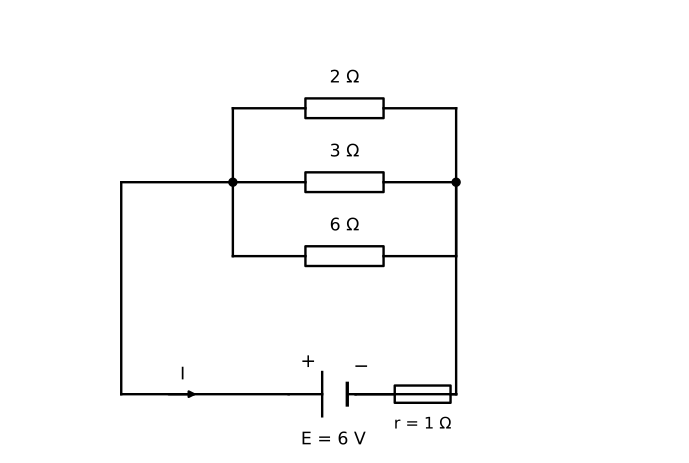
Three resistors of resistances 2 Ω, 3 Ω and 6 Ω are connected in parallel. This parallel combination is then connected in series with a battery of EMF 6 V and internal resistance 1 Ω. Calculate: (a) the effective resistance of the parallel combination, (b) the total current drawn from the battery, and (c) the terminal voltage of the battery.

Diagram for question 17: Current Electricity
Show answer
(a) Effective resistance of the parallel combination:

For resistors in parallel, the equivalent resistance R<sub>p</sub> is given by:

1/R<sub>p</sub> = 1/R<sub>1</sub> + 1/R<sub>2</sub> + 1/R<sub>3</sub>

1/R<sub>p</sub> = 1/2 + 1/3 + 1/6

1/R<sub>p</sub> = 3/6 + 2/6 + 1/6 = 6/6 = 1

∴ R<sub>p</sub> = 1 Ω

(b) Total current drawn from the battery:

The total EMF of the battery is E = 6 V and internal resistance r = 1 Ω.
The parallel combination R<sub>p</sub> = 1 Ω is in series with r.

By Ohm's law applied to the complete circuit:

I = E / (R<sub>p</sub> + r)

I = 6 / (1 + 1)

I = 6 / 2

∴ I = 3 A

(c) Terminal voltage of the battery:

The terminal voltage V is the potential difference across the external (parallel) combination, given by:

V = E − I r

V = 6 − (3)(1)

V = 6 − 3

∴ V = 3 V
Q18Short Answer3 marks

A technician in a quality-control lab has a spool of nichrome wire of resistivity ρ = 1.10 × 10⁻⁶ Ω m and cross-sectional area A = 0.50 mm². She cuts a length L = 2.0 m from the spool and connects it across a cell of emf E = 3.0 V and internal resistance r = 0.5 Ω.

(i) Calculate the resistance R of the nichrome wire.
(ii) Find the drift velocity v_d of electrons in the wire when it carries current. (Given: number density of free electrons in nichrome n = 4.0 × 10²⁸ m⁻³, e = 1.6 × 10⁻¹⁹ C.)
(iii) The technician now doubles the length of the wire to 2L (same wire, same cross-section, same cell). Without doing a full calculation, predict and justify with a formula whether the drift velocity increases, decreases, or remains the same.
(iv) When the current flows through this wire, free electrons drift from the negative terminal side towards the positive terminal. Does this mean that every free electron in the wire moves in the same direction at all times? Justify your answer.

Show answer
(i) State formula and calculate R:

By R = ρL/A,

A = 0.50 mm² = 0.50 × 10⁻⁶ m²

R = (1.10 × 10⁻⁶ × 2.0) / (0.50 × 10⁻⁶)

∴ R = 4.4 Ω

(ii) Find drift velocity v_d:

Current in circuit: I = E / (R + r)

I = 3.0 / (4.4 + 0.5) = 3.0 / 4.9

∴ I ≈ 0.612 A

By I = nAev_d,

v_d = I / (nAe)

v_d = 0.612 / (4.0 × 10²⁸ × 0.50 × 10⁻⁶ × 1.6 × 10⁻¹⁹)

v_d = 0.612 / (4.0 × 10²⁸ × 8.0 × 10⁻²⁶)

v_d = 0.612 / (3200)

∴ v_d ≈ 1.91 × 10⁻⁴ m s⁻¹

(iii) Effect of doubling the wire length:

When the length is doubled to 2L, the resistance becomes R′ = ρ(2L)/A = 2R = 8.8 Ω.

New current: I′ = E / (R′ + r) = 3.0 / (8.8 + 0.5) = 3.0 / 9.3 < I.

Since v_d = I / (nAe) and n, A, e are unchanged, a smaller current means a smaller drift velocity.

∴ The drift velocity decreases when the length is doubled (same cell, increased resistance reduces current and hence v_d).

(iv) Not all free electrons move in the same direction:

Free electrons in a conductor are in continuous random thermal motion with very high speeds (~10⁵ m s⁻¹). When a potential difference is applied, a very small net drift velocity (~ 10⁻⁴ m s⁻¹) is superimposed on this random motion in the direction opposite to the electric field E⃗.

At any instant, individual electrons move in all directions due to thermal agitation; only their average (net) displacement per unit time is directed from the negative to the positive terminal.

∴ No — not every free electron moves in the same direction at all times. The drift velocity represents the average velocity of the electron 'swarm', not the velocity of each individual electron.
Q19Short Answer3 marks

A technician is designing a circuit for a battery-testing station. A battery of EMF 12 V and internal resistance 2 Ω is connected to an external resistor R through a switch S. When S is closed, a current of 2 A flows through the circuit.

(i) Find the value of the external resistance R.

(ii) Calculate the terminal voltage of the battery when S is closed.

(iii) The technician replaces the battery with a second battery of the same EMF (12 V) but internal resistance 0.5 Ω. What current would flow if it is connected to the same external resistance R? Comment on which battery is more efficient for this application and why.

Show answer
(i) Finding external resistance R:

By Ohm's law for a complete circuit, the EMF of a cell is related to current, external resistance, and internal resistance as:

E = I(R + r)

Substituting: 12 = 2 × (R + 2)

→ R + 2 = 6

→ R = 4 Ω

∴ External resistance R = 4 Ω

(ii) Terminal voltage of the battery:

The terminal voltage V is the potential difference across the external resistance (or equivalently, EMF minus the voltage drop across internal resistance):

V = E − Ir

Substituting: V = 12 − (2 × 2) = 12 − 4

∴ Terminal voltage V = 8 V

(iii) Current with the second battery (r′ = 0.5 Ω, R = 4 Ω):

Applying E = I′(R + r′):

12 = I′(4 + 0.5)

→ I′ = 12 / 4.5

∴ I′ = 2.67 A (approximately)

Comment on efficiency:

The efficiency of a cell is defined as the ratio of useful power delivered to the external resistance to the total power generated:

η = P_external / P_total = I²R / (I²(R + r)) = R / (R + r)

For Battery 1 (r = 2 Ω): η₁ = 4 / (4 + 2) = 4/6 ≈ 66.7%

For Battery 2 (r′ = 0.5 Ω): η₂ = 4 / (4 + 0.5) = 4/4.5 ≈ 88.9%

∴ Battery 2 (r = 0.5 Ω) is more efficient for this application because its lower internal resistance results in a smaller voltage drop across the cell itself, delivering a greater fraction of the total power to the external circuit.
Q20Short Answer3 marks

A technician working in an electronics lab has a cylindrical wire of resistivity ρ = 2.0 × 10⁻⁶ Ω m, length L = 2 m, and cross-sectional area A = 0.5 × 10⁻⁶ m². The wire is connected to a battery of emf E = 6 V and internal resistance r = 1 Ω.

(i) Calculate the resistance R of the wire and the current I drawn from the battery.

(ii) The technician now stretches this wire uniformly until its length becomes 3L (i.e., 3 times the original length). Assuming the volume of the wire remains constant during stretching, find the new resistance R′ of the stretched wire.

(iii) If the stretched wire (resistance R′) is now connected to the same battery (emf E = 6 V, internal resistance r = 1 Ω), find the new current I′ and the percentage decrease in current compared to the original current I.

(iv) The technician notices that the terminal voltage of the battery has changed after stretching. Explain why the terminal voltage increases when the external resistance increases, using the relation V = E − Ir.

Show answer
(i) Finding R and I:

The resistance of a wire is given by:
R = ρL/A

Substituting values:
R = (2.0 × 10⁻⁶ × 2) / (0.5 × 10⁻⁶)
R = (4.0 × 10⁻⁶) / (0.5 × 10⁻⁶)
∴ R = 8 Ω

Current drawn from the battery:
By Ohm's law (including internal resistance): I = E / (R + r)
I = 6 / (8 + 1) = 6 / 9
∴ I = 0.67 A (= 2/3 A)

(ii) Finding new resistance R′ after stretching:

When the wire is stretched to length L′ = 3L, volume is conserved:
Volume = A × L = A′ × L′
A × L = A′ × 3L
∴ A′ = A/3

New resistance:
R′ = ρL′/A′ = ρ(3L)/(A/3) = 9 × (ρL/A) = 9R
R′ = 9 × 8
∴ R′ = 72 Ω

(iii) Finding I′ and percentage decrease:

I′ = E / (R′ + r) = 6 / (72 + 1) = 6 / 73
∴ I′ ≈ 0.082 A

Percentage decrease in current:
= [(I − I′) / I] × 100
= [(2/3 − 6/73) / (2/3)] × 100
= [(146/219 − 18/219) / (146/219)] × 100
= [128/219 ÷ 146/219] × 100
= (128/146) × 100
∴ Percentage decrease ≈ 87.7% ≈ 88%

(iv) Explanation of increased terminal voltage:

By Kirchhoff's voltage law, the terminal voltage of a battery is:
V = E − Ir

When the external resistance R increases, the current I = E/(R + r) decreases. Since the voltage drop across the internal resistance (= Ir) decreases, the terminal voltage V = E − Ir increases. Thus, more of the emf is available across the external circuit when a higher external resistance is connected.
Q21Short Answer3 marks

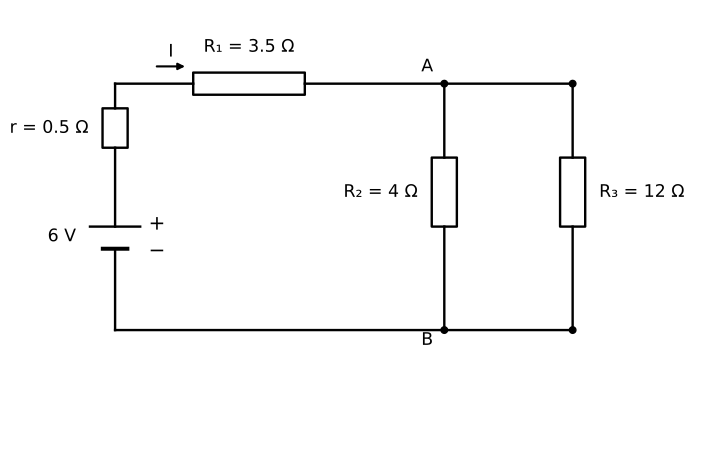
A technician is testing a battery-powered heating element used in a portable hand-warmer. The battery (EMF = 6 V, internal resistance r = 0.5 Ω) is connected to an external circuit consisting of two resistors: a fixed resistor R₁ = 3.5 Ω in series with a parallel combination of two resistors R₂ = 4 Ω and R₃ = 12 Ω.

(a) Find the equivalent external resistance of the circuit.
(b) Find the current drawn from the battery.
(c) Find the terminal voltage of the battery.
(d) The technician observes that the heating element (R₂) grows warm but R₃ does not heat up noticeably. Using the concept of power dissipation, justify this observation quantitatively.

Diagram for question 21: Current Electricity
Show answer
(a) The parallel combination of R₂ and R₃:

Using the formula for parallel combination:

1/R_parallel = 1/R₂ + 1/R₃ = 1/4 + 1/12 = 3/12 + 1/12 = 4/12

∴ R_parallel = 3 Ω

Total external resistance:

R_ext = R₁ + R_parallel = 3.5 + 3 = 6.5 Ω

∴ R_ext = 6.5 Ω

(b) By Ohm's law applied to the complete circuit (including internal resistance):

I = EMF / (R_ext + r) = 6 / (6.5 + 0.5) = 6 / 7

Wait — recalculating: 6.5 + 0.5 = 7 Ω

I = 6 / 7 ≈ 0.857 A

∴ Current drawn from battery I ≈ 0.86 A

(c) Terminal voltage of the battery:

Using V_terminal = EMF − I·r

V_terminal = 6 − (6/7)(0.5) = 6 − 3/7 = (42 − 3)/7 = 39/7 ≈ 5.57 V

∴ Terminal voltage V_terminal ≈ 5.57 V

(Alternatively: V_terminal = I × R_ext = (6/7) × 6.5 = 39/7 ≈ 5.57 V ✓)

(d) The voltage across the parallel combination (= voltage across R₂ and R₃):

V_parallel = I × R_parallel = (6/7) × 3 = 18/7 ≈ 2.57 V

Power dissipated in R₂ (heating element):

Using P = V²/R:

P₂ = (18/7)² / 4 = (324/49) / 4 = 324/196 ≈ 1.65 W

Power dissipated in R₃:

P₃ = (18/7)² / 12 = (324/49) / 12 = 324/588 ≈ 0.55 W

∴ P₂ ≈ 1.65 W and P₃ ≈ 0.55 W

Since P₂ = 3 × P₃, the heating element R₂ dissipates three times more power than R₃. This is because both resistors share the same terminal voltage, and since P = V²/R, the smaller resistance (R₂ = 4 Ω) dissipates more power than the larger resistance (R₃ = 12 Ω). Hence R₂ heats up noticeably while R₃ does not.
Q22Short Answer3 marks

A nichrome wire of length 60 cm and cross-sectional area 0.50 mm² has a resistance of 3.6 Ω at 20°C. The same wire is connected to a battery of EMF 6 V and internal resistance 0.4 Ω. (a) Calculate the resistivity of nichrome at 20°C. (b) Find the current drawn from the battery. (c) Find the potential difference across the ends of the wire.

Show answer
(a) The resistance of a conductor is related to its resistivity by:

R = ρL/A

∴ ρ = RA/L

Substituting: R = 3.6 Ω, A = 0.50 mm² = 0.50 × 10⁻⁶ m², L = 60 cm = 0.60 m

ρ = (3.6 × 0.50 × 10⁻⁶) / 0.60

ρ = 1.80 × 10⁻⁶ / 0.60

∴ ρ = 3.0 × 10⁻⁶ Ω m

(b) By Ohm's law, the current in a circuit containing a source of EMF (E), internal resistance (r), and external resistance (R) is given by:

I = E / (R + r)

Substituting: E = 6 V, R = 3.6 Ω, r = 0.4 Ω

I = 6 / (3.6 + 0.4) = 6 / 4.0

∴ I = 1.5 A

(c) The terminal potential difference across the external resistance (nichrome wire) is given by:

V = E − Ir

Substituting: E = 6 V, I = 1.5 A, r = 0.4 Ω

V = 6 − (1.5 × 0.4) = 6 − 0.6

∴ V = 5.4 V
Q23Short Answer3 marks

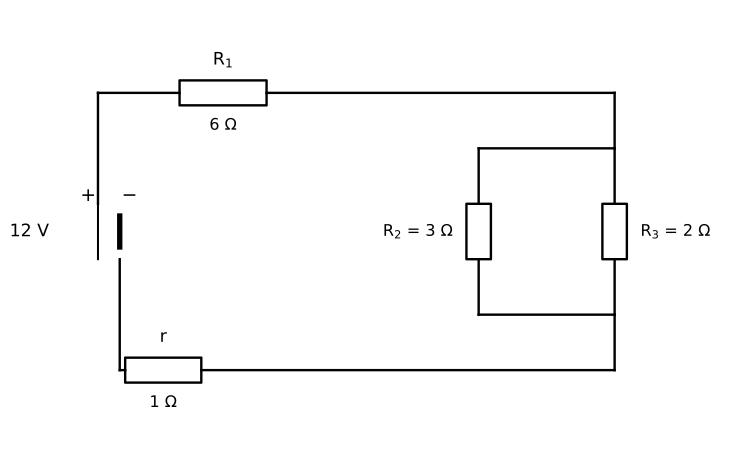
A technician in a factory has three resistors: R₁ = 6 Ω, R₂ = 3 Ω, and R₃ = 2 Ω. She connects them to a battery of EMF 12 V and internal resistance r = 1 Ω as shown: R₁ is connected in series with the parallel combination of R₂ and R₃.

(i) Calculate the equivalent resistance of R₂ and R₃ in parallel. (1 mark)
(ii) Find the total current drawn from the battery. (1 mark)
(iii) Determine the potential difference across the parallel combination (R₂ ∥ R₃). (1 mark)
(iv) The technician now replaces R₁ with a wire of the same material and same mass but double the length. By what factor does the total external resistance change? (1 mark)

Diagram for question 23: Current Electricity
Show answer
(i) Equivalent resistance of R₂ and R₃ in parallel:

For a parallel combination, 1/R_p = 1/R₂ + 1/R₃

→ 1/R_p = 1/3 + 1/2 = 2/6 + 3/6 = 5/6

∴ R_p = 6/5 = 1.2 Ω

(ii) Total current drawn from the battery:

By Ohm's law, I = E / (R_ext + r), where R_ext = R₁ + R_p

→ R_ext = 6 + 1.2 = 7.2 Ω

→ Total resistance = R_ext + r = 7.2 + 1 = 8.2 Ω

→ I = 12 / 8.2 ≈ 1.46 A

∴ Total current I ≈ 1.46 A

(iii) Potential difference across the parallel combination:

V_p = I × R_p

→ V_p = 1.46 × 1.2

∴ V_p ≈ 1.75 V

(iv) Change in total external resistance when R₁ is replaced:

Given: same material (same resistivity ρ) and same mass m, but double the length (L' = 2L).

Since mass = ρ_material × volume = ρ_material × A × L is constant,
and the new length L' = 2L, the new cross-sectional area A' satisfies:

A' × 2L = A × L → A' = A/2

Original resistance: R₁ = ρL/A

New resistance: R₁' = ρL'/A' = ρ(2L)/(A/2) = 4ρL/A = 4R₁ = 4 × 6 = 24 Ω

Original R_ext = R₁ + R_p = 6 + 1.2 = 7.2 Ω

New R_ext' = R₁' + R_p = 24 + 1.2 = 25.2 Ω

Factor = R_ext' / R_ext = 25.2 / 7.2 = 3.5

∴ The total external resistance increases by a factor of 3.5 (i.e., becomes 3.5 times the original).
Q24Short Answer3 marks

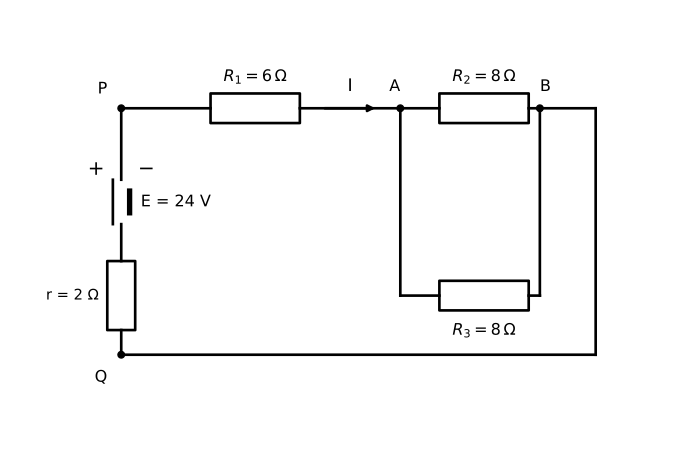
A technician is testing a battery-powered emergency lighting system. The battery has an EMF of 24 V and an internal resistance of 2 Ω. The lighting circuit consists of three resistors connected as follows: a 6 Ω resistor (R₁) in series with a parallel combination of 8 Ω (R₂) and 8 Ω (R₃). The technician notices that if the terminal voltage of the battery drops below 20 V, the lights become too dim to be useful.

(a) Calculate the equivalent resistance of the external circuit.
(b) Find the current drawn from the battery.
(c) Determine the terminal voltage of the battery and state whether the lights will be bright enough.
(d) Find the power dissipated in R₁.

Diagram for question 24: Current Electricity
Show answer
(a) Equivalent Resistance of External Circuit

The parallel combination of R₂ and R₃:

1/R_parallel = 1/R₂ + 1/R₃ = 1/8 + 1/8 = 2/8

∴ R_parallel = 4 Ω

R₁ is in series with this parallel combination:

R_ext = R₁ + R_parallel = 6 + 4

∴ R_ext = 10 Ω

(b) Current Drawn from the Battery

By Ohm's law for the complete circuit (EMF = I(R_ext + r)):

E = I(R_ext + r)

24 = I(10 + 2)

I = 24/12

∴ I = 2 A

(c) Terminal Voltage and Assessment

The terminal voltage is given by:

V_terminal = E − I·r

V_terminal = 24 − (2)(2) = 24 − 4

∴ V_terminal = 20 V

Since V_terminal = 20 V, which is equal to the minimum threshold of 20 V, the lights are just bright enough to be useful (operating at the borderline condition).

(d) Power Dissipated in R₁

The same current I = 2 A flows through R₁ (series connection). Using P = I²R:

P₁ = I² × R₁ = (2)² × 6 = 4 × 6

∴ P₁ = 24 W
Q25Short Answer3 marks

A student sets up the circuit shown below for a school science project. A battery of EMF 12 V and internal resistance 1 Ω is connected to three resistors: R₁ = 2 Ω (in series with the battery), and R₂ = 6 Ω and R₃ = 3 Ω connected in parallel with each other, with this parallel combination in series with R₁ and the battery.

(i) Find the equivalent resistance of the parallel combination of R₂ and R₃.
(ii) Find the total current drawn from the battery.
(iii) Find the current through R₂.
(iv) The student notices that the terminal voltage of the battery is less than its EMF. Using the relation between EMF, terminal voltage, and internal resistance, find the terminal voltage of the battery.

Diagram for question 25: Current Electricity
Show answer
(i) For two resistors R₂ and R₃ in parallel, the equivalent resistance R_p is given by:

1/R_p = 1/R₂ + 1/R₃

→ 1/R_p = 1/6 + 1/3 = 1/6 + 2/6 = 3/6 = 1/2

∴ R_p = 2 Ω

(ii) Total resistance in the circuit:

By Kirchhoff's Voltage Law (KVL), the EMF of the battery equals the sum of potential drops across internal resistance r, R₁, and R_p:

R_total = r + R₁ + R_p = 1 + 2 + 2 = 5 Ω

Using Ohm's law: I = E / R_total

→ I = 12 / 5

∴ I = 2.4 A

(iii) The potential difference across the parallel combination (R₂ ∥ R₃):

V_p = I × R_p = 2.4 × 2 = 4.8 V

Current through R₂:

I₂ = V_p / R₂ = 4.8 / 6

∴ I₂ = 0.8 A

(iv) The terminal voltage V of a battery is related to its EMF E and internal resistance r by:

V = E − I r

→ V = 12 − (2.4 × 1) = 12 − 2.4

∴ Terminal voltage V = 9.6 V

The terminal voltage (9.6 V) is less than the EMF (12 V) because of the potential drop across the internal resistance of the battery when current flows through it.
Q26Short Answer3 marks

A research student is designing a temperature-sensing circuit using two metal wires — Wire P (made of nichrome, temperature coefficient of resistivity α₁ = 4×10⁻⁴ °C⁻¹) and Wire Q (made of copper, temperature coefficient of resistivity α₂ = 4×10⁻³ °C⁻¹). Both wires have the same resistance R₀ = 10 Ω at 0°C and are connected in series to a battery of EMF 6 V and internal resistance r = 1 Ω.

(i) Write an expression for the total resistance of the circuit at temperature T °C in terms of R₀, α₁, α₂, and T. Hence, find the total resistance at T = 100°C.

(ii) Calculate the current drawn from the battery at T = 100°C.

(iii) The student notices that at a certain temperature T*, the voltage drop across Wire Q becomes exactly double the voltage drop across Wire P. Derive an expression for T* in terms of α₁ and α₂, and evaluate it numerically.

(iv) Give one reason why nichrome is preferred over copper for use in standard resistance boxes, linking your answer to the value of α.

Show answer
(i) The resistance of a metallic conductor at temperature T °C is given by:

R(T) = R₀(1 + αT)

For Wire P: R_P = R₀(1 + α₁T)
For Wire Q: R_Q = R₀(1 + α₂T)

Since the wires are in series, total resistance:
R_total = R_P + R_Q = R₀(1 + α₁T) + R₀(1 + α₂T)

∴ R_total = R₀[2 + (α₁ + α₂)T]

At T = 100°C:
α₁ + α₂ = 4×10⁻⁴ + 4×10⁻³ = 4.4×10⁻³ °C⁻¹

R_total = 10 × [2 + (4.4×10⁻³)(100)]
= 10 × [2 + 0.44]
= 10 × 2.44

∴ R_total = 24.4 Ω

(ii) By Ohm's law for a circuit with internal resistance:

I = EMF / (R_total + r)

Substituting values:
I = 6 / (24.4 + 1) = 6 / 25.4

∴ I ≈ 0.236 A (≈ 0.24 A)

(iii) Since the wires carry the same current I (series connection), the voltage drop across each wire is:

V_P = I · R_P and V_Q = I · R_Q

Condition: V_Q = 2 V_P
→ I · R_Q = 2 · I · R_P
→ R_Q = 2 R_P

Substituting:
R₀(1 + α₂T*) = 2 R₀(1 + α₁T*)

1 + α₂T* = 2 + 2α₁T*

α₂T* − 2α₁T* = 1

T*(α₂ − 2α₁) = 1

∴ T* = 1 / (α₂ − 2α₁)

Substituting numerical values:
α₂ − 2α₁ = 4×10⁻³ − 2×(4×10⁻⁴)
= 4×10⁻³ − 8×10⁻⁴
= 3.2×10⁻³ °C⁻¹

∴ T* = 1 / (3.2×10⁻³) ≈ 312.5°C

(iv) Nichrome has a very small temperature coefficient of resistivity (α₁ = 4×10⁻⁴ °C⁻¹), which is nearly ten times smaller than that of copper. This means its resistance changes negligibly with temperature, ensuring that the resistance value remains stable and accurate over a wide range of operating temperatures. Hence nichrome is preferred over copper in standard resistance boxes.
Q27Short Answer3 marks

A battery manufacturer claims that their new 'long-life' battery has an emf of 9 V and an internal resistance of 0.5 Ω. A student connects this battery to a circuit consisting of two resistors: a 4.5 Ω resistor and a 3.0 Ω resistor connected in parallel, and this parallel combination is connected in series with a 1.0 Ω resistor. The student notices that the terminal voltage of the battery is less than 9 V when the circuit is connected.

(a) Calculate the equivalent resistance of the external circuit.
(b) Calculate the current drawn from the battery.
(c) Calculate the terminal voltage of the battery.
(d) A second identical battery is now connected in series with the first battery (both positive terminals facing the same direction). Without detailed calculation, predict whether the terminal voltage of the combination will be greater than, less than, or equal to 18 V when connected to the same external circuit. Justify your answer in one or two sentences.

Show answer
Given: emf E = 9 V, internal resistance r = 0.5 Ω.
External circuit: R₁ = 4.5 Ω and R₂ = 3.0 Ω in parallel, in series with R₃ = 1.0 Ω.

(a) Equivalent resistance of the parallel combination:

By the formula for parallel resistors: 1/R_parallel = 1/R₁ + 1/R₂

→ 1/R_parallel = 1/4.5 + 1/3.0 = 2/9 + 3/9 = 5/9

→ R_parallel = 9/5 = 1.8 Ω

Total external (load) resistance:
R_ext = R_parallel + R₃ = 1.8 + 1.0 = 2.8 Ω

∴ Equivalent resistance of external circuit = 2.8 Ω

(b) Current drawn from the battery:

By Ohm's law applied to the complete circuit (emf, internal resistance, external resistance):

I = E / (R_ext + r)

→ I = 9 / (2.8 + 0.5) = 9 / 3.3

∴ I = 2.73 A (≈ 2.7 A)

(c) Terminal voltage of the battery:

The terminal voltage V_T is the emf minus the voltage drop across the internal resistance:

V_T = E − I·r

→ V_T = 9 − (2.73 × 0.5) = 9 − 1.36

∴ V_T ≈ 7.64 V

This confirms V_T < 9 V, consistent with the student's observation.

(d) Prediction for two identical batteries in series:

When two identical batteries (each E = 9 V, r = 0.5 Ω) are connected in series, the total emf becomes 2E = 18 V and the total internal resistance becomes 2r = 1.0 Ω. The current drawn from the combination increases (since R_ext = 2.8 Ω remains the same but the driving emf is doubled), leading to a larger voltage drop (I′ × 2r) across the combined internal resistance. Therefore, the terminal voltage of the combination will be less than 18 V.

Justification: V_T(combination) = 2E − I′(2r) = 18 − I′ × 1.0, where I′ = 18/(2.8 + 1.0) = 18/3.8 ≈ 4.74 A, giving V_T ≈ 18 − 4.74 ≈ 13.26 V < 18 V.
Q28Short Answer3 marks

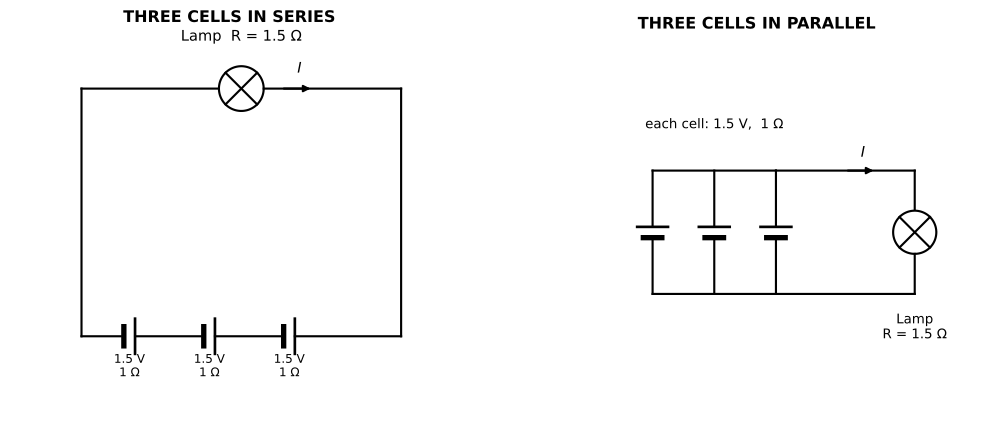
A school science club is designing a battery-powered emergency lamp. They have three identical cells, each of emf 1.5 V and internal resistance 1 Ω. The lamp has a resistance of 1.5 Ω.

(i) If the three cells are connected in SERIES with the lamp, find the current through the lamp and the terminal voltage of the series combination.

(ii) If the three cells are connected in PARALLEL with the lamp, find the current through the lamp and the terminal voltage of the parallel combination.

(iii) In which configuration — series or parallel — does the lamp receive MORE power? Calculate the power in each case and justify which configuration the club should prefer for a BRIGHTER lamp.

Diagram for question 28: Current Electricity
Show answer
Given: emf of each cell E = 1.5 V, internal resistance of each cell r = 1 Ω, external resistance (lamp) R = 1.5 Ω.

━━━━━━━━━━━━━━━━━━━━━━━━━━━━━━
PART (i) — SERIES COMBINATION
━━━━━━━━━━━━━━━━━━━━━━━━━━━━━━

For n cells in series:
E_series = nE and r_series = nr

→ E_series = 3 × 1.5 = 4.5 V
→ r_series = 3 × 1 = 3 Ω

Using I = E_series / (R + r_series):

I_series = 4.5 / (1.5 + 3) = 4.5 / 4.5

∴ I_series = 1 A

Terminal voltage of series combination:
V_series = E_series − I_series × r_series
= 4.5 − (1)(3)

∴ V_series = 1.5 V

━━━━━━━━━━━━━━━━━━━━━━━━━━━━━━
PART (ii) — PARALLEL COMBINATION
━━━━━━━━━━━━━━━━━━━━━━━━━━━━━━

For n identical cells in parallel:
E_parallel = E and r_parallel = r/n

→ E_parallel = 1.5 V
→ r_parallel = 1/3 Ω

Using I = E_parallel / (R + r_parallel):

I_parallel = 1.5 / (1.5 + 1/3) = 1.5 / (5/3) = 1.5 × 3/5

∴ I_parallel = 0.9 A

Terminal voltage of parallel combination:
V_parallel = E_parallel − I_parallel × r_parallel
= 1.5 − (0.9)(1/3)
= 1.5 − 0.3

∴ V_parallel = 1.2 V

━━━━━━━━━━━━━━━━━━━━━━━━━━━━━━
PART (iii) — POWER COMPARISON
━━━━━━━━━━━━━━━━━━━━━━━━━━━━━━

Power delivered to lamp: P = I² R

Series: P_series = (1)² × 1.5 = 1.5 W
Parallel: P_parallel = (0.9)² × 1.5 = 0.81 × 1.5 = 1.215 W

∴ P_series = 1.5 W > P_parallel = 1.215 W

The club should prefer the SERIES configuration because the lamp receives greater power (1.5 W vs 1.215 W) and will therefore glow brighter.

Physical reasoning: In series, the total emf is tripled (4.5 V) while the total internal resistance also triples (3 Ω); here R = r_series, which yields maximum current from the higher emf. In parallel, the emf stays at 1.5 V and the internal resistance drops, but the lower driving emf results in less power to the external load when R ≫ r/n.
Q29Short Answer3 marks

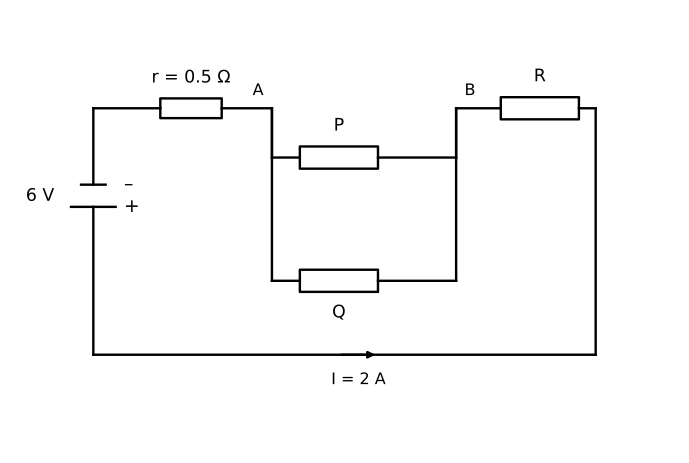
A technician in a school lab is given three cylindrical resistors made of the same material (resistivity ρ). Their dimensions are:
• Wire P: length L, cross-sectional area A
• Wire Q: length 2L, cross-sectional area A
• Wire R: length L, cross-sectional area 2A

The three wires are connected as shown: P and Q are connected in parallel, and this combination is connected in series with R. A battery of emf 6 V and internal resistance 0.5 Ω drives the circuit.

(i) Express the resistance of wire P, wire Q, and wire R each in terms of ρ, L, and A.
(ii) Find the equivalent resistance of the parallel combination of P and Q.
(iii) Find the total resistance of the external circuit (parallel combination + R).
(iv) If the current drawn from the battery is 2 A, find the value of ρL/A.

Diagram for question 29: Current Electricity
Show answer
(i) Resistance of each wire:

The formula for resistance is:
R = ρL/A

Resistance of wire P:
R<sub>P</sub> = ρL/A

Resistance of wire Q (length 2L, area A):
R<sub>Q</sub> = ρ(2L)/A = 2ρL/A

Resistance of wire R (length L, area 2A):
R<sub>R</sub> = ρL/(2A)

∴ R<sub>P</sub> = ρL/A, R<sub>Q</sub> = 2ρL/A, R<sub>R</sub> = ρL/2A [1 mark]

(ii) Equivalent resistance of P and Q in parallel:

For parallel combination:
1/R<sub>PQ</sub> = 1/R<sub>P</sub> + 1/R<sub>Q</sub>

→ 1/R<sub>PQ</sub> = A/ρL + A/2ρL = 2A/2ρL + A/2ρL = 3A/2ρL

∴ R<sub>PQ</sub> = 2ρL/3A [1 mark]

(iii) Total external resistance (R<sub>PQ</sub> in series with R<sub>R</sub>):

R<sub>ext</sub> = R<sub>PQ</sub> + R<sub>R</sub>

→ R<sub>ext</sub> = 2ρL/3A + ρL/2A

→ R<sub>ext</sub> = 4ρL/6A + 3ρL/6A = 7ρL/6A

∴ R<sub>ext</sub> = 7ρL/6A [1 mark]

(iv) Finding ρL/A:

By Ohm's law for a complete circuit:
I = E / (R<sub>ext</sub> + r)

Substituting I = 2 A, E = 6 V, r = 0.5 Ω:

2 = 6 / (7ρL/6A + 0.5)

→ 7ρL/6A + 0.5 = 6/2 = 3

→ 7ρL/6A = 3 − 0.5 = 2.5

→ ρL/A = 2.5 × 6/7 = 15/7

∴ ρL/A = 15/7 Ω ≈ 2.14 Ω [1 mark]
Q30Short Answer3 marks

A battery of emf E and internal resistance r is connected to an external resistance R. (a) Derive an expression for the current I flowing through the circuit. (b) Using this expression, obtain an expression for the terminal voltage V of the battery. (c) If E = 12 V, r = 1 Ω, and R = 5 Ω, calculate the terminal voltage of the battery.

Diagram for question 30: Current Electricity
Show answer
(a) Derivation of current expression:

By Kirchhoff's Voltage Law (KVL): The algebraic sum of all EMFs and potential drops around a closed loop is zero.

Considering the closed circuit with battery (emf E, internal resistance r) and external resistance R:

E − Ir − IR = 0

→ E = I(R + r)

∴ I = E / (R + r)

(b) Expression for terminal voltage:

The terminal voltage V is the potential difference across the external resistance R (or equivalently, across the battery terminals).

V = IR

Substituting I = E / (R + r):

V = E · R / (R + r)

Alternatively, from E = V + Ir:

∴ V = E − Ir

(c) Numerical calculation:

Given: E = 12 V, r = 1 Ω, R = 5 Ω.

Using I = E / (R + r):

I = 12 / (5 + 1) = 12 / 6 = 2 A

Using V = E − Ir:

V = 12 − (2)(1)

∴ V = 10 V

Want unlimited practice on Current Electricity?

The full ClearSteps bank has 42+ reviewed questions on this chapter alone — with step-wise solutions, difficulty levels, and progress tracking. Verify your WhatsApp number and your free trial starts right here.

CBSE · CLASS 12
🎟️14-day free trial · code PRAC auto-applied
Mobile Number
+91
OTP will be sent to your WhatsApp

⭐ Trusted by 12,000+ students across India

Current Electricity — Class 12 Physics Practice Questions