ClearStepsCLEARSTEPS AI
Teacher Login →Student Login →

Dual Nature of Radiation and Matter: Class 12 Physics Practice Questions

30 original exam-pattern questions with full answers, matched to the current CBSE Class 12 paper design, including case-based questions. Attempt each question before opening the answer — or start a free 14-day trial ↓ for the full bank.

Q1Case-based4 marks

A school science exhibit uses a photoelectric effect demonstrator. A sodium metal surface (work function φ₀ = 2.3 eV) is illuminated by a light source. A student observes that when violet light of frequency 8.0 × 10¹⁴ Hz is used, photoelectrons are emitted and a stopping potential V₀ is measured. The student then replaces the violet light with a monochromatic infrared source of frequency 3.0 × 10¹⁴ Hz at much higher intensity. (h = 6.63 × 10⁻³⁴ J s, mₑ = 9.1 × 10⁻³¹ kg, 1 eV = 1.6 × 10⁻¹⁹ J)

A school science exhibit uses a photoelectric effect demonstrator. A sodium metal surface (work function φ₀ = 2.3 eV) is illuminated by a light source. A student observes that when violet light of frequency 8.0 × 10¹⁴ Hz is used, photoelectrons are emitted and a stopping potential V₀ is measured. The student then replaces the violet light with a monochromatic infrared source of frequency 3.0 × 10¹⁴ Hz at much higher intensity.

(i) Calculate the maximum kinetic energy (in eV) of photoelectrons emitted by the violet light. (1 mark)
(ii) Find the stopping potential V₀ (in volts) for the violet light. (1 mark)
(iii) Will the infrared source (3.0 × 10¹⁴ Hz) emit photoelectrons from sodium, even at very high intensity? Justify your answer. (1 mark)
(iv) Calculate the de Broglie wavelength of a photoelectron emitted by the violet light, using its maximum kinetic energy. (Given: h = 6.63 × 10⁻³⁴ J s, mₑ = 9.1 × 10⁻³¹ kg, 1 eV = 1.6 × 10⁻¹⁹ J) (1 mark)

Show answer
(i) Maximum Kinetic Energy of photoelectrons:

By Einstein's photoelectric equation:
KE<sub>max</sub> = hν − φ₀

Energy of violet photon:
hν = (6.63 × 10⁻³⁴ × 8.0 × 10¹⁴) / (1.6 × 10⁻¹⁹) eV
= (5.304 × 10⁻¹⁹) / (1.6 × 10⁻¹⁹) eV
= 3.315 eV ≈ 3.3 eV

KE<sub>max</sub> = 3.3 − 2.3 = 1.0 eV

∴ KE<sub>max</sub> = 1.0 eV

──────────────────────────────
(ii) Stopping Potential V₀:

By the relation: eV₀ = KE<sub>max</sub>

V₀ = KE<sub>max</sub> / e = 1.0 eV / e

∴ V₀ = 1.0 V

──────────────────────────────
(iii) Effect of infrared source:

Threshold frequency of sodium:
ν₀ = φ₀ / h = (2.3 × 1.6 × 10⁻¹⁹) / (6.63 × 10⁻³⁴)
= (3.68 × 10⁻¹⁹) / (6.63 × 10⁻³⁴)
≈ 5.55 × 10¹⁴ Hz

The infrared frequency ν = 3.0 × 10¹⁴ Hz < ν₀ = 5.55 × 10¹⁴ Hz.

Because each photon carries energy hν < φ₀, no single photon can liberate an electron from the surface. Increasing intensity only increases the number of photons, NOT the energy per photon.

∴ No photoelectrons are emitted by the infrared source, regardless of intensity.

──────────────────────────────
(iv) de Broglie wavelength of the emitted photoelectron:

By de Broglie's relation: λ = h / p = h / √(2 mₑ KE<sub>max</sub>)

KE<sub>max</sub> = 1.0 eV = 1.0 × 1.6 × 10⁻¹⁹ J = 1.6 × 10⁻¹⁹ J

2 mₑ KE<sub>max</sub> = 2 × 9.1 × 10⁻³¹ × 1.6 × 10⁻¹⁹
= 2.912 × 10⁻⁴⁹ kg² m² s⁻²

√(2 mₑ KE<sub>max</sub>) = √(2.912 × 10⁻⁴⁹)
= 5.396 × 10⁻²⁵ kg m s⁻¹

λ = (6.63 × 10⁻³⁴) / (5.396 × 10⁻²⁵)
= 1.228 × 10⁻⁹ m

∴ λ ≈ 1.23 × 10⁻⁹ m = 1.23 nm
Q2Case-based4 marks

A research lab is designing a photoelectric sensor using two different metal surfaces — Metal P (work function φ_P = 1.8 eV) and Metal Q (work function φ_Q = 3.2 eV). A monochromatic light source of wavelength 350 nm illuminates both surfaces simultaneously. The sensor circuit can measure stopping potential to an accuracy of 0.01 V. Use: h = 6.63 × 10⁻³⁴ J s, c = 3 × 10⁸ m/s, e = 1.6 × 10⁻¹⁹ C.

A research lab is designing a photoelectric sensor using two different metal surfaces — Metal P (work function φ_P = 1.8 eV) and Metal Q (work function φ_Q = 3.2 eV). A monochromatic light source of wavelength 350 nm is directed at both surfaces. The sensor circuit can measure stopping potential to an accuracy of 0.01 V.

(i) Calculate the energy of each incident photon in eV. [1 mark]
(ii) Determine which metal(s) will emit photoelectrons and calculate the maximum kinetic energy of the emitted electrons (in eV) for the metal(s) that do emit. [1 mark]
(iii) Calculate the stopping potential required to halt the fastest photoelectrons from the emitting metal. [1 mark]
(iv) The intensity of light is now doubled while the wavelength is kept the same. A student claims that both the stopping potential and the number of photoelectrons emitted per second will double. Identify the error(s) in the student's claim and justify using Einstein's photoelectric equation. [1 mark]

Show answer
(i) Energy of each incident photon:

By the photon energy formula, E = hc/λ

E = (6.63 × 10⁻³⁴ × 3 × 10⁸) / (350 × 10⁻⁹)

E = (19.89 × 10⁻²⁶) / (3.50 × 10⁻⁷)

E = 5.683 × 10⁻¹⁹ J

Converting: E = (5.683 × 10⁻¹⁹) / (1.6 × 10⁻¹⁹)

∴ E ≈ 3.55 eV

(ii) Condition for photoelectric emission: Photon energy E must be greater than work function φ.

For Metal P: E = 3.55 eV > φ_P = 1.8 eV → emission occurs.
KE_max = E − φ_P = 3.55 − 1.8
∴ KE_max (Metal P) = 1.75 eV

For Metal Q: E = 3.55 eV > φ_Q = 3.2 eV → emission also occurs.
KE_max = E − φ_Q = 3.55 − 3.2
∴ KE_max (Metal Q) = 0.35 eV

(iii) Stopping potential for Metal P (which emits electrons with higher KE_max):

By Einstein's photoelectric equation, eV₀ = KE_max

V₀ = KE_max / e = 1.75 eV / e

∴ V₀ (Metal P) = 1.75 V

(For Metal Q: V₀ = 0.35 V)

(iv) The student's claim contains ONE correct and ONE incorrect assertion:

Incorrect: The stopping potential will NOT change. By Einstein's photoelectric equation, KE_max = hν − φ₀, the maximum kinetic energy of emitted electrons depends only on the frequency (wavelength) of incident light and the work function — NOT on intensity. Since wavelength is unchanged, V₀ remains 1.75 V (for Metal P). Doubling intensity does not increase photon energy.

Correct (partially): The number of photoelectrons emitted per second does increase with intensity, because higher intensity means more photons incident per second, so more photoelectrons are liberated per second — but the number doubles (not necessarily exactly doubles for all real setups, though proportionally it does).

∴ The student's error is claiming the stopping potential doubles; stopping potential is independent of intensity and is determined solely by photon frequency and work function.
Q3Case-based4 marks

Two LED sources illuminate a metal surface (work function φ₀ = 1.9 eV). LED-1: frequency ν₁ = 5.5 × 10¹⁴ Hz, power P = 2.2 × 10⁻³ W. LED-2: frequency ν₂ = 7.0 × 10¹⁴ Hz. Use h = 6.63 × 10⁻³⁴ Js, e = 1.6 × 10⁻¹⁹ C.

A school science project uses two LED sources. LED-1 emits green light of frequency 5.5 × 10¹⁴ Hz and has a power output of 2.2 × 10⁻³ W. LED-2 emits blue light of frequency 7.0 × 10¹⁴ Hz. A metal surface with work function 1.9 eV is illuminated separately by each LED.

(i) Find the energy (in eV) of one photon from LED-1.
(ii) Find the number of photons emitted per second by LED-1.
(iii) State with reason whether LED-1 can cause photoelectric emission from the metal surface.
(iv) Find the maximum kinetic energy (in eV) of photoelectrons emitted when the metal surface is illuminated by LED-2.

Show answer
(i) Energy of one photon from LED-1:

By the photon energy formula: E = hν

E₁ = (6.63 × 10⁻³⁴ J s) × (5.5 × 10¹⁴ Hz)

E₁ = 36.465 × 10⁻²⁰ J = 3.647 × 10⁻¹⁹ J

Converting to eV: E₁ = (3.647 × 10⁻¹⁹) / (1.6 × 10⁻¹⁹)

∴ E₁ ≈ 2.28 eV

─────────────────────────────────────

(ii) Number of photons emitted per second by LED-1:

If n photons are emitted per second, total power P = n × E₁

→ n = P / E₁

n = (2.2 × 10⁻³ W) / (3.647 × 10⁻¹⁹ J)

∴ n ≈ 6.03 × 10¹⁵ photons per second

─────────────────────────────────────

(iii) Whether LED-1 causes photoelectric emission:

For photoelectric emission to occur, the photon energy must be greater than or equal to the work function of the metal:
E ≥ φ₀

Here, E₁ ≈ 2.28 eV and φ₀ = 1.9 eV

Since E₁ (2.28 eV) > φ₀ (1.9 eV),

∴ Yes, LED-1 CAN cause photoelectric emission from the metal surface.

─────────────────────────────────────

(iv) Maximum kinetic energy of photoelectrons due to LED-2:

By Einstein's photoelectric equation:
KE_max = hν₂ − φ₀

Energy of LED-2 photon:
E₂ = hν₂ = (6.63 × 10⁻³⁴) × (7.0 × 10¹⁴)
E₂ = 46.41 × 10⁻²⁰ J = 4.641 × 10⁻¹⁹ J
E₂ = (4.641 × 10⁻¹⁹) / (1.6 × 10⁻¹⁹) eV ≈ 2.90 eV

KE_max = E₂ − φ₀ = 2.90 − 1.9

∴ KE_max = 1.00 eV
Q4Case-based4 marks

A solar-powered calculator uses a small photovoltaic cell made of a metal whose work function is 2.0 eV. In bright sunlight, light of frequency 8.0 × 10¹⁴ Hz falls on the cell. On a cloudy day, the same metal surface is illuminated with light of frequency 4.0 × 10¹⁴ Hz but with twice the intensity of the bright sunlight.

A solar-powered calculator uses a small photovoltaic cell made of a metal whose work function is 2.0 eV. In bright sunlight, light of frequency 8.0 × 10¹⁴ Hz falls on the cell. On a cloudy day, the same metal surface is illuminated with light of frequency 4.0 × 10¹⁴ Hz but with twice the intensity of the bright sunlight.

(i) Calculate the maximum kinetic energy of photoelectrons emitted in bright sunlight. (1 mark)
(ii) Calculate the stopping potential required to stop the fastest photoelectrons in bright sunlight. (1 mark)
(iii) Will photoelectrons be emitted from the metal surface on the cloudy day? Justify your answer with a calculation. (1 mark)
(iv) The intensity of sunlight is doubled on a clear day (compared to bright sunlight) while the frequency remains 8.0 × 10¹⁴ Hz. How does this affect (a) the maximum kinetic energy and (b) the photocurrent? (1 mark)

[Given: h = 6.63 × 10⁻³⁴ J s, 1 eV = 1.6 × 10⁻¹⁹ J]

Show answer
(i) Maximum kinetic energy in bright sunlight:

By Einstein's photoelectric equation:
KE<sub>max</sub> = hν − φ₀

φ₀ = 2.0 eV = 2.0 × 1.6 × 10⁻¹⁹ J = 3.2 × 10⁻¹⁹ J

Energy of incident photon:
hν = 6.63 × 10⁻³⁴ × 8.0 × 10¹⁴
= 5.304 × 10⁻¹⁹ J
= 5.304 × 10⁻¹⁹ / 1.6 × 10⁻¹⁹ eV
= 3.315 eV ≈ 3.32 eV

KE<sub>max</sub> = 3.32 − 2.0
∴ KE<sub>max</sub> = 1.32 eV

──────────────────────────────────────
(ii) Stopping potential:

By the relation eV₀ = KE<sub>max</sub>:
V₀ = KE<sub>max</sub> / e = 1.32 eV / e
∴ V₀ = 1.32 V

──────────────────────────────────────
(iii) Emission on the cloudy day:

First, calculate the threshold frequency ν₀:
φ₀ = hν₀
ν₀ = φ₀ / h = 3.2 × 10⁻¹⁹ / 6.63 × 10⁻³⁴
= 4.83 × 10¹⁴ Hz

Frequency on cloudy day: ν = 4.0 × 10¹⁴ Hz

Since ν = 4.0 × 10¹⁴ Hz < ν₀ = 4.83 × 10¹⁴ Hz,
∴ No photoelectrons are emitted on the cloudy day, regardless of the higher intensity.

Reason: Photoelectric emission depends on the frequency (energy per photon), not on the intensity of light. Since each photon carries energy hν < φ₀, no single photon has sufficient energy to liberate an electron.

──────────────────────────────────────
(iv) Effect of doubling intensity at same frequency (8.0 × 10¹⁴ Hz):

(a) Maximum kinetic energy: KE<sub>max</sub> = hν − φ₀. Since frequency is unchanged, KE<sub>max</sub> remains the same = 1.32 eV. Maximum kinetic energy does NOT change with intensity.

(b) Photocurrent: Doubling the intensity doubles the number of photons incident per second. Since each photon (above threshold) ejects one electron, the number of photoelectrons emitted per second doubles.
∴ The photocurrent doubles.
Q5Case-based4 marks

Two metal surfaces P and Q have work functions φ_P = 2.0 eV and φ_Q = 3.5 eV respectively. A monochromatic light source of frequency ν = 9.0 × 10¹⁴ Hz illuminates both surfaces. (Given: h = 6.63 × 10⁻³⁴ J s; 1 eV = 1.6 × 10⁻¹⁹ J)

A physics student is investigating the photoelectric effect using two different metal surfaces, P and Q. The work functions of P and Q are 2.0 eV and 3.5 eV respectively. A monochromatic light source of frequency 9.0 × 10¹⁴ Hz is directed at both surfaces.

(i) Calculate the maximum kinetic energy (in eV) of photoelectrons emitted from metal P.
(ii) Determine whether photoelectric emission will occur from metal Q. Justify your answer.
(iii) If the intensity of light incident on metal P is doubled (frequency unchanged), state and explain what happens to (a) the maximum kinetic energy of emitted photoelectrons and (b) the photoelectric current.
(iv) The student now reduces the frequency of light while keeping its intensity constant. At a certain frequency ν₀, emission from metal P just stops. Identify ν₀ and state what ν₀ is called.

Show answer
(i) By Einstein's Photoelectric Equation:
KE_max = hν − φ_P

Energy of incident photon:
hν = (6.63 × 10⁻³⁴ × 9.0 × 10¹⁴) / (1.6 × 10⁻¹⁹) eV
→ hν = (5.967 × 10⁻¹⁹) / (1.6 × 10⁻¹⁹) eV
→ hν ≈ 3.73 eV

KE_max = 3.73 − 2.0
∴ KE_max ≈ 1.73 eV [1 mark]

(ii) For photoelectric emission, the photon energy must be ≥ work function of the metal.
hν ≈ 3.73 eV, φ_Q = 3.5 eV
Since hν (3.73 eV) > φ_Q (3.5 eV), photoelectric emission WILL occur from metal Q.
(KE_max from Q = 3.73 − 3.5 = 0.23 eV > 0) [1 mark]

(iii) By Einstein's photoelectric equation, KE_max = hν − φ, which depends only on the frequency ν and work function φ, NOT on intensity.
(a) Maximum kinetic energy remains UNCHANGED. Doubling intensity does not change the energy of individual photons; it only increases the number of photons per second.
(b) Photoelectric current DOUBLES. Greater intensity means twice as many photons strike the surface per second, so twice as many photoelectrons are emitted per second, doubling the photocurrent. [1 mark]

(iv) Emission just stops when the photon energy exactly equals the work function:
hν₀ = φ_P
ν₀ = φ_P / h = (2.0 × 1.6 × 10⁻¹⁹) / (6.63 × 10⁻³⁴)
→ ν₀ = (3.2 × 10⁻¹⁹) / (6.63 × 10⁻³⁴)
∴ ν₀ ≈ 4.83 × 10¹⁴ Hz
This frequency ν₀ is called the threshold frequency (cut-off frequency) of metal P. Below this frequency, no photoelectric emission occurs regardless of the intensity of incident light. [1 mark]
Q6Short Answer1 mark

Assertion (A) : No photoelectric emission occurs from a metal surface when the frequency of incident light is below the threshold frequency, even if the intensity of light is very high.
Reason (R) : The energy of a photon depends on its frequency and not on the intensity of light.

Show answer
Option (a) is correct.

Explanation: Photoelectric emission requires each incident photon to have energy hν ≥ φ₀ (the work function). Since photon energy E = hν depends only on frequency ν and not on intensity, increasing intensity (i.e., increasing the number of photons) cannot compensate for insufficient photon energy. Hence, below the threshold frequency ν₀ = φ₀/h, no emission occurs regardless of intensity — Assertion (A) is true. Reason (R) correctly states that photon energy depends on frequency, not intensity, which is precisely why emission is impossible below ν₀ — Reason (R) is the correct explanation of Assertion (A).
Q7MCQ1 mark

The work function of a metal surface is φ₀. The minimum frequency of light required to eject photoelectrons from that surface is:

Show answer
Option (A) is correct.

Explanation: By Einstein's photoelectric equation, the threshold (minimum) frequency ν₀ is defined as the frequency at which the photon energy exactly equals the work function of the metal, with no kinetic energy left for the emitted electron.

KE_max = hν − φ₀

At threshold, KE_max = 0:

0 = hν₀ − φ₀ → ν₀ = φ₀ / h

∴ Minimum frequency required = φ₀ / h.
Q8MCQ1 mark

The work function of a photosensitive metal is 2.0 eV. The threshold frequency for photoelectric emission from its surface is:

Show answer
Option (a) is correct.

Explanation: The threshold frequency ν₀ is defined by the relation φ₀ = hν₀, where φ₀ is the work function and h = 6.63 × 10⁻³⁴ Js.

φ₀ = 2.0 eV = 2.0 × 1.6 × 10⁻¹⁹ J = 3.2 × 10⁻¹⁹ J

∴ ν₀ = φ₀ / h = (3.2 × 10⁻¹⁹) / (6.63 × 10⁻³⁴) ≈ 4.83 × 10<sup>14</sup> Hz ≈ 4.84 × 10<sup>14</sup> Hz
Q9MCQ1 mark

The work function of a metal is 2.0 eV. What is the threshold frequency of light required to eject photoelectrons from its surface?
(Take h = 6.63 × 10⁻³⁴ Js, 1 eV = 1.6 × 10⁻¹⁹ J)

Show answer
Option (A) is correct.

Explanation: The threshold frequency ν₀ is defined as the minimum frequency of incident radiation needed to eject a photoelectron from a metal surface. By Einstein's photoelectric equation, at threshold:

φ₀ = hν₀

→ ν₀ = φ₀ / h

Converting work function: φ₀ = 2.0 eV = 2.0 × 1.6 × 10⁻¹⁹ J = 3.2 × 10⁻¹⁹ J

→ ν₀ = (3.2 × 10⁻¹⁹) / (6.63 × 10⁻³⁴)

∴ ν₀ ≈ 4.83 × 10¹⁴ Hz
Q10MCQ1 mark

The work function of a metal surface is 2.0 eV. The threshold frequency for photoelectric emission from this surface is:

Show answer
Option (A) is correct.

Explanation: By Einstein's photoelectric equation, the threshold frequency ν₀ is related to the work function φ₀ by:

φ₀ = hν₀ → ν₀ = φ₀ / h

Given φ₀ = 2.0 eV = 2.0 × 1.6 × 10⁻¹⁹ J = 3.2 × 10⁻¹⁹ J

∴ ν₀ = (3.2 × 10⁻¹⁹) / (6.63 × 10⁻³⁴) ≈ 4.83 × 10¹⁴ Hz
Q11Short Answer2 marks

The work function of a metal is 2.0 eV. Find the threshold frequency and threshold wavelength for photoelectric emission from this metal. (Take h = 6.63 × 10⁻³⁴ J s, c = 3 × 10⁸ m/s, 1 eV = 1.6 × 10⁻¹⁹ J)

Show answer
By Einstein's photoelectric equation, threshold frequency ν₀ is the minimum frequency at which photoelectric emission just occurs, given by:

φ₀ = hν₀

∴ ν₀ = φ₀ / h

Converting work function: φ₀ = 2.0 eV = 2.0 × 1.6 × 10⁻¹⁹ J = 3.2 × 10⁻¹⁹ J

Substituting:

ν₀ = (3.2 × 10⁻¹⁹ J) / (6.63 × 10⁻³⁴ J s)

∴ ν₀ = 4.83 × 10¹⁴ Hz

The threshold wavelength is given by:

λ₀ = c / ν₀

λ₀ = (3 × 10⁸ m/s) / (4.83 × 10¹⁴ Hz)

∴ λ₀ ≈ 6.21 × 10⁻⁷ m = 621 nm
Q12Short Answer2 marks

A proton and an α-particle are accelerated through the same potential difference V. Obtain the ratio of their de Broglie wavelengths λ_p : λ_α.

Show answer
The de Broglie wavelength of a particle accelerated through potential difference V is given by:

λ = h / √(2mqV)

where m is the mass and q is the charge of the particle.

For a proton: mass = m_p, charge = e

λ_p = h / √(2 m_p e V)

For an α-particle: mass = 4m_p, charge = 2e

λ_α = h / √(2 · 4m_p · 2e · V) = h / √(16 m_p e V)

Taking the ratio:

λ_p / λ_α = [h / √(2 m_p e V)] / [h / √(16 m_p e V)]

→ λ_p / λ_α = √(16 m_p e V) / √(2 m_p e V) = √(16/2) = √8 = 2√2

∴ λ_p : λ_α = 2√2 : 1
Q13Short Answer2 marks

The work function of a metal surface is 2.0 eV. What is the threshold frequency of light required to eject electrons from its surface?
(Given: h = 6.63 × 10⁻³⁴ J s, 1 eV = 1.6 × 10⁻¹⁹ J)

Show answer
By Einstein's photoelectric equation, the threshold frequency ν₀ is defined as the minimum frequency of incident light below which no photoelectric emission occurs, regardless of intensity.

Formula: φ₀ = hν₀

→ ν₀ = φ₀ / h

Converting work function to SI units:
φ₀ = 2.0 eV = 2.0 × 1.6 × 10⁻¹⁹ J = 3.2 × 10⁻¹⁹ J

Substituting:
ν₀ = (3.2 × 10⁻¹⁹ J) / (6.63 × 10⁻³⁴ J s)

∴ ν₀ ≈ 4.83 × 10¹⁴ Hz
Q14Short Answer2 marks

A metal surface has a work function of 2.0 eV. Ultraviolet radiation of wavelength 200 nm is incident on it. Find (i) the energy of the incident photon in eV, and (ii) the maximum kinetic energy of the emitted photoelectrons in eV.
(Given: h = 6.63 × 10⁻³⁴ J s, c = 3 × 10⁸ m/s, 1 eV = 1.6 × 10⁻¹⁹ J)

Show answer
By Einstein's photoelectric equation:

KE<sub>max</sub> = hν − φ₀ = hc/λ − φ₀

(i) Energy of incident photon:

E = hc/λ = (6.63 × 10⁻³⁴ × 3 × 10⁸) / (200 × 10⁻⁹)

E = 9.945 × 10⁻¹⁹ J

∴ E = 9.945 × 10⁻¹⁹ / 1.6 × 10⁻¹⁹ ≈ 6.2 eV

(ii) Maximum kinetic energy of photoelectrons:

KE<sub>max</sub> = E − φ₀ = 6.2 − 2.0

∴ KE<sub>max</sub> = 4.2 eV
Q15Short Answer3 marks

A researcher is designing a photoelectric-based security sensor. She uses a metal surface with work function φ₀ = 2.0 eV. In Trial 1, she illuminates it with UV light of wavelength 200 nm. In Trial 2, she doubles the intensity of the same light while keeping the wavelength unchanged.

(i) Calculate the maximum kinetic energy (in eV) of photoelectrons emitted in Trial 1.
(ii) How does doubling the intensity in Trial 2 affect (a) the maximum kinetic energy and (b) the photoelectric current? Justify your answer.
(iii) The researcher now wishes to use electrons (emitted in Trial 1 with maximum kinetic energy) as a probe beam. Calculate the de Broglie wavelength associated with these electrons.
(Given: h = 6.63×10⁻³⁴ Js, c = 3×10⁸ m/s, mₑ = 9.1×10⁻³¹ kg, 1 eV = 1.6×10⁻¹⁹ J)

Show answer
(i) Maximum Kinetic Energy in Trial 1:

By Einstein's photoelectric equation:
KE<sub>max</sub> = hν − φ₀ = hc/λ − φ₀

Substituting values:
hc/λ = (6.63×10⁻³⁴ × 3×10⁸) / (200×10⁻⁹)
= (19.89×10⁻²⁶) / (2×10⁻⁷)
= 9.945×10⁻¹⁹ J
= 9.945×10⁻¹⁹ / 1.6×10⁻¹⁹ eV
= 6.22 eV

KE<sub>max</sub> = 6.22 − 2.0
∴ KE<sub>max</sub> = 4.22 eV

(ii) Effect of Doubling Intensity in Trial 2:

(a) Maximum kinetic energy: KE<sub>max</sub> remains UNCHANGED at 4.22 eV.
Because KE<sub>max</sub> depends only on the frequency (or wavelength) of incident light and the work function of the metal, NOT on intensity. Since wavelength is unchanged, hν − φ₀ is unchanged.

(b) Photoelectric current: The current INCREASES (doubles).
Because intensity is proportional to the number of photons per second. Doubling the intensity doubles the number of photons, which doubles the number of photoelectrons emitted per second, hence doubling the saturation (photoelectric) current.

(iii) de Broglie Wavelength of Emitted Electrons:

By de Broglie's relation: λ = h/p = h/mv = h/√(2m<sub>e</sub> KE<sub>max</sub>)

KE<sub>max</sub> = 4.22 eV = 4.22 × 1.6×10⁻¹⁹ J = 6.752×10⁻¹⁹ J

2m<sub>e</sub> KE<sub>max</sub> = 2 × 9.1×10⁻³¹ × 6.752×10⁻¹⁹
= 2 × 6.144×10⁻⁴⁹
= 1.229×10⁻⁴⁸ kg² m² s⁻²

√(2m<sub>e</sub> KE<sub>max</sub>) = √(1.229×10⁻⁴⁸)
= 1.108×10⁻²⁴ kg m s⁻¹

λ = h / √(2m<sub>e</sub> KE<sub>max</sub>)
= 6.63×10⁻³⁴ / 1.108×10⁻²⁴

∴ λ ≈ 5.98×10⁻¹⁰ m ≈ 0.60 nm
Q16Short Answer3 marks

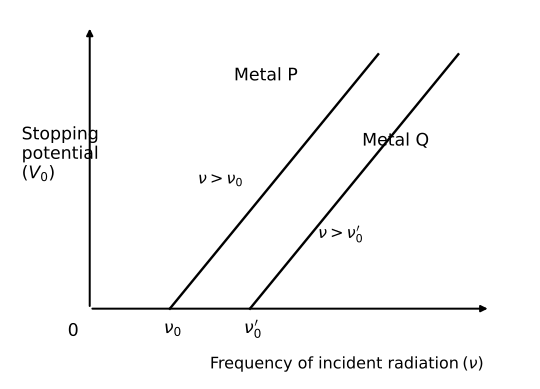
A researcher is studying the photoelectric effect using two different metal surfaces, P and Q. She illuminates each surface with monochromatic light of varying frequencies and records the stopping potential (V₀) for each frequency. The graph obtained is shown below (described as: two parallel straight lines, both with the same positive slope, but the line for metal P has a higher y-intercept than the line for metal Q — i.e., metal P's line is shifted upward compared to metal Q's line).

(i) What does the common slope of these two lines represent? Write its expression in terms of fundamental constants.
(ii) Metal Q has a work function of 2.0 eV. If light of frequency 8.0 × 10¹⁴ Hz is incident on metal Q, calculate the stopping potential.
(iii) The researcher now doubles the intensity of light incident on metal P (keeping frequency the same and above the threshold). How will this affect: (a) the stopping potential, and (b) the photoelectric current? Justify your answer.
(iv) From the graph, which metal — P or Q — has the higher threshold frequency? Give one reason.

Diagram for question 16: Dual Nature of Radiation and Matter
Show answer
(i) The slope of the V₀ versus ν graph:

By Einstein's photoelectric equation:

eV₀ = hν − φ₀

→ V₀ = (h/e)ν − φ₀/e

This is of the form y = mx + c, so the slope = h/e.

∴ The common slope represents the ratio of Planck's constant to the charge of an electron = h/e.

Expression: Slope = h/e = (6.63 × 10⁻³⁴ J s) / (1.6 × 10⁻¹⁹ C)

[1 mark]

(ii) Calculation of stopping potential for metal Q:

Given: φ₀(Q) = 2.0 eV = 2.0 × 1.6 × 10⁻¹⁹ J = 3.2 × 10⁻¹⁹ J; ν = 8.0 × 10¹⁴ Hz.

By Einstein's photoelectric equation:

eV₀ = hν − φ₀

→ eV₀ = (6.63 × 10⁻³⁴)(8.0 × 10¹⁴) − 3.2 × 10⁻¹⁹

→ eV₀ = 5.304 × 10⁻¹⁹ − 3.2 × 10⁻¹⁹

→ eV₀ = 2.104 × 10⁻¹⁹ J

→ V₀ = (2.104 × 10⁻¹⁹) / (1.6 × 10⁻¹⁹)

∴ V₀ ≈ 1.32 V

[1 mark]

(iii) Effect of doubling intensity on metal P (frequency unchanged, above threshold):

Einstein's equation: eV₀ = hν − φ₀

The stopping potential V₀ depends only on the frequency ν and the work function φ₀ of the metal — NOT on intensity.

(a) Stopping potential: Remains unchanged. Because each photon still carries the same energy hν; doubling intensity only increases the number of photons per second, not the energy per photon.

(b) Photoelectric current: Increases (doubles). Because greater intensity means more photons per unit time striking the surface, so more electrons are emitted per second, increasing the saturation (photoelectric) current.

[1 mark]

(iv) Metal with higher threshold frequency:

From Einstein's equation: φ₀ = hν₀, so higher work function → higher threshold frequency ν₀.

From the graph, metal P has a higher y-intercept (more negative intercept on the V₀-axis, meaning a larger value of −φ₀/e in magnitude), which implies metal P has a larger work function.

∴ Metal P has the higher threshold frequency, because its work function is greater than that of metal Q, and threshold frequency ν₀ = φ₀/h.

[1 mark]
Q17Short Answer3 marks

A solar-powered satellite uses a photovoltaic surface made of cesium metal (work function φ₀ = 2.0 eV). When the satellite is in sunlight, radiation of frequency 8.0 × 10¹⁴ Hz falls on the surface.

(i) Calculate the maximum kinetic energy (in eV) of photoelectrons emitted from the cesium surface.

(ii) Calculate the stopping potential required to bring these photoelectrons to rest.

(iii) If the frequency of incident radiation is doubled (keeping intensity constant), state and explain what happens to (a) the stopping potential and (b) the photoelectric current.

Show answer
(i) Maximum Kinetic Energy of Photoelectrons

By Einstein's Photoelectric Equation:

KE<sub>max</sub> = hν − φ₀

where h = 6.63 × 10<sup>−34</sup> J s, ν = 8.0 × 10<sup>14</sup> Hz, φ₀ = 2.0 eV

First, converting hν to eV:

hν = (6.63 × 10<sup>−34</sup> × 8.0 × 10<sup>14</sup>) / (1.6 × 10<sup>−19</sup>) eV

hν = (5.304 × 10<sup>−19</sup>) / (1.6 × 10<sup>−19</sup>) eV

hν = 3.315 eV ≈ 3.3 eV

∴ KE<sub>max</sub> = 3.3 − 2.0 = 1.3 eV

∴ Maximum kinetic energy of photoelectrons = 1.3 eV

---

(ii) Stopping Potential

The stopping potential V₀ is related to KE<sub>max</sub> by:

eV₀ = KE<sub>max</sub>

→ V₀ = KE<sub>max</sub> / e = 1.3 eV / e

∴ Stopping potential V₀ = 1.3 V

---

(iii) Effect of Doubling the Frequency (intensity constant)

New frequency: ν' = 2 × 8.0 × 10<sup>14</sup> = 1.6 × 10<sup>15</sup> Hz

(a) Effect on Stopping Potential:

By Einstein's equation, KE<sub>max</sub> = hν' − φ₀

New KE<sub>max</sub> = h(2ν) − φ₀ = 2hν − φ₀

Since φ₀ remains unchanged and hν' has increased, KE<sub>max</sub> increases.

Because eV₀ = KE<sub>max</sub>, the stopping potential increases.

New V₀' = (2 × 3.3 − 2.0) = 4.6 V

∴ Stopping potential increases from 1.3 V to 4.6 V.

(b) Effect on Photoelectric Current:

When frequency is doubled at constant intensity, the energy per photon (E = hν) doubles, so the number of photons incident per second is halved (since total power = number of photons × energy per photon = constant).

Because the photoelectric current depends on the number of photoelectrons emitted per second, which in turn depends on the number of incident photons per second (not on their individual energy),

∴ the photoelectric current decreases (approximately halves), since fewer photons are available to eject electrons per unit time.
Q18Short Answer3 marks

A metal surface in a photoelectric experiment is illuminated by a lamp rated at 60 W. The lamp emits monochromatic light of wavelength 400 nm, and only 5% of the electrical power is converted into light. The work function of the metal is 1.8 eV.

(i) Calculate the energy (in eV) of each incident photon.
(ii) Determine the maximum kinetic energy of the emitted photoelectrons.
(iii) Find the stopping potential required to halt the fastest photoelectrons.
(iv) If the wavelength of the incident light is gradually increased from 400 nm, at what wavelength will the photoelectric effect just cease? (Given: h = 6.63 × 10⁻³⁴ J s, c = 3 × 10⁸ m/s, e = 1.6 × 10⁻¹⁹ C)

Show answer
By Einstein's Photoelectric Equation:
KE_max = hν − φ₀ = hc/λ − φ₀

(i) Energy of each incident photon:

E = hc/λ

→ E = (6.63 × 10⁻³⁴ × 3 × 10⁸) / (400 × 10⁻⁹)

→ E = (19.89 × 10⁻²⁶) / (4 × 10⁻⁷)

→ E = 4.97 × 10⁻¹⁹ J

→ E = (4.97 × 10⁻¹⁹) / (1.6 × 10⁻¹⁹) eV

∴ E ≈ 3.1 eV

(Note: The lamp power and efficiency data establish the real-world context of the source but do not affect the energy per photon, which depends only on wavelength.)

(ii) Maximum kinetic energy of photoelectrons:

By Einstein's photoelectric equation:
KE_max = E − φ₀

→ KE_max = 3.1 eV − 1.8 eV

∴ KE_max = 1.3 eV

(iii) Stopping potential:

At stopping potential V₀, all kinetic energy is used to do work against the retarding field:
eV₀ = KE_max

→ V₀ = KE_max / e = 1.3 eV / e

∴ V₀ = 1.3 V

(iv) Threshold wavelength (λ₀) at which photoelectric effect just ceases:

At threshold, KE_max = 0, so:
hc/λ₀ = φ₀

→ λ₀ = hc / φ₀

→ φ₀ = 1.8 eV = 1.8 × 1.6 × 10⁻¹⁹ J = 2.88 × 10⁻¹⁹ J

→ λ₀ = (6.63 × 10⁻³⁴ × 3 × 10⁸) / (2.88 × 10⁻¹⁹)

→ λ₀ = (19.89 × 10⁻²⁶) / (2.88 × 10⁻¹⁹)

→ λ₀ = 6.906 × 10⁻⁷ m

∴ λ₀ ≈ 691 nm

When the wavelength exceeds 691 nm, the photon energy falls below the work function and the photoelectric effect ceases.
Q19Short Answer3 marks

A research lab is designing a particle-wave experiment. A proton and an alpha particle are each accelerated from rest through the same potential difference V.

(i) Derive an expression for the de Broglie wavelength of a particle of mass m and charge q accelerated through potential difference V.

(ii) Find the ratio of the de Broglie wavelengths of the proton to the alpha particle (λ_p : λ_α). [Given: mass of proton = m_p, mass of alpha particle = 4m_p, charge of proton = e, charge of alpha particle = 2e]

(iii) If the proton is accelerated through V = 4 kV, calculate its de Broglie wavelength. [Given: m_p = 1.67 × 10⁻²⁷ kg, e = 1.6 × 10⁻¹⁹ C, h = 6.63 × 10⁻³⁴ J s]

Show answer
(i) Derivation of de Broglie wavelength for an accelerated particle: [1 mark]

Let a particle of mass m and charge q be accelerated from rest through potential difference V.

By work-energy theorem, the kinetic energy gained equals the work done by the electric field:

KE = qV

→ ½mv² = qV

→ mv² = 2qV

→ (mv)² = 2mqV

→ p = mv = √(2mqV)

By de Broglie's hypothesis, wavelength λ = h/p:

∴ λ = h / √(2mqV)

(ii) Ratio of de Broglie wavelengths λ_p : λ_α: [1.5 marks]

Using the expression derived in (i):

λ_p = h / √(2 · m_p · e · V)

λ_α = h / √(2 · 4m_p · 2e · V) = h / √(16 m_p e V)

Taking the ratio:

λ_p / λ_α = [h / √(2 m_p e V)] / [h / √(16 m_p e V)]

→ λ_p / λ_α = √(16 m_p e V) / √(2 m_p e V)

→ λ_p / λ_α = √(16/2) = √8 = 2√2

∴ λ_p : λ_α = 2√2 : 1

(This means the proton has a larger de Broglie wavelength than the alpha particle when both are accelerated through the same V, because the alpha particle has a greater charge and greater mass.)

(iii) Numerical calculation for proton at V = 4 kV: [1.5 marks]

Given: m_p = 1.67 × 10⁻²⁷ kg, e = 1.6 × 10⁻¹⁹ C, h = 6.63 × 10⁻³⁴ J s, V = 4 × 10³ V

Using: λ = h / √(2 m_p e V)

First, calculate the quantity under the square root:

2 m_p e V = 2 × 1.67 × 10⁻²⁷ × 1.6 × 10⁻¹⁹ × 4 × 10³

→ = 2 × 1.67 × 1.6 × 4 × 10⁻²⁷⁻¹⁹⁺³

→ = 2 × 10.688 × 10⁻⁴³

→ = 21.376 × 10⁻⁴³

→ = 2.1376 × 10⁻⁴² J·kg (= kg² m² s⁻²)

√(2.1376 × 10⁻⁴²) = √(21.376 × 10⁻⁴³) ≈ 4.623 × 10⁻²¹ kg m s⁻¹

Therefore:

λ = (6.63 × 10⁻³⁴) / (4.623 × 10⁻²¹)

λ ≈ 1.434 × 10⁻¹³ m

∴ λ_p ≈ 1.43 × 10⁻¹³ m (≈ 0.143 pm)

This wavelength is of the order of nuclear dimensions, demonstrating the wave nature of matter at high accelerating voltages.
Q20Short Answer3 marks

Two beams P and Q of photons with wavelengths 310 nm and 180 nm respectively are incident on a metallic surface of work function 1.55 eV successively. (a) Find the maximum kinetic energy (in eV) of photoelectrons emitted by each beam. (b) What is the ratio of the de Broglie wavelength of the fastest photoelectrons emitted by beam P to that emitted by beam Q? (Given: h = 6.63 × 10⁻³⁴ J s, c = 3 × 10⁸ m/s, 1 eV = 1.6 × 10⁻¹⁹ J)

Show answer
By Einstein's photoelectric equation, the maximum kinetic energy of emitted photoelectrons is:

KE<sub>max</sub> = hν − φ₀ = hc/λ − φ₀

(a) For beam P (λ = 310 nm = 310 × 10⁻⁹ m):

hc/λ<sub>P</sub> = (6.63 × 10⁻³⁴ × 3 × 10⁸) / (310 × 10⁻⁹)
= 19.89 × 10⁻²⁶ / 310 × 10⁻⁹
= 6.42 × 10⁻¹⁹ J
= 6.42 × 10⁻¹⁹ / 1.6 × 10⁻¹⁹ eV
= 4.01 eV ≈ 4.0 eV

∴ KE<sub>max</sub>(P) = 4.0 − 1.55 = 2.45 eV

For beam Q (λ = 180 nm = 180 × 10⁻⁹ m):

hc/λ<sub>Q</sub> = (6.63 × 10⁻³⁴ × 3 × 10⁸) / (180 × 10⁻⁹)
= 19.89 × 10⁻²⁶ / 180 × 10⁻⁹
= 11.05 × 10⁻¹⁹ J
= 11.05 × 10⁻¹⁹ / 1.6 × 10⁻¹⁹ eV
= 6.91 eV ≈ 6.9 eV

∴ KE<sub>max</sub>(Q) = 6.9 − 1.55 = 5.35 eV

(b) The de Broglie wavelength of a particle is λ<sub>dB</sub> = h/p = h/√(2m·KE<sub>max</sub>).

Since both electrons have the same mass m,

λ<sub>P</sub>/λ<sub>Q</sub> = √(KE<sub>max</sub>(Q)) / √(KE<sub>max</sub>(P))
= √(5.35) / √(2.45)
= 2.313 / 1.565
≈ 1.48

∴ The ratio of de Broglie wavelengths λ<sub>P</sub> : λ<sub>Q</sub> ≈ 1.48 : 1

(The fastest photoelectrons from beam P have a longer de Broglie wavelength than those from beam Q, since they have lower kinetic energy.)
Q21Short Answer3 marks

A science student is designing a thought experiment. She fires two particles — a proton and a deuteron — through the same potential difference V = 800 V from rest.

(i) Write the formula for the de Broglie wavelength of a particle of mass m and charge q accelerated through a potential difference V.

(ii) Calculate the de Broglie wavelength associated with the proton after acceleration. (Given: mass of proton m_p = 1.67 × 10⁻²⁷ kg, charge e = 1.6 × 10⁻¹⁹ C, h = 6.63 × 10⁻³⁴ J s)

(iii) The student now accelerates a deuteron (mass m_d = 2m_p, charge = e) through the same potential difference V. Find the ratio λ_d / λ_p of their de Broglie wavelengths.

(iv) The student increases the potential difference to 4V for the proton while keeping the deuteron at V. Will the two wavelengths now become equal? Justify with a one-line calculation.

Show answer
(i) When a particle of mass m and charge q is accelerated from rest through potential difference V, it gains kinetic energy:

KE = qV → ½mv² = qV

de Broglie wavelength: λ = h/p = h/√(2mKE)

∴ λ = h / √(2mqV)

(ii) Using the formula derived in (i):

λ_p = h / √(2 m_p e V)

Substituting:

λ_p = (6.63 × 10⁻³⁴) / √(2 × 1.67 × 10⁻²⁷ × 1.6 × 10⁻¹⁹ × 800)

Denominator:
2 × 1.67 × 10⁻²⁷ × 1.6 × 10⁻¹⁹ × 800
= 2 × 1.67 × 1.6 × 800 × 10⁻⁴⁶
= 2 × 2137.6 × 10⁻⁴⁶
= 4275.2 × 10⁻⁴⁶
= 4.2752 × 10⁻⁴³

√(4.2752 × 10⁻⁴³) = √4.2752 × 10⁻²¹·⁵ = 2.068 × 10⁻²¹·⁵
= 2.068 × 3.162 × 10⁻²² = 6.535 × 10⁻²² N·s

λ_p = 6.63 × 10⁻³⁴ / 6.535 × 10⁻²²

∴ λ_p ≈ 1.01 × 10⁻¹² m ≈ 1.01 pm

(iii) For both particles accelerated through the same V with the same charge e:

λ = h / √(2meV)

λ_d / λ_p = √(m_p) / √(m_d) = √(m_p) / √(2m_p) = 1/√2

∴ λ_d / λ_p = 1/√2 ≈ 0.707

(iv) For the two wavelengths to be equal, we need λ_p(at 4V) = λ_d(at V):

h/√(2m_p·e·4V) vs h/√(2·2m_p·e·V)

Denominator for proton at 4V: √(8m_p eV)
Denominator for deuteron at V: √(4m_p eV)

Since √8 ≠ √4, the two wavelengths are NOT equal.

(Quick check: λ_p(4V)/λ_p(V) = 1/√4 = 1/2, so λ_p becomes λ_p/2, while λ_d = λ_p/√2 ≈ 0.707λ_p — they are different.)

∴ No, the two wavelengths do not become equal at the new potential difference.
Q22Short Answer3 marks

The work function of sodium is 2.3 eV. Ultraviolet radiation of wavelength 300 nm is incident on a sodium surface.
(a) Calculate the maximum kinetic energy of the emitted photoelectrons.
(b) Find the stopping potential required to halt the most energetic photoelectrons.
(c) State what happens to the photoelectric current if the intensity of the incident radiation is doubled while keeping its frequency unchanged.

Show answer
(a) Maximum Kinetic Energy of emitted photoelectrons:

By Einstein's photoelectric equation:

KE<sub>max</sub> = hν − φ₀ = hc/λ − φ₀

Substituting values (h = 6.63×10<sup>−34</sup> J s, c = 3×10<sup>8</sup> m/s, λ = 300×10<sup>−9</sup> m, φ₀ = 2.3 eV):

Energy of photon = (6.63×10<sup>−34</sup> × 3×10<sup>8</sup>) / (300×10<sup>−9</sup>)

= (19.89×10<sup>−26</sup>) / (3×10<sup>−7</sup>)

= 6.63×10<sup>−19</sup> J

= 6.63×10<sup>−19</sup> / 1.6×10<sup>−19</sup> eV

= 4.14 eV

KE<sub>max</sub> = 4.14 − 2.3

∴ KE<sub>max</sub> = 1.84 eV

(b) Stopping Potential:

At stopping potential V₀, all kinetic energy of the most energetic photoelectrons is used to overcome the retarding potential:

eV₀ = KE<sub>max</sub>

V₀ = KE<sub>max</sub> / e = 1.84 eV / e

∴ V₀ = 1.84 V

(c) Effect of doubling intensity:

Intensity is proportional to the number of photons incident per unit time. Since the frequency (and hence energy per photon) remains unchanged, doubling the intensity doubles the number of photons striking the surface per second. This increases the rate of emission of photoelectrons.

∴ The photoelectric current doubles, but the maximum kinetic energy of emitted photoelectrons (and hence the stopping potential) remains unchanged.
Q23Short Answer3 marks

A research team is designing a photoelectric-based UV sensor for detecting solar UV-B radiation (wavelength range 280–315 nm). They test three metal photocathodes — Cesium (Cs), Sodium (Na), and Zinc (Zn) — whose work functions are 2.0 eV, 2.3 eV, and 3.6 eV respectively.

(i) Which metal(s) will show photoelectric emission when illuminated with UV-B radiation of wavelength 300 nm? Justify your answer with a calculation. (2 marks)

(ii) For the suitable metal identified in part (i) [use the one with the highest work function among those that show emission], calculate the maximum kinetic energy (in eV) of the emitted photoelectrons when λ = 300 nm. (1 mark)

(iii) If the intensity of the UV-B radiation is doubled while keeping λ = 300 nm, state and explain how the following are affected: (a) stopping potential, and (b) photoelectric current. (1 mark)

Show answer
━━━━━━━━━━━━━━━━━━━━━━━━━━━━━━━━━━━━
CBSE MARKING SCHEME [4 marks total]
━━━━━━━━━━━━━━━━━━━━━━━━━━━━━━━━━━━━

PART (i) [2 marks]

By Einstein's Photoelectric Equation, emission occurs only if the energy of the incident photon E = hc/λ is greater than the work function φ₀ of the metal.

Calculating photon energy at λ = 300 nm:

E = hc/λ

E = (6.63 × 10⁻³⁴ × 3 × 10⁸) / (300 × 10⁻⁹)

E = (19.89 × 10⁻²⁶) / (3 × 10⁻⁷)

E = 6.63 × 10⁻¹⁹ J

Converting to eV:

E = (6.63 × 10⁻¹⁹) / (1.6 × 10⁻¹⁹)

∴ E ≈ 4.14 eV

Comparison with work functions:

| Metal | Work Function φ₀ (eV) | E > φ₀? | Emission? |
|-------|----------------------|---------|----------|
| Cs | 2.0 | 4.14 > 2.0 | Yes |
| Na | 2.3 | 4.14 > 2.3 | Yes |
| Zn | 3.6 | 4.14 > 3.6 | Yes |

∴ All three metals — Cs, Na, and Zn — will show photoelectric emission at λ = 300 nm, since the photon energy (4.14 eV) exceeds the work function of each metal.

━━━━━━━━━━━━━━━━━━━━━━━━━━━━━━━━━━━━
PART (ii) [1 mark]

Zinc (Zn) has the highest work function (φ₀ = 3.6 eV) among the three metals.

By Einstein's Photoelectric Equation:

KE<sub>max</sub> = E − φ₀

KE<sub>max</sub> = 4.14 − 3.6

∴ KE<sub>max</sub> = 0.54 eV

(Equivalently, the stopping potential V₀ = 0.54 V for Zn)

━━━━━━━━━━━━━━━━━━━━━━━━━━━━━━━━━━━━
PART (iii) [1 mark]

When intensity is doubled at constant λ = 300 nm:

(a) Stopping potential: Remains unchanged.
Because the stopping potential depends only on KE<sub>max</sub> = hν − φ₀. Since the frequency (and hence photon energy) is unchanged, the maximum kinetic energy of emitted electrons does not change, and therefore eV₀ = KE<sub>max</sub> remains constant.

(b) Photoelectric current: Doubles (increases).
Because doubling the intensity means twice as many photons strike the cathode per second. Since each photon (above threshold) ejects one electron, the number of photoelectrons emitted per second doubles, and hence the saturation photocurrent doubles.

━━━━━━━━━━━━━━━━━━━━━━━━━━━━━━━━━━━━
MARK ALLOCATION SUMMARY:
• (i) Formula + photon energy calculation in eV: 1 mark
Comparison table / correct identification of all three metals: 1 mark
• (ii) Correct identification of Zn + KE<sub>max</sub> = 0.54 eV: 1 mark
• (iii) (a) Stopping potential unchanged with reason: ½ mark
(b) Current doubles with reason: ½ mark
━━━━━━━━━━━━━━━━━━━━━━━━━━━━━━━━━━━━
Q24Short Answer3 marks

In a photoelectric effect experiment, light of frequency 8.0 × 10¹⁴ Hz is incident on a metal surface having work function 2.0 eV. Calculate: (a) the maximum kinetic energy of the emitted photoelectrons (in eV), and (b) the stopping potential required to bring these photoelectrons to rest. (Given: h = 6.63 × 10⁻³⁴ J s, 1 eV = 1.6 × 10⁻¹⁹ J)

Show answer
By Einstein's Photoelectric Equation:

KE<sub>max</sub> = hν − φ₀

where hν is the energy of the incident photon and φ₀ is the work function of the metal.

(a) Calculating the energy of the incident photon:

hν = 6.63 × 10⁻³⁴ × 8.0 × 10¹⁴
= 5.304 × 10⁻¹⁹ J

Converting to eV:

hν = (5.304 × 10⁻¹⁹) / (1.6 × 10⁻¹⁹) eV
= 3.315 eV ≈ 3.32 eV

Applying Einstein's photoelectric equation:

KE<sub>max</sub> = hν − φ₀
= 3.32 − 2.0

∴ KE<sub>max</sub> = 1.32 eV

(b) Relation between stopping potential and maximum kinetic energy:

eV₀ = KE<sub>max</sub>

where V₀ is the stopping potential and e is the electronic charge.

V₀ = KE<sub>max</sub> / e = 1.32 eV / e

∴ V₀ = 1.32 V
Q25Short Answer3 marks

A solar panel research lab is testing two different light sources to study the photoelectric effect on a zinc metal surface (work function φ₀ = 4.3 eV).

Source P emits ultraviolet radiation of wavelength 200 nm with a power of 4.97 mW.
Source Q emits visible light of wavelength 550 nm.

(i) Calculate the energy (in eV) of a single photon from Source P.
(ii) Will Source Q be able to eject photoelectrons from the zinc surface? Justify your answer.
(iii) Calculate the maximum kinetic energy (in eV) of photoelectrons ejected by Source P.
(iv) Calculate the number of photons emitted per second by Source P.

Show answer
(i) Energy of a photon from Source P:

By the photon energy formula:

E = hc/λ

Substituting:

E = (6.63×10⁻³⁴ × 3×10⁸) / (200×10⁻⁹)
E = (1.989×10⁻²⁵) / (2×10⁻⁷)
E = 9.945×10⁻¹⁹ J

Converting to eV (using 1 eV = 1.6×10⁻¹⁹ J):

E = 9.945×10⁻¹⁹ / 1.6×10⁻¹⁹

∴ E ≈ 6.2 eV

(ii) Will Source Q eject photoelectrons from zinc?

Energy of a photon from Source Q:

E_Q = hc/λ = (6.63×10⁻³⁴ × 3×10⁸) / (550×10⁻⁹)
E_Q = 1.989×10⁻²⁵ / 5.5×10⁻⁷
E_Q = 3.62×10⁻¹⁹ J = 3.62×10⁻¹⁹ / 1.6×10⁻¹⁹ eV ≈ 2.26 eV

Since E_Q (≈ 2.26 eV) < φ₀ (= 4.3 eV), the photon energy is less than the work function of zinc.

∴ Source Q will NOT eject photoelectrons from the zinc surface, regardless of the intensity of light. This is because photoelectric emission requires each individual photon to have energy greater than or equal to the work function; intensity alone cannot compensate for insufficient photon energy.

(iii) Maximum kinetic energy of photoelectrons ejected by Source P:

By Einstein's photoelectric equation:

KE_max = hν − φ₀ = E_P − φ₀

Substituting:

KE_max = 6.2 eV − 4.3 eV

∴ KE_max = 1.9 eV

(iv) Number of photons emitted per second by Source P:

Let n = number of photons per second. Total power P = n × E (energy per photon).

n = P / E
n = (4.97×10⁻³) / (9.945×10⁻¹⁹)
n = 4.97×10⁻³ / 9.945×10⁻¹⁹

∴ n ≈ 5.0×10¹⁵ photons per second
Q26Short Answer3 marks

A researcher sets up a photoelectric experiment using two different metal surfaces, P and Q, and a monochromatic light source whose frequency can be varied. The following data is recorded:

| Metal | Threshold Frequency ν₀ (×10¹⁴ Hz) | Stopping Potential V₀ at ν = 9×10¹⁴ Hz |
|-------|--------------------------------------|-------------------------------------------|
| P | 6.0 | V_P |
| Q | 4.0 | V_Q |

Using Einstein's photoelectric equation:
(i) Calculate the stopping potentials V_P and V_Q for both metals when illuminated at ν = 9×10¹⁴ Hz. (1 + 1 = 2 marks)
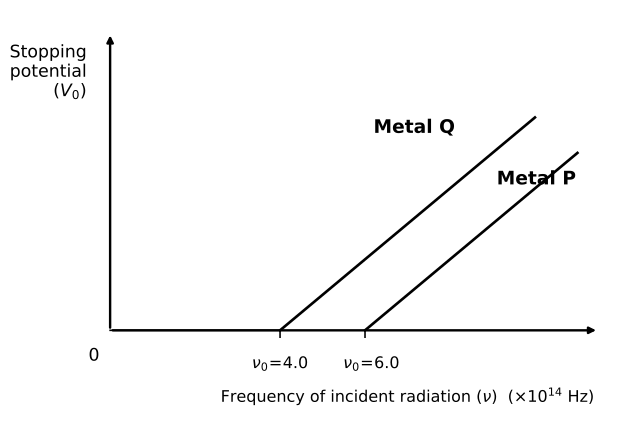
(ii) The researcher now plots a graph of stopping potential V₀ (y-axis) versus frequency ν (x-axis) for both metals on the same axes. State TWO features that will be DIFFERENT for the two graphs, and ONE feature that will be IDENTICAL. (1 + 1 = 2 marks)

(Use h = 6.63×10⁻³⁴ Js, e = 1.6×10⁻¹⁹ C)

Diagram for question 26: Dual Nature of Radiation and Matter
Show answer
Part (i): Finding Stopping Potentials V_P and V_Q

By Einstein's photoelectric equation:

KE<sub>max</sub> = hν − φ₀ = hν − hν₀ = h(ν − ν₀)

Since eV₀ = KE<sub>max</sub>, we have:

eV₀ = h(ν − ν₀)

→ V₀ = h(ν − ν₀) / e

For Metal P (ν₀ = 6.0×10<sup>14</sup> Hz, ν = 9×10<sup>14</sup> Hz):

V_P = [6.63×10<sup>−34</sup> × (9.0 − 6.0)×10<sup>14</sup>] / (1.6×10<sup>−19</sup>)

V_P = [6.63×10<sup>−34</sup> × 3.0×10<sup>14</sup>] / (1.6×10<sup>−19</sup>)

V_P = [19.89×10<sup>−20</sup>] / [1.6×10<sup>−19</sup>]

∴ V_P = 1.24 V

For Metal Q (ν₀ = 4.0×10<sup>14</sup> Hz, ν = 9×10<sup>14</sup> Hz):

V_Q = [6.63×10<sup>−34</sup> × (9.0 − 4.0)×10<sup>14</sup>] / (1.6×10<sup>−19</sup>)

V_Q = [6.63×10<sup>−34</sup> × 5.0×10<sup>14</sup>] / (1.6×10<sup>−19</sup>)

V_Q = [33.15×10<sup>−20</sup>] / [1.6×10<sup>−19</sup>]

∴ V_Q = 2.07 V

[Note: V_Q > V_P because Q has a lower work function, so more kinetic energy is available at the same incident frequency.]

Part (ii): Features of the V₀ vs ν Graph

From Einstein's equation: V₀ = (h/e)ν − (hν₀/e)

This is a straight line of the form V₀ = (h/e)ν − φ₀/e.

TWO DIFFERENT features:

(a) x-intercept (threshold frequency): The graph for P cuts the frequency axis at ν₀ = 6.0×10<sup>14</sup> Hz, while the graph for Q cuts it at ν₀ = 4.0×10<sup>14</sup> Hz. The x-intercepts are DIFFERENT because the two metals have different work functions (φ = hν₀).

(b) y-intercept (−φ₀/e): The y-intercept for P is −hν₀P/e = −(6.63×10<sup>−34</sup> × 6×10<sup>14</sup>)/(1.6×10<sup>−19</sup>) ≈ −2.49 V, while for Q it is −(6.63×10<sup>−34</sup> × 4×10<sup>14</sup>)/(1.6×10<sup>−19</sup>) ≈ −1.66 V. The y-intercepts are DIFFERENT (more negative for P).

ONE IDENTICAL feature:

The SLOPE of both graphs is h/e = (6.63×10<sup>−34</sup>)/(1.6×10<sup>−19</sup>) = 4.14×10<sup>−15</sup> V s, which is the SAME for both metals. The slope depends only on Planck's constant h and electronic charge e — both universal constants independent of the nature of the metal.
Q27Short Answer3 marks

A research team is designing a photoelectric-based UV sensor. They have three metal surfaces available:

| Metal | Work Function (φ₀) |
|-------|-------------------|
| Caesium (Cs) | 2.0 eV |
| Calcium (Ca) | 3.2 eV |
| Platinum (Pt) | 5.6 eV |

The sensor will be exposed to radiation of wavelength 220 nm.

(i) Identify which metal(s) can emit photoelectrons when exposed to this radiation. Justify your answer with a calculation. [2]

(ii) For the metal with the highest kinetic energy of emitted photoelectrons, calculate the stopping potential. [1]

(iii) If the intensity of the incident radiation is doubled while keeping the wavelength the same, state and explain what happens to: (a) the stopping potential, and (b) the photoelectric current. [1]

Show answer
(i) By Einstein's photoelectric equation, emission is possible only if the energy of incident photon E = hc/λ is greater than the work function φ₀ of the metal.

E = hc/λ = (6.63×10⁻³⁴ × 3×10⁸) / (220×10⁻⁹)

→ E = (1.989×10⁻²⁵) / (2.20×10⁻⁷)

→ E = 9.04×10⁻¹⁹ J

Converting to eV: E = 9.04×10⁻¹⁹ / 1.6×10⁻¹⁹

∴ E ≈ 5.65 eV

Comparison with work functions:
• Cs: φ₀ = 2.0 eV < 5.65 eV → emission occurs ✓
• Ca: φ₀ = 3.2 eV < 5.65 eV → emission occurs ✓
• Pt: φ₀ = 5.6 eV < 5.65 eV → emission occurs ✓

∴ All three metals — Caesium, Calcium, and Platinum — emit photoelectrons since E > φ₀ for each.

(ii) The highest kinetic energy corresponds to the metal with the smallest work function, i.e., Caesium (φ₀ = 2.0 eV).

By Einstein's photoelectric equation:
KE<sub>max</sub> = E − φ₀ = 5.65 − 2.0 = 3.65 eV

The stopping potential V₀ is defined by eV₀ = KE<sub>max</sub>:

∴ V₀ = KE<sub>max</sub> / e = 3.65 eV / e

∴ V₀ = 3.65 V

(iii) When intensity is doubled at the same wavelength:

(a) Stopping potential remains unchanged.
Because stopping potential depends only on KE<sub>max</sub> = hν − φ₀, which depends on the frequency (wavelength) of incident radiation, not on its intensity. Since λ is unchanged, KE<sub>max</sub> and hence V₀ are unaffected.

(b) Photoelectric current doubles.
Because greater intensity means a greater number of photons per unit time striking the surface. Since each photon of sufficient energy ejects one electron, the rate of electron emission — and hence the saturation (photoelectric) current — doubles.
Q28Short Answer3 marks

Ultraviolet light of wavelength 200 nm falls on a metallic surface whose work function is 4.0 eV. Calculate: (i) the maximum kinetic energy of the emitted photoelectrons, and (ii) the stopping potential required to halt the fastest emitted electrons.

Show answer
By Einstein's Photoelectric Equation:
KE<sub>max</sub> = hν − φ₀ = hc/λ − φ₀

(i) Calculating the energy of the incident photon:

hc/λ = (6.63×10<sup>−34</sup> × 3×10<sup>8</sup>) / (200×10<sup>−9</sup>)

→ hc/λ = (1.989×10<sup>−25</sup>) / (2×10<sup>−7</sup>)

→ hc/λ = 9.945×10<sup>−19</sup> J

Converting to eV: 9.945×10<sup>−19</sup> / 1.6×10<sup>−19</sup> = 6.22 eV

Applying Einstein's photoelectric equation:
KE<sub>max</sub> = hν − φ₀ = 6.22 − 4.0

∴ KE<sub>max</sub> = 2.22 eV

(ii) The stopping potential V₀ is related to the maximum kinetic energy by:
eV₀ = KE<sub>max</sub>

→ V₀ = KE<sub>max</sub> / e = 2.22 eV / e

∴ V₀ = 2.22 V
Q29Short Answer3 marks

A researcher is testing two metal plates, P and Q, for use in a solar-powered sensor. The work functions of P and Q are 2.0 eV and 3.5 eV respectively. A beam of ultraviolet light of frequency 1.5 × 10¹⁵ Hz is incident on both plates simultaneously.

(a) Calculate the maximum kinetic energy of photoelectrons emitted from plate P. (Given: h = 6.63 × 10⁻³⁴ J s, 1 eV = 1.6 × 10⁻¹⁹ J)

(b) Will plate Q emit any photoelectrons under this radiation? Justify your answer.

(c) The researcher now doubles the intensity of the UV beam falling on plate P, keeping frequency unchanged. How does this affect (i) the maximum kinetic energy of emitted electrons, and (ii) the number of electrons emitted per second? Give reasons.

Show answer
(a) Finding maximum kinetic energy from plate P:

By Einstein's photoelectric equation:
KE<sub>max</sub> = hν − φ₀

Energy of incident photon:
E = hν = 6.63 × 10⁻³⁴ × 1.5 × 10¹⁵
E = 9.945 × 10⁻¹⁹ J

Converting to eV:
E = (9.945 × 10⁻¹⁹) / (1.6 × 10⁻¹⁹) = 6.22 eV

Work function of plate P, φ₀(P) = 2.0 eV

KE<sub>max</sub> = 6.22 − 2.0

∴ KE<sub>max</sub> = 4.22 eV (≈ 6.75 × 10⁻¹⁹ J)

(½ mark: formula stated; ½ mark: substitution; ½ mark: photon energy conversion; ½ mark: final answer with unit — total 1 mark awarded for complete correct working)

(b) Checking emission from plate Q:

Work function of plate Q, φ₀(Q) = 3.5 eV
Energy of incident photon, E = 6.22 eV

Since E = 6.22 eV > φ₀(Q) = 3.5 eV,
the threshold condition (hν > φ₀) is satisfied.

∴ Yes, plate Q will also emit photoelectrons.
KE<sub>max</sub> from Q = 6.22 − 3.5 = 2.72 eV

(c) Effect of doubling intensity on plate P (frequency unchanged):

(i) Maximum kinetic energy:
By Einstein's equation, KE<sub>max</sub> = hν − φ₀.
KE<sub>max</sub> depends only on the frequency ν of incident light and the work function φ₀ of the metal — not on intensity.
Since frequency is unchanged, ∴ the maximum kinetic energy of emitted electrons remains unchanged (= 4.22 eV).

(ii) Number of electrons emitted per second:
Intensity is proportional to the number of photons incident per unit area per unit time. Each photon (if above threshold) ejects one electron. Doubling intensity doubles the number of incident photons per second.
∴ The number of electrons emitted per second doubles.
Q30Short Answer3 marks

The work function of cesium is 2.14 eV. (a) Find the threshold frequency for cesium. (b) If cesium is illuminated with light of wavelength 400 nm, calculate the maximum kinetic energy of the emitted photoelectrons. (c) Explain why increasing only the intensity of the incident light (keeping its frequency constant above the threshold) does NOT increase the maximum kinetic energy of the emitted photoelectrons.

Show answer
(a) Finding threshold frequency:

By Einstein's photoelectric equation, the threshold frequency ν₀ is defined as the minimum frequency of incident radiation below which no photoelectron emission occurs, given by:

φ₀ = hν₀

∴ ν₀ = φ₀ / h

Substituting values:

ν₀ = (2.14 × 1.6 × 10⁻¹⁹ J) / (6.63 × 10⁻³⁴ Js)

ν₀ = (3.424 × 10⁻¹⁹) / (6.63 × 10⁻³⁴)

∴ ν₀ = 5.16 × 10¹⁴ Hz

(b) Finding maximum kinetic energy:

By Einstein's photoelectric equation:

KE<sub>max</sub> = hν − φ₀ = hc/λ − φ₀

Substituting values (λ = 400 nm = 400 × 10⁻⁹ m):

KE<sub>max</sub> = (6.63 × 10⁻³⁴ × 3 × 10⁸) / (400 × 10⁻⁹) − (2.14 × 1.6 × 10⁻¹⁹)

KE<sub>max</sub> = (19.89 × 10⁻²⁶) / (4 × 10⁻⁷) − 3.424 × 10⁻¹⁹

KE<sub>max</sub> = 4.97 × 10⁻¹⁹ J − 3.424 × 10⁻¹⁹ J

KE<sub>max</sub> = 1.546 × 10⁻¹⁹ J

∴ KE<sub>max</sub> ≈ 0.97 eV (since 1 eV = 1.6 × 10⁻¹⁹ J)

(c) Reason why intensity does not affect KE<sub>max</sub>:

According to Einstein's quantum theory, light consists of photons each carrying energy hν. The maximum kinetic energy of an emitted photoelectron depends only on the energy of a single photon (KE<sub>max</sub> = hν − φ₀), which is determined solely by the frequency ν of light.

Increasing intensity increases only the number of photons incident per unit time, not the energy of each individual photon. Since each photoelectron is ejected by a single photon, more photons simply eject more electrons (larger photoelectric current), but the energy available per electron-photon interaction — and hence KE<sub>max</sub> — remains unchanged.

Want unlimited practice on Dual Nature of Radiation and Matter?

The full ClearSteps bank has 40+ reviewed questions on this chapter alone — with step-wise solutions, difficulty levels, and progress tracking. Verify your WhatsApp number and your free trial starts right here.

CBSE · CLASS 12
🎟️14-day free trial · code PRAC auto-applied
Mobile Number
+91
OTP will be sent to your WhatsApp

⭐ Trusted by 12,000+ students across India

Dual Nature of Radiation and Matter Class 12 Questions