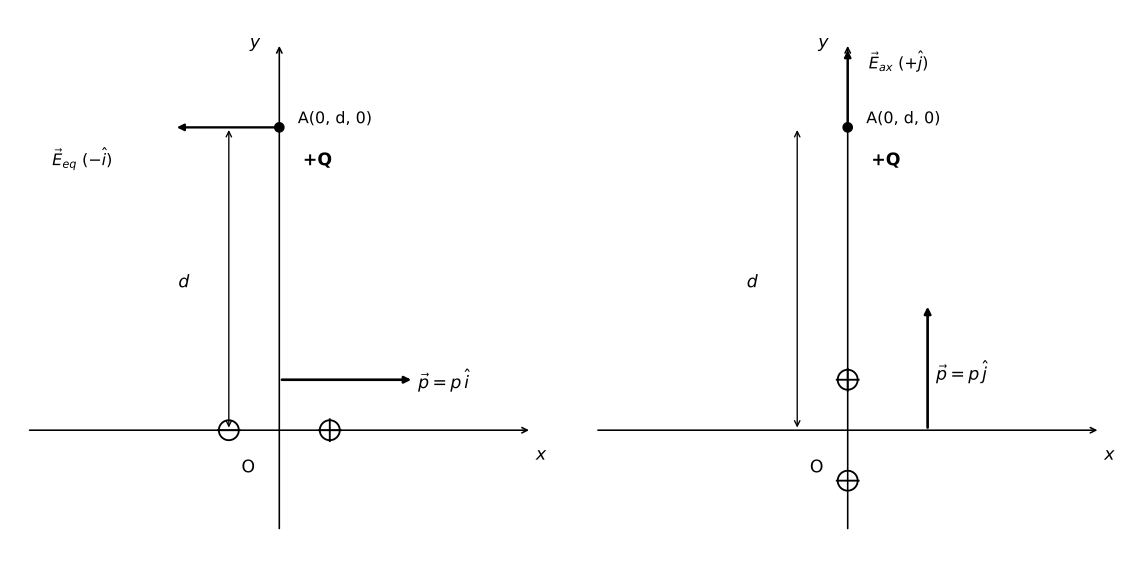
Electric dipoles appear in many molecular systems (e.g., the water molecule). Understanding the field they produce at various points is essential in chemistry and nanotechnology. Consider the following situation involving a dipole and a proton in its neighbourhood.
Given: p = 4 × 10⁻³⁰ C·m, r = 20 nm = 20 × 10⁻⁹ m, e = 1.6 × 10⁻¹⁹ C, mₚ = 1.673 × 10⁻²⁷ kg, 1/4πε₀ = 9 × 10⁹ N m² C⁻².
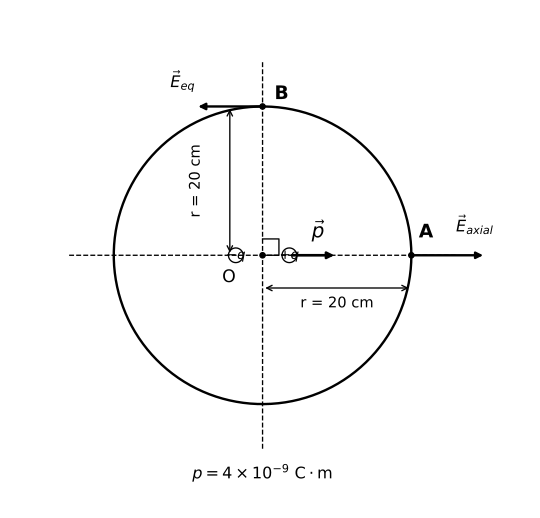
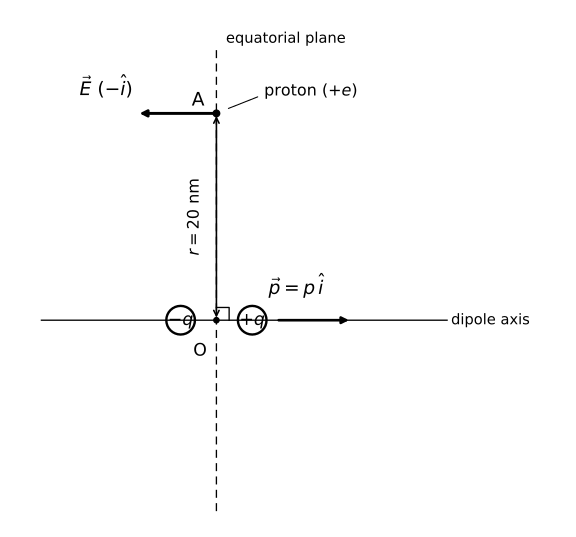
A small electric dipole of dipole moment p⃗ = p î (where p = 4 × 10⁻³⁰ C·m) is placed at the origin of a coordinate system. A proton (charge +e = 1.6 × 10⁻¹⁹ C, mass mₚ = 1.673 × 10⁻²⁷ kg) is released from rest at point A, located on the equatorial plane of the dipole at a distance r = 20 nm from the centre.
(i) State the direction of the electric field E⃗ due to the dipole at point A on its equatorial plane.
(ii) Write the expression for the magnitude of the electric field on the equatorial plane of a short dipole. Using this, calculate the magnitude of E⃗ at point A.
(iii) Calculate the electrostatic force on the proton at A.
(iv) A student argues: 'Since the equatorial field points opposite to p⃗, and the proton has positive charge, the proton will move in the direction opposite to p⃗ (i.e., along −î direction).' Is this reasoning correct? Justify.
Show answerHide answer
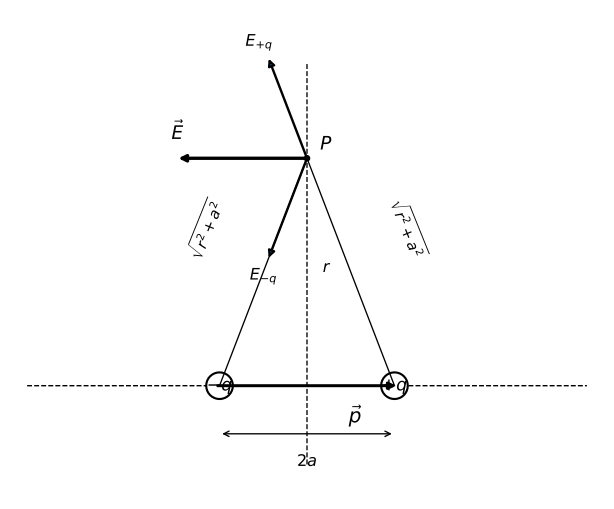
By the standard result for a short dipole, the electric field at any point on the equatorial plane is directed antiparallel to the dipole moment.
∴ Since p⃗ = p î, the electric field at A is directed along −î direction (i.e., opposite to p⃗).
[1 mark]
──────────────────────────────────────
(ii) Magnitude of electric field at equatorial point:
For a short dipole (r >> a), the electric field at a point on the equatorial plane is:
E = (1/4πε₀) · p / r³
Substituting values:
E = (9 × 10⁹) × (4 × 10⁻³⁰) / (20 × 10⁻⁹)³
Denominator: (20 × 10⁻⁹)³ = 8000 × 10⁻²⁷ = 8 × 10⁻²⁴ m³
Numerator: 9 × 10⁹ × 4 × 10⁻³⁰ = 36 × 10⁻²¹ = 3.6 × 10⁻²⁰ N m² C⁻¹
∴ E = (3.6 × 10⁻²⁰) / (8 × 10⁻²⁴)
∴ E = 4.5 × 10³ N C⁻¹ = 4500 N C⁻¹
[1 mark]
──────────────────────────────────────
(iii) Electrostatic force on the proton at A:
The force on a charge q placed in an electric field E⃗ is given by:
F⃗ = q E⃗
Substituting:
F = e × E = (1.6 × 10⁻¹⁹ C) × (4.5 × 10³ N C⁻¹)
∴ F = 7.2 × 10⁻¹⁶ N
The force is directed along −î (i.e., in the direction of E⃗ at A, which is opposite to p⃗).
∴ F⃗ = 7.2 × 10⁻¹⁶ N, directed along −î direction.
[1 mark]
──────────────────────────────────────
(iv) Evaluation of the student's reasoning:
The student's conclusion about the direction of initial motion is correct, but the reasoning is partially incomplete.
Correct reasoning:
The electric field at the equatorial point A is E⃗ = E(−î), directed along −î.
Since the proton carries positive charge (+e), the electrostatic force on it is:
F⃗ = (+e) E⃗ = F(−î)
which is indeed in the −î direction. Therefore, the proton accelerates in the −î direction initially.
However, the student's reasoning is incomplete because:
• As the proton moves away from A, it leaves the equatorial plane. The field direction and magnitude change continuously — the problem is not a one-dimensional one.
• The statement 'the proton moves in the −î direction' is only valid for the instantaneous initial acceleration at point A; the actual trajectory is curved.
∴ The direction of initial acceleration (−î) stated by the student is correct, but the claim about sustained motion in −î is not fully justified, as the field varies with position.
[1 mark]