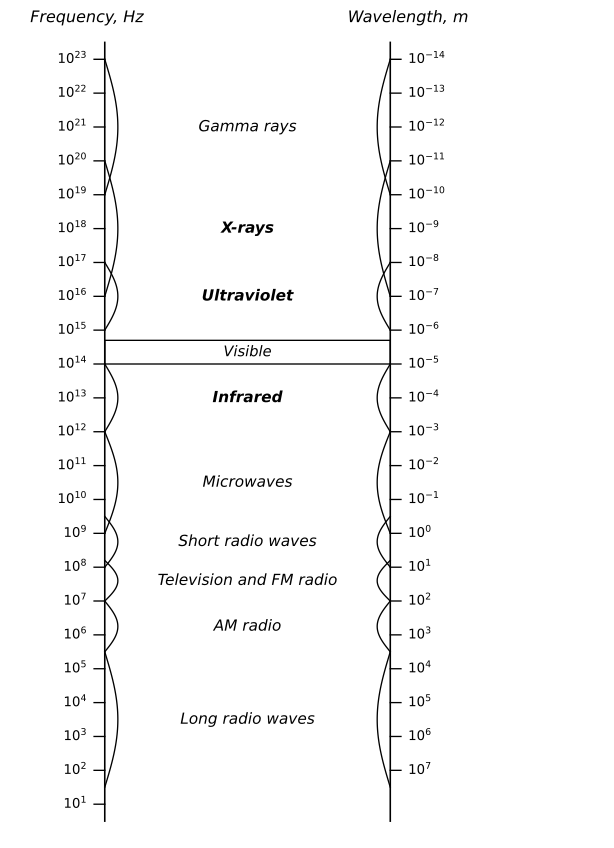
A research team is designing a multi-purpose satellite payload for simultaneous ocean monitoring, ground communication through clouds, water sterilisation, and non-destructive rock imaging. They select four distinct regions of the EM spectrum — infrared, microwave, ultraviolet, and X-rays — assigning one to each task.
A research team is designing a multi-purpose satellite payload that must simultaneously perform the following four tasks:
(P) Map surface temperature variations of ocean water to track climate change.
(Q) Communicate with ground stations through dense cloud cover and rain.
(R) Sterilise water samples collected from a remote sensing module.
(S) Image the internal crystal structure of rock samples without destroying them.
The team selects four different regions of the electromagnetic spectrum — one for each task. Study the information above and answer the following questions:
(i) Identify the most appropriate type of electromagnetic radiation for task (P) and state ONE physical property that makes it suitable.
(ii) Task (Q) requires radiation that can penetrate rain and clouds. Name the type of EM radiation used and write its approximate wavelength range.
(iii) Which type of radiation is used for task (R)? State the mechanism by which it achieves sterilisation.
(iv) For task (S), the team uses radiation whose photon energy is approximately 50 keV. Calculate the frequency of this radiation.
(Given: h = 6.63 × 10⁻³⁴ J s, 1 eV = 1.6 × 10⁻¹⁹ J)
Show answerHide answer
The appropriate radiation is Infrared (IR) radiation.
Suitable property: All objects at temperatures above absolute zero emit infrared radiation; warmer ocean regions emit more intense IR, allowing thermal mapping of surface temperature variations. (Alternatively: IR is absorbed and re-emitted by surface water in proportion to its temperature, enabling thermal imaging.)
∴ Infrared (IR) radiation is used for task (P).
(ii) Task (Q) — Communication through clouds and rain:
Microwaves are used for this purpose.
Approximate wavelength range: 1 mm to 0.1 m (i.e., 10⁻³ m to 10⁻¹ m).
Reason: Microwaves have long enough wavelengths to diffract around or pass through water droplets in clouds and rain without significant absorption.
∴ Microwaves (λ ≈ 1 mm – 10 cm) are used for task (Q).
(iii) Task (R) — Sterilisation of water samples:
Ultraviolet (UV) radiation is used for sterilisation.
Mechanism: UV radiation (particularly in the UV-C range, λ ≈ 100–280 nm) carries photons of sufficiently high energy (~4–12 eV) to be absorbed by the DNA molecules of microorganisms. This causes molecular bonds in the DNA to break or form abnormal cross-links (thymine dimers), disrupting the microorganism's ability to replicate and effectively killing or inactivating the germs.
∴ Ultraviolet (UV) radiation sterilises by destroying the DNA of microorganisms.
(iv) Task (S) — Calculating frequency of radiation with photon energy 50 keV:
By the photon energy formula:
E = hν
Converting energy to joules:
E = 50 keV = 50 × 10³ × 1.6 × 10⁻¹⁹ J
E = 50 × 1.6 × 10⁻¹⁶ J
E = 80 × 10⁻¹⁶ J
E = 8.0 × 10⁻¹⁵ J
Substituting in E = hν:
ν = E / h = (8.0 × 10⁻¹⁵) / (6.63 × 10⁻³⁴)
ν = (8.0 / 6.63) × 10⁻¹⁵ ⁺ ³⁴
ν = 1.207 × 10¹⁹ Hz
∴ ν ≈ 1.21 × 10¹⁹ Hz
This frequency lies in the X-ray region of the electromagnetic spectrum, confirming that X-rays are appropriate for task (S) — imaging internal crystal structure non-destructively.