ClearStepsCLEARSTEPS AI
Teacher Login →Student Login →

Electrostatic Potential and Capacitance: Class 12 Physics Practice Questions

30 original exam-pattern questions with full answers, matched to the current CBSE Class 12 paper design, including case-based questions. Attempt each question before opening the answer — or start a free 14-day trial ↓ for the full bank.

Q1Case-based4 marks

A space probe carries two identical parallel-plate capacitors, C₁ and C₂, each with plate area A = 4×10⁻² m² and plate separation d = 2×10⁻³ m. On Earth, both are connected in series across a 120 V battery and fully charged; the battery is then disconnected. During the mission, the probe enters a region of a planet's atmosphere and the space between the plates of C₁ only is completely filled with a dielectric of relative permittivity (dielectric constant) K = 5. The probe's onboard computer monitors voltage changes across individual capacitors to analyse the dielectric properties of the atmosphere.

A space probe carries two identical parallel-plate capacitors, C₁ and C₂, each with plate area A = 4×10⁻² m² and plate separation d = 2×10⁻³ m. On Earth, both are connected in series across a 120 V battery and fully charged; the battery is then disconnected. During the mission, the probe enters a region of a planet's atmosphere and the space between the plates of C₁ only is completely filled with a dielectric of relative permittivity (dielectric constant) K = 5.

(i) Calculate the capacitance of each capacitor before the dielectric is inserted. (ε₀ = 8.854×10⁻¹² C² N⁻¹ m⁻²)

(ii) When the two capacitors were connected in series across 120 V (before dielectric insertion), find the charge Q stored on the combination and the energy U₀ stored in the series combination.

(iii) After the battery is disconnected and the dielectric (K = 5) is inserted into C₁, find the new equivalent capacitance of the series combination.

(iv) The charge Q on the isolated series combination remains conserved after the dielectric is inserted. Find the new voltage across C₂ alone after the dielectric insertion. What physical principle guarantees that the total charge is conserved?

Show answer
━━━━━━━━━━━━━━━━━━━━━━━━━━━━━━━━━━
CBSE Marking Scheme — 4 Marks (1+1+1+1)
━━━━━━━━━━━━━━━━━━━━━━━━━━━━━━━━━━

(i) Capacitance of each capacitor before dielectric insertion:

Formula: C = ε₀A/d

Substituting:
C = (8.854×10⁻¹² × 4×10⁻²) / (2×10⁻³)
C = (3.5416×10⁻¹³) / (2×10⁻³)
C = 1.77×10⁻¹⁰ F

∴ C₁ = C₂ = C ≈ 177 pF

━━━━━━━━━━━━━━━━━━━━━━━━━━━━━━━━━━
(ii) Charge and energy stored in series combination (before dielectric):

For two identical capacitors C in series:
C_series = C/2 = 1.77×10⁻¹⁰ / 2 = 0.885×10⁻¹⁰ F = 88.5 pF

Charge stored:
Formula: Q = C_series × V
Q = 0.885×10⁻¹⁰ × 120
∴ Q = 1.062×10⁻⁸ C ≈ 10.6 nC

Energy stored:
Formula: U₀ = ½ C_series V²
U₀ = ½ × 0.885×10⁻¹⁰ × (120)²
U₀ = ½ × 0.885×10⁻¹⁰ × 14400
∴ U₀ = 6.37×10⁻⁷ J ≈ 0.637 μJ

━━━━━━━━━━━━━━━━━━━━━━━━━━━━━━━━━━
(iii) New equivalent capacitance after dielectric is inserted into C₁:

When dielectric of constant K = 5 is inserted into C₁:
Formula: C₁' = KC = 5 × 1.77×10⁻¹⁰ = 8.85×10⁻¹⁰ F = 885 pF
C₂ remains unchanged: C₂ = 1.77×10⁻¹⁰ F = 177 pF

New series combination:
Formula: 1/C_new = 1/C₁' + 1/C₂
1/C_new = 1/(8.85×10⁻¹⁰) + 1/(1.77×10⁻¹⁰)
1/C_new = (1.130×10⁹) + (5.650×10⁹)
1/C_new = 6.780×10⁹ F⁻¹

∴ C_new = 1/6.780×10⁹ = 1.475×10⁻¹⁰ F ≈ 147.5 pF

━━━━━━━━━━━━━━━━━━━━━━━━━━━━━━━━━━
(iv) New voltage across C₂ after dielectric insertion:

Physical principle: Since the battery was disconnected before the dielectric was inserted, the capacitor combination forms an isolated system. By the principle of conservation of charge (no charge can flow to or from an isolated conductor system), the total charge Q on the series combination remains Q = 1.062×10⁻⁸ C.

In a series combination, the same charge Q resides on each capacitor (charge on each plate is equal and opposite). Therefore, charge on C₂ after insertion = Q = 1.062×10⁻⁸ C.

Voltage across C₂:
Formula: V₂ = Q / C₂
V₂ = (1.062×10⁻⁸) / (1.77×10⁻¹⁰)
∴ V₂ = 60 V

The physical principle is conservation of charge: in an isolated system with no external current path, the net charge on the conductors cannot change. Since the battery is disconnected, no charge can redistribute beyond the capacitor plates, so Q remains constant.
Q2Case-based4 marks

Two concentric conducting spheres: solid sphere P (radius r = 3 cm = 0.03 m) charged to potential V₀ = 600 V, and hollow shell Q (radius R = 9 cm = 0.09 m), initially uncharged and isolated. k = 9×10⁹ N m² C⁻².

A school physics lab has two spherical conductors: a solid conducting sphere P of radius 3 cm charged to a potential of 600 V, and a larger hollow conducting shell Q of radius 9 cm, initially uncharged and electrically isolated, surrounding P concentrically. The two spheres are not connected.

(i) Calculate the charge on sphere P.
(ii) A student now connects P and Q by a thin conducting wire. What is the final potential on sphere Q after charge redistribution? Justify your answer in one line.
(iii) After connection, what is the electric field intensity at a point 5 cm from the common centre (i.e., between the old surface of P and the inner surface of Q)? Give a reason.
(iv) A classmate argues: 'After connection, the potential inside shell Q (at a point between P and Q) is non-zero even though no charge resides there.' Is this statement correct? Explain briefly.

Show answer
(i) Charge on sphere P before connection:

The potential of an isolated conducting sphere is given by:
V = kq/r

Substituting:
600 = (9×10⁹ × q) / (0.03)

q = (600 × 0.03) / (9×10⁹)
q = 18 / (9×10⁹)

∴ q = 2×10⁻⁹ C = 2 nC

(ii) Final potential on shell Q after connection:

When P and Q are connected by a wire, charge flows from the inner sphere to the outer shell until both are at the same potential. For a conductor, all charge resides on the outermost surface. The entire charge q = 2×10⁻⁹ C transfers to the outer surface of shell Q.

Final potential on Q:
V_Q = kq/R = (9×10⁹ × 2×10⁻⁹) / (0.09)
V_Q = 18 / 0.09

∴ V_Q = 200 V

Justification: After connection, the system behaves as a single conductor; all charge migrates to the outer surface of Q (largest radius = lowest potential energy configuration), making the potential of the entire system equal to 200 V.

(iii) Electric field at a point 5 cm from the centre (between P and Q) after connection:

By Gauss's Law: ∮ E⃗ · dA⃗ = q_enclosed / ε₀

After connection, all charge resides on the outer surface of Q. Therefore, the charge enclosed within a Gaussian surface of radius 5 cm (which lies between P and Q) is:
q_enclosed = 0

∴ E⃗ = 0 N/C at any point between P and Q after connection.

Reason: Since all free charge has moved to the outer surface of Q, the electric flux through any closed surface in this region is zero, giving zero electric field.

(iv) Correctness of the classmate's statement:

The statement is CORRECT.

Even though E⃗ = 0 inside shell Q (between the spheres after connection), the electric potential is not zero — it equals 200 V throughout this region.

This is because potential is related to the work done in bringing a charge from infinity, not to the local electric field. Since E⃗ = 0 inside, no work is done in moving a charge within this region, so the potential remains constant and equal to the surface potential of Q (200 V). A zero electric field means constant potential, not necessarily zero potential.
Q3Case-based4 marks

A student is designing a portable electronic device that requires a capacitor bank with an effective capacitance of 8 μF and must be able to withstand a working voltage of 600 V. The student has access to only one type of capacitor: each has a capacitance of 8 μF and a maximum working voltage of 300 V. The student explores combinations of these capacitors to meet both requirements.

A student is designing a portable electronic device that requires a capacitor bank with an effective capacitance of 8 μF and must be able to withstand a working voltage of 600 V. The student has access to only one type of capacitor: each has a capacitance of 8 μF and a maximum working voltage of 300 V.

(i) If the student connects two such capacitors in series, what is the effective capacitance and the maximum working voltage of the combination?

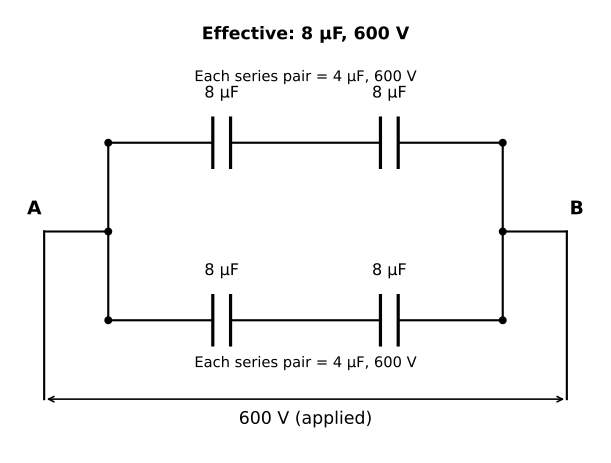
(ii) If the student now connects two such series combinations in parallel, find the effective capacitance and maximum working voltage of the final arrangement.

(iii) Does the final arrangement in (ii) meet both the requirements (8 μF capacitance and 600 V working voltage)? Justify your answer.

(iv) The student stores energy in the final capacitor bank by charging it to 600 V. Calculate the total energy stored in the bank.
(Use: U = ½CV²)

Diagram for question 3: Electrostatic Potential and Capacitance
Show answer
(i) Series combination of two 8 μF capacitors:

For capacitors in series: 1/C<sub>series</sub> = 1/C₁ + 1/C₂ = 1/8 + 1/8 = 2/8

∴ C<sub>series</sub> = 4 μF

In series, the voltage rating adds up:
∴ Maximum working voltage of series combination = 300 + 300 = 600 V

(ii) Two series combinations (each 4 μF, 600 V) connected in parallel:

For capacitors in parallel: C<sub>total</sub> = C<sub>series1</sub> + C<sub>series2</sub> = 4 + 4

∴ C<sub>total</sub> = 8 μF

In parallel, the voltage rating is limited by the lowest individual branch rating:
∴ Maximum working voltage of final arrangement = 600 V

(iii) Checking against requirements:
— Required capacitance: 8 μF → Achieved: 8 μF ✓
— Required working voltage: 600 V → Achieved: 600 V ✓

∴ Yes, the final arrangement meets BOTH requirements. The two-series-combinations-in-parallel arrangement provides exactly 8 μF capacitance and can safely withstand 600 V, because each series branch independently supports the full 600 V and the parallel connection restores the required capacitance.

(iv) Energy stored in the final capacitor bank:

Formula: U = ½CV²

Substituting C = 8 μF = 8 × 10<sup>−6</sup> F and V = 600 V:

U = ½ × 8 × 10<sup>−6</sup> × (600)<sup>2</sup>
U = ½ × 8 × 10<sup>−6</sup> × 3.6 × 10<sup>5</sup>
U = ½ × 2.88

∴ U = 1.44 J
Q4Case-based4 marks

Capacitors are widely used in electronic circuits to store charge and energy. The capacitance of a parallel-plate capacitor depends on the geometry of the plates and the medium between them. Inserting a dielectric material increases the capacitance by a factor equal to the dielectric constant K. The energy stored in a capacitor connected to a battery depends on the voltage (which stays fixed) and the capacitance.

A student is designing a parallel-plate capacitor for a school science project. She has two square aluminium plates, each of side 20 cm, and places them 4 mm apart in air. She then fills the entire space between the plates with a slab of glass (dielectric constant K = 5).

(i) Find the capacitance of the capacitor WITHOUT the glass slab.
(ii) Find the capacitance of the capacitor WITH the glass slab inserted.
(iii) If the capacitor (with the glass slab) is connected to a 12 V battery, find the energy stored in it.
(iv) The student now pulls out the glass slab while the battery remains connected. State whether the energy stored in the capacitor increases, decreases, or remains the same. Give one reason.

Show answer
Given:
Side of each plate, a = 20 cm = 0.20 m
Separation, d = 4 mm = 4 × 10⁻³ m
Dielectric constant of glass, K = 5
ε₀ = 8.854 × 10⁻¹² C² N⁻¹ m⁻²
Plate area, A = (0.20)² = 0.04 m²

━━━━━━━━━━━━━━━━━━━━━━━━━━━━━━
(i) Capacitance WITHOUT the glass slab:

Formula: C₀ = ε₀A / d

Substituting:
C₀ = (8.854 × 10⁻¹² × 0.04) / (4 × 10⁻³)
C₀ = (3.5416 × 10⁻¹³) / (4 × 10⁻³)
C₀ = 8.85 × 10⁻¹¹ F

∴ C₀ ≈ 88.5 pF

━━━━━━━━━━━━━━━━━━━━━━━━━━━━━━
(ii) Capacitance WITH the glass slab:

Formula: C = K ε₀A / d = K C₀

Substituting:
C = 5 × 8.85 × 10⁻¹¹
C = 44.25 × 10⁻¹¹ F

∴ C ≈ 4.43 × 10⁻¹⁰ F (≈ 443 pF)

━━━━━━━━━━━━━━━━━━━━━━━━━━━━━━
(iii) Energy stored when connected to V = 12 V (with slab):

Formula: U = ½ CV²

Substituting:
U = ½ × 4.43 × 10⁻¹⁰ × (12)²
U = ½ × 4.43 × 10⁻¹⁰ × 144
U = ½ × 6.379 × 10⁻⁸
U = 3.19 × 10⁻⁸ J

∴ U ≈ 3.19 × 10⁻⁸ J

━━━━━━━━━━━━━━━━━━━━━━━━━━━━━━
(iv) Effect of removing the glass slab while battery remains connected:

When the battery remains connected, the voltage V across the capacitor stays constant at 12 V.

On removing the slab, K drops from 5 to 1, so capacitance decreases: C′ = C₀ < C.

Since U = ½ CV² and V is fixed, U decreases when C decreases.

∴ The energy stored in the capacitor DECREASES.
Reason: With the battery connected, voltage is held constant. Removing the dielectric reduces the capacitance (C = ε₀A/d < Kε₀A/d), and since U = ½CV², the stored energy decreases.
Q5Case-based4 marks

A food packaging company uses a parallel plate capacitor-based sensor to detect moisture content in packaged food. The sensor consists of two square metal plates, each of side 20 cm, separated by a distance of 4 mm. Initially, the gap between the plates is filled with air (dielectric constant K = 1). When a food sample is inserted between the plates, the dielectric constant of the medium changes to K = 2.5.

A food packaging company uses a parallel plate capacitor-based sensor to detect moisture content in packaged food. The sensor consists of two square metal plates, each of side 20 cm, separated by a distance of 4 mm. Initially, the gap between the plates is filled with air (dielectric constant K = 1). When a food sample is inserted between the plates, the dielectric constant of the medium changes to K = 2.5.

(i) Calculate the capacitance of the sensor when the gap is filled with air.

(ii) When the food sample (K = 2.5) is inserted, the sensor is connected to a 12 V battery and fully charged. Calculate the charge stored on the capacitor.

(iii) After the capacitor is fully charged (with food sample inserted and battery connected), the battery is disconnected. The food sample is then removed, leaving air between the plates. Explain what happens to: (a) the charge on the plates, and (b) the potential difference across the plates. Also calculate the new potential difference.

Show answer
Given data:
Side of square plate, a = 20 cm = 0.20 m → Area A = (0.20)<super>2</super> = 0.04 m<super>2</super>
Separation, d = 4 mm = 4 × 10<super>−3</super> m
ε<sub>0</sub> = 8.854 × 10<super>−12</super> C<super>2</super> N<super>−1</super> m<super>−2</super>

─────────────────────────────────────
(i) Capacitance with air (K = 1) [1 mark]
─────────────────────────────────────
For a parallel plate capacitor with air between the plates:

C<sub>0</sub> = ε<sub>0</sub>A / d

Substituting:

C<sub>0</sub> = (8.854 × 10<super>−12</super> × 0.04) / (4 × 10<super>−3</super>)

C<sub>0</sub> = (3.5416 × 10<super>−13</super>) / (4 × 10<super>−3</super>)

∴ C<sub>0</sub> = 8.85 × 10<super>−11</super> F ≈ 88.5 pF

─────────────────────────────────────
(ii) Charge stored when food sample (K = 2.5) is inserted and battery V = 12 V is connected [1 mark]
─────────────────────────────────────
With a dielectric of constant K between the plates:

C = K ε<sub>0</sub>A / d = K × C<sub>0</sub>

C = 2.5 × 8.85 × 10<super>−11</super>

C = 2.2125 × 10<super>−10</super> F ≈ 221.25 pF

Charge stored: Q = CV

Q = 2.2125 × 10<super>−10</super> × 12

∴ Q = 2.655 × 10<super>−9</super> C ≈ 2.66 nC

─────────────────────────────────────
(iii) Battery disconnected; food sample removed (K returns to 1) [2 marks]
─────────────────────────────────────
(a) Effect on charge:
Since the battery is disconnected before the food sample is removed, there is no conducting path for charge to flow. By conservation of charge, the charge on the plates remains constant.

∴ Q′ = Q = 2.655 × 10<super>−9</super> C (unchanged)

(b) Effect on potential difference and its new value:
When the dielectric (food sample) is removed, K decreases from 2.5 to 1.
The new capacitance (air-filled) is:

C′ = C<sub>0</sub> = 8.85 × 10<super>−11</super> F

Since Q is constant and C′ < C, the potential difference increases.

New potential difference:

V′ = Q / C′

V′ = (2.655 × 10<super>−9</super>) / (8.85 × 10<super>−11</super>)

∴ V′ = 30 V

Physical reason: Removing the dielectric reduces the capacitance (the polarisation of the dielectric medium that was reducing the net electric field between the plates is no longer present). Since charge is conserved, the potential difference V′ = Q/C′ increases by a factor equal to K = 2.5.

Verification: V′ = K × V = 2.5 × 12 = 30 V ✓
Q6Case-based4 marks

A parallel plate capacitor (square plates, side = 20 cm, separation d = 4 mm) is charged by a 100 V battery to full charge. The battery is then disconnected. A dielectric slab of K = 5 is inserted to fill the entire space between the plates. ε₀ = 8.85 × 10⁻¹² C² N⁻¹ m⁻².

Read the following passage and answer the questions that follow.

A physics teacher demonstrates an experiment to her class. She takes a parallel plate capacitor with square plates of side 20 cm and plate separation d = 4 mm. She connects it to a 100 V battery and allows it to charge fully. She then DISCONNECTS the battery. Next, she carefully inserts a dielectric slab of dielectric constant K = 5 and thickness equal to the full plate separation (d = 4 mm) between the plates, filling the entire space.

(i) What is the capacitance of the capacitor BEFORE the dielectric is inserted? (Take ε₀ = 8.85 × 10⁻¹² C² N⁻¹ m⁻²)

(ii) What is the charge stored on the capacitor after it is fully charged by the battery (before the dielectric is inserted)?

(iii) After the battery is disconnected and the dielectric is inserted, what is the new potential difference across the capacitor?

(iv) A student claims: 'Since the battery is disconnected before inserting the dielectric, the energy stored in the capacitor INCREASES after insertion.' Is the student correct? Justify with a calculation of the ratio of energy after insertion to energy before insertion.

Show answer
(i) Capacitance before dielectric insertion:

The capacitance of a parallel plate capacitor is given by:
C₀ = ε₀A/d

Here, A = (0.20)² = 0.04 m², d = 4 × 10⁻³ m

C₀ = (8.85 × 10⁻¹²× 0.04) / (4 × 10⁻³)

C₀ = (3.54 × 10⁻¹³) / (4 × 10⁻³)

∴ C₀ = 8.85 × 10⁻¹¹ F ≈ 88.5 pF

(ii) Charge stored on the capacitor (before dielectric, battery connected at V = 100 V):

Q = C₀V

Q = 8.85 × 10⁻¹¹ × 100

∴ Q = 8.85 × 10⁻⁹ C = 8.85 nC

(iii) New potential difference after battery is disconnected and dielectric is inserted:

Key principle: When the battery is disconnected BEFORE inserting the dielectric, the charge Q on the plates remains CONSTANT (no path for charge to flow).

The new capacitance with dielectric fully filling the gap is:
C = KC₀ = 5 × 8.85 × 10⁻¹¹ = 4.425 × 10⁻¹⁰ F

Since charge is conserved: Q = C × V′

V′ = Q / C = Q / (KC₀) = V / K

V′ = 100 / 5

∴ V′ = 20 V

(The potential difference decreases by a factor of K = 5.)

(iv) Comparison of energy stored before and after insertion:

Energy stored in a capacitor: U = Q²/(2C)

Since Q is constant (battery disconnected):

Energy before insertion: U₀ = Q²/(2C₀)

Energy after insertion: U = Q²/(2KC₀) = U₀/K

Ratio: U/U₀ = 1/K = 1/5 = 0.2

∴ The energy DECREASES to 1/5 of its original value after the dielectric is inserted.

The student's claim is INCORRECT. The energy stored decreases (not increases) when the dielectric is inserted after disconnecting the battery. The reduction in energy (U₀ − U = 4U₀/5) is used up in doing work against the electric force as the dielectric slab is pulled into the capacitor (the field attracts the dielectric inward, and this mechanical work done on the system accounts for the energy balance).
Q7Case-based4 marks

A parallel plate capacitor has plates of area A = 0.02 m² separated by a distance d = 2 mm. The space between the plates is completely filled with a dielectric slab of dielectric constant K = 5. The capacitor is connected to a battery of EMF 12 V and fully charged, after which the battery is disconnected. When a dielectric is introduced between capacitor plates, the capacitance increases by a factor K. When the battery is disconnected, the charge Q on the plates remains constant (charge is conserved). Given: ε₀ = 8.854 × 10⁻¹² C² N⁻¹ m⁻².

A parallel plate capacitor has plates of area A = 0.02 m² separated by a distance d = 2 mm. The space between the plates is completely filled with a dielectric slab of dielectric constant K = 5. The capacitor is connected to a battery of EMF 12 V and fully charged, after which the battery is disconnected.

(i) Calculate the capacitance of the capacitor with the dielectric slab.
(ii) Calculate the energy stored in the capacitor when connected to the battery.
(iii) The dielectric slab is now carefully removed from between the plates (with the battery still disconnected). What happens to the voltage across the capacitor? Calculate the new voltage.
(iv) A student claims: 'Removing the dielectric after disconnecting the battery increases the energy stored in the capacitor.' Is this claim correct? Justify with a calculation.

Show answer
Given: A = 0.02 m², d = 2 × 10⁻³ m, K = 5, V = 12 V, ε₀ = 8.854 × 10⁻¹² C² N⁻¹ m⁻².

(i) Capacitance with dielectric:

The capacitance of a parallel plate capacitor with a dielectric of constant K is:
C = Kε₀A/d

C = (5 × 8.854 × 10⁻¹² × 0.02) / (2 × 10⁻³)
C = (8.854 × 10⁻¹³) / (2 × 10⁻³)
C = 4.427 × 10⁻¹⁰ F

∴ C = 4.43 × 10⁻¹⁰ F ≈ 443 pF

(ii) Energy stored when connected to battery:

The energy stored in a capacitor is:
U = ½CV²

U = ½ × 4.43 × 10⁻¹⁰ × (12)²
U = ½ × 4.43 × 10⁻¹⁰ × 144
U = ½ × 6.38 × 10⁻⁸

∴ U₁ = 3.19 × 10⁻⁸ J

(iii) New voltage after dielectric is removed (battery disconnected):

Since the battery is disconnected before the slab is removed, the charge Q on the plates remains constant (conservation of charge).

Charge stored: Q = CV = 4.43 × 10⁻¹⁰ × 12 = 5.32 × 10⁻⁹ C

Capacitance without dielectric (air/vacuum):
C₀ = ε₀A/d = C/K = 4.43 × 10⁻¹⁰ / 5 = 8.85 × 10⁻¹¹ F

New voltage: V' = Q/C₀ = 5.32 × 10⁻⁹ / 8.85 × 10⁻¹¹

∴ V' = 60 V

The voltage increases (V' = K × V = 5 × 12 = 60 V), because charge is conserved but capacitance decreases by factor K.

(iv) Energy after removal of dielectric:

U₂ = ½C₀V'² = ½ × 8.85 × 10⁻¹¹ × (60)²
U₂ = ½ × 8.85 × 10⁻¹¹ × 3600
U₂ = ½ × 3.19 × 10⁻⁷

∴ U₂ = 1.59 × 10⁻⁷ J

Alternatively, since Q is constant: U₂ = Q²/2C₀ = Q²/(2 × C/K) = K × (Q²/2C) = K × U₁ = 5 × 3.19 × 10⁻⁸ = 1.59 × 10⁻⁷ J

Since U₂ = 1.59 × 10⁻⁷ J > U₁ = 3.19 × 10⁻⁸ J, the student's claim is CORRECT.

The energy increases by a factor K = 5 when the dielectric is removed with the battery disconnected. The extra energy comes from the work done by the external agent in pulling the dielectric slab out against the attractive electrostatic force that tends to pull the dielectric back between the plates.
Q8Case-based4 marks

Capacitors are fundamental components in electronic circuits. When capacitors are combined in series, the reciprocal of equivalent capacitance equals the sum of reciprocals of individual capacitances. In parallel, capacitances add directly. When a dielectric of constant K is inserted into a capacitor, its capacitance increases by a factor K. A battery maintains a constant potential difference across its terminals.

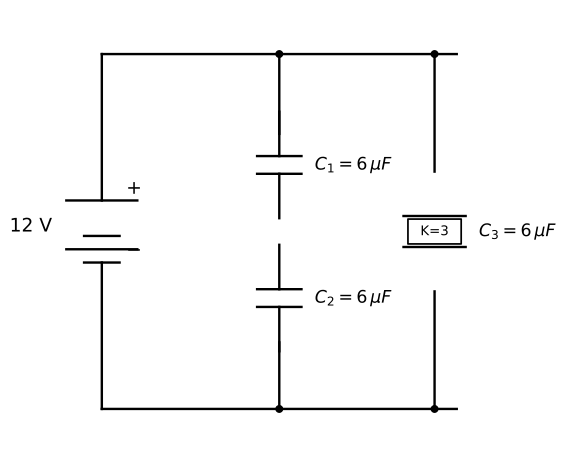
A student assembles a circuit with three identical capacitors, each of capacitance C = 6 μF. She connects two of them in series and then connects the third one in parallel with this series combination. The combination is connected across a 12 V battery.

(i) Calculate the equivalent capacitance of the combination.
(ii) Find the total charge supplied by the battery.
(iii) A dielectric slab of dielectric constant K = 3 is now inserted filling the gap of the capacitor connected in parallel (while the battery remains connected). What is the new equivalent capacitance?
(iv) With the dielectric inserted, find the new charge on the capacitor in parallel.

Diagram for question 8: Electrostatic Potential and Capacitance
Show answer
(i) Equivalent capacitance of the combination:

The two capacitors in series (C₁ = C₂ = 6 μF):

1/C<sub>series</sub> = 1/C + 1/C = 1/6 + 1/6 = 2/6

∴ C<sub>series</sub> = 3 μF

This series combination is connected in parallel with the third capacitor (C₃ = 6 μF):

C<sub>eq</sub> = C<sub>series</sub> + C₃ = 3 + 6

∴ C<sub>eq</sub> = 9 μF

(ii) Total charge supplied by the battery:

By the relation Q = C<sub>eq</sub> × V,

Q = 9 × 10<sup>−6</sup> × 12

∴ Q = 1.08 × 10<sup>−4</sup> C = 108 μC

(iii) New equivalent capacitance after inserting dielectric in the parallel capacitor:

When a dielectric of constant K = 3 is inserted into the capacitor in parallel (while battery remains connected), its new capacitance becomes:

C₃' = K × C = 3 × 6 = 18 μF

The series pair is unchanged: C<sub>series</sub> = 3 μF

New equivalent capacitance:

C<sub>eq</sub>' = C<sub>series</sub> + C₃' = 3 + 18

∴ C<sub>eq</sub>' = 21 μF

(iv) New charge on the capacitor in parallel (with dielectric):

Since the battery remains connected, the voltage across the parallel capacitor is still V = 12 V.

By Q = C₃' × V,

Q₃' = 18 × 10<sup>−6</sup> × 12

∴ Q₃' = 216 μC
Q9MCQ1 mark

The work done in moving a charge of 4 μC between two points in an electric field is 80 μJ. The potential difference between the two points is:

Show answer
Option (C) is correct.

Explanation: The relation between work done, charge, and potential difference is W = qV, where V = W/q.

∴ V = (80 × 10⁻⁶ J) / (4 × 10⁻⁶ C) = 20 V
Q10MCQ1 mark

The capacitance of a parallel plate capacitor with plate area A and plate separation d is C. If a dielectric slab of dielectric constant K is completely filled between the plates, the new capacitance becomes:

Show answer
Option (B) is correct.

Explanation: The capacitance of a parallel plate capacitor without a dielectric is C = ε₀A/d. When a dielectric slab of dielectric constant K completely fills the space between the plates, the permittivity of the medium becomes Kε₀. The new capacitance is C′ = Kε₀A/d = KC.

∴ New capacitance = KC.
Q11MCQ1 mark

The capacitance of a parallel plate capacitor with air between its plates is C₀. When a dielectric slab of dielectric constant K completely fills the space between the plates, its capacitance becomes:

Show answer
Option (C) is correct.

Explanation: The capacitance of a parallel plate capacitor with air (vacuum) between its plates is C₀ = ε₀A/d. When a dielectric of constant K completely fills the gap, ε₀ is replaced by Kε₀, giving C = Kε₀A/d = KC₀. Since K > 1 for any dielectric, the capacitance increases by a factor K.
Q12MCQ1 mark

A parallel plate capacitor has plate area A and plate separation d. When a dielectric slab of dielectric constant K completely fills the space between the plates, the energy stored in the capacitor for the same charge Q is:

Show answer
Option (A) is correct.

Explanation: With a dielectric of constant K fully inserted at constant charge Q, the capacitance becomes C = Kε₀A/d.

Energy stored U = Q²/2C = Q²/(2 × Kε₀A/d) = Q²d/(2Kε₀A).

∴ U = Q²d / (2Kε₀A).
Q13MCQ1 mark

A parallel plate capacitor has capacitance C. It is charged by connecting it to a battery of EMF V and then the battery is disconnected. The space between the plates is completely filled with a dielectric of dielectric constant K. What is the energy stored in the capacitor after introducing the dielectric?

Show answer
Option (A) is correct.

Explanation: When the battery is disconnected before inserting the dielectric, the charge on the capacitor remains constant at Q = CV.

On inserting a dielectric of constant K, the new capacitance becomes C′ = KC.

Energy stored: U′ = Q²/2C′ = (CV)²/2(KC) = CV²/2K.

∴ Energy stored = CV²/2K.
Q14MCQ1 mark

A parallel plate capacitor has plate area A and plate separation d. It is connected to a battery of EMF V. The energy stored in the capacitor is U. If the plate separation is doubled while keeping the capacitor connected to the battery, the new energy stored U′ is:

Show answer
Option (A) is correct.

Explanation: The energy stored in a parallel plate capacitor is U = ½CV².

Since the capacitor remains connected to the battery, the voltage across it stays constant at V.

Capacitance C = ε₀A/d.

When plate separation is doubled (d → 2d), the new capacitance becomes:
C′ = ε₀A/(2d) = C/2.

New energy: U′ = ½C′V² = ½(C/2)V² = U/2.

∴ U′ = U/2.
Q15Short Answer2 marks

Two capacitors of capacitances C₁ = 4 μF and C₂ = 6 μF are connected in series across a potential difference of 100 V. Find the charge on each capacitor and the potential difference across C₁.

Show answer
For capacitors in series, the equivalent capacitance is given by:

1/C_eq = 1/C₁ + 1/C₂

→ 1/C_eq = 1/4 + 1/6 = 3/12 + 2/12 = 5/12

∴ C_eq = 12/5 = 2.4 μF

In series combination, charge on each capacitor is the same and equals:

Q = C_eq × V

→ Q = 2.4 × 10⁻⁶ × 100

∴ Q = 2.4 × 10⁻⁴ C (on each capacitor) [1 mark]

Potential difference across C₁:

V₁ = Q / C₁

→ V₁ = (2.4 × 10⁻⁴) / (4 × 10⁻⁶)

∴ V₁ = 60 V [1 mark]
Q16Short Answer2 marks

Two isolated conducting spheres P and Q have radii R and 2R respectively, and carry charges 4Q and −2Q respectively. They are connected by a thin conducting wire. Find the charges on spheres P and Q after equilibrium is reached.

Show answer
When the spheres are connected by a wire, charge redistributes until both spheres reach the same potential.

Total charge is conserved:
q_P + q_Q = 4Q + (−2Q) = 2Q … (i)

At equilibrium, potentials are equal:
V_P = V_Q

∴ (1/4πε₀)(q_P/R) = (1/4πε₀)(q_Q/2R)

→ q_P/R = q_Q/2R

→ q_P = q_Q/2 … (ii)

Substituting (ii) in (i):
q_Q/2 + q_Q = 2Q
→ (3/2)q_Q = 2Q

∴ q_Q = 4Q/3

And from (ii):
∴ q_P = 2Q/3

∴ After equilibrium, charge on sphere P = 2Q/3 and charge on sphere Q = 4Q/3.
Q17Short Answer2 marks

Two parallel plate capacitors, each of capacitance C, are connected first in series and then in parallel. Find the ratio of energy stored in the series combination to that in the parallel combination, when the same potential difference V is applied across each combination.

Show answer
The energy stored in a capacitor combination is given by U = ½ C_eff V².

For series combination:
C_series = C·C/(C+C) = C/2
∴ U_series = ½ · (C/2) · V² = CV²/4

For parallel combination:
C_parallel = C + C = 2C
∴ U_parallel = ½ · (2C) · V² = CV²

∴ Ratio = U_series / U_parallel = (CV²/4) / (CV²) = 1/4

∴ U_series : U_parallel = 1 : 4
Q18Short Answer2 marks

Three point charges q₁ = +2 μC, q₂ = −4 μC and q₃ = +6 μC are placed at the three vertices of an equilateral triangle of side 20 cm. Calculate the electrostatic potential energy of this system of charges.

Show answer
The electrostatic potential energy of a system of three point charges is the work done in assembling them from infinity, given by:

U = (1/4πε₀) × [q₁q₂/r₁₂ + q₂q₃/r₂₃ + q₁q₃/r₁₃]

Here q₁ = +2×10⁻⁶ C, q₂ = −4×10⁻⁶ C, q₃ = +6×10⁻⁶ C, and r₁₂ = r₂₃ = r₁₃ = 0.20 m (equilateral triangle); k = 9×10⁹ N m² C⁻².

Substituting:

U = (9×10⁹ / 0.20) × [(2×10⁻⁶)(−4×10⁻⁶) + (−4×10⁻⁶)(6×10⁻⁶) + (2×10⁻⁶)(6×10⁻⁶)]

= (9×10⁹ / 0.20) × [−8×10⁻¹² − 24×10⁻¹² + 12×10⁻¹²]

= (45×10⁹) × (−20×10⁻¹²)

∴ U = −0.9 J
Q19Short Answer3 marks

A parallel plate capacitor has plate area A and plate separation d. It is connected to a battery of emf V and fully charged. The battery is then disconnected.

(a) A dielectric slab of dielectric constant K and thickness d is now inserted between the plates. Find the new capacitance, new potential difference across the capacitor, and the new energy stored in it.

(b) Is there an increase or decrease in the energy stored? Give a physical reason for this change.

Show answer
Part (a): [1½ marks]

Initial capacitance (before disconnecting battery):
C₀ = ε₀A/d

Initial charge stored (battery connected, then disconnected):
Q = C₀V = ε₀AV/d

Since the battery is disconnected, the charge Q on the plates remains constant.

New capacitance after inserting dielectric slab of constant K (thickness = d, filling the full gap):
C' = Kε₀A/d = KC₀

∴ New capacitance C' = Kε₀A/d

New potential difference across the capacitor:
Using Q = constant,
V' = Q/C' = (C₀V)/(KC₀)

∴ New potential difference V' = V/K

New energy stored:
U' = Q²/(2C') = (C₀V)²/(2KC₀) = C₀V²/(2K)

Since C₀ = ε₀A/d,

∴ New energy stored U' = ε₀AV²/(2Kd)

[Alternatively: U' = U₀/K, where U₀ = ½C₀V² = ε₀AV²/2d is the initial energy stored.]

Part (b): [1½ marks]

Initial energy stored: U₀ = ½C₀V² = ε₀AV²/(2d)
New energy stored: U' = ε₀AV²/(2Kd) = U₀/K

Since K > 1 for any dielectric,
U' < U₀

∴ There is a decrease in the energy stored.

Physical reason: When the dielectric slab is inserted, the electric field between the plates polarises the dielectric — electric dipoles align opposing the original field. The polar molecules (or induced dipoles) experience a net attractive force pulling the slab inward. Work is done by the electric field on the slab as it is pulled in. This mechanical work drawn from the field accounts for the decrease in the electrostatic energy stored in the capacitor. (Equivalently, the energy U₀/K released is used in doing work against inter-molecular forces as the dielectric gets polarised.)
Q20Short Answer3 marks

A parallel-plate capacitor of plate area A = 4 × 10⁻² m² and plate separation d = 2 mm is connected to a battery of EMF 12 V. The space between the plates is completely filled with a dielectric slab of dielectric constant K = 3.

(i) Find the capacitance of the capacitor with the dielectric slab inserted.

(ii) The capacitor is first charged fully by the battery (with dielectric in place), and then the battery is disconnected. The dielectric slab is now slowly pulled out completely. Find the new potential difference across the capacitor after the slab is removed.

(iii) A student argues: 'Removing the dielectric after disconnecting the battery increases the energy stored in the capacitor. This violates conservation of energy.' Identify whether the student is correct or incorrect, and justify your answer by calculating the change in energy stored.

Show answer
Given: A = 4 × 10⁻² m², d = 2 × 10⁻³ m, V₀ = 12 V, K = 3, ε₀ = 8.854 × 10⁻¹² F/m.

─────────────────────────────────
(i) Capacitance with dielectric slab
─────────────────────────────────
The capacitance of a parallel-plate capacitor with a dielectric of constant K is:

C = Kε₀A / d

Substituting values:

C = (3 × 8.854 × 10⁻¹² × 4 × 10⁻²) / (2 × 10⁻³)

C = (3 × 3.5416 × 10⁻¹³) / (2 × 10⁻³)

C = (10.625 × 10⁻¹³) / (2 × 10⁻³)

C = 5.31 × 10⁻¹⁰ F

∴ C ≈ 531 pF

─────────────────────────────────────────────────────────────────
(ii) New potential difference after battery disconnected and slab removed
─────────────────────────────────────────────────────────────────
When the battery is disconnected, the charge Q on the capacitor is conserved.

Charge stored (with dielectric, battery connected):

Q = C V₀ = 5.31 × 10⁻¹⁰ × 12

Q = 6.37 × 10⁻⁹ C

After removing the dielectric slab, the new capacitance (air/vacuum):

C₀ = ε₀A / d = C / K = 5.31 × 10⁻¹⁰ / 3

C₀ = 1.77 × 10⁻¹⁰ F (≈ 177 pF)

Since charge Q is conserved (battery disconnected), the new potential difference:

V' = Q / C₀

V' = 6.37 × 10⁻⁹ / 1.77 × 10⁻¹⁰

V' = K × V₀ = 3 × 12

∴ V' = 36 V

─────────────────────────────────────────
(iii) Change in energy stored — is energy conserved?
─────────────────────────────────────────
Energy stored in a capacitor: U = Q² / 2C

Initial energy (with dielectric, charged to V₀):

U₁ = ½ C V₀² = ½ × 5.31 × 10⁻¹⁰ × (12)²

U₁ = ½ × 5.31 × 10⁻¹⁰ × 144

U₁ = 3.82 × 10⁻⁸ J

Final energy (dielectric removed, charge conserved):

U₂ = ½ C₀ V'² = ½ × 1.77 × 10⁻¹⁰ × (36)²

U₂ = ½ × 1.77 × 10⁻¹⁰ × 1296

U₂ = 1.147 × 10⁻⁷ J

Change in energy:

ΔU = U₂ − U₁ = 1.147 × 10⁻⁷ − 0.382 × 10⁻⁷

∴ ΔU = +7.65 × 10⁻⁸ J (energy increases)

The student is INCORRECT in claiming this violates conservation of energy.

Because: The dielectric slab is pulled into a region of weaker electric field (between the plates, the field opposes the slab). To pull the slab out against this attractive electrostatic force, an external agent must do positive work on the system. This work done by the external agent is exactly equal to ΔU = +7.65 × 10⁻⁸ J, which gets stored as additional electrical energy in the capacitor. Energy is fully conserved — the source is the mechanical work done by the external agent, not a spontaneous creation of energy.
Q21Short Answer3 marks

Two capacitors of capacitance C₁ = 4 μF and C₂ = 6 μF are connected in series and the combination is connected across a battery of EMF 12 V (internal resistance negligible). A dielectric slab of dielectric constant K = 3 is then inserted fully into the gap of C₁, while it remains connected to the battery.

(a) Find the initial charge on each capacitor before inserting the dielectric.
(b) Find the new capacitance of C₁ after inserting the dielectric.
(c) Find the new charge on capacitor C₂ after inserting the dielectric.

Show answer
(a) Initial charge on each capacitor (series combination):

For capacitors in series, equivalent capacitance is given by:

1/C_eq = 1/C₁ + 1/C₂

→ 1/C_eq = 1/4 + 1/6 = 3/12 + 2/12 = 5/12

→ C_eq = 12/5 = 2.4 μF

In series, both capacitors carry the same charge Q:

Q = C_eq × V = 2.4 × 12

∴ Q = 28.8 μC

(b) New capacitance of C₁ after inserting dielectric (K = 3):

When a dielectric of constant K is fully inserted into a capacitor, its capacitance becomes:

C₁' = K C₁

→ C₁' = 3 × 4 μF

∴ C₁' = 12 μF

(c) New charge on C₂ after inserting the dielectric:

The battery remains connected, so terminal voltage stays V = 12 V.

New equivalent capacitance of the series combination:

1/C_eq' = 1/C₁' + 1/C₂ = 1/12 + 1/6 = 1/12 + 2/12 = 3/12

→ C_eq' = 4 μF

In series, the new charge on each capacitor (including C₂) is:

Q' = C_eq' × V = 4 × 12

∴ Q' = 48 μC
Q22Short Answer3 marks

A student in a physics lab charges a parallel plate capacitor (plate area A = 2×10⁻² m², separation d = 4×10⁻³ m) to a potential difference of 120 V using a battery. The battery is then disconnected. The student now pushes the plates closer so that the separation becomes d' = 2×10⁻³ m, and simultaneously inserts a dielectric slab (dielectric constant K = 3) that completely fills the space between the plates.

(a) Calculate the initial capacitance C₀ of the capacitor.
(b) Find the new capacitance C' after both changes (reduced separation AND dielectric inserted).
(c) What is the new potential difference V' across the capacitor? What does the decrease in potential difference tell you about the energy stored?
(d) Calculate the ratio of the final energy stored U' to the initial energy stored U₀.

Show answer
(a) Initial capacitance C₀:

Formula: C₀ = ε₀A/d

Substituting: C₀ = (8.854×10⁻¹² × 2×10⁻²) / (4×10⁻³)

C₀ = (17.708×10⁻¹⁴) / (4×10⁻³)

∴ C₀ = 4.43×10⁻¹¹ F ≈ 44.3 pF

──────────────────────────────────

(b) New capacitance C' after reduced separation d' = 2×10⁻³ m AND dielectric K = 3:

Formula: C' = Kε₀A/d'

Substituting: C' = 3 × (8.854×10⁻¹² × 2×10⁻²) / (2×10⁻³)

C' = 3 × (17.708×10⁻¹⁴) / (2×10⁻³)

C' = 3 × 8.854×10⁻¹¹

∴ C' = 2.656×10⁻¹⁰ F ≈ 265.6 pF

[Note: C' = 6 C₀, since halving d doubles C and inserting K = 3 triples it: net factor = 2×3 = 6]

──────────────────────────────────

(c) New potential difference V':

Since the battery was disconnected BEFORE the changes, the charge Q on the capacitor remains constant.

Charge: Q = C₀ × V₀ = 44.3×10⁻¹² × 120

∴ Q = 5.316×10⁻⁹ C ≈ 5.32 nC

Formula: V' = Q / C'

Substituting: V' = (5.316×10⁻⁹) / (2.656×10⁻¹⁰)

∴ V' = 20 V

[Alternatively: since C' = 6C₀ and Q is constant, V' = Q/C' = C₀V₀/6C₀ = V₀/6 = 120/6 = 20 V ✓]

Physical interpretation: The decrease in potential difference (from 120 V to 20 V) indicates that the energy stored in the capacitor has also decreased. The energy decrease goes into the work done ON the system: work is done BY the electric field pulling the plates together (as separation decreases), and the dielectric is pulled into the field (polarisation energy). Thus the total energy stored in the capacitor decreases.

──────────────────────────────────

(d) Ratio of final energy U' to initial energy U₀:

Formula: U = Q²/2C (use this form since Q = constant after battery disconnected)

U₀ = Q²/2C₀

U' = Q²/2C' = Q²/(2 × 6C₀) = U₀/6

∴ U'/U₀ = 1/6 ≈ 0.167

[Verification: U₀ = ½C₀V₀² = ½ × 44.3×10⁻¹² × 120² = 3.19×10⁻⁷ J;
U' = ½C'V'² = ½ × 2.656×10⁻¹⁰ × 20² = 5.31×10⁻⁸ J;
Ratio = 5.31×10⁻⁸ / 3.19×10⁻⁷ = 1/6 ✓]

∴ The final energy stored is 1/6 of the initial energy stored.
Q23Short Answer3 marks

A technician is designing a parallel-plate capacitor for a precision electronic instrument. The capacitor has square plates of side 8 cm, separated by a distance of 2 mm. The space between the plates is initially filled with air. The capacitor is connected to a 100 V battery until fully charged, and then disconnected from the battery.

(i) Calculate the charge stored on the capacitor when connected to the battery.

(ii) A dielectric slab of dielectric constant K = 5 and thickness equal to the full plate separation is now inserted between the plates (battery remains disconnected). What is the new potential difference across the capacitor?

(iii) Calculate the ratio of the energy stored in the capacitor before and after inserting the dielectric slab.

(iv) The technician observes that the electric field between the plates decreases after inserting the dielectric. Give a physical reason for this decrease.

Show answer
(i) Finding initial capacitance and charge:

Formula: C₀ = ε₀A/d

Substituting: C₀ = (8.854 × 10⁻¹² × (8 × 10⁻²)²) / (2 × 10⁻³)

C₀ = (8.854 × 10⁻¹² × 64 × 10⁻⁴) / (2 × 10⁻³)

C₀ = (56.67 × 10⁻¹⁶) / (2 × 10⁻³) = 28.3 × 10⁻¹³ F ≈ 2.83 × 10⁻¹² F

Charge stored: Q = C₀V₀

Q = 2.83 × 10⁻¹² × 100

∴ Q ≈ 2.83 × 10⁻¹⁰ C

(ii) New potential difference after dielectric insertion (battery disconnected):

When the battery is disconnected, the charge Q on the plates remains constant.

After inserting dielectric of constant K, the new capacitance is:

C = KC₀ = 5 × 2.83 × 10⁻¹² = 14.15 × 10⁻¹² F

Using Q = C × V′:

V′ = Q / C = Q / (KC₀) = V₀ / K

V′ = 100 / 5

∴ V′ = 20 V

(iii) Ratio of energy stored before and after inserting the dielectric:

Energy before: U₀ = Q²/(2C₀)

Energy after: U = Q²/(2C) = Q²/(2KC₀)

Ratio: U₀/U = [Q²/(2C₀)] / [Q²/(2KC₀)] = K

∴ U₀ : U = K : 1 = 5 : 1

The energy stored decreases by a factor of K = 5 after inserting the dielectric (charge remaining constant).

(iv) Physical reason for decrease in electric field:

When a dielectric slab is inserted between the plates, the electric field E⃗ of the capacitor polarises the dielectric molecules, creating induced (bound) surface charges of opposite polarity on the dielectric faces. These induced charges set up an opposing electric field E⃗_induced inside the dielectric that partially cancels the original applied field E⃗₀.

As a result, the net electric field inside the dielectric becomes E⃗_net = E⃗₀/K, which is smaller than the original field by a factor of K.

∴ The electric field between the plates decreases due to the opposing field produced by polarisation of the dielectric medium.
Q24Short Answer3 marks

A technician is designing an energy-storage unit for a portable medical device. She uses two identical parallel plate capacitors, each having plate area A = 0.02 m² and plate separation d = 2 mm. The space between the plates of capacitor C₁ is completely filled with a dielectric of constant K = 5, while capacitor C₂ has no dielectric. She connects them in series across a 120 V battery.

(i) Calculate the equivalent capacitance of the series combination.
(ii) Find the charge stored on the combination.
(iii) Calculate the energy stored in capacitor C₁.
(iv) If the dielectric slab is now removed from C₁ (battery still connected), state and justify whether the energy stored in C₁ increases, decreases, or remains the same.

Show answer
Given: A = 0.02 m², d = 2×10⁻³ m, K = 5 (for C₁), V = 120 V, ε₀ = 8.854×10⁻¹² C² N⁻¹ m⁻².

(i) Capacitance of C₁ and C₂:

Capacitance of a parallel plate capacitor: C = ε₀A/d (without dielectric); with dielectric C = Kε₀A/d.

C₀ = ε₀A/d = (8.854×10⁻¹² × 0.02) / (2×10⁻³)
→ C₀ = (1.771×10⁻¹³) / (2×10⁻³) = 8.854×10⁻¹¹ F ≈ 88.5 pF

C₁ = KC₀ = 5 × 88.5 pF = 442.5 pF
C₂ = C₀ = 88.5 pF

For series combination: 1/C_eq = 1/C₁ + 1/C₂
→ 1/C_eq = 1/442.5 + 1/88.5 (pF⁻¹)
→ 1/C_eq = (1 + 5)/442.5 = 6/442.5
→ C_eq = 442.5/6 = 73.75 pF

∴ C_eq ≈ 73.8 pF

(ii) Charge stored on the series combination:

For capacitors in series, charge on each = charge on combination.
Q = C_eq × V
→ Q = 73.75×10⁻¹² × 120
→ Q = 8850×10⁻¹² C

∴ Q = 8.85×10⁻⁹ C (= 8.85 nC)

(iii) Energy stored in C₁:

Energy stored in a capacitor: U = Q²/2C

U₁ = Q²/(2C₁)
→ U₁ = (8.85×10⁻⁹)² / (2 × 442.5×10⁻¹²)
→ U₁ = (78.32×10⁻¹⁸) / (885×10⁻¹²)
→ U₁ = 88.5×10⁻⁹ J

∴ U₁ ≈ 8.85×10⁻⁸ J (= 88.5 nJ)

(iv) Effect of removing the dielectric from C₁ (battery still connected):

When the battery remains connected, the voltage across the combination stays 120 V. On removing the dielectric, C₁ decreases from KC₀ to C₀ (= 88.5 pF). The new C_eq(series) = C₀×C₀/(C₀+C₀) = C₀/2 = 44.25 pF, which is smaller than before.

The voltage across C₁: V₁ = Q'/C₁' where Q' = C_eq' × 120. Since both capacitors are now identical (C₀ each), the voltage divides equally → V₁ = 60 V.

Energy stored in C₁ after removal: U₁' = ½C₀V₁² = ½ × 88.5×10⁻¹² × (60)² = ½ × 88.5×10⁻¹² × 3600 = 1.593×10⁻⁷ J ≈ 159 nJ.

Since 159 nJ > 88.5 nJ, the energy stored in C₁ increases.

Reason: With the battery connected, voltage is fixed. Removing the dielectric reduces C₁, so the charge redistributes — the voltage across C₁ increases (from its earlier value). Since U = ½CV² and although C decreases, V₁ increases by a larger factor (from ~20 V to 60 V), the net energy ½C₁V₁² increases.

∴ Energy stored in C₁ increases when the dielectric is removed with the battery connected.
Q25Short Answer3 marks

A point charge q = +2 μC is placed at the origin. A small test charge q₀ = +0.1 μC is moved from a point A at a distance r_A = 20 cm from the origin to a point B at a distance r_B = 5 cm from the origin along any path. (a) State the work-energy theorem as applicable here and find the work done by the electric force in moving q₀ from A to B. (b) If the test charge q₀ is instead moved from B along a circular arc of radius 5 cm centred at the origin to a point C, find the work done by the electric force during this displacement.

Show answer
Part (a) [2 marks]

The electric force due to a point charge is a conservative force; hence the work done is path-independent and depends only on the initial and final positions.

The work done by the electric force on charge q₀ is given by:

W = q₀(V_A − V_B)

where the electric potential at distance r from charge q is:

V = (1/4πε₀) · q/r, with 1/4πε₀ = 9×10⁹ N m² C⁻²

Given values:
q = +2×10⁻⁶ C, q₀ = +0.1×10⁻⁶ C, r_A = 0.20 m, r_B = 0.05 m

Calculating potentials:

V_A = (9×10⁹ × 2×10⁻⁶) / 0.20 = 18000 / 0.20 = 9×10⁴ V

V_B = (9×10⁹ × 2×10⁻⁶) / 0.05 = 18000 / 0.05 = 36×10⁴ V

W_(A→B) = q₀(V_A − V_B)
→ W_(A→B) = (0.1×10⁻⁶) × (9×10⁴ − 36×10⁴)
→ W_(A→B) = (0.1×10⁻⁶) × (−27×10⁴)

∴ W_(A→B) = −2.7×10⁻² J = −0.027 J

The negative sign indicates that external work must be done against the repulsive electric force to bring q₀ closer to q.

Part (b) [1 mark]

When q₀ moves along a circular arc of radius 5 cm centred at the origin (where q is located), every point on this arc is equidistant from q.

∴ V_B = V_C (both at r = 5 cm from q)

Since the potential difference is zero:

W_(B→C) = q₀(V_B − V_C) = q₀ × 0

∴ W_(B→C) = 0 J

(The circular arc is an equipotential surface for a point charge; no work is done by the electric force along an equipotential.)
Q26Short Answer3 marks

A parallel plate capacitor of plate area A and plate separation d is connected to a battery of EMF V. While still connected to the battery, a dielectric slab of dielectric constant K and thickness d/3 is inserted parallel to the plates.

(i) Find the new capacitance of the capacitor after the slab is inserted.

(ii) Find the ratio of the energy stored in the capacitor before and after insertion of the dielectric slab.

(iii) What happens to the charge on the capacitor plates when the slab is inserted? Give a reason.

Show answer
(i) Finding the new capacitance:

When a dielectric slab of thickness t = d/3 is inserted in a capacitor of plate separation d, the system is equivalent to two capacitors in series — one with the dielectric (thickness t = d/3) and one air gap (thickness d − t = 2d/3).

The equivalent capacitance is given by:

1/C = t/(Kε₀A) + (d − t)/(ε₀A)

Substituting t = d/3:

1/C = (d/3)/(Kε₀A) + (2d/3)/(ε₀A)

→ 1/C = (d/ε₀A)[1/(3K) + 2/3]

→ 1/C = (d/ε₀A) × (1 + 2K)/(3K)

Since the original capacitance C₀ = ε₀A/d:

∴ C = 3KC₀/(2K + 1)

(ii) Ratio of energy stored before and after insertion:

Since the capacitor remains connected to the battery, the potential difference across the plates remains constant = V.

Energy stored: U = ½CV²

Before insertion: U₁ = ½C₀V²

After insertion: U₂ = ½CV² = ½ × [3KC₀/(2K + 1)] × V²

∴ U₁/U₂ = C₀/C = (2K + 1)/(3K)

(iii) Change in charge on the plates:

Since the battery remains connected, V = constant.

Charge on capacitor: Q = CV

After insertion, C increases (since K > 1 ⟹ 3K/(2K+1) > 1).

∴ The charge on the capacitor plates increases.

Reason: Because the dielectric slab reduces the net electric field between the plates (due to polarisation), the battery supplies additional charge to maintain the potential difference V constant, thereby increasing Q.
Q27Short Answer3 marks

A school physics laboratory has three identical parallel-plate capacitors P, Q and R, each having plate area A = 4 × 10⁻² m² and plate separation d = 2 × 10⁻³ m. The students connect them as described below and then measure the stored energy and charge distribution.

(i) Capacitor P is connected alone across a 12 V battery. Calculate the capacitance of P and the energy stored in it.

(ii) Capacitors Q and R are connected in series and the combination is connected across the same 12 V battery. A student claims: 'The charge on each capacitor in series is the same, but the voltage across each is different.' Justify this claim using the principle of charge conservation on isolated conductors.

(iii) If a dielectric slab of dielectric constant K = 3 is now inserted to completely fill the gap of capacitor P (still connected to the 12 V battery), state what happens to (a) the capacitance and (b) the energy stored in P. Calculate the new energy stored.

Show answer
Part (i): Capacitance of P and energy stored.

Formula: C = ε₀A/d

Substituting:
C = (8.854 × 10⁻¹² × 4 × 10⁻²) / (2 × 10⁻³)
C = (35.4 × 10⁻¹⁴) / (2 × 10⁻³)
C = 17.7 × 10⁻¹¹ F
∴ C ≈ 177 pF (accept 1.77 × 10⁻¹⁰ F)

Energy stored: U = ½CV²
U = ½ × 1.77 × 10⁻¹⁰ × (12)²
U = ½ × 1.77 × 10⁻¹⁰ × 144
∴ U ≈ 1.27 × 10⁻⁸ J (≈ 12.7 nJ)

──────────────────────────────────────────
Part (ii): Justification of the student's claim.

When Q and R are connected in series across the battery, the inner plate of Q and the inner plate of R form an electrically isolated system (connected only to each other by the connecting wire).

By the principle of conservation of charge: the net charge on this isolated combination must remain zero. Therefore, if charge +Q_s appears on one plate of Q, charge −Q_s must appear on the adjacent plate of R.
∴ the charge on each capacitor is the same: Q_Q = Q_R = Q_s. ✓

However, since both capacitors have the same capacitance C, and the total voltage V = 12 V is shared:
V_Q + V_R = 12 V
Q_s/C + Q_s/C = 12 V → Q_s = 6C

Each capacitor carries voltage V_Q = V_R = 6 V in this case (equal, since C_Q = C_R).

In general (if capacitances differ), V = Q/C differs for each capacitor — the larger capacitor has smaller voltage across it. Hence charge is the same but voltage distribution depends on individual capacitance values. The student's claim is justified by charge conservation on the isolated inner plates. ✓

──────────────────────────────────────────
Part (iii): Effect of dielectric on capacitor P (battery remains connected, so V = 12 V = constant).

(a) When a dielectric of constant K is inserted:
New capacitance: C' = KC = 3 × 1.77 × 10⁻¹⁰
∴ C' = 5.31 × 10⁻¹⁰ F (≈ 531 pF)
The capacitance increases by a factor K = 3.

(b) Since the battery maintains V = 12 V (constant), the energy stored:
U' = ½C'V² = ½ × 5.31 × 10⁻¹⁰ × 144
U' = ½ × 7.65 × 10⁻⁸
∴ U' ≈ 3.82 × 10⁻⁸ J (≈ 38.2 nJ)

The energy stored increases by a factor K = 3 (because the battery supplies additional charge to maintain the same voltage across the larger capacitance).

∴ New energy stored U' ≈ 3.82 × 10⁻⁸ J
Q28Short Answer3 marks

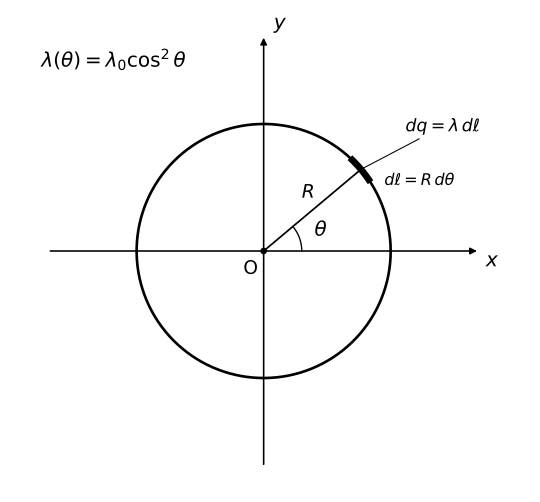
A thin non-conducting ring of radius R carries a non-uniform linear charge density λ(θ) = λ₀ cos²θ, where θ is the angle measured from the positive x-axis and λ₀ is a positive constant. The ring lies in the x-y plane with its centre at the origin.

(i) Find the total charge Q on the ring.
(ii) Find the electric potential V at the centre of the ring.
(iii) A small test charge q₀ = +2 μC is brought from infinity to the centre of the ring. Given λ₀ = 4 μC/m and R = 0.5 m, calculate the work done by the external agent in this process (assume the charge is moved quasi-statically with zero final kinetic energy).
(iv) If the charge distribution were instead uniform with the same total charge Q spread over the ring, would the potential at the centre increase, decrease, or remain the same? Justify your answer in one line.

Diagram for question 28: Electrostatic Potential and Capacitance
Show answer
(i) Total charge on the ring:

The arc length element at angle θ is dℓ = R dθ, so the charge element is:

dq = λ(θ) dℓ = λ₀ cos²θ · R dθ

∴ Q = ∫₀²π λ₀ cos²θ · R dθ

Using ∫₀²π cos²θ dθ = π:

∴ Q = λ₀ R π

(ii) Electric potential at the centre of the ring:

By Coulomb's law, the potential at a point due to a charge element dq at distance r is dV = (1/4πε₀)(dq/r).

Every element of the ring is at the same distance r = R from the centre, so:

V = (1/4πε₀) · (1/R) ∫ dq = (1/4πε₀) · Q/R

Substituting Q = λ₀Rπ:

∴ V = (1/4πε₀) · (λ₀Rπ/R) = λ₀π / 4πε₀ = λ₀ / 4ε₀

(iii) Work done by external agent in bringing q₀ from infinity to centre:

The work-energy theorem for a quasi-static process (ΔKE = 0) gives:

W_external = q₀ (V_centre − V_∞) = q₀ × V_centre

(since V_∞ = 0)

First, calculate V_centre using the formula derived above:

V_centre = λ₀ / 4ε₀

Given λ₀ = 4 μC/m = 4 × 10⁻⁶ C/m, ε₀ = 8.854 × 10⁻¹² C² N⁻¹ m⁻²:

V_centre = (4 × 10⁻⁶) / (4 × 8.854 × 10⁻¹²)

V_centre = (4 × 10⁻⁶) / (3.54 × 10⁻¹¹)

∴ V_centre ≈ 1.13 × 10⁵ V

(Alternatively, using 1/4πε₀ = 9 × 10⁹ and Q = λ₀Rπ = 4×10⁻⁶ × 0.5 × π ≈ 6.28 × 10⁻⁶ C:

V_centre = 9×10⁹ × 6.28×10⁻⁶ / 0.5 = 9×10⁹ × 1.257×10⁻⁵ ≈ 1.13 × 10⁵ V)

Now, q₀ = 2 μC = 2 × 10⁻⁶ C:

W_external = q₀ × V_centre = 2 × 10⁻⁶ × 1.13 × 10⁵

∴ W_external ≈ 0.226 J ≈ 0.23 J

(iv) If the same total charge Q is distributed uniformly, the potential at the centre remains the same.

Justification: Electric potential at the centre depends only on the total charge Q and the distance R (V = Q/4πε₀R); since every element is equidistant from the centre, the distribution shape does not affect V.
Q29Short Answer3 marks

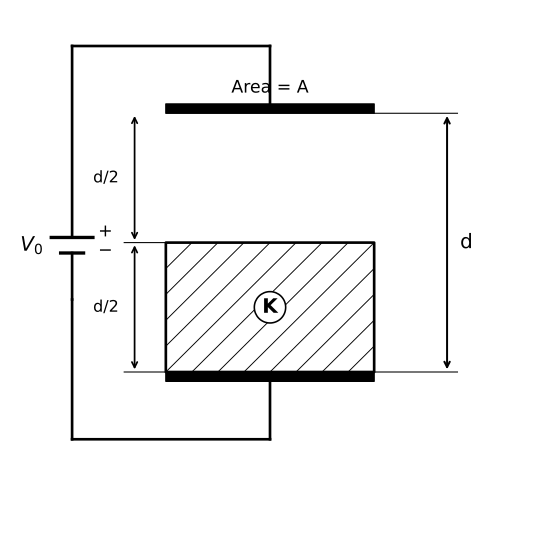
A parallel plate capacitor of plate area A and plate separation d is connected to a battery of EMF V₀. While still connected to the battery, a dielectric slab of dielectric constant K and thickness d/2 is inserted between the plates as shown. Answer the following:
(i) Find the new capacitance of the system after the slab is inserted.
(ii) Find the ratio of the energy stored in the capacitor after insertion to that before insertion.
(iii) A student claims: 'Since the battery maintains constant voltage, the electric field between the plates is unchanged even after inserting the dielectric.' Is the student correct? Justify your answer analytically.
(iv) If the dielectric slab is now slowly pulled out while the battery remains connected, the charge on the capacitor [increases / decreases / remains same]. Choose the correct option and give one reason.

Diagram for question 29: Electrostatic Potential and Capacitance
Show answer
(i) New Capacitance after partial dielectric insertion:

The system with dielectric of thickness d/2 and air gap d/2 is equivalent to two capacitors in series:
— C₁ (dielectric region): C₁ = Kε₀A/(d/2) = 2Kε₀A/d
— C₂ (air region): C₂ = ε₀A/(d/2) = 2ε₀A/d

For series combination:
1/C_new = 1/C₁ + 1/C₂ = d/(2Kε₀A) + d/(2ε₀A) = d/(2ε₀A) · (1/K + 1) = d(K+1)/(2Kε₀A)

∴ C_new = 2Kε₀A / [d(K+1)]

Initial capacitance (without dielectric): C₀ = ε₀A/d

∴ C_new = 2K/(K+1) · C₀

(ii) Ratio of energy stored (battery remains connected ⟹ voltage = V₀ = constant):

Energy stored: U = ½CV²

U_after / U_before = C_new / C₀ = [2Kε₀A/d(K+1)] / [ε₀A/d]

∴ U_after / U_before = 2K/(K+1)

Since K > 1 for any dielectric, 2K/(K+1) > 1, so energy increases.

(iii) Analysis of the student's claim:

The total potential difference across the capacitor = V₀ (constant, battery connected).
However, this V₀ is shared between the two regions in series.

Let E_d = electric field inside dielectric, E_air = electric field in air gap.

Boundary condition (normal D continuous at interface with no free surface charge):
D = ε₀E_air = Kε₀E_d → E_air = K·E_d

Applying V = E_d·(d/2) + E_air·(d/2) = V₀:
E_d·(d/2) + K·E_d·(d/2) = V₀
E_d · (d/2)(1 + K) = V₀
∴ E_d = 2V₀ / [d(1 + K)]

Before insertion, uniform field: E₀ = V₀/d

Since K > 1: E_d = 2V₀/[d(K+1)] < V₀/d = E₀

∴ The student is INCORRECT. The field inside the dielectric region is reduced by a factor 2/(K+1) compared to E₀. The field in the air gap E_air = 2KV₀/[d(K+1)] > E₀, so the field is non-uniform and redistributed — not unchanged.

(iv) When the dielectric slab is slowly pulled out (battery still connected, V = V₀ constant):

As the dielectric is removed, C decreases (approaches C₀ = ε₀A/d).
Since Q = CV and V = V₀ = constant:
As C decreases, Q = CV₀ also decreases.

∴ The charge on the capacitor DECREASES.
Reason: With the battery maintaining constant voltage, the charge is directly proportional to capacitance (Q = CV₀). Removal of the dielectric reduces the capacitance, hence the charge decreases and flows back to the battery.
Q30Short Answer3 marks

A student is designing an energy storage system using capacitors. She has three identical capacitors, each of capacitance C = 6 μF and each capable of withstanding a maximum voltage of 300 V. She needs to store charge in a combination that can operate safely at a total voltage of 600 V across the combination.

(i) Which combination of the three capacitors — series, parallel, or mixed (two in parallel connected in series with one) — allows safe operation at 600 V? Justify your answer.

(ii) Calculate the equivalent capacitance of the combination you identified in part (i).

(iii) Calculate the total energy stored in the combination when 600 V is applied across it.

(iv) If a dielectric slab of dielectric constant K = 2 is now inserted, filling the space between the plates of each capacitor in the combination (voltage across combination remains 600 V), what happens to the total energy stored? Calculate the new total energy.

Show answer
(i) The combination that allows safe operation at 600 V:

In a series combination of all three capacitors, the total voltage 600 V is divided equally across each capacitor (since all are identical), so each capacitor experiences 600/3 = 200 V, which is within the safe limit of 300 V.

In a parallel combination, the full 600 V appears across each capacitor, which exceeds the 300 V limit — unsafe.

In a mixed combination (two in parallel + one in series), the two parallel capacitors each bear half the remaining voltage. Let V₁ = voltage across the series capacitor and V₂ = voltage across the parallel pair, with V₁ + V₂ = 600 V. The equivalent capacitance of the parallel pair is 2C, so charge on the series arm: Q = C·V₁ = 2C·V₂, giving V₁ = 2V₂. Then 2V₂ + V₂ = 600 V → V₂ = 200 V, V₁ = 400 V. The single series capacitor bears 400 V > 300 V — unsafe.

∴ The series combination of all three capacitors is the correct choice for safe operation at 600 V.

(ii) Equivalent capacitance of three capacitors in series:

For capacitors in series: 1/C<sub>eq</sub> = 1/C + 1/C + 1/C = 3/C

→ C<sub>eq</sub> = C/3 = 6/3

∴ C<sub>eq</sub> = 2 μF

(iii) Total energy stored:

Energy stored in a capacitor: U = ½ C<sub>eq</sub> V²

→ U = ½ × 2 × 10<sup>−6</sup> × (600)<sup>2</sup>

→ U = ½ × 2 × 10<sup>−6</sup> × 3.6 × 10<sup>5</sup>

∴ U = 0.36 J

(iv) Effect of inserting dielectric (K = 2) in each capacitor, voltage held constant at 600 V:

When a dielectric of constant K is inserted and voltage is kept constant (battery connected), the capacitance of each capacitor increases: C′ = KC = 2 × 6 = 12 μF.

New equivalent capacitance of the series combination:
C′<sub>eq</sub> = C′/3 = 12/3 = 4 μF

New energy stored: U′ = ½ C′<sub>eq</sub> V²

→ U′ = ½ × 4 × 10<sup>−6</sup> × (600)<sup>2</sup>

→ U′ = ½ × 4 × 10<sup>−6</sup> × 3.6 × 10<sup>5</sup>

∴ U′ = 0.72 J

The total energy stored doubles (increases by a factor of K = 2), because at constant voltage the energy U = ½CV² increases with capacitance. The extra energy is supplied by the source (battery) that maintains the voltage.

Want unlimited practice on Electrostatic Potential and Capacitance?

The full ClearSteps bank has 40+ reviewed questions on this chapter alone — with step-wise solutions, difficulty levels, and progress tracking. Verify your WhatsApp number and your free trial starts right here.

CBSE · CLASS 12
🎟️14-day free trial · code PRAC auto-applied
Mobile Number
+91
OTP will be sent to your WhatsApp

⭐ Trusted by 12,000+ students across India

Electrostatic Potential and Capacitance Class 12 Questions