ClearStepsCLEARSTEPS AI
Teacher Login →Student Login →

Nuclei: Class 12 Physics Practice Questions

30 original exam-pattern questions with full answers, matched to the current CBSE Class 12 paper design, including case-based questions. Attempt each question before opening the answer — or start a free 14-day trial ↓ for the full bank.

Q1Case-based4 marks

The radius of a nucleus is given by the empirical relation R = R₀A^(1/3), where R₀ = 1.2 × 10⁻¹⁵ m and A is the mass number. This relation shows that the nuclear volume is directly proportional to the number of nucleons (A), implying that nucleons are packed with nearly uniform density in all nuclei, regardless of their size.

A science student reads that the nucleus of gold (Au-197) has a radius of about 7.0 × 10⁻¹⁵ m. She wants to compare it with the nucleus of aluminium (Al-27).

(i) Using the relation R = R₀A^(1/3), where R₀ = 1.2 × 10⁻¹⁵ m, calculate the radius of the Al-27 nucleus.

(ii) Find the ratio of the radius of Au-197 to the radius of Al-27.

(iii) The student claims: 'Since gold has many more nucleons, its nuclear density must be much greater than that of aluminium.' Is she correct? Justify your answer in one or two sentences.

(iv) Calculate the nuclear density of Al-27. (Mass of Al-27 nucleus ≈ 27 × 1.66 × 10⁻²⁷ kg, use π ≈ 3.14)

Show answer
(i) Radius of Al-27 nucleus:

By the nuclear radius formula: R = R₀A^(1/3)

For Al-27, A = 27:
R(Al) = 1.2 × 10⁻¹⁵ × (27)^(1/3)
= 1.2 × 10⁻¹⁵ × 3
∴ R(Al) = 3.6 × 10⁻¹⁵ m

(ii) Ratio of radii R(Au) : R(Al):

R(Au) / R(Al) = R₀(197)^(1/3) / R₀(27)^(1/3)
= (197/27)^(1/3)
= (7.30)^(1/3)
≈ 1.94

∴ R(Au) / R(Al) ≈ 1.94 ≈ 1.94 : 1

(iii) The student is NOT correct.

Since R = R₀A^(1/3), the volume V = (4/3)πR³ = (4/3)π R₀³ A, which is directly proportional to A.
Nuclear density ρ = mass / volume = (A × mₙ) / [(4/3)πR₀³A] = 3mₙ / (4πR₀³), which is independent of A.
∴ All nuclei have approximately the same nuclear density, regardless of mass number.

(iv) Nuclear density of Al-27:

ρ = mass / volume = m / [(4/3)πR³]

Mass of Al-27 nucleus = 27 × 1.66 × 10⁻²⁷ = 4.482 × 10⁻²⁶ kg

Radius R(Al) = 3.6 × 10⁻¹⁵ m (from part (i))

Volume = (4/3) × 3.14 × (3.6 × 10⁻¹⁵)³
= (4/3) × 3.14 × 46.656 × 10⁻⁴⁵
= 4.189 × 46.656 × 10⁻⁴⁵
= 195.4 × 10⁻⁴⁵
= 1.954 × 10⁻⁴³ m³

ρ = 4.482 × 10⁻²⁶ / 1.954 × 10⁻⁴³

∴ ρ ≈ 2.29 × 10¹⁷ kg m⁻³
Q2Case-based4 marks

A nuclear scientist studies two radioactive samples: Sample P (<sup>238</sup><sub>92</sub>U) and Sample Q (<sup>56</sup><sub>26</sub>Fe). Given: m<sub>p</sub> = 1·007825 u, m<sub>n</sub> = 1·008665 u, atomic mass of <sup>56</sup><sub>26</sub>Fe = 55·934939 u, 1 u = 931·5 MeV/c².

A nuclear scientist is studying two radioactive samples in a laboratory. Sample P contains the isotope <sup>238</sup><sub>92</sub>U (uranium-238) and Sample Q contains the isotope <sup>56</sup><sub>26</sub>Fe (iron-56). She notes the following data:

• Mass of a proton, m<sub>p</sub> = 1·007825 u
• Mass of a neutron, m<sub>n</sub> = 1·008665 u
• Atomic mass of <sup>56</sup><sub>26</sub>Fe = 55·934939 u
• 1 u = 931·5 MeV/c²

Using your knowledge of nuclear stability and binding energy, answer the following questions:

(i) Identify the number of protons and neutrons in the nucleus of <sup>56</sup><sub>26</sub>Fe.

(ii) Calculate the mass defect (Δm) for the nucleus of <sup>56</sup><sub>26</sub>Fe.

(iii) Calculate the binding energy per nucleon of <sup>56</sup><sub>26</sub>Fe.

(iv) The scientist claims that <sup>56</sup><sub>26</sub>Fe is more stable than <sup>238</sup><sub>92</sub>U. Justify this claim using the concept of binding energy per nucleon.

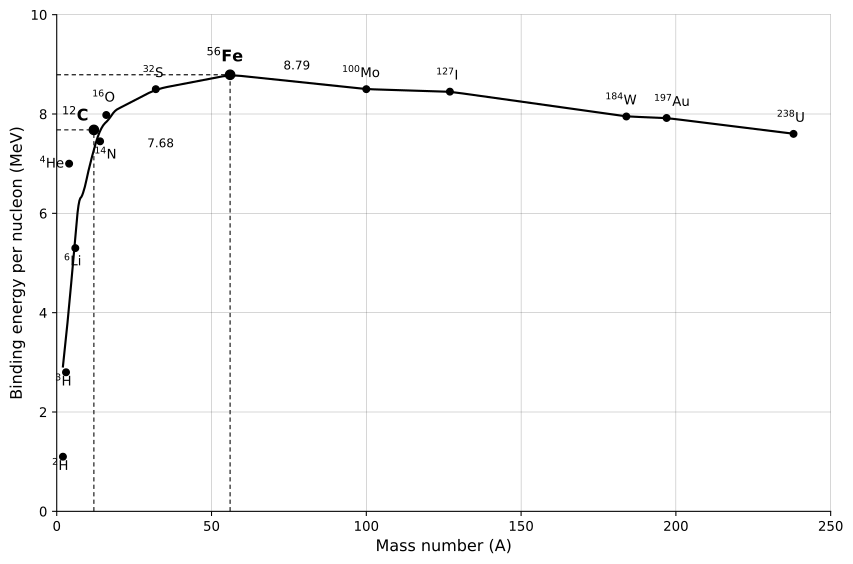
Diagram for question 2: Nuclei
Show answer
(i) For the nucleus ⁵⁶₂₆Fe:

Number of protons, Z = 26
Number of neutrons, N = A − Z = 56 − 26 = 30

∴ Protons = 26, Neutrons = 30.

——————————————————

(ii) The mass defect of a nucleus is defined as the difference between the sum of masses of constituent nucleons and the actual nuclear mass.

Formula: Δm = Z·m<sub>p</sub> + (A − Z)·m<sub>n</sub> − M

Substituting values:
Δm = 26 × 1·007825 + 30 × 1·008665 − 55·934939
Δm = 26·20345 + 30·25995 − 55·934939
Δm = 56·46340 − 55·934939

∴ Δm = 0·528461 u

——————————————————

(iii) The binding energy (BE) of a nucleus is the energy equivalent of its mass defect.

Formula: BE = Δm × 931·5 MeV

Substituting:
BE = 0·528461 × 931·5
BE ≈ 492·26 MeV

Binding energy per nucleon = BE / A = 492·26 / 56

∴ Binding energy per nucleon of ⁵⁶₂₆Fe ≈ 8·79 MeV/nucleon

——————————————————

(iv) The binding energy per nucleon is a measure of nuclear stability — a higher value means nucleons are more tightly bound and the nucleus is more stable.

From the binding energy per nucleon (BE/A) curve:
• ⁵⁶₂₆Fe lies near the peak of the curve with BE/A ≈ 8·79 MeV/nucleon, which is the maximum.
• ²³⁸₉₂U is a heavy nucleus lying on the right side of the curve with BE/A ≈ 7·6 MeV/nucleon, which is significantly lower.

Since BE/A of ⁵⁶₂₆Fe > BE/A of ²³⁸₉₂U, the nucleons in iron-56 are more tightly bound.

∴ The scientist's claim is correct — ⁵⁶₂₆Fe is more stable than ²³⁸₉₂U.
Q3Case-based4 marks

Radioactive decay is a statistical process governed by the decay constant λ of the nucleus. The activity of a sample — defined as the number of disintegrations per second — decreases exponentially with time. A physician using a radioactive tracer in a diagnostic scan or a geologist dating a rock sample must account for how the activity changes over time. The half-life T½ is the time after which exactly half the nuclei in a sample have decayed, and it is related to the decay constant by T½ = 0.693/λ. Understanding how activity evolves with time is central to nuclear medicine, carbon dating, and reactor safety.

A nuclear physicist is studying two radioactive samples in the laboratory:

• Sample X: Initial activity A₀ = 3200 disintegrations per second; half-life T½ = 2 days.
• Sample Y: Initial activity A₀ = 800 disintegrations per second; half-life T½ = 4 days.

Based on the above information, answer the following questions:

(i) Write the mathematical relation between activity A, initial activity A₀, decay constant λ, and time t.

(ii) Calculate the activity of Sample X after 8 days.

(iii) Calculate the activity of Sample Y after 8 days.

(iv) At t = 8 days, which sample has higher activity? What does this tell us about the relationship between half-life and the rate of decay of a radioactive substance?

Show answer
(i) The activity A of a radioactive sample at time t is given by:

A = A₀ e^(−λt)

where A₀ is the initial activity (at t = 0), λ = 0.693/T½ is the decay constant, and t is the elapsed time.

Alternatively, since after n half-lives the activity reduces by a factor of (1/2)ⁿ:

A = A₀ × (1/2)ⁿ, where n = t / T½

∴ A = A₀ (1/2)^(t/T½)

(ii) Activity of Sample X after 8 days:

For Sample X: A₀ = 3200 dis s⁻¹, T½ = 2 days, t = 8 days.

Number of half-lives n = t / T½ = 8 / 2 = 4.

Using A = A₀ × (1/2)ⁿ:

A_X = 3200 × (1/2)⁴ = 3200 × (1/16)

∴ A_X = 200 disintegrations per second (dis s⁻¹)

(iii) Activity of Sample Y after 8 days:

For Sample Y: A₀ = 800 dis s⁻¹, T½ = 4 days, t = 8 days.

Number of half-lives n = t / T½ = 8 / 4 = 2.

Using A = A₀ × (1/2)ⁿ:

A_Y = 800 × (1/2)² = 800 × (1/4)

∴ A_Y = 200 disintegrations per second (dis s⁻¹)

(iv) At t = 8 days, A_X = 200 dis s⁻¹ and A_Y = 200 dis s⁻¹.

Both samples have equal activity at t = 8 days.

Physical interpretation: Sample X started with a much higher activity (3200 dis s⁻¹) but has a shorter half-life (T½ = 2 days), meaning it decays much faster. Sample Y started with lower activity (800 dis s⁻¹) but decays more slowly (T½ = 4 days). This illustrates that a shorter half-life corresponds to a larger decay constant λ (since λ = 0.693/T½), and hence a faster rate of decay. A substance with a shorter half-life loses its activity more rapidly, and the two samples eventually reach the same activity at t = 8 days despite having different initial activities.
Q4Case-based4 marks

A nuclear physicist is analysing two possible reactions to be used in future energy reactors:

Reaction P: ²³⁵₉₂U + ¹₀n → ⁹⁰₃₈Sr + ¹⁴³₅₄Xe + 3 ¹₀n
Reaction Q: ²H₁ + ³H₁ → ⁴₂He + ¹₀n + 17.6 MeV

The average binding energies per nucleon of the relevant nuclei are given below:

| Nucleus | BE/nucleon (MeV) |
|---------|------------------|
| ²³⁵U | 7.59 |
| ⁹⁰Sr | 8.70 |
| ¹⁴³Xe | 8.22 |

(i) Identify which reaction (P or Q) is nuclear fission and which is nuclear fusion. Give one distinguishing feature between them.
(ii) Using the data provided, calculate the energy released (in MeV) in Reaction P.
(iii) The binding energy per nucleon curve has a peak near A = 56. Explain why both fission of heavy nuclei AND fusion of light nuclei release energy.
(iv) State one advantage of Reaction Q (fusion) over Reaction P (fission) as an energy source.

A nuclear physicist is analysing two possible reactions to be used in future energy reactors:

Reaction P: ²³⁵₉₂U + ¹₀n → ⁹⁰₃₈Sr + ¹⁴³₅₄Xe + 3 ¹₀n
Reaction Q: ²H₁ + ³H₁ → ⁴₂He + ¹₀n + 17.6 MeV

The average binding energies per nucleon of the relevant nuclei are given below:

| Nucleus | BE/nucleon (MeV) |
|---------|------------------|
| ²³⁵U | 7.59 |
| ⁹⁰Sr | 8.70 |
| ¹⁴³Xe | 8.22 |

(i) Identify which reaction (P or Q) is nuclear fission and which is nuclear fusion. Give one distinguishing feature between them.
(ii) Using the data provided, calculate the energy released (in MeV) in Reaction P. (Assume the binding energy of the neutron is zero.)
(iii) The binding energy per nucleon curve has a peak near mass number A = 56. Explain why both fission of very heavy nuclei AND fusion of very light nuclei release energy, using this fact.
(iv) State one advantage of Reaction Q (fusion) over Reaction P (fission) as an energy source.

Show answer
(i) Reaction P is nuclear fission; Reaction Q is nuclear fusion.

Distinguishing feature: In fission, a heavy nucleus (A > 200) splits into two lighter fragments of comparable mass, whereas in fusion, two very light nuclei combine to form a heavier, more stable nucleus.

[1 mark]

(ii) The energy released in a nuclear reaction equals the difference between the total binding energy of products and the total binding energy of reactants.

Formula: Q = BE(products) − BE(reactants)

Binding energy of ²³⁵U (reactant, neutron BE = 0):
BE(²³⁵U) = 235 × 7.59 = 1783.65 MeV

Binding energy of products:
BE(⁹⁰Sr) = 90 × 8.70 = 783.00 MeV
BE(¹⁴³Xe) = 143 × 8.22 = 1175.46 MeV
BE(3n) = 0

Total BE of products = 783.00 + 1175.46 = 1958.46 MeV

∴ Q = 1958.46 − 1783.65

∴ Energy released in Reaction P = 174.81 MeV ≈ 174.8 MeV

[1 mark]

(iii) The binding energy per nucleon (BE/A) curve peaks at A ≈ 56 (iron-56, ~8.8 MeV/nucleon).

• For very heavy nuclei (e.g. ²³⁵U), BE/A ≈ 7.6 MeV/nucleon, which is less than that of the mid-range fragments produced. When fission occurs, the fragments (A ~ 90–140) have a higher BE/A (~8.4–8.7 MeV/nucleon). Since total binding energy increases, the excess energy is released.

• For very light nuclei (e.g. ²H, ³H), BE/A is very low (~1–2.8 MeV/nucleon). When they fuse to form ⁴He (BE/A ≈ 7.07 MeV/nucleon), total binding energy increases sharply, so energy is released.

In both cases, the product nuclei lie closer to the peak of the BE/A curve, so they are more tightly bound → energy is released.

[1 mark]

(iv) One advantage of fusion (Reaction Q) over fission (Reaction P):

Fusion produces no long-lived radioactive waste (the products ⁴He and ¹n are not hazardous), whereas fission produces highly radioactive daughter fragments (e.g. ⁹⁰Sr) that require thousands of years of safe storage.

[1 mark]
Q5Case-based4 marks

Nuclear size follows the empirical relation R = R₀A^(1/3), where R₀ ≈ 1.2 × 10⁻¹⁵ m is the empirical constant and A is the mass number. Since nuclei are approximately spherical and nuclear matter is nearly incompressible, the density of nuclear matter is a fundamental quantity. Medical physicists exploit the predictable sizes of nuclei in designing isotope-based imaging tracers.

A nuclear physicist is studying two radioactive isotopes used in medical imaging. Isotope P has mass number 64 and isotope Q has mass number 216. She observes that both nuclei are approximately spherical and that nuclear matter is nearly incompressible.

(i) Using the empirical relation R = R₀A^(1/3), where R₀ = 1.2 × 10⁻¹⁵ m, calculate the radius of nucleus P (A = 64).

(ii) Find the ratio of the radii of nuclei P and Q (R_P : R_Q).

(iii) The physicist states that the nuclear density is independent of mass number. Justify this statement mathematically by deriving an expression for nuclear density in terms of R₀ and fundamental constants only.

(iv) If the radius of nucleus P is R_P, what is the radius of a nucleus whose mass number is 8 times that of P? Express your answer in terms of R_P.

Show answer
(i) Radius of nucleus P (A = 64):

By the empirical nuclear radius relation:
R = R₀ A^(1/3)

Substituting R₀ = 1.2 × 10⁻¹⁵ m, A = 64:
R_P = 1.2 × 10⁻¹⁵ × (64)^(1/3)
= 1.2 × 10⁻¹⁵ × 4

∴ R_P = 4.8 × 10⁻¹⁵ m

(ii) Ratio of radii R_P : R_Q (A_P = 64, A_Q = 216):

Using R = R₀ A^(1/3):
R_P / R_Q = (A_P / A_Q)^(1/3) = (64/216)^(1/3)

(64/216)^(1/3) = (8/27)^(1/3) — dividing numerator and denominator by 8:
= (8)^(1/3) / (27)^(1/3) = 2/3

∴ R_P : R_Q = 2 : 3

(iii) Nuclear density is independent of mass number — mathematical justification:

Mass of nucleus = A × m_p (where m_p = mass of a nucleon ≈ 1.67 × 10⁻²⁷ kg)

Volume of nucleus = (4/3)πR³ = (4/3)π(R₀ A^(1/3))³ = (4/3)πR₀³ A

Nuclear density:
ρ = Mass / Volume = (A × m_p) / ((4/3)πR₀³ A)

The factor A cancels:
ρ = m_p / ((4/3)πR₀³)

Substituting values:
ρ = (1.67 × 10⁻²⁷) / ((4/3) × π × (1.2 × 10⁻¹⁵)³)
= (1.67 × 10⁻²⁷) / (4.189 × (1.728 × 10⁻⁴⁵))
= (1.67 × 10⁻²⁷) / (7.24 × 10⁻⁴⁵)

∴ ρ ≈ 2.3 × 10¹⁷ kg m⁻³

Since ρ = m_p / ((4/3)πR₀³) contains no A, nuclear density is the same for all nuclei — independent of mass number.

(iv) Radius of a nucleus with mass number 8A_P:

Using R = R₀ A^(1/3):
R_new = R₀ (8A_P)^(1/3) = R₀ × 8^(1/3) × A_P^(1/3) = 2 × (R₀ A_P^(1/3))

Since R_P = R₀ A_P^(1/3):

∴ R_new = 2R_P
Q6Case-based4 marks

Nuclear stability depends on the binding energy per nucleon (BE/A) of a nucleus. The nuclear radius is given by R = R₀A^(1/3), where R₀ = 1.2 × 10⁻¹⁵ m and A is the mass number. The activity of a radioactive sample after n half-lives is A_n = A₀ / 2ⁿ. The binding energy of a nucleus = (BE per nucleon) × (mass number A).

A nuclear physicist is studying two radioactive samples in a laboratory. Sample A contains ²³²₉₀Th (Thorium-232) and Sample B contains ⁵⁶₂₆Fe (Iron-56). She notes that Iron-56 is extremely stable and rarely undergoes radioactive decay, whereas Thorium-232 undergoes alpha decay with a half-life of about 1.4 × 10¹⁰ years.

(i) Calculate the ratio of the nuclear radius of ²³²₉₀Th to that of ⁵⁶₂₆Fe. (Take R₀ as a constant.)

(ii) The binding energy per nucleon of ⁵⁶₂₆Fe is approximately 8.8 MeV. Estimate the total binding energy of its nucleus.

(iii) A freshly prepared sample of Thorium-232 has activity 1200 decays per second. What will be its activity after two half-lives?

(iv) Give ONE reason why Iron-56 is more stable than Thorium-232, based on binding energy.

Show answer
(i) Nuclear Radius Ratio:

By the empirical relation, the nuclear radius is given by:
R = R₀ A^(1/3)

For ²³²₉₀Th: R_Th = R₀ (232)^(1/3)
For ⁵⁶₂₆Fe: R_Fe = R₀ (56)^(1/3)

R_Th / R_Fe = (232/56)^(1/3) = (4.143)^(1/3)

∴ R_Th / R_Fe = (4.143)^(1/3) ≈ 1.61

∴ The ratio of nuclear radii R_Th : R_Fe ≈ 1.61 : 1 [1 mark]

(ii) Total Binding Energy of ⁵⁶₂₆Fe:

The total binding energy of a nucleus is:
BE_total = (BE per nucleon) × A

For ⁵⁶₂₆Fe:
BE_total = 8.8 MeV × 56

∴ BE_total = 492.8 MeV ≈ 493 MeV [1 mark]

(iii) Activity After Two Half-Lives:

By the radioactive decay law, activity after n half-lives is:
A_n = A₀ / 2ⁿ

Given: A₀ = 1200 decays/s, n = 2

A₂ = 1200 / 2² = 1200 / 4

∴ Activity after two half-lives = 300 decays per second [1 mark]

(iv) Reason for Greater Stability of Iron-56:

Iron-56 (⁵⁶₂₆Fe) has a binding energy per nucleon of approximately 8.8 MeV, which is the highest among all nuclei — corresponding to the peak of the binding energy per nucleon curve. Thorium-232, being a very heavy nucleus (A = 232), has a lower binding energy per nucleon (~7.6 MeV). Since higher binding energy per nucleon means the nucleons are more tightly bound and more energy is required to break the nucleus apart, Iron-56 is far more stable than Thorium-232. [1 mark]
Q7MCQ1 mark

The radius of a nucleus of mass number A is R. If the mass number is increased to 8A, what will be the new radius of the nucleus?

Show answer
Option (B) is correct.

Explanation: By the empirical relation, nuclear radius R = R₀A^(1/3), where R₀ is a constant.

For mass number 8A: R' = R₀(8A)^(1/3) = R₀ · 8^(1/3) · A^(1/3) = 2 · R₀A^(1/3) = 2R.

∴ New radius = 2R.
Q8MCQ1 mark

The binding energy per nucleon is maximum for the nucleus ⁵⁶Fe. This means ⁵⁶Fe is:

Show answer
Option (B) is correct.

Explanation: Binding energy per nucleon (BE/A) represents the average energy required to remove one nucleon from the nucleus — it is a direct measure of nuclear stability. Since ⁵⁶Fe has the highest BE/A (≈ 8.8 MeV/nucleon), it is the most stable nucleus among all nuclei. A higher BE/A means nucleons are more tightly bound, making the nucleus harder to break apart.
Q9Short Answer1 mark

Assertion (A): The nuclear density of all nuclei is approximately the same, regardless of their mass number.
Reason (R): The radius of a nucleus is proportional to A^(1/3), where A is the mass number.

Show answer
Option (a) is correct.

Explanation: Since nuclear radius R = R₀A^(1/3), nuclear volume V = (4/3)πR³ = (4/3)πR₀³ · A. Nuclear mass ≈ A · mᵤ. ∴ Nuclear density ρ = Mass/Volume = (A · mᵤ) / ((4/3)πR₀³ · A) = 3mᵤ / (4πR₀³), which is independent of A. Thus Assertion (A) is TRUE. Reason (R) — R = R₀A^(1/3) — is also TRUE and is precisely the reason why the A-dependence cancels in the density formula, making (R) the correct explanation of (A).
Q10MCQ1 mark

The half-life of a radioactive nucleus is T½. After a time equal to 4T½, the fraction of the original number of nuclei that has DECAYED is:

Show answer
Option (C) is correct.

Explanation: By the law of radioactive decay, after n half-lives the fraction of nuclei remaining is (1/2)ⁿ.

After n = 4 half-lives: fraction remaining = (1/2)⁴ = 1/16.

∴ Fraction decayed = 1 − 1/16 = 15/16.
Q11MCQ1 mark

The binding energy per nucleon of ⁵⁶Fe is approximately 8.8 MeV, while that of ²³⁵U is approximately 7.6 MeV. Which nucleus is more stable, and why?

Show answer
Option (B) is correct.
Explanation: Binding energy per nucleon is defined as the total binding energy of the nucleus divided by its mass number A. It represents the average energy needed to remove one nucleon from the nucleus. A nucleus with a higher binding energy per nucleon is more tightly bound and hence more stable. Since ⁵⁶Fe has a binding energy per nucleon of ~8.8 MeV, which is greater than that of ²³⁵U (~7.6 MeV), ⁵⁶Fe is more stable.
Q12Short Answer2 marks

The half-life of a radioactive nucleus is 20 minutes. (i) Write the relation between half-life (T½) and decay constant (λ). (ii) Calculate the decay constant of this nucleus.

Show answer
(i) The relation between half-life and decay constant is:

T½ = 0.693 / λ

(ii) Given: T½ = 20 minutes = 20 × 60 = 1200 s

Using T½ = 0.693 / λ:

λ = 0.693 / T½

λ = 0.693 / 1200

∴ λ = 5.775 × 10⁻⁴ s⁻¹
Q13Short Answer2 marks

The half-life of a radioactive nucleus is T½. Show that the fraction of nuclei remaining undecayed after a time t = 3T½ is 1/8.

Show answer
By the law of radioactive decay, the number of undecayed nuclei at time t is given by:

N = N₀ e^(−λt)

The fraction remaining undecayed is N/N₀ = e^(−λt).

Since the decay constant λ is related to half-life by λ = 0.693/T½, after each half-life the number of nuclei reduces to half. Therefore, after n half-lives:

N/N₀ = (1/2)ⁿ

For t = 3T½, n = 3:

N/N₀ = (1/2)³ = 1/8

∴ The fraction of nuclei remaining undecayed after time t = 3T½ is 1/8.
Q14Short Answer2 marks

The half-life of a radioactive nucleus is T½. Show that the number of nuclei present after a time t = 3T½ is one-eighth of the initial number N₀.

Show answer
The law of radioactive decay states that the number of undecayed nuclei at time t is given by:

N = N₀ e^(−λt)

where λ is the decay constant, related to half-life by:

T½ = 0.693/λ → λ = 0.693/T½

Substituting t = 3T½:

N = N₀ e^(−λ × 3T½) = N₀ e^(−3 × 0.693) = N₀ e^(−ln 8)

∴ N = N₀ × (1/8)

Alternatively, after each half-life the number of nuclei halves:

After T½ : N = N₀/2
After 2T½ : N = N₀/4
After 3T½ : N = N₀/8

∴ After time t = 3T½, the number of nuclei remaining is N₀/8, i.e., one-eighth of the initial number N₀. Hence proved.
Q15Short Answer3 marks

A nuclear research team is studying two radioactive isotopes, P and Q, used in medical imaging. Isotope P has a half-life of 6 hours, while isotope Q has a half-life of 12 hours. A freshly prepared sample contains 8.0 × 10²⁰ atoms of P and 6.0 × 10²⁰ atoms of Q.

(i) Find the initial activity (in disintegrations per second) of isotope P.

(ii) After 24 hours, how many atoms of isotope P remain undecayed?

(iii) After 24 hours, how many atoms of isotope Q remain undecayed?

(iv) A technician argues: 'Since Q has a longer half-life, the ratio of undecayed atoms of Q to undecayed atoms of P will keep increasing with time.' Is this statement correct? Justify your answer quantitatively using the values found in parts (ii) and (iii).

Show answer
(i) Activity of isotope P at t = 0:

The activity A of a radioactive sample is given by:

A = λN = (0.693 / T½) × N

For isotope P:
T½ = 6 hours = 6 × 3600 s = 2.16 × 10⁴ s
N₀(P) = 8.0 × 10²⁰ atoms

→ λ_P = 0.693 / (2.16 × 10⁴) = 3.208 × 10⁻⁵ s⁻¹

→ A₀(P) = λ_P × N₀(P) = 3.208 × 10⁻⁵ × 8.0 × 10²⁰

∴ A₀(P) ≈ 2.57 × 10¹⁶ disintegrations per second

(ii) Number of undecayed atoms of P after 24 hours:

The law of radioactive decay states:
N = N₀ × (1/2)^(t / T½)

Number of half-lives of P in 24 h:
n_P = 24 / 6 = 4 half-lives

→ N_P(24h) = 8.0 × 10²⁰ × (1/2)⁴ = 8.0 × 10²⁰ × 1/16

∴ N_P(24h) = 5.0 × 10¹⁹ atoms

(iii) Number of undecayed atoms of Q after 24 hours:

Number of half-lives of Q in 24 h:
n_Q = 24 / 12 = 2 half-lives

→ N_Q(24h) = 6.0 × 10²⁰ × (1/2)² = 6.0 × 10²⁰ × 1/4

∴ N_Q(24h) = 1.5 × 10²⁰ atoms

(iv) Checking the technician's claim:

Initial ratio (t = 0):
N_Q / N_P = (6.0 × 10²⁰) / (8.0 × 10²⁰) = 0.75

Ratio after 24 hours:
N_Q / N_P = (1.5 × 10²⁰) / (5.0 × 10¹⁹) = 3.0

The ratio has increased from 0.75 to 3.0 after 24 hours.

The technician's statement is correct. Because Q has a longer half-life (λ_Q < λ_P), Q decays more slowly than P. Even though Q started with fewer atoms, with every passing half-life more atoms of P are lost proportionally than atoms of Q. As a result, the ratio N_Q / N_P increases with time.

Quantitatively, at any time t:
N_Q / N_P = [N₀(Q) / N₀(P)] × 2^(t/T½(P) − t/T½(Q))
= 0.75 × 2^(t/6 − t/12) = 0.75 × 2^(t/12)

Since the exponent t/12 > 0 for all t > 0, the ratio increases indefinitely with time.

∴ The technician's argument is correct.
Q16Short Answer3 marks

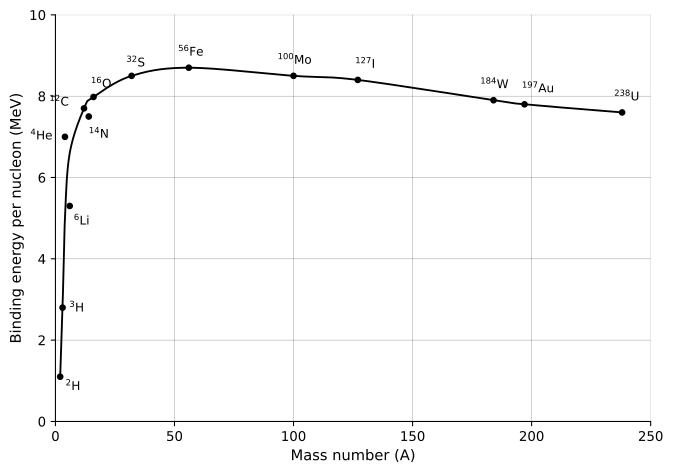
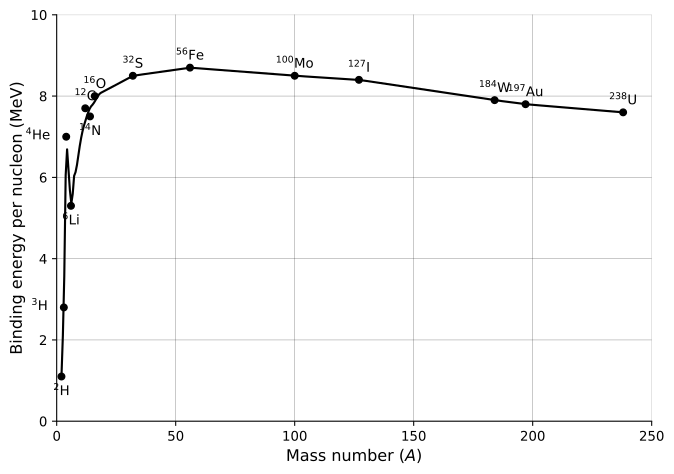
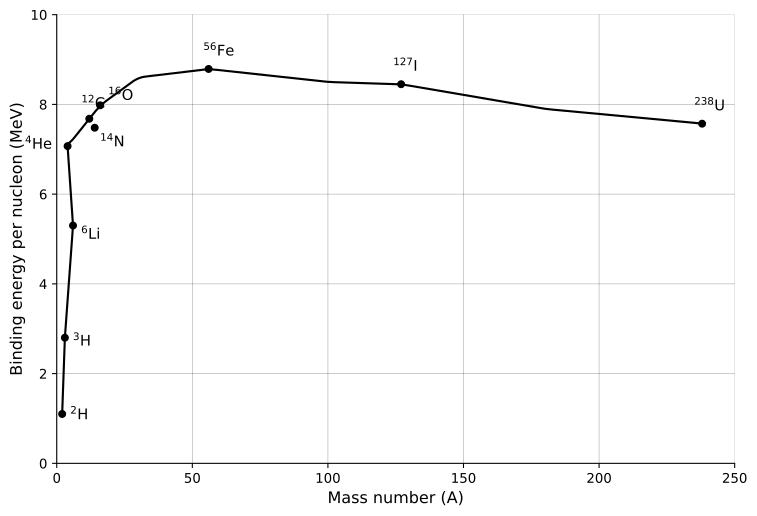
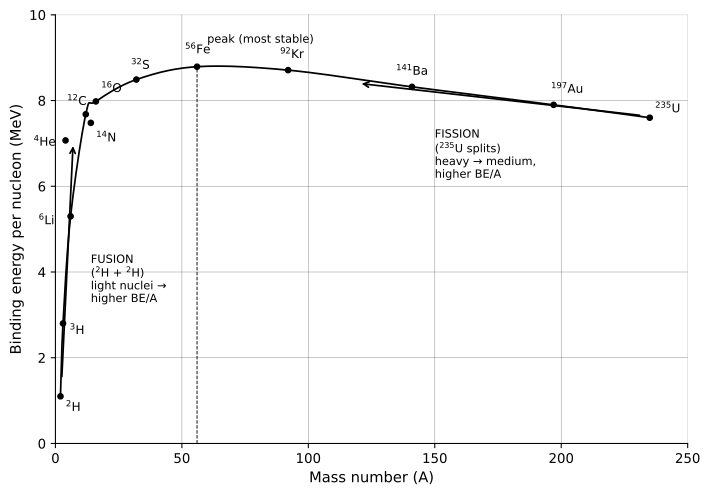
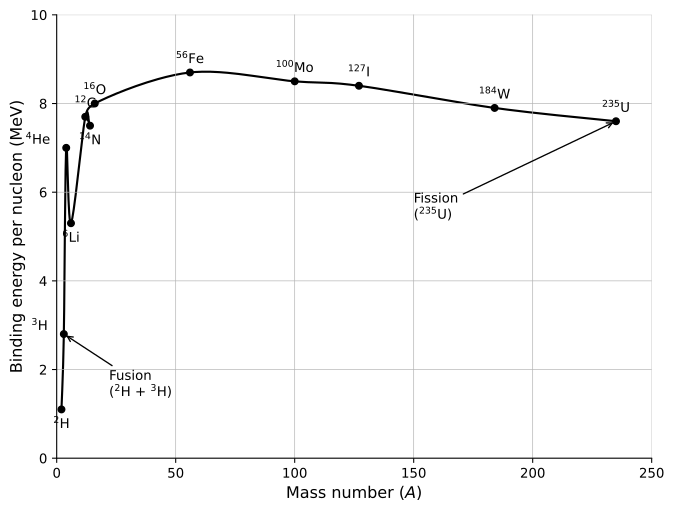
The binding energy per nucleon (BE/A) versus mass number (A) curve is given below.

(a) Two light nuclei, each with mass number around A = 10, fuse to form a heavier nucleus. Will the product nucleus have higher or lower BE/A than the reactants? Justify your answer.

(b) Calculate the energy released when two ²H nuclei fuse to form ³He and a neutron, given:
Mass of ²H = 2.014102 u
Mass of ³He = 3.016029 u
Mass of neutron = 1.008665 u
(1 u = 931.5 MeV/c²)

Diagram for question 16: Nuclei
Show answer
(a) The BE/A versus mass number (A) curve shows that nuclei with A around 10 have a relatively LOW binding energy per nucleon (approximately 6–7 MeV/nucleon), while nuclei in the mid-range (A ≈ 56) have the highest BE/A (~8.8 MeV/nucleon).

When two light nuclei (A ≈ 10 each) fuse, the product nucleus has A ≈ 20, which lies at a higher position on the BE/A curve than the reactants.

∴ The product nucleus has a HIGHER BE/A than the reactants.

Justification: A higher BE/A means the nucleons in the product are more tightly bound. The increase in total binding energy appears as energy released in the fusion reaction. This is consistent with nuclear fusion releasing energy for light nuclei.

(b) The nuclear fusion reaction is:

²<sub>1</sub>H + ²<sub>1</sub>H → ³<sub>2</sub>He + ¹<sub>0</sub>n

The energy released is given by:
Q = Δm × 931.5 MeV

where Δm = (total mass of reactants) − (total mass of products)

Δm = [2 × m(²H)] − [m(³He) + m(n)]

Substituting values:
Δm = [2 × 2.014102] − [3.016029 + 1.008665] u
Δm = [4.028204] − [4.024694] u
Δm = 0.003510 u

Q = 0.003510 × 931.5 MeV

∴ Q = 3.269 MeV ≈ 3.27 MeV

The process releases energy (exothermic), consistent with fusion of light nuclei into a more tightly bound product.
Q17Short Answer3 marks

A nuclear research team is investigating two proposed energy-release reactions involving light nuclei. They propose the following two processes:

Process I (Fusion): ²₁H + ³₁H → ⁴₂He + ¹₀n
Process II (Fission): ⁸₄Be → ² ²₂He (i.e., ⁸₄Be splits into two ⁴₂He nuclei)

Given atomic masses:
m(²₁H) = 2.01410 u, m(³₁H) = 3.01605 u
m(⁴₂He) = 4.00260 u, m(¹₀n) = 1.00867 u
m(⁸₄Be) = 8.00531 u

(a) Calculate the Q-value of Process I and state whether it releases or absorbs energy. [2]
(b) Calculate the Q-value of Process II. Comment on the stability of ⁸₄Be on the basis of your result. [1]
(c) The binding energy per nucleon (BE/A) of ⁴₂He is approximately 7.07 MeV and that of ²₁H is approximately 1.11 MeV. Without performing a fresh calculation, explain qualitatively — using the concept of BE/A — why Process I is energetically favourable. Also identify which region of the BE/A vs. mass number graph is relevant here. [1]

Show answer
MARKING SCHEME (Total: 4 marks)

━━━━━━━━━━━━━━━━━━━━━━━━━━━━━━━━━━━━━
Part (a): Q-value of Process I [2 marks]
━━━━━━━━━━━━━━━━━━━━━━━━━━━━━━━━━━━━━

The Q-value of a nuclear reaction is given by:
Q = (sum of masses of reactants − sum of masses of products) × 931.5 MeV/u

Reactants: ²₁H + ³₁H
Total mass of reactants = m(²₁H) + m(³₁H)
= 2.01410 + 3.01605
= 5.03015 u

Products: ⁴₂He + ¹₀n
Total mass of products = m(⁴₂He) + m(¹₀n)
= 4.00260 + 1.00867
= 5.01127 u

Mass defect:
Δm = 5.03015 − 5.01127 = 0.01888 u

→ Q = 0.01888 × 931.5 MeV
∴ Q ≈ 17.59 MeV

Since Q > 0, the reaction releases energy.
∴ Process I is exothermic (energy is released ≈ 17.59 MeV). ✓ (1 mark: correct Δm) ✓ (1 mark: correct Q with unit and conclusion)

━━━━━━━━━━━━━━━━━━━━━━━━━━━━━━━━━━━━━
Part (b): Q-value of Process II [1 mark]
━━━━━━━━━━━━━━━━━━━━━━━━━━━━━━━━━━━━━

Using Q = (mass of reactant − mass of products) × 931.5 MeV/u:

Mass of ⁸₄Be = 8.00531 u
Mass of 2 × ⁴₂He = 2 × 4.00260 = 8.00520 u

Δm = 8.00531 − 8.00520 = 0.00011 u

→ Q = 0.00011 × 931.5 MeV
∴ Q ≈ 0.10 MeV

Since Q > 0, the fission of ⁸₄Be into two α-particles releases energy.

Conclusion: ⁸₄Be is inherently unstable — it spontaneously breaks into two ⁴₂He nuclei because the product state has lower total mass (and hence lower rest energy). This explains why ⁸₄Be has an extremely short half-life (≈ 8×10⁻¹⁷ s). ✓ (1 mark: correct Q + stability comment)

━━━━━━━━━━━━━━━━━━━━━━━━━━━━━━━━━━━━━
Part (c): Qualitative explanation using BE/A [1 mark]
━━━━━━━━━━━━━━━━━━━━━━━━━━━━━━━━━━━━━

Binding energy per nucleon (BE/A) represents the average energy needed to remove one nucleon from the nucleus — a higher BE/A means a more tightly bound, more stable nucleus.

In Process I:
• Reactant ²₁H has BE/A ≈ 1.11 MeV (very loosely bound, low-A region of graph).
• Product ⁴₂He has BE/A ≈ 7.07 MeV (more tightly bound).

When lighter nuclei with low BE/A fuse to form a heavier nucleus with higher BE/A, the nucleons become more tightly bound. The difference in total binding energies is released as energy:
Energy released ≈ [BE of ⁴₂He] − [BE of ²₁H + BE of ³₁H]

Since BE/A increases steeply for light nuclei (A < 20) on the BE/A vs. A graph, fusion of light nuclei always moves the system toward the rising portion of the curve, releasing energy.

∴ Process I is energetically favourable because the product ⁴₂He is significantly more tightly bound per nucleon than the reactants. The relevant region of the BE/A vs. A graph is the low-A (rising) region (approximately A = 1 to 20). ✓ (1 mark: correct physical reasoning + correct region identified)
Q18Short Answer3 marks

A nuclear physicist is designing a reactor and needs to choose between two nuclear reactions for energy release:

Reaction P: ²³⁵₉₂U + ¹₀n → ¹⁴¹₅₆Ba + ⁹²₃₆Kr + 3¹₀n
Reaction Q: ²₁H + ³₁H → ⁴₂He + ¹₀n

Given that the binding energy per nucleon (BE/A) values are approximately:
• ²³⁵U: 7.6 MeV, ¹⁴¹Ba: 8.3 MeV, ⁹²Kr: 8.7 MeV
• ²H: 1.1 MeV, ³H: 2.8 MeV, ⁴He: 7.1 MeV

(i) Identify Reaction P and Reaction Q by name.
(ii) Calculate the energy released (in MeV) in Reaction P.
(iii) Calculate the energy released (in MeV) in Reaction Q.
(iv) The physicist observes from the binding energy per nucleon curve that iron-56 (⁵⁶Fe) has the highest BE/A ≈ 8.8 MeV/nucleon. Explain why neither Reaction P nor Reaction Q can occur spontaneously with ⁵⁶Fe as a reactant.

Show answer
(i) Reaction P is nuclear fission (a heavy nucleus splits into lighter nuclei). Reaction Q is nuclear fusion (two light nuclei combine to form a heavier nucleus). [½ + ½ = 1 mark]

(ii) Energy released in Reaction P:

By the principle of nuclear binding energy, the energy released in a nuclear reaction is given by:
Q = [Total BE of products − Total BE of reactants]

Total BE of reactants:
BE(²³⁵U) = 7.6 × 235 = 1786 MeV
(The neutron has zero BE/A, so it contributes 0 MeV.)

Total BE of products:
BE(¹⁴¹Ba) = 8.3 × 141 = 1170.3 MeV
BE(⁹²Kr) = 8.7 × 92 = 800.4 MeV
(3 neutrons contribute 0 MeV.)
Total BE of products = 1170.3 + 800.4 = 1970.7 MeV

Q_P = 1970.7 − 1786 = 184.7 MeV

∴ Energy released in Reaction P ≈ 184.7 MeV [1 mark]

(iii) Energy released in Reaction Q:

Q = [Total BE of products − Total BE of reactants]

Total BE of reactants:
BE(²H) = 1.1 × 2 = 2.2 MeV
BE(³H) = 2.8 × 3 = 8.4 MeV
Total BE of reactants = 2.2 + 8.4 = 10.6 MeV

Total BE of products:
BE(⁴He) = 7.1 × 4 = 28.4 MeV
(neutron contributes 0 MeV)
Total BE of products = 28.4 MeV

Q_Q = 28.4 − 10.6 = 17.8 MeV

∴ Energy released in Reaction Q ≈ 17.8 MeV [1 mark]

(iv) ⁵⁶Fe has the highest binding energy per nucleon (≈ 8.8 MeV/nucleon) of all nuclei — it lies at the peak of the BE/A vs. mass number curve.

For energy to be released in a nuclear reaction, the products must have a higher total binding energy than the reactants, i.e., the products must be more tightly bound.

• Fission of ⁵⁶Fe would produce lighter nuclei with lower BE/A (since the curve rises steeply to the left of iron), so the products would be less tightly bound — energy would need to be supplied, not released.
• Fusion of ⁵⁶Fe with another nucleus would produce a heavier nucleus with lower BE/A (since the curve falls gently to the right of iron), again releasing no energy.

∴ Since ⁵⁶Fe is already at the maximum of the binding energy curve, neither fission nor fusion can yield a product with higher total binding energy. Hence no energy is released, and neither reaction can occur spontaneously with ⁵⁶Fe as a reactant. [1 mark]
Q19Short Answer3 marks

A nuclear research team is studying two unknown nuclides P and Q. The following data is recorded:

Nuclide P: Atomic number Z = 20, Mass number A = 40
Nuclide Q: Atomic number Z = 18, Mass number A = 40

The team also measures the nuclear radii and binding energies of these nuclides.

(i) Identify the relationship between nuclides P and Q (isotopes, isobars, or isotones). Justify your answer.

(ii) The empirical formula for nuclear radius is R = R₀A^(1/3), where R₀ = 1.2 × 10⁻¹⁵ m. Calculate the ratio of the nuclear radius of nuclide P to that of nuclide Q.

(iii) The binding energy per nucleon of nuclide P is 8.55 MeV. Estimate the total binding energy of nuclide P.

(iv) A researcher claims: 'Since P and Q have the same mass number, they must have the same total binding energy.' Is this claim correct? Give a reason.

Show answer
(i) Nuclides P and Q are ISOBARS.

Isobars are defined as nuclides having the same mass number (A) but different atomic numbers (Z).

Here, both P (Z = 20, A = 40) and Q (Z = 18, A = 40) have the same mass number A = 40, but different atomic numbers (Z = 20 and Z = 18 respectively).

∴ P and Q are isobars. [1 mark]

(ii) By the empirical formula for nuclear radius:

R = R₀A^(1/3)

For nuclide P: R_P = R₀ × (40)^(1/3)
For nuclide Q: R_Q = R₀ × (40)^(1/3)

Ratio: R_P / R_Q = [R₀ × (40)^(1/3)] / [R₀ × (40)^(1/3)] = 1

∴ R_P / R_Q = 1 : 1

Since both nuclides have the same mass number A = 40, their nuclear radii are identical. [1 mark]

(iii) The total binding energy is given by:

Total Binding Energy = Binding Energy per nucleon × A

Substituting values:

Total Binding Energy = 8.55 MeV × 40

∴ Total Binding Energy of nuclide P = 342 MeV [1 mark]

(iv) The researcher's claim is INCORRECT.

Although P and Q are isobars (same A = 40), the total binding energy depends not only on the mass number A but also on the specific composition of the nucleus — that is, the number of protons (Z) and neutrons (N = A − Z). The nuclear forces (strong force) and electrostatic repulsion between protons both influence the binding energy. Since P has Z = 20 and Q has Z = 18, they have different proton-neutron compositions, leading to different binding energies per nucleon and hence different total binding energies.

∴ Same mass number does NOT guarantee the same total binding energy. [1 mark]
Q20Short Answer3 marks

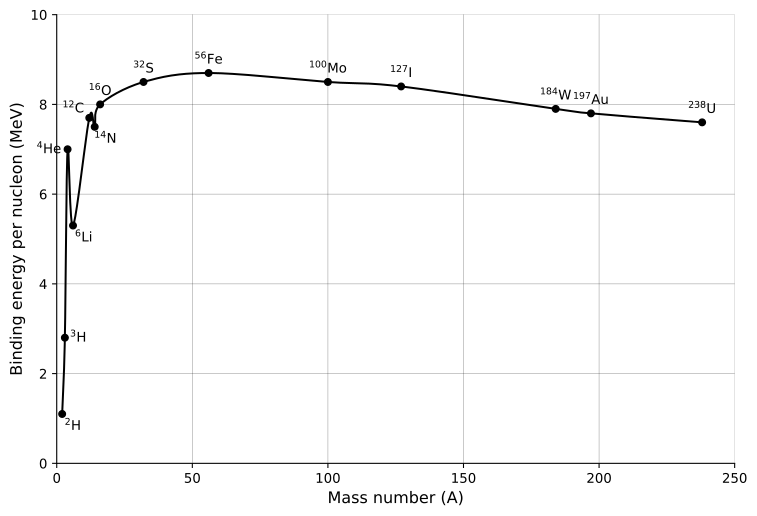
The binding energy per nucleon versus mass number (A) graph for nuclei is given below. Using this graph, answer the following:
(a) Why is the fusion of two light nuclei (such as ²₁H) energetically favourable?
(b) Why is the fission of a very heavy nucleus (such as ²³⁵₉₂U) energetically favourable?
(c) Calculate the energy released when two ²₁H nuclei fuse to form ⁴₂He, given that the binding energy per nucleon of ²₁H is 1.1 MeV and of ⁴₂He is 7.0 MeV.

Diagram for question 20: Nuclei
Show answer
(a) From the binding energy per nucleon (BE/A) curve, light nuclei (low A) have a lower BE/A compared to nuclei in the middle of the periodic table (A ≈ 56). When two light nuclei fuse, the product nucleus has a higher BE/A than the reactants. Since higher BE/A means greater stability and more energy is needed to break the nucleus apart, the total binding energy of the product is greater than that of the reactants. The difference in total binding energy is released as energy. Therefore, fusion of light nuclei is energetically favourable.

(b) Very heavy nuclei (high A, such as ²³⁵₉₂U) have a lower BE/A than the middle-mass nuclei produced during fission. When a heavy nucleus splits into two medium-mass fragments, the BE/A of the fragments is higher than that of the original nucleus. The total binding energy of the products exceeds that of the reactant, and this excess energy is released. Therefore, fission of a very heavy nucleus is energetically favourable.

(c) The reaction is:
²₁H + ²₁H → ⁴₂He

Total binding energy of reactants:
BE(²₁H + ²₁H) = 2 × (BE/A of ²₁H) × A
= 2 × 1.1 MeV × 2
= 4.4 MeV

Total binding energy of product:
BE(⁴₂He) = (BE/A of ⁴₂He) × A
= 7.0 MeV × 4
= 28.0 MeV

Energy released = BE(product) − BE(reactants)
= 28.0 − 4.4

∴ Energy released = 23.6 MeV
Q21Short Answer3 marks

The half-life of a radioactive element X is 20 years. Calculate: (a) the decay constant of element X, and (b) the time taken for 75% of a given sample of X to disintegrate.

Show answer
The radioactive decay law states that the number of undecayed nuclei decreases exponentially as:

N = N₀ e^(−λt)

where λ is the decay constant and T½ is the half-life, related by:

T½ = 0.693 / λ

(a) Finding the decay constant λ:

Using T½ = 0.693 / λ

→ λ = 0.693 / T½

→ λ = 0.693 / 20

∴ λ = 3.465 × 10⁻² year⁻¹ (≈ 0.035 year⁻¹)

(b) Finding the time for 75% disintegration:

If 75% of the sample has disintegrated, 25% remains undecayed.

→ N / N₀ = 25 / 100 = 1/4

Using N = N₀ e^(−λt)

→ 1/4 = e^(−λt)

→ e^(λt) = 4

Taking natural logarithm on both sides:

→ λt = ln 4 = 2 ln 2 = 2 × 0.693 = 1.386

→ t = 1.386 / λ = 1.386 / (0.693 / T½)

→ t = 2 × T½

→ t = 2 × 20

∴ t = 40 years

(Alternatively: after 1 half-life → 50% remains; after 2 half-lives → 25% remains, i.e., 75% disintegrated. ∴ t = 2 × 20 = 40 years.)
Q22Short Answer3 marks

A research team studying stellar nucleosynthesis analyses two nuclear reactions occurring inside a star:

Reaction I (Proton–Proton chain, first step): ¹₁H + ¹₁H → ²₁H + ⁰₁e + ν

Reaction II (Carbon cycle step): ¹²₆C + ¹₁H → ¹³₇N + γ

Separately, the team also measures the radius of a ⁵⁶₂₆Fe nucleus and a ¹²₅₀Sn nucleus.

Given masses:
m(¹₁H) = 1.007825 u
m(²₁H) = 2.014102 u
m(⁰₁e) = 0.000549 u
m(¹²₆C) = 12.000000 u
m(¹³₇N) = 13.005739 u
1 u = 931.5 MeV/c², R₀ = 1.2 × 10⁻¹⁵ m

(i) Calculate the Q-value (energy released) of Reaction I.
(ii) Calculate the Q-value of Reaction II and state whether it is exothermic or endothermic.
(iii) Show that the ratio of the radii R(⁵⁶Fe) : R(¹²⁰Sn) is independent of R₀, and find its numerical value.
(iv) The team argues that nuclear density is the same for both ⁵⁶Fe and ¹²⁰Sn. Justify this argument with a brief derivation.

Show answer
(i) Q-value of Reaction I

The Q-value is given by:
Q = (mass of reactants − mass of products) × 931.5 MeV/u

Reactants: 2 × m(¹₁H) = 2 × 1.007825 = 2.015650 u
Products: m(²₁H) + m(⁰₁e) = 2.014102 + 0.000549 = 2.014651 u

Δm = 2.015650 − 2.014651 = 0.000999 u

∴ Q₁ = 0.000999 × 931.5 = 0.931 MeV ≈ 0.93 MeV

Since Q > 0, Reaction I is exothermic (energy is released).

(ii) Q-value of Reaction II

Q = (mass of reactants − mass of products) × 931.5 MeV/u

Reactants: m(¹²₆C) + m(¹₁H) = 12.000000 + 1.007825 = 13.007825 u
Products: m(¹³₇N) = 13.005739 u (γ-ray carries energy, not rest mass)

Δm = 13.007825 − 13.005739 = 0.002086 u

∴ Q₂ = 0.002086 × 931.5 = 1.944 MeV ≈ 1.94 MeV

Since Q > 0, Reaction II is also exothermic (energy is released in the form of a γ-ray).

(iii) Ratio of nuclear radii R(⁵⁶Fe) : R(¹²⁰Sn)

By the empirical relation for nuclear radius:
R = R₀ A^(1/3)

where A is the mass number and R₀ is a universal constant.

R(⁵⁶Fe) = R₀ × (56)^(1/3)
R(¹²⁰Sn) = R₀ × (120)^(1/3)

Ratio = R(⁵⁶Fe) / R(¹²⁰Sn) = (56/120)^(1/3) = (7/15)^(1/3)

The factor R₀ cancels completely, confirming the ratio is independent of R₀.

Numerical value:
56/120 = 0.4667
(0.4667)^(1/3) ≈ 0.775

∴ R(⁵⁶Fe) : R(¹²⁰Sn) = 0.775 : 1 (or approximately 7^(1/3) : 15^(1/3))

(iv) Nuclear density is the same for all nuclei

Let a nucleus have mass number A.

Mass of nucleus ≈ A × m_p (where m_p ≈ 1.67 × 10⁻²⁷ kg is the nucleon mass)

Volume of nucleus = (4/3)πR³ = (4/3)π(R₀A^(1/3))³ = (4/3)πR₀³ A

Nuclear density:
ρ = Mass / Volume = (A × m_p) / ((4/3)πR₀³ A)

ρ = m_p / ((4/3)πR₀³)

The mass number A cancels from numerator and denominator.

∴ ρ = 3m_p / (4πR₀³) = constant, independent of A.

Substituting values: ρ = (3 × 1.67 × 10⁻²⁷) / (4π × (1.2 × 10⁻¹⁵)³)
= (5.01 × 10⁻²⁷) / (4π × 1.728 × 10⁻⁴⁵)
= (5.01 × 10⁻²⁷) / (2.174 × 10⁻⁴⁴)
≈ 2.3 × 10¹⁷ kg m⁻³

Since ρ depends only on fundamental constants m_p and R₀ (and not on A), the nuclear density is the same (~2.3 × 10¹⁷ kg m⁻³) for both ⁵⁶Fe and ¹²⁰Sn, and indeed for all nuclei.
Q23Short Answer3 marks

A nuclear scientist is comparing properties of four different nuclei: Helium-4 (<sup>4</sup><sub>2</sub>He), Carbon-12 (<sup>12</sup><sub>6</sub>C), Iron-56 (<sup>56</sup><sub>26</sub>Fe), and Uranium-238 (<sup>238</sup><sub>92</sub>U). She makes the following four statements about nuclear properties. Identify which statement is INCORRECT and explain why.

(i) The nuclear radius of Uranium-238 is approximately (238/4)<sup>1/3</sup> times the nuclear radius of Helium-4.
(ii) The nuclear density of Carbon-12 is approximately equal to the nuclear density of Iron-56.
(iii) The binding energy per nucleon is highest for Iron-56, making it the most stable nucleus among the four.
(iv) Nuclear forces between nucleons are long-range forces, similar in nature to gravitational forces.

Also, using the relation R = R₀A<sup>1/3</sup>, calculate the ratio of the nuclear radii of Uranium-238 and Helium-4. (Take R₀ = 1.2 × 10⁻¹⁵ m)

Show answer
Statement (iv) is INCORRECT.

Nuclear forces are SHORT-RANGE forces, not long-range like gravity. They are effective only up to distances of the order of 10⁻¹⁵ m (~ 1 fm). Beyond 2–3 fm, nuclear forces become negligible. Gravitational forces, in contrast, are long-range forces that follow an inverse-square law and act over infinite distances.

Verification that statements (i), (ii), and (iii) are correct:

Statement (i): By the empirical relation R = R₀A<sup>1/3</sup>,
R<sub>U</sub>/R<sub>He</sub> = (238)<sup>1/3</sup>/(4)<sup>1/3</sup> = (238/4)<sup>1/3</sup> ✓

Statement (ii): Nuclear density ρ = (mass of nucleus)/(volume of nucleus)
→ ρ = (A × m<sub>u</sub>) / ((4/3)πR₀³A) = 3m<sub>u</sub> / (4πR₀³)
Since R₀ and m<sub>u</sub> are constants, nuclear density is independent of mass number A. Therefore, density of Carbon-12 ≈ density of Iron-56. ✓

Statement (iii): From the binding energy per nucleon (BE/A) curve, Iron-56 has the highest BE/A ≈ 8.8 MeV/nucleon, making it the most stable nucleus among the four. ✓

Calculation of Ratio of Nuclear Radii:

By the empirical relation: R = R₀A<sup>1/3</sup>

∴ R<sub>U</sub>/R<sub>He</sub> = (A<sub>U</sub>)<sup>1/3</sup> / (A<sub>He</sub>)<sup>1/3</sup>

→ R<sub>U</sub>/R<sub>He</sub> = (238/4)<sup>1/3</sup> = (59.5)<sup>1/3</sup>

→ R<sub>U</sub>/R<sub>He</sub> ≈ (59.5)<sup>1/3</sup> ≈ 3.91

∴ Ratio of nuclear radii R<sub>U</sub> : R<sub>He</sub> ≈ 3.91 : 1
Q24Short Answer3 marks

A nuclear scientist is studying two possible energy-release reactions for a proposed fusion reactor. She considers the following two processes:

Process P: ²₁H + ²₁H → ³₂He + ¹₀n
Process Q: ²₁H + ³₁H → ⁴₂He + ¹₀n

Given atomic masses:
m(²₁H) = 2.014102 u, m(³₁H) = 3.016049 u, m(³₂He) = 3.016029 u, m(⁴₂He) = 4.002603 u, m(¹₀n) = 1.008665 u

(i) Calculate the Q-value (energy released) for Process P. [2]
(ii) The scientist observes that Process Q releases 17.59 MeV per reaction. Without detailed calculation, explain why Process Q releases significantly more energy than Process P, using the concept of binding energy per nucleon. [1]
(iii) In a fusion reactor, extremely high temperatures (~10⁷ K) are needed to initiate these reactions, even though they release large amounts of energy. Give one reason why such high temperatures are necessary. [1]

Diagram for question 24: Nuclei
Show answer
(i) Q-value of Process P: ²₁H + ²₁H → ³₂He + ¹₀n

The Q-value of a nuclear reaction is given by:
Q = Δm × 931.5 MeV/u
where Δm = (total mass of reactants) − (total mass of products)

Mass of reactants = 2 × m(²₁H) = 2 × 2.014102 u = 4.028204 u

Mass of products = m(³₂He) + m(¹₀n)
= 3.016029 + 1.008665 u
= 4.024694 u

Δm = 4.028204 − 4.024694 = 0.003510 u

∴ Q = 0.003510 × 931.5 MeV
∴ Q = 3.269 MeV ≈ 3.27 MeV

(ii) The binding energy per nucleon (BE/A) for ⁴₂He (the product of Process Q) is approximately 7.07 MeV/nucleon — one of the highest values on the BE/A curve — whereas the product ³₂He of Process P has a lower BE/A (~2.57 MeV/nucleon). Since the reactants (²₁H, ³₁H) have low BE/A, Process Q results in a much larger increase in total binding energy of the system, and by the mass-energy equivalence this larger increase in binding energy appears as greater energy released. In other words, the product ⁴₂He is exceptionally tightly bound, so Process Q releases far more energy than Process P.

(iii) The reacting nuclei (e.g., two deuterium nuclei) are both positively charged. They experience a strong electrostatic (Coulomb) repulsion as they approach each other. Extremely high temperatures (~10⁷ K) are required to give the nuclei sufficient thermal kinetic energy to overcome this Coulomb potential barrier and come within the range of the attractive nuclear force (~10⁻¹⁵ m), so that fusion can take place.
Q25Short Answer3 marks

A nuclear scientist is studying two reactions in a laboratory:

Reaction 1 (Fission): ²³⁵₉₂U + ¹₀n → ¹⁴¹₅₆Ba + ⁹²₃₆Kr + 3 ¹₀n

Reaction 2 (Fusion): ²₁H + ²₁H → ³₂He + ¹₀n

Given masses:
m(²³⁵₉₂U) = 235.043930 u, m(¹₀n) = 1.008665 u
m(¹⁴¹₅₆Ba) = 140.914411 u, m(⁹²₃₆Kr) = 91.926156 u
m(²₁H) = 2.014102 u, m(³₂He) = 3.016029 u

(i) Using the binding energy per nucleon (BE/A) curve, explain why BOTH fission of heavy nuclei AND fusion of light nuclei release energy. [1 mark]

(ii) Verify that Reaction 1 (fission) conserves both mass number and atomic number. [1 mark]

(iii) Calculate the energy released (in MeV) in Reaction 2 (fusion). [2 marks]

(1 u = 931.5 MeV/c²)

Diagram for question 25: Nuclei
Show answer
(i) The binding energy per nucleon (BE/A) curve peaks around mass number A ≈ 56 (iron group, ~8.8 MeV/nucleon).

→ For heavy nuclei (large A, e.g., ²³⁵U), BE/A is lower (~7.6 MeV/nucleon) than the peak. When they split (fission) into medium-mass fragments, the products have higher BE/A — the nucleons become more tightly bound, so energy is released.

→ For very light nuclei (small A, e.g., ²₁H), BE/A is also lower (~1.1 MeV/nucleon) than the peak. When they fuse into a heavier nucleus, the product has higher BE/A — again, nucleons become more tightly bound, so energy is released.

∴ In both cases, the products lie closer to the peak of the BE/A curve than the reactants, and the difference in binding energy is released.

(ii) Checking conservation in Reaction 1:

²³⁵₉₂U + ¹₀n → ¹⁴¹₅₆Ba + ⁹²₃₆Kr + 3 ¹₀n

Mass number (A): Left side: 235 + 1 = 236
Right side: 141 + 92 + 3(1) = 141 + 92 + 3 = 236 ✓

Atomic number (Z): Left side: 92 + 0 = 92
Right side: 56 + 36 + 3(0) = 92 ✓

∴ Both mass number and atomic number are conserved in Reaction 1.

(iii) Energy released in Reaction 2: ²₁H + ²₁H → ³₂He + ¹₀n

Using: Q = Δm × 931.5 MeV/u

Mass of reactants:
m<sub>reactants</sub> = m(²₁H) + m(²₁H)
= 2.014102 + 2.014102
= 4.028204 u

Mass of products:
m<sub>products</sub> = m(³₂He) + m(¹₀n)
= 3.016029 + 1.008665
= 4.024694 u

Mass defect:
Δm = m<sub>reactants</sub> − m<sub>products</sub>
= 4.028204 − 4.024694
= 0.003510 u

Energy released:
Q = 0.003510 × 931.5
Q = 3.270 MeV

∴ Energy released in Reaction 2 (fusion) = 3.27 MeV
Q26Short Answer3 marks

The activity of a radioactive sample drops to 1/8th of its initial value in 24 years. (i) Calculate the half-life of the radioactive substance. (ii) What fraction of the initial number of nuclei will remain undecayed after 40 years?

Show answer
Part (i): Calculating Half-Life

The law of radioactive decay states that the activity A of a radioactive sample at time t is given by:

A = A₀ e^(−λt)

where A₀ is the initial activity and λ is the decay constant.

Since activity is directly proportional to the number of undecayed nuclei (A ∝ N), after n half-lives:

A/A₀ = (1/2)ⁿ

Given: A/A₀ = 1/8 = (1/2)³

∴ n = 3 half-lives in 24 years

∴ T½ = 24/3

∴ T½ = 8 years

Part (ii): Fraction of nuclei remaining after 40 years

Using the decay law, the fraction of nuclei remaining after time t is:

N/N₀ = (1/2)^(t/T½)

Substituting t = 40 years and T½ = 8 years:

N/N₀ = (1/2)^(40/8) = (1/2)^5

∴ N/N₀ = 1/32

∴ The fraction of the initial number of nuclei remaining undecayed after 40 years is 1/32.
Q27Short Answer3 marks

A nuclear power plant uses uranium-235 as fuel. In one fission event, the reaction is:

²³⁵₉₂U + ¹₀n → ¹⁴¹₅₆Ba + ⁹²₃₆Kr + 3¹₀n + Q

Given: mass of ²³⁵₉₂U = 235.043930 u, mass of ¹₄₁₅₆Ba = 140.914411 u, mass of ⁹²₃₆Kr = 91.926156 u, mass of neutron = 1.008665 u, 1 u = 931.5 MeV/c².

(a) Calculate the energy released Q (in MeV) in one fission event.
(b) A city requires an average power of 200 MW. How many fission events per second are needed to supply this power? (1 MeV = 1.6 × 10⁻¹³ J)
(c) Give ONE reason why nuclear fission reactors use a moderator.
(d) State ONE advantage of nuclear fusion over nuclear fission as an energy source.

Show answer
(a) Energy released per fission event:

By the mass-energy equivalence, the energy released Q = Δm × 931.5 MeV, where Δm is the mass defect.

Δm = m(²³⁵U) + m(n) − m(¹⁴¹Ba) − m(⁹²Kr) − 3m(n)

→ Δm = [235.043930 + 1.008665] − [140.914411 + 91.926156 + 3 × 1.008665] u

→ Δm = 236.052595 − [140.914411 + 91.926156 + 3.025995] u

→ Δm = 236.052595 − 235.866562 u

→ Δm = 0.186033 u

∴ Q = 0.186033 × 931.5 MeV

∴ Q ≈ 173.3 MeV

(b) Number of fission events per second required:

Energy released per fission event in joules:
E₁ = 173.3 MeV × 1.6 × 10⁻¹³ J/MeV

→ E₁ = 173.3 × 1.6 × 10⁻¹³ J

→ E₁ = 277.3 × 10⁻¹³ J = 2.773 × 10⁻¹¹ J

Required power P = 200 MW = 200 × 10⁶ W = 2 × 10⁸ W

Number of fission events per second n = P / E₁

→ n = (2 × 10⁸) / (2.773 × 10⁻¹¹)

∴ n ≈ 7.21 × 10¹⁸ fission events per second

(c) Role of moderator:

The fast neutrons released during fission have very high kinetic energies and are not efficient at causing further fission of ²³⁵U. A moderator (e.g., heavy water or graphite) slows down (thermalises) these fast neutrons to thermal energies, thereby increasing the probability of inducing further fission and sustaining the chain reaction.

(d) Advantage of nuclear fusion over fission:

The fuel for fusion (deuterium/tritium, obtained from water) is virtually inexhaustible and abundantly available, whereas fission relies on limited reserves of uranium/plutonium. Additionally, fusion produces far less long-lived radioactive waste compared to fission.
Q28Short Answer3 marks

A nuclear scientist is studying two reactions in a laboratory:

Reaction 1 (Fission): ²³⁵₉₂U + ¹₀n → ¹⁴⁰₅₆Ba + ⁹³₃₆Kr + 3 ¹₀n

Reaction 2 (Fusion): ²₁H + ³₁H → ⁴₂He + ¹₀n + 17.6 MeV

Given atomic masses: m(²³⁵U) = 235.0439 u, m(¹⁴⁰Ba) = 139.9106 u, m(⁹³Kr) = 92.9310 u, m(n) = 1.0087 u.

(i) Calculate the mass defect (Δm) for Reaction 1.
(ii) Find the energy released (in MeV) in Reaction 1.
(iii) The scientist notes that Reaction 2 releases MORE energy per unit mass than Reaction 1, even though the total energy released per event is much less. Using the concept of binding energy per nucleon, explain why fusion releases more energy per unit mass than fission.
(iv) Despite releasing more energy per unit mass, nuclear fusion has NOT yet been achieved as a controlled, sustained source of energy on Earth. State ONE major reason for this difficulty.

Diagram for question 28: Nuclei
Show answer
(i) Mass Defect for Reaction 1:

The mass defect is given by:
Δm = [m(²³⁵U) + m(n)] − [m(¹⁴⁰Ba) + m(⁹³Kr) + 3m(n)]

Substituting values:
Δm = [235.0439 + 1.0087] − [139.9106 + 92.9310 + 3 × 1.0087]
→ Δm = 236.0526 − [139.9106 + 92.9310 + 3.0261]
→ Δm = 236.0526 − 235.8677
∴ Δm = 0.1849 u

(ii) Energy Released in Reaction 1:

Using the mass-energy equivalence, 1 u = 931.5 MeV/c²:
E = Δm × 931.5 MeV
→ E = 0.1849 × 931.5
∴ E ≈ 172.2 MeV

(iii) Explanation using Binding Energy per Nucleon (BE/A):

In the binding energy per nucleon (BE/A) vs. mass number (A) graph:
• Light nuclei (A < 20, e.g., ²H, ³H) have LOW BE/A (~1–3 MeV/nucleon).
• Medium-mass nuclei (A ≈ 56, e.g., Fe) have the HIGHEST BE/A (~8.8 MeV/nucleon).
• Heavy nuclei (A > 200, e.g., ²³⁵U) have moderately lower BE/A (~7.6 MeV/nucleon).

In fusion (²H + ³H → ⁴He): The reactants have very low BE/A (~1–2.8 MeV/nucleon), while ⁴He has a high BE/A (~7.1 MeV/nucleon). The RISE in BE/A per nucleon is very large (~4–5 MeV/nucleon).

In fission (²³⁵U → fragments): The rise in BE/A from ~7.6 to ~8.4 MeV/nucleon is only ~0.8 MeV/nucleon.

∴ Fusion releases a greater increase in BE/A per nucleon, meaning more energy is released per unit mass of fuel, even though the total energy per event is smaller (because fewer nucleons are involved).

(iv) Major Difficulty in Achieving Controlled Fusion:

Fusion requires extremely high temperatures (~10⁷–10⁸ K) to give nuclei sufficient kinetic energy to overcome the strong electrostatic (Coulomb) repulsion between positively charged nuclei and bring them close enough for the short-range nuclear force to take effect. Sustaining such extreme temperatures in a controlled manner (plasma confinement) has not yet been achieved practically on Earth.
Q29Short Answer3 marks

A nuclear scientist is comparing two nuclides: Carbon-12 (<sup>12</sup><sub>6</sub>C) and Iron-56 (<sup>56</sup><sub>26</sub>Fe). She plots the binding energy per nucleon (BE/A) curve for all known nuclei and locates both nuclides on it.

(i) Which of the two nuclides has a higher binding energy per nucleon? What does this tell us about their relative nuclear stability?

(ii) The scientist calculates the binding energy of <sup>12</sup><sub>6</sub>C. Given: mass of <sup>12</sup><sub>6</sub>C = 12.000 u, mass of proton = 1.00728 u, mass of neutron = 1.00867 u, 1 u = 931.5 MeV/c². Calculate the binding energy per nucleon of Carbon-12.

(iii) Using the BE/A curve, explain why energy is released in both nuclear fission and nuclear fusion reactions.

Diagram for question 29: Nuclei
Show answer
(i) <sup>56</sup><sub>26</sub>Fe (Iron-56) has a higher binding energy per nucleon.

Iron-56 lies near the peak of the BE/A curve with BE/A ≈ 8.8 MeV/nucleon, whereas Carbon-12 has BE/A ≈ 7.68 MeV/nucleon. A higher binding energy per nucleon means more energy is needed to break the nucleus apart. ∴ Iron-56 is more tightly bound and hence more stable than Carbon-12.

(ii) For <sup>12</sup><sub>6</sub>C: number of protons Z = 6, number of neutrons N = A − Z = 12 − 6 = 6.

Mass defect formula:
Δm = Z·m<sub>p</sub> + N·m<sub>n</sub> − M(nucleus)

Substituting values:
Δm = 6 × 1.00728 u + 6 × 1.00867 u − 12.000 u
Δm = 6.04368 u + 6.05202 u − 12.000 u
Δm = 12.09570 u − 12.000 u
Δm = 0.09570 u

Binding energy:
BE = Δm × 931.5 MeV/u
BE = 0.09570 × 931.5 MeV
BE = 89.15 MeV

Binding energy per nucleon:
BE/A = 89.15 / 12

∴ BE/A of Carbon-12 = 7.43 MeV/nucleon (≈ 7.4 MeV/nucleon)

(iii) The BE/A curve rises steeply for light nuclei, reaches a peak near Iron-56 (≈ 8.8 MeV/nucleon), and decreases gradually for very heavy nuclei.

Fusion: When two very light nuclei (e.g., <sup>2</sup>H + <sup>3</sup>H) combine to form a heavier nucleus, the product has a higher BE/A than the reactants. The increase in binding energy per nucleon means the product is more tightly bound, and the excess energy is released.

Fission: When a very heavy nucleus (e.g., <sup>235</sup><sub>92</sub>U) splits into two medium-mass fragments, the fragments lie closer to the peak of the curve and have higher BE/A than the original nucleus. The increase in total binding energy of the products over the reactants is released as energy.

∴ In both cases, the products are more stable (higher BE/A) than the reactants, and the difference in binding energy is released — as kinetic energy of products and radiation.
Q30Short Answer3 marks

A nuclear research team is investigating two candidate reactions for an energy source:

Reaction P: A heavy nucleus X (A = 200, B.E./A = 6.8 MeV) splits into two fragments, each with A = 100 and B.E./A = 8.2 MeV.

Reaction Q: Two light nuclei, each with A = 2 and B.E./A = 1.1 MeV, fuse to form a nucleus with A = 4 and B.E./A = 7.1 MeV.

(i) Identify which reaction is fission and which is fusion. Give one reason for each.
(ii) Calculate the energy released in Reaction P.
(iii) Calculate the energy released in Reaction Q.
(iv) The team finds that per unit mass of fuel, Reaction Q releases significantly more energy than Reaction P. Using the concept of binding energy per nucleon, justify this observation.

Show answer
(i) Reaction P is nuclear fission — a heavy nucleus (A = 200) splits into two lighter fragments (A = 100 each), which is the defining feature of fission. Reaction Q is nuclear fusion — two very light nuclei (A = 2 each) combine to form a heavier nucleus (A = 4), which is the defining feature of fusion.
[1 mark — ½ for each correct identification with reason]

(ii) Energy released in Reaction P:

Binding energy is defined as the energy required to completely separate a nucleus into its constituent nucleons. The energy released in a nuclear reaction = Total B.E. of products − Total B.E. of reactants.

B.E. of nucleus X = B.E./A × A = 6.8 × 200 = 1360 MeV

B.E. of each fragment = 8.2 × 100 = 820 MeV
Total B.E. of two fragments = 2 × 820 = 1640 MeV

Energy released in Reaction P:
ΔE<sub>P</sub> = Total B.E. of products − Total B.E. of reactant
ΔE<sub>P</sub> = 1640 − 1360
∴ ΔE<sub>P</sub> = 280 MeV
[1 mark]

(iii) Energy released in Reaction Q:

B.E. of each light nucleus = 1.1 × 2 = 2.2 MeV
Total B.E. of two reactant nuclei = 2 × 2.2 = 4.4 MeV

B.E. of product nucleus = 7.1 × 4 = 28.4 MeV

Energy released in Reaction Q:
ΔE<sub>Q</sub> = 28.4 − 4.4
∴ ΔE<sub>Q</sub> = 24.0 MeV
[1 mark]

(iv) Justification using binding energy per nucleon:

The energy released per nucleon tells us how much energy is obtained per unit mass of fuel. In Reaction P (fission): total fuel mass corresponds to A = 200 nucleons, and ΔE<sub>P</sub> = 280 MeV, giving energy per nucleon = 280/200 = 1.4 MeV/nucleon. In Reaction Q (fusion): total fuel mass corresponds to A = 2 + 2 = 4 nucleons, and ΔE<sub>Q</sub> = 24.0 MeV, giving energy per nucleon = 24.0/4 = 6.0 MeV/nucleon.

The gain in B.E./A is far greater in fusion (from ~1.1 to ~7.1 MeV/nucleon, a rise of ~6.0 MeV/nucleon) than in fission (from ~6.8 to ~8.2 MeV/nucleon, a rise of ~1.4 MeV/nucleon). Since nucleons in the light fusion fuel have very low initial binding energy, they release much more energy per nucleon when they fuse into a tightly bound product. This is why Reaction Q releases significantly more energy per unit mass of fuel than Reaction P.
[1 mark]

Want unlimited practice on Nuclei?

The full ClearSteps bank has 40+ reviewed questions on this chapter alone — with step-wise solutions, difficulty levels, and progress tracking. Verify your WhatsApp number and your free trial starts right here.

CBSE · CLASS 12
🎟️14-day free trial · code PRAC auto-applied
Mobile Number
+91
OTP will be sent to your WhatsApp

⭐ Trusted by 12,000+ students across India

Nuclei — Class 12 Physics Practice Questions