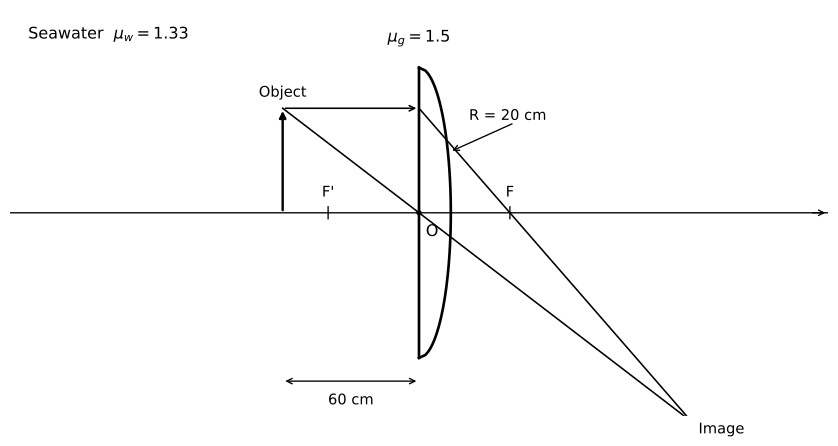
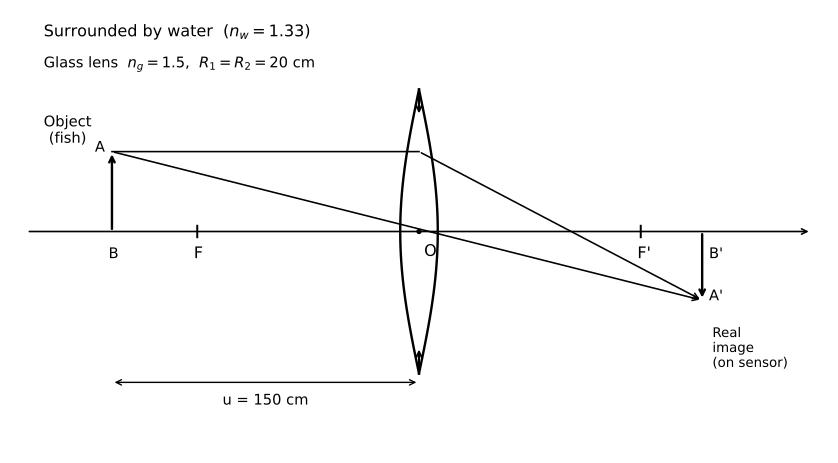
An underwater photographer uses a special biconvex glass lens (n_g = 1.5, both radii of curvature = 20 cm). In air the lens forms sharp images. When submerged in water (n_water = 1.33), the optical behaviour of the lens changes significantly — a real-world challenge faced in underwater photography and aquatic optical instruments.
An underwater photographer uses a special camera lens made of glass (refractive index n_g = 1.5). The lens is a biconvex lens with both radii of curvature equal to 20 cm. In air, this lens produces sharp images of distant objects on the sensor.
(i) Using the Lens Maker's Formula, calculate the focal length of this lens when it is used in air (n_air = 1.0).
(ii) The photographer submerges the camera in a swimming pool. The lens is now surrounded by water (n_water = 1.33). Calculate the new focal length of the lens in water.
(iii) The photographer focuses on a fish that is 150 cm away (measured along the principal axis) while the camera is underwater. Using the focal length found in part (ii), find the position of the image formed on the sensor. State whether the image is real or virtual.
(iv) How does the power of the lens change when it is taken from air into water? Give a reason based on your calculation.
Show answerHide answer
Lens Maker's Formula states:
1/f = (n_rel − 1)(1/R₁ − 1/R₂)
where n_rel = n_lens / n_medium.
By New Cartesian Sign Convention: for a biconvex lens, R₁ = +20 cm, R₂ = −20 cm.
n_rel (air) = n_g / n_air = 1.5 / 1.0 = 1.5
1/f_air = (1.5 − 1)(1/20 − 1/(−20))
→ 1/f_air = (0.5)(1/20 + 1/20)
→ 1/f_air = (0.5)(2/20)
→ 1/f_air = (0.5)(0.1) = 0.05 cm⁻¹
∴ f_air = +20 cm
(ii) Focal length in water:
Applying Lens Maker's Formula with the lens surrounded by water:
n_rel (water) = n_g / n_water = 1.5 / 1.33 ≈ 1.128
1/f_water = (1.128 − 1)(1/20 − 1/(−20))
→ 1/f_water = (0.128)(1/20 + 1/20)
→ 1/f_water = (0.128)(2/20)
→ 1/f_water = (0.128)(0.1) = 0.0128 cm⁻¹
∴ f_water = 1/0.0128 ≈ +78.1 cm
(iii) Position of image in water (object at u = −150 cm):
Using the thin lens formula: 1/v − 1/u = 1/f
By New Cartesian Sign Convention: u = −150 cm, f = +78.1 cm
1/v = 1/f + 1/u
→ 1/v = 1/78.1 + 1/(−150)
→ 1/v = 0.01281 − 0.00667
→ 1/v = 0.00614 cm⁻¹
∴ v = 1/0.00614 ≈ +162.9 cm ≈ +163 cm
Since v is positive, the image is formed on the other side of the lens from the object.
∴ The image is real, inverted, and formed approximately 163 cm behind the lens.
(iv) Change in power from air to water:
Power of a lens is defined as P = 1/f (in metres).
In air: P_air = 1/0.20 = +5.0 D
In water: P_water = 1/0.781 ≈ +1.28 D
The power of the lens decreases significantly (from +5 D to approximately +1.28 D) when taken from air to water.
Reason: Power depends on n_rel = n_lens/n_medium. In water, n_medium increases from 1.0 to 1.33, so n_rel = 1.5/1.33 decreases, making the lens less convergent. The lens bends light through a smaller angle at each surface, resulting in a much longer focal length and hence smaller power.