A quality-control chemist in a pharmaceutical laboratory has four unlabelled bottles, each containing one of the following compounds: ethanol (A), phenol (B), cyclohexanol (C), and benzyl alcohol (D). She uses a series of chemical tests to identify each bottle.
A quality-control chemist in a pharmaceutical laboratory has four unlabelled bottles, each containing one of the following compounds: ethanol (A), phenol (B), cyclohexanol (C), and benzyl alcohol (D). She needs to identify each compound using simple chemical tests and also understands why certain reactions behave differently with these compounds.
(i) She adds a small amount of neutral FeCl₃ solution to each sample. Only one bottle gives a characteristic colour. Identify the compound and name the colour produced. (1 mark)
(ii) She then treats samples A and C separately with Lucas reagent (conc. HCl + anhydrous ZnCl₂) at room temperature. Describe what she observes in each case and explain the difference in reactivity. (2 marks)
(iii) When phenol is treated with Br₂ water (not Br₂/CS₂), a white precipitate forms immediately even without a Lewis acid catalyst. Name the product and give a reason why this reaction is so facile compared to bromination of benzene. (1 mark)
Show answerHide answer
[Value point: identification of phenol — ½ mark; colour — ½ mark]
(ii) Lucas test observations:
• Ethanol (A) — primary alcohol: no turbidity / no cloudiness is observed at room temperature. The solution remains clear. (The reaction with Lucas reagent is too slow at room temperature for a primary alcohol.)
• Cyclohexanol (C) — secondary alcohol: turbidity / cloudiness appears after approximately 5 minutes, because the reaction proceeds via the SN1 mechanism with moderate rate for a secondary carbocation intermediate.
Reason for the difference: The rate of reaction with Lucas reagent depends on the stability of the carbocation intermediate formed. Cyclohexanol gives a secondary carbocation, which is more stable than the primary carbocation that would form from ethanol. Therefore, cyclohexanol reacts faster, producing the insoluble alkyl chloride (cloudiness) within a few minutes, while ethanol shows no observable reaction at room temperature.
[Value point: correct observation for ethanol — ½ mark; correct observation for cyclohexanol — ½ mark; correct reason based on carbocation stability / mechanism — 1 mark]
(iii) Product: 2,4,6-tribromophenol (white precipitate ↓)
Reaction:
C₆H₅OH + 3Br₂(aq) → C₆H₂Br₃OH↓ (2,4,6-tribromophenol) + 3HBr
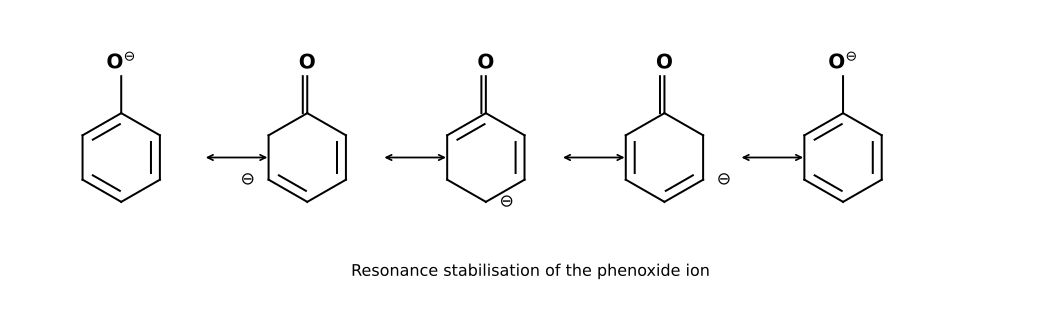
Reason: Due to the strong electron-donating effect of the —OH group through resonance, the electron density at the ortho and para positions of the benzene ring is greatly increased. This makes the ring highly activated towards electrophilic aromatic substitution. As a result, Br₂ (a weak electrophile) can react directly without a Lewis acid catalyst, and all three activated positions (two ortho + one para) are substituted in a single step.
[Value point: correct product name / structure — ½ mark; correct reason (ring activation by —OH through resonance / increased electron density at o- and p-positions) — ½ mark]