ClearStepsCLEARSTEPS AI
Teacher Login →Student Login →

Chemical Kinetics: Class 12 Chemistry Practice Questions

30 original exam-pattern questions with full answers, matched to the current CBSE Class 12 paper design, including case-based questions. Attempt each question before opening the answer — or start a free 14-day trial ↓ for the full bank.

Q1Case-based4 marks

A pharmaceutical company is studying the degradation of a drug compound X in aqueous solution. The degradation follows the mechanism given below:

Step I : X + H⁺ → Y (slow)
Step II : Y + H₂O → Z + H⁺ (fast)

In a separate kinetics experiment, the rate of decomposition of X was monitored at two temperatures. At 300 K, the rate constant k₁ = 2.0 × 10⁻³ s⁻¹. At 320 K, the rate constant k₂ = 8.0 × 10⁻³ s⁻¹.

A pharmaceutical company is studying the degradation of a drug compound X in aqueous solution. The degradation follows the mechanism given below:

Step I : X + H⁺ → Y (slow)
Step II : Y + H₂O → Z + H⁺ (fast)

In a separate kinetics experiment, the rate of decomposition of X was monitored at two temperatures. At 300 K, the rate constant k₁ = 2.0 × 10⁻³ s⁻¹. At 320 K, the rate constant k₂ = 8.0 × 10⁻³ s⁻¹.

(a) Write the rate law expression for the overall reaction and identify the order with respect to each reactant. Also state the role of H⁺ in this mechanism. [2]
(b) Calculate the energy of activation (Eₐ) for the degradation of drug X.
[Given: 2.303R = 19.15 J K⁻¹ mol⁻¹, log 2 = 0.301] [2]

Show answer
(a) Rate law expression and role of H⁺: [2 marks]

The rate-determining step (slow step) governs the rate law.

Step I (slow): X + H⁺ → Y

∴ Rate = k[X][H⁺]

Order with respect to X = 1 (first order)
Order with respect to H⁺ = 1 (first order)
Overall order of reaction = 1 + 1 = 2 (second order)

Role of H⁺: H⁺ is a catalyst — it is consumed in Step I (slow) but regenerated in Step II (fast), so its concentration remains unchanged at the end of the reaction. It increases the rate without being permanently consumed.

(½ mark: correct rate law expression; ½ mark: orders stated; ½ mark: overall order; ½ mark: role of H⁺ as catalyst correctly justified)

─────────────────────────────────────────────

(b) Calculation of Energy of Activation (Eₐ): [2 marks]

Given:
k₁ = 2.0 × 10⁻³ s⁻¹ at T₁ = 300 K
k₂ = 8.0 × 10⁻³ s⁻¹ at T₂ = 320 K
2.303R = 19.15 J K⁻¹ mol⁻¹, log 2 = 0.301

Using the Arrhenius equation:

log(k₂/k₁) = (Eₐ / 2.303R) × (1/T₁ − 1/T₂)

Substituting:

log(8.0 × 10⁻³ / 2.0 × 10⁻³) = (Eₐ / 19.15) × (1/300 − 1/320)

log 4 = (Eₐ / 19.15) × (1/300 − 1/320)

log 4 = log 2² = 2 × 0.301 = 0.602

(1/300 − 1/320) = (320 − 300)/(300 × 320) = 20/96000 = 2.083 × 10⁻⁴ K⁻¹

∴ 0.602 = (Eₐ / 19.15) × 2.083 × 10⁻⁴

Eₐ = (0.602 × 19.15) / (2.083 × 10⁻⁴)

Eₐ = 11.529 / (2.083 × 10⁻⁴)

∴ Eₐ = 5.535 × 10⁴ J mol⁻¹ ≈ 55.35 kJ mol⁻¹

(½ mark: correct formula written; ½ mark: correct substitution including correct log ratio and temperature term; ½ mark: correct simplification; ½ mark: correct final answer with unit)
Q2Case-based4 marks

A pharmaceutical company is studying the thermal decomposition of a drug compound X in solution for shelf-life prediction. The following concentration-time data were recorded at 300 K:

| Time (min) | [X] (mol L⁻¹) |
|---|---|
| 0 | 0.800 |
| 10 | 0.400 |
| 20 | 0.200 |
| 30 | 0.100 |

When the experiment was repeated at 330 K, the half-life of compound X was found to be 2.5 minutes.

(Given: R = 8.314 J K⁻¹ mol⁻¹; log 2 = 0.301)

A pharmaceutical company is studying the thermal decomposition of a drug compound X in solution for shelf-life prediction. The following concentration-time data were recorded at 300 K:

| Time (min) | [X] (mol L⁻¹) |
|---|---|
| 0 | 0.800 |
| 10 | 0.400 |
| 20 | 0.200 |
| 30 | 0.100 |

When the experiment was repeated at 330 K, the half-life of compound X was found to be 2.5 minutes.

(a) Using the concentration-time data, identify the order of the reaction and calculate the rate constant k₁ at 300 K. (2 marks)
(b) Calculate the activation energy (Eₐ) for the decomposition of X. (2 marks)

(Given: R = 8.314 J K⁻¹ mol⁻¹; log 2 = 0.301)

Show answer
PART (a) — Order and Rate Constant k₁ at 300 K [2 marks]

Step 1: Identify the order from the data.

From the table, the concentration of X halves every 10 minutes — the half-life is constant (t½ = 10 min) regardless of the initial concentration. Since a constant half-life is the diagnostic feature of a first-order reaction, the decomposition of X is a FIRST-ORDER reaction.

Rate law: Rate = k[X]

Step 2: Apply the first-order half-life expression.

For a first-order reaction:

t½ = 0.693 / k₁

∴ k₁ = 0.693 / t½ = 0.693 / 10 min

∴ k₁ = 6.93 × 10⁻² min⁻¹

[Award 1 mark: correct identification of first-order with justification (constant half-life / halving of concentration)
Award 1 mark: correct formula, substitution, and value of k₁ with unit]

---

PART (b) — Activation Energy Eₐ [2 marks]

Step 1: Calculate k₂ at T₂ = 330 K.

At 330 K, t½ = 2.5 min.

Using: k₂ = 0.693 / t½ = 0.693 / 2.5 min = 0.2772 min⁻¹

Step 2: Apply the Arrhenius equation in logarithmic form.

log(k₂ / k₁) = (Eₐ / 2.303 R) × (1/T₁ − 1/T₂)

Given:
k₁ = 6.93 × 10⁻² min⁻¹, T₁ = 300 K
k₂ = 2.772 × 10⁻¹ min⁻¹, T₂ = 330 K

Step 3: Evaluate the left-hand side.

log(k₂ / k₁) = log(0.2772 / 0.0693) = log(4) = log(2²) = 2 × 0.301 = 0.602

Step 4: Evaluate the temperature term.

1/T₁ − 1/T₂ = 1/300 − 1/330

= (330 − 300) / (300 × 330) = 30 / 99000 = 1/3300 K⁻¹

Step 5: Solve for Eₐ.

0.602 = Eₐ / (2.303 × 8.314) × (1/3300)

0.602 = Eₐ / (19.147 × 3300)

0.602 = Eₐ / 63185

Eₐ = 0.602 × 63185

∴ Eₐ = 38037 J mol⁻¹ ≈ 38.0 kJ mol⁻¹

[Award 1 mark: correct value of k₂ and correct substitution into the Arrhenius equation
Award 1 mark: correct calculation giving Eₐ = 38.0 kJ mol⁻¹ (accept 37.9–38.1 kJ mol⁻¹)]

Note (ECF): If a candidate uses an incorrect k₁ from part (a) but carries it correctly through the Arrhenius equation in part (b), award full marks for part (b) — penalise the error only once in part (a).
Q3Case-based4 marks

A food technologist is studying the spoilage of packaged fruit juice. She finds that the rate of spoilage follows first-order kinetics with respect to the concentration of a key enzyme responsible for degradation. The enzyme concentration data at 300 K is given in the table above.

A food technologist is studying the spoilage of packaged fruit juice. She finds that the rate of spoilage follows first-order kinetics with respect to the concentration of a key enzyme responsible for degradation. She collects the following data at 300 K:

| Time (minutes) | [Enzyme] (mol L⁻¹) |
|---|---|
| 0 | 0.800 |
| 30 | 0.400 |
| 60 | 0.200 |

She also knows that the activation energy for this enzymatic spoilage reaction is 55,000 J mol⁻¹.

(a) Using the data, verify that the spoilage reaction is first order and calculate the rate constant k at 300 K. (2 marks)
(b) Calculate the temperature at which the rate constant becomes double its value at 300 K. (Given: R = 8.314 J K⁻¹ mol⁻¹, log 2 = 0.301) (2 marks)

Show answer
(a) Verification that the reaction is first order and calculation of k:

For a first-order reaction, the integrated rate law is:

k = (2.303 / t) × log ([R]₀ / [R])

Checking with t = 30 min:

k = (2.303 / 30) × log (0.800 / 0.400)

k = (2.303 / 30) × log 2

k = (2.303 / 30) × 0.301

k = 0.0769 × 0.301

k = 2.31 × 10⁻² min⁻¹

Checking with t = 60 min:

k = (2.303 / 60) × log (0.800 / 0.200)

k = (2.303 / 60) × log 4

k = (2.303 / 60) × 2 × 0.301

k = (2.303 / 60) × 0.602

k = 0.03838 × 0.602

k = 2.31 × 10⁻² min⁻¹

Since k is constant at both time intervals, the reaction is first order.

∴ k at 300 K = 2.31 × 10⁻² min⁻¹

(b) Calculation of temperature at which k₂ = 2k₁:

Using the Arrhenius equation in its two-temperature form:

log (k₂ / k₁) = (Eₐ / 2.303 R) × (1/T₁ − 1/T₂)

Here, k₂ = 2k₁, so log (k₂ / k₁) = log 2 = 0.301

T₁ = 300 K, Eₐ = 55,000 J mol⁻¹, R = 8.314 J K⁻¹ mol⁻¹

Substituting:

0.301 = (55,000 / (2.303 × 8.314)) × (1/300 − 1/T₂)

0.301 = (55,000 / 19.147) × (1/300 − 1/T₂)

0.301 = 2872.5 × (1/300 − 1/T₂)

(1/300 − 1/T₂) = 0.301 / 2872.5

(1/300 − 1/T₂) = 1.048 × 10⁻⁴

1/T₂ = (1/300) − 1.048 × 10⁻⁴

1/T₂ = 3.333 × 10⁻³ − 1.048 × 10⁻⁴

1/T₂ = 3.228 × 10⁻³

∴ T₂ = 1 / (3.228 × 10⁻³)

∴ T₂ ≈ 309.8 K ≈ 310 K

∴ The rate constant doubles at approximately 310 K.
Q4Case-based4 marks

A food scientist is studying the spoilage of a packaged fruit juice. She models the degradation of vitamin C (ascorbic acid) in the juice as a first-order reaction. She measures the concentration of vitamin C at different time intervals and records the following data:

Time (min): 0, 20, 40
[Vitamin C] (mol L⁻¹): 0.800, 0.400, 0.200

She also notices that when the storage temperature is raised from 300 K to 320 K, the rate constant doubles.

A food scientist is studying the spoilage of a packaged fruit juice. She models the degradation of vitamin C (ascorbic acid) in the juice as a first-order reaction. She measures the concentration of vitamin C at different time intervals and records the following data:

| Time (min) | [Vitamin C] (mol L⁻¹) |
|---|---|
| 0 | 0.800 |
| 20 | 0.400 |
| 40 | 0.200 |

She also notices that when the storage temperature is raised from 300 K to 320 K, the rate constant doubles.

(a) Using the data, verify that the degradation of vitamin C follows first-order kinetics. Also calculate the rate constant k at 300 K. [2 marks]

(b) The scientist claims: "Storing the juice at a lower temperature will double the shelf life of the product." Using the Arrhenius equation, calculate the activation energy (Ea) for this reaction and comment on whether a further 20 K drop (from 300 K to 280 K) would again double the shelf life. [2 marks]

Show answer
Part (a) — Verification of first-order kinetics and calculation of k [2 marks]

For a first-order reaction, the half-life (t½) is independent of the initial concentration.

From the data:
• From t = 0 to t = 20 min: concentration falls from 0.800 to 0.400 mol L⁻¹ → t½ = 20 min
• From t = 20 to t = 40 min: concentration falls from 0.400 to 0.200 mol L⁻¹ → t½ = 20 min

Since the half-life is constant (20 min) regardless of concentration, the reaction is verified to be first order. [1 mark]

For a first-order reaction:

k = 0.693 / t½

k = 0.693 / 20 min

∴ k = 3.465 × 10⁻² min⁻¹ [1 mark]

─────────────────────────────────────────
Part (b) — Activation energy and comment on shelf life [2 marks]

Using the Arrhenius equation in the two-temperature form:

log(k₂/k₁) = (Ea / 2.303R) × (1/T₁ − 1/T₂)

Given:
• T₁ = 300 K, T₂ = 320 K
• k₂/k₁ = 2 (rate constant doubles)
• R = 8.314 J K⁻¹ mol⁻¹

Substituting:

log(2) = (Ea / 2.303 × 8.314) × (1/300 − 1/320)

0.301 = (Ea / 19.147) × (320 − 300) / (300 × 320)

0.301 = (Ea / 19.147) × (20 / 96000)

0.301 = (Ea / 19.147) × (2.083 × 10⁻⁴)

Ea = (0.301 × 19.147) / (2.083 × 10⁻⁴)

Ea = 5.763 / (2.083 × 10⁻⁴)

∴ Ea ≈ 2.767 × 10⁴ J mol⁻¹ ≈ 27.67 kJ mol⁻¹ [1 mark]

Comment on shelf life from 300 K to 280 K:

Applying the same formula with T₁ = 280 K, T₂ = 300 K:

1/T₁ − 1/T₂ = 1/280 − 1/300 = (300 − 280)/(280 × 300) = 20/84000 = 2.381 × 10⁻⁴

log(k₂/k₁) = (27670 / 19.147) × 2.381 × 10⁻⁴

log(k₂/k₁) = 1444.8 × 2.381 × 10⁻⁴ = 0.344

k₂/k₁ = antilog(0.344) ≈ 2.21

Since k₂/k₁ ≈ 2.21 > 2, the rate constant at 280 K is more than halved compared to 300 K. This means the half-life (and hence shelf life) more than doubles — it does not merely double.

∴ A further 20 K drop (to 280 K) would increase the shelf life by a factor greater than 2, because the Arrhenius relationship is exponential and non-linear — equal temperature drops do not give equal changes in rate constant. The scientist's claim is valid for the 300 K → 320 K step, but a drop from 300 K to 280 K gives an even larger benefit than doubling. [1 mark]
Q5Case-based4 marks

A food technologist is studying the spoilage of a fruit juice stored at different temperatures. She finds that the rate constant for the spoilage reaction (first order) is 2.0 × 10⁻³ min⁻¹ at 27°C and 8.0 × 10⁻³ min⁻¹ at 47°C.

A food technologist is studying the spoilage of a fruit juice stored at different temperatures. She finds that the rate constant for the spoilage reaction (first order) is 2.0 × 10⁻³ min⁻¹ at 27°C and 8.0 × 10⁻³ min⁻¹ at 47°C.

(a) Calculate the activation energy (Eₐ) for the spoilage reaction. (Given: R = 8.314 J K⁻¹ mol⁻¹; log 4 = 0.602) [2 marks]
(b) The technologist observes that the juice kept at 27°C has an initial spoilage-indicator concentration of 0.04 mol L⁻¹. How long (in minutes) will it take for this concentration to reduce to 0.01 mol L⁻¹? [1 mark]
(c) If the spoilage reaction were zero order instead of first order (with the same rate constant at 27°C), how would the half-life of the reaction change with a decrease in the initial concentration of the spoilage indicator? Give reason. [1 mark]

Show answer
Part (a) — Activation Energy [2 marks]

Using the Arrhenius equation in its two-temperature logarithmic form:

log(k₂/k₁) = Eₐ / (2.303 × R) × (1/T₁ − 1/T₂)

Given:
k₁ = 2.0 × 10⁻³ min⁻¹, T₁ = 27 + 273 = 300 K
k₂ = 8.0 × 10⁻³ min⁻¹, T₂ = 47 + 273 = 320 K

Substituting:
log(8.0 × 10⁻³ / 2.0 × 10⁻³) = Eₐ / (2.303 × 8.314) × (1/300 − 1/320)

log 4 = Eₐ / (2.303 × 8.314) × (320 − 300) / (300 × 320)

0.602 = Eₐ / (2.303 × 8.314) × 20 / 96000

0.602 = Eₐ × 20 / (2.303 × 8.314 × 96000)

Eₐ = 0.602 × 2.303 × 8.314 × 96000 / 20

Eₐ = 0.602 × 2.303 × 8.314 × 4800

Eₐ = 0.602 × 91,855.3

∴ Eₐ ≈ 55,297 J mol⁻¹ ≈ 55.3 kJ mol⁻¹

[Award 1 mark for correct formula with substitution; 1 mark for correct answer with unit]

---

Part (b) — Time for concentration to fall from 0.04 mol L⁻¹ to 0.01 mol L⁻¹ (first order) [1 mark]

For a first-order reaction:
k = (2.303 / t) × log([R]₀ / [R])

Given: k = 2.0 × 10⁻³ min⁻¹, [R]₀ = 0.04 mol L⁻¹, [R] = 0.01 mol L⁻¹

t = (2.303 / k) × log([R]₀ / [R])

t = (2.303 / 2.0 × 10⁻³) × log(0.04 / 0.01)

t = (2.303 / 2.0 × 10⁻³) × log 4

t = (2.303 / 2.0 × 10⁻³) × 0.602

t = 1151.5 × 0.602

∴ t ≈ 693.2 min

(Alternatively, since [R]₀/[R] = 4 = 2², this equals exactly 2 half-lives: t = 2 × t½ = 2 × 0.693/k = 2 × 0.693/(2.0 × 10⁻³) = 693 min)

[Award 1 mark for correct substitution in the first-order integrated rate law and correct answer with unit]

---

Part (c) — Effect of decreasing initial concentration on half-life for a zero-order reaction [1 mark]

For a zero-order reaction, t½ = [A]₀ / (2k).

Due to this direct proportionality, the half-life would decrease with a decrease in the initial concentration of the spoilage indicator, since t½ is directly proportional to [A]₀.

[Award 1 mark for the correct statement (half-life decreases) AND the correct reason (t½ = [A]₀/2k, directly proportional to initial concentration)]
Q6Case-based4 marks

A food chemist is studying the decomposition of vitamin C (ascorbic acid) in a juice bottle at room temperature. The concentration drops from 0.080 mol L⁻¹ to 0.020 mol L⁻¹ in 60 minutes under first-order kinetics. Experimental rate data at different initial concentrations are provided.

A food chemist is studying the decomposition of a vitamin C (ascorbic acid) solution in a juice bottle kept at room temperature. She finds that the concentration of vitamin C drops from 0.080 mol L⁻¹ to 0.020 mol L⁻¹ in 60 minutes, and the reaction follows first-order kinetics.

The following data were collected at different initial concentrations of vitamin C to confirm the rate law:

| Experiment | [Vitamin C] / mol L⁻¹ | Initial Rate / mol L⁻¹ min⁻¹ |
|---|---|---|
| 1 | 0.040 | 2.4 × 10⁻³ |
| 2 | 0.080 | 4.8 × 10⁻³ |
| 3 | 0.020 | 1.2 × 10⁻³ |

(a) Using the data in the table, confirm the order of the reaction with respect to vitamin C. Write the rate law expression.
(b) Calculate the rate constant k for the decomposition reaction using the integrated rate law. State its unit.
(c) The chemist claims that doubling the initial concentration of vitamin C will double the initial rate but will NOT change the half-life of the reaction. Justify this claim.

Show answer
(a) Order of reaction — 2 marks

Comparing Experiments 1 and 2:

Rate₂ / Rate₁ = k[0.080]ⁿ / k[0.040]ⁿ

4.8 × 10⁻³ / 2.4 × 10⁻³ = (0.080 / 0.040)ⁿ

2 = (2)ⁿ

∴ n = 1

The reaction is first order with respect to vitamin C.

(Verification with Experiments 1 and 3: Rate₁/Rate₃ = 2.4×10⁻³ / 1.2×10⁻³ = 2 = (0.040/0.020)¹ ✓)

Rate law: Rate = k [Vitamin C]

(b) Rate constant k — 1 mark

For a first-order reaction, the integrated rate law is:

k = (2.303 / t) log ([R]₀ / [R])

Given: [R]₀ = 0.080 mol L⁻¹, [R] = 0.020 mol L⁻¹, t = 60 min

k = (2.303 / 60) log (0.080 / 0.020)

k = (2.303 / 60) log 4

k = (2.303 / 60) × 0.6021

k = (2.303 × 0.6021) / 60

k = 1.3865 / 60

∴ k = 2.31 × 10⁻² min⁻¹

Unit: min⁻¹

(c) Justification of chemist's claim — 1 mark

Claim 1 — Doubling [Vitamin C] doubles the initial rate:
Due to the first-order rate law Rate = k[Vitamin C], the rate is directly proportional to concentration. Hence doubling the concentration doubles the rate. ✓

Claim 2 — Doubling initial concentration does NOT change t½:
For a first-order reaction, t½ = 0.693 / k. Since t½ depends only on k and NOT on the initial concentration [R]₀, doubling [Vitamin C] leaves the half-life unchanged. ✓

∴ Both parts of the chemist's claim are correct.
Q7Case-based4 marks

A food preservation company stores fruit juices at 5°C instead of 25°C to prevent microbial spoilage. The spoilage reaction follows the Arrhenius equation with an activation energy (Eₐ) of 75 kJ mol⁻¹. The company's food technologist claims that refrigeration slows the spoilage rate by more than 10 times compared to room temperature storage.

[Given: R = 8.314 J K⁻¹ mol⁻¹; log 2.303 = 0.3623; use log e = 0.4343]

A food preservation company stores fruit juices at 5°C (refrigerator temperature) instead of 25°C (room temperature). The activation energy for the spoilage reaction is 75 kJ mol⁻¹. A food technologist claims that refrigeration slows the spoilage rate by a factor of more than 10.

(a) Using the Arrhenius equation, calculate the ratio k₂₅/k₅ (rate constant at 25°C to rate constant at 5°C). [2]
(b) Is the technologist's claim correct? Justify your answer. [1]
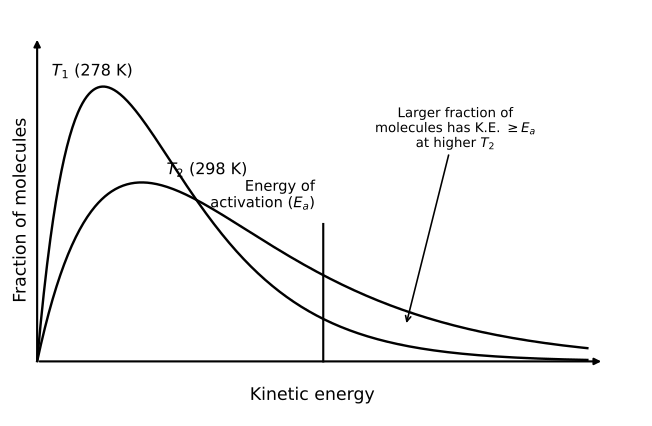
(c) Which among the following graphs correctly represents the fraction of molecules (f) having kinetic energy equal to or greater than activation energy (Eₐ) as temperature increases from T₁ to T₂ (T₂ > T₁)?
(i) The area under the curve beyond Eₐ decreases as temperature increases.
(ii) The area under the curve beyond Eₐ increases as temperature increases.
(iii) The area under the curve beyond Eₐ remains the same at both temperatures.
(iv) The curve shifts to lower energy values as temperature increases. [1]

Diagram for question 7: Chemical Kinetics
Show answer
Part (a): [2 marks]

The Arrhenius equation in logarithmic form is:

log(k₂/k₁) = Eₐ / (2.303 R) × (1/T₁ − 1/T₂)

Here: T₁ = 5 + 273 = 278 K (refrigerator), T₂ = 25 + 273 = 298 K (room temperature), Eₐ = 75 kJ mol⁻¹ = 75000 J mol⁻¹, R = 8.314 J K⁻¹ mol⁻¹.

We calculate log(k₂₅/k₅), i.e., log(k₂/k₁) with k₂ = k₂₅ and k₁ = k₅:

1/T₁ − 1/T₂ = 1/278 − 1/298

= (298 − 278) / (278 × 298)

= 20 / 82844

= 2.415 × 10⁻⁴ K⁻¹

log(k₂₅/k₅) = [75000 / (2.303 × 8.314)] × 2.415 × 10⁻⁴

= [75000 / 19.147] × 2.415 × 10⁻⁴

= 3917.8 × 2.415 × 10⁻⁴

= 0.9456

∴ k₂₅/k₅ = antilog (0.9456) ≈ 8.82

∴ The rate constant at 25°C is approximately 8.82 times greater than at 5°C.

Part (b): [1 mark]

The technologist's claim is NOT correct. The calculated ratio k₂₅/k₅ ≈ 8.82, which means refrigeration slows the spoilage rate by approximately 8.82 times — less than 10 times. Hence, the claim that refrigeration slows the rate by more than 10 times is not justified by the Arrhenius calculation.

Part (c): [1 mark]

Correct option: (ii) — The area under the Maxwell–Boltzmann distribution curve beyond Eₐ increases as temperature increases.

At higher temperature T₂, more molecules possess kinetic energy equal to or greater than Eₐ. The distribution curve broadens and shifts to higher energy values, increasing the fraction of effective collisions (f = e^(−Eₐ/RT)), which leads to a higher rate constant.
Q8Case-based4 marks

A pharmaceutical company is testing a new drug that decomposes in the bloodstream according to first-order kinetics. A pharmacologist monitors the drug concentration and records the following data:

Time (min): 0, 30, 60
Concentration (mol L⁻¹): 0.800, 0.400, 0.200

A pharmaceutical company is testing a new drug that decomposes in the bloodstream according to first-order kinetics. A pharmacologist monitors the drug concentration and records the following data:

Time (min): 0, 30, 60
Concentration (mol L⁻¹): 0.800, 0.400, 0.200

(a) Using the data, calculate the rate constant k for the decomposition. (2 marks)
(b) The drug is considered therapeutically ineffective once its concentration falls to 6.25% of the initial dose. Calculate the time required for this to occur. (1 mark)
(c) A second drug, under identical conditions, has a half-life that doubles when the initial concentration is doubled. Identify the order of this second reaction and give one reason for your answer. (1 mark)

Show answer
(a) For a first-order reaction, the integrated rate law is:

k = (2.303 / t) × log([R]₀ / [R])

Using t = 30 min, [R]₀ = 0.800 mol L⁻¹, [R] = 0.400 mol L⁻¹:

k = (2.303 / 30) × log(0.800 / 0.400)

k = (2.303 / 30) × log 2

k = (2.303 / 30) × 0.3010

k = (0.6932 / 30)

∴ k = 2.31 × 10⁻² min⁻¹

[Verification using t = 60 min: k = (2.303/60) × log(0.800/0.200) = (2.303/60) × log 4 = (2.303/60) × 0.6020 = 2.31 × 10⁻² min⁻¹ ✓]

(b) 6.25% of initial concentration means [R] = 6.25/100 × [R]₀ = [R]₀/16

∴ [R]₀/[R] = 16

Using the first-order expression:

t = (2.303 / k) × log([R]₀ / [R])

t = (2.303 / 2.31 × 10⁻²) × log 16

t = (2.303 / 2.31 × 10⁻²) × 4 × log 2

t = (2.303 / 2.31 × 10⁻²) × 4 × 0.3010

[Alternatively: since t½ = 30 min, reaching 6.25% requires 4 half-lives (100% → 50% → 25% → 12.5% → 6.25%):]

t = 4 × t½ = 4 × 30

∴ t = 120 min

(c) The second reaction is zero order.

For a zero-order reaction, t½ = [A]₀ / 2k. Since t½ is directly proportional to the initial concentration [A]₀, doubling [A]₀ doubles t½. This behaviour is characteristic of zero-order kinetics only.
Q9MCQ1 mark

The half-life of a first-order reaction is 30 minutes. What is the rate constant (k) for this reaction?

Show answer
(A) 0.0231 min⁻¹

Explanation: For a first-order reaction, the half-life is independent of initial concentration and is related to the rate constant by t½ = 0.693/k. Rearranging, k = 0.693/t½ = 0.693/30 min = 0.0231 min⁻¹. Options (B) and (C) arise from incorrect rearrangements, and option (D) is merely the value of 0.693 without dividing by t½.
Q10MCQ1 mark

The half-life of a first-order reaction is 693 s. What is the rate constant of the reaction?

Show answer
Option (A) — 1.0 × 10⁻³ s⁻¹

Explanation: For a first-order reaction, the half-life is independent of the initial concentration and is related to the rate constant by t₁/₂ = 0.693/k. Rearranging, k = 0.693/t₁/₂ = 0.693/693 s = 1.0 × 10⁻³ s⁻¹.
Q11MCQ1 mark

The rate constant of a first-order reaction is 2.31 × 10⁻² min⁻¹. What are the units of the rate constant for a zero-order reaction?

Show answer
(A) mol L⁻¹ s⁻¹

Explanation: The unit of the rate constant k depends on the overall order of the reaction. For a zero-order reaction, rate = k[A]⁰ = k, so k has the same units as the rate itself, which is mol L⁻¹ s⁻¹ (or equivalently mol L⁻¹ min⁻¹). For a first-order reaction k has units s⁻¹; for a second-order reaction, L mol⁻¹ s⁻¹. Option (A) is therefore the correct unit for a zero-order rate constant.
Q12Short Answer2 marks

For a first order reaction, the half-life is independent of the initial concentration of the reactant. Give reason.

Show answer
For a first order reaction, the integrated rate equation is:

k = (2.303 / t) log([R]₀ / [R])

At half-life, [R] = [R]₀ / 2, so:

t½ = 0.693 / k

Since t½ depends only on the rate constant k, and NOT on [R]₀, the half-life of a first order reaction is independent of the initial concentration.
Q13Short Answer2 marks

The rate constant of a first-order reaction is 0.693 min⁻¹. Calculate the half-life of the reaction.

Show answer
For a first-order reaction, the half-life is given by:

t<sub>½</sub> = 0.693 / k

Substituting the given value:

t<sub>½</sub> = 0.693 / 0.693 min<sup>-1</sup>

∴ t<sub>½</sub> = 1 min
Q14Short Answer2 marks

The concentration of a reactant decreases from 0.8 mol L⁻¹ to 0.1 mol L⁻¹ in 21 minutes in a first order reaction. Calculate the rate constant of the reaction. (Given: log 2 = 0.301)

Show answer
For a first-order reaction, the integrated rate law is:

k = (2.303 / t) × log([R]₀ / [R])

Substituting the given values — [R]₀ = 0.8 mol L⁻¹, [R] = 0.1 mol L⁻¹, t = 21 min:

k = (2.303 / 21) × log(0.8 / 0.1)

k = (2.303 / 21) × log 8

k = (2.303 / 21) × log 2³

k = (2.303 / 21) × 3 × log 2

k = (2.303 / 21) × 3 × 0.301

k = (2.303 × 0.903) / 21

k = 2.0796 / 21

∴ k = 0.099 min⁻¹ ≈ 9.9 × 10⁻² min⁻¹
Q15Short Answer2 marks

For a first-order reaction, the half-life is independent of the initial concentration of the reactant. Give reason.

Show answer
For a first-order reaction, the integrated rate law gives the half-life as:

t½ = 0.693 / k

Since k is a constant at a given temperature, t½ depends only on k and NOT on the initial concentration [R]₀.

∴ The half-life of a first-order reaction is independent of the initial concentration of the reactant.
Q16Short Answer3 marks

A food scientist is studying the spoilage of a packaged juice. She models the decomposition of ascorbic acid (Vitamin C) in the juice as a first-order reaction. She observes that at 27°C, the concentration of ascorbic acid drops from 0.080 mol L⁻¹ to 0.020 mol L⁻¹ in 80 minutes. When the storage temperature is raised to 47°C, the rate constant increases to 5.42 × 10⁻² min⁻¹.

(a) Calculate the rate constant k at 27°C. [2 marks]
(b) Calculate the activation energy Eₐ for this decomposition.
[Given: 2.303 R = 19.15 J K⁻¹ mol⁻¹, log 2 = 0.301] [2 marks]

Show answer
(a) For a first-order reaction, the integrated rate law is:

k = (2.303 / t) × log([R]₀ / [R])

Given: [R]₀ = 0.080 mol L⁻¹, [R] = 0.020 mol L⁻¹, t = 80 min

k = (2.303 / 80) × log(0.080 / 0.020)

k = (2.303 / 80) × log 4

k = (2.303 / 80) × 2 × log 2

k = (2.303 / 80) × 2 × 0.301

k = (2.303 × 0.602) / 80

k = 1.3864 / 80

∴ k = 1.73 × 10⁻² min⁻¹

(b) The Arrhenius equation in logarithmic form is:

log(k₂ / k₁) = (Eₐ / 2.303R) × (1/T₁ − 1/T₂)

Given: k₁ = 1.73 × 10⁻² min⁻¹ (at T₁ = 27°C = 300 K)
k₂ = 5.42 × 10⁻² min⁻¹ (at T₂ = 47°C = 320 K)

log(k₂ / k₁) = log(5.42 × 10⁻² / 1.73 × 10⁻²)

= log(3.133) ≈ log 3 + log(1.044) ≈ 0.496 ≈ 0.496

[Acceptably calculated as: log(5.42/1.73) = log(3.133) ≈ 0.496]

(1/T₁ − 1/T₂) = (1/300 − 1/320) = (320 − 300)/(300 × 320) = 20/96000 = 2.083 × 10⁻⁴ K⁻¹

Substituting:

0.496 = (Eₐ / 19.15) × 2.083 × 10⁻⁴

Eₐ = (0.496 × 19.15) / (2.083 × 10⁻⁴)

Eₐ = 9.498 / (2.083 × 10⁻⁴)

∴ Eₐ = 4.56 × 10⁴ J mol⁻¹ = 45.6 kJ mol⁻¹
Q17Short Answer3 marks

For the decomposition of azomethane, CH₃N₂CH₃(g) → CH₃CH₃(g) + N₂(g), the following data were obtained at 600 K:

Time (s) [CH₃N₂CH₃] (mol L⁻¹)
0 2.00 × 10⁻²
500 1.00 × 10⁻²
1000 5.00 × 10⁻³

(a) Show that the above reaction is of first order.
(b) Calculate the rate constant for this reaction.
(c) State the units of the rate constant and write the expression for the half-life of a first-order reaction.

Show answer
(a) For a first-order reaction, the half-life t½ is independent of the initial concentration.

From the data:
• From t = 0 to t = 500 s: concentration falls from 2.00 × 10⁻² to 1.00 × 10⁻² mol L⁻¹ — it halves in 500 s.
• From t = 500 s to t = 1000 s: concentration falls from 1.00 × 10⁻² to 5.00 × 10⁻³ mol L⁻¹ — it halves again in the next 500 s.

Since the time taken for the concentration to reduce to half its value is constant (= 500 s) regardless of the initial concentration, the reaction is of first order. (1 mark)

(b) For a first-order reaction, the integrated rate law is:

k = (2.303 / t) log ([R]₀ / [R])

Using the data at t = 500 s:

k = (2.303 / 500 s) × log (2.00 × 10⁻² / 1.00 × 10⁻²)

k = (2.303 / 500) × log 2

k = (2.303 / 500) × 0.301

k = (0.6931) / 500

∴ k = 1.386 × 10⁻³ s⁻¹ (1 mark)

(c) Units of k for a first-order reaction: s⁻¹ (or time⁻¹).

Expression for half-life of a first-order reaction:

t½ = 0.693 / k

Note: t½ is independent of the initial concentration of the reactant. (1 mark)
Q18Short Answer3 marks

A food scientist is studying the spoilage of a fruit juice at different storage temperatures. The spoilage follows first-order kinetics with respect to the concentration of a key degradable compound. The rate constant k is found to obey the following relationship:

log k = 14.80 − 4200 / T

where T is the temperature in Kelvin and k is in s⁻¹.

(a) Calculate the activation energy Eₐ for the spoilage reaction. [R = 8.314 J K⁻¹ mol⁻¹] (2 marks)

(b) The juice is stored at 27°C. Calculate the rate constant k at this temperature. Also state the unit of k. (1 mark)

(c) The food scientist claims: 'Storing the juice at a lower temperature slows spoilage because the fraction of molecules with energy equal to or greater than Eₐ decreases significantly.' Justify this claim using the Arrhenius equation. (1 mark)

Show answer
(a) Comparing the given equation with the Arrhenius logarithmic form:

log k = log A − Eₐ / (2.303 R T)

The slope of log k vs 1/T gives:

−Eₐ / 2.303R = −4200

∴ Eₐ = 4200 × 2.303 × R

∴ Eₐ = 4200 × 2.303 × 8.314

∴ Eₐ = 4200 × 19.147

∴ Eₐ = 80,417 J mol⁻¹ ≈ 80.42 kJ mol⁻¹

(b) At T = 27°C = 300 K, substituting in the given equation:

log k = 14.80 − 4200 / 300

log k = 14.80 − 14.00

log k = 0.80

∴ k = antilog (0.80) = 6.31 × 10⁻¹ s⁻¹

Unit of k = s⁻¹ (since the reaction is first order)

(c) According to the Arrhenius equation:

k = A · e^(−Eₐ/RT)

The term e^(−Eₐ/RT) represents the fraction of molecules possessing energy equal to or greater than the activation energy Eₐ. At a lower temperature T, the value of Eₐ/RT increases, so e^(−Eₐ/RT) decreases exponentially. This means fewer molecules have sufficient energy to cross the activation energy barrier, the rate constant k decreases, and hence the rate of spoilage decreases significantly. ∴ the scientist's claim is justified.
Q19Short Answer3 marks

The initial concentration of a substance A in the first order reaction A(g) → B(g) + C(g) was 0·80 mol L⁻¹. After 40 minutes the concentration of A was 0·10 mol L⁻¹. Calculate: (i) the rate constant of the reaction, and (ii) the half-life of the reaction. [log 2 = 0·301]

Show answer
For a first order reaction, the integrated rate equation is:

k = (2·303 / t) × log([A]₀ / [A])

(i) Calculation of rate constant k:

Given: [A]₀ = 0·80 mol L⁻¹, [A] = 0·10 mol L⁻¹, t = 40 min

k = (2·303 / 40) × log(0·80 / 0·10)

k = (2·303 / 40) × log 8

k = (2·303 / 40) × log 2³

k = (2·303 / 40) × 3 × log 2

k = (2·303 / 40) × 3 × 0·301

k = (2·303 × 0·903) / 40

k = 2·0786 / 40

∴ k = 5·20 × 10⁻² min⁻¹

(ii) Calculation of half-life t½:

t½ = 0·693 / k

t½ = 0·693 / (5·20 × 10⁻²)

∴ t½ = 13·33 min
Q20Short Answer3 marks

The following data were obtained for the reaction: P + Q → Products

| Experiment | [P] / mol L⁻¹ | [Q] / mol L⁻¹ | Initial Rate / mol L⁻¹ s⁻¹ |
|---|---|---|---|
| 1 | 0·10 | 0·10 | 2·0 × 10⁻² |
| 2 | 0·20 | 0·10 | 4·0 × 10⁻² |
| 3 | 0·10 | 0·30 | 1·8 × 10⁻¹ |

(a) Determine the order of reaction with respect to P and with respect to Q.
(b) Write the rate law for the reaction.
(c) Calculate the rate constant, k, giving its units.

Show answer
(a) Determination of individual orders:

Let the rate law be: rate = k[P]^x [Q]^y

Order with respect to P (comparing Experiments 1 and 2, where [Q] is constant):

Rate₂ / Rate₁ = ([P]₂ / [P]₁)^x

(4·0 × 10⁻²) / (2·0 × 10⁻²) = (0·20 / 0·10)^x

2 = (2)^x

∴ x = 1

The order with respect to P is 1 (first order).

Order with respect to Q (comparing Experiments 1 and 3, where [P] is constant):

Rate₃ / Rate₁ = ([Q]₃ / [Q]₁)^y

(1·8 × 10⁻¹) / (2·0 × 10⁻²) = (0·30 / 0·10)^y

9 = (3)^y

∴ y = 2

The order with respect to Q is 2 (second order).

(b) Rate law:

rate = k[P]¹[Q]²

Overall order of reaction = 1 + 2 = 3 (third order)

(c) Calculation of rate constant k:

Using data from Experiment 1:

k = rate / ([P][Q]²)

k = (2·0 × 10⁻²) / (0·10 × (0·10)²)

k = (2·0 × 10⁻²) / (0·10 × 0·01)

k = (2·0 × 10⁻²) / (1·0 × 10⁻³)

∴ k = 20 L² mol⁻² s⁻¹
Q21Short Answer3 marks

The decomposition of azomethane, CH₃N₂CH₃(g) → C₂H₆(g) + N₂(g), follows first-order kinetics. At 600 K, the initial partial pressure of azomethane was 3.6 × 10⁻² atm. After 40 minutes, the partial pressure fell to 0.6 × 10⁻² atm.
(a) Calculate the rate constant k at 600 K. [Given: log 6 = 0.778]
(b) Calculate the half-life of the reaction at 600 K.
(c) State one characteristic feature that distinguishes a first-order reaction from a zero-order reaction with respect to half-life.

Show answer
(a) For a first-order reaction, the integrated rate law is:

k = (2.303 / t) × log([R]₀ / [R])

Substituting the values:

k = (2.303 / 40) × log(3.6 × 10⁻² / 0.6 × 10⁻²)

k = (2.303 / 40) × log 6

k = (2.303 / 40) × 0.778

k = (2.303 × 0.778) / 40

k = 1.7917 / 40

∴ k = 4.48 × 10⁻² min⁻¹

(b) The half-life of a first-order reaction is:

t½ = 0.693 / k

t½ = 0.693 / (4.48 × 10⁻²)

∴ t½ = 15.47 min (≈ 15.5 min)

(c) For a first-order reaction, the half-life (t½ = 0.693/k) is independent of the initial concentration of the reactant. For a zero-order reaction, the half-life (t½ = [A]₀ / 2k) is directly proportional to the initial concentration — it decreases as the reaction proceeds.
Q22Short Answer3 marks

The following data were obtained during the first order thermal decomposition of SO₂Cl₂ at constant volume:

SO₂Cl₂(g) → SO₂(g) + Cl₂(g)

| S. No. | Time (s) | Total Pressure (atm) |
|--------|----------|----------------------|
| 1 | 0 | 0.40 |
| 2 | 60 | 0.60 |

Calculate the rate constant for this reaction.
[Given: log 2 = 0.3010, log 4 = 0.6021]

Show answer
Let the initial pressure of SO₂Cl₂ = P₀ = 0.40 atm.

At time t, let the decrease in pressure of SO₂Cl₂ = p.

SO₂Cl₂(g) → SO₂(g) + Cl₂(g)

At t = 0: P₀ 0 0
At t = 60s: (P₀ − p) p p

Total pressure at time t:
P_t = (P₀ − p) + p + p = P₀ + p

∴ p = P_t − P₀ = 0.60 − 0.40 = 0.20 atm

Pressure of SO₂Cl₂ at t = 60 s:
P_(SO₂Cl₂) = P₀ − p = 0.40 − 0.20 = 0.20 atm

For a first order reaction, the integrated rate law is:

k = (2.303 / t) × log(P₀ / P_(SO₂Cl₂))

Substituting the values:

k = (2.303 / 60) × log(0.40 / 0.20)

k = (2.303 / 60) × log 2

k = (2.303 / 60) × 0.3010

k = (2.303 × 0.3010) / 60

k = 0.6932 / 60

∴ k = 1.155 × 10⁻² s⁻¹
Q23Short Answer3 marks

(a) The rate constant of a first order reaction is 2.303 × 10⁻³ s⁻¹. Calculate the time required for 75% of the reactant to decompose.
(b) How does the rate constant of a reaction change with temperature? Name the equation used.
(c) Write the unit of rate constant for a second order reaction.

Show answer
(a) For a first order reaction, the integrated rate law is:

t = (2.303 / k) × log([R]₀ / [R])

If 75% of the reactant has decomposed, then [R] = 25% of [R]₀.

∴ [R]₀ / [R] = 100 / 25 = 4

Substituting:

t = (2.303 / 2.303 × 10⁻³) × log 4

t = (1 / 10⁻³) × 0.6020

t = 1000 × 0.6020

∴ t = 602 s

(b) The rate constant of a reaction increases with increase in temperature. For every 10 K rise in temperature, the rate constant approximately doubles (temperature coefficient ≈ 2).

The equation used is the Arrhenius equation:

k = A e^(−Eₐ/RT)

where A is the Arrhenius factor (frequency factor), Eₐ is the activation energy, R is the gas constant and T is the absolute temperature.

(c) For a second order reaction, rate = k[A]²

∴ k = rate / [A]²

k = (mol L⁻¹ s⁻¹) / (mol L⁻¹)²

∴ Unit of k for second order reaction = L mol⁻¹ s⁻¹
Q24Short Answer3 marks

A pharmaceutical company is studying the degradation of a drug in a patient's bloodstream. The drug follows first-order kinetics. A doctor administers a dose such that the initial concentration of the drug in the blood is 200 mg L⁻¹. Clinical records show that the drug concentration falls to 25 mg L⁻¹ in 120 minutes.

(a) Calculate the rate constant (k) for the degradation of the drug. [log 2 = 0.3010]

(b) The drug is therapeutically effective only when its concentration is above 50 mg L⁻¹. Using your answer from part (a), calculate the time window during which the drug remains effective after administration.

(c) A trainee pharmacist claims: 'Since the drug follows first-order kinetics, doubling the initial dose will double the time the drug remains effective.' Evaluate this claim with a suitable calculation. [log 2 = 0.3010]

Show answer
PART (a) — Calculate the rate constant k [1 mark]

For a first-order reaction, the integrated rate equation is:

k = (2.303 / t) × log([R]₀ / [R])

Given: [R]₀ = 200 mg L⁻¹, [R] = 25 mg L⁻¹, t = 120 min

log(200/25) = log 8 = log 2³ = 3 × log 2 = 3 × 0.3010 = 0.9030

k = (2.303 / 120) × 0.9030

k = (2.303 × 0.9030) / 120

k = 2.0796 / 120

∴ k = 0.01733 min⁻¹ (≈ 1.733 × 10⁻² min⁻¹)

────────────────────────────────────────
PART (b) — Time window of therapeutic effectiveness [2 marks]

The drug is effective while concentration > 50 mg L⁻¹. The drug starts losing effectiveness when concentration falls from 200 mg L⁻¹ to 50 mg L⁻¹.

Using the first-order integrated rate equation:

t = (2.303 / k) × log([R]₀ / [R])

t = (2.303 / 0.01733) × log(200 / 50)

log(200/50) = log 4 = log 2² = 2 × 0.3010 = 0.6020

t = (2.303 / 0.01733) × 0.6020

t = 132.89 × 0.6020

∴ t ≈ 80 min

Alternatively, noting that 200 → 50 mg L⁻¹ represents exactly 2 half-lives:

t½ = 0.693 / k = 0.693 / 0.01733 ≈ 40 min

∴ Time window of effectiveness = 2 × t½ = 2 × 40 = 80 min

∴ The drug remains therapeutically effective for 80 minutes after administration.

────────────────────────────────────────
PART (c) — Evaluate the pharmacist's claim [1 mark]

If the initial dose is doubled: [R]₀ = 400 mg L⁻¹ (while [R] threshold remains 50 mg L⁻¹)

t = (2.303 / k) × log(400 / 50)

log(400/50) = log 8 = 3 × log 2 = 3 × 0.3010 = 0.9030

t = (2.303 / 0.01733) × 0.9030

t = 132.89 × 0.9030

∴ t ≈ 120 min

The time window increases from 80 min to 120 min — an increase of only 40 min (i.e., one additional half-life), NOT doubled (which would require 160 min).

∴ The pharmacist's claim is INCORRECT. For a first-order reaction, the half-life t½ is independent of initial concentration. Doubling the dose adds exactly one more half-life to the effective time window, it does not double the time. The time window follows a logarithmic (not linear) relationship with the initial concentration.
Q25Case-based4 marks

A food scientist is studying the spoilage of a packaged fruit juice. She finds that the degradation of Vitamin C (ascorbic acid) in the juice follows first-order kinetics. At 25°C, the rate constant for degradation is 1.386 × 10⁻² day⁻¹. The juice is considered unfit for consumption when 75% of the original Vitamin C has degraded.

A food scientist is studying the spoilage of a packaged fruit juice. She finds that the degradation of Vitamin C (ascorbic acid) in the juice follows first-order kinetics. At 25°C, the rate constant for degradation is 1.386 × 10⁻² day⁻¹. The juice is considered unfit for consumption when 75% of the original Vitamin C has degraded.

(a) Calculate the half-life of Vitamin C degradation at 25°C. [1]

(b) Calculate the time (in days) after which the juice becomes unfit for consumption. [2]

(c) The scientist also observes that storing the juice at 5°C instead of 25°C significantly slows the degradation. Identify the factor responsible for this observation and state how it affects the rate constant. [1]

Show answer
(a) For a first-order reaction, the half-life is given by:

t½ = 0.693 / k

t½ = 0.693 / (1.386 × 10⁻² day⁻¹)

∴ t½ = 50 days

(b) For a first-order reaction, the integrated rate law is:

k = (2.303 / t) log ([R]₀ / [R])

If 75% of Vitamin C has degraded, then 25% remains.
∴ [R] = 25% of [R]₀, i.e., [R]₀ / [R] = 100 / 25 = 4

Substituting:

1.386 × 10⁻² = (2.303 / t) × log 4

1.386 × 10⁻² = (2.303 / t) × 0.6021

t = (2.303 × 0.6021) / (1.386 × 10⁻²)

t = 1.3866 / (1.386 × 10⁻²)

∴ t = 100 days

[Alternatively, since 75% degraded = two half-lives elapsed (after 1st half-life, 50% remains; after 2nd half-life, 25% remains): t = 2 × t½ = 2 × 50 = 100 days]

(c) The factor responsible is temperature.

At lower temperature (5°C), the fraction of molecules possessing energy equal to or greater than the activation energy (Ea) decreases. According to the Arrhenius equation, k = A·e^(−Ea/RT), the rate constant k decreases exponentially with a decrease in temperature.

∴ Lowering temperature from 25°C to 5°C decreases the rate constant k, thereby slowing the rate of Vitamin C degradation.
Q26Case-based4 marks

A food scientist is studying the spoilage of a fruit juice at different storage temperatures. The decomposition of ascorbic acid (Vitamin C) in the juice follows first-order kinetics. The scientist records the following data:

| Experiment | Temperature (K) | Rate constant, k (s⁻¹) |
|---|---|---|
| 1 | 300 | 2.0 × 10⁻³ |
| 2 | 320 | 8.0 × 10⁻³ |

(Given: R = 8.314 J K⁻¹ mol⁻¹, log 4 = 0.602, log 2 = 0.301)

A food scientist is studying the spoilage of a fruit juice at different storage temperatures. The decomposition of ascorbic acid (Vitamin C) in the juice follows first-order kinetics. The scientist records the following data:

| Experiment | Temperature (K) | Rate constant, k (s⁻¹) |
|---|---|---|
| 1 | 300 | 2.0 × 10⁻³ |
| 2 | 320 | 8.0 × 10⁻³ |

(a) Using the Arrhenius equation, calculate the activation energy (E_a) for the decomposition of ascorbic acid. (Given: R = 8.314 J K⁻¹ mol⁻¹, log 4 = 0.602)

(b) The scientist finds that at 300 K, the initial concentration of ascorbic acid is 0.80 mol L⁻¹. How long will it take for the concentration to drop to 0.10 mol L⁻¹? (Given: log 2 = 0.301)

(c) If the juice is stored at 280 K instead of 300 K, predict qualitatively — with a reason — whether the juice will stay fresh for a longer or shorter time.

Show answer
(a) Calculation of Activation Energy E_a [2 marks]

The Arrhenius equation in its two-temperature logarithmic form is:

log(k₂/k₁) = (E_a / 2.303R) × (1/T₁ − 1/T₂)

Given:
k₁ = 2.0 × 10⁻³ s⁻¹ at T₁ = 300 K
k₂ = 8.0 × 10⁻³ s⁻¹ at T₂ = 320 K
R = 8.314 J K⁻¹ mol⁻¹

Substituting:
log(8.0 × 10⁻³ / 2.0 × 10⁻³) = (E_a / (2.303 × 8.314)) × (1/300 − 1/320)

log 4 = (E_a / 19.147) × (320 − 300) / (300 × 320)

0.602 = (E_a / 19.147) × (20 / 96000)

0.602 = (E_a / 19.147) × 2.083 × 10⁻⁴

E_a = (0.602 × 19.147) / (2.083 × 10⁻⁴)

E_a = 11.527 / 2.083 × 10⁻⁴

∴ E_a = 5.534 × 10⁴ J mol⁻¹ ≈ 55.34 kJ mol⁻¹

(b) Time for concentration to fall from 0.80 mol L⁻¹ to 0.10 mol L⁻¹ [1 mark]

The integrated first-order rate equation is:

t = (2.303 / k) × log([R]₀ / [R])

Given:
k = 2.0 × 10⁻³ s⁻¹
[R]₀ = 0.80 mol L⁻¹
[R] = 0.10 mol L⁻¹

Substituting:
t = (2.303 / 2.0 × 10⁻³) × log(0.80 / 0.10)
t = (2.303 / 2.0 × 10⁻³) × log 8
t = 1151.5 × log(2³)
t = 1151.5 × 3 × log 2
t = 1151.5 × 3 × 0.301
t = 1151.5 × 0.903

∴ t = 1039.8 s ≈ 1040 s

(c) Qualitative Prediction at 280 K [1 mark]

The juice will stay fresh for a longer time at 280 K.

Due to lower temperature, the fraction of molecules possessing energy equal to or greater than the activation energy (E_a) decreases. According to the Arrhenius equation, k decreases as temperature decreases. A smaller rate constant means the decomposition of ascorbic acid proceeds more slowly, so the juice retains its Vitamin C content — and hence freshness — for a longer duration.
Q27Case-based4 marks

A food-processing company studies the decomposition of a preservative P in canned food at 300 K. The reaction P(aq) → Products is monitored and the following initial rate data are recorded:

| Experiment | [P] / mol L⁻¹ | Initial Rate / mol L⁻¹ s⁻¹ |
|---|---|---|
| 1 | 0.10 | 2.0 × 10⁻³ |
| 2 | 0.20 | 4.0 × 10⁻³ |
| 3 | 0.40 | 8.0 × 10⁻³ |

A food-processing company studies the decomposition of a preservative P in canned food. The reaction is: P(aq) → Products. The technician records the following initial rate data at 300 K:

| Experiment | [P] / mol L⁻¹ | Initial Rate / mol L⁻¹ s⁻¹ |
|---|---|---|
| 1 | 0.10 | 2.0 × 10⁻³ |
| 2 | 0.20 | 4.0 × 10⁻³ |
| 3 | 0.40 | 8.0 × 10⁻³ |

(a) Determine the order of the reaction with respect to P and write the rate law. (1 mark)
(b) Calculate the value of the rate constant k, stating its units. (1 mark)
(c) The company needs the preservative to drop to 25% of its initial concentration. Using the first-order integrated rate law, calculate the time required if k = 2.0 × 10⁻² s⁻¹. (2 marks)

Show answer
(a) Determining the order with respect to P and writing the rate law: (1 mark)

Comparing Experiments 1 and 2:

Rate₂ / Rate₁ = k[P]₂ⁿ / k[P]₁ⁿ

(4.0 × 10⁻³) / (2.0 × 10⁻³) = (0.20 / 0.10)ⁿ

2 = (2)ⁿ

∴ n = 1

The reaction is first order with respect to P.

Rate law: Rate = k[P]

(Award 1 mark for correct order = 1 AND correct rate law. Accept verification using Experiments 2 and 3.)

---

(b) Calculating the rate constant k with units: (1 mark)

Using Experiment 1:

Rate = k[P]

k = Rate / [P]

k = (2.0 × 10⁻³ mol L⁻¹ s⁻¹) / (0.10 mol L⁻¹)

∴ k = 2.0 × 10⁻² s⁻¹

(Award 1 mark for correct value AND correct unit s⁻¹. Deduct ½ mark if unit is missing or incorrect.)

---

(c) Calculating the time for [P] to drop to 25% of its initial value: (2 marks)

For a first-order reaction, the integrated rate law is:

t = (2.303 / k) log ([R]₀ / [R])

When [P] drops to 25% of [P]₀:

[R]₀ / [R] = [P]₀ / (0.25 [P]₀) = 1 / 0.25 = 4

Substituting k = 2.0 × 10⁻² s⁻¹:

t = (2.303 / (2.0 × 10⁻²)) × log (4)

t = (2.303 / (2.0 × 10⁻²)) × log (4)

log 4 = log 2² = 2 × log 2 = 2 × 0.301 = 0.602

t = (2.303 / 0.020) × 0.602

t = 115.15 × 0.602

∴ t = 69.3 s

(Award 1 mark for correct substitution into the integrated rate law with [R]₀/[R] = 4. Award 1 mark for the correct final answer 69.3 s with unit. ECF applies — if a wrong k from part (b) is carried forward correctly, award the process marks.)
Q28Case-based4 marks

A food scientist is studying the spoilage of a packaged fruit juice. The spoilage reaction follows first-order kinetics. Rate constants: k₁ = 2.0 × 10⁻³ min⁻¹ at 300 K; k₂ = 8.0 × 10⁻³ min⁻¹ at 320 K.

A food scientist is studying the spoilage of a packaged fruit juice. The spoilage reaction follows first-order kinetics with respect to the concentration of a key reactant (vitamin C degradation). The following data were collected at two different storage temperatures:

| Storage Temperature | Rate constant (k) |
|---|---|
| 27°C (300 K) | 2.0 × 10⁻³ min⁻¹ |
| 47°C (320 K) | 8.0 × 10⁻³ min⁻¹ |

(a) Calculate the activation energy (Eₐ) for the vitamin C degradation reaction. (Given: R = 8.314 J K⁻¹ mol⁻¹, log 2 = 0.301)

(b) The juice manufacturer wants to ensure that at 27°C, at least 50% of the original vitamin C remains. Calculate the shelf life of the juice (in minutes) at 27°C.

(c) Based on your answer to (a), explain briefly whether the spoilage reaction is more sensitive to temperature change compared to a reaction with Eₐ = 30 kJ mol⁻¹, and what practical recommendation you would give the manufacturer.

Show answer
SECTION D — CASE/APPLICATION-BASED · 4 marks · Split: 2 + 1 + 1

─────────────────────────────────────────
(a) Calculation of Activation Energy Eₐ [2 marks]
─────────────────────────────────────────

Using the Arrhenius equation in its two-temperature logarithmic form:

log(k₂/k₁) = (Eₐ / 2.303R) × (1/T₁ − 1/T₂)

Given:
k₁ = 2.0 × 10⁻³ min⁻¹ at T₁ = 300 K
k₂ = 8.0 × 10⁻³ min⁻¹ at T₂ = 320 K
R = 8.314 J K⁻¹ mol⁻¹

Step 1 — Evaluate the left-hand side:
log(k₂/k₁) = log(8.0 × 10⁻³ / 2.0 × 10⁻³) = log 4 = log 2² = 2 × 0.301 = 0.602

Step 2 — Evaluate the temperature term:
1/T₁ − 1/T₂ = 1/300 − 1/320
= (320 − 300) / (300 × 320)
= 20 / 96000
= 2.083 × 10⁻⁴ K⁻¹

Step 3 — Substitute and solve for Eₐ:
0.602 = (Eₐ / (2.303 × 8.314)) × 2.083 × 10⁻⁴

0.602 = (Eₐ × 2.083 × 10⁻⁴) / 19.147

Eₐ = (0.602 × 19.147) / (2.083 × 10⁻⁴)

Eₐ = 11.526 / (2.083 × 10⁻⁴)

∴ Eₐ = 5.534 × 10⁴ J mol⁻¹ ≈ 55.34 kJ mol⁻¹

─────────────────────────────────────────
(b) Shelf Life at 27°C (when 50% vitamin C remains) [1 mark]
─────────────────────────────────────────

Since the reaction is first-order, the half-life formula applies directly:

t½ = 0.693 / k

When 50% of the original concentration remains, the time elapsed equals the half-life.

Given k at 300 K = 2.0 × 10⁻³ min⁻¹:

t½ = 0.693 / (2.0 × 10⁻³)

∴ Shelf life = 346.5 min ≈ 346.5 minutes

─────────────────────────────────────────
(c) Temperature Sensitivity & Practical Recommendation [1 mark]
─────────────────────────────────────────

The activation energy of the vitamin C degradation reaction (≈ 55.34 kJ mol⁻¹) is significantly higher than 30 kJ mol⁻¹. Due to a higher Eₐ, the rate constant is more sensitive to a rise in temperature (since k increases more steeply with temperature for a reaction with higher Eₐ, as given by the Arrhenius equation k = Ae^(−Eₐ/RT)). A small increase in storage temperature causes a proportionally greater increase in spoilage rate.

∴ Practical recommendation: The juice must be stored and transported at low temperature (refrigeration, ~4°C), as even a modest rise in ambient temperature will dramatically accelerate vitamin C degradation and shorten shelf life.
Q29Case-based4 marks

A food scientist is studying the degradation of Vitamin C (ascorbic acid) in a packaged fruit juice. She finds that the degradation follows first order kinetics. At 27°C, the concentration of Vitamin C drops from 200 mg/L to 25 mg/L in 60 minutes. At 47°C, the same drop (200 mg/L to 25 mg/L) occurs in only 15 minutes.

A food scientist is studying the degradation of Vitamin C (ascorbic acid) in a packaged fruit juice. She finds that the degradation follows first order kinetics. At 27°C, the concentration of Vitamin C drops from 200 mg/L to 25 mg/L in 60 minutes. At 47°C, the same drop (200 mg/L to 25 mg/L) occurs in only 15 minutes.

(a) Calculate the rate constant (k) for the degradation of Vitamin C at 27°C. [log 2 = 0.301]

(b) Calculate the activation energy (Eₐ) for this degradation process.
[R = 8.314 J K⁻¹ mol⁻¹; log 4 = 0.602]

Show answer
(a) Calculation of rate constant k at 27°C (T₁ = 300 K):

For a first order reaction, the integrated rate law is:

k = (2.303 / t) × log([R]₀ / [R])

Given: [R]₀ = 200 mg/L, [R] = 25 mg/L, t = 60 min

k₁ = (2.303 / 60) × log(200 / 25)

k₁ = (2.303 / 60) × log 8

k₁ = (2.303 / 60) × log 2³

k₁ = (2.303 / 60) × 3 × log 2

k₁ = (2.303 / 60) × 3 × 0.301

k₁ = (2.303 × 0.903) / 60

k₁ = 2.0786 / 60

∴ k₁ = 0.03464 min⁻¹ ≈ 3.46 × 10⁻² min⁻¹

(b) Calculation of activation energy Eₐ:

First, calculate k₂ at 47°C (T₂ = 320 K):

k₂ = (2.303 / 15) × log(200 / 25)

k₂ = (2.303 / 15) × 3 × 0.301

k₂ = (2.303 × 0.903) / 15 = 2.0786 / 15

∴ k₂ = 0.1386 min⁻¹

Note: k₂ / k₁ = 60 / 15 = 4 (since the log ratio is the same; only t changes)

Using the Arrhenius equation in two-temperature form:

log(k₂ / k₁) = (Eₐ / 2.303R) × (1/T₁ − 1/T₂)

log(4) = (Eₐ / (2.303 × 8.314)) × (1/300 − 1/320)

0.602 = (Eₐ / 19.147) × [(320 − 300) / (300 × 320)]

0.602 = (Eₐ / 19.147) × [20 / 96000]

0.602 = (Eₐ / 19.147) × (2.083 × 10⁻⁴)

0.602 = Eₐ × (2.083 × 10⁻⁴ / 19.147)

0.602 = Eₐ × 1.088 × 10⁻⁵

Eₐ = 0.602 / (1.088 × 10⁻⁵)

Eₐ = 55, 330 J mol⁻¹

∴ Eₐ ≈ 55.33 kJ mol⁻¹
Q30Case-based4 marks

A food scientist is studying the degradation of Vitamin C (ascorbic acid) in a bottled juice under controlled storage conditions. She monitors the concentration of Vitamin C at regular intervals and records the following data at 300 K:

| Time (min) | [Vitamin C] (mol L⁻¹) |
|---|---|
| 0 | 0.800 |
| 10 | 0.400 |
| 20 | 0.200 |
| 30 | 0.100 |

She also finds that when the storage temperature is raised from 300 K to 310 K, the rate constant doubles.

A food scientist is studying the degradation of Vitamin C (ascorbic acid) in a bottled juice under controlled storage conditions. She monitors the concentration of Vitamin C at regular intervals and records the following data at 300 K:

| Time (min) | [Vitamin C] (mol L⁻¹) |
|---|---|
| 0 | 0.800 |
| 10 | 0.400 |
| 20 | 0.200 |
| 30 | 0.100 |

She also finds that when the storage temperature is raised from 300 K to 310 K, the rate constant doubles.

(a) Identify the order of this degradation reaction. Justify your answer using the data given. (2 marks)
(b) Calculate the rate constant at 300 K. State its unit. (1 mark)
(c) Calculate the activation energy (Eₐ) for the degradation process. (Given: R = 8.314 J K⁻¹ mol⁻¹, log 2 = 0.301) (1 mark)

Show answer
(a) The degradation follows FIRST ORDER kinetics.

Justification: For a first-order reaction, the half-life t½ is independent of initial concentration.

From the data:
• Concentration falls from 0.800 → 0.400 mol L⁻¹ in 10 min ∴ t½ = 10 min
• Concentration falls from 0.400 → 0.200 mol L⁻¹ in the next 10 min ∴ t½ = 10 min
• Concentration falls from 0.200 → 0.100 mol L⁻¹ in the next 10 min ∴ t½ = 10 min

Since the half-life remains constant (10 min) irrespective of the initial concentration, the reaction is FIRST ORDER. (2 marks)

(b) For a first-order reaction:

k = 0.693 / t½

k = 0.693 / 10 min

∴ k = 0.0693 min⁻¹

Unit of k for a first-order reaction: min⁻¹ (or s⁻¹). (1 mark)

(c) Using the Arrhenius equation in logarithmic form:

log(k₂/k₁) = Eₐ / (2.303 × R) × (1/T₁ − 1/T₂)

Given: k₂/k₁ = 2, T₁ = 300 K, T₂ = 310 K, R = 8.314 J K⁻¹ mol⁻¹

log 2 = Eₐ / (2.303 × 8.314) × (1/300 − 1/310)

0.301 = Eₐ / (2.303 × 8.314) × (310 − 300) / (300 × 310)

0.301 = Eₐ / 19.147 × 10 / 93000

0.301 = Eₐ × 10 / (19.147 × 93000)

0.301 = Eₐ / 178067

Eₐ = 0.301 × 178067

∴ Eₐ = 53,598 J mol⁻¹ ≈ 53.6 kJ mol⁻¹ (1 mark)

Want unlimited practice on Chemical Kinetics?

The full ClearSteps bank has 43+ reviewed questions on this chapter alone — with step-wise solutions, difficulty levels, and progress tracking. Verify your WhatsApp number and your free trial starts right here.

CBSE · CLASS 12
🎟️14-day free trial · code PRAC auto-applied
Mobile Number
+91
OTP will be sent to your WhatsApp

⭐ Trusted by 12,000+ students across India

Chemical Kinetics — Class 12 Chemistry Practice Questions